i
Proceeding
International Conference on Vocational Education and Training
(ICVET) 2012
Publishing Institute
Yogyakarta State University
Director of Publication
Bruri Triyono
Chief Editor
Kuswari Hernawati
Secretary
Titik Sudartinah
Editor
Eko Marpanaji
Retna Hidayah
Lay Out
Henry Lutfidwianto S
Bayu Aryo Yudanto
Administrator
Pramusinta Putri Dewanti
Address
Yogyakarta State University
ISSN: 977 23017 14009
© 2012 Yogyakarta State University
All rights reserved. No part of this publication may be reproduced without the prior written permission
of Yogyakarta State University
Printed in Yogyakarta
By Yogyakarta State University
Address : Jl. Colombo, Karangmalang, Yogyakarta 55281
:
[email protected]; [email protected]
|
Website
:
http://icvet.uny.ac.id/
ii
FOREWORD
This proceeding compiles all papers from the invited speakers and complementary papers in
International Conference on Vocational Education and Training (ICVET) 2012. The conference is
organized by Yogyakarta State University in collaboration with the German Embassy in Jakarta and
the Indonesian Embassy in Berlin on 28 June 2012. It is conducted as a part of event series held to
celebrate 60 Years Indonesia-Germany Partnership.
The main theme of this conference is
“Strengthening the Partnership between Vocational Education
and Training and Industry”
. Three sub themes are covered in this conference: 1) Management; 2)
Learning Process; and 3) Program and Collaboration.
I should apologize for the discontentment and inconvenience concerning both the conference and
proceeding. I hope this proceeding will give deeper insights about vocational education and training.
Yogyakarta, 28 June 2012
iii
TABLE OF CONTENTS
Title Page
i
Foreword
ii
Table of Contents
iii
INVITED SPEAKERS
Identifying the Customer in Vocational Education and Training ( Andrew Williamson) ...
1
Partnership Models Of Vet And Industry: Germany Experiences In First And Continuous
Education (Thomas Köhler) ...
6
Industrial Support in Vocational Education and Training Development to Achieve Quality
Assurance of Indonesian Professional Labor Force (M Thaufik Pinat) ...
11
Designing New Concept of Internship In Vocational Education Curriculum: New
Approach to Increase Alumni Assimilation In Workplaces (Vilia Darma Paramita, Dyah
Darma Andayani) ...
19
Development Funding Model in the Implementation of Education in Vocational High
Schools in the Field of the Construction Engineering Study Program (Machmud Sugandi)
23
Utilization on Quality Management standars of ISO 9001:2000 in Electrical Engineering
Education Department Engineering Faculty of Yogyakarta State University (Sukir) ...
29
Principal Role in Strengthening The School Culture of Vocational High School (Nuryadin
ER) ...
36
Redesign of Vocational Education in Indonesia as a Discourse in The Future
(Badraningsih Lastariwati) ...
42
Students’ Skills Competency Assessment Models on
Vocational School (SMK) in Central
Java (Aris Budiyono, Sugiyono, Pardjono) ...
48
Notes on the Process of Professionalizing Vocational and Career Counseling in Nigeria
(Moromoke Nimota Raji) ...
56
Spiritual Teaching Strategies to Reculture Student’s Character in Vocational Secondary
Schools (Istanto W Djatmiko) ...
60
Ethnic Minority Pupils in Indonesia Schools: Some Trends in Over-Representation of
Minority Pupils in Special Educational Programmes at the Vocational (Soetyono Iskandar)
66
Graduates’ Perception On The Graduate Competences of the Diploma III Vocational
Education of Polytechnic (Ahmad Rifandi) ...
77
Entrepreneurship Incubator Increase Independence Students (Suranto, Rahmawati) ...
85
Development of Integrated Task-Based English Language Learning Model (PBTT) for
Vocational Technical School (Y. Gatot Sutapa Yuliana) ...
89
Problem Solving-Based Performance Assessment in the Learning of Consumer Education
as a Tool in Building Character of Critical-Thought Vocational Students (Sri Wening) ...
97
Implementation of E-Learning Model in Training on Learning Management System
iv
Musical Interpretation in Music Learning in SMK Negeri 2 Kasihan Bantul Yogyakarta
(Ayu Niza M) ...
107
Class-Base Integrated Soft Skills Learning Model (CISL) For Vocational High School
Students (Siti Hamidah) ...
110
Video Recording of Teaching Micro-teaching Element : An Experimental Study to
Improve The Teaching Skills of Vocational Teacher Candidates (Apri Nuryanto) ...
115
The CNC Virtual as Teaching and Training Aid of CNC Programming in Vocational High
School (Bambang Setyo Hari P) ...
121
The Effect of Blended Learning on the Motivation and Learning Achievement of the
Students of SMKN 1 Paringin (Izuddin Syarif) ...
126
Work Based Learning (WBL) at Vocational Education (V Lilik Hariyanto) ...
136
The Competency Profile of Sewing Clothing in Vocational High School (Emy Budiastuti)
141
Assessment of Student Result Information System Design in Vocational High School
(Rahmatul Irfan) ...
147
The Empowerment of Integrated Quality-Minded Vocational Schools (Marwanti) ...
155
Based Learning Implementation Model in Vocational Education (Tri Budi Siswanto)...
159
Curriculum Development in Vocational High School (SMK) of The International Standard
School Pilot (RSBI) A Study at SMK RSBI Automotive Engineering (Agus Budiman) ...
168
Pengembangan Perangkat Pembelajaran Berbasis Kompetensi Bidang Kelistrikan di
Sekolah Menengah Kejuruan (Riana T Mangesa) ...
174
Project Based Learning Model for Building Construction Drawing Course of Vocational
School (Ikhwanuddin , Retna Hidayah, Sativa) ...
180
Reorientation Learning in Vocational High School (Dwi Rahdiyanta) ...
186
Internet as a Learning Resource for Vocational School (Review of Planed Behavior
Theory) ( Ima Ismara) ...
192
Development for Vocational Teachers' Professionalism (Sunaryo Soenarto) ...
199
Vocational Teacher Candidates: Problems and Solutions Needed (Dwi Widjanarko) ...
205
Developing Soft Skills for the Work Readiness in Industry of Vocational High School
Students (Siti Mariah) ...
209
The Impact of Polytechnics Programs on the Malaysian Economics Development Based
on the Graduate’s job Performance (Harlina Nordin)
...
218
Implementation of International Vocational Training Best Practices to Youth in Post
Conflict Environment (Shakespeare Vaidya) ...
225
School to Work Transition on the Job training Facilitated by OJT Monitoring (Kathryn
Halili) ...
232
Making Apprenticeship Program Meaningful to Polytechnic Education (Peni Handayani)
237
Challenges and issues in tourism and hospitality education: Case of Indonesia (Dewi Eka
M) ...
243
Development “Mini Office” as A Learning Media in State College of Accountancy:
Mandatory or or Reccomendatory? (Mila Mumpuni) ...
247
Deutsche Unternehmen in Indonesian ( Ikhfan Haris) ...
254
Strengthening the Collaboration Partnership for Vocational School Quality Improvement
v
Optimizing the Role of Industry in the Development of Vocational Education and Training
in Indonesia (Hasanah) ...
265
Revitalization of Industrial Cooperation Based-Learning Activities in An Effort to
Improve The Work Competence of Boga (Kokom Komariyah) ...
270
Design Mobile Game Base Learning(mGBL) with Single Loop Learning Method (Eko
Subiantoro, Joko Pitono) ...
276
Development of Virtual Laboratory Through Hand Motion Detector in Order to Improve
Psychomotor Skills Student of Vocational High School
(Hendra Jaya, Sapto Haryoko,
Mustamin, Indah Maulina ...
284
Developing a Module and Instruction for the Vocational Competence in CNC Machining
for Vocational High School (B Sentot W) ...
292
Society for IPTEKS Weave Fasten ATBM Sub in Village Juwiran Juwiring District
184
REORIENTATION LEARNING
IN VOCATIONAL HIGH SCHOOL
Dwi Rahdiyanta
Lecturer of Education Department of Mechanical Engineering, FT-UNY [email protected]
Abstract
Being a vocational high school teacher in the global era definitely not easy, this is because vocational teachers have a very tough task in preparing its graduates to be ready to work. This is reasonable because the world of work in a global era is always characterized by uncertainty, the more rapid and frequent change, and demands for greater flexibility. This change fundamentally not only demanded the labor force that has the ability to work in the field (hard competencies) but also very important to master the ability to deal with change and take advantage of the change itself (soft competence). Therefore, the challenge of vocational education (SMK) to be able to integrate these two kinds of components in an integrated competency in preparing the human resources that have the ability to work and grow in the future.
Learning is the essence of education. Thereby solving the problem of vocational education at the vocational school will not be released from the need for innovations that are focused on improving the quality of learning. Form, shape, and the efforts of these innovations can vary but all have the same common goal, namely the establishment of a quality learning process so as to enhance the competence, ability, skill, and competitiveness of graduates.
Learning model based on constructivism, contextual learning (Contextual Teaching and Learning), media computer-assisted learning and holistic assessment is an appropriate learning model is applied in an effort to improve the quality of vocational school graduates.
Keywords: a reorientation of learning, constructivism, contextual.
1. Preliminary
The rapid development of science and technology and the challenges of the global era requires educational institutions to actually produce graduates capable of competing, adaptive and anticipatory responses to changes and new conditions, open to change, able to learn how to learn (learning how to learn), multi-Skilling, easily retrained, as well as have the basics of broad capabilities, powerful, and fundamental to evolve in the future. Further Pardjono (2003), states that can exist in the face of changes in employment structure, are also required communication skills, interpersonal, leadership, team working, analytical, academic disipline, understand globalization, trained and have the ethics, and have the ability in the mastery of language foreign.
Education is a conscious and deliberate effort to create an atmosphere of learning and the learning process so that learners are actively
developing the potential for him to have a religious spiritual strength, self-control, personality, intelligence, noble character, and skills needed him, the nation and the state ((UU No. 20 Tahun 2003, Pasal 1). Are learning is a process of individual effort made a conscious effort to obtain a change in a relatively sedentary behavior, both of which can be observed and can not be observed directly, which occurs as a result of training or experience in interacting with the environment.
Vocational education as preparation of the main institutions of labor (as a bridge to enter the working world) is supposed to be oriented in accordance with the conditions and guidance needs of the community, as well as pioneering the transformation desired by the community.
185
psychological factors and physical factors. Which includes psychological factors such as: cognitive, affective, psychomotor, mix, and personality, while including physical factors such conditions: the senses, limbs, body, glands, nerves and organs in the body. Factors originating outside the individual can be classified into natural environmental factors, socioeconomic factors, educators / teachers and non teachers, the system of teaching / learning models, curriculum, program, course materials, facilities and infrastructure. Thus the goal is reached or absence of vocational education in preparing a qualified workforce that is highly dependent on the quality of inputs and a number of variables in the educational process. One important factor that determines the achievement of these objectives is the learning model used.
2. Principles of Competency Based Learning (CBT)
Competence is a combination of knowledge, skills, values and attitudes are reflected in the habit of thinking and acting. McAshan (1981, in Mulyasa, 2003) suggests that competence is the knowledge, skills, and abilities are controlled by a person who has been a part of him so that he can perform the behaviors of cognitive, affective, and psychomotor as well as possible. In line with this further Finch and Crunkilton (1979) defines competence as mastery of a task, skills, attitudes, and appreciation necessary to be successful. It shows that competence includes tasks, skills, attitudes, and appreciation necessary to be successful. Directed competency-based learning to develop knowledge, understanding, skills, values, attitudes and interests of learners in order to do something in the form of proficiency, accuracy, and success with full responsibility.
Various attempts have been made by secondary vocational education institutions in this CMS, in order to produce graduates who are truly needed by the workforce as a form of accountability to the public. These efforts include the implementation of the policy appear to link and match, dual system of education, competency-based education, Broad-based Education, and Life Skill Education, all of which aim to improve the quality of graduates according to real needs in the workplace. Competency-based learning that has been
implemented in the CMS requires a reorientation of learning (classroom reform) from model to model learning by teaching centered on the learner (student centered learning). This model puts students as learning subjects that have to actively develop themselves. Learning activities should be directed to help learners to master at least a minimal level of competence so that they can achieve the goals set. In accordance with the principles of learning and talent development thoroughly, each student should be given the opportunity to achieve goals in accordance with the capacity and speed of each study. The learning process is an educational interaction between students with learning environments. In the process of learning based on competencies (Competence-Based Training), there is freedom to choose the strategies, methods, teaching techniques are most effective in accordance with the characteristics of the subjects, student characteristics, teacher characteristics and condition of the resources available.
In education, the old paradigm of learning theory or assumption is sourced in John Locke's tabula taste. Locke (in Anita Lie, 2002) states that the mind of a child is as pure white blank piece of paper and scribble-scribble ready to wait for the teacher. In other words, a child's brain is like an empty bottle of a completed with all the knowledge and wisdom of the great teachers. Put more teachers in the teaching activities based on the principles: (1) transfer of knowledge from teacher to students (tasks and duties of teachers are giving students are accepted), (2) fill up the blank with the knowledge (students are passive recipients of knowledge and teachers have knowledge that is to be memorized by the students), (3) mengkotak-kotakkan students (teachers group students based on value and include in the category and the ability of students evaluated the ranking and was reduced to the figures), and (4) drive the students in each beat competition (students work hard to beat his friend and have not been asked to work together)
186
children) to be unnoticed. Though the talent or the ability of gifted children should be attended to and developed through education programs. Along with the rapid development of science and technology, development of learning theories with the findings indicate that the old paradigm has been properly abandoned. Theory, research and implementation of teaching and learning activities to prove that the teacher must change the paradigm of teaching to empower students.
There are at least three underlying theoretical foundation CBT. First, the shift from teaching to the individual learning group. In the individual learning of each student can learn by themselves according to the manner and the ability of each and do not depend on others. Second, the development concept thoroughly studied (mastery learning) or learn a mastery (learning for mastery) which states that most students can master what is taught and conditioned learning task is a learning environment that enables learners to master a given learning materials. Third, the redefinition of talent. Each student can achieve an optimal learning if given enough time.
The third theoretical foundation CBT above give some implications on the desired
learning, among others: (1) learning needs to be more emphasis on individual activities performed in the classical style though, and need to pay attention to the differences of students, (2) need a conducive learning environment sought by the method and media varied to allow each student to learn in a calm and pleasant, and (3) the learning needs to be given sufficient time, especially the completion of tasks or practice.
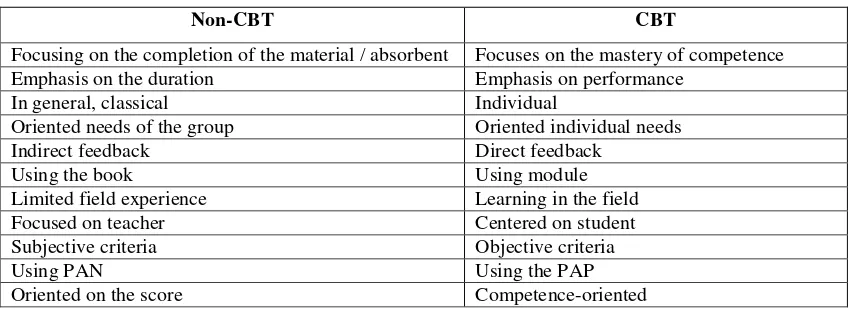
[image:9.612.108.538.441.596.2]Further aspects of learning in the Ministry of Education (2002) states that a competency-based curriculum has the following five characteristics: (1) Emphasis on achievement of competencies students both individually and classical. (2) results-oriented learning and diversity. (3) Submission of learning using a variety of approaches and methods. (4) The source of learning not only teachers but also other learning resources that meet the educational element. (5) assessment process and the emphasis on learning outcomes in an effort to achieve mastery or competence. If the learning system that uses a competency approach (CBT) and the non-competence (Non CBT) compared the difference can be seen as in the table below.
Table 1.Learning Differences Non-CBT and CBT
Non-CBT CBT
Focusing on the completion of the material / absorbent Focuses on the mastery of competence Emphasis on the duration Emphasis on performance
In general, classical Individual
Oriented needs of the group Oriented individual needs Indirect feedback Direct feedback
Using the book Using module Limited field experience Learning in the field Focused on teacher Centered on student Subjective criteria Objective criteria Using PAN Using the PAP Oriented on the score Competence-oriented
Learning model is actually a more appropriate use in an attempt to prepare a qualified workforce (competent)?. Answers to these questions can we trace from the demands of the development of science and technology and the rapid flow of information today and in terms of learning theory. In relation to the demands of the development of science and technology and the rapid flow of information
187
berdasararkan facts to learn and problem-based projects, (6) of based learning theory to the world and the real action and reflection, (7) of the habit of repetition and practice to the design and investigation, (8) obey the rules and procedures of a discovery and creation, (9) from competitive to collaborative, (10) of focus class to focus on the community, (11) of predetermined outcomes to the outcomes that are open, (12) of learning to follow the norms to be creative diversity (13) from the use of computers as a learning object to the use of computers as a learning tool, (14) of the presentation static media into a dynamic multimedia interaction, (15) of the extent of classroom communication are not limited to communication, (16) from a normative assessment of learning outcomes into a comprehensive performance measurement.
Furthermore, the learning paradigm shift has implications for the determination of a particular order in constructing theories of learning. Particular order are the focus of learning theory based on the nature of the demands of science and technology development. Some of this trend, among others: (1) placement of UNESCO's four pillars of education: learning to know, leraning to do, learning to be, and learning to life together as a paradigm of learning, (2) trend of shifting the orientation of teacher centered learning to student centered, (3) the trend shift from content-based curriculum toward competency-based curriculum, (4) changes in the theory of learning from model to model of constructivist Behavioristic, and (5) theoretical approach to contextual changes, (6) Standardization of the learning paradigm shift to customization.When viewed from the theories of learning, in general there are three theories of learning that can be used in learning. The third theory is behaviouristik learning, cognitive, and constructivist.
Behaviouristik a learning theory based on changes in behavior. Behaviorism emphasizes the new behavior patterns that are repeated samapai become automatic. This theory was pioneered by Pavlov, Watson, Thorndike, and Skinner. In general behaviouristik learning principles include: (1) Emphasizing attention to changes in behavior can be observed after one treatment, (2) behavior can be strengthened or
stopped through reward or punishment, (3) teaching is planned to develop instructional goals can be measured or observed, and (4) teachers do not need to know knowledge of what is already known and what happens to a person's thought processes. Teachers put more emphasis on the behavior of what should be done on the understanding of learners rather than learners of something.
Cognitive theory is based on the thought processes behind behavior. Changes in behavior were observed and used as an indicator of what happens in the brain learners. The main idea of the theory of the main initiators of this Piagiet is representative of one's ideas mental.semua represented in mental structure called a schema. The scheme will determine how data and information received will be understood. If the information in accordance with the existing scheme the students will absorb the information in this scheme. If not in accordance with the existing scheme, the information will be rejected or modified, or coinciding with the scheme or schemes to be changed or adjusted.
188
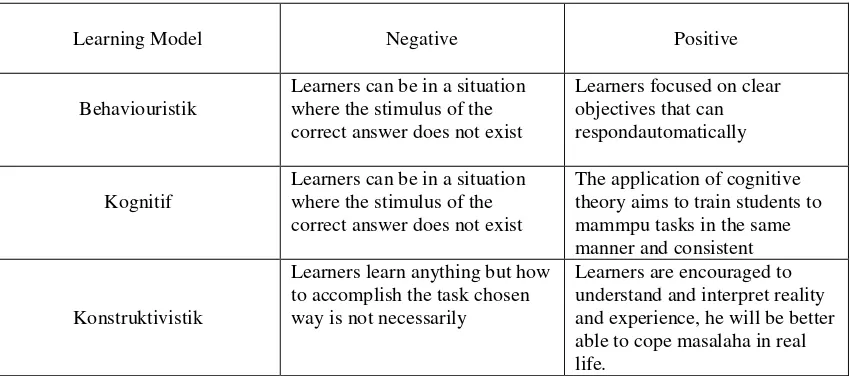
Table 2.Pros and Cons Learning Model
Learning Model Negative Positive
Behaviouristik
Learners can be in a situation where the stimulus of the correct answer does not exist
Learners focused on clear objectives that can respondautomatically
Kognitif
Learners can be in a situation where the stimulus of the correct answer does not exist
The application of cognitive theory aims to train students to mammpu tasks in the same manner and consistent
Konstruktivistik
Learners learn anything but how to accomplish the task chosen way is not necessarily
Learners are encouraged to understand and interpret reality and experience, he will be better able to cope masalaha in real life.
Based on the characteristics of behaviouristik theory, cognitive, and constructivist are the experts through his researches are more likely to suggest that the learning competencies (CBT), constructivist theory is more feasible to be applied predominantly in the learning process
3. Learning Model
Revitalization of learning by applying the constructivist approach to complement or further the actualization of the applied current competency approach is believed to provide greater opportunities to support the success of education in workforce preparation. In order for this approach provides optimal results then some of the principles to be followed are:
a. Organized learning environment with real experience and an alternative, because it is necessary to allow a person to proceed in learning (learning to know, learning to do, and actually doing) contextually b. Learning content must be designed to be relevant to the characteristics of the learner as the learning function as an adaptive mechanism in the process of construction, deconstruction and reconstruction of knowledge, attitudes and abilities
c. Learning content must be understood and designed within the framework or context of the initial stock (entry level behavior) learners, so learning experiences can be effected optimally. d. Assessment of students as a formative done to adjust to the diagnosis of a learning experience on an ongoing basis within the framework of lifelong learning (Life-long-continuing-education)
e. Educators who serve as facilitators provide flexibility and encourage the emergence of kemajemuukan in perspective and schematic organization of knowledge and skills, knowledge or skills that students master is rich in context.
The principles mentioned above in accordance with the theory of vocational education, known as the
Sixteen Prosser’s Theory (Prosser and Allen, 1952), three are as follows:
a. Effective vocational education can only be given if the task is done by training, tools, and machines the same as that applied in the workplace;
b. Vocational education will be effective if the individual is directly and specifically trained to get to work and think on a regular basis;
c. Foster an effective work habits students will occur only if the training and learning provided in the form of a real job and not just exercise.
As for some models of learning that can be applied to the preparation of labor, among others: a. Active student learning
b. Contextual approach to learning c. Cooperative and collaborative learning d. Learning discovery-learning
e. Thematic learning (project / task) f. Learning problem-solving.
g. Information technology-based learning model
4. Models of active student learning (Learning by Doing)
189
applying the principles of learning by doing, ie students need to be involved in the learning process spontaneously. Curiosity learners (students) to encourage active involvement in the learning process. Faculty role in providing a means for students to learn. On the other hand is an active learning approach to the management of the learning system by means of active learning to learn independently. Self-learning ability is the ultimate goal of active learning. Self-learning, defined as an individual effort from students to achieve an autonomous competence (Kozma, Belle, William: 1978). Students had the opportunity to set goals, plan the process, using sources, and make decisions. Independent learning does not mean isolating students from the guidance of teachers who serve as a resource, a guide and encouragement. Students do not depend on the direction of continuous teaching. He also has his own creativity and initiative with reference to the guidance obtained (Self Directed Learning, Knowles: 1975). In other words, meaningful learning occurs when students actively participate in the learning process and ultimately be able to decide what will be learned and how to learn
5. Contextual Learning Model
According to Blanchard (2001), contextual learning (Contextual Teaching and Learning), is a study that attempted to link learning content with real-world situations and motivates students to make connections between knowledge and its application in their daily lives. With this model of learning will be more meaningful and enjoyable for students. In contextual learning model, there are seven important aspects to be considered are: (1) discovery, (2) ask, (3) constructive, (4) community learning, (5) authentic assessment, (6) reflection, (7) modeling (The Washington State Consortium fo Contextuel Teaching and Learning,).
With contextual learning is believed to be students more easily understand the subject matter with a more concrete, learning closer to life and will eventually create a meaningful and enjoyable learning. Thus this learning model can be used to develop the know-how of students, and students will more easily understand the concept and recorded in long term memory.
6. Cooperative and Collaborative Learning
Slavin (1987) suggested that cooperative learning can assist students in defining motivation and organizational structure to foster collaborative partnerships (collaborative partnership).
Collaborative learning that focuses on a variety of cognitive advantages that arise because of the intimate interaction when working together. Modify learning objectives than just the delivery of information (transfer of information) into the construction of knowledge (construction of knowledge) by students through study groups.
7. Thematic Learning Model
Develop cross-thematic learning learning across subjects and even subjects. This learning model can improve the efficiency of the learning process because in a learning activity can include many subjects and even the subject of several subjects. Form of learning is usually in the form of project tasks.
8. Discoveri Learning Model Learning
Discovery learning is not merely find the answers to things that are already known to teachers. The learning process is also not a mere process of acquiring knowledge (acquisition). Discovery learning is based on constructivism is a learning process to discover something new (invention), individually or in groups.
9. Problem-Based Learning Model Learning
In this model offers the freedom to students in learning (Barrows, 1970). Learners are expected in the research process can identify problems, collect data and use data for troubleshooting. Problem-Based Learning gives control to students, both individuals and groups to learn according to their interest and attention. Not infrequently the students involved are very intensive, so the motivation to continue learning and continue to find out is increasing.
10.Information Technology-Based Learning Model
190
innovation model of learning. E-Learning is identical with the use of internet technology to deliver course material.
Sensitivity to changes in science learning and rapid progress required him to use information technology in communication and learning. Innovation model of information technology-based learning begins from the use of computers in learning it offline and then developed with the use of the web in online learning.
Development of computer based learning software is deemed worthy and important because it has several advantages including: (1) is a highly effective learning media and can facilitate learning and improve instructional quality, (2) may increase the motivation to learn, (3) can be used as a transmitter of direct and immediate feedback to learners effectively, (4) strongly support individual learning, (5) train the learners to choose the parts skillfully learning the desired content, (6) allows learners to get to know and be familiar with computers is becoming increasingly important in society modern, (7) learning becomes more interesting because it is equipped with color, songs, pictures, graphics and animations that are able to present an interesting study.
Of the effectiveness of computer mediated learning strategies, Roblyer and Hanafin (1988) classify the characteristics of effective computer-assisted learning in the twelve following properties: (1) program is designed based on the destination instruktursional. Made very clear instructional objectives and measurable so that it can be read by the designer of learning, student / student and teacher / lecturer, (2) program is designed in accordance with the characteristics of learners. Computer-assisted learning program designed specifically, to determine the level of knowledge / skills of learners, (3) is effective in maximizing the interaction, (4) is individualized. This program has the potential to organize learning activities in accordance with the needs of students, (5) effective in maintaining the interest of learners, being able to combine different types of media, moving image information is printed properly, (6) can be approached in a positive student, (7) can be prepared variety of feedback, (8) match the learning environment, (9) is effective in assessing the appearance of a worthy, (10) using the computer resources makasimal, (11) was designed based on the principles of instructional design, (12) the whole program has been evaluated.
Learning to use computers is growing very rapidly, especially after the availability of computers "superhighway" and "internet". Learning system through the internet known as: e-learning, online learning, virtual learning, virtual campus, school net,
web-based learning, resource based learning, distance learning, and other names. Development and application of this learning in the schooling is becoming increasingly important given the development of information technology and the increasingly rapid pace of Indonesia and with other nations, especially in the quality of education and human resources to face the global era, APEC and AFLA. Therefore, the importance of internet in education, especially in the use of the web for education is the fact that we all know (Arsham, 2002). By using the Internet over a rich source of learning and learning techniques. When discussing new things such as teachers and students can use a variety of instances that are accessed via the internet. Because of this learning program can be called the internet melaklui berbasisi learning a variety of sources (Resource-Based Learning). In this learning process-oriented rather than oriented to students and teachers such as conventional systems. In these students to be self-reliant and actively seek the information necessary for their own learning.
Some advantages of the Internet as a medium of learning, as quoted Anung Haryono (2003), among others: (1) can provide real examples of integrated knowledge, (2) is very useful to support the learning program based on various sources, because the Internet can provide lessons (courses ), can identify and use various sources of learning, can be used for communication and discussion, can be used to conduct activities and assessment, can be used to work together, and can be used to manage learning and counts the support of student learning, (3) capable of provide learning options such as to provide opportunities for students to learn according to their individual learning pace, allowing students to learn in a pleasant place for him, allowing students to learn the material not covered in pembelajatran received lessons in the classroom, giving students the chance to learn the various types of media , technology, giving the opportunity to direct their own learning, giving students the chance to participate in school or university program of good quality and without having to switch majors, (4) can deliver the content at any time in all directions, can be renewed (updating) learning material immediately, can increase the interaction between students and tutors, and can use elements of the CD-ROM-based learning. By considering the characteristics of internet-based learning, where learning is grounded immediately applied in any school or educational institutions.
11.Conclusion
191
pendidiakan especially vocational institutions to actually be able to produce graduates capable of competing, adaptive and anticipatory responses to changes and new conditions, open to change, able to learn how to learn (learning how to learn) , multi-skilling, easily retrained, as well as have the basics of broad capabilities, powerful, and fundamental to evolve in the future.
2. In accordance with the principles of learning and talent development thoroughly, each student should be given the opportunity to achieve goals in accordance with the capacity and speed of each study. 3. Improvement of the quality of education can not be separated from the learning system is used. Therefore, for the preparation of highly qualified workforce need for a reorientation of learning from model to model learning by teaching centered on the learner (student centered learning). This model puts students as learning subjects that have to actively develop themselves.
4. Learning models suitable for the preparation of labor between the assessments are: active learning, contextual, cooperative and collaborative, thematic, discoveri learning, problem-solving model (problem-solved learning) and information technology-based learning model.
LITERATURE
Anita Lie. (2002). Cooperative Learning. Jakarta : Grassindo. Blanchard, Allan. (2001). Contextual Teaching and Learning. New
York :B.E.S.T.
Dewey. J. (1959). Democracy and Education. New York : Mac Millan, Inc.
Finch, RF and Crunkilton, JR. (1984). Curriculum Development in Vocational and Technical Education. Boston : Allyn and Bacon, Inc.
Gagne, R.M. (1974). The Conditions of Learning and Theory of Instruction. New York : Rinehart and Winston.
Knowles, M. (1975). Self Directed Learning : A Guide for Learners and Teachers. New York : Cambride Adult Education Mulyasa (2003) Competence Based Training. Bandung: Rosda Prosser, C.A., & Allen, C.R. (1952). Vocational Education in a
Democracy. New York : Century.
Slavin, R. (1990). Cooperative Learning : Theory, Research and Practice. Boston : Allyn & Bacon.
Unesco. (1992). Learning to be. The World of Education to Day and Tomorrow. Paris : Printed in France.
Yulelawati. (2004). Kurikulum dan Pembelajaran. Bandung: Pakar Raya
Undang-Undang Nomor 20 Tahun 2003 tentang Sistem Pendidikan Nasional
Undang-Undang Nomor 14 Tahun 2005 Tentang Guru dan Dosen Peraturan Pemerintah RI Nomor 19 Tahun 2005 Tentang Standar
Nasional Pendidikan.