Does Environmental Uncertainty Affect Entrepreneurs’
Orientation and Performance?
Empirical Evidence from Indonesian SMEs*
Rina Herani
Faculty of Economics and Business, Universitas Gadjah Mada, Indonesia
Otto Andersen
University of Agder (UiA), Norway
Gadjah Mada International Journal of Business
Vol. 14, No. 1 (January - April 2012): 1 - 16
Abstract: Small and medium enterprises (SMEs) have a critical role in economic growth in Indonesia and become the backbone for job creation, poverty alleviation, and safeguard during the crisis. However, they are highly exposed to uncertain environments. The present study aimed to investigate the influence of SMEs’ entrepreneurial orientation on business performance when uncertain environments exist. A total of 152 Indonesian SMEs were studied in order to assess this relationship. Moderated regression analysis is performed as the main statistical procedures to analyse the moderating role of environmental uncer-tainty on the influence of entrepreneurial orientation on business performance. Surprisingly, the result of the present study did not confirm the previous predominant studies which found that entrepreneurial orientation dimensions are positively associated with business performance in growing in an uncertain environment. Indonesian entrepreneurs were reluctant to innovate, be proactive, and take risks when an uncertain environment exists. The present study was an endeavour to provide better insight in explaining the inconsistent and ambiguous findings from existing literature.
Abstrak: Usaha kecil dan menengah (UKM) memiliki peran penting dalam pertumbuhan ekonomi di Indonesia dan menjadi tulang punggung untuk penciptaan lapangan kerja, pengentasan kemiskinan, dan menjaga ekonomi tetap stabil selama krisis. Meskipun demikian, UKM sangat rentan terhadap ketidakpastian lingkungan. Penelitian ini bertujuan untuk menganalisis pengaruh orientasi kewirausahaan UKM terhadap kinerja bisnis dalam kondisi yang tidak pasti. Sebanyak 152 UKM Indonesia diteliti untuk menilai hubungan tersebut. Moderated Regression Analysis digunakan sebagai prosedur statistik utama untuk menganalisis peran moderasi ketidakpastian lingkungan terhadap hubungan antara orientasi kewirausahaan terhadap kinerja bisnis.Hasil pada penelitian ini tidak mengkonfirmasi penelitian sebelumnya yang pada umumnya menemukan bahwa dimensi orientasi kewirausahaan berpengaruh positif terhadap kinerja bisnis dalam kondisi lingkungan yang tidak pasti. Penelitian ini menemukan bahwa pemilik UKM di Indonesia enggan untuk berinovasi, proaktif, dan mengambil risiko ketika dihadapkan pada lingkungan yang tidak pasti. Penelitian ini merupakan upaya untuk memberikan pemahaman yang lebih baik dalam menjelaskan literatur terdahulu yang cenderung memberikan hasil dan penjelasan yang tidak konsisten dan ambigu.
Keywords: business performance; entrepreneurial orientation; environmental uncertainty
Introduction
Small and medium-sized enterprises (SMEs) play a vital role in economic devel-opment and income growth in many coun-tries (Indarti and Langenberg 2004; Swierczek and Ha 2003; and Tambunan 2006). In the Indonesian context, SMEs make up more than 99 percent of national business entities, employ more than 96 percent of the total workforce, and contribute to USD 113 bil-lion to exports (Depkop 2007). During the economic crisis in 1997, SMEs became a backbone for job creation, poverty allevia-tion, and safeguard during the crisis. Manning (2000) reported that during the Asian eco-nomic crisis, unemployment in South Korea more than tripled and more than doubled in Malaysia and Thailand. In contrast, the crisis did not affect the Indonesian labor market so badly. In 1997-1998, unemployment rose only slightly to 5.5 percent in August 1998 from just 5 percent a year earlier. Beside the agri-cultural sector, Manning (2000) noted that SME is a labour-intensive sector which is able to absorb a large number of workers during the economic crisis.
The man behind this success is the en-trepreneur who has a critical role in manag-ing and directmanag-ing the business venture to achieve business performance. The develop-ments of entrepreneurship and human skill improvement have become two major criti-cal factors for a country which is striving to establish ‘a sustainable economic and social development’ (Tambunan 2007). Hence, it is not a surprise that the topic of entrepreneur-ial orientation has gained remarkable inter-est from scholars since they found that en-trepreneurial orientation strongly associated with a firm’s superior development and per-formance (Covin and Miles 1999; Covin and Slevin 1991; and Wiklund 1999). Covin and
Miles (1999) and Wiklund (1999) reported that entrepreneurial orientation is closely re-lated to first-mover advantage and the pro-pensity to take advantage of emerging op-portunities which in turn will strengthen com-petitive position and deliver positive influ-ence on business performance. By having entrepreneurial orientation, entrepreneurs willing to “look for information that can help them better meet the needs of their custom-ers, manage risk taking, as well as challenge their competitors” (Tat Keh et al. 2007).
However, the previous studies related to entrepreneurial orientation have several drawbacks. First, study on entrepreneurial orientation has been concerned primarily with large firms; relatively few studies have been conducted that are specific to small and
me-dium-sized businesses (Bechereret al. 2001).
In Indonesian context, the influence of the external environment was experienced by SMEs during the year 2003-2008. The eco-nomic, political, and social environments have created major sources of uncertainties. There are several kind of environmental un-certainty faced by Indonesian entrepreneurs: unstable oil prices which have a knock down effect on electricity bills, raw material prices, and transportation fees; regulated and ‘unregu-lated fees’ from local government and time consuming government bureaucratic pro-cesses. Other external environments are ad-vance of technology, price competition from China’s product, and global financial crisis make the external environment even more uncertain for Indonesian SMEs.
To the best of our knowledge, a com-prehensive study into environmental uncer-tainty, entrepreneurial orientation, and busi-ness performance of Indonesian SMEs has not yet been undertaken. Investigating the aforementioned uncertainties is interesting and worthwhile since we can get an under-standing of how it influences the propensity to innovate, be proactive, take risk, and busi-ness performance. The objective of the present study is to investigate the influence of entrepreneurial orientation on business performance in increasingly uncertain envi-ronments. It is hoped that the findings of the present work will contribute valuable insights to enrich and extend the previous studies in the field of entrepreneurship. The practical implications from empirical examination should provide entrepreneurs with insight into the flexible and appropriate strategies to cope with the uncertain environment
Definition of SMEs in
Indonesian Context
Small and Medium Scale Enterprises in the present study combines the definition of SME by Indonesian Central Bureau of Sta-tistics (BPS) and State Ministry of Coopera-tives and Small & Medium Enterprises (Menegkop and UKM) which is defined as economic activity run by an individual, household, or institution which has an ob-jective to produce goods for commercial pur-poses which employ more than 4 but less than 100 employees and have initial assets of less than Rp 200 million (approximately USD 21,000 at the current exchange rate). This definition was used as the basis for selecting the sample of SMEs in the present study.
Conceptual Framework
Business Performance (BP)
Business Performance (BP) has been widely used in entrepreneurship studies to measure the success level of the company. The business performance can be defined as something that financially or non-financially provides benefit for the company short-term or long-term (Appiah-Adu 1998). Lumpkin and Dess (1996) note that business perfor-mance is a multidimensional construct and the entrepreneurial process may lead to favourable or unfavourable impact on differ-ent aspects performance. Therefore, employ-ing unidimensionality of performance would result in “misleading descriptive and norma-tive theory building” (Lumpkin and Dess 1996: 153). Due to this consideration, the present study employed both financial per-formance and non-financial perper-formance in order to capture a comprehensive understand-ing of the influence of constructs on both of the performances. Financial performance measured the return on assets, return on in-vestment, return on equity; profitability; sales volume; market share, and net income (Kohli
and Jaworski 1993; Narver and Slater 1990; Raju et al. 1995; Ruekert 1992; Slater and Narver 1994). While non-financial perfor-mance usually measures market access, pro-viding secure jobs to employees, employee productivity, job creation, contribution to community development, achieve start-up goals, and innovative leadership (Appiah-Adu 1998; Jantunen et al. 2005; Murphy and Callaway 2004; Swierczek and Thanh Ha 2003; Tat Keh et al. 2007).
Entrepreneurial Orientation (EO)
Lumpkin and Dess (1996) described Entrepreneurial Orientation (EO) as “pro-cesses, practices, and decision-making activi-ties that lead to new entry opportunity.” The concept of EO is embodied in the firm-level processes, practices, decision-making style (Lumpkin and Dess 1996), and strategic ori-entation (Wiklund 1999) of an entre-preneurially-oriented firm. Entrepreneurial Orientation consists of three key dimensions of: innovativeness, proactiveness and risk-tak-ing (Covin and Slevin 1989; Wiklund 1999).
Figure 1. Conceptual Framework of The Study
ENTREPRENURIAL ORIENTATION
Innovativeness
Proactiveness
Risk Taking
BUSINESS PERFORMANCE
Financial Performance
Non-Financial Performance
ENVIRONMENTAL UNCERTAINTY
Price, materials, product obsolete, economic, technology, taste, government
H1, H2, H3 H4, H5, H6
The present study will employ the EO mea-surement and classification by Covin and Slevin (1989) since this measurement con-sists of comprehensive dimensions which are suitable to be implemented for small compa-nies (i.e. SMEs). Lumpkin and Dess (1996) defined innovativeness as a firm’s “tendency to engage in and support new ideas, novelty, experimentation, and creative processes that may result in new products, services, or tech-nological processes.” Venkatraman (1989: 949) defined proactive-ness as the propen-sity to anticipate future needs by “seeking new opportunities which may or may not be re-lated to the present line operations, introduc-tion of new product and brands ahead of competition, strategically eliminating opera-tions which are in the mature or declining stages of life cyle” in the operating environ-ment, and to pioneer new methods and tech-niques.” Lumpkin and Dess (1996) described risk taking propensity as the willingness to make investments in projects that have un-certain outcomes or unusually high profits and losses. Miller and Friesen (1978: 923) defined risk taking as “the degree to which managers are willing to make large and risky resource commitments.”
Perceived Environmental
Uncertainty (PEU)
The concept of (Perceived Environ-mental Uncertainty) PEU has been inten-sively examined by several researchers (Matthews and Scott 1995; Miliken 1987; Gordon and Narayanan 1984; Taylor 1984; Miles and Snow 1978; Duncan 1972; and Conrath 1967). Miliken (1987) defined un-certainty as an individual’s perceived inabil-ity to predict something accurately. An indi-vidual experiences uncertainty because he/ she perceives himself/herself to be lacking sufficient information to predict accurately
or because he/she feels unable to discrimi-nate between relevant data and irrelevant data (Gifford et al. 1979).
The perceived environmental uncer-tainty in the present study is conceptualized as moderating the variable of entrepreneur-ial orientation-business performance relation-ship. The present study combines the mea-surement developed by Gordon and Narayanan (1984) and Miller and Friesen (1984). These measures are comprehensive but have smaller set of items. Thus, these will increase technical rigor and constitute parsi-monious measure. In addition, these measures are suitable with issues of environmental condition faced by Indonesian SMEs. The perceived environmental uncertainty as moderator on
relationship between entrepreneurial orientation and business performance
func-tion of the entrepreneurial personality but also a conscious strategic response to envi-ronmental uncertainty. Lawrence and Lorsch (1967) argued that “congruence or fit among key variables, such as environment, structure, and strategy, is critical for obtaining optimal performance.”
However, a small number of works have findings that are inconsistent with the afore-mentioned studies (Kreiser et al. 2002 Miles et al. 1993). Kreiser et al. (2002) found that environmental hostility is negatively associ-ated with level of innovativeness and risk
taking. Miles et al. (1993) reported that the
degree of environmental hostility and the propensity to adopt entrepreneurial orienta-tion was negatively correlated.
Based on the major aforementioned lit-erature review, the present study proposes that:
H1:High innovativeness is positively associated with the financial performance of the firms facing in-creasingly perceived environmental uncertainty. H2:High proactiveness is positively associated with
the financial performance of the firms facing in-creasingly perceived environmental uncertainty. H3:High risk taking is positively associated with
the financial performance of the firms facing in-creasingly perceived environmental uncertainty.
Extending the previous studies, the present study suggests that in increasing en-vironmental uncertainty, entrepreneurial ori-entation not only be expected to provide evi-dentially positive influence on financial per-formance, but also on non-financial perfor-mance. Indeed, Indonesian SMEs are char-acterized with as labour intensive; conse-quently creating employment is an important goal (Tambunan 2006).
H4:High innovativeness is positively associated with the non-financial performance of the firms fac-ing increasfac-ingly perceived environmental uncer-tainty.
H5: High proactiveness is positively associated with the non-financial performance of the firms fac-ing increasfac-ingly perceived environmental uncer-tainty.
H6: High risk taking is positively associated with the non-financial performance of the firms fac-ing increasfac-ingly perceived environmental uncer-tainty.
Method
Data Collection
The present study used a structured questionnaire as the instrument of study. The questionnaire was translated into Indonesian language. The use of a back-translation pro-cedure involving a native English speaker ensured that the meanings of the item state-ments were not altered. A participant infor-mation sheet was provided to inform them of the purpose of the study and other details related to the ethical issues to the partici-pants.
at least 5 years ago; they employ more than 4 but less than 100 employees; and they has initial asset less than USD 20,000. The SMEs must have been established 5 years ago since both environmental uncertainty and business performance measurements required the par-ticipants to assess these factors during the last 5 years (2008-2003). Moreover, we need to avoid the start-up effects where environment factors influences the firm merely internal rather than external factors.
To test the wordings of the items, a pi-lot study was conducted involving 10 SME owners. The wording was accordingly. Instead of using mail survey, the main study was con-ducted through personal direct interview at the firms’ location in order to obtain greater participation. Some cases, e.g. the participants are busy or not available on location, a “drop and collect” procedure then chosen. If there were missing values in the submitted ques-tionnaire, a follow up call was made to com-plete the missing data.
Profile of Respondents and
Enterprises
The totals of 180 questionnaires were distributed to the participating entrepreneur. However, only 163 completed questionnaires were collected. The responses rate was 90.5 percent. Eleven participats with incomplete quetionnaire could not be contacted hence these questionnaires were dropped. The us-able sample was 152 questionnaires. The pro-file of entrepreneurs comprised 63 percent male and 37 female. With respect to the length of operation of the firms, the profile consists of 35 percent less than 10 years, 48 percent between 10 to 20 years, and 17 per-cent more than 20 years.
Measures
Business performance
The present study will apply both finan-cial performance and non-finanfinan-cial perfor-mance which adopted from Jantunen et al. (2005) and Swierczek and Thanh Ha (2003) which have proven to have high reliability of
Cronbach = 0.91 and Cronbach = 0.78.
The financial performance consists of two indicators which measure the perceived im-provement of sales volume and profitability during the last five years. The non-financial performance consists of two indicators which measure the perceived improvement of mar-ket access and job creation during the last five years. A subjective approach will be used to measure business performance due to the difficulty in obtaining objective data from documentary sources, due to the possibility that the recorded financial and accounting data on daily basis are not available, and also because of the reluctance of organizations to divulge such information which was clas-sified as confidential (i.e. assets, profits, sales volume). Responses to each question will be measured on a five-point Likert-type improve-ment scale, with response options ranging from 1 (Much Worse) to 5 (Much Better) for all items. The present study considers that five years duration could capture better informa-tion and be aligned with perceived environ-mental uncertainty measures (developed by Gordon and Narayanan 1984) which previ-ously used a duration of five years to mea-sure the environmental uncertainty.
Entrepreneurial Orientation
develop related and distinct measures of stra-tegic orientation with all items loaded above 0.5 and reliability coefficient of 0.87. EO measure consist of nine items which divided into three key dimensions namely innovative-ness (3 items), proactiveinnovative-ness (3 items), and risk-taking (3 items). The Innovativeness measures the extensiveness of using ad-vanced production technology; the frequency of a company in innovating new product; and the intensity of a company in improving the existing product. The proactiveness measures the aggressiveness of a firm to be the first in introducing new product or technology; the aggressiveness to start the head-to-head com-petition; and the proclivity to be the first in initiating action. The risk taking dimension measures the extent to which the owner or manager is willing to take risky project, the extent to which the owner or manager is in-clined to make risky investment, and the ex-tent to which the owner or manager is inclined to make decision under the uncertain busi-ness environment. Responses of each ques-tion were measured on a five-point Likert scale.
Perceived Environmental
Uncertainty
The present study adopts the PEU mea-sure from Gordon and Narayanan (1984). This measure has been proven of having Cronbach á 0,77. This scale measures the sta-bility of production technology; the severity of price competition; severity raw material supply; the rate of product become out-of-date; the stability of economic condition; the influence of government regulation; the dy-namics of customer’s preference; and the market activities of competitors. Respon-dents were asked to respond about their stance towards uncertainty conditions on a five-point Likert scale.
Data Analysis
Confirmatory Factor Analysis
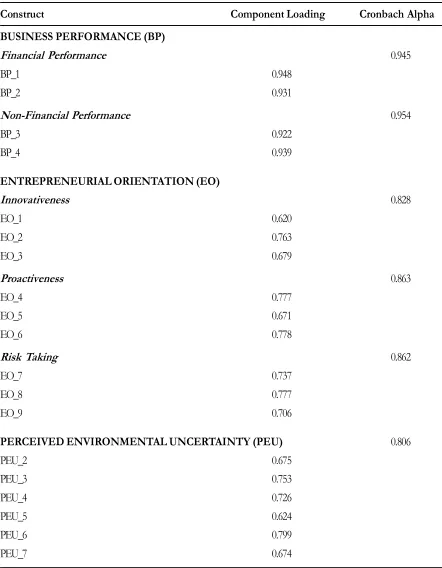
The factor analyses were performed on the composite variable of business perfor-mance, entrepreneurial orientation, and per-ceived environmental uncertainty and re-sulted in the validity analysis below:
The factor analysis reported that KMO and Bartlett’s test of above variables were greater than 0.60 and were significant at
p<0.01 level which indicated that validity
analysis could be continued on examining communalities and factor loadings. All five items which measured Business Performance have communality greater than 0.30. The ro-tated component matrix reported that items for financial and non-financial were correctly loaded into different components. All nine items which measure entrepreneurial orien-tation were found to have acceptable munalities greater than 0.30. The rotated com-ponent matrix reported that innovativeness, proactiveness, and risk taking were correctly loaded into different components. During the process, two items of perceived environ-mental uncertainty were deleted due to the existence of cross loading with values greater than 0.35. The rest were loaded into one com-ponent and employed for further analysis. The split-half method analysis was use to analyse the reliability of the measure. The result re-veals that the dimensions of entrepreneurial orientation, dimensions of business perfor-mance, and perceived environmental uncer-tainty have good reliability with Cronbach alpha ranging from 0.806 to 0.945.
Hypotheses Testing
frame-Table 1. Confirmatory Factor Analysis and Scale Reliability
Construct Component Loading Cronbach Alpha
BUSINESS PERFORMANCE (BP)
Financial Performance 0.945
BP_1 0.948
BP_2 0.931
Non-Financial Performance 0.954
BP_3 0.922
BP_4 0.939
ENTREPRENEURIAL ORIENTATION (EO)
Innovativeness 0.828
EO_1 0.620
EO_2 0.763
EO_3 0.679
Proactiveness 0.863
EO_4 0.777
EO_5 0.671
EO_6 0.778
Risk Taking 0.862
EO_7 0.737
EO_8 0.777
EO_9 0.706
PERCEIVED ENVIRONMENTAL UNCERTAINTY (PEU) 0.806
PEU_2 0.675
PEU_3 0.753
PEU_4 0.726
PEU_5 0.624
PEU_6 0.799
PEU_7 0.674
work in the present study involves interac-tion effects so-called ‘moderator effect’. The interaction effects exist because there is in-teraction of the third variable (moderating variable) which changes the relation between two original variables (predictor variable and criterion variables) (Tabachnick and Fidell 2007). The present study used MRA to ex-amine the existence of the interaction effect between EO (Entrepreneurial Orientation) dimensions and Perceived Environmental Uncertainty (PEU) in its relation to business performance (BP).
Due to the possibility of a multico-llinearity problem, the predictors in the present study were ‘centered’ before calcu-lating the interaction effects. The term “cen-tering” refers to the method of subtracting the variable mean from each case’s value on that variable (Jaccard et al. 1990).
Moderated regression analysis was per-formed by conducting hierarchical regres-sions. The existence of a moderating role of perceived environmental uncertainty on en-trepreneurial orientation and business perfor-mance relationship can be seen from the sig-nificance of interaction between perceived environmental uncertainty and each dimen-sions of entrepreneurial orientation on each regression (Jaccard et al. 1990).
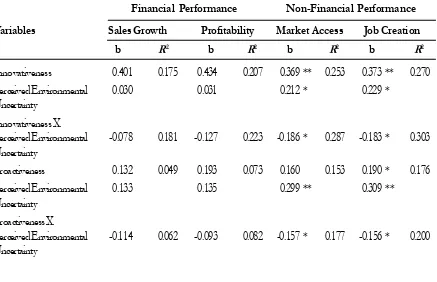
Hypothesis 1 suggested that firms with high innovativeness in an increasing environ-mental uncertainty would be positively cor-related with financial business performance and Hypothesis 2 predicted that proactive firms in an escalating environmental uncer-tainty would have greater financial perfor-mance. Table 2 indicates no statistically sig-nificant support for both hypotheses since the interaction effects of
innovativeness-envi-Table 2. Result of Moderated Regression Analysis – Perceived Environmental
Uncer-tainty
Financial Performance Non-Financial Performance Variables Sales Growth Profitability Market Access Job Creation
b R2 b R2 b R2 b R2
Innovativeness 0.401 0.175 0.434 0.207 0.369 ** 0.253 0.373 ** 0.270
Perceived Environmental 0.030 0.031 0.212 * 0.229 *
Uncertainty
Innovativeness X
Perceived Environmental -0.078 0.181 -0.127 0.223 -0.186 * 0.287 -0.183 * 0.303
Uncertainty
Proactiveness 0.132 0.049 0.193 0.073 0.160 0.153 0.190 * 0.176
Perceived Environmental 0.133 0.135 0.299 ** 0.309 **
Uncertainty Proactiveness X
Perceived Environmental -0.114 0.062 -0.093 0.082 -0.157 * 0.177 -0.156 * 0.200
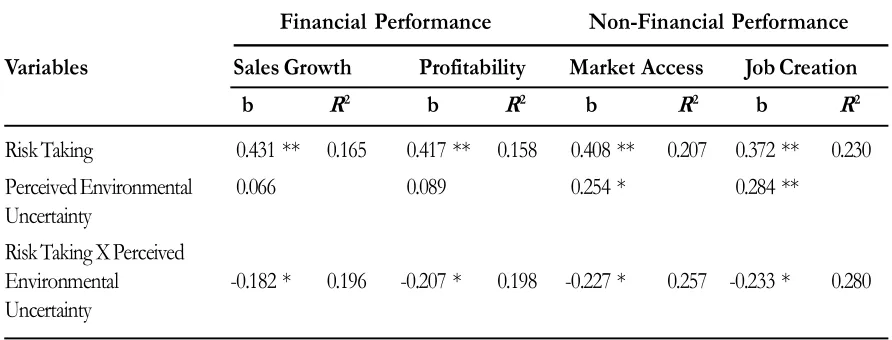
ronmental uncertainty and proactiveness-en-vironmental uncertainty were found to be not significant. Hypothesis 3 proposed that firms which are willing to take risk in increasing environmental uncertainty would reap greater financial performance. This hypothesis was not supported because the moderated regres-sion analysis reports the opposite. The inter-action of risk taking-environmental uncer-tainty reported statistically negative affected financial performance.
Hypothesis 4 suggested that innovative firms in increasing environmental uncertainty would have greater non-financial perfor-mance. This hypothesis was not supported due to the interaction effect of innovatiness-perceived environmental uncertainty was negative related to non-financial performance. This result was the opposite to the hypoth-esis. The same results occurred for Hypoth-esis 5 and hypothHypoth-esis 6. HypothHypoth-esis 5 pro-posed that firms which have high proactiveness in increasing environmental uncertainty would enhance the non-financial performance. This hypothesis was not
sup-ported because the interaction effect of proactiveness and non-financial performance was statistically negative related to non-finan-cial performance. Hence, it is contrary to the hypothesis. Hypothesis 6 suggested that firms which engage in high risk taking in an increas-ing environmental uncertainty would improve the non-financial performance. This hypoth-esis is not supported because the interaction effect of risk taking and non financial per-formance shows evidence of a negative in-fluenced on the non-financial performance. This result was opposed the hypothesis.
Discussion
In general, the moderating effects of perceived environmental uncertainty on en-trepreneurial orientation dimensions - busi-ness performance relationships were reported to be negatively associated with business per-formance when perceived environmental uncertainty exists. These findings indicated that among Indonesian entrepreneurs, pro-posing new ideas and/or getting involved in
Financial Performance Non-Financial Performance Variables Sales Growth Profitability Market Access Job Creation
b R2 b R2 b R2 b R2
Risk Taking 0.431 ** 0.165 0.417 ** 0.158 0.408 ** 0.207 0.372 ** 0.230
Perceived Environmental 0.066 0.089 0.254 * 0.284 **
Uncertainty
Risk Taking X Perceived
Environmental -0.182 * 0.196 -0.207 * 0.198 -0.227 * 0.257 -0.233 * 0.280
Uncertainty
Source: processed data (2008)
Notes: Regression weights shown are standardized coefficients obtained at the final step. N = 152; *p < 0.05; ** p < 0.001
creative processes tend to be considered less favourably in an increasingly uncertain envi-ronment. The same result was revealed for proactiveness. Entrepreneurs are less reactive in responding opportunities when the envi-ronment is uncertain. The interaction effects between risk taking and perceived environ-mental uncertainty are negative in terms of all business performance indicators. This im-plies that Indonesian entrepreneurs have a preference not to invest or not to get involved in a project that has uncertain outcomes. In other words, in an uncertain environment, Indonesian entrepreneurs are discouraged from being innovative, proactive, and taking risks given that it would damage their busi-ness performance.
Surprisingly, these results did not con-firm the previous predominant studies which found that entrepreneurial orientation dimen-sions were positively associated with business performance in a growing environment un-certainty (i.e. Yusuf 2002; Covin and Slevin 1989; Miller 1983; and Khandwalla 1977). The present study proposes several arguments that may cause these inconsistencies:
First, the inconsistent results may be caused by the use of aggregated measures for entrepreneurial orientation as employed by Covin and Slevin (1989) and Yusuf (2002) instead of sub-dimensions of entrepreneur-ial orientation (i.e. innovativeness, proactive-ness, and risk taking). Kreiser (2002) noted that employment of entrepreneurial orienta-tion dimensions tend to ‘vary independently of one another in a given context’.
Second, an uncertain environment is characterized as having scarcer resources and less profit margins that lead firms to be more careful in resource conservation (Miller and Friesen 1983). Hence, strongly emphasizing intensive innovative ideas, forceful
proactive-ness, and extensive risk taking in this uncer-tain period would be considered hazardous and poor strategic choices and consequently would erode the business performance (Goll and Rasheed 1997; Kreiser et al. 2002; Miles et al. 1993; Miller and Friesen 1983; Slater and Narver1994; Zahra and Bogner 1999; Zahra and Garvis 2000).
Third, the present study found that in an uncertain environment, entrepreneurs are discouraged from adopting proactive orien-tation because in an uncertain environment, firms are facing fierce competition and the asymmetries are more hostile and more un-predictable. Therefore, interlocking organiza-tional behaviour and less slack for experimen-tal new strategy to preserve resources are preferable (Bourgeois 1981; Pfeffer and Leblebeci 1973).
Fourth, the inconsistent findings across the study in the entrepreneurship field could be simply caused by the difference of cul-tural background where the studies were con-ducted. Lee and Peterson (2000) proposed that an entrepreneurship study should ac-knowledge the entrepreneur as an individual and part of social environment whose per-sonalities and behaviour intertwined and originate from national culture.
The findings of the present study make several important contributions in the theo-retical area. First, the present study provides better insight into explaining the inconsistent and ambiguous findings of the major exist-ing literature. Second, the present study ex-tends the study into entrepreneurial orienta-tion by employing entrepreneurial orientaorienta-tion dimensions (innovativeness, proactiveness, and risk taking) instead of an aggregated en-trepreneurial orientation construct and look-ing at financial and non-financial performance which have rarely been investigated in previ-ous studies. Third, this study was performed in developing countries and in the small and medium sized sector which has been less fre-quently examined by previous studies.
The practical implication can be drawn from this study. Entrepreneurs should care-fully examine and select the information about the current situation in the market in order to make precise decisions in respond-ing it. Overstatrespond-ing the current situation could impact in ineffective strategy choice and squandered business opportunities.
Suggestion for Future
Research
The following limitations need to be acknowledged when interpreting the findings
of the study. First, the perceived environmen-tal uncertainty is a multidimensional construct and should be evaluated separately in order to have meaningful analysis. Instead of using aggregate environmental uncertainty, the fur-ther study should examine, for example, the moderating role of technological uncertainty or competition uncertainty in the entrepre-neurial orientation and business performance relationship. Second, national culture and other internal factors (firms and entrepreneurs characteristics) should be incorporated in or-der to have a better unor-derstanding of the re-lationship. Third, the number of participants in the study was relatively small and focused only on one province. The findings may not be generalised in the Indonesian context, as differences in responses to the interviews between one region to others may exist. Hence, it would be interesting if, in the fu-ture, further study also recruited the partici-pants from provinces where SMEs are a criti-cal sector for the regions. Fourth, the present study employs cross-sectional design which may not allow causal inferences. Therefore, for further studies, the longitudinal approach would provide a better understanding of the nature of these relationships.
References
Appiah-Adu, K. 1998. Marketing orientation and performance: Empirical test in transition economy.
Journal of Strategic Marketing 6: 25-45.
Becherer, R. C., D. Halstead, and P. Haynes. 2001. Marketing orientation in SMEs: Effect of the internal environment. Journal of Research in Marketing and Entrepreneurship 3 (1): 1-17.
Conrath, D. W. 1967. Organizational decision making behavior under varying conditions of uncertainty.
Management Science 13: 487-500.
Covin J., and M. Miles. 1999. Corporate entrepreneurship and the pursuit of competitive advantage.
Entrepreneurship Theory and Practice 23 (3): 47–63.
Covin, J. G., and D. P. Slevin. 1989. Strategic management in small firms in hostile and benign environ-ments. Strategic Management Journal 10: 75-87.
Covin, J. G., and D. P. Slevin. 1991. A conceptual model of entrepreneurship as firm behaviour. Entrepre-neurship Theory and Practice 16 (1): 7-25.
Depkop. 2007. Statistik UKM Tahun 2002-2007. Retrieved on 10 January 2008 from www.depkop.go.id. Duncan, R. B. 1972. Characteristic of organizational environments and perceived environmental
uncer-tainty. Administrative Science Quarterly 17: 313-327.
Foxall, G. 1984. Corporate Innovation: Marketing and Strategy. New York: St. Martins Press.
Gifford, W. E., H. R. Bobbitt, and J. W. Slocum. 1979. Message characteristics and perceptions of uncer-tainty by organizational decision maker. Academy of Management Journal 22: 456-481.
Goll, I., and A. M. A. Rasheed. 1997. Rational decision-making and firm performance: The moderating role of environment. Strategic Management Journal 18 (7): 583-591.
Gordon, L. A., and V. K. Narayanan. 1984. Management accounting systems, perceived environmental uncertainty and organization structure: An empirical investigation. Accounting, Organization, and Soci-ety 9 (1): 33-47.
Grewal, R., and P. Tansuhaj. 2001. Building organizational capabilities for managing economic crisis: The role of market orientation and strategic flexibility. Journal of Marketing 65 (2): 67-80.
Indarti, N., and M. Langenberg. 2004. Factors affecting business success among SMEs: Empirical evi-dences from Indonesia. Paper Presented at The secons Bi-Annual European Summer University. University of Twente, Enschede, The Netherlands.
Jaccard, J., R. Turrisi, and C. K. Wan. 1990. Interaction Effects in Multiple Regression: Quantitative Application in the Social Sciences. London, UK: Sage Publications. Inc.
Jantunen, A., P. Kaisu, S. Saarenketo, and K. Kylaheiko. 2005. Entrepreneurial orientation dynamic capa-bilities, and international performance. Journal of International Entrepreneurship 3 (3): 223-244. Khandwalla, P.N., (1977), The Design of Organizations. New York: Harcourt Brace Jovanovich.
Kohli, A. K., B. J. Jaworski, and A. Kumar. 1993. MARKOR: A measure of market orientation. Journal of Marketing Research 30 (November): 467-77.
Kreiser, P. M., L. D. Marino, and K. M. Weaver. 2002. Reassessing the environment-EO link: The impact of environmental hostility on the dimensions of entrepreneurial orientation. Proceedings of Academy of Management.
Lawrence, P., and J. Lorsch. 1967. Organization and Environment. Cambridge MA: Harvard University Press.
Lee, S. M., and S. J. Peterson. 2000. Culture, entrepreneurial orientation, and global competitiveness.
Journal of World Business 35 (4): 401-416.
Lumpkin, G. T., and G. G. Dess. 2001. Linking two dimensions of entrepreneurial orientation to firm performance: The moderating ole of environment and industry life cycle. Journal of Business Ventur-ing 16: 429-451.
Manning, C. 2000. Labour market adjustment to Indonesia’s economic crisis: Context, trends and impli-cations. Bulletin of Indonesian Economic Studies 36 (1): 105–36.
Matthews, C. H., and S. G. Scott. 1995. Uncertainty and planning in small and entrepreneurial firms: An empirical assessment. Journal of Small Business Management 33 (4): 34-52.
Miles, M. P., D. R. Arnold, and D. L. Thomson. 1993. The interrelationship between environmental hostility and entrepreneurial orientation. Journal of Applied Business Research 9 (4): 2-24.
Miles, R. E., and C. C. Snow. 1978. Organizational Strategy, Structure and Process. New York, McGraw-Hill. Miliken, F. J. 1987. Three types of perceived uncertainty about the environment: State, effect, and
re-sponse uncertainty. Academy of Management Review 12 (1): 133-143.
Miller, D. 1983. The correlates of entrepreneurship in three types of firms. Management Science 29 (7): 770-791.
Miller, D., and P. Friesen. 1978. Archetypes of strategy formulation. Management Sciences 24: 921-933. Miller, D., and P. Friesen. 1984. A longitudinal study of the corporate life cycle. Management Science 30:
1161-1183.
Miller, D., and P. H. Friesen. 1983. Strategy-making and environment: The third link. Strategic Management Journal 4: 221-235.
Miller, D., and P. H. Friesen. 1982. Innovation in conservative and entrepreneurial firms: two model of strategic momentum. Strategic Management Journal 3: 1-25.
Murphy, G. B., and S. K. Callaway. 2004. Doing well and happy about it? Explaining variance in entrepre-neurs’ stated satisfaction with performance. New England Journal of Entrepreneurship 7: 15-26. Narver, J. C., and S. F. Slater. 1990. The effect of a market orientation on business profitability. Journal of
Marketing 54 (4): 20-35.
Pfeffer, J., and H. Leblebici. 1973. The effect of competition on some dimensions of organization structure. Social Forces 52: 268–279.
Raju, P. S., S. C. Lonial, and Y. P. Gupta. 1995. Market orientation and performance in the hospital industry. Journal of Health Care Marketing 15 (4): 34-41.
Ruekert, R. W., 1992. Developing a market orientation: An organizational strategy perspective. Interna-tional Journal of Research in Marketing 9 (3): 255-245.
Slater, S. F., and J. C. Narver. 1994. Does competitive-environment moderate the market orientation-performance relationship? Journal of Marketing 58 (January): 46-55.
Smart, C., and I. Vertinksy. 1984. Strategy and the environment: A study of corporate response to crises.
Strategic Management Journal 5 (3): 199-214.
Swierczek, F. W., and H. T. Thanh. 2003. Entrepreneurial orientation, uncertainty avoidance and firm performance: An analysis of Thai and Vietnamese SMEs. Entrepreneurship and Innovation (February): 46-58.
Tabachnick, B. G., and L. S. Fidell. 2007. Using Multivariate Statistics (5th ed.). Pearson International Edition.
Tambunan, T. T. H. 2007. Entrepreneurship development: SMEs in Indonesia. Journal of Developmental Entrepreneurship 12 (1): 95-118.
Tat Keh, H., T. T. Mai Nguyen, and H. Ping Ng. 2007. The effect of entrepreneurial orientation and market information on the performance of SMEs. Journal of Business Venturing 22 (4): 592-611. Taylor, R. N. 1984. Behavioral Decision Making. Glenview. LL: Scott Foresman.
Van Gelderen, M., M. Frese and R. Thurik. 2000. Strategies, uncertainty and performance of small busi-ness startups. Small Business Economics 15: 165–181.
Venkatraman, N. 1989. Strategic orientation of business enterprises: The construct dimensionality, and measurement. Management Science 35: 942-962.
Wiklund, J. 1999. The sustainability of the entrepreneurial orientation –performance relationship. Entrepre-neurship Theory and Practic 24 (1): 37-48.
Yusuf, A. 2002. Environmental uncertainty, the entrepreneurial orientation of business ventures and per-formance. IJCM 12 (3 and 4): 83-102.
Zahra, S. A., and W. Bogner. 1999. Technology strategy and software new ventures’ performance: Ex-ploring the moderating effect of competitive environment. Journal of Business Venturing 15: 135-173.
Zahra, S., and W. Bogner. 1999. Technology strategy and software new venture performance: The mod-erating effect of the competitive environment. Journal of Business Venturing 15 (2): 135-173. Zahra, S. A., and J. G. Covin. 1995. Contextual influences on the corporate
entrepreneurship-perfor-mance relationship: a longitudinal analysis. Journal of Business Venturing 10: 43-58.