THE EFFECT OF MANAGERIAL ORIENTATION
ON SALESPERSONS’ JOB SATISFACTION
BM. Purwanto
Universitas Gadjah Mada
ABSTRAK
Studi ini mengungkap efek orientasi manajerial terhadap kepuasan kerja tenaga penjual. Kepuasan kerja merupakan konstruk yang sangat penting bagi manajer karena memiliki efek yang signifikan terhadap perilaku dan kinerja tenaga penjual. Responden adalah tenaga penjual jasa asuransi jiwa dari 12 perusahaan asuransi jiwa yang beroperasi di Indonesia. Data dikumpulkan dengan menggunakan kuesioner. Two-step approach to SEM digunakan untuk menguji model hubungan struktural antara konstruk-konstruk yang mencerminkan orientasi manajerial (komitmen manajemen terhadap kualitas layanan, pemberdayaan, evaluasi berdasar perilaku, dan evaluasi berdasar ha sil) dan kepuasan kerja. Hasil pengujian menunjukkan bahwa komitmen manajemen terhadap kualitas layanan akan mendorong manajemen untuk memberdayakan tenaga penjualnya. Manajemen yang berupaya memberdayakan tenaga penjual cenderung menggunakan sistem evaluasi berdasar perilaku dari pada menggunakan sistem evaluasi berdasar hasil. Evaluasi berdasar perilaku berefek positif terhadap kepuasan kerja, sedangkan evaluasi berdasar hasil cenderung berefek negatif terhadap kepuasan kerja tenaga penjual.
Keywords: salesperson, management commitment to service quality, empowerment, behavior-based evaluation, outcome-based evaluation, job satisfaction, two-step approach to SEM.
INTRODUCTION
In terms of strategic management, managers need to know whether a satisfied employee will contribute more to achieving objectives than a dissatisfied employee. Researchers have found that there is a link between job satisfaction and job performance. Schneider (1980) finds evidence that job satisfaction is a primary reason that employees deliver good service. Churchill, Ford, Hartley, and Walker (1985) argue that job satisfaction is closely related to employees’ behavioral performance in a sales context. Bitner (1990) finds a similar relationship is likely to occur with respect to service employees. There is also evidence that satisfied employees are more likely to engage in behaviors that assist
customers (Locke and Latham 1990; Weatherly and Tansik 1993). Furthermore, in a meta-analytic study, Brown and Peterson (1993) report a correlation between employee satisfaction and performance across many studies, although with a modest correlation of only 0.15.
addressed the effect of management commit-ment to service quality (Hartline and Ferrell 1996; Reeves and Hoy 1993), behavior-based evaluation (Oliver and Anderson 1994; Challagalla and Shervani 1996; Ramaswarni 1996) and empowerment (Conger and Kanungo 1988; Bowen and Lawler 1995) on employees’ behaviors. The objective of this study, in turn, is to investigate the effect of managerial orientation (management commit-ment to service quality, empowercommit-ment, behavior-based evaluation, and outcome-based evaluation) on salespersons’ job satisfaction.
THEORETICAL BACKGROUND Managerial Orientation
Webster’s Third New International Dictionary (1986) defines orientation as (1) the act of determining one’s sense of direction, (2) the settling of a sense of direction or relationship in moral or social concerns or in thought or art. Managerial orientation, therefore, can be thought of as a manager’s characteristic, which is determined by his or her act of determining the direction of his or her organization.
A manager’s managerial orientation is reflected in his or her vision, support to employees, choice of control mechanism, and choice of reward system necessary to motivate employees (e.g. Loh, Shankar, and Yeong 1995; Abernathy 1996). Furthermore, there is a significant relationship between managerial orientation, work centrality, and job satis-faction (e.g. Mannheim 1984). A manager’s commitment to service quality, employee empowerment, and adoption of behavior-based evaluation may imply the manager’s orientation of promoting relationships with employees and customers.
Management Commitment to Service Quality
Management commitment to service quality can become the manager’s vision,
which is likely to be noticed and modeled by employees (Reardon and Enis 1990). It also implies the management’s underlying value. An organization having commitment to service quality believes that service quality is important to the well being of the organization. This belief will guide the behaviors of all the organization’s members. It is also a precursor to the use of process control mechanisms (George 1990).
Ahmed and Parasuraman (1994) define management commitment to service quality as encompassing the conscious choice of quality initiatives as operational and strategic options for the firm, and engaging in activities such as providing visible quality leadership and resources for the adoption and implementation of quality initiatives. Management commit-ment to service quality involves two compo-nents: (1) a strong, personal commitment to quality improvement and (2) a visible and active involvement in the quality-improvement process (Mohr-Jackson 1993).
Zeithaml, Parasuraman, and Berry (1990) conclude that quality will not be achieved without total management commitment to service quality. Customer-contact service employees and middle management do not and cannot improve quality without strong leadership from management. Shoop (1991) revealed that the failure of quality programs was primarily caused by a lack of management support. Moreover, Reeves and Hoy (1993) found that restaurants, whose employees believed that the quality of service was emphasized by the manager, were more successful in achieving high quality service, as measured by customer evaluations. Unless management is committed to quality and effectively express such commitment, employees in the organization will only be as committed to quality as their personal standards dictate (Reeves and Hoy 1993).
(George 1990). These initiatives include creating more flexible processes, dedicating resources to the improvement effort, promul-gating a quality-oriented vision throughout the firm, and rewarding employees for their efforts and commitment to the process (Ahmed and Parasuraman 1994; Wall and Zeynel 1991). Furthermore, Hartline and Ferrel (1996) postulate that empowerment and behavior-based evaluation are MCSQ-type initiatives that managers can use to influence customer-contact service employee responses during service delivery.
Empowerment
Empowerment refers to a situation in which the manager gives employees the discretion to make day-to-day decisions about job-related activities (Bowen and Lawler 1992; Conger and Kanungo 1988). Moreover, Conger and Kanungo (1988) propose that empowerment be viewed as a motivational construct – meaning to enable. Enabling implies creating conditions for heightening motivation for task accomplishment through the development of a strong sense of personal efficacy. The manager relinquishes control over many aspects of the service delivery process by allowing contact employees to make decisions (Hartline and Ferrell 1996). Bowen and Lawler (1995) argue that organizations must change their policies, practices, and structures to create and sustain empowerment. Empowerment will not be an ongoing force unless all the structures, practices, and policies send the message that employees are empowered to deal effectively with customers.
Empowerment exists when companies implement practices that distribute power, information, knowledge, and rewards throughout the organization (Bowen and Lawler 1995). Companies can redistribute power by giving employees latitude on how they perform their daily tasks and deal with unforeseen problems. Giving service employees more power may help them to
recover from service failures and delight customers by exceeding their expectations. Companies need to disseminate relevant information to help customer-contact service employees (frontline employees) to act as customer advocates. Contact employees need to know about the business goals, and objectives as well as the full-service delivery process of which they are a part. Furthermore, service firms should allocate rewards based on how effectively employees use information, knowledge, and power to improve service quality and the company’s financial performance.
Hartline and Ferrel (1996) summarize that empowerment has a positive effect on the attitudinal and behavioral responses of contact employees. The increased discretion and flexibility experienced by empowered contact employees make them feel better about their jobs, reduce stress they feel in performing their jobs, increase their confidence in performing job-related tasks, and increase their adaptability to changing conditions within the service encounter.
Hypothesis 1: The stronger the managers’
commitment to service quality the more the managers empower the employees.
Behavior-Based and Outcome-Based Evaluation System
Sales force control systems can be classified into outcome-based control system and behavior-based control system. Characteristics of outcome-based control system are the following: (a) relatively little monitoring of salesperson by management, (b) relatively little managerial direction or effort to direct salesperson, and (c) straight-forward objective measures of results, rather than measures of the methods salesperson use to achieve results, are used to evaluate and compensate the salespersons (Oliver and Anderson 1994; Anderson and Oliver 1987).
monitoring of salesperson’s activities and results, (b) high levels of management direction of and intervention in the activities of salesperson, and (c) subjective and complex methods based largely on salesperson aptitude, product knowledge, activities, and their sales strategies to evaluate and compensate the salespersons (Oliver and Anderson 1994; Anderson and Oliver 1987). Under a behavior-based system, contact employees are evaluated and compensated on the basis of such criteria as effort, commitment, teamwork, customer orientation, friendliness, the ability to solve customer problems, and behaviors that are directed toward improved service quality (Reardon and Enis 1990).
Hypothesis 2: Managers that empower their
employees tend to emphasize more on behavior-based evaluation and less on outcome-based evaluation.
Job Satisfaction
Wright and Noe (1996) define job satisfaction as a positive attitude toward work. Some people have a positive attitude toward their work; they enjoy their work, and it fulfills their needs. An employee’s level of job satisfaction depends on his or her needs and
hopes – what they are and how important each one is to the person. The conceptual domain of job satisfaction is broad. It includes all characteristics of the job itself and the work environment which employees find rewarding, fulfilling and satisfying, or frustrating and unsatisfying (Churchill, Ford, and Walker
1974). Brown and Peterson (1993)
operationalize job satisfaction as consisting of satisfaction with the supervisor, work, pay, advancement, coworkers, and customers.
Bowen and Lawler (1992) suggest that employees feel better about their jobs and more enthusiastic about serving customers when they are empowered. Furthermore, Oliver and Anderson (1994) find that employees’ job satisfaction will increase when their supervisors emphasize on behavioral criteria, for example, using behavior-based evaluation.
Hypothesis 3a: Behavior-based evaluation
system has a positive effect on job-satisfaction.
Hypothesis 3b: Outcome-based evaluation
system has a negative effect on job-satisfaction.
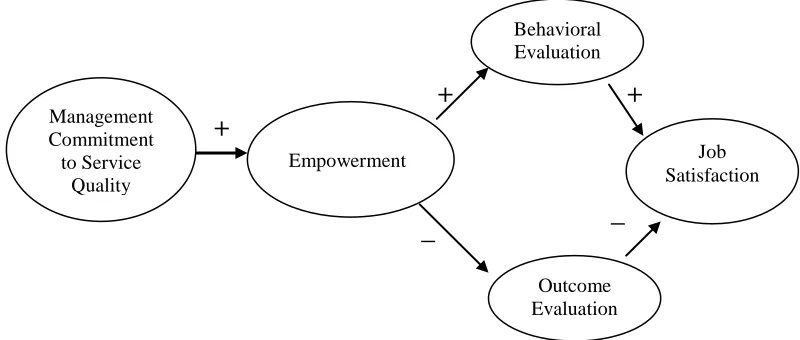
Based on the hypotheses, the study proposes the following model.
Figure 1: The Proposed Model
Management Commitment to Service
Quality
Empowerment
Outcome Evaluation
Job Satisfaction Behavioral
Evaluation
+
+
_
_
RESEARCH METHODS
Sample Selection and Data Collection
The respondents were salespersons of twelve life insurance companies operating in Indonesia. The data were collected as follows. An introductory letter, questionnaires, and self-addressed stamped envelopes were sent to each participating company. The participating companies distributed the questionnaires to their salespersons that have been working with the company for at least one year. Follow-up letters were mailed to the companies not responding within two weeks after the initial mailing. Personal visits to several agency offices were also conducted by the researcher to encourage their participation. The survey got 368 responses (about 30% response rate). Three hundred and sixteen (316) respondents qualified for analysis.
Questionnaire Development
This study used Likert scaling method to measure employees’ perceptions of manag e-ment commite-ment to service quality, empower-ment, behavior-based and outcome-based evaluation system, and employees’ job satis -faction. An initial version of questionnaire was developed based on existing questionnaires that had been used in previous studies. Some modifications were made to suit this research context based on in-depth interviews with four branch managers and five agents of two life insurance companies.
Reliability and convergent validity assess-ment were performed after the survey had been accomplished by examining item-to-total correlation and employing confirmatory factor analysis, where several items were dropped for further analysis (see e.g. Hartline and Ferrell 1996; Settoon, Bennett, and Liden 1996).
Measurement and Operationalization of the Constructs
All constructs were measured from the salespersons’ perspective using a self
-adminis-tered questionnaire. Because this study focused on the effects of managerial orientation on the salespersons’ internal states and relational selling intentions, the salespersons’ perception of the managerial orientation was the relevant way to measure this construct (see e.g. Siguaw, Brown, and Widing 1994).
This study is concerned with 5 latent constructs. Each latent construct in the model was represented with a single multi-item indicator. Composite scores obtained from factor score coefficients were used for each latent construct. Composite scores enabled the researcher to represent several variables by a single indicator that reduced the difficulties of dealing with complex data and moderate sample size. Utilization of composite scores reduced the number of parameters to be estimated and yielded an acceptable variable-to-sample size ratio (Garbarino and Johnson 1999; Hair, Anderson, Tatham, and Black 1998; Hartline and Ferrell 1996).
The constructs of this study were operationalized as follows. All five constructs are measured with five-point Likert scales.
Management commitment to service quality
was operationalized as the salesperson’s perception of the manager’s affective desire to improve his or her unit’s service quality. The scale was adapted from the study of Hartline and Ferrell (1996). The scale consists of 9 items. Empowerment was operationalized as the salesperson’s perception regarding the extent to which managers give support and allow employees to use their own initiatives and judgments in performing better jobs. The scale was adapted from the study of Hartline and Ferrell (1996). The scale consists of 7 items. Behavior-based evaluation and
outcome-based evaluation were
suitable for salesperson respondents. The new scales consist of 6 and 2 items respectively.
Job satisfaction was operationalized as a
twelve-item measure that assesses satisfaction with eight facets of the overall job (Brown and Peterson 1993).
Data – Model Fit Assessment
This study employed a two-step approach to structural equation modeling (Howell, 1987 and Anderson and Gerbing, 1988). In a two-step process, the measurement model is first estimated and then fixed in the second stage when the structural model is estimated (Anderson and Gerbing, 1988). The measu-rement model in conjunction with the structural model enables a comprehensive, confirmatory assessment of construct validity. A two-step approach allows tests of the signi-ficance for all pattern coefficients. Convergent validity can be assessed from the measurement model by determining whether each indicator’s estimated pattern coefficient on its posited underlying construct factor is significant, that is greater than twice its standard error. The error term of each composite indicator was fixed at fixed at (1-) 2 and the lambda, a loading from a latent construct to its indicator, was calculated as = 1/2.
Data-model fit assessments were based on multiple indices: (a) the chi-square value and chi-square over degree of freedoms (normed Chi-square), (b) the Goodness-of-Fit Index (GFI), (c) the Adjusted Goodness-of-Fit Index (AGFI), (d) the Root Mean Square Residual
(RMR), Tucker-Lewis Index (TLI), and (e) the Root Mean Square Error of Approximation (RMSEA) (Mueller, 1996).
RESULTS
Measurement Model
Thirty six (36) questionnaire items of salespersons’ perceptions represented five latent constructs for this study. After reversed scores were adjusted, items representing the constructs and dimensions were subjected to reliability and validity tests.
Reliability of Measures
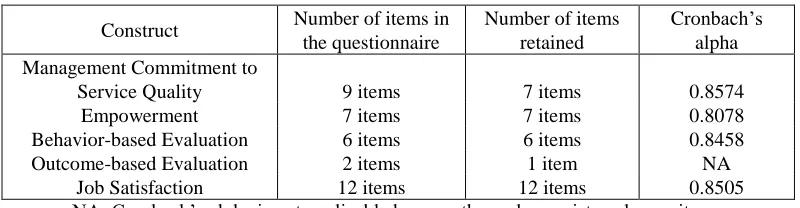
Cronbach’s alpha coefficients were computed to estimate the reliability of each scale (observed variable or indicator). Item to total correlation was used to refine the measures and eliminate items whose inclusion resulted in lower alpha coefficients. Items with item to total correlation coefficients less than 0.50 were eliminated. However, items with item to total correlation coefficients less than 0.50 were retained if eliminating those items would result in lower Cronbach’s alpha coefficient of the related scale (Hair, Anderson, Tatham, and Black, 1998). The Cronbach’s alpha of the measures is ranging from 0.7114 to 0.9167, which, according to DeVellis (1991), are respectable to very good. Table 1 shows the reliability of the measures.
Table 1: Reliability Coefficients (Cronbach’s Alpha) of the Constructs
Construct Number of items in
the questionnaire
Number of items retained
Cronbach’s alpha Management Commitment to
Service Quality 9 items 7 items 0.8574
Empowerment 7 items 7 items 0.8078
Behavior-based Evaluation 6 items 6 items 0.8458
Outcome-based Evaluation 2 items 1 item NA
Job Satisfaction 12 items 12 items 0.8505
Validity of Measures
After the scales had met the necessary levels of reliability, the scales were assessed for validity. Confirmatory factor analysis was used to assess the validity of each scale, which consisted of the retained items or manifest indicators. All loadings (path coefficients or regression weights) from a latent construct to their corresponding manifest indicators were significant (t statistic > 2). This provided evidence of convergent validity (Ramsey, 1998; Challagalla and Shervani, 1996; Sujan, Weitz, and Kumar, 1994).
This study also assessed the discriminant validity of the latent constructs. Discriminant validity is the degree to which two conceptually similar constructs are distinct. According to Anderson and Gerbing (1988), when the confidence interval, two standard errors, around a correlation estimate between two factors (constructs) does not include the value 1, it is evidence of discriminant validity for the two constructs. None of the confidence intervals in this study includes one.
Summed-scale Indicator
Because the final sample was small and retaining each item as an indicator of its construct would result in identification problem, this study combined the items measuring each construct into a single indicator measure (see Sujan, Weitz, and Kumar, 1994; Hartline and Ferrell, 1996). Factor score weights obtained from confirmatory factor analysis were used to create composite measures (indicators) of the corresponding latent constructs.
Construct Reliability ()
The composite reliability of each latent construct () measures the internal consistency of the construct indicators, depicting the degree to which they indicate the common
latent (unobserved) construct. High reliability of measures provides the researcher with greater confidence that the individual indicators consistently measure the same measurements (see Table 5.2). The threshold value for acceptable reliability is 0.70 (Hair, Anderson, Tatham, and Black, 1998).
Fixing the Error Terms and the Lambdas
Latent constructs of this study were measured by single indicators; however, in each case, the indicator was a multiple-item scale. It is unlikely that a single indicator perfectly measures a construct; therefore, this study estimated the measurement error terms. The measurement error terms were fixed at
(1-) 2 and the corresponding lambdas – the loading from a latent construct to its corresponding indicator – were fixed at 1/2 (Howell, 1987). However, outcome-based evaluation uses a single-item scale, hence the error term (theta epsilon or theta delta) has been fixed at 0.1 sx2 and its associated lambda
has been set at 0.95 sx (Anderson and Gerbing
1988).
Structural Model
Table 2: Reliability of the Constructs, Lambdas, Error Terms , Means, and
Standard Deviations of the Indicators
Composite Indicator of the Construct
Construct
Construct Reliability
()
Means
Mcsq Management Commitment to
Service Quality 0.8604 0.561 0.0510 3.6988 0.60521
Emp Empowerment 0.7970 0.322 0.0264 2.0754 0.36065
BheEval Behavior-based Evaluation 0.8501 0.543 0.0521 2.9204 0.58969
OutEval Outcome-based Evaluation*) NA 0.798 0.0688 2.3861 0.83076
Js Job Satisfaction 0.8500 0.342 0.0207 2.1800 0.37119
NA: construct reliability is not applicable because the construct has only one indicator *) Because the construct has one indicator then = 0.95sx and = 0.1sx
2
Table 3: Correlations among Composite Indicators *)
Composite
Indicator Emp BehEval OutEval Mcsq Js
Emp 1 .546 -.333 .740 .276
BehEval .546 1 -.237 .484 .257
OutEval -.333 -.237 1 -.307 -.231
Mcsq .740 .484 -.307 1 .353
Js .276 .257 -.231 .353 1
N 316 316 316 316 316
*) All correlations are significant at the 0.05 level (2-tailed).
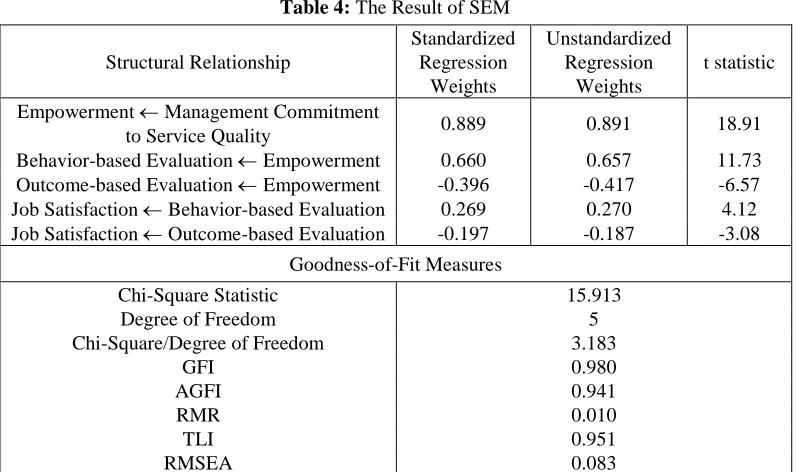
Table 4: The Result of SEM
Structural Relationship
Standardized Regression
Weights
Unstandardized Regression
Weights
t statistic
Empowerment Management Commitment
to Service Quality 0.889 0.891 18.91
Behavior-based Evaluation Empowerment 0.660 0.657 11.73
Outcome-based Evaluation Empowerment -0.396 -0.417 -6.57
Job Satisfaction Behavior-based Evaluation 0.269 0.270 4.12
Job Satisfaction Outcome-based Evaluation -0.197 -0.187 -3.08
Goodness-of-Fit Measures
Chi-Square Statistic 15.913
Degree of Freedom 5
Chi-Square/Degree of Freedom 3.183
GFI 0.980
AGFI 0.941
RMR 0.010
TLI 0.951
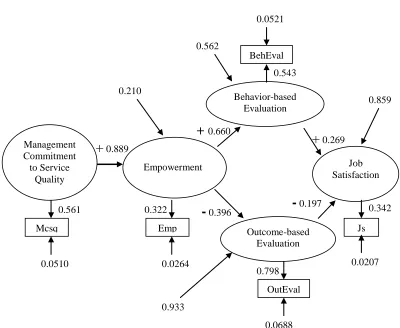
Figure 2: The Result of Two-step Approach to SEM
DISCUSSION
In the selling context, the concepts of relationship or relational exchange are built based on the idea of discrete transaction (Dwyer, Schurr, and Oh 1987). The archetype of discrete transaction is manifested by money on one side and an easily measured commodity on the other (MacNeil 1980). The concept of discrete transaction specifically excludes relational elements. Relational exchange is the departure from the anchor point of discreteness and transpires over time. The basis for future collaboration may be supported by implicit and explicit assumptions, trust, and planning. Participants of relational exchange can be expected to derive complex, personal, and
non-economic satisfaction. Hence, relational exchange leads to customer loyalty.
Managers who realize the benefit of relational exchange emphasize on service quality and empower its employees to ensure that the employees get the resources and support their need in order to be able to build quality relationships with customers. Managers that empower their salespersons emphasize on the effectiveness of its salespersons to recover from service failures, delight customers by exceeding their expectations, and increase their adaptability to changing conditions within the service encounter. Managers that empower their salespersons tend to use behavior-based evaluation; that is the managers allocate rewards based on how effectively employees Management
Commitment to Service
Quality
Empowerment
Outcome-based Evaluation
Job Satisfaction Behavior-based
Evaluation
+
0.889+ 0.660
-
0.197- 0.396
+
0.269Mcsq 0.561
0.0510
Emp 0.322
0.0264
OutEval
Js BehEval
0.543
0.342
0.798 0.0207
0.0688 0.0521
0.933 0.210
use information, knowledge, and power to improve service quality and the company’s financial performance. Behavior-based evalua-tion motivates salespersons in establishing long-term relationships with customers. On the other hand, outcome-based evaluation induces salespersons to emphasize on discrete transac-tions and ignore long-term relatransac-tionships.
Behavior-based evaluation appears to have a positive effect on job satisfaction, while outcome-based evaluation has a negative effect on job satisfaction. When managers employ behavior-based evaluation, salespersons tend to experience increased discretion and flexibility in performing their jobs. This make them feel better about their jobs, less stressful and more confident in performing their jobs. In behavior-based evaluation, a manager or a supervisor evaluates a salesperson based on her or his activity (e.g. commitment) and capability (e.g. ability to resolve service problems efficiently). Salespersons may be amenable to having performance of routine activities evaluated using behavior-based measures, because they are more controllable by the salespersons. On the other hand, they may be dissatisfied with evaluation based merely on output performance, especially when they have little control over output performance, as in selling life insurance products in Indonesia.
CONCLUSIONS AND RECOMMENDA-TIONS
This study examined a model that defines structural relationships among constructs that are relevant to management of customer-contact employees. The variables are management commitment to service quality, empowerment, behavior-based evaluation, outcome-based evaluation, and job satisfaction. Management commitment to service quality was seen to have positive effects on empowerment. In turn, empowerment was seen to emphasize more on using behavior-based evaluation and less on using outcome-based
evaluation. Behavior-based evaluation was found to have a positive effect on job satisfaction, while outcome-based evaluation was found to have a negative effect on job satisfaction.
A compensation system plays an important role in the motivation and control of sales-persons. In the development of a compensation plan, a manager has to choose whether he/she should put emphasis on salary or incentive compensation (outcome control system). Outcome control system provides a criterion for performance evaluations. However, the emphasis on incentive compensation (outcome control) may reduce the motivation to practice relational selling. Outcome control is also reactive. It does not provide mechanism for preventing mistakes. Further, outcome control can elicit myopic behavior, whereby sales-persons may pursue short-term targets and activities with immediate payoffs to the exclusion of long-term results, such as minimizing service on established accounts (Stathakopoulos 1996).
On the other hand, managers should be flexible in dealing with their salespersons. Managers should keep an open mind when listening to new or different approaches offered by salespersons. Keeping an open mind is crucial for the success of sales partnership (Jackson and Hisrich, 1996). In addition, in contrast to directing salespersons toward achieving goals, managers can help sales-persons direct themselves – setting their own goals and deciding how they will achieve these goals. This approach is particularly advan-tageous in the personal selling context where problems to be solved are not highly structured and subordinates have more information than their managers for solving the problems.
Regarding the implementation of empowerment, the study of Ann Howard (1996) revealed that although senior executives had a strong vision of the potential gains from empowerment, they were not taking actions that guarantee its implementation. These actions require sharing, information, know-ledge, power to act, and rewards throughout the workforce. Howard (1996) suggested actions of an empowering leader that can be applied in the personal selling management setting. First, the empowering leader should constantly seek new and better ways of accomplishing the work unit’s mission. Second, the leader’s goal is to inspire commitment and not to demand compliance. Third, the leader’s objective is to boost her subordinates’ confidence rather than judge their incompetence. Fourth, the empowering leader should offer a helping hand so that her subordinates can make their own decisions and manage their own responsibilities. Delegation is not enough; the leader must play a direct role in enabling her subordinates to handle tasks. Finally, the leader must bring needed information and materials into the group and build mutually supportive relationships with outsiders.
The results of the study suggest several directions for further research. Variables on
managerial orientation (management commit-ment to service quality, empowercommit-ment, and behavior-based evaluation) may be measured both from salespersons’ as well as managers’ perceptions. Managers may be requested to report on the initiatives they take; the resulting information may be compared with that provided by the salespersons under the managers’ supervision. Future studies may also investigate a dyadic interaction between a manager and a salesperson. This would serve to validate and/or confirm the salespersons’ perceptions regarding their managers’ managerial orientation.
REFERENCES
Abernathy, Margaret A. (1996), “Physicians and Resource Management: The Role of
Accounting and Non-Accounting
Controls,” Financial and Accountability Management, 12 (May), 141-156.
Ahmed, Irfan and A. Parasuraman (1994), “Environmental and Positional Antecedents of Management Commitment to Service Quality: A Conceptual Framework,” in Advances in Services Marketing and Management, Vol. 3, Teresa A. Swartz, David E. Bowen, and Stephen W. Brown, eds. Greenwich, Ct: JAI Press, 69-93.
Anderson, James C. and David W. Gerbing (1988), “Structural Equation Modeling in Practice: A Review and Recommended Two-step Approach,” Psychological Bulletin, Vol. 103, No. 3, 411-423.
Anderson, Erin and Richard L. Oliver (1987), “Perspective on Behavior-Based Versus Outcome-Based Salesforce Control Systems,” Journal of Marketing, 51 (October), 76-88.
Bowen, David E. and Edward E. Lawler III (1995), “Empowering Service Employees,” Sloan Management Review, (Summer), 73-84.
Bowen, David E. and Edward E. Lawler III (1992), “The Empowerment of Service Workers: What, Why, How, and When,” Sloan Management Review, 33 (Spring), 31-39.
Challagalla, Goutam N and Tasadduq A. Shervani (1996), “Dimensions and Types of Supervisory Control: Effects on
Salesperson Performance and
Satisfaction,” Journal of Marketing, 60 (January), 89-105.
Churchill, Gilbert A., Jr., N. Ford, S. Hartley, and O. Walker, Jr. (1985), “The Determinants of Salesperson Performance: A Meta-Analysis,” Journal of Marketing Research, 27 (May), 103-18.
Churchill, Gilbert A., Jr., N. Ford, and O. Walker, Jr. (1974), “Measuring the Job Satisfaction of Industrial Salesmen,” Journal of Marketing Research, 11 (August), 254-60.
Conger, Jay A. and Rabindra N. Kanungo (1998), “The Empowerment Process: Integrating Theory and Practice,” Academy of Management Review, 13 (July), 471-82.
DeVellis, Robert F. (1991), Scale Development, Newbury Park, California: Sage Publications
Dwyer, F. R., P. H. Schurr, and S. Oh (1987), “Developing Buyer-Seller Relationships,” Journal of Marketing, 51 (April), 11-27.
Garbarino, Ellen and Mark S. Johnson (1999), “The Different Roles of Satisfaction, Trust, and Commitment in Customer Relationships,” Journal of Marketing, 63 (April), 70-87.
George, William R. (1990), “Internal Marketing and Organizational Behavior: A Partnership in Developing
Customer-Conscious Employees at Every Level,” Journal of Business Research, 20 (January), 63-70.
Hair, Joseph F., Jr., Rolph E. Anderson, Ronald L. Tatham, and William C. Black (1998), Multivariate Data Analysis, 5th ed., New Jersey: Prentice-Hall, Inc.
Hartline, Michael D. and O. C. Ferrell (1996), “The Management of Customer-Contact Service Employees: An Empirical Investigation,” Journal of Marketing, 60 (October), 52-70.
Howard, Ann (1996), “The Empowering Leader: Unrealized Opportunity,” in Leading Organizations: Perspectives for New Era (1998), Gil Robinson Hickman), Editor, London: Sage Publications, Inc. Howell, Roy D. (1987), “Covariance Structure
Modeling and Measurement Issues: A Note on Interrelations among A Channel Entity’s Power Sources,” Journal of Mar-keting Research, 24 (February), 119-126.
Jackson, Ralph W. and Robert D. Hisrich (1996), Sales and Sales Management, New Jersey: Prentice-Hall, Inc.
Locke, Edwin A. and Gary P. Latham (1990), “Work Motivation and Satisfaction: Light at the End of the Tunnel,” Psychological Science, 1 (July), 240-46.
Loh, Lawrence, Chetan S. Shankar, and Wee Yong Yeong (1995), “Job Orientation, Perceptions, and Satisfaction – A Study of Information Technology Professionals in Singapore,” Information and Management, 29 (November), 240-250.
MacNeil, Ian R. (1980), The New Social Contract: An Inquiry into Modern Contractual Obligations, New Haven: Yale University Press.
Mohr-Jackson, Iris (1993), “Comparing Total Quality with Market Orientation: An In-depth Interview Approach” in AMA Winter
Educators’ Conference Proceedings,
Rajan Varadarajan and Bernard Jaworski, eds., Chicago: American Marketing Association, 427-32.
Mueller, Ralph O. (1996), Basic Principles of Structural Equation Modeling: An Introduction to LISREL and EQS, New York: Springer-Verlag New York Inc.
Oliver, Richard L. and Erin Anderson (1994), “An Empirical Test of the Consequences of Behavior and Outcome-Based Sales Control Systems,” Journal of Marketing, 58 (October), 53-67.
Ramaswarni, Sridhar N. (1996), “Marketing Control and Dysfunctional Employee Behaviors: A Test of Traditional and Contingency Theory Postulates,” Journal of Marketing, 58 (April), 105-120.
Reardon, Kathleen K. and Ben Enis (1990), “Establishing A Company-Wide Customer Orientation Through Persuasive Internal Marketing,” Management Communication Quarterly, 3 (February), 376-87.
Reeves, Carol and Frank Hoy (1993), “Employee Perceptions of Management Commitment and Customer Evaluations of Quality Service in Independent Firms,” Journal of Small Business Management, (October), 52-59.
Schneider, Benjamin (1980), “The Service Organization: Climate is Crucial,” Organi-zational Dynamics, (Autumn), 52-65.
Settoon, Randall P., Nathan Bennett, and Robert C. Liden (1996), “Social Exchange in Organizations: Perceived Organizatio-nal Support, Leader-Member Exchange, and Employee Reciprocity,” Journal of Applied Psychology, Vol. 81, No.3, 219-227.
Shoop, T. (1991), “Uphill Climb to Quality,” Government Executive, (March), 17-19.
Siguaw, Judy A, Gene Brown, and Robert E. Widing, II (1994), “The Influence of The Market Orientation of the Firm on Sales Force Behavior and Attitude,” Journal of Marketing Research, Vol. 31 (February), 106-16.
Stathakopoulos, Vlasis (1996), “Sales Force Control: A Synthesis of Three Theories,” Journal of Personal Selling and Sales Management, Vol. XVI, 2 (Spring), 1-12.
Sujan, Harish, Barton A. Weitz, and Nirmalya Kumar (1994), “Learning Orientation, Working Smart, and Effective Selling,” Journal of Marketing, July, 39-52.
Wall, Stephen J. and S. Charles Zeynel (1991), “The Senior Manager’s Role in Quality Improvement,” Quality P rogress, 24 (January), 66-68.
Weatherly, Kristopher A. and David A. Tansik (1993), “Managing Multiple demands: A Role-Theory Examination of the Behaviors of Customer Contact Sevice Workers,” in Advances in Services Marketing and Management, Vol 2,
Webster’s Third New International Dictionary
of the English Language: Unabridge (1986), Philip Babock and The Miriam-Webster Editorial Staff, eds., Springfield, Massachusetts, USA.
Weitz, Barton A., Harish Sujan, and Mita Sujan (1986), “Knowledge, Motivation, and Adaptive Behavior: A framework for Improving Sales Effectiveness,” Journal of Marketing, 50 (October), 174-91.
Wright, Patrick M. and Raymond A. Noe (1996), Management of Oragnizations, Richard D. Irwin.