RESEARCH DESIGN
Qualitative, Quantitative, and mixed
methods approaches
SECOND EDITION
Brief Contents
Preface xix
Acknowledgment xxvi
Part 1: Preliminary Considerations 1
1. A Framework for Design 3
2. Review of the Literature 27
3. Writing Strategies and Ethical Considerations 49
Part II. Designing Research 7 1 4. The introduction 73
5. The purpose Statement 87
6. Research questions and Hypotheses 105
7. The use of Theory 119
8. Definitions, Limitations, and Significance 142
9. Quantitative methods 153
10. Qualitative Procedures 179
11. Mixed Method Procedures 208
Reference 228
Author index 237
Subject index 240
CHAPTER ONE
A Framework
For design
In the past two decades, research approaches have multiplied to a point
at which investigatory or inquires have many choices. For those
designing a proposal or plan, I recommend that a general framework be adopted to provide guidance about all facets of the study, from assessing
the general philosophical ideas being the inquiry to the detailed data
collection and analysis procedures. Using an extant framework also
allows researchers to lodge their plans in ideas well grouped in the literature and recognized by audiences (e.g., faculty committee) that read
and support proposals for research.
What frameworks exist for designing a proposal. Although different
types and terms abound in the literature, I will focus on three: quantitative, qualitative, and mixed methods approaches. The first has
been available to the social and human scientist for years, the second
has emerged primarily during the last three or four decades, and the
lasts is new and still developing in form and substance.
This chapter introduces the reader o the three approaches to
research, I suggest that to understand them, the proposal developer
needs to consider three framework elements: philosophical assumptions about what constitutes knowledge claims; general procedures of research
called strategies of inquiry, and detailed procedures of data collection,
analysis, and writing, called methods. Qualitative, quantitative, and
mixed methods approaches frame each of these elements differently, and these differences are identified and discussed in this chapter. Then
typical scenarios that combine he three elements are advanced, followed
designing a study. This discussion will not be a philosophical treatise on
the nature of knowledge, but it will provide a practical g rounding in
some of the philosophical ideas behind research.
THREE ELEMENTS OF INQUIRY
In the first edition of this book, I used two approaches – qualitative and quantitative. I described each in terms of different philosophical
assumptions about the nature of reality, epistemology, values, the
rhetoric of research, and methodology (Creswell, 1994). Several
development in the last decade have caused a reexamination of this stance.
• Mixed methods research has come of age. To include only quantitative and qualitative methods falls short of the major
approaches being used today in the social and human sciences. • Other philosophical assumptions beyond those advanced in 1994
have been widely discussed in the literature. Most notably, critical
perspectives, advocacy/participatory perspectives, and pragmatic
ideas (e.g., see Lincoln and Guba, 2000; Tashakkori and Taddile, 1998) are being extensively discussed. Although philosophical
ideas remain largely “hidden” in research (Slife and Williams,
1995), they still influence the practice of research and need to be
identified.
• The situation today is less quantitative versus qualitative and more how research practices lie some where on a continuum between
the tow (e.g., Newman and Benz, 1998). The best that can be said is that studies tend to be more quantitative or qualitative in
nature. Thus later in the chapter I introduce typical scenarios of
• Finally, the practice of research (such as writing a proposal) involves much more than philosophical assumptions. Philosophical
ideas must be combined with broad approaches to research (Strategies) and implemented with specific procedure (methods).
Thus, a framework is needed that combines the elements of
philosophical ideas, strategies, and method into the three
approaches to research.
Crotty’s (1998) ideas established the ground work for this frame work. He
suggested that in designing a research proposal, we consider four
questions:
1. What epistemology --- theory of knowledge embedded in the theoretical perspective --- informs the research (e.g., objectivism,
subjectivism, etc.)?
2. What theoretical perspective –-- philosophical stance-lies behind the methodology in questions (e.g., objectivism, subjectivism. etc)?
3. What methodology --- strategy or plan of action that links methods
to outcomes --- governs our choice and use of methods) e.g.,
experimental research, survey research, ethnography, etc.)?
4. What methods --- techniques and procedures --- do we propose to
use (e.g., questionnaire, interview, focus group, etc).
These four questions show the interrelated levels of decisions that go into the process of designing research. Moreover, these are aspects that
inform a choice of approach, ranging from the broad assumptions that
are brought to a project to the more practical decisions made about how
to collect and analyze data.
With these ideas in mind, I conceptualized Crotty’s model to
address three questions central to the design of research:
1. What knowledge claims are being made by the researcher
(including a theoretical perspective)?
3. What methods of data collection and analysis will be used?
Next, I drew a picture, as shown in Figure 1.1. This display how three
elements of inquiry (i.e., knowledge claims, strategies, and methods) combine to form different approaches to research. These approaches, in
turn, are translated into processes in the design of research. Preliminary
steps in designing a research proposal, then, are to assess the knowledge
claims brought to the study, to consider the strategy of inquiry that will be used, and to identify specific methods. Using these three elements, a
researcher can then identify either the quantitative, qualitative, or mined
methods approach to inquiry.
Alternative knowledge Claims
Setting a knowledge claim means that researchers start a project with certain assumptions about how they will learn and what they will learn
during their inquiry. These claims might be called paradigms (Lincoln
and Guba, 2000; Martens, 1998); or broadly conceived research
methodologies (Neuman, 2000). Philosophically, researchers make claims about what is knowledge (ontology), how we know it (epistemology), what
values go into it (axiology), how we write about it (rhetoric), and the
processes for studying it (methodology) (Creswell, 1994). Four schools of
thought about knowledge claims will be discussed: post positivism, constructivism, advocacy participatory, and pragmatism. The major
elements of each position are presented in Table 1.1. In discussions to
follow, I will attempt to translate the broad philosophical ideas of these
positions into practice.
Traditionally, the psotpositvist assumptions have governed claims about
what warrants knowledge. This position is sometimes called the
“scientific method” or doing “science” research. It is also called quantitative research, positivist/postpositivist research, empirical
science, and postpostivism. The last term, “postpositivism,” refers to the
thinking after positivism, challenging the traditional notion of the
absolute truth of knowledge (Phiillips and Burbules, 2000) and recognizing that we cannot be “positive” about our claims of knowledge
when studying the behavior and actions of humans. The postpositive
tradition comes from 19th century writers such as Comte, mil, Durkheim,
Newton, and Locke (Smith, 1983), and it has been most recently
articulated by writers such as Phillips and Burbules (2000).
Postpositivism reflects ad deterministic philosophy in which causes
probably determine effects or outcomes. Thus, the problems studied by psotpositivits reflect a need to examine causes that influence outcomes,
such as issues examined in experiments. It is also reductionistic in that
the intent is to reduce he ideas into a small, discrete set of ides to test, such as the variable that constitute hypotheses and research questions.
The knowledge that develops through a postpositivist lens is based on
careful observation and measurement of the objective reality that exists
“out there” in the world. Thus, developing numeric measures of observations and studying the behavior of individual become paramount
for a psotpositviist. Finally, there are laws or theories that govern the
world, and these need to be tested or verified and refined so that we can
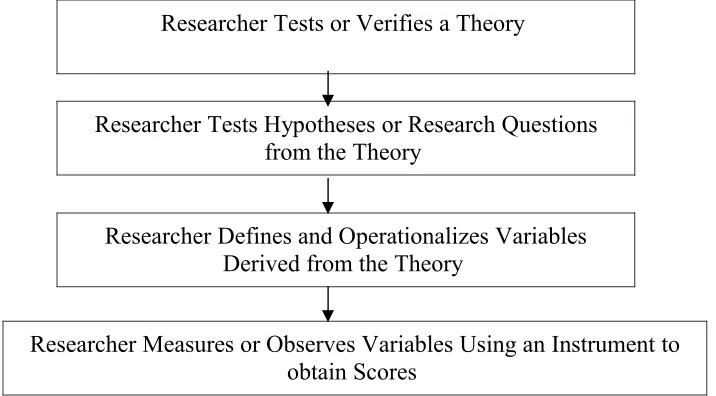
understand the world. Thus, in the scientific method – the accepted approach to research by psotpostivists- an individual begins with a
theory, collects data that either supports or refutes the theory, and then
makes necessary revisions before additional tests are conducted.
1. That knowledge is conjectural (an anti-foundational)- absolute
truth can never be found. Thus, evidence established in research is
always imperfect and fallible. It is for this reason that researchers do not proved hypotheses and it stead indicate a failure to reject.
2. Research is the process of making claims and then refining or
abandoning some of them for other claims more strongly war
ranted. Most quantitative research, for example, starts with the test of a theory.
3. Data, evidence, and rational considerations shape knowledge. In
practice, the researcher collects information on instruments based on measures completed by the participants or by observations
recorded by the researcher.
4. Research seeks to develop relevant true statements, ones that can
serve to explain the situation that is of concern or that descries the causal relationships of interest. In quantitative studies,
researchers advance the relationship among variables and pose
this in terms of questions or hypotheses.
5. Being objective is an essential aspect of competent inquiry, and for
this reason researchers must examine methods and conclusions
for bias. For example, standards of validity and reliability are
important in quantitative research.
Socially Constructed knowledge claims
Others claim knowledge through an alternative process and set of
assumptions. Social constructivism (often combined with itnerpetivism;
se Mertens, 1998) in such a perspective. The ideas came from Mannheim and from works such as Berger and Luckmann’s The Social construction
of Reality (1967) and Lincoln and Guba’s Naturalistic Inquiry (1985).
among others. Assumptions identified in these works hold that
individuals seek understanding of the world in which they live and work.
They develop subjective meanings of their experiences-meanings directed toward certain objects or things. These meanings are varied and
multiple, leading the researcher to look for the complexity of views rather
than narrowing meanings into a few categories or ideas. The goal of
research, then, is to rely as much as possible on the participants views of the situation being studied. The questions become broad and general so
hat the participants can construct the meaning of a situation, a meaning
typically forged in discussions or interactions with other persons. The more open-ended he questioning, the better, as the researcher listens
carefully to what people say or do in their life setting. Often these
subjective meanings are negotiated socially and historically. In other
words, they are not simply imprinted on individuals but are formed through interaction with others (hence social constructivism) and
through historical and cultural norms that operate in individuals’ lives.
Thus, constructivist researchers often address the “process” of interaction among individuals. They also focus on the specific contexts in
which people live and work in order to understand the historical and
cultural settings of the participants. Researchers recognize that their
own background shapes their interpretation, and they “position themselves” in the research to acknowledge how their interpretation
flows from their own personal, cultural, and historical experiences. The
researcher’s intent, then, is to make sense of (or interpret) the meanings
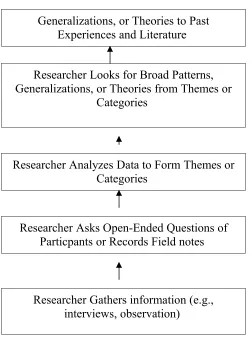
others have about the world. Rather than starting with a theory (as in postpostivism) inquirers generate or inductively develop a theory or
pattern of meaning.
For example, in discussing constructivism Crotty (1998) identified
1. Meanings are constructed by human beings as they engage with
the world they are interpreting. Qualitative researchers tend to use
open-ended questions so that participants can express their views. 2. Humans engage with their world and make sense of it based on
their historical and social perspective-we are all born into a world
of meaning bestowed upon us by our culture. Thus, qualitative
researchers seek to understand the context or setting of the participants through visiting this context and gathering
information personally. They also make an interpretation of what
they find, an interpretation shaped by the researchers’ own experiences and backgrounds.
3. The basic generation of meaning is always social, arising in and
out of interaction with a human community. The process of
qualitative research is largely inductive, with the inquire generating meaning from the data collected in the field.
Advocacy/participatory knowledge claims
Another group of researchers claims knowledge through an advocacy/participatory approach. This position arose during the 1980s
and 1990s from individuals who felt that the psotpostivist assumptions
imposed structural laws and theories that did not fit marginalized
individuals or groups or did not adequately address issues of social justice, historically, some of the advocacy/participatory (or emacipatory)
writers have drawn on the works of Marx, Adorno, Marcuse, Habermas,
and Freire (Neuman, 2000). More recently, works by Fay (1987), Heron
and Reason (1997), and Kemmis and Wilkinson (1998) can be read for this perspective. In the main, these inquires felt that the constructivist
stance did not go far enough in advocating for an action agenda to help
should contain an action agenda for reform that may change the lies of
the participants, the institutions in which individuals work or live, and
the researcher's life. Moreover, specific issues needed to be addressed that speak to important social issues of the day, issues such as
empowerment, inequality, oppression, domination, suppression, and
alienation. The advocacy researcher often begins with one of these issues
as the focal point of research. This research also assumes that the inquirer will proceed collaboratively so as to not further marginalize the
participants as a result of the inquiry. In this sense, the participants may
help design questions, collect data, analyze information, or receive rewards for participating in the research. The "voice" for the participants
becomes a united voice for reform and change. This advocacy may mean
providing a voice for these participants, raising their consciousness, or
advancing an agenda for change to improve the lives of the participants. With these knowledge claims are stances for groups and
individuals in society that may be marginalized or disenfranchised.
Therefore, theoretical perspectives may be integrated with the philosophical assumptions that construct a picture of the issues being
examined to the people to be studied, and the changes that are needed.
Some of these theoretical perspectives are listed blow.
• Feminist perspectives center and make problematic women's diverse situations and the institutions that frame those situations.
Research topics may include policy issues related to realizing
social justice for women in specific contexts or knowledge about
oppressive situations for women (Olesen, 200).
• Racialized discourses raise important questions about5 the control and production of knowledge, particularly knowledge about people
• Critical theory perspectives are concerned with empowering human beings to transcend the constraints placed on them by race, class,
and gender (Fay, 1987).
• Queer theory focuses on individuals calling themselves lesbians, gay, bisexuals, or transgender people. The research can be less
objectifying, can be more concerned with cultural and political
means, and can convey the voices and experiences of individuals who have been suppressed (Gamson, 2000).
• Disability inquiry addresses the meaning of inclusion in schools and encompasses administrators, teachers, and parents who have
children with disabilities (Mertens, 1998).
These are diverse groups and topics, and my summaries here are
inad3equate generalizations. It is helpful to view the summary by
Kemmis and Wilkinson (1998) of key features of the advocacy or
participatory forms of inquiry:
1. Participatory action is recursive or dialectical and is focused on
brining about change in practices. Thus, at the end of
advocacy/participatory studies, researchers advance an action agenda for change.
2. It is focused on helping individuals free themselves form
constraints found in the media, in language, in work procedures.
and in the relationships of power in educational settings. Advocacy/participatory studies often being with an important
issue or stance about the problems in society, such as the need for
empowerment.
3. It is emancipator in that it helps unshackle people form the
constraints of irrational and unjust structures that limit self
development and self-determination. The aim of
4. It is practical and collaborative because it is inquiry completed
"with" other rather than "on" or "to" others. In this spirit,
advocacy/participatory authors engage the participants as active collaborators in their inquires.
Pragmatic Knowledge claims
Another position about claims on knowledge comes form the
pragmatist. Pragmatism derives form the work of Peirce, James, Mead, and Dewey (Cherryholmes, 1992). Recent writers include Rorty (1990).
Murphy (1990), Patton (1990), and cherrholmes (1992). there are many
forms of pragmatism. For many of them, knowledge claims arise out of actions, situations, and consequences rather than antecedent conditions
(as in post positivism).there is a concern with applications-"what works" -
and solutions to problems (Patton, 1990). Instead of methods being
imp0rotant, the problem is most important, and researchers use all approaches to understand the problem, (see Rossman and Wilson, 1985).
As a philosophical underpinning for mixed methods studies, Tashakkori
and Teddlie (1998) and Patton (19990) convey the importance for focusing attention on the research problem is social science research and
then using pluraistick approaches to derive knowledge about the
problem. According to Cherrholmes (1992), Murphy (1990), and my own
9nterpretaions of these writers, pragmatism provides a basis for the following knowledge claims:
1. Pragmatism is not committed to any one system of philosophy and
reality. This applies to mixed methods research in that
assumptions when they engage in their research.
2. Individual researchers have a freedom of choice. They are " free" to
choose the methods, techniques, and procedures of research that
best meet their needs and purposes.
collecting and analyzing data rather than subscribing to only one
way (e.g. quantitative or qualitative).
4. Truth is what works at the time: it is not based in a strict dualism between the mind and reality completely independent of the mind.
Thus, in mixed methods research, investigators use both
quantitative and qualitative data because they work to provide the
best understanding of a research problem.
5. Pragmatist researchers look to the "what" and "how" to research
based on its intended consequences---where they want to go with
it. Mixed methods researchers need to establish a purpose for their "mixing," a rational for the reasons why quantitative and
qualitative data need to be mixed in the first place.
6. Pragmatists agree that research always occurs in social, historical,
political, and other contexts. In this way, mixed methods studies may include a postmodern turn, a theoretical lens that is reflexive
of social justice and political aims.
7. Pragmatists belives (Cherrolmes, 1992) that we need to stop asking questions about reality and the laws of nature. "they would simply
like to change the subject" (Rorty, 1983, P. xiv)
Thus, for the mixed methods researcher, pragmatism opens the door to
multiple methods, different worldviews, and different assumptions, as well as to different forms of data collection and analysis in the mixed
methods study.
Strategies of Inquiry
The researcher brings to the choice of a research design assumptions
about knowledge claims. In additions, operating at a more applied level are strategies of inquiry (or traditions of inquiry, Creswell, 1998; or
methodologies, Mertens, 1998) that provide specific direction for
data analysis and the ability to analyze complex models, and as
individuals have articulated new procedures for conducting social
science research. These strategies of inquiry contribute to our overall research approach
The major strategies employed in the social sciences are discussed in
chapters 9, 10, and 11 of this book. Rather than cover all or a large
number of strategies, these chapter focus on those frequently used in the social sciences. Here I will introduce those that will be discussed later
and that are cited in examples of research throughout the book. An
overview of these strategies is shown in Table 1.2.
Strategies Associated with the quantitative Approach
During the late 19th century and throughout the 20th, strategies of
inquiry associated with quantitative research were those that invoked the
post positivist perspectives. These include the true experiments and the less rigorous experiments called quasi-experiments and correlation
studies (Campbell and stanley, 1963), and specific single-subject
experiments (cooper, Heron, and Heward, 1987: Neuman and Mc McCormick, 1995). More recently, quantitative strategies involved
complex experiments with may variables and treatments (e.g. factorial
designs and repeated measure designs). They also included elaborate
structural equation models that incorporated causal paths and the identification of the collective strength of multiple variables. In this book,
we will focus on two strategies of inquiry: experiments and surveys.
• Experiments include true experiments, with the random assignment of subjects to treatment conditions, as well as quasi-experiments that use nonrandomized designs (Keppel, 1991).
Included within quasi-experiments are single-subject designs.
the intent of generalizing from a sample to a population (Babbie,
1990)
Strategies Associated with the Qualitative Approach
In qualitative research, the numbers and types of approaches also
become more clearly visible during the 1990s. Books have summarized
the various types (such as the 19 strategies identified by Wolcott, 2001).
And complete procedures are now available anon specific qualitative inquiry approaches. For example, clandinin and Connelly (2000) have
constructed a picture of what "narrative researchers do," Moustakas
(1994) discussed the philosophical tents and the procedures of the phenomenological method, and Strauss and Corbin (1990, 1998) have
explicated the procedures of grounded theory. Wolcott (1999) has
summarized ethnographic procedures, and Stake (19950 has identified
the processes of case study research. In this book, illustrations will be drawn from the following strategies:
• Ethnographies, in which the researcher studies an intact cultural group in a natural setting over a prolonged period of time by
collecting, primarily, observational data (Creswell, 1998). The research process is flexible and typically evolves contextually in
response to the lived realties encountered in the field setting
( Lecompte and Schensul, 1999).
• Grounded theory, in which the researcher attempts to derive a general, abstract theory of a process, action, or interaction
grounded in the views of participants in a study. This process
involves using multiple stages of data collection and the refinement and interrelationship of categories of information (Strauss and
Corbin, 1990, 1998). Two primary characteristics of this design are
the constant comparison of data with emerging categories and
• Case studies, in which the researcher explores in depth a program, and event, and activity, a process, or one or more individuals. The
case (s) are bounded by time and activity, and researchers collect detailed information using a variety of data collection procedures
over a sustained period of time (Stake, 1995).
• Phenomenological research, in which the researcher identifies the "essence" of human experiences concerning a phenomenon, as described by participants in a study. Understanding the "lived
experiences" marks phenomenology as a philosophy as well as a
method, and the procedure involves studying a small number of
subjects through extensive and prolonged engagement to develop patterns and relationships of meaning (Moustaas, 1994). In this
process, the researcher "brackets" this or her own experiences in
order to understand those of the participants in the study ( Nieswiadomy, 1993.
• Narrative research, a form of inquiry in which the researcher studies the lives of individuals and asks one or more individuals to
provide stories about their4 lives. This information is then retold or restoried by the researcher into a narrative chronology. In the end,
the narrative combines views form the participant's life with those
of the researcher's life in a collaborative narrative (clandinin and
Connelly, 2000).
Strategies Associated with the Mixed Methods Approach
Less well known than either the quantitative or qualitative strategies are
those that involve collecting and analyzing both forms of data n a single
study. The concept of mixing different methods probably originated in 1959, when Campbell and Fiske used multiple methods to study validity
of psychological traits. They encouraged other to employ their "multi
study. This prompted others to mix methods, and soon approaches
associated with field methods such as observations and interviews
( qualitative data) were combined with traditional surveys 9quantiative data) (S.D. Sieber, 1973). Recognizing that all methods have limitations,
researchers felt that biases inherent in any single method could
neutralize or cancel the biases of other methods. Triangulating data
sources-a means for seeking convergence a cross qualitative and quantitative methods -were born (Jack, 1979). From the original concept
of triangulation emerged additional reasons for mixing different types of
data. For example, the results form one method can help develop or ifnrom the other method (Green, Caracelli, and Graham, 1989).
Alternatively, one method can be nested within another method to
provide insight into different levels or units of analysis (Tashakkori and
Teddlie, 1989). Or the methods can serve a larger, transformative purpose to change and advocate for marginalized groups, such as
women, ethnic/racial minorities, members of gay and lesbian
communities people with disabilities, and those who are poor (Mertens, 2003).
These reasons for mixing methods have led writers from around the
world to develop procedures for mixed methods strategies of inquiry and
to take he numerous terms found in the literature, such as multi method, convergence, integrated, and combine (Creswell, 1994) and
shape procedures for research (Tashakkori and Teddle, 2003).
In particular, there general strategies and several variations within
them will be illustrated in this book:
• Sequential procedures, in which the researcher seeks to elaborate on or expand the findings of one method with another method.
This may involve beginning with a qualitative method for
a population. Alternatively, the study may begin with a
quantitative method in which theories or concepts are tested, to be
followed by a qualitative method involving detailed exploration with a few cases or individuals.
• Concurrent procedures, in which the researcher converges quantitative and qualitative data in order to provide a
comprehensive analysis of the research problem. In this design, the investigator collects both forms of data at the same time during
the study and then integrates the information in the interpretation
of the overall results. Also, in this design, the researcher nests one
form of data within another, larger data collection procedure in order to analyze different questions or levels or units in an
organization.
• Transformative procedures, in which the researcher uses a theoretical lens (see chapter 7) as an overarching perspectives
within a design that contains both quantitative an qualitative data.
This lens profiles a framework for topics of interest, methods for
collecting data, and outcomes or changes anticipated by the study. Within this lens could be a data collection method that involves a
sequential or a concurrent approach.
Research Methods
The third major element that goes into a research approach is the
specific methods of data collection and analysis. As shown in Table 1.3,
it is useful to consider the full range of possibilities for data collection in any study, and to organize these methods by their degree of
predetermined nature, their use of closed-ended versus open-ended
analysis. These method will be developed further in Chapters 9 through
11 as quantitative, qualitative, and mixed methods.
Researchers collect data on an instrument or test (e.g., a set of questions bout attitudes toward self-esteem) or gather information on a
behavioral checklist (e.g., where researchers observe a worker engaged in
using a complex skill). On the other end of the continuum, it might
involve visiting a research site and observing the behavior of individuals without predetermined questions or conducting an interview in which the
individual is allowed to talk openly about a topic largely without the use
of specific question. The choice of methods by a researcher turns on whether the intent is to specify the type of information to be collected in
advance of the study or to allow it to emerge from participants in the
project. Also, the type of data may be numeric information gathered on
scales of instruments or more text information, recording and reporting the voice of the participants. In some forms of data collection, both
quantitative and qualitative data are collected. Instrument data may be
augmented with open-ended observations, or census data may be followed by in-depth exploratory interviews.
THREE APPROACHES TO RESEARCH
The knowledge claims, the strategies, and the method all contribute to a research approach that tends to be more quantitative, qualitative or
mixed. Table 1.4 creates distinction that may be useful in choosing an
approach for a proposal. This table also includes practices of all three
approaches that will be emphasized in the remaining chapters of this book.
• A quantitative approach is one in which the investigatory primarily uses postpositive claims for developing knowledge (i.e., cause and
effect thinking, reduction to specific variables and hypotheses and questions, use of measurement and observation, and the test of
the ories), employs strategies of inquiry such as experiments and
surveys, and collect data on predetermined instruments that yield
statistics data.
• Alternatively, a qualitative approach is one in which the inquirer often makes knowledge claims based primarily on constructivist
perspectives (i.e., the multiple meanings of individual experiences
meanings socially and historically constructed, with an intent of developing a theory or pattern) or advocacy/participatory
perspectives (i.e., political, issue-oriented, collaborative, or change
oriented) or both. It also sues strategies of inquiry such as narratives, phenomenologies, ethnographies, grounded theory
studies, or case studies. The researcher collect open-ended,
emerging data with the primary intent of developing themes from
the data.
• Finally, a mixed methods approach is one in which the researcher tends to base knowledge claims on pragmatic grounds (e.g.,
consequence-oriented, problem-centered, and pluralistic). It
employs strategies of inquiry that involve collecting data either simultaneously or sequentially to best understand research
problem. The data collection also involves gathering both numeric
information (e.g., on instruments) as well as text information (e.g., on interviews) so that the final database represents both
quantitative and qualitative information.
To see how these three elements (knowledge claims, strategies, and
• Quantitative approach: postpositive knowledge claims, experimental strategy of inquiry, and pre-and posttest measures of
attitudes.
In this scenario, the researcher tests a theory by specifying narrow
hypotheses and the collection of data to support or refute the
hypotheses. An experimental design is used in which attitudes are
assessed both before and after an experimental treatment. The data are collected on an instrument that measures attitudes, and he
information collected is analyzed using statistical procedures and
hypothesis testing.
• Qualitative approach: constructivist knowledge claims, ethnographic design, and observation of behavior.
In this situation the researcher seeks to establish the meaning of a
phenomenon from the view of participants. This means identifying a culture-sharing group and studying how it developed shared patterns of
behavior over time (i.e., ethnography). One of the key elements of
collecting data is to observe participants’ behaviors by participating in
their activities.
• Qualitative approach: participatory knowledge claims, narrative design, and open-ended interviewing.
For this study, the inquirer seeks to examine an issue related to
oppression of individuals. To study this, the approach is taken of collecting stories of individuals oppression using a narrative approach.
Individuals are interviewed at some length to determine how they have
personally experienced oppression.
• Mixed methods approach: pragmatic knowledge claims, collection of both quantitative and qualitative data sequentially.
The researcher bases the inquiry on the assumption that collecting
results to a population and then focuses, in a second phase, on detailed
qualitative, open-ended interviews to collect detailed views from
participants.
CRITERIA FOR SELECTING AN APPROACH
Given these three approaches, what factors affect a choice of one approach over another for the design of a proposal? Thee considerations
play into this decision: the research problem the personal experiences of
the researcher, an the audience (s) for whom the report will be written.
Match Between Problem and Approach
Certain types of social research problems call for specific approaches. A
research problem, as discussed in Chapter 4, is an issue or concern that needs to be addressed (e.g., whether one type of intervention works
better than another type of intervention). For example, if the problem
better than another type of intervention). Fro example, if the problem
is identifying factors that influence an outcome, the utility of an intervention, or understanding the best predictors in outcomes, then a
quantitative approach is best. It is also the best approach to sue o test a
theory or explanation. On the other hand, if a concept or phenomenon
needs to be understood because little research has been done on it, then it merits a qualitative approach. Qualitative research is exploratory and
is useful when the researcher does not know the important variable to
examine. This type of approach may be needed because the topic is new, the topic has never been addressed with a certain sample or group of
people, or existing theories do not apply with the particular sample or
A mixed methods design is useful to capture the best of both
quantitative and qualitative approaches. Fro example, a researcher may
want to both generalize the findings to a population and develop a detailed view of the meaning of a phenomenon or concept for individuals.
In this research, the inquirer first explores generally to learn about what
variables to study and then studies hose variables with a large sample of
individuals. Alternatively, researchers may first survey a large number of individuals, then follow up with a few of them to obtain their specific
language and voices about the topic. In these situations the advantages
of collecting both closed-ended quantitative data and open-ended qualitative data prove advantageous to best understand a research
problem.
Personal Experiences
Into this mix of choice also comes the researcher’s own personal
training and experiences. An individual trained in technical, scientific
writing, statistics, and computer statistical programs who is also familiar
with quantitative journals in the library would most likely choose the quantitative design. The qualitative approach incorporates much more of
a literary form of writing, computer text analysis programs, and
experience in conducting open-ended interviews and observations.
The mixed methods researcher needs to be familiar with both quantitative and qualitative research. This personals needs un
understanding of the rationales for combining both forms of data so that
they can be articulated in a proposal. The mixed methods approach also
requires knowledge about the different mixed methods designs that help organize procedures for a study.
Because quantitative studies are the traditional mode of research,
systematic procedures of quantitative research. Also, for some
individuals, it can be uncomfortable to challenge accepted approaches
among some faculty by using qualitative and advocacy/participatory approaches to inquiry. On the other hand, qualitative approaches allow
room to be innovative and to work more within researcher-designed
frameworks. They allow more creative, literary-style writing, a form that
individuals may like to use. For advocacy/participatory writers, there is undoubtedly a strong personal stimulus to pursue topics that are of
personal interest- issues that relate to marginalized people and an
interest in creating a better society for them and everyone.
For the mixed methods researcher, a project will take extra
time because of the need to collect and analyze both quantitative
research and the flexibility of qualitative inquiry.
Audience
Finally, researchers are sensitive to audiences to whom they report their research. These audiences m be journal editors, journal readers,
graduate committees, conference attendees, or colleagues in the field.
Students should consider the approaches typically supported and used
by their advisers. The experiences of these audiences with quantitative, qualitative, or mixed methods studies will shape the decision made about
this choice.
Summary
One preliminary consideration before designing a proposal is to identify a
framew2ork for the study. Three approaches to research are discussed in
this chapter: quantitative, qualitative, and mixed methods research. They
contain philosophical assumptions about knowledge claims, strategies of inquiry, and specific research methods. When philosophy, strategies, and
methods are combined, they provide different frameworks for conducting
problem, personal experiences, and the audiences for whom one seeks to
write.
Additional Readings
Cherry Holmes, C.H. (1992). Notes on pragmatism and scientific
realism. Educational researcher,14 August-September, 13-17
Cleo cherry Holmes contrasts pragmatism with traditional
scientific research. The strengths of this article are the numerous citations to writers about pragmatism and a clarification of the
alternative versions of pragmatism. Cherry Holmes clarifies his own
stance by indicating that pragmatism is driven by anticipated
consequences, a reluctance to tell a true story, and the idea that there is an external world independent of our minds.
Crotty, M. (1998). The foundations of social research: meaning and
perspective in the research process. London: Sage.
Michale cortty offers a useful framework for tying together the many epistemological issues theoretical perspectives, methodology, and
methods of social research. He interrelates the four components of the
research process and shows in Table 1 a representative sampling of
topics of each component. He then goes on to discuss nine different theoretical orientation in social research, such as postmodernism,
feminism, critical inquiry, interpretivism, constructions and positivism.
Kemmis, S., And Wilkinson, M. (1998). Participatory aciton
researcha nd the study of practice. In B. Atweh, S. Kemmis, and P.
Weeks (Eds.) , Action research in practice: partnerships for social
justice in education (pp. 21-36). New York: Routledge.
Stephen kemmis and Mervyn Wilkinson provide an excellent overview of participatory research. In particular, they note the six major features of
this inquiry approach and then discuss how action research is practiced
Lincoln, Y. S., & Guba, E. G. (2000). Paradigmatic controversies,
contradictions, and emerging confluences In N.K. Denzin, Y.S. Lincoln, &
E. G. Guba (Eds.), Handbook of qualitative research (2nd ed.,pp.163-188).
thousand Oaks, CA: Sage.
Uvonna Lincoln and Egon Guba have provided the basic beliefs of five
alternative inquiry paradigms in social science research. These extend
the earlier analysis provided in the first edition of the Handbook and include positivism, psotopsitivism, critical theory, constructivism, and
participatory paradigms. Each is presented in terms of ontology (i.e.,
nature of reality), , epistemology (i.e., how we know what we know), and methodology (i.e., the process of research). The participatory paradigm
adds another alternative paradigm to those originally advanced in the
first edition. After briefly presenting these five ap0praches, the authors
contrast them in terms of seven issues, such as the nature of knowledge and how knowledge accumulates.
Neuman, W,L. (2000). Social research methods: Qualitative and
quantitative approaches (4th ed.). Boston: Allyn and Bacon.
Lawrence Neumann provides a comprehensive research methods text as
an introduction to social science research. Especially helpful in
understanding the alternative manning of methodology is chapter 4, title
"The meanings of methodology" in which he contrasts three methodologies- positivist social science, interpretive social science, and
critical social science - in terms of eight questions (e.g., What constitutes
an explanation or theory of social reality? What does good evidence of
factual information look like?)
Phillips, D, C., and Burbules, N. C. (2000). Post positivism and
educational research. Lanham, MD: Rowman and Littlefield.
and "Philosophical commitments of Post positivist Researchers," the
authors advance major ideas about post positivism, especially those that
differentiate it from positivism. These include knowing that human knowledge is conjectural rather than unchallengeable, and that our
warrants for knowledge can be withdrawn in light of further
CHAPTER TWO
REVIEW OF THE LITERATURE
In addition to selecting a quantitative, qualitative, or mixed methods approach, the proposal designer also needs to begin reviewing the
scholarly literature. Literature reviews help researchers limit the scope of
their inquiry, and they convey the impotence to studying a topic to
readers.
This chapter continues the discussion about preliminary choices to
e made before launching into a proposal. it begins with a discussion
about selecting a topic and writing this topic down so that he researcher can continually reflect on it. At this point, researchers also need to
consider whether the topic can and should be researched. Then, the
discussion moves into the actual process of reviewing the literature. It
begins by addressing the general purpose for using literature in a study, then turns to principles helpful in providing a literature review in
qualitative, quantitative, and mixed methods studies.
IDENTIFYING A TOPIC
Before considering what literature to sue in a project, first identify a topic
to study and reflect on whether it is practical and useful thunder take
the study. Describe the topic in a few words or in a short phrase. The
topic becomes the central idea to learn about or to explore in a study. There are several ways in which researchers often gain some
insight into their topic when they are beginning their research. My
assumption will be that the topic is chosen by the researcher and not be an adviser or committee member. Several strategies can help start the
One way is to draft a brief title for the study, I am surprised at how
often researchers fail to draft a title early in their projects. In my opinion,
the "working title" becomes a major road sign in research- a tangible idea to keep refocusing on and changing as the project goes on (see Glesne
and Peshkin, 1992). I find that in my research, this topic grounds me
and profiles a sign of that I am studying, as well as a sign often used in
conveying to others the central notion of my study. When students first provide their prospectus of a research study to me, I ask them to supply
a working title if they do not already have one on the paper.
How would this working title be written? Try completing this sentence: "My study is about . . . ." A response might bone "My study is about
at-risk children in the junior high" or "my study is about helping college
faculty become better researchers." At this stage in the design, frame the
answer to the question so that another scholar might easily grasp the meaning of the project. A common shortcoming of beginning researchers
is that they frame their study in complex and erudite language. This
perspective may result from evading published article that have undergone numerous revisions before being set in print. Good, sound
research project begin with straightforward, uncomplicated thoughts,
easily read and understood.
These easily understood tiles should also reflect principles of good titles. Wilkinson (1991) provides useful advice for creating a title: Be brief
and avoid wasting words, Eliminate unnecessary words such as "An
Approach to" or "A study of." Use a single title or a double title. An
example of a double title is "an Ethnography: Understanding a Child's Perception of War." In addition to Wilkinson's thoughts, consider a title
no longer than 12 words, eliminate most articles and prepositions, and
make sure that it includes the focus or topic of the study.
study? A researcher might ask "What treatment is best for depression?"
"What does it mean to be Arabic in American society today?." or "What
brings people to tourist sites in the Midwest?" When drafting questions such as these, focus on the key topic in the question as the major
signpost for the study. Consider how this question night be expanded
later (see chapters 5 and 6, on the purpose statement and on research
question and hypotheses, respectively) to be more descriptive of you study.
A Researchable topic
To actively elevate this topic to a research study calls also for reflecting on whether the topic can and should be researched. A topic can be
researched if researchers have participants willing to serve in the study,
It also can be researched if investigators have resources at key points in the study, such as resources to collect data over a sustained period of
time and resources to analyze the information, such as through data
analysis or text analysis programs.
The question of should is more complex, Several factors might to into this decision. Perhaps the most important is whether the topic adds
to the pool of research knowledge available on the topic. A first step in
any project is to spend considerable time in the library examining the
research on a topic (see later in this chapter for strategies for effectively using the library and library resources). This point cannot be
overemphasized. Beginning researchers may advance a great study that
is complete in every way, such as in the clarity of research questions, the
comprehensiveness of data collection, and the sophistication of statistical analysis. After all that, the researcher may garner little support from
faculty committees or conference planners because the study does not
address a topic that has yet to be examined, extend the discussion by
incorporating new elements, or replicate (or repeat) a study in new
situations or with new participants.
The issue of whether the topic should be studied also relates to
whether anyone outside the researcher's own immediate institution or
area would be interested in the topic. Given two topics, one that might be
of limited, regional interest and one of national interest, I would opt or the latter because its appeal to a general audience will help readers
appreciate the worth of the study. Journal editors, committee members,
conference planners, and funding agencies all like research that will reach a board audience. Finally, the should issue also relates to the
researcher's personal goals. Consider the time it takes to complete a
project, revise it, and disseminate the results. Any researcher should
consider how the research study and its heavy input of the researcher's time will pay off in enhancing career goals, whether these goals relate to
doing more research, obtaining a future position, or advancing toward a
degree.
Before proceeding with a proposal or a study, one needs to weigh
these factors and ask others for their reaction to a topic. Seek reactions
from colleagues, noted authorizes in the field, academic advisers and
faculty committee members, and colleagues.
PURPOSE OF THE LITERATURE REVIEW
The literature review in a research study accomplishes several purposes.
It shares with the reader the results of other studies that are closely related to the study being reported. it relates a study to the larger
ongoing dialogue in the literature about a topic, filling in gaps and
extending prior studies (Coopera, 1984; Marshall and Rossman, 1999). It
as a benchmark for comparing the results of a study with other findings.
All or some of these reasons may be the foundation for writing the
scholarly literature into a study (see Miller, 1991, for a more extensive list of purposes for using literature in a study). Beyond the question of
why it is used is the issue of how it use might differ in the three
approaches to research.
LITERATURE REVEIWS IN QUALITATIVE,
QUANTITATIVE, AND MIXED METHODS RESEARCH
In qualitative research, inquirers use the literature in a manner
consistent with the assumptions of learning from the participant, and
not prescribing the questions that need to be answered from the researcher's stand point. One of the chief reasons for conducting a
qualitative study is that the study is exploratory. This means that not
much has been written about the topic or the population being studied,
and the researcher seeks to listen to participants and build an understanding based on their ideas.
However, the use of the literature in qualitative research varies
considerably. In theoretically oriented qualitative studies such as ethnographies or critical ethnographies, the literature on a cultural
concept or a critical theory from the literature is introduced by
researchers early in a study as an orienting framework. In grounded
theory studies, case studies, and phenomenological studies, literature will serve less to set the stage for the study.
With an approach grounded in learning from participants and
variation by type of qualitative research, we see several models for
incorporating the literature in a qualitative study. I offer three placement locations. A literature review can be used in any or all of these locations.
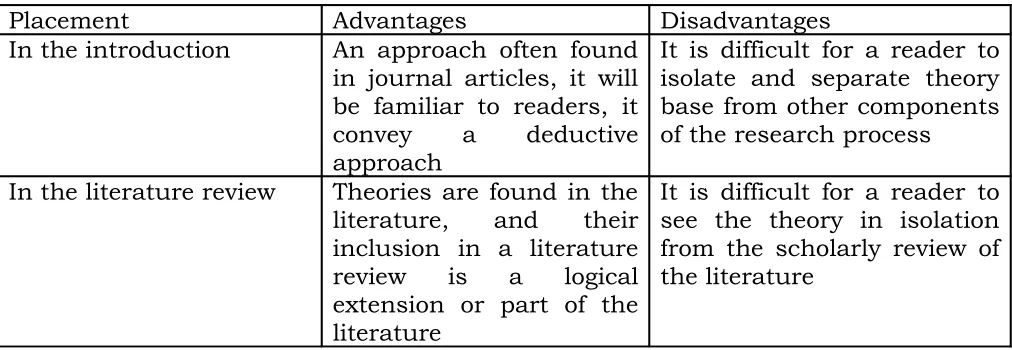
As shown in Table 2.1, you might include the literature in the
useful backdrop for the problem or issue that has led to the need for the
study, such as who has been writing about it, who has studied ti, and
who has indicated the impotence of styding the issue. This "framing" of the problem is, of course, contingent on available studies. One can find
illustrations of this model in many qualitative studies employing different
strategies of inquiry.
A second from is to reviews the literature in a separate section, a model typically used in quantitative research. This approach often
appears when the audience consists of individuals or readers with a
quantitative orientation. Moreover, in theory-oriented qualitative studies, such as ethnographies and critical theory studies or studies with an
advocacy or emancipator aim, the inquirer might locate the theory
discussion and literature in a separate second, typically towards the
beginning of the study. Third, the research may incorporate the related literature in the final section of the study, where it is used to compare
and contrast with the result (or themes or categories) that emerged from
the study. This model is especially popular in grounded theory studies. I recommend it because it uses the literature inductively.
Quantitative research, on the other hand, includes a substantial
amount of literature at the beginning of a study to provide direction for
the research questions or hypotheses. In planning a quantitative study, the literature is often used at the beginning of a study to introduce a
problem or to describe in detail the existing literature in a section titled
"related literature" or "review of literature," or something similar. In
addition, the literature is included in the end of a study in which the researcher compares the results of the study with the existing finds in
the literature. In this model, the end of a study in which the researcher
compares the results of the study with the existing finds in the literature.
A separate section on the "review of the literature" deserves special
mention because it is a popular form for writing literature into a study.
This literature review might take several different forms, and little consensus exists about a preferable form. Cooper (1984) suggests that
literature reviews can be integrative, with the researchers summarizing
broad themes in the literature. This model is popular in dissertation
proposal and dissertation. A second form recommended by Cooper is a theoretical review, in which the researcher focuses on extant theory that
relates to the problem under study,. This form appears in journal articles
in which the author integrates the theory into the introduction to the study. A final form suggested by cooper is a metrological review, in which
the researcher focuses on methods and definition. These reviews may
provide not only a summary of studies but also an actual critique of the
strengths and weaknesses of the method sections. Some authors use this form in dissertations and in "reviews of related literature" seconds in
journal articles.
In a mixed methods study, the researcher uses either a qualitative or a quantitative approach to the literature depending on the type of mixed
method design being used. In a sequential design, he literature is
presented in each phase in a way consistent with the type of design being
used in that phase. For example, if the study begins with a quantitative phase, then the investigator is likely to include a substantial literature
review that helps to establish a rational for the research questions or
hypotheses. If the study begins with a qualitative phase, then the
literature is substantially less, and the researcher may incorporate it more into the end of the sty- an inductive approach to literature use. If
the researcher advance a concurrent study with an equal weight and
emphasis on both qualitative and quantitative data, then the literature
type of strategy and the relative weight given to the qualitative or
quantitative research in the study.
My suggestions, then, for planning to use the literature in a qualitative, quantities, or mixed methods study are as follows.
• In a qualitative study, use the literature sparingly in the beginning of the plan in order to convey an inductive deign, unless the
qualitative strategy-type requires a substantial literature orientation at the outset.
• Consider the most appropriate place for the literature in a qualitative study and base the decision on the audience for he
project. Keep in mind placing it at the beginning to “frame” the problem, placing it in a separate section, and using it at the end of
a study to compare and contrast with the findings of the current
study.
• Use the literature in a quantitative study deductively as a basis for advancing research questions or hypotheses.
• Use the literature to introduce the study, describe related literature in a separate section, or compare extant literature with findings in a quantitative study plan.
• If a separate “review of the literature” is use, consider whether the review will consist of integrative summaries, theoretical reviews, or
methodological reviews. A typical practice in dissertation writing is to advance an integrative review.
• In a mixed methods study, use the literature in a way that is consistent with the major type of strategy and the
DESIGN TECHNIQUES
Regardless of whether you write the literature into a qualitative,
quantitative, or a mixed methods study, several steps are useful in
conducting a literature review.
STEPS IN CONDUCTING A LITERATURE REVIEW
A literature review for a proposal or a research study means locating and
summarizing the studies about a topic. Often these summaries are
research studies (because you are conducting a research study), but they may also include conceptual articles or thought pieces that provide
fireworks for thinking about topics. There is no one way to conduct a
literature review, but many scholar proceed in a systematic fashion to capture, evaluate and summarize the literature.
Step1: Being by identifying key works useful in locating material in an
academic library at a college or university. These key words may
emerge in identifying and topic, or they may result form preliminary readings in the library.
Step 2: with these key words in mind, next go to the library and begin
searching the library catalog for holdings (i.e. journals and books). Mot major libraries have computerized data bases of their
holdings, I suggest focusing initially on journals and books
related to the topic. Also. I suggest beginning to search the
computerized databases typically reviewed by social science researcher, such as ERIC, PsycINPO, sociofile and the social
science Citation index (later, these will be reviewed in some
detail). These databases are available online using the library’s
Web site, or they may be available on CD-ROM in a library.
Step 3: I would initially try to locate about 0 reports of research in article
or books related to research on my topic, I would set a priority on
locate and obtain. I would determine whether these articles and
books are held in my academic library or whether I need to send
for them by interlibrary loan or purchase them through a bookstore.
Step 4: Using this initial group of articles, I would them look at the
articles and photocopy those that are central to my topic. IN the
selection process, I would look over the abstract and skim the article or chapter. Throughout this process, I would try simply to
obtain a sense of whether the article or chapter will make a
useful contribution to my understanding of the literature.
Step 5: As I identify useful literature, I begin designing my literature
map, a visual picture of the research literature on my topic.
Several possibilities exist for drawing this map (to be discussed
later). This picture provides a useful organizing device for positioning my own study within the larger body of the literature
on a topic.
Step 6: At the same time that I am organizing the literature into my
literature map, I am also beginning to draft summaries of the mot
relevant articles. These summaries are combined into the final
literature review that I write for my proposal or research study. In
addition, I am including precise references to the literature using an appropriate style, such as that contained in the American
Psychological Association style manual (American Psychological
Association, 2001), So that I have a complete reference to use at
the end of my proposal or study.
Step 7: After summarizing the literature, I then assemble the literature
review, in which I structure the literature thematically or organize
it by important concepts addressed in the study. I would end my