
Southern Dialect Used by Lieutenant Aldo Raine in the
Movie
“Inglourious Basterds”
A THESIS
Submitted as Partial Fulfillment of the Requirements for the Sarjana Degree of English Department Faculty of Humanities UIN Sunan Ampel Surabaya
By:
Lutfiansyah
Reg. Number: A83211158
ENGLISH DEPARTMENT
FACULTY OF LETTERS AND HUMANITIES
STATE ISLAMIC UNIVERSITY SUNAN AMPEL
ii
Southern Dialect Used by Lieutenant Aldo Raine in
the Movie
“Inglourious Basterds”
Lutfiansyah
Reg. Number: A83211158
Thesis Advisor
Raudlotul Jannah, M.App.Ling.
ENGLISH DEPARTMENT
FACULTY OF LETTERS AND HUMANITIES
STATE ISLAMIC UNIVERSITY SUNAN AMPEL
xiv
INTISARI
Lutfiansyah. 2015. Southern Dialect Used by Lieutenant Aldo Raine in the Movie
“Inglourious Basterds” Thesis. English Deparment, Faculty of Letters and Humanities, State Islamic University Sunan Ampel Surabaya. Advisor: Raudlotul Jannah, M.App.Ling.
Kata kunci: Language variation, Southern Dialect, Aldo the Apache
Penelitian ini fokus pada salah satu dialek Inggris-Amerika yang digunakan oleh seorang Letnan Aldo Raine di sebuah film “Inglourious Basterds.
Ada dua permasalahan dibidang studi ini. (1) Pola-pola dialek apakah yang digunakan oleh Letnan Aldo Raine di sebuah film “Inglourious Basterds? (2) Apa pengaruh dialek yang digunakan oleh Aldo Raine di sebuah film “Inglourious
Basterds? Penulis menggunakan teori Holmes dan Wardhaugh untuk menjawab pola dan pengaruh penggunaan dialek yang digunakan oleh Letnan Aldo Raine. Penelitian ini menggunakan pendekatan kualitatif. Penulis menafsirkan dan menggambarkan ungkapan-ungkapan yang diucapkan oleh Aldo Raine beserta dengan karakter-karakter yang lain yang berhubungan. Data-data penelitian juga diperoleh dari ungkapan-ungkapan Aldo dengan karakter yang lainnya baik dalam bentuk kalimat dan dialog.
Dalam penelitian ini, penulis menemukan bahwa dialek yang digunakan oleh Aldo Raine berasal dari wilayah selatan Amerika. Semua ungkapan yang diucapkan oleh Aldo menunjukan sebagai dialek selatan Amerika.Dari beragam fonologi, tata bahasa dan variasi kosa kata, dialek Aldo dikategorikan sebagai dialek dari kalangan kelas bawah. Disisi lain, dialek tersebut digunakan oleh kalangan orang kulit putih.
Didalam film, Aldo dikenalkan sebagai seorang karakter yang berasal orang pribumi Amerika yang memiliki ras suku Indian didalam dirinya. Meskipun Aldo seorang Letnan tentara Amerika, dia tetap memakai dialeknya kepada prajurit-prajurit dan musuh-musuhnya. Itu dikarenakan solidaritas dan situasi. Aldo menggunakan dialek kepada prajuritnya sebagai bentuk solidaritas. Dan dia juga menggunakan dialek kepada musuh-musuhnya untuk menunjukan identitasnya sebagai orang asli Amerika. Maka dari itu, dia dikenal sebagai Aldo the Apache.
ABSTRACT
Lutfiansyah. 2015. Southern Dialect Used by Lieutenant Aldo Raine in the Movie
“Inglourious Basterds”. Thesis. English Deparment, Faculty of Letters and Humanities, State Islamic University Sunan Ampel Surabaya. Advisor: Raudlotul Jannah, M.App.Ling.
Key words: Language variation, Southern Dialect, Aldo the Apache
This research focuses on analyzing one of American English dialect used by Lieutenant Aldo Raine in “Inglourious Basterds” movie. There are two problem of this study: (1) What are the patterns of dialect used by Lieutenant Aldo Raine in movie of ‘Inglourious Basterds’? (2) What is the effect of the dialect used by Lieutenant Aldo Raine in movie of ‘Inglourious Basterds’? The writer tends to use the theory Holmes and Wardhaugh to answer the dialect pattern and the effect of using dialect that used by Lieutenant Aldo Raine. The analysis is used qualitative approach. The writer describes and interprets the utterances uttered by Aldo Raine and other related characters. Also, the data are taken from Aldo’s utterances and other related characters in the sentences and dialogues.
In this research, the writer found that the dialect used by Aldo Raine is from the Southern a part of United State. In all his utterances are indicated as Southern dialect. From the phonology features, grammatical pattern and vocabulary variation Aldo’s dialect is categorized as lower social group. Besides, Southern dialect itself is commonly used by white people.
In the movie, Aldo is introduced as a character from Native American which has a little Indian in himself. Although Aldo is a lieutenant of American soldier, he tends to use his dialect to his soldiers and his enemy. It is due to the solidarity and situation. Aldo used his dialect as solidarity to his soldiers and also he used his dialect to his enemy to show his identity as American. On the other hand, he is well known as Aldo the Apache.
ix
TABLE OF CONTENTS
Inside Cover Page i
Inside Title Page ii
Motto iii
Declaration Page iv
Dedication Page v
Thesis Advisor’s Approval Page vi
Thesis Examiner’s Approval Page vii
Acknowledgements viii
Table of Contents ix
Table of List xi
Abstract xiii
Intisari xiv
CHAPTER 1 INTRODUCTION 1
1.1. Background of The Study 1
1.2. Statement of The Problem 6
1.3. Objective of The Study 6
1.4. Significant of The Study 7
1.5. Scope and Limitation 8
1.6. Definition of Key Term 9
CHAPTER 2 REVIEW OF RELATED LITERATURE 11
2.1. Language Variation 11
2.2. Dialect 13
2.2.1. Phonology Features 15
2.2.2. Grammatical Pattern 16
2.2.3. Vocabulary Variation 18
CHAPTER 3 RESEARCH METHOD 21
3.1. Research Approach 21
3.2. Data and Data Source 22
3.3. Research Instrument 22
3.4. Technique of Data Collection 23
3.5. Technique of Data Analysis 24
CHAPTER 4 FINDING AND DISCUSSION 25
4.1. Findings 25
4.1.1. Dialect Pattern 25
4.1.1.1. Phonology Feature 27
4.1.1.2. Grammatical Pattern 43
4.1.1.3. Vocabulary Variation 56
4.2. Discussion 57
CHAPTER 5 CONCLUSION 60
REFERENCES 62
1
CHAPTER I
INTRODUCTION
In this chapter, the writer explains about background of the study, problems of
the study, objectives of the study, significance of the study, scope and limitation, and
the definition of the key terms.
1.1Background of the Study
Language variation always exist insides any one single language in society.
People have different way to use the same language. It indicates that no one
speaks the same way all the time. For instance, university student from
Bojonegoro may speak differently with their friend from Surabaya. It is due to
they tend to use their language which they feel proper for their environment and
situation. Therefore, in this case, the writer is going to analyze language variation.
Language variation is a specific linguistic items or human speech pattern
(e.g. sound, words, grammatical features, etc) which is uniquely associated with
some external factors, such as a geographical area or a social group (Wardhaugh,
2006). For instance, as the sound, the word brought is uttered differently between British and American speaker. British pronounce brought as /brɔt/ and American
pronounce brought as /brɑːt/. Then, as the word, Australians talk of sole parents,
while people in England call them single parents, and New Zealanders call them
2
have, though this can now also be heard in Britain alongside the traditional British English have you got. Americans ask did you eat?while the English ask have you eaten?
The phenomena above are caused by some external factors such as social
group or geographical area. In social group or social variation, it is speech
varieties associated with different social factors, especially related to the
speakers’ social status such as social groups or classes; racial status/ ethnicity,
income; education, and cultural background etc. Those are included vulgar or
taboo language, slang, colloquial, jargon, argot, register, and style (including
standard and nonstandard variety).
Vulgar or taboo language is referred to words or expressions which should
not be used because they are shocking, offensive, blasphemous, and indecent
(inappropriate). For example, swear word which words relating to sex organ or
animal. Slang is universal and can be found in all languages and all time, but no
one can define it precisely. The characteristics of slang are informal and often
used in spoken not in written. For example, Gonna refers to going to and Gimme
refers to give me.
Other informal language is Colloquial. It is also informal language
variation used in daily conversation and it is spoken not written. For the example,
3
participate in the activity. Indonesian language, for example, roda gila, kunci inggris, and didongkrak refers to mechanical terms.
The other language for particular group or community is Argot. It is secret
language for a particular group/ community. It refers to the kinds of slang
vocabulary which is typically created and used by criminal groups such as,
pickpockets, thieves, killers, etc. Then, Style is the different ways of speaking
used by a speaker with regard to whom he or she is talking to. For instance, a
university student may speak differently with their friends and their lecturers.
Register is a language variation associated with a particular occupation, activity,
topic, or subject. For example: different technical terms used by surgeons,
medical people, linguists, educators, politicians, musicians, film makers,
biochemistry, etc.
The other factor of language variation is geographical area. It is dialect
variation. It is a regional or social variety of a language characterized by its own
phonological, syntactic, and lexical properties (O’Grady et al., 2001). Then, there
are three kinds of dialect. They are regional dialect, social dialect and personal
dialect. Regional dialect is distinctive varieties of language spoken in particular
region. Then, social dialect is varieties of a language associated with different
social groups, status, religion, and ethnicity. Personal dialect is varieties of
language spoken by individual speaker of the language. In this case, the writer
limits the analysis of language variation which is focus on dialect variation
4
Dialect variation is one of language variation which some linguist interest
to analyze. They are mostly interest to analyze a variation of language to find the
pattern which differs from the standard language. Moreover, when the dialect
variation comes from a fictional character in a movie, it can create a unique
characteristic for the character itself and represent one particular social status.
Therefore, the writer focuses on dialect variation and tries to find out the pattern
the dialect variation and special characteristic contribute to one character in a
movie.
Dialect includes in linguistics features which already identified variant as
Wardhaugh (2006, p.143) claimed that linguistic variable is a linguistic item and
it has identifiable variant. For example, the words singing and fishing are usually pronounced singin’ and fishin’. The meaning is called linguistic features which
are the final sound (ng) with its two variants dropping –ing in phonology feature. Then, in grammatical variation, sometime someone says she do/he do to other people. As long as the people understand, it is relevant to use as communication.
Lexical or vocabulary variation means someone may say different a word in the
same meaning in society life. For example, a lift in British English is called an
elevator in American English. In this case, the writer is going to analyze dialect variation within a character in the movie based on phonology features,
grammatical variation and vocabulary variation to find out the pattern and the
5
The movie used in this research is Inglourious Basterds. It is a 2009 American war film written and directed by Quentin Tarantino and starring Brad
Pitt, Christoph Waltz, Mélanie Laurent,Michael Fassbender, Eli Roth and Diane
Kruger. The film tells the fictional alternate history story of two plots to
assassinate Nazi Germany's political leadership, one planned by a young French
Jewish cinema proprietor (Laurent), and the other by a team of Jewish-American
soldiers led by First Lieutenant Aldo Raine (Pitt). The film's title was inspired by
director Enzo G. Castellari's 1978 macaroni combat film, The Inglorious Bastards.
Lieutenant Aldo Raine is one of characters in movie Inglourious Basterds. He is the leader of American soldier who is also a secret agent from United
States. His team is known as well Basterds which has a mission to kill Nazi. He was born from Indian tribes which known as the ‘apache’. The Apache itself is
collective term for several culturally related groups of Native Americans in
United States originally from Southwestern. He spoke used the language which is
categorized as the lower class. Therefore, the writer focuses on analyze language
6
1.2Statement of Problem
Based on the background of the study written above, the writer
proposes to analyze dialect used by Lieutenant Aldo Raine in ‘Inglourious
Basterds’movie. The research problem can be formulated as follows:
1. What are the patterns of dialect used by Lieutenant Aldo Raine in
movie of ‘Inglourious Basterds’?
2. What is the effect of the dialect used by Lieutenant Aldo Raine in
movie of ‘Inglourious Basterds’?
1.3Objective of Study
Based on the research problem above, there are two objectives of the
study, as follows:
1. To describe the pattern of dialect used by Lieutenant Aldo Raine in
movie of ‘Inglourious Basterds’.
2. To find the effect of the dialect used by Lieutenant Aldo Raine in
movie of ‘Inglourious Basterds’.
1.4Significance of the Study
This study is about sociolinguistics field towards the sub language variation which focuses on the dialect used by Lieutenant Aldo Raine in
7
research can give contribution to this field study especially dialect as
language variation. Furthermore, this research also analyzes the effect of
dialect in movie of ‘Inglourious Basterds. Hopefully, this study can become the new reference for the next researcher who wants to conduct research in
language variation of dialect.
The writer hopes by finding the pattern and the effect of dialect
variation used by Lieutenant Aldo Raine, it can enrich the language itself
especially in study language variation. It means that the writer wants to show
the varieties a language spoken by a speaker of the language taken from a
movie to the reader or the next researcher. Then, by knowing the dialect used
by Lieutenant Aldo Raine, the writer hopes that the reader or the next
researcher can take the positive values in this research which people cannot
judge someone is bad from the their dialect. Instead, dialect itself is exactly
showed the identity where someone belongs to and described a unique way of
speaking.
1.5Scope and Limitation 1.5.1 Scope
In this study, the writer focuses on a movie which had taken
from the internet. All of the characters in the Inglourious Basterds
8
writer is focused on the dialect variation used by Lieutenant Aldo
Raine. It means that this study focuses on sociolinguistics field in
language variation especially in dialect variation. Then, this research
discusses the features of phonological, grammatical and vocabulary
variation. The writer analysis the dialect variation is used those items
to find the pattern and the effect uttered by Lieutenant Aldo Raine in
that movie.
1.5.2 Limitation
This research is going to analysis a movie of ‘Inglourious Basterds which focuses on dialect variation of the main actor as object of study. In this case, the writer interprets and describes its based on
his point of view and other relation. The writer limits the research
which analysis the patterns and the effect of dialect variation used by
Lieutenant Aldo Raine based on three aspects varies in grammar,
vocabulary variation, and phonology features. To support the analysis,
the writer not only takes Aldo’s utterances but also other related
9
1.6Definition of key term
The writer provides definition of key word of this study which is
avoiding the misunderstanding and misinterpretation. Some of the definition
as follows
1.6.1 Language Variation
It is a specific set of linguistic items or human speech patterns (e.g.
sounds, words, grammatical features, etc.) which is uniquely
associated with some external factors, such as a geographical area or a
social group (Wardhaugh, 1998).
1.6.2 Dialect
Dialect is used to refer to an entire language variety, with features on
all levels of language patterning for example, phonology, grammar,
and the lexicon (O’Grady et al., 2001).
1.6.3 Linguistic Variable
A linguistic variable is a linguistic item and it has identifiable variant.
(Wardhaugh, 2006).
1.6.4 Lieutenant Aldo Raine
He is one of characters in the movie of Inglourious Basterds. He is the leader of secret agent of American soldier which against Nazi. He is
10
1.6.5 Inglourious Basterds
It is a 2009 American war film written and directed by Quentin
Tarantino and starring Brad Pitt, Christoph Waltz, Mélanie Laurent,
Michael Fassbender, Eli Roth and Diane Kruger. The film tells about
11
CHAPTER II
REVIEW OF RELATED LITERATURE
This chapter consists of many important aspects concerning the theoretical
framework and the related studies.
2.1 Language Variation
Many people use language more than one to connect and attract other people in various purposes in society. As Wardhaugh (2006) claimed
that many speakers may use two or more languages. An Indonesian student
may speak to his friend from Surabaya using Javanese but he
communicates Indonesian to his friend from Jakarta. He may also change
to speak English as he starts to learn in the English class. Then, the
language he uses also may change from the standard to non-standard based
on the situation with whom he speak. It indicates that no one speaks the
same way all the time andpeople constantly exploit the nuances of the
languages they speak for a wide variety of purposes (Wardhaugh, 2006).
These phenomena are called language variation.
A language variation is a specific linguistic items or human speech
pattern (e.g. sound, words, grammatical features, etc.) which is uniquely
associated with some external factors, such as a geographical area or a
social group (Wardhaugh, 2006). For instance, as the sound, the word
12
broughtas/brɑːt/. Then, as the word, Australians talk of sole parents,while people in England call them single parents, and NewZealanders call them
solo parents. As the grammatical, Speakers of US English tend to prefer
do you have, though this can now also be heard in Britainalongside the traditional British English have you got.Americans ask did you eat?While the English ask have you eaten?
The phenomena above are determined from many factors such as
social and geographical area. The social factors is speech varieties
associated with different social factors, especially related to the speakers‘
social status such as social groups or classes; racial status/ ethnicity,
income; education, and cultural background etc. Those are included vulgar
or taboo language, slang, colloquial, jargon, argot, register, and style
(including standard and nonstandard variety). The other factorof language
variation is geographical area. It is dialect variation.In this case, the writer
is going to analyze language variation which is focused on dialect
13
2.2. Dialect
Dialect variation is part of language variation. It is a regional or social variety of a language characterized by its own phonological,
syntactic, and lexical properties (O‘Grady et al., 2001).Also,
Schilling-Estes (2006, p.312) found that dialect is used to refer to an entire language
variety, with features on all levels of language patterning, for example,
phonology, grammar, and the lexicon.It means the English speaker likes
American, Britain and Australian may speak different in phonology,
grammar and vocabulary to speak English.
There are three kinds of dialect. They are regional dialect, social
dialect and personal dialect. The first, the regional dialect is distinctive
varieties of language spoken in a particular region. The term dialect is
sometimes used only if there is a strong tradition of writing in the local
variety. Then, there is term patois which describes the variety. Wardhaugh
(2006, p.44) found that many linguists writing in English tend to use
dialect to describe both situation and rarely. Patois itself refers only to the
speech of the lower strata in society. As the example, Jamaicans who is
often refer to the variety of English spoken on the island as a patois.
The differences patois and dialect are dialect usually has a wider
geographical distribution than a patois, so that, whereas regional dialect
and village patois seem unobjectionable, the same cannot be said for
14
claimed that many Jamaicans refer to the popular spoken variety of
Jamaican English as a patois rather than as a dialect.
Also, there is a dialect continuum. Over large distances the dialects
at each end of the continuum may well be mutually unintelligible, and also
some of the intermediate dialects may be unintelligible with one or both
ends, or even with certain other intermediate ones. For instance, there is
Italian travel to France. He found that there is the same dialect with his
dialect in one of France area. Then, he tries to wide his travel until he does
not find the same dialect with his dialect.
Second, social dialect is varieties of a language associated with
different social groups, status, religion, and ethnicity. As the example, in a
city like Baghdad the Christian, Jewish, and Muslim inhabitants speak
different varieties of Arabic. In this case the first two groups use their
variety solely within the group but the Muslim variety serves as a lingua
franca, or common language, among the groups.
Third, personal dialect is called idiolect. It is varieties of language
spoken by an individual speaker of the language. For example, there are
some Native Americans who have a little Indian continue to study in
England. All of them come from the same region. They speak American
English. But, one of them speaks differently with others. The different
seems in sound, vocabulary and grammar. It means that the person has a
15
unique characteristics of the language of an individual speaker are referred
to as the speaker‘s idiolect.
There are some reasons why people use dialect in society. While
the people are educated, they tend to use dialect to communicate to other.
Schilling-Estes (2006, p.312) found that people tend to use dialect to show
their solidarity, style and political statement. It means solidarity is
associated with home and local neighborhood. Style itself is commonly
used by teenager as shows to be cool person. The using dialect as political
statement is used by politic party as the tool to attract people to convey the
message. In addition, people tend to use their dialect to show their identity
where they are come from.
Dialect has parts of linguistics features. The linguistics features is
studying the variable of linguistics. Wardhaugh (2006, p.143) stated that
linguistic variable is a linguistic item and it has identifiable. The variable
itself is included the phonology features, vocabulary and grammatical
variation.
2.2.1. Phonology Features
There are many different sounds in single language. As a
comparison of ―r-less‖ and other dialects which illustrates phonological differences among dialect (Hyams and Rodman,
2003). The linguists add, there are many differences among the
dialects of American English. Hyams and Rodman (2003, p.450)
16
word in which sounds occur. For instance some readers pronounce
Mary, marry, and merry in the same; others pronounce the three words differently as /meri/, /mæri/ and /mεri/; and still others
pronounce two of them.
From differences phonology features, we can find the
regional dialect where a person comes from. As the example /h/ is
pronounced at the beginning of both head and herb in British dialect, whereas in American English dialects it is not pronounced
in the second word. Then, in some English dialect /h/ regularly
dropped from most word in which it is pronounced in American,
such as house, pronounce /aws/, and hero, pronounced /iro/ (Hyams and Rodman, 2003).
In this case, sound can also identify the social class of the
speaker. A linguist Labov (1972b) provided the example of sound
that identifies the social class where is the person belongs to. For
instance, the pronouncing car and cart in New York City in their r -less varieties are identified people as using a type of pronunciation
associated with lower-class speech in that city (Wardhaugh, 2003).
2.2.2. Grammatical Pattern
There are grammatical differences in the varieties spoken in
different regions. For instance,speakers of American English tend
17
gotten used to it, whereas British speakerstend to use got, as in she has got used to it (Schilling-Estes, 2006). It indicates that grammatical pattern in variation form can be foundusing of past
participle verb form.
Grammatical can identify the social class where the person
belongs to. For example, she walks (standard) and she walk
(vernacular). In this case, it can determine that the standard is used
by Middle class and the vernacular is used by Lower class. Holmes
(2012) stated that there is a sharp distinction between the
middle-class groups and the lower-middle-class groups for using grammatical
pattern. This pattern is foundboth in a variety of US English
spoken in Detroit, and in a variety of British English spoken in
Norwich (Holmes, 2012).
There is grammatical pattern that avoided by Middle class
and it always indicated by Lower class is using negation or
multiple negation or negative concord. Holmes (2012, p.151)
claimed that negation or negative concord or multiple negation
always avoid by Middle class and the Lower class use it
comfortably. For instance, It ain’t no cat can’t get in no coop. This
grammatical pattern is multiple negations which are found in all
English speaking communities. It is mostly used by lower class
than middle class speech. Multiple negations are a very silent
18
pattern to identify the utterances of the character in the movie to
find out the pattern used by Lieutenant Aldo Raine.
2.2.3. Vocabulary Variation
There are vocabulary differences in the varieties spoken in different regions too. For instance, people take lift to the first floor (our second floor) in England, but an elevator in the United States. Using word can also identify the social class of people. In England,
in the 1950s shows that the use of sitting room (upper-class speaker) is different from lounge the rest (lower-class) and referred to the lavatory (upper-class) rather than the toilet (lower-class) (holmes. 2012).
By vocabulary variation, the writer can determine where the
region and social class the character belongs to. In other words, the
writer is also used vocabulary variation to find out the pattern
dialect variation used by Lieutenant Aldo Raine.
2.3. Related Studies
Regarding on this study, the writer finds some other writers which
the topics are related. For the first thesis is Santika (2014) a student UIN
Sunan Ampel Surabaya, did research entitled An Analysis of West
19
analyzed the dialect variation and showed the pattern and the effects of
Hagrid‘s dialect vary from the range of phonology feature, grammatical
pattern, and vocabulary variation. In this research, Santika used literary
work from J.K Rowling‘s novel to find the pattern and the effect of
Hagrid‘s dialect. The interesting of this research, Santika analyzed and
showed the regional dialect where comes from the author hometown
which put on one of character in her literary work of Harry Potter. Thus,
the whole analysis dialect features, Hagrid represent as the lower social
group.
Second, the thesis is Ningrum (2014) a student of UIN Sunan
Ampel Surabaya. She did a research analyzed African American English
and Slang used by Jim and Huck Finn in The Adventure of Huckleberry
Finnn from a novel written by Mark Twain. She found AAE and Slang
words that uttered by Jim and Huck Finn. She analyzed the sound and the
grammar by both character. In this research, Ningrum found the using of
multiple negations and slang negation [ain‘t]. The using of [ain‘t] is to
replace is, are, were, has not, and have not as the Standard English. She also found the using of –in that replace –ing like killin’, goin’, lookin’ and etc.
The third research is Molventer and Tagliamonte (2011) written
journal of language in society, they did the research entitled How‘d you
get that accent? : acquiring a second dialect of the same language. The
20
second dialect acquisition by three children over six years as they shift
room Canadian to British English. This analysis focuses on a frequent and
socially embedded linguistic feature, T-voicing (e.g., pudding versus
putting).
Those studies are related with this research which is described
social dimension and phenomenon of language variation. It describes the
dialect which the purpose and distinguish of dialect variation. It can also
describe the identity of person from regional dialect that used by the
person. In addition, dialect can also make intimate the social relationship
the people from the same region. As the language variation, dialect
21
CHAPTER III
RESEARCH METHOD
This research method discussed the method that the writer used in this
study. The writer explained the general process in collecting and analyzing the
data. It consisted of research approach, data source, data, data collection, and
research instruments and data analysis.
3.1Research Approach
In this research, the writer applied the qualitative approach. The writer
used qualitative approach to describe the utterances that uttered by a character
in movie. The reasons are establishing the theory and describing dialect within
a language variation to enrich the language itself that used in the movie.
This research analyzed the utterances that spoken by a character. Bodgan
(1982) claimed that qualitative method is a research procedure which observes
the data in a form of written and/or spoken words from people and also
includes their behavior. It means that from the definition, the writer used this
method to describe the pattern and the effect of dialect used by Lieutenant
Aldo Raine in movie of ‘Inglourious Basterds’ on the personality character.
3.2Data Sources
In this research the writer analyzed dialect from the movie. The writer took
the movie from the internet. The movie had took from www.ganool.com
22
3.3Data
In this research, the data are the words, sentences, and utterances from the
character. The writer analyzed Lieutenant Aldo Raine as the character. Then,
to deep the explanation, the writer included some utterances from other
character in dialog related to Lieutenant Aldo Raine.
3.4Research Instrument
The writer applied qualitative approach method which the writer becomes
the investigator. In qualitative data, human investigator is the primary
instrument for the gathering and analyzing data (Bogdan and Biklen, 1998).
Therefore, this study used human instrument in conducting research which the
writer analyzed the data sources. The writer took the dialog in the movie of
‘Inglourious Basterds’ which uttered by Lieutenant Aldo Raine and other character which involve the Aldo Raine.
3.5Technique of Data Collection
In collecting the data, the writer had done doing several ways to collect the
data sources. These are the several ways as follow:
1. The writer downloads the movie included the transcript from the
www.ganool.com and save it into the laptop and the flash disk to
avoid something happen to the laptop or flash disk.
23
3. The writer paid attention and focused on Aldo’s character during
watching the movie.
4. The writer sorted all dialects occur in the movie.
5. The writer only focused on Aldo.
6. The writer watched many times to collect the data from Aldo’s
utterances and other related character.
7. The writer made table to put all data of Aldo’s utterances and other
related character.
8. The writer classified the data that already put in the table. The
writer classified from the phonological features, grammatical
pattern and vocabulary variation.
9. The writer analyzed the data that already classified.
10. The writer made conclusion what already found and discussed.
3.6Technique of Data Analysis
After collecting data by doing several ways, the writer started to analyze
the data which already provided in the table. The writer analyzed and
categorized by selecting words, sentences and utterances which uttered by
Lieutenant Aldo Raine in movie of ‘Inglourious Basterd and other character involve Aldo Raine into the standard and nonstandard. As explained in the
previous chapter 2, this research used phonology features, grammatical
variation and vocabulary variation to analyze the dialect variation. To find the
24
grouped them into several classifications from the three types as mentioned.
After finish classifying, the writer started to analyze three types such as
phonology features, grammatical and vocabulary variation that used by Aldo.
25
CHAPTER IV
FINDINGS AND DISCUSSIONS
The focus of this study is to identify patterns of a dialect and the
significance of the dialect found in the movie of ‗InglouriousBasterds‘. The main purpose of this chapter is to answer the questions presented in Chapter I.
4.1 Findings
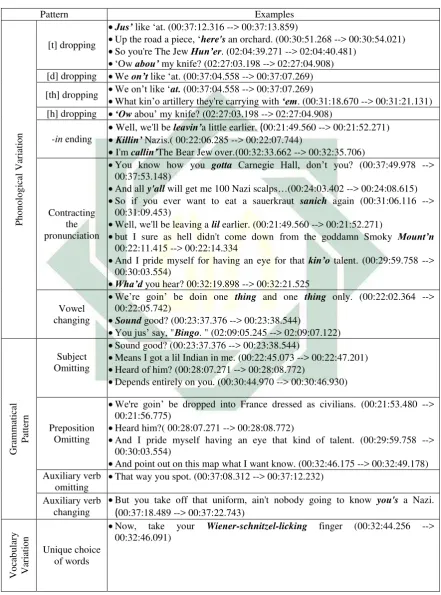
The writer found the patterns and the effect of Aldo‘s dialect. The patterns
of Aldo‘s dialect vary in phonological variation, grammatical pattern and vocabulary variation. The effect of Aldo‘s dialect is explained in discussion.
4.1.1 Dialect Pattern used by Lieutenant Aldo Raine
Lieutenant Aldo Raine is a leader of American soldier. He is also a
secret agent who leads a team as known as ―Basterds‖ and he well-known as Aldo Raine ―the apache.‖ He was born in United Stated. As in the movie, Aldo Raine introduces himself to his soldiers that he has a
little bit Indian. Then, he decided to use Apache resistance in his
mission. Besides, Aldo always put swastika sign to every German‘s soldier. That is the caused he well known as Aldo the Apache. The data
finding are shown below in the table. In this case, the writer recognizes
that the dialect used by Lieutenant Aldo Raine is from American
English. Further explanation about the origin of dialect will be
26
Table 4.1 Aldo Raine’s Dialect Patterns
Pattern Examples
Jus’like ‗at. (00:37:12.316 --> 00:37:13.859)
Up the road a piece, ‗here's an orchard. (00:30:51.268 --> 00:30:54.021) So you're The Jew Hun’er. (02:04:39.271 --> 02:04:40.481)
‗Ow abou’ my knife? (02:27:03.198 --> 02:27:04.908) [d] dropping We on’tlike ‗at. (00:37:04.558 --> 00:37:07.269) [th] dropping We on‘t like ‗at. (00:37:04.558 --> 00:37:07.269)
What kin‘o artillery they're carrying with ‘em. (00:31:18.670 --> 00:31:21.131) [h] dropping ‘Ow abou‘ my knife? (02:27:03.198 --> 02:27:04.908)
-in ending
Well, we'll be leavin’a little earlier. (00:21:49.560 --> 00:21:52.271)
Killin’ Nazis.( 00:22:06.285 --> 00:22:07.744)
I'm callin’The Bear Jew over.(00:32:33.662 --> 00:32:35.706)
Contracting the pronunciation
You know how you gotta Carnegie Hall, don‘t you? (00:37:49.978 --> 00:37:53.148)
And all y'all will get me 100 Nazi scalps…(00:24:03.402 --> 00:24:08.615) So if you ever want to eat a sauerkraut sanich again (00:31:06.116 --> 00:31:09.453)
Well, we'll be leaving a lil earlier. (00:21:49.560 --> 00:21:52.271)
but I sure as hell didn't come down from the goddamn Smoky Mount’n 00:22:11.415 --> 00:22:14.334
And I pride myself for having an eye for that kin’o talent. (00:29:59.758 --> 00:30:03.554)
Wha’d you hear? 00:32:19.898 --> 00:32:21.525
Vowel changing
We‘re goin‘ be doin one thing and one thing only. (00:22:02.364 --> 00:22:05.742)
Sound good? (00:23:37.376 --> 00:23:38.544)
You jus‘ say, "Bingo. " (02:09:05.245 --> 02:09:07.122)
Gr
Sound good? (00:23:37.376 --> 00:23:38.544)
Means I got a lil Indian in me. (00:22:45.073 --> 00:22:47.201) Heard of him? (00:28:07.271 --> 00:28:08.772)
Depends entirely on you. (00:30:44.970 --> 00:30:46.930)
Preposition Omitting
We're goin‘ be dropped into France dressed as civilians. (00:21:53.480 --> 00:21:56.775)
Heard him?( 00:28:07.271 --> 00:28:08.772)
And I pride myself having an eye that kind of talent. (00:29:59.758 --> 00:30:03.554)
And point out on this map what I want know. (00:32:46.175 --> 00:32:49.178) Auxiliary verb
omitting
That way you spot. (00:37:08.312 --> 00:37:12.232)
Auxiliary verb
27
There are three types of dialect variation that distinguish one
dialect with another. They are phonology features, grammatical pattern
and vocabulary variation. They exist used by Lieutenant Aldo Raine in
his utterances.
4.1.1.1 Phonology Features
Phonology features used by Lieutenant Aldo Raine
are such as consonant dropping, –in pronunciation, contracting the pronunciation, and changing vowel pronunciation. In
consonant dropping, which omits the pronunciation of a
consonant, Aldo Raine only drops the [t], [d], [h] and [th]. He
also pronounces –in instead of –ing and contracts some words in his utterances. In addition, he also changes vowel
pronunciation [i]and[a]become [e] in some words. a. [t] dropping
The [t] dropping is accumulated in some words.
Firstly, we are going to focus at the [t] dropping which is
28
Table 4.2 [t] Dropping in the middle and the last consonant
No The Dialogue Time
1. Aldo
Now, jus’ take that finger of yours. And point out on this here map where this party is being held, how many is
Werner I respectfully refuse, sir.
2
Landa So you're Aldo the Apache. 02:04:35.267
–
2:04:40.481 Aldo So you're The Jew Hun’er.
The italicized and bold words are typed differently.
They are typed only jus‘ and hun’er as the consonant [t] is dropped. The sentences which contain with end [t] such as sit
and brought. Then, the sentences which contain with end [t] and add suffix er such as adjuster and administer. Aldo Raine not only drops the final consonant of [t] at the aforementioned
word just, but also drops [t] in suffix of word hunter. This relies on the principle of ease of articulation. The principle
covers the simplest way to pronounce words and eases the
speaker in producing words. Aldo Raine tends to simplify the
word whose pronunciation of the last [t] consonant comes
after another consonant. It is:
Just: /jəst/
That word is commonly pronounced with [t] as the
29
phone remains unpronounced. It is due to the existence of
another consonant which is prior to the [t] phone. Also, Aldo
Raine tends to simplify the word which pronunciation of [t]
consonant comes after another consonant and before suffix er. It is:
Hunter /hʌntər/
That word is commonly pronounced with [t] as the second
sound. Meanwhile, Aldo Raine drops the [t] so the second
sound started by [t] phone remains unpronounced.
Secondly, Aldo does not only drop the [t] in last
phone and in the middle phone but also he drops the first
consonant as [t] the first phone in words. They are:
Table 4.3 [t] Dropping in the first consonant
No The Sentences Time
Besides you, we know ‗here's another Kraut patrol fucking around here somewhere.
remains unpronounced. It is due to the consistent which Aldo
30
There are other words pronounce Standard English
which uttered by Aldo. They are:
Sit /sɪt/
Table 4.4 Pronunciation [t] phone by Aldo
No The Dialogue Time
The first and the second sentences are described that
Aldo stressing the word sit and let to make an understanding what he speaks. He avoids dropping [t] to make the listener or
other speaker is able to catch the meaning. Besides, there is a
word which the final consonant dropped after vowel. It is:
Table 4.5 Phonology Feature [t] Dropping
No The Dialogue Time
31
Aldo Ow abou’ my knife? 02:27:4.908
The italicized and bold, it is known that there is [t]
dropping in the word which last [t] phone comes after a vowel.
The word is commonly pronounced /əbaʊ t/ but Aldo pronounces abou as he drops the last [t] phone. Aldo sometimes pronounced about as the Standard English. As following dialog between Aldo and Werner:
Table 4.6 Pronunciation [t] phone in the last consonant
No The Sentences Time
1. Aldo And the German will talk
about us.
(00:23:21.151 -- 00:23:23.362
2
Aldo
I need to know about Germans hiding in trees.
00:31:32.643 --00:31:34.853
It indicates that he does not consistent as pronounce
the word about. As the first sentence above, it describes that Aldo did not in a bad situation. So, he drops [t] of asking his
knife to Hands Landa. The second sentence, Aldo did not drop
[t] in the word about because he wants to stress this word as to make an understanding with his soldiers and his enemy.
In the contracting, Aldo also drops [t] in the middle
32
articulation. The example following the sentences uttered by
Aldo:
Table 4.7 [t] Dropping in the middle consonant
No The Sentences Time
1. Aldo Well, we'll be leavin‘ a lil earlier.
00:21:49.560 -- 00:21:52.271
2
Aldo Means I got a lil Indian in me.
00:22:45.073
–
00:22:47.201
This contraction is almost the same with word
hunter which Aldo drops the [t] so it becomes hun’er. In this case, Aldo mostly drops [t] phone in good position. The writer
has already listened this sound for ten times to ensure the
pronunciation that pronounced by Aldo.
b.[d] dropping
The [d] dropping is accumulated only in one word.
From the whole utterances that Aldo Raine produced in
movie, there is only one word which first [d] phone is
dropped. The word is don’t as shown in the following dialogs:
Table 4.8 [d] Dropping
No The Dialogue Time
33
Aldo Yeah, ‗at's what we thought. We on’tlike ‗at.
00:37:07.269
The word don’tis negative verb. Aldo drops the [d]
phone before a vowel. But, he does not apply this word all the
time. He drops this negative verb is due to the situation. In the
situation, Aldo does not under pressure. Besides, he
pronounced this word in Standard English when he felt worry.
As the example, the sentences uttered by Aldo:
Table 4.9 Pronunciation [d] phone in the first consonant
No The Dialogue Time fight. She was picking a place isolated and without Germans
He pronounced don’t as the Standard English is not
only to ensure the listener understand what he talks about, but
also he wants to show his worry of the situation. Archie tried
to cooling the condition. He makes sure that all is well.
c. [th] dropping
Like the [d] dropping feature, this consonant
34
accumulated only in two words. The words are that and them
unpronounced by Aldo‘s utterances shown in the following
sentences and dialogue: Hirschberg You. Go (asking the
sergeant Werner) divulge information that would put German lives in danger.
The dialogue and the sentences of Aldo‘s utterances above, Aldo drops the [th] phone of the words that and them to be only ‘at and ‘em. In the dialogue, Aldo drops the [th] phone
when he asked one of his soldiers to send a Germany sergeant.
It is due to the ease of articulation. Also, the good situation
makes him ease to use his dialect. These words are commonly
35
In other situation Aldo did not drop [th] in the word
that when he speaks to his soldiers. He pronounced that as the Standard English. For example, the sentences uttered by Aldo:
Table 4.11 Pronunciation [th] phone by Aldo
No The Sentence Time important for their mission. Aldo also pronounced that as the Standard English to get more information from his enemy
sergeant Werner. It shown in the following dialogues between
Aldo and Werner:
Table 4.12 Pronunciation [th] phone by Aldo
No The Dialogue Time Werner I respectfully refuse, sir.
Aldo Hear that?
36
Aldo That's Sergeant Donny Donowitz.
Those dialogues describe that Aldo needs more
information from Werner. On the other hand, he pronounced
that as the Standard English. Besides, when Werner refused to give the information, Aldo pronounced that to intimidate Werner to give information.
d.[h] dropping
Aldo Raine drops the [h] phone of the word how to be only ow. He did not pronounce how as shown in the following dialogue between Hands Landa and Aldo:
Table 4.13 [h] Dropping
No The Dialogue Time
1. .
Hands
Landa We're your prisoners. 02:27:00.571
--02:27:04.908 Aldo Ow abou‘ my knife?
He drops the first consonant [h] before a vowel. As the
situation, Aldo did not in unlucky position. Therefore he drops
[h] to show that he did not worry.
The other situation, Aldo did not drop [h] in the
word how. He pronounced how as the Standard English when he interrogated Werner (Germany Soldier) to ask some
37
Table 4.14 Pronunciation [h] phone by Aldo
No The Sentence Time
1. Aldo How is your English, Werner?
00:27:47.376 -- 00:27:48.460
2 Aldo How many is coming and what they brought to play with?
00:31:44.321 -- 00:31:47.699
The sentences indicate Aldo pronounced how as the Standard English to ensure the man whom he speaks is
understood. By stressing the word how, he hopes get more the information what he needs. However, he does not need to
apply drops [h] as the first consonant.
e. –in ending
The –in pronunciation is also featured in Aldo
Raine‘s dialogs which represent the distinctive dialect. It is by
simplifying the pronunciation of the –ing form of a verb. (verb+–ing) and words ended by –ing. The most common –in
ending appears in the –ing form of a verb as shown below: Table 4.15 [-in] Ending pronounced by Aldo to his soldiers
killing respectively, as the standard pronunciation. Aldo also pronounced calling, going, and licking as callin’, goin’ and
lickin’ when he interrogated Werner to get German
information. For example as the following dialogue between
Aldo and Werner:
Table 4.16 [-in] Ending pronounced by Aldo to his enemy
No The Dialogue Time
The dialogues describe that Aldo pronounced verb –
ing as –in even though he speaks with his enemy. In this case, he thought Werner understood what he talks about.
39
f. Contracting the Pronunciation
Aldo Raine maximizes the principle of the ease of
articulation in producing speech. He simplifies some words by
contracting them into a non-standard form. However, the
contracted pronunciation still maintains to have a similar
pronunciation to the standard one. Here are some examples of
Aldo contracting his pronunciation:
Table 4.17 Contracting Pronunciation 1
No The Sentence Time sauerkraut sanich again…
00:31:06.116 -- 00:31:09.453
Table 4.18 Contracting Pronunciation 2
No The Dialogue Time
1. Aldo Wha’d you hear? 00:32:19.898
--00:32:29.199 Werner Beats German soldiers
40
Aldo
You know how you gotta Carnegie
Hall, don‘t you? Practice.
The first dialog contains a contracted form of little
which is pronounced by Aldo simply as lil. Meanwhile, the second utterance is you all. However, Aldo contract you all as he pronounces y’all. The last example contains a contraction
of word got to. Aldo pronounces it as gotta to ease his articulation. Here are the words Aldo contracted throughout
the movie:
Table 4.19 Contracted Pronunciations by Aldo
41
Table 4.20 Vowel Changing Pronunciation 1
No The Sentence Time
Table 4.21 Vowel Changing Pronunciation 2
No The Dialogue Time
1.
Aldo
And everything went
exactly the way it was supposed to. What
was the next step? 01:39:19.209 --
Hands Landa Bingo! How fun.
42
to say bingo, he keeps to say bingo as the Standard English
even Aldo say different pronunciation. Also, Aldo changed the
pronunciation of the word everything /evri, θɪŋ/ become /
evri, θeŋ/.
The vowel a also changes into e in the word sound
/saʊnd/, it changes and pronounces into /seʊnd/. Aldo tends
to pronounce those words even he speaks to Werner or other
characters. He does not worry whether the listener understand
or not. But all the character understood what he speaks. As the
example, following the dialogues:
Table 4.22 Vowel Changing Pronunciation 3
No The Dialogue Time
Hammersmark That sounds good.
01:43:21.743
Hammersmark No, that sounds good.
The first dialogue, Aldo pronounced sound did not as the Standard English. He keeps pronouncing it when he
speaks to one of American spy which is also an actress Von
Hammersmark. The second dialogue, although Aldo
43
pronounced sound as the Standard English as seem in the dialogue.
4.1.1.2 Grammatical Pattern
The unique grammatical pattern of the dialect used
by Aldo Raine lies on the missing subject, auxiliary verb
omitting, auxiliary verb changing, multiple slang negation and
slang negation.
a. Subject Omittion
We focus on the omitting subject feature. Aldo
frequently leaves his sentences with no subject though it does
not always happen. The following sentences and dialogue are
uttered by Aldo:
Table 4.23 Subject Omittion Grammatical Pattern 1
No The Sentence Time
1. Aldo Means I got a lil Indian in me.
00:22:45.073 -- 00:22:47.201
2. Aldo Depends entirely on you
00:30:44.970 -- 00:30:46.930
Table 4.24 Subject Omittion Grammatical Pattern 2
No The Dialogue Time
From those sentences, there is a similarity which is
the absence of the subjects in the sentences. As the correct
grammatical pattern, the sentences must be:
Table 4.25 Subject Omittion Grammatical Pattern 3
No The Sentence Time
Table 4.26 Subject Omittion Grammatical Pattern 4
some instruction to his soldiers. He asks the agreement to his
soldiers that used a sentence Sound good? Although the sentence should be it sound good? He believes that what he talks about is a question of asking agreement.
There is also subject omitting which he introduces
his self to his soldiers. He adds information that he has little
Indian which is Native American. Aldo omits that as the subject in the sentence Means I got a lil Indian in me. It is due to the confidence of showing his identity. Besides, he is proud
to be American which his known as Aldo the Apache.
He also shows his proud to his soldiers to Werner as
Nazi. As he proud of his soldiers, he introduces to Werner by
46
addition, the soldier is wanted which had already killed many
leaders of German soldier.
Aldo omits the subject when he interrogated his
enemy. He interrogated to get more information of other
German soldiers. When he gives some question, he also offers
the deal to free of life as answering and giving information.
Aldo used the sentence Depends entirely on you as the bargaining. The pattern should be added it as the subject.
Aldo also omits [you] as the subject when he ask his
soldier to kill Werner. The sentence got us a German here who wants die for country must be added [you] to complete the grammar. Then, the sentence Oblige him also must be added [you] as the Standard English. Those sentences are
categorized as ordering sentence.
Besides, Werner as the enemy, he also omits the
subject when he answered Aldo‘s question. It shown in
dialogue below:
Table 4.27 Subject Omittion Grammatical Pattern 5
No The Dialogue Time
1. Aldo Wha‘d you hear? 00:32:19.898
--00:32:29.199 Werner Beats German soldiers
with a club.
Werner omits [he] as the subject when Aldo ask him a
47
subject when he explains Werner about The Bear Jew to
Werner. It is due to intimidate Werner to give the information.
a. Preposition Omittion
In this case, Aldo also omits the preposition such as
to, of, and, and for in some utterances. These are the following sentences which is Aldo omits the preposition:
Table 4.28 Preposition Omittion 1
No The Sentence Time
Table 4.29 Preposition Omittion 2
complete the grammatical as Standard English. As the correct
pattern, the sentences and the dialogues they must be:
Table 4.30 Preposition Omittion 3
No The Sentence Time
1. Aldo
We‘re goin‘ [to] be doin one thing [and] one thing only.
Table 4.31 Preposition Omittion 4
49
over. He's goin‘[to] take that big bat his, and he's
goin‘ [to] beat your ass death with it. Now, take your
Wiener-schnitzel-lickin‘ finger, and point
out on this map what I want [to] know
Werner Fuck you. And your Jew dogs.
.
There is similarity which is the absence of the
preposition in the sentences that uttered by Aldo. Mostly, Aldo
omits the preposition after verb –ing. The sentence We're
goin’ be dropped into France dressed as civilians is indicated as simple future be going to. Aldo omits to preposition which is the pattern of the sentence must be We're goin’ (to) be dropped into France dressed as civilians.
Aldo omit and preposition in his utterance. It is We’re goin’ be doing one thing one thing only. This sentence is incorrect grammatical. The sentence must be added and as the preposition in middle after doing one thing to correlate one thing only. So, it will be corrected grammar.
The omitting preposition of in the Aldo‘s utterances is mostly happen in all the way he talks to other characters.
For the example, cross 5, 000 miles water, fight my way through half Sicily. This sentence should be added of
50
sentence should be cross 5, 000 miles (of) water, fight my way through half (of) Sicily. The other sentence like a question which is uttered by Aldo Heard him? It also should be added
of as preposition.
Aldo also omits for preposition before gerund. For example, the sentence And I pride myself having an eye that kind of talent. This case, for preposition must be added after the word myself. Aldo also must be added for preposition before that as correlation in the sentence itself.
In other situation, Aldo sometimes did not omit the
preposition in his utterances. The preposition included to,
and, and for. Those preposition pronounced in the following dialogues:
Table 4.32 Preposition Omittion 5
No The Dialogue Time
1.
Werner
51
Aldo
Got us a German here who wants die for country. Oblige him.
The first and the second dialogues show that Aldo
pronounced the entire preposition mentioned above. The first
dialogues show that Aldo really wants get German
information from Werner. On the other hand, he pronounced
the preposition clearly to him. The second dialogue, Aldo
pronounced the preposition for to show that he really serious
of his decision to kill Werner if he refuses his offer.
b. Auxiliary Verb Omittion
In the movie, Aldo omits an auxiliary in his
utterance. He omits an auxiliary verb in the following
sentence:
Table 4.33 Auxiliary Verb Omittion 1
No The Sentence Time
1. Aldo
See, we like our Nazis in uniforms. That way you
spot ‗em.
00:37:08.312 -- 00:37:12.232
As the Standard English, this sentence should be added an
52
Table 4.34 Auxiliary Verb Omittion 2
No The Sentence Time
1. Aldo
See, we like our Nazis in uniforms. That way you
[can] spot ‗em.
00:37:08.312 -- 00:37:12.232
c. Auxiliary Verb Changing
In the movie, Aldo also changes the verb in his
utterance. He changes the verb are become is. The sentence is: Table 4.35 Auxiliary Verb Changing 1
No The Sentence Time
1. Aldo
But you take off that
uniform, ain't nobody goin‘
know you's a Nazi.
00:37:18.489 -- 00:37:22.743
In this case, Aldo used is in you's a Nazi. As the Standard English, the correct grammar is you [are] a Nazi. The verb of [is] is used to the subject he, she, it and the name a person.
53
In Aldo‘s utterances, he pronounced slang negation
to speak with his soldiers and his enemy. He pronounced ain’t
to change Standard English negation in his utterances. As the
following dialogues uttered by Aldo:
Table 4.36 Slang Negation
54
restaurants
The first sentence, Aldo used slang negation ain’t to
change did not negation as the Standard English. Then, the second sentence, Aldo used slang negation of ain’t to change
is it not in his utterance. The third, Aldo used ain’t to change
does not. The last dialogues, Aldo pronounced ain’t to change does not in the question tag form. In other words, the slang
negation of ain’t can change all the Standard English negation.
Aldo tends to used the slang negation is due to the ease of
articulation to speak.
e. Slang Multiple Negation
Aldo also pronounced multiple negations in his
utterances. He pronounced multiple negations not only he
speaks with his soldiers but also with his enemy. The
following sentences and dialogue are uttered by Aldo:
Table 4.37 Slang Multiple Negation 1
No The Sentence Time
1. Aldo Nazi ain't got no humanity.
Table 4.38 Slang Multiple Negation 2
No The Dialogue Time
meaning will be positive. However, the dialog above does not
receive the same treatment as Aldo means. Therefore, despite
the fact that Aldo used more than one negation, the sentence‘s
meaning remains negative. It is due to the ease of articulation
of pronouncing multiple negations.
The first sentence, Aldo pronounced Nazi ain't got
no humanity. He pronounced ain’t to change have not. As the Standard English, Aldo should be used has not got to in negative sentence. But, this case he omits to. Then, he adds no
though he knows it does no need to apply as negative
sentence.
![Table 4.2 [t] Dropping in the middle and the last consonant](https://thumb-ap.123doks.com/thumbv2/123dok/825044.588342/37.595.137.515.142.586/table-t-dropping-middle-consonant.webp)
![Table 4.3 [t] Dropping in the first consonant](https://thumb-ap.123doks.com/thumbv2/123dok/825044.588342/38.595.135.515.213.609/table-t-dropping-consonant.webp)
![Table 4.5 Phonology Feature [t] Dropping](https://thumb-ap.123doks.com/thumbv2/123dok/825044.588342/39.595.136.514.259.539/table-phonology-feature-t-dropping.webp)
![Table 4.6 Pronunciation [t] phone in the last consonant](https://thumb-ap.123doks.com/thumbv2/123dok/825044.588342/40.595.137.512.231.544/table-pronunciation-t-phone-consonant.webp)
![Table 4.7 [t] Dropping in the middle consonant](https://thumb-ap.123doks.com/thumbv2/123dok/825044.588342/41.595.203.514.646.707/table-t-dropping-middle-consonant.webp)
![Table 4.9 Pronunciation [d] phone in the first consonant](https://thumb-ap.123doks.com/thumbv2/123dok/825044.588342/42.595.202.514.112.174/table-pronunciation-d-phone-consonant.webp)
![Table 4.10 [th] dropping](https://thumb-ap.123doks.com/thumbv2/123dok/825044.588342/43.595.137.514.216.533/table-th-dropping.webp)
![Table 4.12 Pronunciation [th] phone by Aldo](https://thumb-ap.123doks.com/thumbv2/123dok/825044.588342/44.595.137.516.224.755/table-pronunciation-th-phone-by-aldo.webp)
![Table 4.13 [h] Dropping](https://thumb-ap.123doks.com/thumbv2/123dok/825044.588342/45.595.137.514.257.556/table-h-dropping.webp)
