Peatlands and past climate change
Chapter 4: Peatlands and past climate change
Lead author: Dan J. CharmanContributing authors: Robert K. Booth, Markku Mäkilä, Andrey Sirin
Summary points:
1. Climate is the most important determinant of the distribution and character of peatlands. It determines the location, typology and biodiversity of peatlands throughout the world. 2. The earth has experienced many climate changes in the past, and peatland distribution has
varied in concert with these changes. Most existing peatlands began growth during the current postglacial period. Peatland extent has increased over the course of the last 15,000 years.
3. Peatlands preserve, in the constantly accumulating peat, a unique record of their own development as well as of past changes in climate and regional vegetation.
4. Records show that the vegetation, growth rate (carbon accumulation) and hydrology of peatlands was altered by past climate change and this can help in making predictions for the future.
5. Peatlands affect climate via a series of feedback effects including; sequestration of carbon dioxide, emission of methane, increased albedo and alteration of microclimate.
6. Natural peatlands showed resilience to the climate changes that have occurred in the past. However, the rate and magnitude of predicted future climate changes and extreme events may push many peatlands over their threshold for adaptation.
7. The effects of recent climate change are already apparent in melting of permafrost peatlands, changing vegetation patterns in temperate peatlands, desertification of steppe peatlands, and increased burning of tropical peatlands during strong ENSO events. Other impacts may remain unrecorded.
8. Human activities such as vegetation clearance, drainage and overgrazing have increased the vulnerability of peatlands to climate change.
4.1 Climate and peatland characteristics
Climate is the most important control on peatland distribution. The strong relationship between climate and peatland distribution suggests that any future climate change will exert a strong influence on the distribution of peatlands.
Climate is self-evidently an important influence on the distribution and character of peatlands throughout the world. The occurrence of peatlands is controlled by water balance and they are therefore most abundant in areas with excess moisture (Chapter 2, Lappalainen 1996). Consequently, peatlands are dominant over large parts of the landscape in the mid-high latitudes of North America and Eurasia, where cool conditions led to peat development even in areas with relatively low precipitation. In more temperate locations, peatlands are most extensively developed in oceanic climates where summer temperatures are lower than equivalent continental latitudes and precipitation tends to be higher. Peatlands in New England, USA, and the Atlantic seaboard of the British Isles and France are good examples of such locations. In some tropical regions, high potential evapotranspiration is counterbalanced by extremely high rainfall, so that there is still more than adequate soil moisture for peatland development. At very high latitudes and altitudes, peat growth may be limited by the shorter growing season and low plant productivity. For example, in Finnish Lapland, where the growing season is short, severe winters exert a strong frost action, and the subsoil is highly permeable, peat deposits are shallow compared to southern mires. Peatlands in this region therefore have a lower average growth rate than those found further south (Mäkilä and Moisanen 2007). Climate is therefore the most important fundamental control on peatland distribution, although the geological and topographic settings are also important.
Peatlands and past climate change
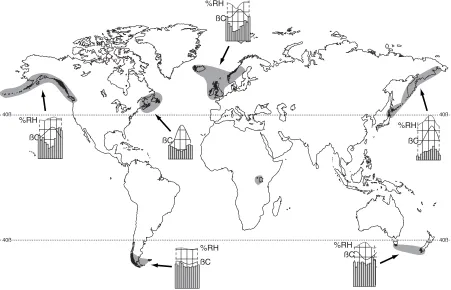
typologies described in chapter 2 are fundamentally controlled by factors such as the amount and seasonality of rainfall, mean annual and seasonal temperatures, winter minimum temperatures and freeze-thaw processes. For example, the formation of many of the landforms associated with arctic peatlands such as polygonal patterns and palsa formation are only possible where winter temperatures are low enough to produce permanent and seasonal ice formation within the peat (Allard and Rousseau 1999). In contrast, the most extensive ombrotrophic systems occur in oceanic regions with rainfall throughout the year and low summer temperatures leading to year-round saturated ground (Lindsay et al. 1988, Figure 4.1). The control of climate on peatland typology is best expressed by the zonation of peatland types in relation to main climate gradients through individual regions. This has been described for North America, Europe and Russia (Botch and Masing 1983, Eurola et al. 1984, National Wetlands Working Group 1988). Within Europe for example, the oceanic fringe from western Norway, western areas of the British Isles, and as far south as northeast Spain, is dominated by blanket mire. Eastward of this zone, there is an extensive and varied region where raised mires are the principal peat-forming systems. Raised mires extend throughout northern Europe into European Russia but change in form across this region, with the best developed raised domes of peat to the west and north and drier, flatter forms to the south and east. Moving north from this zone into much of Fennoscandia and northern European Russia (above approx. 60oN), aapa mires are dominant. Then in the extreme north, palsa mires are found with arctic polygonal fens in even colder continental settings. Of course, there are transitional zones between regions and some local variability due to local topographic and climatic conditions, but these general patterns are striking in their clarity when viewed at the continental scale.
40ß 40ß
40ß 40ß
40ß 40ß
40ß 40ß
%RH
%RH %RH
%RH ßC
ßC ßC
ßC ßC
%RH ßC
Figure 4.1: Climatically suitable areas for blanket mire formation (shaded). There is a strong association between areas with cool, wet summers and this peatland type, where peat covers most of the landscape. The inset climate graphs show the variation throughout the year of rainfall (bars), temperature and relative humidity (lines). See Chapter 2 for further description of this and other peatland types. Redrawn from Lindsay et al. (1988) and Charman (2002).
The distribution of peatland species is often closely related to climate.
Peatlands and past climate change
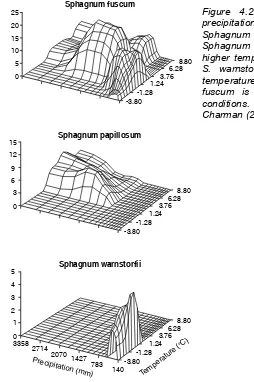
extending their overall geographical range. For example, the dwarf birch (Betula nana) shows a strong relationship with maximum July temperatures. Dwarf birch and some other arctic species like Crowberry (Empetrum nigrum) and Labrador tea (Ledum palustre) are found only in peatlands in the southern part of their distribution, where local temperature conditions are cooler, while in the Arctic they are wide spread species, not associated with peat.
Invertebrates are often more closely tied to temperature regimes than plants. For example in the UK, there is a strong altitudinal gradient of invertebrate taxa, as a function of decreasing temperatures at higher elevations. Relationships between species distributions, diversity and climate are most apparent on continental scales. Glaser (1992) shows that species diversity increases with mean annual precipitation and annual freezing degree days (cumulative temperature below 0 oC). Sites with higher precipitation and less intensive and prolonged periods of winter freezing contained a greater range of peatland taxa.
Peatlands and past climate change
4.2 Past climate variability and peatland distribution
Climate change is a normal condition for the Earth; the past record suggests continuous change rather than stability (Figure 3).
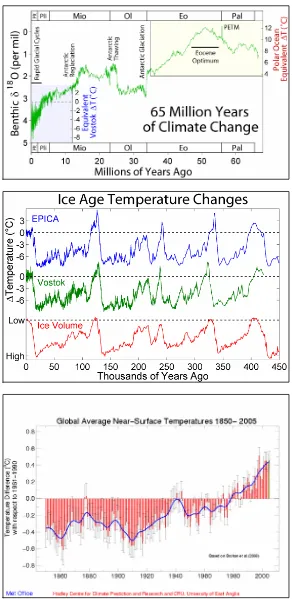
Climate change is constant. There is no period of the Earth’s history when the climate has been completely stable. Evidence from the geological record shows that climate varies over a range of timescales and with varying magnitude. Recent climate change recorded in meteorological records covering the last 150 years (see below) and future climate predictions should be seen in the context of longer term climate variability. Recent climate change may already be outside the range of natural climate variability. Climate is normally defined as average conditions over periods of 30 years or more. Variability on shorter timescales is usually referred to as changes in weather. However, this division is not a strict one; for example continuous trends in temperature within periods of 30 years may still constitute climate change. The details of very long-term climate changes are sketchy due to the incomplete and imperfect geological record. However, it seems likely that global temperatures have shown a slow decline from the beginning of the Cenozoic (approx. 65 million years ago) to the current period of geological time, the Quaternary (approximately the last 2 million years, Figure 4.3a). The climate changes on these very long timescales are controlled by various factors including the movement of the continents and tectonic uplift. These factors are insignificant over centennial to millennial timescales.
Peatlands have existed from the earliest periods of geological history, as soon as wetland plants evolved. Peatlands are a key component of the Earth system and peat formation has provided an important terrestrial carbon sink for hundreds of millions of years.
Rather little is known about the changes in distribution and mass of peatlands over very long timescales, but peatlands have certainly existed for hundreds of millions of years. The early peatlands form the coal and oil deposits from a wide range of geological periods during a variety of climatic conditions and from all continents (e.g. Bojesen-Koefoed et al. 2001, Gastaldo et al. 2004, Sykes 2004). Many of these peatlands were formed in tropical or sub-tropical climates but we have to be careful about drawing direct parallels between these ancient peatlands and those in existence today, not least because many of the plants that formed them have become extinct. Estimates of the magnitude of the carbon stored in peat compared to the carbon stored in exploitable coal show that ‘modern’ peat holds almost as much carbon as is contained in exploitable global coal reserves (Box 4.1).
The last 2 million years of Earth history (the Quaternary period) is characterised by a series of cold glacial events with warmer intervening interglacial periods. These large changes in climate are forced by predictable variations in the Earth’s orbit around the sun. Sea level was around 120m lower than present during major glacial periods.
There have been at least 20 glacial-interglacial cycles and the last 400,000 years has seen a regular pattern of change with glaciations lasting around 100,000 years and interglacials around 10-20,000 years (Figure 4.3b). The nature of this cyclicity has been demonstrated by changes in ocean sediments and ice cores (Petit et al. 1999, EPICA Community members 2004) (Petit et al. 1999, EPICA Community members 2004). The ultimate cause of these climate changes is the orbital variations of the earth around the sun, which produce predictable changes in the amount and distribution of solar radiation received at the earth’s surface. However, orbital variations alone cannot account for the climate changes observed in the geological record, and amplification mechanisms in
Box 4.1: How big is the ‘modern’ peatland carbon store compared to the ‘ancient’ peatland carbon contained in coal?
Peatlands and past climate change
the earth system must have been involved. These include changes in the carbon cycle and greenhouse gas concentrations, changes in albedo from ice, snow and vegetation, and variability in ocean circulation and heat transport.
Figure 4.3: Global temperature change a) For the last 65 million years, as shown by oxygen isotopes in benthic foraminifera in ocean sediments b) for the last 450,000 years, as shown by oxygen isotope variations in ice cores c) since AD 1850 from instrumental meteorological records. Images from Global Warming Art (2006), based on original sources Zachos et al. (2001), 1 b). Petit et al. (1999),
EPICA community members
(2004), Lisiecki and Raymo (2005), 1 c) UK Meteorological Office Hadley Centre and Climate Research Unit, University of East Anglia, Brohan et al. (2006).
Peatlands and past climate change
120 m. Peat would also have been present in tropical regions, and some existing peatlands from lower latitude areas contain sediments from during the last glacial, for example, Lynch’s Crater in Australia (e.g. Turney et al. 2005) and the Nakaikemi Wetland in south-west Honshu Japan (Saito 2004). The deepest peat/lignite layer in the world is probably the Phillipi peatland in Greece, reputed to be 190 m deep (Kalaitzidis and Christanis 2002), and dating largely from the Pleistocene.
Fragments of peatlands that formed during previous warm phases (interglacials or interstadials) can also be found under glacial till in areas that were subsequently covered by ice. For example, in Finnish Lapland, peat from the last (‘Eemian’, c. 120,000 years BP) interglacial has been reported. The peat contains abundant pollen of spruce and Sphagnum spores, which together indicate that peatland was present across a wide area (Saarnisto et al. 1999). Further east, peat deposits formed during a later interstadial and dating from 33,300 to 41,900 years BP can be found in Southern Valday. These deposits lie outside the last glacial maximum and therefore avoided destruction by the ice sheet (Minayeva et al 2005). Other old peat deposits occur in North America in sediments from below the Laurentide ice sheet, such as the Missinaibi beds in Ontario, Canada. These have been dated to 38 000 and 53 000 years BP (Terasmae and Hughes 1960). The extent of peatlands during previous interglacial and glacial periods cannot be estimated with any certainty because they have been subsequently eroded by ice or submerged under rising sea levels. However, refugia for peatland taxa must have existed during these phases and peatland development may have been very extensive in some locations.
Atmospheric carbon dioxide concentrations were much lower during glacial periods, and peatlands and other organic-rich soils may have still played a significant role as one of the enhanced sinks for CO2 during these phases. Peat growth may also have played a role in the feedbacks controlling glacial-interglacial cycles, removing carbon during warm phases thus lowering atmospheric CO2 levels and contributing to the climatic downturn to an ice age (Franzen et al. 1996).
Climate changes in the current postglacial (approximately the last 11,500 calendar years) occurred gradually as a result of changes in the Earth’s orbit, and more rapidly due to changes in solar output, volcanic activity and internal ocean-atmosphere processes.
The last 11,500 calendar years (= c. 10,000 radiocarbon years1) have been relatively stable compared to the glacial-interglacial cycles (Figure 3). However, it is increasingly realised that there were significant changes in global and regional climate during this time, and that some of these changes were manifested as abrupt climate changes rather than as long term gradual shifts. Most importantly for peatlands, hydrological changes appear to have been some of the most marked changes during the Holocene, often occurring over short (decadal to centennial) timescales. In many continental regions there is abundant evidence for recurrent and severe drought episodes during the late Holocene, many of which were greater in magnitude and/or extent than those observed during historical times (Cook et al. 2004, Booth et al. 2005, 2006). For example, a widespread drought spanning several centuries about 4200 years ago has been documented throughout mid-continental North America and parts of the rest of the world (Booth et al. 2005). Similarly, tree-ring based drought reconstructions in western North America indicate recurring intervals of persistent, severe, and widespread drought during the last 1000 years, most notably a series of multidecadal events during the Medieval Climate Anomaly (or Medieval Warm Period) (Cook et al. 2004). The causes of these and other centennial and sub-centennnial scale fluctuations in water balance are not well understood, and the influence of orbital cycles on continental climate is only apparent over much longer timescales. However, variations in water balance over these shorter timescales may have been triggered by the dynamical response of the coupled ocean-atmosphere system to changes in solar and/or volcanic forcing. For example, sea-surface temperature anomalies (SSTs) appear to have played an important role in decadal to multidecadal drought episodes during historical time periods (Hoerling and Kumar 2003, McCabe et al. 2004, Schubert et al. 2004), and past changes in solar output and volcanic emissions may have amplified similar dynamics. However, mechanisms linking drought and SST anomalies are not clear and the response of the ocean-atmosphere system to changes in external forcing needs to be better understood.
Many existing peatlands started growth soon after the warming following the last glacial maximum. The initiation of new peatlands has continued throughout the postglacial period in response to changes in climate and successional change.
After the recession of the large Eurasian and North American ice sheets, new land surfaces for
1 Ages younger than 11,500 calendar years are all cited as calibrated radiocarbon ages unless they are
Peatlands and past climate change
peatland development were exposed. At the same time, other land was inundated by the rising seas. This process still continues at a much lower rate today. Many modern peatlands started growth almost as soon as the climate warmed. For example boreal peatlands began growth as early as 16,500 years ago (MacDonald et al. 2006) and the extensive western Siberian peatlands began their main period of growth 11,500 years ago (Smith et al. 2004). Other peatlands took longer to begin growth, either because of greater delays in the exposure of the land surface or because of climatic factors. For example, it is clear that large parts of the northern hemisphere were subjected to a short (around 1000 years) cold snap which interrupted the warming after the last glacial maximum. Extensive peat growth in the northern hemisphere may also have been delayed by the relatively warm conditions in the early Holocene. The extended retreat of the large ice sheets over the first 3000-4000 years of the Holocene in the northern hemisphere also delayed peat growth (e.g. Mäkilä 2006). However, in many regions, the initiation of new peatlands continued into the early Holocene and proceeded throughout the whole of the Holocene period. New peatlands are still beginning growth on freshly exposed terrain such as the emerging land surface of the Gulf of Bothnia (Hulme 1994).
Holocene climate change led to a succession of new peatlands being formed in many parts of the world including Australia (Kershaw et al. 1997) and western Canada (Halsey et al. 1998). This is confirmed by the correspondence between dates of peat initiation and other independently derived records of past climate change (Campbell et al. 2000). Other factors clearly played a role in encouraging the growth of peat in some regions. In Britain, it has long been recognised that deforestation by humans probably altered the water balance sufficiently to allow the accumulation of organic matter and ultimately the development of deeper peat (Moore 1993). However, most peat initiation appears to be climatically driven rather than a result of human activity or other local factors.
Peatland expansion has been a constant process during the Holocene.
Once peatlands became established, most of them continued to grow vertically and expand laterally throughout the Holocene period. It is not known whether some peatlands disappeared during this time because evidence for any former peatlands may have eroded or decayed completely. For example it is well known that sub-Saharan Africa experienced much wetter climates during the early Holocene, and it is likely that there were peat-forming wetlands in this region. Elsewhere, peatlands spread partly as a result of ecological and soil development processes and partly as a result of changing climate. Korhola (1995) attributes the spread of mires in Finland to climatic change, with phases of expansion occurring at times of increased moisture excess also reflected in lake level changes in the region.
4.3 Peatland archives of past climate change
Peatlands provide a record of their own development preserved in the peat itself. This means that it is possible to trace the changes in peatlands through time, in response to climate change and other influences such as succession and human activity (see Box 4.2).
Peatlands are unique ecosystems because they preserve a record of their ecological and physical structure in water-saturated sediments, where decomposition rates are slower than production (Charman 2002). Peat is primarily formed from the dead remains of plants that once grew on the mire surface. However, when the layers of successive vegetation remains are laid down, they incorporate a range of other microscopic remains and geochemical signals of past environmental conditions. In fact, virtually everything living in or around a peatland has the potential to be preserved in the accumulating peat (Charman 2002), although there is a clear bias toward materials that are decay-resistant, such as structures rich in refractory compounds like lignin or chitin. The excellent preservation of materials in peat allows a variety of biological, physical, and geochemical techniques to be used to reconstruct past environmental conditions. Application of these methods provides a secure basis for understanding how peatlands have responded to past climate variability and change.
Peatlands and past climate change
widespread deforestation of catchments and the formation of at least some of the ‘floating bogs’ that are found in the numerous surface depressions in the area (Warner et al. 1989).
Peatlands also provide records of past changes in the wider landscape and environment such as regional vegetation change, atmospheric pollution and climate change.
Some peat characteristics are representative of the local peatland environment and structure, and others are derived from adjacent uplands or the wider region. Thus, landscape and regional perspectives can be provided by peat stratigraphy, and compared to the developmental history of the peatland itself. For example, plant macrofossils can provide excellent records of peatland vegetation, and can be used to investigate local vegetational and hydrological dynamics within a peatland (McMullen et al. 2004). These local dynamics can be compared to temporal changes in macrofossils and pollen of upland plants, providing insight into the long-term linkages between peatlands and the surrounding landscape (e.g. Singer et al. 1996, Campbell et al. 1997, Wilmhurst et al. 2002, Booth et al. 2004). Recent and ongoing studies in the mid-continent of North America have been employing coupled studies of past peatland hydrology and upland vegetation to provide insight into the direct responses of upland tree populations to changes in water balance, providing insight into population dynamics at centennial timescales (Jackson et al. 2006). Peatlands also record changes in atmospheric deposition, and changes in heavy metal concentrations have been used assess regional and sometimes global atmospheric pollution levels (Shotyk and Krachler 2004).
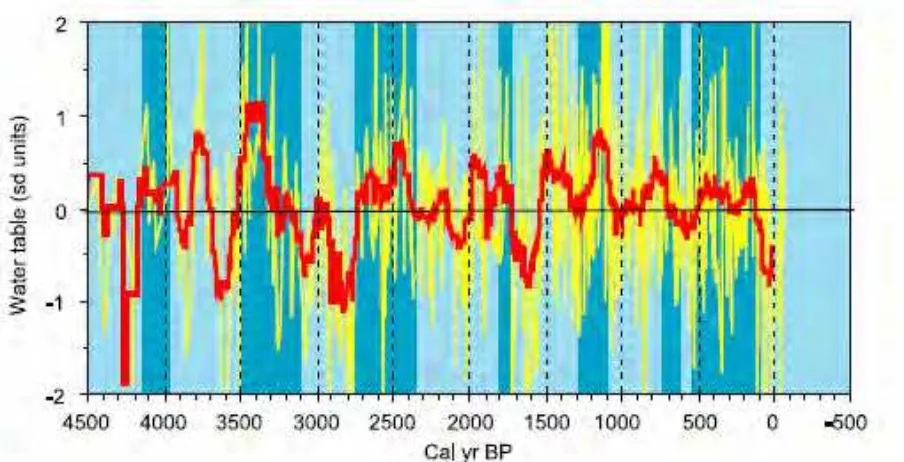
Figure 4.4: Changes in peatland surface wetness over the past 4500 years inferred from 12 records of reconstructed water table variability from northern Britain (Charman et al. 2006). When the peatlands were wet (up on the graph), precipitation was higher and temperature may have been lower. Using multiple cores avoids problems associated with purely local, non-climatic influences. The change at around 2750 years ago is the same period as the Sub-Boreal to Sub-Atlantic transition (see text). This change was identified over 100 years ago but as the diagram shows, there were also other, sometimes equally important changes at other times. The blue bands mark periods when lake levels were higher in central Europe, showing that the main phases of wet conditions were similar across the European continent.
Evidence from peatlands can be used to reconstruct past changes in climate, contributing to the growing archive of information on past climate changes, as well as providing information on the ways in which peatland systems respond and adapt to climate changes.
Peatlands and past climate change
In many peatland systems, hydrological status is particularly sensitive to climate variability. These ombrotrophic peatlands receive all of their water from precipitation rather than from runoff or groundwater supplies and therefore changes in their surface wetness primarily reflect climate change from either precipitation or evapotranspiration variations (Blackford 2000). However, local changes in hydrology can also occur as a result of non-climatic factors such as successional processes and local vegetation dynamics. As a result, more reliable reconstructions of past climate can be gained from multi-core and multi-site reconstructions of hydrology (Figure 4.4, Charman et al. 2006). Climate change can also be inferred from other independent markers of climate change such as isotopes of carbon, hydrogen and oxygen (Pendall et al. 2001).
Box 4.2: Peatland archives
Evidence of past change: To understand the way the ‘Earth system’ works, we need information on how the environment and climate have changed in the past. This information is provided by a range of natural ‘archives’ that range from ice cores, ocean and lake sediments, to tree rings and stalactites in caves.Peat also contains a variety of evidence of past environmental changes. These consist of plants, animals and microbes that once lived on the peatland, as well as material such as pollen, dust and pollution blown in from more distant areas. Studies of the biology and geochemistry of peat have taught us much about changes in the past. Some of the main indicators are:
• Pollen and spores. These provide us with information on the main changes in vegetation on and around the peatland, such as forest history
• Plant macrofossils. These are larger plant fragments usually from plants growing on the peatland itself. They tell us how the vegetation of the peatland has changed through time in more detail than pollen alone.
• Protozoa, diatoms and other microfossils. There is a huge variety of remains of small organisms preserved in peat, including amoebae, diatoms and other algae, fungi and a range of invertebrates. Particularly notable are the testate amoebae that allow us to reconstruct hydrological changes on peatlands.
• Peat humification or degree of decay of the peat. This provides information on past changes in decomposition.
• Heavy metals. These indicate changes in pollutant history and other disturbances to the peatland.
• Stable isotopes of carbon, oxygen and hydrogen. These can be used to help understand changes in hydrology and temperature.
• Biomarkers. These are complex chemicals associated with particular plants and are being developed as a new tool for reconstructing environmental changes from peat.
Finding out when changes took place: The evidence of past changes can be used to reconstruct what happened in the past, but they don’t tell us when events took place. However, peat can be dated using various techniques. The principal technique is radiocarbon dating which depends on the presence of tiny amounts of radioactive carbon. This gradually decays at a known rate over time; more radiocarbon indicates the peat is young. Older peat contains much less radiocarbon and almost none at all after about 50,000 years. Other similar ‘radiometric’ techniques include lead (210Pb), caesium (137Cs), and Americium (241Am) for peat formed in the last 150 years. We can also estimate the age of peat from other markers such as volcanic ash layers of known age, vegetation changes of known age detected by pollen analysis (e.g. plantation of non-native trees in Europe), and pollution markers of known age (e.g. increased use of fossil fuels in the 20th century).
4.4 Peatland responses to past climate change
Peatlands change as a result of both internal ecological processes and external forcing such as climate change and human disturbance. The relative influence of these factors depends on the magnitude of forcing and the type and stage of development of the peatland. In the past, climate has been the most important influence on changes in peatlands.
Peatlands and past climate change
when severe enough, may over-ride both internal ecological factors and climate change to alter the system. However, under natural conditions, climate is the most important determinant of changes over time (e.g. Barber 1981).
Peatlands have experienced many climate changes in the past and in their natural state, peatlands are often resilient to such changes.
Changing climates over the Holocene have been a major influence on peatland condition. Because of the preservation of biological and geochemical evidence in peat, quite a lot is known about the responses of peatlands to climate change over several centuries and millennia. However, these studies are sometimes limited in the range of changes they can detect. In northwest Europe, a series of fluctuations from wet to dry conditions have occurred in response to past climate changes. The most easily observed and dramatic change is the switch from dark peat to lighter peat at the so-called ‘Grenzhorizont’ dating from approximately 2500 years BP. This widespread feature reflects changes from dry to wet conditions at this time. Throughout the Holocene period there has been a series of such changes from dry to wet and back to dry conditions recorded in many peatlands (Barber and Charman 2003). This suggests that in their natural state, peatlands can persist through a variety of climate regimes. Extreme dry periods may in some cases result in a cessation of peat growth but accumulation resumes once conditions become wetter again, for example, in peatlands of north-west Europe and mid-continental North America. In some circumstances, climate change is sufficient to stop or at least retard peat growth for much longer periods of time. For example, in some parts of the arctic, there is evidence that peat growth has slowed down substantially in the last 3000 to 5000 years as a result of regional cooling (Vardy et al. 2005). Under natural conditions, peatlands are self-regulated systems that have developed different mechanisms to resist changes in hydrological regime caused by climatic fluctuations. During drought, evaporative loss is reduced due to the formation of a ‘skin’ of dried surface vegetation. Changes in moisture content result in ‘mire breathing’ where the surface of the peatland rises and falls depending on the amount of available water, assisting the maintenance of the water table at a high level during drought periods.
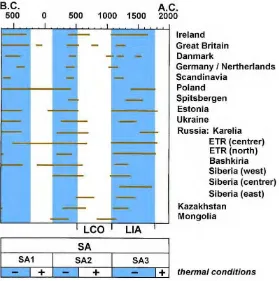
Figure 4.5: Periods of intensive peat accumulation in different regions of Eurasia. SA – Subatlantic (2600 B.P. to present) and some suggested subperiods (labelled here as SA1, SA2, SA3), LCO – Little Climatic Optimum (500–1100 A.D.), LIA – Little Ace Age (1100–1750 A.D.) (After Klimanov and Sirin, 1997).
Hydrological change is the most frequently recorded response to past long-term climate change but the exact nature of the response depends on peatland type and local setting.
Peatlands and past climate change
are most likely to be sensitive to shifts in summer precipitation whereas in more continental areas, temperature is probably an additional significant influence (Charman et al. 2004). In high latitudes, snow melt is an important additional influence (Ruuhijarvi 1983). Because hydrology is a key driver of many peatland functions, past hydrological changes would have been accompanied by shifts in biodiversity, carbon accumulation and greenhouse gas exchanges.
Having inputs of surface and ground water, fens often show more resilience to shifts of precipitation and evapotranspiration than bogs, which only have an atmospheric water supply. Less connection to water sources other then precipitation make peatlands more sensitive to paleoclimate fluctuations, as shown by comparison of the Holocene history of the raised bogs, groundwater-fed fen and the peatland with water inflow from adjacent upland in the Central European Russia (Sirin 1999). Among raised bogs of the same region larger peatlands occurring on moraine clay were more resilient to the climate changes during last 3 thousand years than the smaller bog lying on the outwash sands (Rauber 2002).
Palaeoecological records show that fire frequency is increased during periods of warm, dry climate, but that much greater changes are brought about as a result of human activity. Although fires occur under natural conditions, there is evidence that fire frequency has been altered by human activity in both prehistoric and historical times.
Although peatlands generally have water tables near the surface and are therefore less susceptible to fire than dryland ecosystems, natural fires do occur during dry periods. The relationship between fire, climate and human activity varies between regions and peatland types, although in general peatland fires are more frequent during warm, dry periods. In western Siberia, it seems unlikely that fire has led to large losses of peat at any time during the last 7-8000 years, with fires only affecting the extreme margins of the main peatland expanse (Turunen et al. 2001). In this case, it appears that the wetness of the mire has prevented the spread of upland forest fires onto the peatland surface. In northwest Europe, similarly small marginal areas of peatland have been burnt and large increases in fire frequency are only found as a result of human activity (Pitkanen et al. 2002). In Kalimantan, Indonesia, the presence of charcoal demonstrates that the forest experienced fires during the whole of the past 30,000 years (Anshari et al. 2001). Increases in fire frequency are recorded as a result of human activity during the last 3000 years and especially within the last 1000 years (Anshari et al. 2004, Hope et al. 2005). Although human activity appears to be typically associated with increased fire frequency on peatlands, this is not always the case. For example, fire is an important part of the ecology of pocosins, which are precipitation-fed shrub bogs of the southeastern United States (e.g. Christensen et al. 1981). Fire suppression during the past 100 years is decreasing the natural fire frequency and leading to ecological changes in these systems.
Rates of carbon accumulation have varied in response to past climate change. The nature of the response depends upon the initial climate conditions and the type of peatland. Peatland response depends on the balance between plant productivity and decay rates in the surface peat layers.
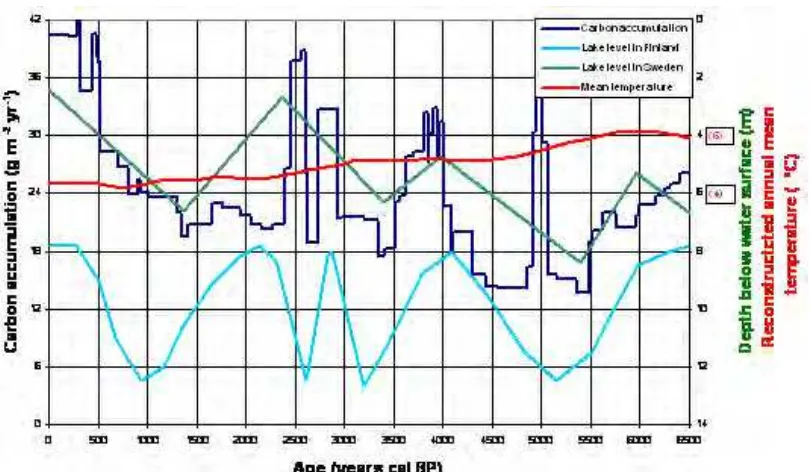
Rates of peat accumulation in peatlands have varied through the Holocene period. Some of these changes are due to successional change in peatlands, typically with high accumulation rates in phases of terrestrialisation. However, where there is stability of peatland type through a period of climate change, palaeoecological studies show that the rate of carbon storage changes. In northern Finland, aapa mires show reduced carbon accumulation after 7000 years BP, followed by an increase at around 4500 years BP, thought to be related to the change from a relatively warm, dry mid-Holocene period to a cooler and moister later mid-Holocene (Makila et al. 2001). Similar linkages between climate and carbon accumulation have been documented in other regions (e.g. Mauquoy et al. 2002, Yu et al. 2003).
Peatlands and past climate change
Figure 4.6: Average rate of carbon accumulation in the three raised bogs in southern Finland (Mäkilä and Saarnisto 2005) and lake-level fluctuations in Finland and in Sweden. The green line indicates modified Holocene lake-level fluctuations according to Digerfeldt (1988) and light blue line the fluctuations according to Sarmaja-Korjonen (2001). Lake-level positions are expressed only as high or low by Sarmaja-Korjonen (2001). The quantitative annual mean temperature reconstruction based on pollen is also shown (Heikkilä and Seppä 2003).
Raised bogs in mid-latitude areas show significant changes over time. For example, during the Little Ice Age (approx. AD 1300 to 1800 in this case), carbon accumulation rates in three European mires were lower than former periods because of reduced plant productivity in shorter growing seasons but also perhaps because of a shift to species with high decomposition rates (Mauquoy et al. 2002). This last point highlights the inter-relationships between climate, peat accumulation and biodiversity changes and demonstrates the need for a complete systems understanding to be able to predict responses to future change. In Kalimantan, carbon accumulation was lower during the last glacial maximum, presumably due to lower primary productivity because of lower temperatures. Holocene rates were much faster, especially during the early Holocene (Page et al. 2004). In West Siberia, the early to mid Holocene was also the most important period for carbon accumulation, with around 55% of the total stored carbon accumulated by 6000 years ago. Particularly rapid lateral expansion of peatlands and consequent increased carbon storage was found between 7000 and 8000 years ago (Turunen et al. 2001), perhaps due to a warmer climate during this time.
Lateral spread of peatlands may also be an important control on overall carbon accumulation rates. In southern Finland, lateral spread of peatlands occurred rapidly with around half of the total present area paludified by 8000 years BP (Mäkilä 1997, Mäkilä et al. 2001). In the north, spread was slower (Mäkilä and Moisanen 2007). Local differences in rates of mire expansion and therefore carbon accumulation rates are also affected by topography, which is a key control on the locations to which peatland can spread (e.g. Korhola 1992). For Finnish mires, by the time they had attained their modern extent, they had accumulated over half of their modern carbon store. 55% of the carbon had formed before 4000 cal. yr BP in a southern aapa mire Ruosuo, and 58% of the carbon before 5000 cal. yr BP in a northern fen Luovuoma in Finnish Lapland (Mäkilä 1997, Mäkilä et al. 2001, (Mäkilä and Moisanen, 2007).
Peatland response to climate change may not occur smoothly; sudden changes may occur when specific climate and/or ecological thresholds are reached.
Peatlands and past climate change
4.5 Peatland feedbacks to climate change
Peatlands are affected by climate changes in many different ways but they also play an important role in modifying climate themselves. These effects are known as ‘feedbacks’. Several of these effects are covered in more detail elsewhere in this report so here we simply summarise some of the key points.
Peatlands play a key role in the global carbon cycle, acting both as sinks for carbon dioxide and as sources of methane. Both these processes have had a significant influence on global climate change throughout Earth history.
It is evident from preceding sections that the build up of large volumes of peat represents a vast quantity of carbon. The drawdown of carbon dioxide from the atmosphere to storage in peat has a net cooling effect on climate. Any factors that either slow down (speed up) carbon sequestration represent a warming (cooling) effect on global climate. The carbon stored in peatlands during previous millennia is the basis of all the coal, oil and gas reserves now being exploited as energy sources. This is therefore a feedback that has operated throughout Earth history. Methane emissions from peatland are a further feedback to climate change. Warmer, wetter conditions enhance methane emissions increasing global temperatures, while cool, dry conditions suppress methane emissions and reduce global temperatures. It is now known that past natural variations in methane concentrations were strongly influenced by changes in peatland extent and condition (See section 7.2 for further detail)
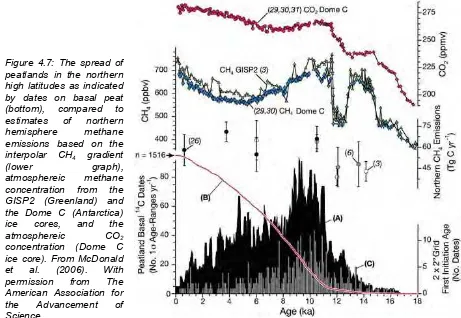
Figure 4.7: The spread of peatlands in the northern high latitudes as indicated by dates on basal peat (bottom), compared to estimates of northern hemisphere methane emissions based on the interpolar CH4 gradient
(lower graph),
atmosphereic methane concentration from the GISP2 (Greenland) and the Dome C (Antarctica) ice cores, and the atmosphereic CO2
concentration (Dome C ice core). From McDonald et al. (2006). With permission from The American Association for the Advancement of Science.
Greenhouse gases show variable atmospheric concentrations throughout the last 15,000 years. Peatlands contribute to these natural variations in atmospheric composition.
Peatlands and past climate change
Peatlands reduce atmospheric warming by reflecting more incoming solar radiation than forested dryland regions.
Peatlands are generally more open landscapes than adjacent upland regions. Surface vegetation of mosses, sedges, grasses, low growing shrubs and open water has a much higher albedo (ability to reflect radiation) than closed canopy forest. Treeless peatlands in northern regions and oceanic areas therefore reflect much more incoming solar radiation than surrounding forested areas. On forested peatlands, tree cover tends to be less dense than on mineral soils and there is a therefore a smaller but still significant difference in the albedo between peat and non-peat dominated areas in these regions. Furthermore, open ground in northern regions tends to have much higher albedo during the period of snow cover in winter, an effect particularly noticeable in late spring (Rouse, 2000).
Peatlands exert a strong effect on local microclimates such that the temperature regime and relative humidity are significantly different to those in surrounding dryland areas.
The high moisture levels in peatlands, the mass of peat with a high thermal inertia and the particular characteristics of the vegetation cover modify local climate regimes. In particular, they produce higher air humidity and lower temperatures in summer. Wind speeds are also typically higher than in surrounding areas. This results in conditions that allow disjunct distributions of species, with some taxa occurring on peatlands far beyond their normal range for surrounding areas (see Chapter 5).
4.6 Recent changes in climate and peatland responses
To document recent changes in both climate and peatland systems, direct observations and measurements can often be used rather than the geological record, although direct observations on peatlands are limited in timescale and scope. The main changes in climate are highlighted in the Summary for Policymakers of the IPCC Fourth Assessment Report (IPCC 2007). The key findings of most relevance to peatlands are summarised here.
Global temperatures have risen by approximately 0.74oC during the last 100 years (Years AD
1906-2005). Temperature changes in the last 50 years are very likely explained by anthropogenic greenhouse gas emissions. It is likely that the 1990s and 2000s were the hottest decades for at least the last 600 years.
It is not until the 17th century that reliable and regular meteorological measurements were made. Before this we are reliant on ‘proxy’ records of climate from the geological record, tree rings and indirect documentary sources. The last 150 years or so is the only period for which direct measurements of global surface temperatures are reliable. These show that temperatures have risen by approximately 0.74oC since the early 20th century, with the increases occurring mostly during the first half of the 20th century and since around 1970 (Trenberth et al. 2007) These changes can only be explained by invoking both natural climate forcings (solar and volcanic) and the effects of increasing greenhouse gas concentrations in the atmosphere (principally carbon dioxide, CO2, and methane, CH4) (Mitchell et al. 2001). Although results are still controversial to some extent, a number of studies have shown that it is likely that the 1990s were the warmest decade for at least the last 600 years and probably the last 1000 years (Mann et al. 1999, Moberg et al. 2005).
Global changes in precipitation over the last 100 years are harder to detect but there is strong evidence to suggest changes in total precipitation, seasonality and extremes in some regions where peatlands are found.
Peatlands and past climate change
persistent and frequent since the mid-1970s, increasing the inter-annual variability of precipitation to some areas (such as SE Asia) that have important concentrations of peatlands. There were generally only small increases in severe droughts or severe wetness and much of the variability in these phenomena was controlled by inter-decadal and multi-decadal climate variability rather than centennial scale trends. Seasonal changes in precipitation may be of particular importance in some regions. For example, in the United Kingdom, there has been a decrease in summer precipitation and a smaller increase in winter precipitation over the 20th century.
Global sea levels have risen at an average rate of 1.8 ± 0.5 mm p.a. over the period 1961 to 2003 Regional rates of sea-level rise are moderated by land surface movements which may increase or decrease these global averages.
Observations of past sea levels from tide gauges and satellite data suggest that there has been a rise in sea level of 17 cm ± 5 cm during the 20th century Data from before 1900 are rather few but there is high confidence that there was an acceleration of sea-level rise from the 19th to the 20th century (Bindoff et al. 2007). Geological data support this conclusion (e.g. (Gehrels et al. 2002).However, the impacts of any sea-level rise will depend on local factors such as land surface changes principally from isostatic change but also from local variability in ocean circulation, warming and expansion. These local differences are more difficult to predict with any accuracy, although the general directions and magnitude of isostatic change are well-known, For example, there is land uplift in northern Scandinavia and subsidence in southern England.
Recent observed changes show that peatlands have already responded to 20th century climate
change.
Direct observations of changes in peatlands indicate that recent climate changes may already be having an impact. However, in some cases it is difficult to attribute changes to climate alone because of alterations in atmospheric pollution (especially nitrogen deposition) and management (grazing, fire). The following examples indicate changes that may have already have occurred as a result of 20th century climate change.
The extent and duration of permafrost in northern peatlands has decreased.
In northern peatlands a rise in late 20th century temperatures is linked to a reduction in the extent of permafrost. In northern Manitoba, a regional warming of 1.32 oC has caused accelerated permafrost thawing (Camill 2005). These patterns are repeated across much of arctic Canada where the southern limit of permafrost in peatlands has moved north by 39km on average and as much as 200km north in some places (Beilman et al. 2001). However, there are indications that changes in permafrost are not exclusively linked to temperature rise. For example, rapid permafrost melting since the late 1950s in Quebec has caused an increase in thermokarst ponds as a result of increased snow precipitation and insulation of the surface rather than a rise in temperature, which did not occur until the late 1990s (Payette et al. 2004, Camill 2005). This was accompanied by an increase in peat accumulation rates as a result of renewed succession and terrestrialisation in the areas affected.
Changes observed over shorter timescales also indicate that these northern systems are sensitive even to small changes in climate. For example, in August 2005 the permafrostmounds of the northern fen Luovuoma (Finland) thawed due to abnormally wet weather in the two preceding years. Although there were late snowfalls up to May 2005, the snow cover quickly thawed. In addition, the ensuing July was abnormally warm (eight days in which the temperature was at least 25 oC, compared to two for the period 1971-2000). Small changes in precipitation, snow cover and temperature thus cause a step change in the system. Progressively milder winters may already threaten the prolonged existence of frozen palsa mounds because of the thicker snow cover caused by increased precipitation. Several other authors have shown the responsiveness of permafrost to climatic fluctuation. Permafrost has been found to be highly dynamic during short-term climatic fluctuations, for instance in Alaska (Osterkamp et al. 1994) and in north-western European Russia (Oberman and Mazhitova 2001).
Changes in plant communities have occurred during the last 50 years that may be related to recent climate change.
Peatlands and past climate change
cases, it is impossible to separate the effects of successional processes from those ‘external’ factors such as atmospheric pollution, subtle changes in human management and climate change. However, recent work suggests that the impact of climate change on mid-latitude peatlands may already be one of surface drying and water table decline (Smith et al. 2003, Hendon and Charman 2004).
Strong El Nino events have produced a larger number of severe fires in South East Asian peatlands.
The smoke from burning forests and peatlands that has become a regular occurrence in south east Asia is a severe threat to peatlands in the region as well as to human health and economic growth. The fires are started for forest or scrub clearance and are made much worse by drainage and previous damage making them more susceptible to burning. However, meteorological conditions play an important part in determining the frequency and severity of fires. During ENSO events, south east Asia experiences much drier than usual conditions and moisture levels in peatlands are much lower than normal. Thus some of the most severe fires occur during ENSO years. For example in 1997/98, it is estimated that between 0.81-2.57 Gt of carbon was lost from burning peatlands in Indonesia – equivalent to 13-40% of global annual fossil fuel emissions (Page et al. 2002).
Changes in the phenology (timing of plant growth stages) such as spore and pollen production have occurred in many ecosystems. It is likely that similar changes have occurred in peatlands.
Phenological changes have been recorded for many ecosystems around the world, as evidenced by large scale compilations of long-term biological records (e.g. Menzel 2006). Phenological records on peatlands are not available over sufficiently long periods but short term monitoring and experimental studies show that climate exerts a major control on peatland organisms. Monitoring over a 10 year period showed that sporophyte production in Sphagnum is positively related to the amount of precipitation the previous summer, suggesting the process is especially sensitive to summer droughts (Sundberg 2002). Experimental studies using artificially altered microclimate show that temperature is an important control on the timing of flowering in higher plants on peatlands (Aerts 2006).
Increasing aridity and associated drought frequency and intensity has led to degradation of peatlands in some steppe and mountain regions.
There is evidence of increased aridity in steppe and mountain regions of Central Asia and some other parts of the world. The last 10 years have been drier than average (especially 2000-2002) and this, combined with overgrazing, has led to the loss of extensive areas of peatland in Mongolia. During the extended droughts, the peatlands become much drier and the growth of dryland grasses is encouraged, changing vegetation to meadows and steppe ecotypes. These effects are particularly noticeable in the Orchon River and Ider valleys and the Darchat inter-montain basin. Old maps, native populations and existing literature data described these areas as covered with vast mires, and as very wet and impassable during the early 20th century. During the 1950s, botanists described very wet rich fens with peat and tall sedges covering the Orchon River valley. In 2004 and 2005, this same area had only sparse vegetation cover with areas of exposed peat and fungal growth. Instead of being impassable, it is now easy to drive across the surface in an ordinary vehicle (Minayeva et al. 2004, 2005).
Drier peat surfaces have experienced erosion during storm rainfall.
Increased aridity and consequent drying of peat surfaces makes peatlands more susceptible to erosion because the structure of the peat is weakened, especially where vegetation cover has been reduced or removed altogether. In Mongolia, erosion of dried sloping peatlands was observed in mountain regions during 2004-2005 (Minayeva et al. 2004, 2005). Similar situations may exist in other regions of the world, although it is sometimes difficult to dissociate the effect of climate variability from human impacts such as drainage, grazing and burning.
Coastal peatlands have undergone marine transgressions during periods of past sea-level rise and new peatlands have formed in areas where sea level has fallen.
Peatlands and past climate change
In many cases, human activity has exacerbated impacts associated with climate change phenomena.
Disentangling the effects of climate change from those of human activity is not always possible, but it is clear that in many cases human actions have increased the vulnerability of peatlands to climate changes during the last 100 years. The impacts of climate change in many of the above examples are much worse where drainage, burning and over-grazing are also involved. In Indonesia, peat fires are always more severe in drained, logged peatlands than in pristine areas. Likewise, peatland damage in Mongolia from increased droughts is exacerbated by over-grazing. Erosion of peat from high intensity rainfall is more likely when vegetation has been reduced or removed by grazing and pollution (Warburton et al. 2004).
References
Allard, M., and Rousseau L. 1999. The internal structure of a palsa and a peat plateau in the Riviere Boniface region, Quebec: Inferences on the formation of ice segregation mounds. Geographie Physique et Quaternaire 53:373-387.
Alpinis, A. 1940. Untersuchung über die Ökologie der Trapa L. I. Teil: Systematische Zugehörigkeit, Geschichte, Standortsverhältnisse und die Verbreitung der Pflanze in Lettland. II. Teil. Bedingungen der Keimung und Entwicklung der Pflanze. Acta Horti Bot. Univ. Latviensis 13: 84-145.
Anshari, G., Kershaw A. P., and Van der Kaars S. 2001. A Late Pleistocene and Holocene pollen and charcoal record from peat swamp forest, Lake Sentarum wildlife reserve, West Kalimantan, Indonesia. Palaeogeography, Palaeoclimatology, Palaeoecology 171:213-228.
Anshari, G., Kershaw A. P., Van der Kaars S., and Jacobsen G. 2004. Environmental change and peatland forest dynamics in the Lake Sentarum area, West Kalimantan, Indonesia. Journal of Quaternary Science 19:637-655.
Aurela, M. 2005. Carbon dioxide exchange in subarctic ecosystems measured by a micrometeorological technique. Finnish Meteorological Institute. Contributions 51: 1-39 . Barber, K. E., and Charman D. J. 2003. Holocene palaeoclimate records from peatlands. Pages
210-226 in A. W. Mackay, R. W. Battarbee, H. J. B. Birks, and F. Oldfield editors. Global Change in the Holocene . Edward Arnold, London.
Barber, K.E. 1981. Peat stratigraphy and climatic change. AA Balkema, Rotterdam.
Beilman, D. W., Vitt D. H., and Halsey L. A. 2001. Localized permafrost peatlands in western Canada: Definition, distributions, and degradation. Arctic, Antarctic, and Alpine Research 33:70-77.
Blackford, J. 2000. Palaeoclimatic records from peat bogs. Trends in Ecology & Evolution 15:193-198. Bojesen-Koefoed, J. A., Dam G., Nytoft H. P., Pedersen G. K., and Petersen H. I. 2001. Drowning of a
nearshore peat-forming environment, Atane Formation (Cretaceous) at Asuk, West Greenland: Sedimentology, organic petrography and geochemistry. Organic Geochemistry 32:967-980. Booth, R.K. , Notaro M., Jackson S.T., and Kutzbach J.E.. 2006. Widespread drought episodes in the
western Great Lakes region during the past 2000 years: geographic extent and potential mechanisms. Earth and Planetary Science Letters 242: 415-427.
Botch, M. S., and Masing V. V. 1983. Mire systems in the USSR. Pages 95-152 in A. J. P. Gore editor. Ecosystems of the World 4B, Mire: Swamp, Bog, Fen and Moor. Elsevier, Amsterdam.
Camill, P. 2005. Permafrost thaw accelerates in boreal peatlands during late-20th century climate warming. Climatic Change 68:135-152.
Campbell, D.R., Duthie H.C., Warner B.G., 1997. Post-glacial development of a kettle-hole peatland in southern Ontario. Ecoscience 4:404 – 418.
Peatlands and past climate change
Cannell, M. G. R., Milne R., Hargreaves K. J., Brown T. A. W., Cruickshank M. M., Bradley R. I., Spencer T., Hope D., Billett M. F., Adger W. N., and Subak S. 1999. National inventories of terrestrial carbon sources and sinks: The UK experience. Climatic Change 42:505-530.
Charman, D. J., Blundell A., Chiverrell R. C., Hendon D., and Langdon P. G. 2006. Compilation of non-annually resolved Holocene proxy climate records: Stacked Holocene peatland palaeo-water table reconstructions from northern Britain. Quaternary Science Reviews 25:336-350.
Charman, D., Mäkilä, M. 2003. Climate reconstruction from peatlands. PAGES Newsletter 11, 2-3: 15-17.
Church, J. A., Gregory J. M., Huybrechts M., Kuhn M., Lambeck K., Nhuan M. T., Qin D., and Woodworth P. L. 2001. Pages 639-693 in J. T. Houghton, and et al editors. Climate Change 2001: The scientific basis. Cambridge University Press.
Cook, E.R., C. Woodhouse, D.M. Meko, D.W. Stahle. 2004. Long-term aridity changes in the western United States, Science 306:1015–1018.
Digerfeldt, G.1988. Reconstruction and regional correlation of Holocene lake-level fluctuations in Lake Bysjön, south Sweden. Boreas 17: 165-182.
EPICA Community members. 2004. Eight glacial cycles from an Antarctic ice core. Nature 429:623-628.
Eurola, S., Hicks S., and Kaakinen E. 1984. Key to Finnish Mire Types. in European Mires, Moore, P.D., , Academic Press.
Folland, C. K., Karl T. R., Christy J. R., Clarke G. V., Gruza G. V., Jouzel J., Mann M. E., Oerlemans J., salinger M. J., and Wang S. W. 2001. Observed climate variability and change. Pages 99-181 in J. T. Houghton, et al (editors). Climate Change 2001: The scientific basis. Cambridge University Press.
Gastaldo, R. A., Walls I. M., Ware W. N., and Greb S. F. 2004. Community heterogeneity of Early Pennsylvanian peat mires. Geology 32:693-696.
Gehrels, W. R., Belknap D. F., Black S., and Newnham R. M. 2002. Rapid sea-level rise in the Gulf of Maine, USA, since AD 1800. Holocene 12:383-389.
Gignac, L. D., Vitt D. H., and Bayley S. E. 1991. Bryophyte response surfaces along ecological and climatic gradients. Vegetatio 93:29-45.
Global Warming Art (http://www.globalwarmingart.com/wiki/Main_Page). Accessed Sept 2006.
Gunnarsson, U., Maimer N., and Rydin H. 2002. Dynamics or constancy in Sphagnum dominated mire ecosystems? A 40-year study. Ecography 25:685-704.
Halsey, L. A., Vitt D. H., and Bauer I. E. 1998. Peatland initiation during the Holocene in continental western Canada. Climatic Change 40:315-342.
Heikkilä, M., and Seppä, H. 2003. A 11000 yr palaeotemperature reconstruction from the southern boreal zone in Finland. Quaternary Science Reviews 22: 541-554.
Hoerling, M. and Kumar A. 2003. A perfect ocean for drought. Science 299:691-694.
Hope, G., Chokkalingam U., and Anwar S. 2005. The stratigraphy and fire history of the Kutai Peatlands, Kalimantan, Indonesia. Quaternary Research 64:407-417.
Hulme, P. D. 1994. A paleobotanical study of paludifying pine forest on the island of hailuoto, northern finland. New Phytologist 126:153-162.
IPCC. 2001. Climate Change 2001: The Scientific Basis. Cambridge University Press.
Jackson, S.T., Booth R.K., Huang Y., Pendall E.G., Nichols J.E., Minckley T.A., and Taylor M. 2006. Late Holocene hydrological variability in ombrotrophic peatlands of eastern North America. PAGES news 14:26-28.
Peatlands and past climate change
Klimanov V.A., Sirin A.A. The Dynamics of Peat Accumulation by Mires of Northern Eurasia During the Last Three Thousand Years. Chapter 22 In: Trettin C.C., et al. Editors. Northern Forested Wetlands: Ecology and Mana-gement, Lewis Publishers/CRC Press, Boca Raton-N .Y.-London-Tokyo, 1997 p.313-324.
Korhola, A. 1992. Mire induction, ecosystem dynamics and lateral extension on raised bogs in the southern coastal area of Finland. Fennia 170 (2): 25 - 94.
Korhola, A. 1995. Holocene climatic variations in southern finland reconstructed from peat-initiation data. Holocene 5:43-58.
Lappalainen E. 1996. Global peat resources. International Peat Society, Finland.
Lindsay R. A., Charman D. J., Everingham F., O'Reilly R. M., Palmer M. A., Rowell T. A., and Stroud D. A. 1988. The Flow Country: The peatlands of Caithness and Sutherland. Nature Conservancy Council, Peterborough.
Lisiecki, L. E., and M. E. Raymo (2005), A Pliocene-Pleistocene stack of 57 globally distributed benthic d18O records, Paleoceanography, 20, PA1003, doi:10.1029/2004PA001071.
Mäkilä, M. 2006. Regional distribution of peat increment in Finland- In Lindholm, T. and Heikkilä, R. (eds.) FINLAND-LAND OF MIRES. The Finnish Environment 23/2006. Helsinki. Finnish Environment Institute 89-93.
Mäkilä, M., and Saarnisto, M. 2005. Holocene climate reconstruction from carbon accumulation rates of three raised bogs in southern Finland. Southern Finland Office. Report CP43.4.005: 1- 22.
Mäkilä, M., Moisanen, M., Kauppila, T., Rainio, H., and Grundström, A. 2006. Summary: Is the oldest postglacial peat of Finland in Ilomantsi? SUO Mires and Peat 57(1): 11-20.
Makila, M., Saarnisto M., and Kankainen T. 2001. Aapa mires as a carbon sink and source during the Holocene. Journal Of Ecology 89:589-599.
Mann, M. E., Bradley R. S., and Hughes M. K. 1999. Northern hemisphere temperatures during the past millennium: Inferences, uncertainties, and limitations. Geophysical Research Letters 26:759-762.
Mauquoy, D., Engelkes T., Groot M. H. M., Markesteijn F., Oudejans M. G., Van der Plicht J., and Van Geel B. 2002. High-resolution records of late-Holocene climate change and carbon accumulation in two north-west European ombrotrophic peat bogs. Palaeogeography, Palaeoclimatology, Palaeoecology 186:275-310.
McCabe, G.J., Palecki M., and Betancourt J.L. 2004. Pacific and Atlantic Ocean influences on multidecadal drought frequency in the United States. Proceedings of the National Academy of Sciences 101:4136-4141.
McMullen, J.A., Barber K.E., and Johnson B. 2004. A paleoecological perspective of vegetation succession on raised bog microforms. Ecological Monographs 74:45-77.
Merila, P., Galand P. E., Fritze H., Tuittila E. S., Kukko-Oja K., Laine J., and Yrjala K. 2006. Methanogen communities along a primary succession transect of mire ecosystems. FEMS Microbiology Ecology 55:221-229.
Minayeva T., Gunin P., Sirin A., Dugardzhav C., Bazha S. Peatlands in Mongolia: The typical and disappearing landscape // Peatlands International. 2004. N 2 P. 44–47.
Minayeva T., Sirin A., Dorofeyuk N., Smagin V., Bayasgalan D., Gunin P., Dugardjav Ch., Bazha S., Tsedendash G., Zoyo D. Mongolian Mires: from taiga to desert // Mires - from Siberia to Tierra del Fuego". Stapfia 85, zugleich Kataloge der OÖ. Landesmuseen Neue Serie 35 (2005). P. 335-352. Minayeva T.Yu., Zaretskaya N.Ye., Sulerzhitsky L.D., Uspenskaya O.N. 2005. The new data on the age of interstadial peat deposits in Central Forest Reserve (Tver region) In: Quarter-2005 – The IV All-Russian Symposium on the Quaternary Studies. Proceedings (Syktyvkar, August 23-26, 2005) Institute of Geology Komi SC Ural RAS. Syktyvkar: Geoprint: 267-269.
Peatlands and past climate change
Moberg, A., Sonechkin D. M., Holmgren K., Datsenko N. M., and Karlen W. 2005. Highly variable Northern Hemisphere temperatures reconstructed from low- and high-resolution proxy data. Nature 433:613-617.
Moore, P. D. 1993. The origin of blanket mire, revisited. Pages 217-224 in F. M. Chambers editor. Climate change and human impact on the landscape. Chapman and Hall, London.
National Wetlands Working Group. 1988. Wetlands of Canada. Montreal, Canada, Environment Canada and Polyscience Publications.
Oberman, N. G. and Mazhitova, G. G. 2001. Permafrost dynamics in the north-east of European Russia at the end of the 20th century. Norsk Geografisk Tidskrift 55: 241-244.
Osterkamp, T. E., Zhang, T. and Romanovsky, V. E. 1994. Evidence for a cyclic variation of permafrost temperature in northern Alaska. Permafrost and Periglacial Processes 5: 137-144.
Page, S. E., Siegert F., Rieley J. O., Boehm H. D. V., Jaya A., and Limin S. 2002. The amount of carbon released from peat and forest fires in Indonesia during 1997. Nature 420:61-65.
Page, S. E., Wust R. A. J., Weiss D., Rieley J. O., Shotyk W., and Limin S. H. 2004. A record of Late Pleistocene and Holocene carbon accumulation and climate change from an equatorial peat bog (Kalimantan, Indonesia): Implications for past, present and future carbon dynamics. Journal of Quaternary Science 19:625-635.
Payette, S., Delwaide A., Caccianiga M., and Beauchemin M. 2004. Accelerated thawing of subarctic peatland permafrost over the last 50 years. Geophysical Research Letters 31.
Pellerin, S., and Lavoie C. 2003. Recent expansion of jack pine in peatlands of southeastern Quebec: A paleoecological study. Ecoscience 10:247-257.
Pendall, E., Markgraf V., White J. W. C., and Dreier M. 2001. Multiproxy record of late pleistocene-holocene climate and vegetation changes from a peat bog in Patagonia. Quaternary Research 55:168-178.
Petit J.R., Jouzel J., Raynaud D., Barkov N.I., Barnola J.M., Basile I., Bender M., Chappellaz J., Davis J., Delaygue G., Delmotte M., Kotlyakov V.M., Legrand M., Lipenkov V., Lorius C., Pépin L., Ritz C., Saltzman E., Stievenard M. (1999) Climate and Atmospheric History of the Past 420,000 years from the Vostok Ice Core, Antarctica, Nature, 399, 429-436.
Pitkanen, A., Huttunen P., Jungner H., and Tolonen K. 2002. A 10 000 year local forest fire history in a dry heath forest site in eastern Finland, reconstructed from charcoal layer records of a small mire. Canadian Journal of Forest Research 32:1875-1880.
Ruuhijärvi, R. 1983. The Finnish mire types and their regional distribution. Mires: Swamp, Bog, Fen and Moor. Ecosystems of the World 4A (ed. A.P. Gore): 47-67. Elsevier Publishing, Amsterdam. Saarnisto, M., Eriksson, B., and Hirvas, H. 1999. Tepsankumpu revisited – pollen evidence of stable
Eemian climates in Finnish Lapland. Boreas 28: 12-22.
Sarmaja-Korjonen, K., 2001. Correlation of fluctuations in cladoceran planktonic, littoral ratio between three cores from a small lake in southern Finland, Holocene water-level changes. Holocene 11.1: 53-63.
Schubert, S.D., Suarez M., Pegion P., Koster R., and Bacmeister J. 2004. On the cause of the 1930’s Dust Bowl, Science 303:1855-1859.
Shotyk, W., and Krachler M. 2004. Atmospheric deposition of silver and thallium since 12 370 14C years BP recorded by a Swiss peat bog profile, and comparison with lead and cadmium. Journal of Environmental Monitoring 6:427-433.
Singer, D.K., Jackson S.T., Madsen B.J., and Wilcox D.A. 1996. Differentiating climatic and successional influences on long-term development of a marsh. Ecology 77:1765-1778.
Peatlands and past climate change
Smith, R. S., Charman D., Rushton S. P., Sanderson R. A., Simkin J. M., and Shiel R. S. 2003. Vegetation change in an ombrotrophic mire in northern England after excluding sheep. Applied Vegetation Science 6:261-270.
Sundberg, S. 2002. Sporophyte production and spore dispersal phenology in Sphagnum: the importance of summer moisture and patch characteristics. Canadian Journal of Botany 80:543-556.
Sykes, R. 2004. Peat biomass and early diagenetic controls on the paraffinic oil potential of humic coals, Canterbury Basin, New Zealand. Petroleum Geoscience 10:283-303.
Turunen, J., Tahvanainen T., Tolonen K., and nen A. 2001. Carbon accumulation in West Siberian mires, Russia. Global Biogeochemical Cycles 15:285-296.
Tzedakis, P. C. 2005. Towards an understanding of the response of southern European vegetation to orbital and suborbital climate variability. Quaternary Science Reviews 24:1585-1599.
Vardy, S. R., Warner B. G., and Asada T. 2005. Holocene environmental change in two polygonal peatlands, south-central Nunavut, Canada. Boreas 34:324-334.
Warburton, J., Holden J., and Mills A. J. 2004. Hydrological controls of surficial mass movements in peat. Earth-Science Reviews 67:139-156.
Yu, Z., Campbell I.D., Campbell C., Vitt D.H., Bond G.C. and Apps M.J. 2003. Carbon sequestration in western Canadian peat highly sensitive to Holocene wet-dry climate cycles at millennial timescales. The Holocene 13:801-808.