Contemporary Educational
Researches Journal
Volume 07, Issue 1, (2017) 2-10
www.cerj.eu
Teachers’
organizational citizenship behavior: A causal relationship
model
Thanomwan Prasertcharoensuk*, Faculty of Education, Khon Kaen University, 40002, Khon Kaen, Changwat Khon Kaen, Thailand
Somprach Kanokorn, Faculty of Education, Khon Kaen University, Khon Kaen University, 40002, Thailand Tang Keow Ngang,Department of Educational Administration and Management, School of Educational Studies,
University Science of Malaysia, 11800 Penang, Malaysia
Suggested Citation
Prasertcharoensuk, T., Kanokorn, S. & Ngang, T.K. . Tea he s’ O ga izatio al Citize ship Beha io : A Causal Relationship Model. Contemporary Educational Researches Journal. 7(1), 2-10.
Received October 27,2016; revised December 10,2016; accepted February 3, 2017.
Selection and peer review under responsibility of Prof. Dr. Gulsun Atanur Baskan, Hacettepe University, Turkey. ©2016 SciencePark Research, Organization & Counseling. All rights reserved.
Abstract
This research aimed to examine the direct, indirect and overall influences as well as validate the appropriateness of the ausal elatio ship odel of tea he s’ o ga izatio al itize ship eha iou u de the Office of Khon Kaen Secondary Educational Service Area 25. A total of 300 teachers were selected as research samples utilizing multistage random sampling technique. A survey quantitative research design was employed using questionnaire as an instrument to collect data thus developed evident from theories. The instrument comprised of five sections including demographic factors, factors influencing organizational citizenship behaviour namely job satisfaction, organizational commitment and servant leadership and organizational citizenship behaviour. Data was analyzed by using the mPlus program. Results of the study i di ated that ausal elatio ship odel of tea he s’ o ganizational citizenship behaviour is appropriately fit in accordance
ith the statisti alues χ2 = . , χ 2
/df = 1.274, CFI = 0.994 , TLI = 0.990, SRMR = 0.027 and RMSEA = 0.030). In addition, result of the study revealed that all the three independent variables have significant direct influence toward o ga izatio al itize ship eha iou . O ga izatio al o it e t β = . a d se a t leade ship β = . ha e positi e, sig ifi a t a d di e t i flue e ut jo satisfa tio β = -0.303) has negative, significant and direct influence on organizational citizenship behaviour at 0.01 level. School administrators should emphasize on servant leadership, organization commitment and job satisfaction in order to have overall influence on organizational citizenship behaviour.
Keywords: Organizational citizenship behaviour, job satisfaction, organizational commitment, servant leadership, relationship model.
Contemporary Educational Researches Journal. 7(1), 2-10.
3 1. Introduction
Currently, the operations of both governmental and private organizations in Thailand are encouraged to build confidence among the members of the society. In order to achieve this purpose, good membership behaviour is the major concern of the organization. Therefore, organizational members have to acquire organizational citizenship behavior (OCB) to support the operations of both governmental and private organizations. The factors contributing to OCB are identified as job satisfaction, organizational commitment, and servant leadership. Organizational citizenship behavior (OCB) is referred as the discretionary behaviour that emerging beyond the roles set by the organization but not recognized by the formal reward or punishment. OCB consisted of five main components namely altruism, compliance with organizational rules and regulations, cooperation with organizational operations, patience and perseverance towards happenings with willingness, and loyalty to the organization.
According to the past studies that related to OCB concepts, theories and their findings, indicated that job satisfaction of organizational members was affected by organizational effectiveness and
e e s’ happi ess Ro i s, . I additio , jo satisfa tio as fou d to e st o gest
correlated with organizational commitment thus was identified to have direct influence on retention of organizational members (Shashi, Bharti & Ptamod, 2010).
Besides, organizational commitment is another factor that found to be correlated and had direct impact on organizational citizenship (Schappe, 1998). Organizational members who are committed would like to dedicate to their work beyond what have been assigned to them in order to give a return to the organization. On top of that, Wisuttikum (2011) found that organizational leadership is another key factor that affecting organizational commitment. In short, success of an organization is depending on how the leader understands the needs of its organizational members. Hence this type of leadership is referred as servant leadership (Laub, 2014). There are three independent variables to be identified to fit into a causal relationship model of OCB of teachers. They are job satisfaction, organizational commitment, and servant leadership. Job satisfaction in this study was defined as love and admiration of oneself needs, measured from four components like advancement opportunities, income, characteristics of tasks, and relationship with colleagues.
Meanwhile, organizational commitment is referred to the strong dedicated feeling of teachers to
the s hool o ga izatio that a isi g f o tea he s’ lo alt a d lo e to o k fo the e efi ial of the
organization. On top of that, teachers would like to be retained the organizational membership. Organizational commitment in this study is included two components namely compliance with organizational requirements and hope to retain the organizational membership. Servant leadership is a leadership style that enhances teachers to acquire OCB. There are four components of servant leadership involved in this study namely foresight, dedication, people development, and community building.
Today our school society has changed in all respect primarily because of the change in social and cultural environment. School organizational members are shifting from cooperation towards a competitive behavior. The helping attitude amongst school principals and teachers has also been influenced by these changes. In this scenario OCBs (extra role behavior) is very important for any school. More importantly, a majority of the existing study on the determinants of OCBs needs to be conducted in Thailand. Therefore it is essential to explore the relative effects of the various potential variables that are predicted to have causal relationship of OCB model. In this line of reasoning, it is quite important for a school to be aware of the factors that may affect OCBs.
2. Problem statement
4
quality required by this national plan. This showed that teachers were not responding to requirement because of teachers have other workload on top of teaching (Rakpolmueng & Madirokkowit, 2004).
The efo e tea he s’ effi iency in their working behaviors is questionable.
Past research has found a positive correlation between job satisfaction and organizational commitment (Mathieu & Zajac, 1990). Furthermore, vast majority of research indicates a positive relationship between job satisfaction and commitment (Aranya, Kushnir & Valency, 1986). Generally research supports a positive association between commitment and satisfaction the causal ordering between these two variables remains both controversial and contradictory (Saimir & Jonida, 2013). However Kalleberg and Mastekaasa (2001) found that previous research on the relationship between job satisfaction and organizational commitment has not shown any consistent and easily reconcilable findings. Tett and Meyer (1993) highlighted that satisfaction is a cause of commitment to maintain and assume a satisfaction-to-commitment model. A second commitment-to-satisfaction model holds that commitment contributes to an overall positive attitude toward the job (Tett & Meyer, 1993).
However, the empirical research on the relationship between servant leadership, job satisfaction, and organizational commitment to OCB are scarce and quite new in Thailand thus required more research being conducted to explore in depth on this area particularly on the causal relationship model. As a result this study desires to fill up the gap.
3. Aim of the Research
The main aim of this study is to validate the appropriateness of the causal relationship model of OCB of teachers under the Office of Secondary Education Service Area 25, Khon Kaen, Thailand. The following are the specific objectives of this study:
a.To validate the appropriateness of the causal relationship model of OCB of teachers according to the evident data.
b. To examine the direct, indirect, and overall influences of the causal relationship on the
tea he s’ OCB.
4. Research assumptions
This study was examined according to the seven assumptions as below:
a. The causal relationship model of OCB is appropriate and in accordance with the evident data. b. Job satisfaction directly influences OCB.
c. Organizational commitment directly influences OCB. d. Servant leadership directly influences OCB.
e. Job satisfaction directly influences organizational commitment. f. Servant leadership directly influences job satisfaction.
g. Servant leadership directly influences organizational commitment.
5. Method
Contemporary Educational Researches Journal. 7(1), 2-10.
5
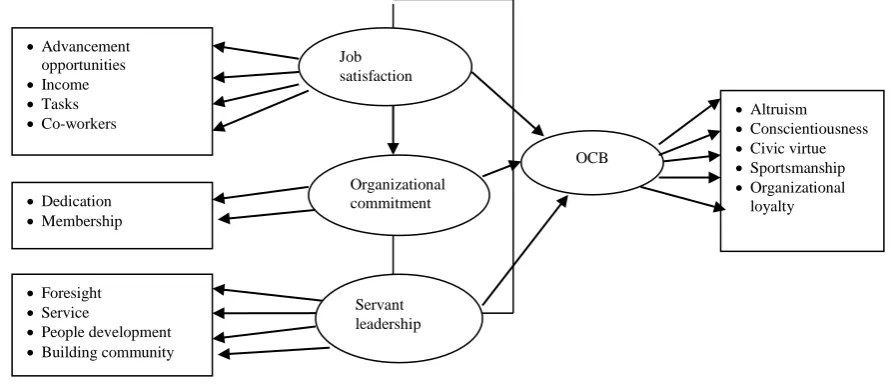
latent variables. OCB acted as internal latent while job satisfaction, organizational commitment, and servant leadership were external variables. There were 15 observable variables derived from both internal and external latent variables. There were five observable variables derived from OCB such as willingness to assist others, compliance with organizational rules and regulations, cooperation with organizational operations, patience and perseverance towards happenings with willingness, and loyalty to the organization.
Likewise job satisfaction comprised of four observable variables, they are advancement opportunities, income, characteristics of tasks, and relationship with colleagues. In addition, organizational commitment was consisted of two observable variables namely compliance with the
o ga izatio ’s e ui e e ts a d hope to etai the o ga izatio ’s e e ship. Fi all , the e e e
four observable variables from servant leadership namely foresight, dedication, people development, and community building.
The survey questionnaire was administered. It is consisted of five sections including demographic information of respondents, job satisfaction, organizational commitment, servant leadership and OCB. This questionnaire was then sent to a panel of experts for comments and feedbacks. The panel of experts was selected using the criteria based on their expertise in the area of leadership for validation purpose. From the feedback by the panel, some modifications were made to the original instrument. Pilot testing of the instrument was carried out. It could be concluded that the instrument was reliable and good to use as the Cronbach alpha value indicated that all the research variables had high Cronbach alpha values ranging from 0.759 to 0.931. The Statistical Package for Social Science (SPSS) and mPlus program was utilized to analyze the statistical data.
6. Conceptual framework
The variables in this study are elucidated in Figure 1. The variables include job satisfaction, organizational commitment, servant leadership, and OCB. This study utilizes Podsakoff, Mackenzie, Moorman, and Fette ’s OCB di e sio s hi h a e alt uis , o s ie tious ess, sportsmanship, courtesy and civic virtue. Altruism is the discretionary behavior that have the effect of helping a specific other person with an organizationally relevant task or problem. Conscientiousness is the discretionary behavior on the part of the teachers that go well beyond the minimum role requirements of the organization, in the area of attendance, obeying rules and regulations, taking breaks, and so forth. Sportsmanship refers to the willingness of the employee to tolerate less than ideal circumstances without complaining while courtesy is the discretionary behavior on the part of an individual aimed at preventing work-related problems with others from occurring. Likewise, civic virtue refer to the behavior on the part of an individual that indicates that he or she responsibly participates in, is involved in, or is concerned about the life of the organization.
6 7. Results
a. Correlation matrix of latent variables OCB
Ta le p ese ted the o elatio at i of late t a ia les OCB. Based o De Vaus’s (2002) interpretation of correlation coefficients in Table 1, the correlation results between the latent variables and OCB showed a significant and positive relationship (p<0.01), with strength of association as moderate to substantial.
Table 1. Designation strength of association based on size of correlation coefficients.
Strength of association Negative Positive
Low to moderate -0.29 till -0.10 0.10 till 0.29 Moderate to substantial -0.49 till -0.30 0.30 till 0.49 Substantial to very strong -0.69 till -0.50 0.50 till 0.69 Very strong -0.89 till -0.70 0.70 till 0.89 Near perfect -0.99 till -0.90 0.90 till 0.99
Perfect relationship -1.00 1.00
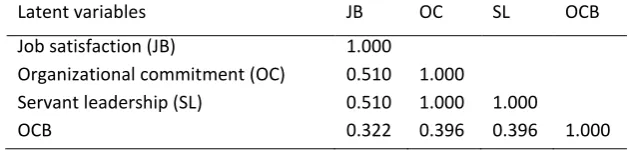
As indicated in Table 2, the OCB was significant, positive and moderate to substantial correlated with the organizational commitment and servant leadership (r = 0.396; p<0.01). Although job satisfaction was found to have moderate to substantial correlation with OCB but the r-value is comparatively lowest among the three latent variables (r = 0.322; p<0.01). This means that, to a moderate to substantial, an increase in the latent variables is associated with an increase in OCB.
Table 2. Correlation matrix of latent variables OCB.
Latent variables JB OC SL OCB
Job satisfaction (JB) 1.000
Organizational commitment (OC) 0.510 1.000
Servant leadership (SL) 0.510 1.000 1.000
OCB 0.322 0.396 0.396 1.000
b. Factor loading values of the causal relationship model of OCB
According to Table 3, the factor loading values of the causal relationship model of OCB are as follows:
Job satisfaction measured from the four observable variables shows the highest factor
loadi g alue β = . , follo ed elatio ships ith olleagues β = . , ad a e e t oppo tu ities β = . , a d i o e β = . espe ti el .
Organizational commitment measured from the two observable variables shows the highest factor loading value and prediction coeffi ie t i the a ia le of o plia e ith o ga izatio ’s
e ui e e t β = . a d the lo est alue fo the eed to etai e e ship β = . .
Servant leadership measured from four observable variables shows the highest factor loading value and predictio oeffi ie t i the a ia le of people de elop e t β = . , follo ed
dedi atio β = . , fo esight β = . , a d uildi g o u it β = . .
Contemporary Educational Researches Journal. 7(1), 2-10.
7
o ga izatio β = . , patie e a d pe se e a e β = . , o plia e ith o ga izatio al ules β = . , a d oope atio i o ga izatio al a ti ities β = . .
Table 3. Factor loading values of causal relationship model of OCB.
Factors of the causal model β S.E. t R2
Job satisfaction 0.058 8.513 0.495
-Advancement opportunities 0.530 0.057 9.238 0.281
-Income 0.372 0.059 6.326 0.138
-Characteristics of tasks 0.840 0.033 25.25 0.706 -Relationship with colleagues 0.732 0.035 20.87 0.536
Organizational commitment 0.075 11.02 0.841
-Co plia e ith o ga izatio ’s requirement
0.865 0.034 25.18 0.748
-Hope to retain membership 0.692 0.036 19.07 0.479
Servant leadership 0.072 5.310 0.380
-Foresight 0.838** 0.020 41.95 0.702
-Dedication 0.866 0.017 49.72 0.751
-People development 0.944 0.012 77.58 0.892 -Building community 0.779 0.025 30.71 0.607 OCB
-Altruism 0.849 0.034 24.97 0.722
-Complying with rules and regulations
0.733 0.037 20.00 0.538
-Cooperating with organization in activities
0.727 0.040 17.98 0.528
-Patient and perseverance 0.771 0.039 19.61 0.594 -Loyal to organization 0.848 0.040 21.24 0.719
c. Agreement of causal relationship model of OCB with evidence
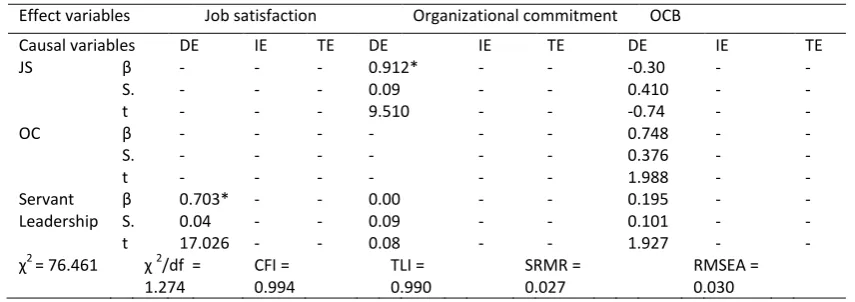
I Ta le , all of the statisti s used et the ite ia, ith χ2 = . > . , χ 2
/df = 1.274 (<2.00), CFI = 0.994 (>0.90), TLI = 0.990 (>0.95), SRMR = 0.027 (<0.05) and RMSEA = 0.030 (<0.05). Thus the causal relationship model of OCB developed is in accordance with the evidence
.
d. The direct, indirect, and overall influences on OCB
8 Table 4. Loading values of direct, indirect, and overall influences of latent variables.
Effect variables Job satisfaction Organizational commitment OCB
Causal variables DE IE TE DE IE TE DE IE TE OCB of teachers under the Office of Secondary Education Service Area 25, Khon Kaen, Thailand. The findings of this study revealed that job satisfaction had negative direct influence on OCB. This finding is contradicted with past research findings from Podsakoff, Steven, Philip & Brian (2009). Podsakoff et al. stated that a rather high coefficient of correlation between OCB and overall organizational performance (rc = 0.43) through meta-analysis. Subsequently, this finding was supported by Shashi et
al.’s fi di gs . Thei fi di gs i di ated o ga izatio al o it e t a d jo satisfaction are significant predictors of OCB of middle level managers in India.
In addition, organizational commitment shows positive direct influence on OCB. This finding was found to be consistent with past research findings from Shashi et al. (2010), Arti, Atul Dutt, and Kuldeep (2011), Rifai (2005), Feather and Rauter (2004), and Podsakoff, MacKensie, Paine, and
Ba h a h . Shashi et al’s fi di g sho ed that jo satisfa tio a d o ga izatio al o it e t
toward explaining variance in OCB, with the strongest correlation associated with organizational
o it e t. A ti et al.’s stud sho ed that o ati e o it e t e e positi el o elated ith OCB = . ; p< . . Fu the o e o ati e o it e t has sig ifi a t i pa t o OCB β =
0.269, p<0.05). However Rifai (2005), Feather and Rauter (2004), and Podsakoff et al. (2000) claimed that affective commitment is significant predictor of OCB. Furthermore, Organ (1988) claimed that when job satisfaction and perception of fairness are measured together, the latter explains an increase in variance in OCB. Next, attitudinal variables (job satisfaction and organizational commitment) are significant predictors of OCB while personal variables do not predict OCBs of middle level manager. In addition, Organ also claimed that people who are satisfied and committed towards organization tend to be more display OCB than with those who are less satisfied and
o itted. Co se ue tl O ga ’s fi di g as fou d to e pa tial o t adi ted ith this stud .
Finally, result from this study revealed that servant leadership shows positive direct influence on OCB. This finding has been supported by Abdu, Fa idah ati a d Cha d akata . A du Ja’afa u et al. indicated that emotional healing leader behavior is found to be st o gl i flue i g follo e s’
OCB i o ga izatio β = . ; t = . ; p = . . Additio all thei fi di gs also de o st ated that sig ifi a t egati e elatio ship et ee eati g alue fo the o u it a d OCB β = -0.183; t = 2.153, p = 0.016) a d leade s’ o eptual skills st o gl i flue i g OCB β = . ; t = . , p<0.003). However their result showed that helping subordinate grow and success was not
Contemporary Educational Researches Journal. 7(1), 2-10.
9 9. Conclusion and Recommendations
Results of this study showed that there are positive influences from organizational commitment and servant leadership but there is negative influence from job satisfaction on OCB. Therefore school administrators shall take into account the special attention and treatment to enhance latent variables that have direct, indirect and overall influence on OCB in order to deliver excellent service performance to the students. The current findings have contributed to management practice by revealing the importance of servant leadership as a significant leadership style. Certainly, increased
p i ipals’ a a e ess a out the o e tio et ee se a t leade eha iou a d OCB a help to
motivate supervisory teachers to develop servant leader behaviour. In addition, the current findings have revalidated the significant causal relationship between job satisfaction, organizational commitment, and servant leadership toward OCB in Thailand context.
Previous studies have employed the use of other analytical tools to produce results. This study has explored a relatively different tool of analysis (i.e. mPlus) to explain the causal relationship of the constructs of this study. The use of mPlus tool provides an opportunity for testing and predictive power of the tool in a study that explores integrative relationships of job satisfaction, organizational commitment, servant leadership, and OCB. Finally, by using causal relationship model in this study, would provide a new framework for comparisons of results obtained from previous studies that used different tools of analysis.
Acknowledgements
This project was made possible with funding from Faculty of Education, Khon Kaen University, Thailand.
References
Abdu, J. B., Faridahwati, M. S., & Chandrakatan, S. (2015). Effects of servant leader behaviour on organizational citizenship behaviours for the individual (OCB-I i the Nige ia’s utilit i dust usi g pa tial least squares (PLS). International Journal of Management and Sustainability, 4(6), 130-144.
Aranya, N., Kushnir, P., & Valency, R. (1986). Organizational commitment in a maledominated profession. Human Relations, 39, 433-448.
Arti, B., Atul, D. S., & Kuldeep, K. (2011). Organizational commitment as predictor of organizational citizenship behaviour. European Journal of Business and Management, 3(4), 78-86.
Aungsuchot, S. (2010). Statistics for social science and behavioural science research: technique in using LISREL program. Bangkok: Jareondeemankong Express.
De Vaus, D. (2002). Analysing social science data. London: Sage Publications Limited.
Feather, N. T., & Rauter, K.A. (2004). Organizational citizenship behaviours in relation to job status, job insecurity, organizational commitment and identification, job satisfaction and work values. Journal of Occupational and Organizational Psychology, 77, 81-94.
Kalleberg, A. L., & Mastekaasa, A. (2001). Satisfied movers, committed stayers: The impact of job mobility on work attitudes in Norway. American Sociological Review, 28, 183-209.
Laub, J. (2014). Defining servant leadership: A recommended typology for servant leadership studies. Proceedings of the 2004 Servant Leadership Research Roundtable. Retrieved December 22, 2014 from; http://www.regent.edu/acad/global/publications/sl_proceeding/home.shtm?start=now&utm_expid=14 0130747-102.K9FyzC9RTau7_prsKT8CFA.1
Mathieu, J. E., & Zajac, D. M. (1990). A review and meta-analysis of the antecedents, correlates, and consequences of organizational commitment. Psychological Bulletin, 108(2), 171-194.
Office of the National Education Commission Education (2003). Revised National Education Plan (2009-2016). Bangkok: Amarin Printing and Publishing.
10 94(1), 122-141.
Podsakoff, P., MacKensie, S., Paine, J., & Bachrach, D. (2000). Organizational citizenship behaviours: A critical review of the theoretical and empirical literature and suggestions for future research. Journal of Management, 26, 513-563.
Podsakoff, P. M., Mackenzie, S. B., Moorman, R. H., & Fetter, R. (1990). Transformational leaders behaviour and thei effe ts o follo e s’ t ust i leader, satisfaction and organizational citizenship behaviours. Leadership Quarterly, 1, 107-142.
Rakpolmueng, C., & Madirokkowit, C. (2004). Shortage of teachers at basic education level. Bangkok: Office of the Education Council.
Rifai, H. A. (2005). A test of the relationships among perceptions of justice, job satisfaction, affective commitment and organizational citizenship behaviour. Gadjah Mada International Journal of Business, 7, 131-154.
Robbins, S. P. (2001). Organizational behaviour (9th ed.). Jersey: Prentice-Hall.
Saimir, S., & Jonida, L. (2013). Job satisfaction and organizational commitment: The case of Shkodra municipality. European Scientific Journal, 9(17), 41-51.
Schappe, S. P. (1998). The influence of job satisfaction, organizational commitment, and fairness perceptions on organizational citizenship behaviour. The Journal of Psychology, 132, 277-290.
Shashi, K. M., Bharti, M., & Pramod, K. (2010). Traditional attitudinal variables matters for organizational citizenship behaviour among middle level managers. Journal of the Indian Academy of Applied Psychology, 36(2), 255-261.
Tett, R. P., & Meyer, J. P. (1993). Job satisfaction, organizational commitment, turnover intention and turnover: Path analyses based meta-analytic findings. Personnel Psychology, 46(2), 259-294.