and present a simplified model for the OFDM communication system with its
to select the encryption method that best fulfills your application requirements.
IMAGE
ENCRYPTION
A Communication Perspective
Fathi E. Abd El-Samie
u
Hossam Eldin H. Ahmed
Ibrahim F. Elashry
u
Mai H. Shahieen
Osama S. Faragallah
u
El-Sayed M. El-Rabaie
Saleh A. Alshebeili
u
u
u
u
IMAGE
ENCRYPTION
A Communication Perspective
IMAGE
ENCRYPTION
A Communication Perspective
Fathi E. Abd El-Samie
uHossam Eldin H. Ahmed
Ibrahim F. Elashry
uMai H. Shahieen
Osama S. Faragallah
uEl-Sayed M. El-Rabaie
Saleh A. Alshebeili
warrant the accuracy of the text or exercises in this book. This book’s use or discussion of MATLAB® soft-ware or related products does not constitute endorsement or sponsorship by The MathWorks of a particular pedagogical approach or particular use of the MATLAB® software.
CRC Press
Taylor & Francis Group
6000 Broken Sound Parkway NW, Suite 300 Boca Raton, FL 33487-2742
© 2014 by Taylor & Francis Group, LLC
CRC Press is an imprint of Taylor & Francis Group, an Informa business No claim to original U.S. Government works
Version Date: 20131009
International Standard Book Number-13: 978-1-4665-7699-5 (eBook - PDF)
This book contains information obtained from authentic and highly regarded sources. Reasonable efforts have been made to publish reliable data and information, but the author and publisher cannot assume responsibility for the validity of all materials or the consequences of their use. The authors and publishers have attempted to trace the copyright holders of all material reproduced in this publication and apologize to copyright holders if permission to publish in this form has not been obtained. If any copyright material has not been acknowledged please write and let us know so we may rectify in any future reprint.
Except as permitted under U.S. Copyright Law, no part of this book may be reprinted, reproduced, transmit-ted, or utilized in any form by any electronic, mechanical, or other means, now known or hereafter inventransmit-ted, including photocopying, microfilming, and recording, or in any information storage or retrieval system, without written permission from the publishers.
For permission to photocopy or use material electronically from this work, please access www.copyright. com (http://www.copyright.com/) or contact the Copyright Clearance Center, Inc. (CCC), 222 Rosewood Drive, Danvers, MA 01923, 978-750-8400. CCC is a not-for-profit organization that provides licenses and registration for a variety of users. For organizations that have been granted a photocopy license by the CCC, a separate system of payment has been arranged.
Trademark Notice: Product or corporate names may be trademarks or registered trademarks, and are used only for identification and explanation without intent to infringe.
Visit the Taylor & Francis Web site at http://www.taylorandfrancis.com and the CRC Press Web site at http://www.crcpress.com
v
Contents
PR E FA C E ix
AB O U T T H E AU T H O R S xi
CH A P T E R 1 IN T R O D U C T I O N 1
CH A P T E R 2 FU N D A M E N TA L S O F IM A G E EN C R Y P T I O N 3
2.1 Introduction 3
2.2 Basic Concepts of Cryptography 4
2.2.1 Goals of Cryptography 4
2.2.2 Principles of Encryption 5
2.3 Classification of Encryption Algorithms 6
2.3.1 Classification According to Encryption Structure 6
2.3.2 Classification According to Keys 7
2.3.3 Classification According to Percentage of
Encrypted Data 8
2.4 Cryptanalysis 9
2.5 Features of Image Encryption Schemes 10
2.6 Conventional Symmetric Block Ciphers 11
2.6.1 Data Encryption Standard 11
2.6.2 Double DES 14
2.6.3 Triple DES 14
2.6.4 International Data Encryption Algorithm 15
2.6.5 Blowfish 16
2.6.6 RC5 Algorithm 16
2.6.6.1 RC5 Encryption Algorithm 17
2.6.6.2 RC5 Decryption Algorithm 17
2.6.6.3 RC5 Key Expansion 17
2.6.7 RC6 Algorithm 19
2.6.7.1 RC6 Encryption Algorithm 19
2.6.7.2 RC6 Decryption Algorithm 20
2.6.8 The Advanced Encryption Standard 21
2.7 Modes of Operation 24
2.7.1 The ECB Mode 25
2.7.2 The CBC Mode 26
2.7.3 The CFB Mode 27
2.7.4 The OFB Mode 27
2.8 Chaos and Cryptography 28
2.9 The 2D Chaotic Baker Map 31
CH A P T E R 3 EN C R Y P T I O N EVA L U AT I O N ME T R I C S 33
3.1 Introduction 33
3.2 Encryption Evaluation Metrics 34
3.2.1 Histogram Deviation 34
3.2.2 Correlation Coefficient 35
3.2.3 Irregular Deviation 35
3.2.4 Histogram Uniformity 36
3.2.5 Deviation from Ideality 36
3.2.6 Avalanche Effect 37
3.2.7 NPCR and UACI 37
3.3 Other Tests 38
3.3.1 Noise Immunity 38
3.3.2 The Processing Time 38
3.4 Testing the Evaluation Metrics 38
3.5 Summary 42
CH A P T E R 4 HO M O M O R P H I C IM A G E EN C R Y P T I O N 43
4.1 Overview 43
4.2 Homomorphic Cryptosystem 43
4.3 Security Analysis and Test Results 45
4.3.1 Statistical Analysis 45
4.3.1.1 Histograms of Encrypted Images 46
4.3.1.2 Encryption Quality Measurements 47
4.3.2 Key Space Analysis 48
4.3.2.1 Exhaustive Key Search 48
4.3.2.2 Key Sensitivity Test 49
4.3.3 Differential Analysis 53
4.4 Effect of Noise 54
4.5 Summary 54
CH A P T E R 5 CH A O T I C IM A G E EN C R Y P T I O N W I T H DI F F E R E N T
MO D E S O F OP E R AT I O N 57
5.1 Overview 57
5.2 Chaotic Encryption with Modes of Operation 57
5.3 Implementation Issues 58
5.4 Simulation Examples and Discussion 60
5.5 Summary 68
v i i C O N T E N T S
CH A P T E R 6 DI F F U S I O N ME C H A N I S M F O R DATA EN C R Y P T I O N
I N T H E E C B MO D E 71
6.1 Introduction 71
6.2 The Preprocessing Network 72
6.2.1 The Addition Part 72
6.2.2 The SPN 73
6.3 Implementation Issues 73
6.3.1 Effect of the Normalized Block Size on Diffusion 74 6.3.2 Effect of the Normalized Block Size on Block
Dependency 77
6.4 Simulation Examples 78
6.4.1 Encryption Quality 79
6.4.2 Diffusion 79
6.4.3 Encryption of Images with Few Details 82
6.5 Summary 88
CH A P T E R 7 OR T H O G O N A L FR E Q U E N C Y DI V I S I O N
MU LT I P L E X I N G 89
7.1 Introduction 89
7.2 Basic Principles of OFDM 90
7.2.1 Orthogonality 92
7.2.2 Frequency Domain Orthogonality 93
7.3 OFDM System Model 94
7.3.1 FFT-OFDM 94
7.3.2 DCT-OFDM 95
7.3.3 DWT–OFDM 95
7.3.4 Discrete Wavelet Transform 96
7.3.4.1 Implementation of the DWT 96
7.3.4.2 Haar Wavelet Transform 98
7.4 Guard Interval Insertion 99
7.5 Communication Channels 100
7.5.1 Additive White Gaussian Noise Channel 100
7.5.2 Fading Channel 100
7.6 Channel Estimation and Equalization 101
CH A P T E R 8 O F D M LI M I TAT I O N S 103
8.1 Introduction 103
8.2 Analysis of Intercarrier Interference 104
8.3 CFO in FFT-OFDM System Model 105
8.4 CFO in DCT-OFDM System Model 107
8.5 CFO in DWT-OFDM System Model 108
8.6 CFO Compensation 108
8.7 Simulation Parameters 109
8.8 Effect of PAPR 114
8.9 PAPR Reduction Methods 119
8.9.1 The Clipping Method 120
8.9.2 The Companding Method 121
8.9.3 The Hybrid Clipping-and-Companding Method 124
8.10 Simulation Experiments of PAPR Reduction Methods 124
8.11 Sampling Clock Offset 128
8.11.1 System Model 129
CH A P T E R 9 SI M U L AT I O N EX A M P L E S 133
9.1 Simulation Parameters 133
9.2 Simulation Experiments in the Presence of CFO 169 9.3 Simulation Experiments for Enhanced Algorithms 171 9.4 Simulation Experiments of PAPR Reduction Methods 187
9.5 Summary 223
RE F E R E N C E S 225
AP P E N D I X A 237
AP P E N D I X B 293
i x
Preface
We try in this book to look at image encryption with the eyes of
communication researchers. Traditional studies of encryption
concentrate on the strength of the encryption algorithm without
taking into consideration what is after encryption. What is after
encryption is the question we must answer to select the appropriate
encryption algorithm. For real-life applications, what is after
encryp-tion is communicaencryp-tion of encrypted images. With the advances in
mobile and TV applications, we have to transmit encrypted images
wirelessly. So, “Do our encryption algorithms tolerate the wireless
communication impairments?” is the question we are trying to answer
in this book.
We can summarize the main contributions in this book as follows:
This book is devoted to the issue of image encryption for the
purpose of wireless communications.
Diffusion as well as permutation ciphers are considered in
this book, with a comparison between them using different
evaluation metrics.
Modifications are presented to existing block ciphers either to
speed up or to enhance their performance.
The wireless communication environment in which the encrypted
images needs to be communicated is studied.
Simulation experiments are presented for the validation of the
discussed algorithms and their modifications and for
investi-gating the performance of algorithms over wireless channels.
MATLAB
®codes for most of the simulation experiments in this
book are included in two appendices at the end of the book.
Finally, we hope that this book will be helpful for the
image-processing and wireless communication communities.
MATLAB
®and Simulink
®are registered rademarks of The Math
Works, Inc. For product information, please contact:
The Math Works, Inc.
3 Apple Hill Drive
Natick, MA 01760-2098 USA
Tel: 508 647 7000
Fax: 508-647-7001
x i
About the Authors
Fathi E. Abd El-Samie received the
BSc(Honors), MSc, and PhD degrees from
Menoufia University, Menouf, Egypt in
1998, 2001, and 2005, respectively. Since
2005, he has been a teaching staff
mem-ber with the Department of Electronics
and Electrical Communications, Faculty
of Electronic Engineering, Menoufia
University. He is currently a researcher
at KACST-TIC in radio frequency and
photonics for the e-Society (RFTONICs). He is a co-author of
about 200 papers in international conference proceedings and
journals and 4 textbooks. His current research interests include
image
enhancement, image
restoration, image interpolation,
superresolution reconstruction of images, data hiding, multimedia
communications, medical image processing, optical signal
processing, and digital communications.
Dr. Abd El-Samie was a recipient of the Most Cited Paper Award
from the
Digital Signal Processing
journal in 2008.
University, Egypt); an MSc in
microelectronic
electron diffraction in
April 1977 (Nuclear Department, Faculty
of Engineering, Alexandria University);
and a PhD in June 1983 (High Institute
of Electronic and Optics, Paul Sabatier
University, Toulouse, France). From 1970
to 1977, he was in the Egyptian marine
forces. He was a demonstrator in 1977,
giving lectures to staff members in the Department of Electronic
and Electrical Communications, Faculty of Engineering and
Technology, Menoufia University. In 1993, he became a professor
of microelectronics, VLSI design technology, communication
sys-tems, and computer networks. From 1993 until 1999, he was vice
dean for education and student affairs at the Faculty of Electronic
Engineering. In 2001, he became a chairman of the Electronics
and Electrical Communications Department. He is a member of
the Menoufia periodic electronic faculty journal and since 1995
has been the director, designer, and constructor of the Menoufia
University wide-area network (WAN) (21 LANs). He is the
devel-oper of the Menoufia University libraries and FRCU universities
libraries. His current research interests are electron microscopy;
transmission and backscattering of electrons and ion beams into
amorphous or polycrystalline targets; optical fibers; VLSI design;
nanotechnology; lithography; digital, optical, and multimedia
com-munications; digital images; multimedia and database
communica-tions; security applicacommunica-tions; telemetry microcomputer applications
in satellites; and OBC and satellite communications.
x i i i A B O U T T H E AU T H O R S
Mai H. Shahieen graduated in May 2005
from the Faculty of Electronic Engineering,
Menoufia University. Her 2011 MSc degree
is in encrypted image transmission over
wire-less channels. She is now a PhD student at
the Faculty of Electronic Engineering. Her
research interests are
broadband wireless
distribution systems, image and video
com-pression, multimedia systems, and wireless
networks.
Osama S. Faragallah received BSc, MSc,
and PhD degrees in computer science and
engineering from Menoufia University,
Menouf, Egypt in 1997, 2002, and 2007,
respectively. He is currently associate professor
with the Department of Computer Science
and Engineering, Faculty of Electronic
Engineering, Menoufia University, where he
was a demonstrator from 1997 to 2002 and
assistant lecturer from 2002 to 2007. Since
2007, he has been a teaching staff member
with the same department. His research interests are network
secu-rity, cryptography, Internet secusecu-rity, multimedia secusecu-rity, image
encryption, watermarking, steganography, data hiding, medical
image processing, and chaos theory.
on harmonic balance techniques. Since then, he has been involved
in different research areas, including CAD of nonlinear microwave
circuits, nanotechnology, digital communication systems, and digital
image processing. He was invited in 1992 as a research fellow at North
Arizona University (College of Engineering and Technology) and
in 1994 as a visiting professor at Ecole Polytechnique of Montreal,
Quebec, Canada. Professor El-Rabaie has authored and co-authored
more than 130 papers and technical reports and 15 books. In 1993,
he was awarded the Egyptian Academic Scientific Research Award
(Salah Amer Award of Electronics), and, in 1995, he received the award
of the Best Researcher on CAD from Menoufia University. He acts
as a reviewer and member of the editorial board for several scientific
journals. He participated in translating the first part of the Arabic
encyclopedia. Professor El-Rabaie was the head of the Electronics
and Electrical Communications Engineering Department, Faculty
of Electronic Engineering, Menoufia University, and then the vice
dean of postgraduate studies and research in the same faculty. He
currently is the vice dean of the Scientific Committee for Professors
and Assistant Professors promotion in Egypt.
Saleh A. Alshebeili is professor and
chairman (2001–2005) of the Electrical
Engineering Department, King Saud
University, Riyadh, Saudi Arabia. He has more
than 20 years of teaching and research
experi-ence in the area of communications and signal
processing. Dr. Alshebeili is a member of the
board of directors of Prince Sultan Advanced
1
1
I
N T RO D U C T I O N
The presence of communication networks has prompted new problems
with security and privacy. Having a secure and reliable means for
communicating with images and video is becoming a necessity, and
its related issues must be carefully considered. Hence, network
secu-rity and data encryption have become important. Images can now be
considered one of the most usable forms of information. Image and
video encryption have applications in various fields, including wireless
communications, multimedia systems, medical imaging,
telemedi-cine, and military communications [1–5].
In this book, image encryption algorithms are studied for the
purpose of wireless communication of images in a secure form. The
main objective is to come to a conclusion whether a certain image
encryption algorithm is suitable for wireless communication
applica-tions. In this regard, we explore in this book some of the
number-theory-based encryption algorithms such as the Data Encryption
Standard (DES), the Advanced Encryption Standard (AES), and the
RC6 algorithms [6–12]. These algorithms are known in the literature
as strong encryption algorithms. Our main concern is not only the
strength of the encryption algorithm, but also its ability to work with
the limitations of wireless communication systems. Unfortunately,
some of the ciphers used currently were not designed for image
encryption. For example, the AES implemented in the Electronic
Code-Book (ECB) mode is not recommended for encrypting images
because of the repetitive data patterns existing in images. So, we
either modify these ciphers to work for image encryption or search for
other approaches suitable for this task. This book tries to investigate
both directions.
encryption can be traced to Shannon’s classical article [13]. Chaotic
maps have been applied to cryptography in several different ways.
Chaotic sequences have several good properties, including ease of
generation, sensitive dependence on the initial conditions, and
noise-like behavior. Applying the chaos to cryptography was a great
contri-bution to improve the security of data due to the adequate properties
of chaotic sequences [14,15].
To make the study in this book comprehensive, we switch in
Chapters 7 and 8 to communication concepts concentrating on
the orthogonal frequency division multiplexing (OFDM) system.
In these chapters, we present a simplified model for the OFDM
communication system with its different implementations, with
concentration on the limitations of this system, and how these
limita-tions affect the quality of received images after decryption. An
exten-sive comparison study is presented in Chapter 9, considering different
possible scenarios and different encryption algorithms to determine
which encryption algorithm is suitable for which scenario. Finally, we
include all MATLAB
®codes utilized in the experiments in this book
3
2
F
U N DA M E N TA L S
O F
I
M AG E
E
N C RY P T I O N
2.1 Introduction
We are living in the information age; we need to keep information
about every aspect of our lives. In other words, information is an asset
that has a value like any other asset. As an asset, information needs
to be secured from attacks. Since 1990, communication networks
cre-ated a revolution in the use of information. Authorized people can
send and receive information from a distance using communication
networks. To be secure, information needs to be hidden from
unau-thorized access (confidentiality), protected from unauunau-thorized change
(integrity), and available to an authorized entity when it is needed
(availability). Although these three requirements have not changed,
they now have some new dimensions. Not only should information
be confidential when it is stored in a computer, but also there should
be a way to maintain its confidentiality when it is transmitted over a
communication network [16].
entertainment has had an enormous impact on artists, publishers,
copyright holders, and consumers [17,18].
This chapter gives the principles underlying the design of
crypto-graphic algorithms. A review of the different issues that arise when
selecting, designing, and evaluating a cryptographic algorithm is
pre-sented. Diffusion-based cipher algorithms along with their modes of
operation are covered. Chaotic encryption with a Baker map is also
discussed.
2.2 Basic Concepts of Cryptography
Image security
is based on cryptography. In fact, some basic concepts
from cryptography are used as building blocks (primitives) for
appli-cations in image security. For a better understanding of issues
con-cerning image security, an overview of cryptography is presented first.
2.2.1 Goals of Cryptography
Cryptography
is a study of techniques (called
cryptosystems
) that are
used to accomplish the following four goals [1,16–18]:
• Confidentiality
• Data integrity
• Authentication
• Nonrepudiation
The study of the techniques used to break existing cryptosystems is
called
cryptanalysis
. Since cryptography and cryptanalysis are greatly
dependent on each other, people refer to
cryptology
as a joint study
of cryptography and cryptanalysis. Let us try to understand all four
goals of cryptography.
Confidentiality
refers to the protection of information from
unau-thorized access. An undesired communicating party, called an
adver-sary, must not be able to access the communication material. This
goal of cryptography is a basic one that has always been addressed and
enforced throughout the history of cryptographic practice.
5 F U N D A M E N TA L S O F I M A G E E N C R Y P T I O N
Authentication
methods are classified into two categories: entity
authentication and message authentication.
Entity authentication
is
the process by which one party is assured of the identity of a
sec-ond party involved in a protocol, and that the secsec-ond has actually
participated immediately prior to the time the evidence is acquired.
Message authentication
is a term used analogously with data origin
authentication. It provides data origin authentication with respect to
the original message source and data integrity but with no uniqueness
and timeliness guarantees.
Nonrepudiation
means that the receiver can prove to everyone that
the sender did indeed send the message. That is, the sender cannot
claim that he or she did not encrypt or sign certain digital information.
Fortunately, modern cryptography has developed techniques to
handle all four goals of cryptography.
2.2.2 Principles of Encryption
The basic idea of
encryption
is to modify the message in such a
way that only a legal recipient can reconstruct its content [16–18].
A discrete-value cryptosystem can be characterized by
a set of possible plaintexts
P
a set of possible ciphertexts
C
a set of possible cipher keys
K
a set of possible encryption and decryption transformations
E
and
D
An
encryption system
is also called a
cipher
, or a cryptosystem. The
message for encryption is called
plaintext
, and the encrypted message
is called
ciphertext
. Denote the plaintext and the ciphertext by
P
and
C
, respectively [16–19]. The encryption procedure of a cipher can be
described as
( )
=
C
E
KeP
(2.1)
where
K
eis the encryption key, and
E
is the encryption function.
Similarly, the decryption procedure is defined as
( )
=
P
D
KdC
(2.2)
where
K
dis the decryption key, and
D
is the decryption function.
The security of a cipher should only rely on the decryption key
K
das an adversary can recover the plaintext from the observed
cipher-text once the adversary gets
K
d. Figure 2.1 shows a block diagram for
encryption/decryption of a cipher.
2.3 Classification of Encryption Algorithms
Encryption algorithms can be classified in different ways: according
to structures of the algorithms, according to keys, or according to the
percentage of the data encrypted [19,20].
2.3.1 Classification According to Encryption Structure
Encryption algorithms can be classified according to encryption
structure into block ciphers and stream ciphers.
A
block cipher
is a type of symmetric-key encryption algorithm
that transforms a fixed-length block of plaintext data into a block
of ciphertext data of the same length. The fixed length is called the
block size
. For several block ciphers, the block size is 64 or 128 bits.
The larger the block size, the more secure is the cipher, but the more
complex are the encryption and decryption algorithms and devices.
Modern block ciphers have the following features [21]:
1. Variable key size
2. Mixed arithmetic operations, which can provide nonlinearity
3. Data-dependent rotations and key-dependent rotations
4. Lengthy key schedule algorithms
5. Variable plaintext/ciphertext block sizes and variable number
of rounds
Block ciphers can be characterized by
1. Block size: Larger block sizes mean greater security.
2. Key size: Larger key sizes mean greater security.
Ke Kd
Ciphertext Recoveredplaintext Public channel
Plaintext
Encryption Decryption
7 F U N D A M E N TA L S O F I M A G E E N C R Y P T I O N
3. Number of rounds: Multiple rounds increase security.
4. Encryption modes: They define how messages larger than the
block size are encrypted.
Unlike block ciphers that operate on large blocks of data,
stream ciphers
typically operate on smaller units of plaintext, usually bits. So, stream
ciphers can be designed to be exceptionally fast, much faster than a
typical block cipher. Generally, a stream cipher generates a sequence
of bits as a key (called key stream) using a pseudorandom number
gen-erator (PRNG) that expands a short secret key (e.g., 128 bits) into a
long string (key stream) (e.g., 10
6bits), and the encryption is
accom-plished by combining the key stream with the plaintext. Usually, the
bitwise XOR operation is chosen to perform ciphering, basically for its
simplicity [6–9]. Stream ciphers have the following properties [22, 23]:
1. They do not have perfect security.
2. Security depends on the properties of the PRNG.
3. The PRNG must be unpredictable; given a consecutive
sequence of output bits, the next bit must be hard to predict.
4. Typical stream ciphers are very fast.
2.3.2 Classification According to Keys
[24–27]. Table 2.1 shows a comparison between symmetric
encryp-tion and asymmetric encrypencryp-tion.
In general, there are two types of cryptosystems: (1) symmetric-
(private-) key cryptosystems and (2) asymmetric- (public-) key
cryp-tosystems. Most people have chosen to call the first group simply
symmetric-key cryptosystems, and the popular name for the second
group is just public-key cryptosystems.
2.3.3 Classification According to Percentage of Encrypted Data
With respect to the amount of encrypted data, the encryption can
be divided into full encryption and partial encryption (also called
selective encryption) according to the percentage of the data
encrypted.
The Source A
The Destination B
.H
X
Figure 2.3 Asymmetric-key encryption.
Decryption
Sender Transmission Receiver
Kd Xe
9 F U N D A M E N TA L S O F I M A G E E N C R Y P T I O N
2.4 Cryptanalysis
Cryptanalysis
is the art of deciphering an encrypted message as a
whole or in part when the decryption key is not known. Depending
on the amount of known information and the amount of control over
the system by the adversary (cryptanalyst), there are several basic
types of cryptanalytic attacks [28–30]. Some of the most important
ones, for a system implementer, are described next, and they are
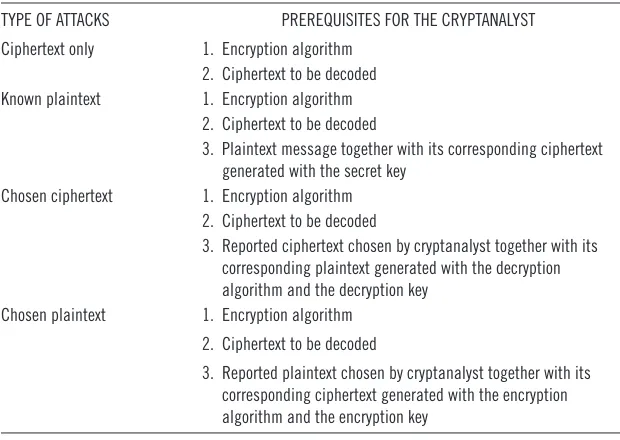
sum-marized in Table 2.2.
Ciphertext-only attack
. The adversary only has access to one or
more encrypted messages. The most important goal of a
pro-posed cryptosystem is to withstand this type of attack.
Brute-force attack
. This is a type of ciphertext-only attack. It is
based on an exhaustive key search, and for well-designed
cryptosystems, it should be computationally infeasible.
Known-plaintext attack
. In this type of attack, an adversary has
some knowledge about the plaintext corresponding to the
given ciphertext. This may help the adversary determine the
key or a part of the key.
Chosen-plaintext attack
. Essentially, an adversary can feed the
chosen plaintext into the black box that contains the
encryp-tion algorithm and the encrypencryp-tion key. The black box gives
the corresponding ciphertext, and the adversary may use the
Table 2.1 Comparison between Symmetric Encryption and Asymmetric EncryptionCONVENTIONAL ENCRYPTION (SYMMETRIC ENCRYPTION)
PUBLIC-KEY ENCRYPTION (ASYMMETRIC ENCRYPTION)
Requirements to work:
1. The same algorithm with the same key can be used for encryption and decryption. 2. The sender and receiver must share the
algorithm and the key.
Requirements to work:
1. One algorithm is used for encryption and decryption with a pair of keys, one for encryption and one for decryption. 2. The sender and receiver must each have
one of the matched pair of keys. Requirements for security:
1. The key must be kept secret. 2. It must be impossible or at least
impractical to decipher a message if no other information is available.
3. Knowledge of the algorithm plus samples of the ciphertext must be insufficient to determine the key.
Requirements for security:
1. The decryption key must be kept secret. 2. It must be impossible or at least
impractical to decipher a message if no other information is available.
accumulated knowledge about the plaintext–ciphertext pairs
to obtain the secret key or at least a part of it.
Chosen-ciphertext attack
. Here, an adversary can feed the
cho-sen ciphertext into the black box that contains the decryption
algorithm and the decryption key. The black box produces the
corresponding plaintext, and the adversary tries to obtain the
secret key or a part of the key by analyzing the accumulated
ciphertext–plaintext pairs.
2.5 Features of Image Encryption Schemes
Unlike text messages, image data have their special features, such as
high redundancy and high correlation among pixels. Also, they are
usu-ally huge in size. Together, these make traditional encryption methods
difficult to apply and slow to process. Sometimes, image applications
have their own requirements, like real-time processing, fidelity
reser-vation, image format consistency, data compression for transmission,
and so on. Simultaneous fulfillment of these requirements along with
high-security and high-quality demands has presented great
chal-lenges to real-time imaging practice. For studying image encryption,
Table 2.2 Types of Attacks on Encrypted ImagesTYPE OF ATTACKS PREREQUISITES FOR THE CRYPTANALYST
Ciphertext only 1. Encryption algorithm 2. Ciphertext to be decoded Known plaintext 1. Encryption algorithm
2. Ciphertext to be decoded
3. Plaintext message together with its corresponding ciphertext generated with the secret key
Chosen ciphertext 1. Encryption algorithm 2. Ciphertext to be decoded
3. Reported ciphertext chosen by cryptanalyst together with its corresponding plaintext generated with the decryption algorithm and the decryption key
Chosen plaintext 1. Encryption algorithm
2. Ciphertext to be decoded
11 F U N D A M E N TA L S O F I M A G E E N C R Y P T I O N
we must first analyze the differences between implementations for
image data and text data encryption. Basically, there are some
differ-ences between image and text data encryption [31–34]:
1. When the ciphertext is produced, it must be decrypted to
the original plaintext in a full lossless manner. However, the
cipherimage can be decrypted to the original plainimage in
some lossy manner.
2. Text data are sequences of words. They can be encrypted
directly by using block or stream ciphers. However,
digi-tal images are usually represented as two-dimensional (2D)
arrays. For protecting the stored 2D arrays of data with
text-processing algorithms, they must be converted to 1D arrays
before using various traditional encryption techniques.
3. Because the storage space of a picture is very large, it is
some-times inefficient to encrypt or decrypt images directly. One
of the best methods is to encrypt/decrypt information that is
used by image compression only for reducing both its storage
space and transmission time.
2.6 Conventional Symmetric Block Ciphers
This section gives a brief overview of the construction of some popular
conventional encryption algorithms. Each of the following
encryp-tion algorithms is a symmetric block cipher algorithm.
Symmetric
means that the key used for encryption and decryption is the same;
block
means that the data (information) to be encrypted is divided into
blocks of equal length [35–45].
2.6.1 Data Encryption Standard
The Data Encryption Standard (DES) is the most well-known
sym-metric-key block cipher. It was selected by the National Bureau of
Standards as an official Federal Information Processing Standard
(FIPS) for the United States in 1976, and it subsequently enjoyed
widespread use internationally [46].
algorithm and key of size 56 bits are used for both encryption and
decryption except for minor differences in the key schedule. The key
is usually expressed as a 64-bit number, but every eighth bit, one bit
is used for parity checking and is ignored. These parity bits are the
least-significant bits of the key bytes. The key can be any 56-bit
num-ber and can be changed at any time, although some selections can be
considered weak keys.
The DES is based on four basic operations: expansion, permutation,
XOR, and substitution. The data to be encrypted are first divided into
64-bit blocks and fed into an Initial Permutation (IP) stage, in which
each block is divided into two subblocks, each with a 32-bit length.
The right subblock is fed into a Feistel function (f-function), which is
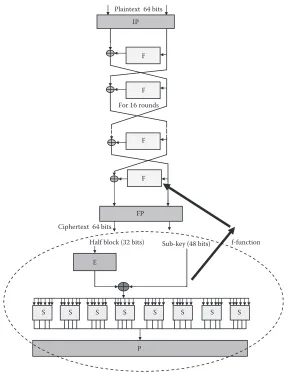
depicted in Figure 2.4. It operates on half a block (32 bits) at a time
and consists of four stages as shown in Figure 2.5.
1. Expansion. The 32-bit half block is expanded to 48 bits using
the expansion permutation, denoted as
E
in the diagram, by
duplicating half of the bits. The output consists of eight 6-bit
(8 × 6 = 48 bits) pieces, each containing a copy of 4
corre-sponding input bits plus a copy of the immediately adjacent
bit from each of the input pieces to either side.
2. Key mixing. The result is combined with a subkey using
an XOR operation. Sixteen 48-bit subkeys, one for each
round, are derived from the main key using a key-schedule
mechanism.
3. Substitution. After mixing with the subkey, the block is
divided into eight 6-bit pieces before processing by the
Substitution boxes (S-boxes). Each of the eight S-boxes
replaces its six input bits with four output bits according to
a nonlinear transformation, provided in the form of a lookup
table. The S-boxes provide the core of security of the DES.
1 2 3 4
1 2 3 4 5 6
9 10 11 12
13 14 15 16 17 18
5 6 7 8
7 8 9 10 11 12
32
48 32
48
13 F U N D A M E N TA L S O F I M A G E E N C R Y P T I O N
Without them, the cipher would be linear and trivially
breakable.
4. Permutation. Finally, the 32 outputs from the S-boxes are
rearranged according to a fixed permutation, the P-box,
which is designed so that, after expansion, each group of
S-box output bits is spread across six different S-boxes in the
next round.
At its simplest level, the DES algorithm is nothing more than a
combination of the two basic techniques of encryption: confusion
Ciphertext 64 bits
For 16 rounds IP
F
F F F
FP Plaintext 64 bits
P E
Sub-key (48 bits) Half block (32 bits)
S S S S S S S S
f-function
and diffusion. The fundamental building block of the DES is a
single combination of these techniques: a substitution followed
by a permutation on the data based on the key. After an initial
permutation, each block is broken into a right half and a left half,
each with 32 bits. Then, there are 16 rounds of identical
opera-tions, called f funcopera-tions, in which the data are combined with the
key. After these rounds, the right and left halves are joined, and a
final permutation, the inverse of the initial permutation, finishes
the algorithm.
2.6.2 Double DES
A naive way of improving the security of a block cipher algorithm is
to encrypt each block twice with two different keys. First, encrypt a
block with the first key and then encrypt the resulting ciphertext with
the second key. Decryption is the reverse process. In the Double DES
encryption algorithm, each 64-bit block of data is encrypted twice
with the DES algorithm, first with a key
K
1and then with another
key
K
2. The scheme involves a key of 112 bits.
The resultant doubly encrypted ciphertext block should be
much harder to decrypt using an exhaustive search. Instead of 2
56attempts, it requires 2
128attempts to find the key and 2
112attempts
to break the encryption. In 1981, Merkle and Hellman declared
their “ meet-in-the-middle” attack, which proved the weakness of
the Double DES algorithm [47]. The “meet-in-the-middle” attack
is a known plaintext attack that requires that an attacker have
both a known piece of plaintext and the corresponding ciphertext.
The attack requires storing 2
56intermediate results when trying to
crack a message that has been encrypted with the double DES.
Merkle and Hellman developed a time-memory trade-off that
could break this double-DES encryption scheme in 2
56+1trials, not
in 2
112trials.
2.6.3 Triple DES
15 F U N D A M E N TA L S O F I M A G E E N C R Y P T I O N
This method is called Triple DES. Triple DES is performed by
exe-cuting the DES three times, producing an effective key size of 168
bits. In the Triple DES, each 64-bit block of data is encrypted three
times with the DES algorithm. In practice, the most common way to
perform the Triple DES is
1. Encrypt with key 1.
2. Decrypt with key 2.
3. Encrypt with key 3.
To decrypt, reverse the steps:
1. Decrypt with key 3.
2. Encrypt with key 2.
3. Decrypt with key 1.
For several applications, we can use the same key for both key 1 and
key 3 without creating a significant vulnerability. The choice between
Single, Double, and Triple DES is a trade-off between performance
and security requirements [45].
2.6.4 International Data Encryption Algorithm
The International Data Encryption Algorithm (IDEA) cipher was
first presented by Lai and Massey in 1990 under the name Proposed
Encryption Standard (PES). After Biham and Shamir presented
differential cryptanalysis, the authors strengthened their cipher
against the attack and named it the Improved Proposed Encryption
Standard (IPES). The IPES name was changed to the International
Data Encryption Algorithm (IDEA) in 1992. This algorithm was
intended as a replacement for the DES. IDEA is a block cipher that
operates on 64-bit plaintext blocks. The key is 128 bits long. There
are eight identical rounds, and the same algorithm is used for both
encryption and decryption. It uses both confusion and diffusion.
The design philosophy behind the algorithm is based on mixing
operations from different algebraic groups. Three algebraic groups
(XOR, addition modulo, and multiplication modulo) are mixed in
this algorithm [16,18], and they are all easily implemented in both
hardware and software. All of these operations operate on 16-bit
subblocks.
2.6.5 Blowfish
Blowfish is a 64-bit block cipher with a variable-length key. It was
designed in 1993 by Schaneier [16]. This algorithm consists of two
parts: key expansion and data encryption. Key expansion converts a
key of up to 448 bits into several subkey arrays totaling 4168 bytes.
Data encryption consists of a simple function iterated 16 times.
Each round consists of a key-dependent permutation and a key-
and data-dependent substitution. All operations are additions and
XORs on 32-bit words. The only additional operations are four
indexed array data lookups per round.
The keys must be
precom-puted before any data encryption or decryption, with decryption
exactly the same as encryption except that the subkeys are used in
reverse order.
2.6.6 RC5 Algorithm
The iterated block RC5 was introduced by Rivest, Shamir, and
Adleman in 1994 [48]. The main feature of the RC5 is the heavy
use of data-dependent rotations. RC5 has a variable word size
w
, a
variable number of rounds
r
, and a variable secret key with
b
bytes.
It is represented as RC5
w
/
r
/
b
. The nominal value of
w
is 32 bits, and
RC5 encrypts blocks of two words. The RC5 is composed of
encryp-tion, decrypencryp-tion, and key expansion. The expanded key contains
t
= 2 × (
r
+ 1) words. The primitive operations of the RC5 are illustrated
in Table 2.3. Generally, RC5 is a fast symmetric block cipher that is
suitable for hardware and software implementations with low
mem-ory requirements. It provides high security when good parameters are
chosen.
Table 2.3 Primitive Operations of RC5
a + b Integer addition modulo 2w
a – b Integer subtraction modulo 2w
a ⊕ b Bitwise XOR of w-bit words
a * b Integer multiplication modulo 2w
a <<< b Rotate the w-bit word a to the left by the amount given by the least-significant lg w bits of b
17 F U N D A M E N TA L S O F I M A G E E N C R Y P T I O N
2.6.6.1 RC5 Encryption Algorithm
We assume that the input block is
given in two
w
-bit registers A and B, and we also assume that key
expansion has already been performed so that
S
[0],
S
[1],
…, S
[
t - 1
]
have been computed. The steps of the encryption algorithm can be
summarized as follows:
A = A+S [0]; B = B+S [1]; For i = 1 to r do
A = ((A ⊕ B) <<< B) +S [2i]; B = ((B ⊕ A) <<< A) +S [2i+1]; End
In each round of RC5, both registers
A
and
B
are updated as shown
in Figure 2.6.
2.6.6.2 RC5 Decryption Algorithm
The decryption step can be
sum-marized as follows:
For i = r downto 1 do
B = ((B - S [2i+1]) >>> A) ⊕ A; A = ((A - S [2]) >>> B) ⊕ B; End
B = B-S [1]; A = A-S [0];
2.6.6.3 RC5 Key Expansion
Key expansion expands the user’s secret
key
K
to fill the expanded key array
S
, which makes
S
similar to an
Ai–1 Bi–1
Ai Bi
S2i
S2i+1
+ +
+ +
<<< <<<
array of
t =
2(
r +
1) random binary words. Two magic constants,
P
wand
Q
w, are used in this process. These constants are defined as
(
(
)
)
=
−
2 2
P
wOdd e
w(2.3)
(
(
)
)
=
φ −
1 2
Q
wOdd
w(2.4)
where
e = 2.718281828459....(base of natural logarithms)
ϕ = 1.618033988749....(
golden ratio
)
and
Odd(x)
is the odd integer nearest to
x
. For
w
= 16 and 32, these
constants are given in hexadecimal:
P
16= b7e1; Q
16= 9e37
P
32= b7e15163; Q
32= 9e3779b9,
The expansion begins by copying the secret key
K[0....b-1]
into an
array
L[0....c-1]
that has
c
=
[
b u
/
]
words, where
u = w/8
is the number
of bytes per word.
u
consecutive key bytes of
K
are used to fill each
successive word in
L
in a low-order to high-order byte manner. All
unfilled byte positions of
L
are zeroed.
To initialize the array
S
, we use the following steps:
S [0] = PW;
For i = 1 to t-1 do
S [i] = S [i-1] + QW;
End
The last step is to mix the user secret key in three passes over the
arrays
S
and
L
as follows:
i = j = 0; A = B = 0;
Do 3*max (t, c) times:
A = S [i] = (S [i] +A+B) <<<3; B = L[j] = (L[j] + A+ B) <<< (A+B); i = (i+1) mod (t);
19 F U N D A M E N TA L S O F I M A G E E N C R Y P T I O N
2.6.7 RC6 Algorithm
The RC6 block cipher is a modified version of RC5 that uses four
working registers instead of two and integer multiplication as an
addi-tional primitive operation. The integer multiplication process greatly
enhances the diffusion achieved per round, which leads to greater
security, fewer rounds, and increased throughput. The key schedule
of RC6-
w/r/b
is similar to the key schedule of RC5-
w/r/b
. The only
difference is that for RC6-
w/r/b,
more words are derived from the
user-supplied key for use during encryption and decryption. The user
supplies a key of
b
bytes, where 0 ≤
b
≤ 255. From this key, 2
r
+ 4
words (
w
bits each) are derived and stored in the array
S[0, … , 2r + 3].
This array is used in both encryption and decryption [12]. Generally,
RC6 consists of two Feistel networks whose data are mixed via
data-dependent rotations. The operations in a single round of RC6
con-tain two applications of the squaring function
f(x) = x(2x + 1)
mod
2
32, two fixed 32-bit rotations, two data-dependent 32-bit rotations,
two XORs, and two additions modulo 2
32. The steps of RC6
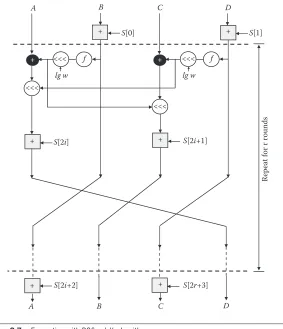
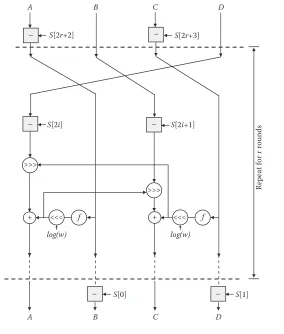
encryp-tion and decrypencryp-tion are summarized next, and the block diagrams of
RC6 encryption and decryption are shown in Figures 2.7 and 2.8,
respectively.
2.6.7.1 RC6 Encryption Algorithm
Input: Four w-bit plaintext values stored in registers
A, B, C, and D
Number r of rounds
w-bit round keys S[0, …, 2r+3]
Output: Four w-bit ciphertext values stored in
registers A, B, C, and D.
Procedure: B = B + S [0];
D = D + S [1];
For i = 1 to r do
{t = (B × (2B + 1)) <<< lg w;
u = (D × (2D + 1)) <<< lg w;
A = ((A ⊕ t) <<< u) + S [2i]; C = ((C ⊕ u) <<< t) + S [2i + 1]; (A, B, C, D) = (B, C, D, A);} End
2.6.7.2 RC6 Decryption Algorithm
Input: Four w-bit ciphertext values stored in registers A, B, C, and D
Number of rounds r w-bit round keys S[0, …, 2r+3]
Output: Four w-bit plaintext values stored in
registers A, B, C, and D.
Procedure: C = C − S [2r + 3];
A = A − S [2r + 2];
for i = r downto 1 do
{(A, B, C, D) = (D, A, B, C); u = (D × (2D + 1)) <<< log(w); t = (B × (2B + 1)) <<< log(w); C = ((C − S[2i + 1]) >>> t) ⊕ u;
A
+ <<<
C
+
+ +
<<<
+
D
f
<<<
B
f
<<<
A B C D
S[0] S[1]
S[2i] S[2i+1]
S[2r+3]
S[2i+2]
lg w lg w
Repeat for r rounds
+
+ +
21 F U N D A M E N TA L S O F I M A G E E N C R Y P T I O N
A = ((A − S[2i]) >>> u) ⊕ t;} End
D = D − S [1]; B = B − S [0];
2.6.8 The Advanced Encryption Standard
The Advanced Encryption Standard (AES) is based on the Rijndael
algorithm, which is an iterated block cipher algorithm with a variable
block size and a variable key size. The block size and the key size can
be independently 128, 192, or 256 bits. The intermediate resulting
ciphertext is called a
state,
and it is in the form of a rectangular array
of four rows and a number of columns equal to the block size divided
>>> –
B
–
S[2i] S[2i+1]
f
<<<
log(w) log(w)
D B
–
A
S[2r+2] – S[2r+3]
C
f
<<<
–
>>>
A D
–
C
+ +
S[1]
S[0]
Repeat for r rounds
by 32. The cipher key is similarly a rectangular array with four rows
and a number of columns equal to the key size divided by 32. The
number of rounds performed on the intermediate state is related to the
key size. For key sizes of 128, 192, and 256 bits, the number of rounds
is 10, 12, and 14, respectively. Each round consists of a fixed sequence
of transformations, except the first and the last round [16–18].
The AES consists of rounds. Any round, except the final one,
consists of SubBytes, ShiftRows, MixColumns, and AddRoundKey
operations. In the final round, no MixColumns operation is
per-formed. In the SubBytes step, a linear substitution for each byte is
performed according to Figure 2.9. Each byte in the array is updated
using an 8-bit S-box, which provides the nonlinearity in the cipher
system [16–18].
The S-box is derived from the multiplicative inverse over the finite
Galois field GF(2
8), known to have good nonlinearity properties. To
avoid attacks based on simple algebraic properties, the S-box is
cho-sen to avoid any fixed points and any opposite fixed points [16–18].
The ShiftRows step operates on the rows of the state. It
cycli-cally shifts the bytes in each row. For the AES, the first row is left
unchanged. Each byte of the second row is shifted a single byte to the
left. Similarly, the third and fourth rows are shifted by offsets of 2 and
3 bytes, respectively. For the block of size 128 bits and 192 bits, the
shifting pattern is the same [16–18].
In this way, each column of the output state of the ShiftRows step
is composed of bytes from each column of the input state. In the case
of the 256-bit blocks, the first row is unchanged, and the shifting for
b1 b2
2 3 F U N D A M E N TA L S O F I M A G E E N C R Y P T I O N
second, third, and fourth rows is 1 byte, 3 bytes, and 4 bytes,
respec-tively, as shown in Figure 2.10.
In the MixColumns step, the 4 bytes of each column of
the state are combined using an invertible linear
transforma-tion. The MixColumns function takes 4 bytes as input and
out-puts 4 bytes, where each input byte affects all 4 output bytes. With
ShiftRows, MixColumns provides diffusion in the cipher system.
Each column is treated as a polynomial over GF(2
8) and is then
multiplied with a fixed polynomial
C
(
x
) = 3
x
3+
x
2+
x
+
2. The
MixColumns step can also be viewed as multiplication by a
particu-lar matrix as shown in Figure 2.11 [16–18].
In the AddRoundKey step, the subkey is combined with the state.
For each round, a subkey is derived from the main key using the
algorithm key schedule. Each subkey has the same size as the state.
b1 b2
Figure 2.10 ShiftRows step.
b1 b2
The subkey is added by combining each byte of the state with the
corresponding byte of the subkey using a bitwise XOR [16–18]. The
AddRoundKey step is shown in Figure 2.12. We apply the AES with
a fixed block size of 128 bits and a key size of 128 bits.
2.7 Modes of Operation
Block ciphers can be run in different modes of operation, allowing users
to choose appropriate modes to meet the requirements of their
appli-cations. Using a certain mode in the encryption process restricts the
decryption process to use the same mode. In this section, we discuss
dif-ferent possible ways in which block codes can be utilized to implement a
cryptosystem. The possible block cipher modes of operation that we treat
are identified by the acronyms electronic codebook (ECB), cipher-block
chaining (CBC), cipher feedback (CFB), and output feedback (OFB). In
each case, we assume that we have a block cipher of block length
n
with
enciphering map
E
Kand deciphering map
D
Kfor each key
K
.
2 5 F U N D A M E N TA L S O F I M A G E E N C R Y P T I O N
2.7.1 The ECB Mode
ECB is the simplest mode of operation for encryption algorithms;
the data sequence is divided into blocks of equal size, and each block
is encrypted, separately, with the same encryption key. As illustrated
in Figure 2.13, the plaintext is divided into blocks (
P
1,
P
2,
P
3, ....) of
size
n
bits that are encrypted to ciphertext blocks (
C
1,
C
2,
C
3, ....). The
encryption algorithm is
C
j=
E
K(
P
j) (2.5)
and the decryption algorithm is
P
j=
D
K(
C
j) (2.6)
where
j
= 1, 2, 3, ... ;
E
Kis the encryption map with the key
K
; and
D
Kis the decryption map with the same key
K
.
The ECB mode has several advantages. There is no need to encrypt
a file progressively; the middle blocks can be encrypted first, then
the blocks at the end, and finally the blocks at the beginning. This is
important for encrypted files that are accessed randomly, like a
data-base. If a database is encrypted in the ECB mode, then any record can
be added, deleted, encrypted, or decrypted independently, assuming
that a record consists of independent encryption blocks.
The disadvantage of this mode is that identical plaintext blocks
are encrypted to identical ciphertext blocks; it does not hide data
patterns. The advantage is that error propagation is limited to a
single block. The disadvantage of the ECB mode appears in image
encryption if there is an image with large areas of the same color or
repeated patterns so that there are many blocks of the same plaintext.
Key EncryptionAlgorithm Key Encryption
Key EncryptionAlgorithm Plaintext
P2
Plaintext
P3
Figure 2.13 Using a block cipher in the ECB mode.
This may reveal much information about the original image from the
encrypted image. This disadvantage is treated in CBC, CFB, and
OFB modes.
2.7.2 The CBC Mode
The CBC mode uses an initialization vector (IV) of size equal to the
size of each block of pixels. In this mode, each block of plaintext is
XORed with the previous ciphertext block before being encrypted.
By this way, each ciphertext block is dependent on all plaintext
blocks up to that point. In decryption, the same XOR operation is
repeated so that its effect is cancelled. This mechanism is shown in
Figure 2.14.
The main disadvantage of the CBC mode is that an error in (or
attack on) one ciphertext block impacts two plaintext blocks on
decryption. On the other hand, if there is an image that has blocks
of the same input data, these blocks are encrypted to totally different
ciphertext data. So, the CBC mode is a better approach in encrypting
images in the spatial domain, especially when these images contain
large areas of the same activity. In the CBC mode, the encryption
algorithm is
C
j=
E
K(
C
j−1⊕
P
j) (2.7)
and the decryption algorithm is
P
j=
D
K(
C
j)
⊕
C
j−1,
j
= 1, 2, 3, ...
(2.8)
C
0=
IV
(2.9)
Key
C1 C2 C3
EK EK EK
P2 P3
P1
+ + +
Key Key
C0 = IV
2 7 F U N D A M E N TA L S O F I M A G E E N C R Y P T I O N
2.7.3 The CFB Mode
In contrast to the CBC mode, the CFB mode begins by
encrypt-ing the IV, and then an XOR operation is performed between the
bits of the encrypted IV and the corresponding bits of the first block
of the image. The result is the encrypted version of the first block.
For the encryption of each of the next plaintext blocks, the previous
ciphertext block is encrypted, and the output is XORed with the
cur-rent plaintext block to create the curcur-rent ciphertext block. The XOR
operation conceals plaintext patterns.
Common to the CBC mode, changing the IV to the same
plain-text block results in different outputs. Although the IV need not be
secret, some applications would see this as desirable [16–18,49,50].
Figure 2.15 shows the CFB mode. The encryption algorithm is
C
j=
P
j⊕
I
j(2.10)
and the decryption algorithm is
P
j=
C
j⊕
I
j(2.11)
I
j=
E
K(
C
j-1),
j
= 1, 2, 3, ...
(2.12)
C
0=
IV
(2.13)
2.7.4 The OFB Mode
The OFB mode is similar to the CFB mode. It begins by encrypting
the IV. The bits of the encrypted IV are XORed with the
correspond-ing bits of the first plaintext block to obtain the correspondcorrespond-ing
cipher-text block. Also, the output of the encryption algorithm is used as
an input to the next encryption step instead of the IV. This process
EK I1
C0 = IV
P1
C1
P2
C2
EK I2
P3
C3
EK I3
+ + +
continues until the last block. Changing the IV for the same plaintext
block results in different ciphertext blocks. Figure 2.16 shows the
OFB mode [16–18,49,50]. The encryption algorithm is
C
j=
P
j⊕
I
j(2.14)
and the decryption algorithm is
P
j=
C
j⊕
I
j(2.15)
I
j=
E
K(
I
j-1),
j
= 1,2,3,...
(2.16)
I
0=
IV
(2.17)
2.8 Chaos and Cryptography
Chaos theory has been established since the 1970s in many different
research areas, such as physics, mathematics, engineering, biology,
and others. The most well-known characteristics of chaos are the
so-called butterfly effect (sensitivity to initial conditions) and the
pseudo-randomness generated by deterministic equations. Many fundamental
properties of chaotic systems have their corresponding counterparts
in traditional cryptosystems. Chaotic systems have several significant
features favorable to secure communications, such as ergodicity,
sen-sitivity to initial conditions and control parameters, and random-like
behavior [38–40]. With all these advantages, scientists expected to
introduce new and powerful tools of chaotic cryptography. So, chaos
has become a new rich source of new ciphers [31–35].
Chaotic dynamic systems are dimensional nonlinear dynamic
sys-tems that are capable of complex and unpredictable behavior. Chaos
describes a system that is sensitive to initial conditions to generate an
apparently random behavior but at the same time it is completely
deter-ministic. These properties of chaos have much potential for applications
P1 P2 P3
C1 C2 C3
EK I1 EK I2 EK I1
I0 = IV
+ +
+
2 9 F U N D A M E N TA L S O F I M A G E E N C R Y P T I O N
in cryptography as it is hard to make long-term predictions on chaotic
systems. First, being completely deterministic means that we can
always obtain the same set of values provided we have exactly the same
mapping function and initial conditions. Because chaotic functions
are sensitive to initial conditions, any slight difference in the initial
values used means that the ciphertext produced using chaos will be
completely different. This means that the system will be strong against
brute-force attacks as the number of possible keys is large.
The basic properties of chaotic systems are the deterministicity, the
sensitivity to initial conditions and parameters, the topological
transi-tivity, and the ergodicity [51–55].
Deterministicity means that chaotic systems have some
determin-ing mathematical equations ruldetermin-ing their behavior.
Sensitivity to initial conditions means that when a chaotic map is
iteratively applied to two initially close points, the iterations quickly
diverge and become uncorrelated in the long term. Sensitivity to
parameters causes the properties of the map to change quickly when
slightly perturbing the parameters on which the map depends. Hence,
a chaotic system can be used as a pseudorandom number generator.
Topological transitivity is the tendency of the system to quickly
scramble up small portions of the state space into an intricate network
of filaments. Local, correlated information becomes scattered over the
state space.
The ergodicity of a chaotic map means that if the state space is
partitioned into a finite number of regions, no matter how many, any
orbit of the map will pass through all these regions. The ergodicity of
a chaotic map is ensured by the topological transitivity property.
Many properties of chaotic systems, such as mixing and
sensi-tivity to initial conditions, have their corresponding counterparts
in traditional cryptosystems. Table 2.4 contains a partial list of
Table 2.4 Similarities and Differences between Chaotic Systems and Cryptographic Algorithms
CHAOTIC SYSTEMS CRYPTOGRAPHIC ALGORITHMS
Set of real numbers Finite set of integers
Iterations Rounds
Parameters Key
Sensitivity to a change in initial conditions Diffusion