Natural Biodegradation of Coprostanol In An Experimental System of Three Environmental Conditions of Jakarta Waters, Indonesia Original paper
NATURAL BIODEGRADATION OF COPROSTANOL IN
AN EXPERIMENTAL SYSTEM OF THREE ENVIRONMENTAL
CONDITIONS OF JAKARTA WATERS, INDONESIA
Tonny Bachtiar 1, 2, 3 *, Ocky Karna Radjasa 2, 4, Agus Sabdono 2, 4
1
Graduate Program on Environmental Studies, Diponegoro University
2
Center for Coastal and Marine Tropical Studies, Research Institute, Diponegoro University
3
Oceanography Study Program, Department of Marine Science, Diponegoro University
4
Marine Science Study Program, Department of Marine Science, Diponegoro University
Received: March, 29, 2004 ; Accepted: May, 30, 2004
ABSTRACT
Constraint of using bio-indicator (coliform bacteria) as an indicator of domestic (sewage) pollution in the environment with high environmental stress encourages the discovering of other alternate indicators. Coprostanol has been proposed as a chemical indicator of domestic waste pollution, but most research on were conducted in the temperate (high latitude) region. The persistence of coprostanol in tropical region, especially in Indonesia, is still very poor. It is very important to understand the persistence of coprostanol in the nature, as one of the requirements to propose coprostanol as an alternate indicator of domestic waste pollution. In order to better understand the natural biodegradation of coprostanol, experimental system on three environmental conditions (river, river mouth, and coastal waters) was conducted. In April 2004, samples of water and surface bottom sediments were collected from each environmental condition in duplicate. Before the samples were put into aerated and non-aerated aquaria, about 35-40 g of surface bottom sediments were taken to analyze the initial concentration (C0) of coprostanol. The sediments were subsequently sampled from each
aquarium within a certain interval day to analyze the concentration of coprostanol (C10, C20, and C40).
The results showed that aeration plays not an important role in natural biodegradation of coprostanol. In average, the highest rate of coprostanol biodegradation is 0.438 µg/g day-1 in non aerated coastal water environment, where as the lowest was found in the non aerated river mouth environment (0.021 µg/g day-1). Since coprostanol was degraded very slowly, and could be detected in the sediments of three environmental conditions, coprostanol has an excellent potency to be used as an alternate indicator of domestic wastes.
Key words: Biodegradation,coliform, coprostanol, domestic, existence, rate.
*Correspondence: Phone: 62-24-8453635, Fax: 62-24-8453635, E-mail: [email protected]
I
NTRODUCTION
In the last two decades, the reliability of coliform test as an adequate indicator of domestic (sewage) pollution, especially in
variety of point sources, such as streams and drainage outfalls. Increasing volume of toxic and heated industrial wastes, the subsequent change of salinity from freshwater to seawaters, chlorination of wastewaters, and low dissolved oxygen were the constrains for the existence of coliform bacteria (Walker et al. 1982, Bartlett 1987, and Bachtiar 2002). Bartlett (1987) stated that the question of using coliform is mainly due to the lack of knowledge regarding die-off rates, particularly in saline waters. Manahan (1994) stated that die-off rates of bacteria in saline waters cauld be the result of the osmotic affect.
In order to better understand the sewage contamination in urban coastal waters an alternate indicator more persistence to the environmental stress is required. Various alternate indicators were proposed, and coprostanol showed a promised indicator of sewage contami-nation (Hatcher et al. 1977, Hatcher and McGillivary 1979, Brown and Wade 1984, Düreth et al. 1986, Holm and Windsor conducted in temperate region, information related to coprostanol in tropical region, especially in Indonesia is urgently needed.
Several requirements for using a substance as an indicator are: a) related to the specific source, b) quantified (exist in field), and c) relatively conservative (the substance unchanged to become other substance or persistence). Coprostanol (5β -Cholestan-3β-ol) is the major fecal sterol of human, comprising 40 to 60 % of total neutral sterols excreted, and also detected in feces of mammals and chicken, but was not found in intestinal content of marine animals (Walker et al. 1982). Therefore it is a very specific indicator when coprostanol preset in marine environment
uniquely confirms recent or continuing sewage contamination.
In this work the persistence of coprostanol was studied using experimental system of three environmental conditions (river, river mouth, and coastal waters). The prime objective of this work is to evaluate the persistence of coprostanol as one of the requirements to use coprostanol as an alternate indicator of domestic waste in tropics, especially in Indonesia urban coastal waters.
M
ATERIALS AND
M
ETHODS
Water and Sediment Sampling
Duplicate of water and sediment samples were collected from three environmental conditions (river, river mouth, and coastal waters) of Ciliwung River Jakarta in April 2004 (Figure 1). Five liters of water samples of each station were collected by using van Dron water sampler about 10 cm of the upper most. These samples were immediately put into dark bottles and stored in a cool box (about 5°C) during fieldwork. About 5 kg of sediment samples of each station were collected using van Veen grab sampler. The grab sampler was carefully used to ensure that the surface of sediment was as undisturbed as possible.
Field Measurements
Water Quality Checker was used to measure on site temperature, conductivity, dissolved oxygen, and pH. Refractometer was used for salinity, and Secchi disc for water clarity.
Experimental System
Natural Biodegradation of Coprostanol In An Experimental System of Three Environmental Conditions of Jakarta Waters, Indonesia
sediment samples of each station were homogenized by mixing them manually before put into the aquarium. The aeration system was installed only to aerate the water column and undisturb the surface of sediments. About 35-40 g of sediments was collected from each sample for analyzing
the initial concentration of coprostanol (C0). The sediments were taken as samples
from each aquarium with certain days period to understand the change of coprostanol concentration (C10, C20, and
C40).
Coprostanol Analysis
The concentration of coprostanol in sediment samples was analyzed using UV Spectrophotometer which applies to the standard curve of coprostanol. The analytical procedure is as follows:
Standard curve of coprostanol in
ethanol
Preliminary UV spectrophotometer
analysis of coprostanol standard in ethanol was conducted to find the optimum wave length. The result showed that the optimum wave length for coprostanol in ethanol was 250 nm. Based on that result, five concentration of coprostanol standard: 5, 10, 15, 20, and 25 ppm in ethanol were analyzed using UV Spectrophotometer with λ 250 nm to understand the
correlation of absorbance and
concentration of coprostanol standard called the standard curve of coprostanol in ethanol.
Sample preparation
- About 35-40 g of sediment samples were twice extracted using diethyl ether for 6 hours. The extract was collected and the sediments were allowed to dry by placing them in the oven (60°C) for a few days. The weights were continuously recorded until their value no longer changed.
- The extracts were evaporated in room temperature to near dryness by stirring using orbital shaker. Ethanol (2 ml) was used to dilute the extract.
- Total organic content (TOC) and grain concentration of coprostanol in ethanol could be determined by using the standard curve of coprostanol in ethanol. The concentration of coprostanol in sediment samples was calculated based on the concentration of coprostanol in ethanol and the dry weight of sediment residue of each sample.
Biodegradation Rate
Biodegradation rate of coprostanol in each environmental condition was determined by using the formula as follows (Bartlett, biodegradation is determined, and listed in
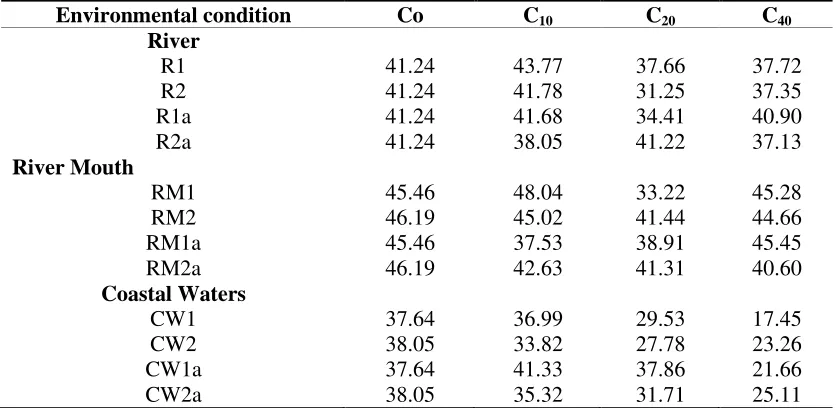
Natural Biodegradation of Coprostanol In An Experimental System of Three Environmental Conditions of Jakarta Waters, Indonesia Table 1 .Coprostanol analysis in natural biodegradation experiment (µg/g)
Environmental condition Co C10 C20 C40
River
R1 41.24 43.77 37.66 37.72
R2 41.24 41.78 31.25 37.35
R1a 41.24 41.68 34.41 40.90
R2a 41.24 38.05 41.22 37.13
River Mouth
RM1 45.46 48.04 33.22 45.28
RM2 46.19 45.02 41.44 44.66
RM1a 45.46 37.53 38.91 45.45
RM2a 46.19 42.63 41.31 40.60
Coastal Waters
CW1 37.64 36.99 29.53 17.45
CW2 38.05 33.82 27.78 23.26
CW1a 37.64 41.33 37.86 21.66
CW2a 38.05 35.32 31.71 25.11
Table 2 The rates of natural biodegradation of coprostanol (µg/g day-1) in three environmental conditions of Ciliwung river, Jakarta
Environmental Condition
Non-aerated Aerated
I II Average SD I II Average SD
River 0.088 0.097 0.093 0.006 0.009 0.103 0.056 0.066
River Mouth 0.004 0.038 0.021 0.024 0.0002 0.140 0.070 0.099
Coastal
Waters 0.505 0.370 0.438 0.095 0.400 0.324 0.362 0.054
Fig. 3 The rates of natural biodegradation of coprostanol in three environmental conditions (river, river mouth, and coastal waters) of Ciliwung River, Jakarta (April 2004).
Table 3 TOC and sediment grain size analysis
Sample ID TOC (%) Percentage of Grain Size Grain Size
Sand Silt Clay
R1 37.80 9.83 22.65 67.52 Silty clay
R2 36.23 11.01 20.12 68.87 Silty clay
RM1 40.68 10.42 19.57 70.01 Silty clay
RM2 42.21 11.03 20.55 68.42 Silty clay
CW1 31.93 11.95 22.40 65.65 Silty clay
CW2 29.97 12.14 23.36 64.50 Silty clay
Discussion
The results of coprostanol analyses (Table 1 and Figure 2) showed the fluctuation of coprostanol concentration. The
concen-a grconcen-aduconcen-al degrconcen-adconcen-ation. This is concen-a common occurrence difficult to be eliminated in a
natural biodegradation experiment
(Bartlett, 1987), where the sediments are not well homogenized. Because of that, it
!
"
#
#
$
$#
Natural Biodegradation of Coprostanol In An Experimental System of Three Environmental Conditions of Jakarta Waters, Indonesia
characteristic (grain size), coprostanol, and microorganism in the sediment are well distributed. Beside that, random sediment sampling in the aquaria is another factor that affects the fluctuation values of coprostanol concentration. As a result, the concentration of coprostanol does not decrease gradually, and the natural biodegradation rates of coprostanol also vary depending on the values of C0 and
C40.
(Table 2 and Figure 3) showed that the highest average of coprostanol natural biodegradation rate (0.438 µg/g day-1) occurred in the sediment non-aerated coastal water environment where the initial concentration of coprostanol is relatively low (37.64 – 38.05 µg/g) compared to the initial concentrations of coprostanol in the river sediments (41.24 µg/g) and river mouth sediments (45.46 – 46.19 µg/g). The lowest rate of natural coprostanol biodegradation occurred in sediments of non-aerated river mouth environment (0.021 µg/g day-1). The results show that aeration which only aerated water column
does not play important role in
biodegradation of coprostanol in sediment.
These phenomena indicate that to
determine the natural biodegradation rate many factors need to be considered.
The initial values of coprostanol concentration (C0) should have very
important role in determining the natural biodegradation rate of coprostanol. However, the results indicated that not always high initial concentration of coprostanol will have high natural biodegradation rates.
The lowest average natural biodegradation rate (0.021 µg/g) was found in the sediment of river mouth with non-aeration treatment, where the sediments contained a relatively high concentration of coprostanol (45.46 – 46.19 µg/g) and organic material (40.68 – 42.21 %). Based on the data, it is clear that homogenety of the sample has important role in determining the natural biodegradation rate. This also indicates that
coprostanol degraded relatively very slowly. As a result coprostanol would be accumulated in the sediments and could be used as an alternate indicator of domestic waste pollution in urban coastal waters.
C
ONCLUSSION
To better understand the persistence of coprostanol as one of the requirements to be used as an indicator of domestic waste, it is necessary to conduct such as a natural biodegradation studies of coprostanol in other cities in Indonesia representing different environmental condition to the condition of Jakarta. This is because different environmental conditions would suppose to have a certain characteristic of coprostanol natural biodegradation rates.
A
CKNOWLEDGEMENTS
We gratefully acknowledge to National Education Department of Republic of Indonesia for funding this research through
Postgraduate Research Team Grand
(HPTP/Hibah Pasca) Phase II. We thank the Research and Development Agency (BALITBANG) and Environmental Impact Management Agency (BAPPEDAL) of Central Java Province, Organic Chemistry
Laboratory of UGM, Biotechnology
R
EFERENCES
Bachtiar, T. 200 , Koprostanol Sebagai
Indikator Kontaminasi dan
Perunut Alamiah Limbah
Domestik di Perairan Pantai Banjir Kanal Timur Semarang. Disertasi Doktor, Departemen
Teknik Lingkungan ITB,
Bandung.
Bachtiar, T., J. P. Coakley, and M. J. Risk.
1996, Tracing
sewage-contaminated sediment in
Hamilton Harbour using selected geochemical indicators, Total
Environ. 179, 3-16.
Bachtiar, T. 1993, Tracing Contaminated
Sediment Using Natural
Indicators, Master Thesis,
Department of Geology,
McMaster University, Hamilton, Ontario, Canada.
Bartlett, P. D. 1987, Degradation of coprostanol in an experimental system, Marine Poll. Bull., 27-29.
Brown, R. C. and T. L. Wade, 1984. Sedimentary coprostanol and
hydrocarbon distribution
adjacent to a sewage outfall.
Wat. Res., 18, 621-632.
Chan, K. H., M. H. W. Lam, and K. F. Poon. 1998. Application of Sedimentary Fecal Stanol and Sterols in Tracing Sewage Pollution in Coastal Waters,
Wat. Res., 32 (1) 225-235.
1992, Specific organic
components as tracers of
contaminated fine sediment dispersal in Lake Ontario near Toronto, Hydrobiologia, 235/ 236, 85-96.
Düreth, S, R. Herrman, and K. Pecher, 1986, Tracing fecal pollution by coprostanol and intestinal bacteria in an ice-covered Finnish lake loaded with both industrial and domestic sewage.
Water, Air, Soil Poll.., 28,
131-149.
Hatcher, P. G., L. E. Keister, and P. A. McGillivary, 1977, Steroids as sewage specific indicators in New York Bight sediments,
Bull. Environ Contam. Toxicol.
17, 491-498.
Hatcher, P. G. and P. A. McGillivary, 1979, Sewage contamination in
the New York Bight:
Coprostanol as an indicator.
Environ. Sci. Technol., 13,
1225-1229.
Holm, S. E. and J. G. Windsor, 1990, Exposure assessment of sewage treatment plant effluent by a
selected chemical marker
method. Arch. Environ. Contam.
Toxicol., 19, 674-679.
Jeng, W. L. and B. C. Han. 1994. Sedimentary coprostanol in Kaoshsiung Harbour and the Tan Sui Estuary, Taiwan. Mar. Poll.
Bull., 28, 494-499.
Jeng W. L., J. Wang, and B. C. Hang, 1996, Coprostanol distribution in
marine sediments off
Natural Biodegradation of Coprostanol In An Experimental System of Three Environmental Conditions of Jakarta Waters, Indonesia
Manahan, S. E., 1994, Environmental
Chemistry, 6th ed., Lewis
Publishers, Boca Raton, Florida.
Walker, R. W., C. K. Wun, and W. Litsky,
1982, Coprostanol as an
indicator of fecal pollution,