ANTI -1HEFT SECURITY APPLICATION USING
MICROCONTROI,I ,ER
Sebastian Edwin Amin
",
Bachelor of Engineering with Honours
TJ
(Electronics and Computer Engineering)
223
2004
P76
S443 2004O_I.£) ~ -:l,
r
Pusat Khidmat Maktuma emD. UNIVERSm MALAYSIA SARAWA¥
94300 KOla Samaraban
ANTI-THEFT SECURITY APPLICATION
USING MICROCONTROLLER
P.KHIDMA TMAKLUMA TAKADEMIK UllMAS
1111111111111111111111111
1000133646SEBASTIAN EDWIN AMIN
This project is submitted in partial fulfilment of
the requirements for the degree of Bachelor of Engineering with Honours (Electronic & Computer Engineering)
Faculty of Engineering
UNIVERSITI MALAYSIA SARAWAK
2004
UNIVERSITI MALAYSIA SARA W AK
R13a
BORANG PENGESAHAN STATUS TESIS ANTI-THEFf SECURITY APPLICATION USING
Judul:
MICROCONTROLLER
SESI PENGAJIAN: _ _~2=OO-,<,3~/"",,200,,-,,-,,4,--_ __
Saya SEBASTIAN ANAK EDWIN AMIN
mengaku membenarkan tesis • ini disimpan di Pusat Khidmat Maklumat Akademik, Universiti Malaysia Sarawak dengan syarat-syarat kegunaan seperti bcrikut:
1. Tesis adalah hakmilik Universiti Malaysia Sarawak.
2. Pusat Khidmal Maklumal Akadcmik, Universili Malaysia Sarawak dibenarkan membual salinan unluk lujuan pengajian sahaja.
3. Membuat pendigilan untuk membangunkan Pangkalan Data K..lndungan Tcmpalan.
4. Pusat Khidmal Maklumal Akademik, Universili Malaysia Sarawak dibenarkan mcmbual salinan lesis ini sebagai bahan pertukaran antara inslitusi pengajian tinggi.
5. •• Sila landakan ( .; ) di kolak yang berkenaan
o
SULlT (Mengandungi maklumat yang berdarjah keselamatan alau kepentingan Malaysia seperti yang termaktub di dalam AKTA RAHSlA RASMI1972).o
TERHAD (Mengandungi maklumat TERHAD yang telah dilenlukan olch organisasi/ badan di mana penyelidikan dijalankan).r;l
TlDAKU
TERHADDisahkan oleh
AJamal letap:
131, Sunny Hill Garden, Jln
Pearl Park, 93250, Kuching, Wan Azlan Wan Zainal Abidin
Sarawak, Malaysia. Nama Penyelia
Tarikh: _ _ _ __ 2=2=-b_b.;.:M.::a::.;rc;::h:...;2::.:004=:_ _ _ __ Tarikh:
CATATAN
•
Tesis dimaksudkan sebagai lesis bagi Jjazah Doktor Falsafah, Sarjana dan Sarjana Muda .••
Jika lesis ini SULIT alau TERHAD, sila lampirkan surat daripada pihak berkuasa/organisasi berkcnaan dengan menyalakan sekali sebab dan lempoh lesis ini perlu dikelaskan sebagai SULIT dan TERHAD.This project report attached here entitled "ANTI-THEFT SECURITY APPLICATION USING MICROCONTROLLER", was edited and prepared by Sebastian Edwin Amin as a partial fulfillment of the requirement for the Degree Bachelor of Engineering with Honours (Electronics and Computer) is hereby read and approved by:
Mr. Wan Azlan Wan Zainal Abidin Date
Dedicated especially
to
ACKNOWLEDGEMENT
The author would like to express a big sincere thanks and gratitude to everyone involved in the quest of finishing this project.
This project involves not only academic contributions but financial as well. Specia,l thanks to
Mr.
Wan Azlan Wan Zainal Abidin and Mr. Martin Anyi for both their invaluable technical advice and guidance throughout the completion of this thesis project.The author would also like to convey his outmost gratitude to his parents, family and love ones for their undying support and understanding all throughout these years.
Finally, the author would like to thank his fellow mates for their small contributions in
ABSTRACT
Microcontrollers are widely used in many electronic gadgets nowadays. Many of which are embedded in daily domestic appliances such as in microwave ovens, refrigerator, washing machines,just to name a few.
In security and monitoring devices, microcontrollers are well embedded within the system
due to its simplicity yet robust performance. This gives an added advantage to users who wish to customize its application according to operational environment needs.
In addition to its simplicity and robust performance, microcontrollers are also inexpensive, easy to modify its programming contents and certainly perfect for applications that runs on
real time conditions.
Hence, this project report is intended to illustrate an overview operation of an anti-theft application device. This project will illustrate how external data is extracted and translated
into electrical signals, processed accordingly and generates the intended output, while at the
same time communicates with other devices via a serial link. This overview is commonly
ABSTRAK
Kebanyakan peralatan elektronik pada masa kini melibatkan penggunaan litar pengawal milcro. Litar-litar ini boleh didapati dalam pelbagai peralatan domestik harian seperti dalam aIat ketuhar gelombang mikro, peti sejuk, mesin pembasuh pakaian, dan banyak lagi.
Penggunaan litar pengawal-mikro amat sesuai digunakan dalam aplikasi peralatan sistem kawalan dan keselamatan kerana ianya mudah disenggara dan difahami penggunaannya, selain mempunyai prestasi yang tinggi. lni seterusnya memberi kelebihan kepada pengguna untuk membuat perubahan terhadap sistem aplikasinya mengikut keperluan operasi semasa.
Tambahan pula, penggunaan litar pengawal - mikro adalah murah dan senang didapati di pasaran, manakaIa kandungan aturcaranya yang mudah diubah sememangnya sesuai digunakan untuk aplikasi 'real-time'.
Oleh yang demikian, laporan projek ini adalah bertujuan untuk menunjukkan secara keseluruhannya prototaip sebuah aplikasi sistem keselamatan untuk simulasi keadaan sebenar operasi sistem keselamatan yang terdapat di pasaran. Projek ini akan menerangkan secara
....
mendalam mengenai kaedah pengambilan data dari persekitaran, memproses data terse but mengikut kehendak litar dan mengeluarkan output yang dikehendaki.
Pusat Khidrnat Maklumat Akademlk
UNIVERsm M.(\LAYSIA SARAWM
94~OO Kola Samar3han
TABLE OF CONTENTS
Content Acknowledgement Abstract Abstrak Table o/Contents List o/Tables List0/
Figures Notations1. INTRODUCTION
1.1. Introduction 1.2. Project Objectives 1.3. Project Overview 1.4. Thesis Overview2. LITERATURE REVIEW
2.1. The MeS51 ™ Microcontroller
2.1.1. Microcontroller Variants 2.1.2. Architecture and Organization 2.1.3. Central Processing Unit 2.1.4. Memory Organization
2.1. 5. Reset ..,.
2.1.6. Clock and Resonator Circuit 2.1.7. 110 Port Structures 2.1.8. Timers/Counters 2.1.9. Interrupts 2.1. 10. Serial Port Page Number ii III lV Vl vii x 01 02 03 03 05
06
08
10 10 14 14 15 17 19 202.2. RS-232 Serial Port Communications 22
2.2.1. Serial Communications 22
2.2.2. Plug and Pin Descriptions 25
2.2.3. Signals Descriptions 26
2.2.4. RS232 Serial Interface (MAX232) 28
2.3. Sensors 30
2.3.1. Category ofsensors 30
2.3.2. Magnetic Proximity Switches 31
2.4. 74HC373 Latch 34
2.5. BC557B Transistor 35
3. PROJECT DESIGN METHDOLODY AND DEVELOPMENT
3.1. Introduction 37
3.2. Circuitry Operation 38
3.3. Design Description and Development (Hardware) 41
3.3.1. Input 41
3.3.2. Actuators and Output 42
3.3.3. Microcontroller Main Circuit 44
3. 3. 4. Power Supply 45
3.4. Part list 46
3.5. Design Description and Development (Software) 48
3.5.1. Low-Level Language Programming 48
3.5.2. High-Level Language Programming 51
4. RESULTS AND DISCUSSIONS
4.1. Hardware Analysis and Discussions 54
4.1.1. Power Supply Circuit 55
4.1.2. Magnetic Sensor Circuit 57
4.1.3. Actuator and Output Circuit 59
4.2. Software Analysis and Discussions
62
4.2.1. Assembly Language Programming 654.2.2. GUI Programming 65
4.3. Problem Statements 65
s.
CONCLUSION AND RECOMMENDATIONS
5.1. Conclusion
67
5.2. Recommendations
68
5.2.1. Expanding the I/O Ports
69
5.2.2. Optocoupler
70
5.2.3. USB Transport Medium
71
REFERENCES
72APPENDIX A
75
APPENDIXB
82
LIST OF TABLES
Table Page Number
MCS51™ Family Variants 7
2 MCS51TM Special Function Registers 13 3 Port 1 and 3 Alternative Functions 17
4 Timer Mode Control Register 18
5 Timer Control Register 18
6 Interrupt Sources 19
7 SCON Functions 22
8 RS-232C Signals Summary Standard 26
9 Typical Maximum Distance Modem Line DriverlReceivers 29 10 Anti-Theft Security Application Parts List 46
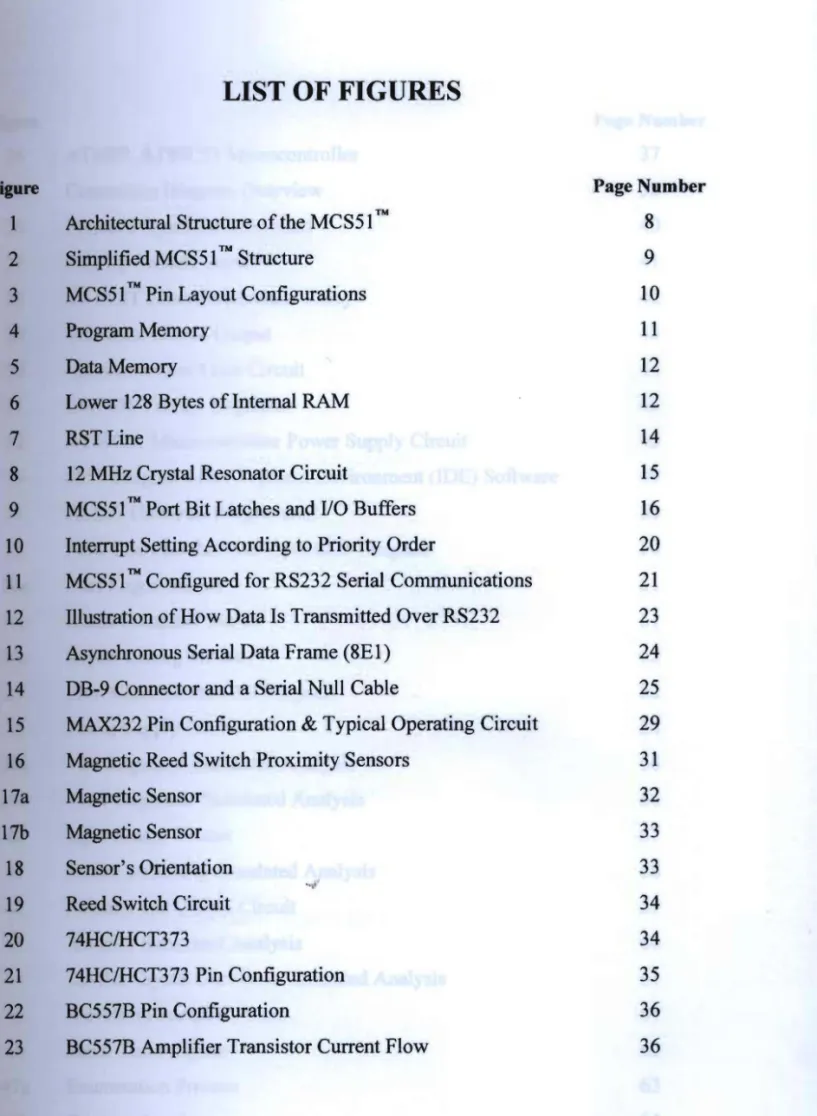
LIST OF FIGURES
Figure Page Number
1 Architectural Structure of the MCS51™ 8
2 Simplified MCS51 ™ Structure 9
3 MCS51 ™ Pin Layout Configurations 10
4 Program Memory 11
5 Data Memory 12
6 Lower 128 Bytes ofInternal RAM 12
7 RST Line 14
8 12 MHz Crystal Resonator Circuit 15
9 MCS51TM Port Bit Latches and VO Buffers 16
10 Interrupt Setting According to Priority Order 20
11 MCS51TM Configured for RS232 Serial Communications 21
12 Illustration of How Data Is Transmitted Over RS232 23 13 Asynchronous Serial Data Frame (8E 1) 24 14 DB-9 Connector and a Serial Null Cable 25 15 MAX232 Pin Configuration & Typical Operating Circuit 29 16 Magnetic Reed Switch Proximity Sensors 31
17a Magnetic Sensor 32
17b Magnetic Sensor 33
18 Sensor's Orientation 33
"/I'
19 Reed Switch Circuit 34
20 74HCIHCT373 34
21 74HCIHCT373 Pin Configuration 35
22 BC557B Pin Configuration 36
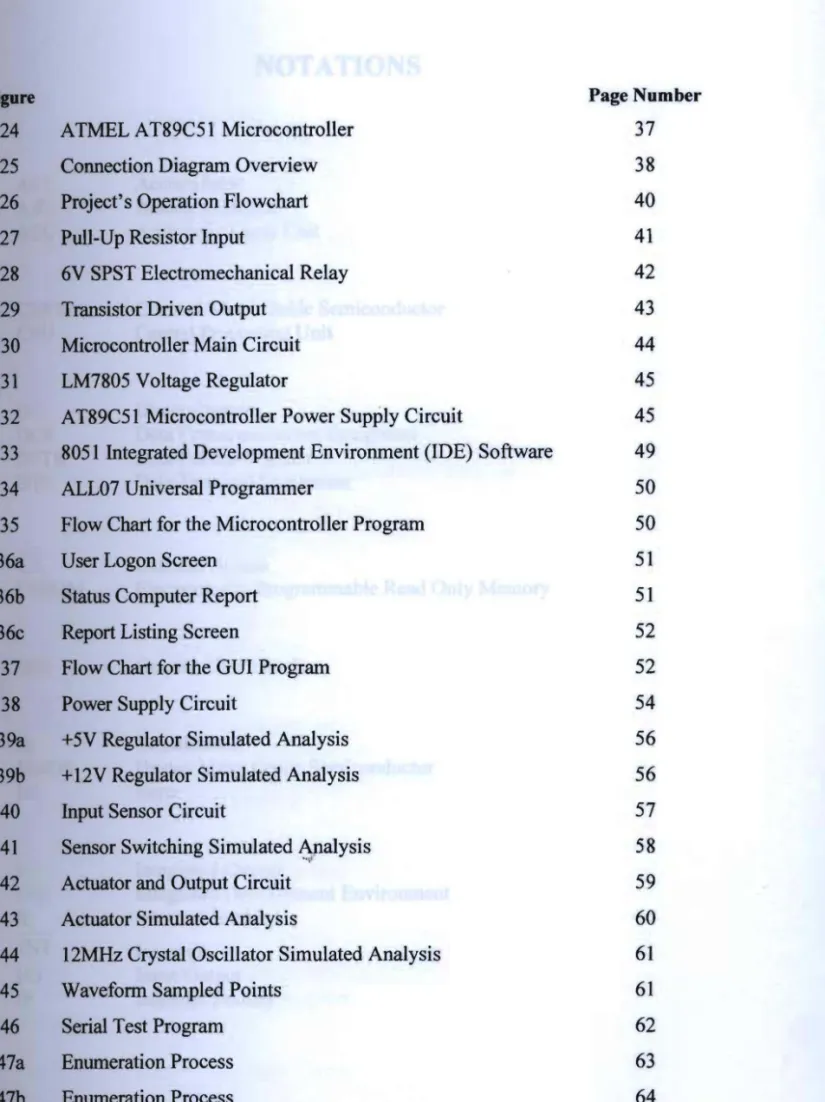
Figure Page Number
24 ATMEL A T89C51 Microcontroller 37
25 Connection Diagram Overview 38
26 Project's Operation Flowchart 40
27 Pull-Up Resistor Input 41
28 6V SPST Electromechanical Relay 42
29 Transistor Driven Output 43
30 Microcontroller Main Circuit 44
31 LM7805 Voltage Regulator 45
32 AT89C51 Microcontroller Power Supply Circuit 45 33 8051 Integrated Development Environment (IDE) Software 49
34 ALL07 Universal Programmer 50
35 Flow Chart for the Microcontroller Program 50
36a User Logon Screen 51
36b Status Computer Report 51
36c Report Listing Screen 52
37 Flow Chart for the GUI Program 52
38 Power Supply Circuit 54
39a +5V Regulator Simulated Analysis 56 39b +12V Regulator Simulated Analysis 56
40 Input Sensor Circuit 57
41 Sensor Switching Simulated Analysis 58
42 Actuator and Output Circuit 59
43 Actuator Simulated Analysis 60
44 12MHz Crystal Oscillator Simulated Analysis 61
45 Waveform Sampled Points 61
46 Serial Test Program 62
47a Enumeration Process 63
47b Enumeration Process 64
110 Parallel Expansion 69
NOTATIONS
A
ACC Accumulator
AID Analog to Digital
ALU Arithmetic Logic Unit
C
CMOS Channel Metal Oxide Semiconductor
CPU Central Processing Unit
D
DC Direct Current
DCE Data Communications Equipment
DPTR Data Pointer Register
DTE Data Terminal Equipment
E
EA External Access
EPROM Electronically Programmable Read Only Memory
G
GUI Graphic User Interface
H
H Hexadecimal
HMOS Heated Metal Oxide Semiconductor
Hz Hertz
I
...,
IC Integrated Circuit
IDE Integrated Development Environment
IE Interrupt Enabled
INT Interrupt
110 Input/Output
L
LE Latch Enabled
LED Light Emitting Diode
M
MCU Microcontroller Unit MCS5111( Microcontrollers 51 Family
MS Microsoft
N
n/e Normally Close
n/o Normally Open
0
OE Output Enabled
OTPROM One Time Programmable Read Only Memory
p
PC Program Counter
PC
Personal ComputerPCON Power Control
PEROM Programmable and Erasable Read Only Memory
PSW Program Status Word
R
RAM Random Access Memory
R-C Resistance-Capacitance
RD External Data Memory Read Strobe
ROM Read Only Memory
RST Reset
RS232 Standard 9-pin PC serial port .... RxD Receive Serial Input Line
S
SBUF Serial Buffer SCON Serial Condition
SFR Special Function Register
SMOD Serial Mode
SP Stack Pointer
T
T Timer
TCON Timer Condition
1L Timer Low
TH
Timer HighTMOD Timer Mode
TIL Transistor-Transistor Logic
TxD Transmit Serial Output Line
U
UART Universal Asynchronous Receiver Transmitter
USB Universal Serial Bus
V
VB Visual Basic
Vee Voltage Supply
VeE Voltage Collector - Emitter
W
WD External Data Memory Write Strobe
WWW World Wide Web
Measurement Symbols
A Ampere F Farad .... K Kilo M Megam
mili micron
'"
Ohm p piko V VoltCHAPTER!
INTRODUCTION
1.1
INTRODUCTION
Microcontrollers [I] are widely used in industrial and consumer applications
nowadays. In many cases, absolute precision, good performance, precise control and multi
tasking are issues of great concerned. For example, a burglar alarm system is supposed to
detect an intruder. It must be able to detect and act upon a variety of situations. With just a
microcontroller connected with the proper sensors [2] and actuators, it can do just this and
become an effective burglar alarm.
A microcontroller is an embedded computer-on-chip, whereby the processor and its
support
circuits are embedded together. Hence, this gives an added advantage to a smaller, inexpensive and flexible system design on which a microcontroller can be implemented withto fully operate the system as
• Construct an Anti-Theft Security Application using the integration of electronic devices,
• Developed software programs for the required alarm activation, • Simulate the event on both hardware and software.
This report contains a detailed description of the hardware used, component
schematic diagrams on various components interfaced to the MeS51 Tl\I microcontroller, and the program flow chart for the entire circuit operation.
.2
Project
Objectives
The main aim of this project is the integration of different electronics components
-connected
together via a microcontroller to construct an Anti-Theft Security Application. A software program for the alarm is also to be developed,required. Below is a summary of the project objectives.
• Identify key elements in an Anti-Theft Security Application System,
• Integrate different electronics components together,
Project Overview
The purpose of the project is to design a microcontroller based Anti-Theft Security lication. This application will solely detect computer system detachments.
The project will use sensors (magnetic switch sensors) [2] as input detections, while a
microcontroller [I) will be used to evaluate the sensed data and take appropriate action.
Thesis Overview
In the early part of this thesis, the author describes the main purpose of the project,
·:wI!lit'.h is to construct an alarm system using a MCS51 ™ microcontroller. Later in the next
':c:baptJer, the author will discuss the structure and core fundamentals of a microcontroller
system particularly about the architecture, memory model, and the internal registers.
Belridc~ that, descriptions about the input sensors and actuators, peripheral latches, amplifier
• •)Dents as well as the RS232 serial communication will also be rendered in the literature
Chapter 3 will discuss the design methodology and development of the project.
~au., on the hardware and software design procedures and considerations will be discussed
The results and discussions of the project will be rendered in Chapter 4. In this
, findings and outcome of the project are detailed in simulation test results (hardware)
The conclusion and recommendation will be In the final chapter of this report.
at the end of this thesis report are the project's schematic circuitry,
. :roc:onll'OlJleJ s source codes, and the VB6.0 OUI source codes for references. The report's
CHAPTER 2
LITERATURE REVIEW
THE MCS51™ MICROCONTROLLER
A microcontroller is an embedded computer-on-chip. The Input/Output ports and -tlOI'Y subsystems built in a microcontroller are specialized for control applications. The
_mal
program
memory (ROM) stores the control software and the CPU executes theiDstlruC:tiOlllS from the ROM. The internal data memory (RAM) allows the CPU to stores
" ,iDlec:uate data.
A very popular microcontroller widely used in control applications is the MCS51 ™
_rocc)ntIollc~, manufactured by Intel ® Corporation [51. The device has the following core
_ a
[S]·
• Single supply 5V operation using HMOS technology
• 4096 bytes program memory on-chip
• 128
bytes program memory on-chip• 4 register banks
• 128
User-defined software flags64 Kilobytes each program and external RAM addressability IJlS instruction cycle with 12 MHz crystal
2 bidirectional 1/0 lines organized as four 8-bit ports ·ple mode, high-speed programmable Serial Port
• Two multiple mode, 16-bit Timers/Counters • Two-level prioritized interrupt structure • Direct Byte and Bit addressability • Binary or Decimal arithmetic
• Integrated Boolean Processor for control application
Microcontroller Variants
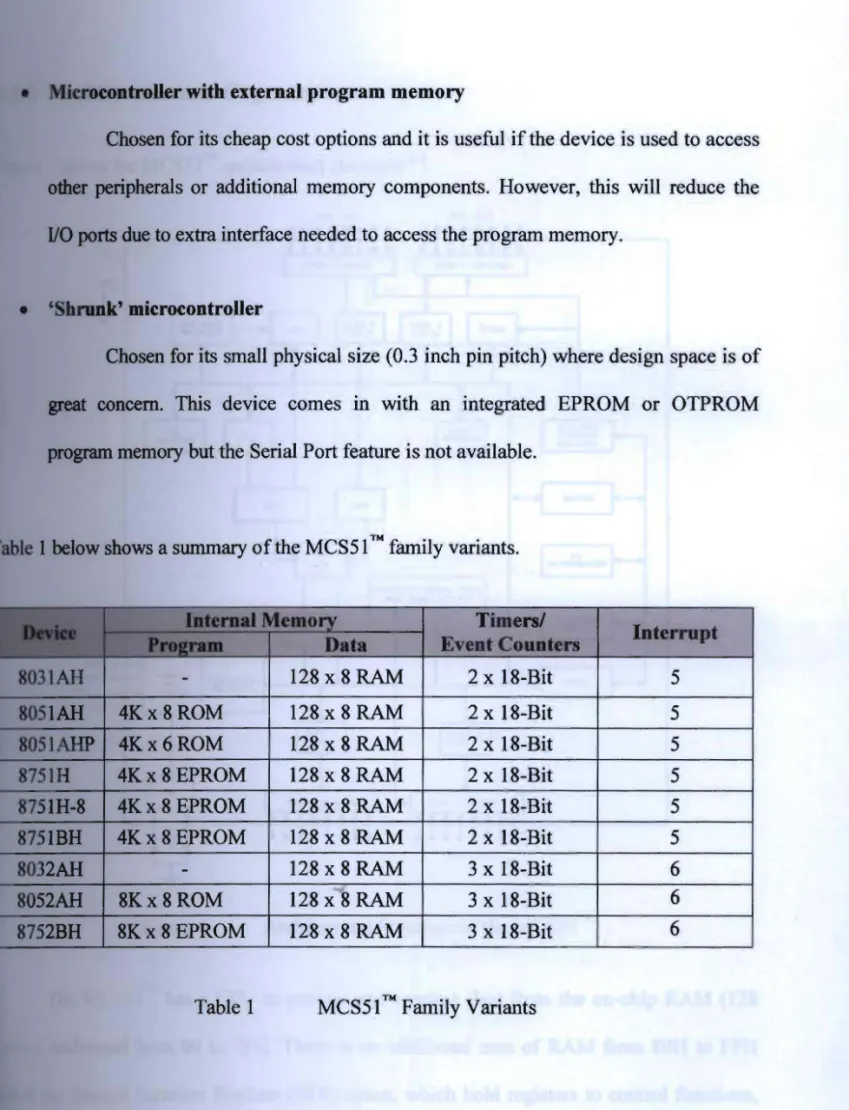
MCS51111 rnicrocontroller family [4] comes in a variety of options:
• Mieroc:ontroller with internal mask-programmed ROM
Chosen for mass-produced items with a specified program embedded into the device. The advantage of this device is that it is cheap at the retail side but expensive
during the initial manufacturing stage.
MIerocontroller with internal EPROM
Chosen for prototyping or developing microcontroller software, which is
suitable for short production, runs. This device is relatively expensive because of the built-in memory and has limited programmable/erase cycles.
MIcroeontroUer with external program memory
Chosen for its cheap cost options and it is useful if the device is used to access other peripherals or additional memory components. However, this will reduce the 110 ports due to extra interface needed to access the program memory.
'Slanmk' microcontroller
Chosen for its small physical size (0.3 inch pin pitch) where design space is of great concern. This device comes in with an integrated EPROM or OTPROM
program
memory but the Serial Port feature is not available.1 below shows a summary of the MCS51 TM family variants.
Timers!
Ia
terrapt
EV 2 x 18-Bit 5 128 x 8 RAM 2 x 18-Bit 4Kx 8 ROM 54Kx6ROM 128 x 8 RAM 2xl8-Bit 5
128 x 8 RAM
4Kx 8 EPROM 2x 18-Bit 5
4Kx8EPROM 128 x 8 RAM 2 x 18-Bit 5
875
1H-8
4Kx8EPROM 128 x 8 RAM 2 x 18-Bit 5
87S
1BH
128 x 8 RAM 3 x 18-Bit 6803
2AH
6 128x 8 RAM 3 x 18-Bit 8Kx 8 ROM80
52AH
68Kx 8 EPROM 128x 8 RAM 3 x 18-Bit