Full Terms & Conditions of access and use can be found at
http://www.tandfonline.com/action/journalInformation?journalCode=vjeb20
Download by: [Universitas Maritim Raja Ali Haji] Date: 11 January 2016, At: 19:35
Journal of Education for Business
ISSN: 0883-2323 (Print) 1940-3356 (Online) Journal homepage: http://www.tandfonline.com/loi/vjeb20
The Impact of a Business Education on Fiscal
Conservatism
Noel Mark Noël, Philip Trocchia & Michael Luckett
To cite this article: Noel Mark Noël, Philip Trocchia & Michael Luckett (2015) The Impact of a Business Education on Fiscal Conservatism, Journal of Education for Business, 90:6, 306-313, DOI: 10.1080/08832323.2015.1046359
To link to this article: http://dx.doi.org/10.1080/08832323.2015.1046359
Published online: 29 May 2015.
Submit your article to this journal
Article views: 27
View related articles
The Impact of a Business Education
on Fiscal Conservatism
Noel Mark No
€
el
University of South Florida, Sarasota, Florida, USA
Philip Trocchia and Michael Luckett
University of South Florida, St. Petersburg, Florida, USAThis article examines the differences in fiscal conservatism between students enrolled in a college of business and those enrolled as nonbusiness majors. Fiscal conservatism is examined using two constructs: fiscal ideology (a) at a macro level and (b) at a micro level, students’ ability to monitor and regulate their personal consumer spending self-control. Further, the authors investigate whether a gender gap exists in regards to these constructs and examine potential ideological and personal spending differences between juniors and seniors to assess the impact a business education might have on these attitudes.
Keywords: business education, business versus nonbusiness majors, consumer spending self-control, fiscal ideology, gender differences
Empirical and anecdotal evidence suggests that students and faculty at some universities are often stereotyped according to their political ideology. Some believe business students and their professors to be conservative, while lib-eral arts students and their professors are characterized as decidedly left-leaning. Research correlating sociopolitical attitudes and opinions with specific social issues prolifer-ates outside of the academic business literature. However, politics often play an influential role in business. The impact is most prominent with fiscal issues and outcomes but rarely noted as an ideological debate in the academic business literature. This article attempts to clarify whether these perceptions hold true at a macro ideological level based on opinions about fiscal conservatism, and on a micro level by examining college students’ own consumer spend-ing self-control.
Merriam-Webster (2012) ranked two words, socialism
andcapitalism, as sharing the top spot on its website for the year 2012. The ranking was based on the volume of users, which was likely high due to the discussion and debate around the U.S. presidential election. The wordcapitalism
refers to private or business ownership of the tools used to
make and transport products whose prices are set by com-petition in a free marketplace, while socialism refers to government ownership and administration of production and distribution of goods (Merriam-Webster, 2012). Although the role of ideological differences in the sociopo-litical sphere is intuitive, empirical studies have shown that self-ratings on political orientation scales provide a useful approximation to opinions and attitudes on a variety of issues (Bafumi & Shapiro, 2009; Carney, Jost, Gosling, & Potter, 2008).
Although many believe American students to be politically apathetic, recent attention was given to the Occupy Wall Street movement comprised mainly of col-lege students (Kreiss & Tufekci, 2013). Research by Lipset and Altbach (1966) historically noted that atten-tion has been paid to the more extreme groups, which have been part of the student left, be it the Students for a Democratic Society movement during the Vietnam Era or the civil rights movements. Although ideological opinions and attitudes do exist to some degree among students, little research among college of business stu-dents presently exists in the academic literature. How-ever, findings show that, with a few exceptions, American colleges and universities have a disproportion-ately higher percentage of faculty that are liberal Correspondence should be addressed to Noel Mark No€el, University of
South Florida, College of Business, 8350 N. Tamiami Trail, Sarasota, FL 34243-2025, USA. E-mail: [email protected]
ISSN: 0883-2323 print / 1940-3356 online DOI: 10.1080/08832323.2015.1046359
(Rothman, Lichter, & Nevitte, 2005; Zipp & Fenwick, 2006). Additional studies have shown that business and engineering faculty tend to be more conservative than their peers in the social sciences and humanities (Hamil-ton & Hargens, 1993; Ladd & Lipset, 1975; Zipp & Fenwick, 2006). In a study examining the political self-identification of 1,643 faculty across 22 academic disci-plines at 183 colleges, Rothman et al. found business faculty tied with 26% identifying themselves as Republi-can and 26% identifying themselves as Democrat. Fur-ther, business was the only discipline where fewer than half (49%) of the faculty identified themselves as lib-eral. Additionally, self-described conservative faculty were more committed than liberal faculty to the idea of shaping student values (Carnegie Foundation for the Advancement of Teaching, 1994). Finally, conservative students gravitate toward more practical majors such as business and engineering, which allows for a greater potential for a direct entry into the workforce (Woess-ner, 2012).
Conventional wisdom also suggests that students who are exposed to economic and financial concepts, such as the time value of money, cash flow analysis, and opportu-nity costs, are more likely to incorporate these ideas into their daily spending habits. The adage that a penny saved is a penny earned suggests that people should think about their own actions before they take them (Bearden & Haws, 2012). This axiom suggests that fiscal ideology may have an impact on personal financial self-control. Haws, Bearden, and Nenkov (2012) found that lowered consumer financial well-being resides in the lack of restraint many consumers have over their own consumer spending self-control (CSSC). They defined CSSC as an individual’s ability to monitor and regulate spending-related thoughts and decisions in accordance with self-imposed standards. It can also be assumed that students are attracted and influenced by their professors’ ideology to their selected college (Zipp & Fenwick, 2006).
Rarely noted in the academic business literature is any discussion concerning business students’ knowledge and opinions about their conservative fiscal ideology at a macro level. We explore whether students’ fiscal ideology is con-gruent with their personal spending behavior.
HYPOTHESES
Surveys of conservative-liberal or Republican-Democrat affiliations often subject respondents to predisposed or loaded questions prompting predetermined political atti-tudes and opinions (Weatherford, 1983). We avoid the use of political affiliations and focus on college students’ spe-cific business and economic attitudes and opinions about their fiscal knowledge. Therefore the first set of hypotheses was the following:
Hypothesis 1a (H1a): Undergraduate business majors would exhibit higher scores on macro fiscal conserva-tism than undergraduate nonbusiness majors.
H1b: Undergraduate business majors would exhibit higher scores on micro CSSC than would undergraduate non-business majors.
The more students support a fiscally conservative ideol-ogy the more they would correspondingly monitor their own finances. We propose the following related hypothesis:
H2: There would be a positive correlation between students’ macro fiscal conservatism scores and their micro CSSC scores.
Students’ responses to their fiscal conservative ideol-ogy are expected to increase during their educational experience and time spent in their college programs. Incoming business students with existing views on fiscal ideology in their junior year are expected to see their attitudes and opinions reinforced and become stronger based on their educational training and influence by their business professors. Similarly, students with more liberal views would presumably select courses, profes-sors, and educational experiences that would reinforce their non–business-oriented viewpoints. An increase in the mean responses between junior and senior business school respondents would indicate an impact of the con-servative educational experiences on students’ macro fis-cal ideology and micro personal spending behaviors. Likewise, a decrease in the mean responses between junior and senior nonbusiness school respondents would provide an indication that an impact on the liberal edu-cational experiences on those students’ fiscal ideology and personal spending behaviors. We investigated whether students from their selected colleges have learned anything to support their fiscally conservative-liberal views and personal spending behavior over the course of their college studies.
H3a: Senior business majors would exhibit higher scores on macro fiscal conservatism than junior business majors.
H3b: Senior nonbusiness majors would exhibit lower scores on macro fiscal conservatism than junior nonbusiness majors.
H4a: Senior business majors would exhibit higher scores on micro consumer spending self-control then junior busi-ness majors.
H4b: Senior nonbusiness majors would exhibit lower scores on micro consumer spending self-control then junior nonbusiness majors.
The pedagogical literature is replete with research reporting gender differences among students in business education from the assessment of their computer skills THE IMPACT OF A BUSINESS EDUCATION ON FISCAL CONSERVATISM 307
(Caputo, 2010; Yau & Cheng, 2012), financial literacy (Chen & Volpe, 2002; Ford & Kent, 2009) responses to ethical business dilemmas (McInerney, Mader, & Mader, 2010), group learning experiences (Ball, 2012; Kaenzig, Anderson, Hyatt, & Griffin, 2006; Kaenzig, Hyatt, & Anderson, 2007), and to the differential gender perfor-mance on the Major Field Test in Business (Bielinska-Kwapisz & Brown, 2013).
Recent indications are that broad ideological differen-ces exist between the sexes based on fiscal conservative-liberal attitudes and opinions (May, McGarvey, & Wha-ples, 2014; Zip & Fenwick, 2006). Both report signifi-cant differences between males and females based on their ideological viewpoints. May et al. conducted one of the first systematic studies among economists in the United States and found significant gender differences on important policy issues among those holding doctoral level membership in the American Economic Associa-tion. Despite having similar academic training and adherence to core economic principles and methodology, significant ideological differences were found. Women economists held significantly more favorable views regarding minimum wage, labors standards, health insur-ance, the gender wage gap, and equal opportunity in the labor market than did the men. In their study, women were less likely to favor limiting government supported redistribution policies then men and were more likely to favor government intervention over free market solu-tions than their male counterparts. Overall, male econo-mists in the study supported market solutions as more efficient while women favored government regulations. The authors concluded that their findings provide one possible explanation of why female economists are underrepresented and under promoted among faculty in leading research institutions. These recent studies indicate that gender differences exist on economic and fiscal issues, which led me to include the following hypotheses:
H5: Gender has a significant influence on business and non-business students’ responses to their macro fiscal con-servatism scores and micro CSSC scores.
H5a: Male business students would score significantly higher on both macro fiscal conservatism and micro CSSC than male nonbusiness students.
H5b: Female business students would score significantly higher on both macro fiscal conservatism and micro CSSC than female nonbusiness students.
H5c: Male business students would score higher on both macro fiscal conservatism and micro CSSC than female business students.
H5d: Male nonbusiness students would score higher on both macro fiscal conservatism and micro CSSC than female nonbusiness students.
METHODOLOGY
Participants
Student volunteers were recruited from undergraduate busi-ness and nonbusibusi-ness courses at a large urban southeast regional state university serving both commuter and resi-dential students. Respondents were given minimal course credit for their participation. All students had declared col-lege majors and were randomly selected from large enroll-ment classes with a focus on junior and senior undergraduate students in business and primarily nonbusi-ness liberal arts and sciences programs. Hospitality majors were included in this study, as they may take courses in both business and the liberal arts and sciences. Of the 918 surveys distributed during the fall semester of 2012. Nine-teen were discarded for lack of full response and 25 dis-carded due to undeclared college or major. A total of 874 useable surveys were returned for a response rate of 95%. Declared business majors numbered 489 students (57%) compared to 367 (43%) liberal arts and sciences and hospi-tality students. Our sample included 374 men (43 %) and 498 women (57 %) which matches the university’s existing gender demographic proportion. Significant gender differ-ences,x2(1,ND872) D0.18,p <.000, exist with more
men enrolled in business, and more women in nonbusiness, as can be expected from both national trends (Hussar & Bailey, 2013) and existing university demographic informa-tion. Male business students outnumber male nonbusiness students by nearly a 2:1 ratio, while female business stu-dents held a nearly 1:1 ratio with their male business coun-terparts. Table 1 provides a list of survey respondents by their specific college majors.
The mean age for all students was 24.97 (SD D6.75) within the 95% confidence interval compared to existing university student data of (25.11). Reported quartile age groups were 25% from 18 to 21 years old, 25% were 22–23 years old, 25% were 23–27 years old, and 25% were older than 28 years old.
Measurement Instruments
Fiscal conservatism ideology scale. While no aca-demically validated survey presently exists, Rasmussen Reports (2012), which engages in the collection, publica-tion, and distribution of public opinion polling informapublica-tion, reported a series of findings based on a 2012 national poll of nine questions concerning attitudes and opinions toward fiscal conservatism. The poll was conducted on a national sample with a sampling error of§3 percentage points and a 95% level of confidence. The answers to the Rasmussen survey were largely based on bipolar (yes/no) worded scales. We applied the same questions in the survey, which included a 7-point Likert-type scale ranging from 1
(disagree) to 7 (agree). The fiscal ideology scale is pre-sented in Table 2. Three of the nine questions were deleted from the analysis because pretest respondents noted diffi-culty in their interpretation. “The USA has a system based on free market capitalism versus that of crony capitalism” was deleted, for instance, as early feedback indicated that students did not understand the termcrony capitalism. As further evidence of misinterpretation, all three items scored low in Cronbach’s alpha (under .50) and adversely affected Cronbach’s alpha overall reliability scores. The six remain-ing questions contribute to an overall Cronbach’s alpha of .723. This is considered to be an adequate scale response in
support of this construct (Nunnally, Bernstein, & Berge, 1967).
Consumer Spending Self-Control (CSSC) scale.
Haws et al. (2012) found that a consistent factor contribut-ing to lowered consumer financial well-becontribut-ing resides in the lack of restraint many consumers have over their own spending and self-control. Their validated construct of Con-sumer Spending Self-Control (CSSC) scale is based on individual consumer spending differences as distinct from general self-control and is comprised of ten questions on a seven point Likert scale. The CSSC scale is applied to
TABLE 1
Comparisons of Majors by Fiscal Conservatism Scales
Major n Fiscal ideology scaleM Major n CSSC scaleM
Info systems 10 5.68 Bus. economics 7 5.81
Bus. economics 7 5.37 Info systems 10 5.68
Finance 94 4.99 Accounting 128 5.65
Accounting 128 4.89 General bus. 102 5.63
General bus. 102 4.88 Criminology* 41 5.52
Marketing 131 4.81 Social science* 26 5.51
Management 27 4.64 Finance 94 5.49
Social science* 26 4.51 Hospitality* 49 5.46
Criminology* 41 4.45 Management 27 5.42
Psychology* 101 4.38 Biology* 62 5.35
Biology* 62 4.30 Political science* 8 5.35
Hospitality* 49 4.29 Graphic design* 9 5.27
Political science* 8 4.25 Marketing 131 5.26
Literature* 9 4.22 Communications* 60 5.22
Communications* 60 4.20 Literature* 9 5.02
History* 10 3.98 Psychology* 101 5.00
Graphic design* 9 3.58 History* 10 4.88
Note:*non-business majors. CSSCDconsumer spending self-control.MDMean.
TABLE 2
Independentt-Test Results for Fiscal Ideology
Business Nonbusiness
Question M SD M SD t df. p
Capitalism is a better system than socialism. 5.16 1.71 4.42 1.69 6.31 872 <.000* The USA has a system based on free market
capitalism versus that of crony capitalism.
4.40 1.47 4.23 1.53 1.59 871 .113
A free market economy is the same as a capitalist economy 4.07 1.76 3.71 1.63 3.06 872 <.000*
A free market economy is better than an economy managed by the government.
5.16 1.58 4.57 1.59 5.41 872 <.000*
To hold large companies accountable, free market competition is better than more government regulation.
4.37 1.79 4.18 1.66 1.52 871 .130
The nation’s largest corporations are good for the economy 4.65 1.59 3.95 1.63 6.36 872 <.000*
More innovation is created by companies seeking new ways to beat their competitors versus government subsidies of new technology.
5.35 1.46 4.94 1.41 4.10 872 <.000*
Some people believe that government has played a vital role in the success of every company and every industry in America
3.49 1.66 3.59 1.57 –0.85 872 .397
Capitalism unfairly concentrates power and wealth among a small segment of society.
4.89 1.76 4.35 1.66 –3.94 872 <.000*
Note. Responses were rated on a 7-point Likert-type scale ranging from 1 (disagree) to 7 (agree). *p
<.05.
THE IMPACT OF A BUSINESS EDUCATION ON FISCAL CONSERVATISM 309
measure an individual’s ability to monitor and regulate spending-related thoughts and decisions in accordance with self-imposed standards. Those with high CSSC ratings tend to be more aware of the future consequences of their pres-ent behavior, and more fiscally conservative on a personal level, than those with lower ratings. A list of questions that comprise this construct is presented in Table 3. Cronbach’s alpha of .934 for this study is consistent with the psycho-metrically validated findings of Haws et al. (2012). A com-parison of business and nonbusiness majors by both constructs is presented in Table 1.
RESULTS
An independent-samples t-test was conducted to compare students’ macro fiscal conservative ideology between busi-ness and nonbusibusi-ness majors, as stated inH1a. A significant difference was found with the overall mean for business students (M D 4.88) and for nonbusiness students (M D
4.33),t(872)D6.95,p<.000. Table 2 presents how
busi-ness and nonbusibusi-ness students differed on each question. Business students scored significantly higher in agree-ment to five (p<.000) of the six fiscal ideology statements
than did the nonbusiness students. They are the following: “Capitalism is a better system than socialism”; “A free mar-ket economy is the same as a capitalist economy”; “A free market economy is better than an economy managed by the government”; “The nation’s largest corporations are good for the economy”; and “More innovation is created by com-panies seeking new ways to beat their competitors versus government subsidies of new technology.” Business stu-dents significantly disagreed (p<.000) with the nonbusi-ness students on the reverse-worded question: “Capitalism unfairly concentrates power and wealth among a small seg-ment of society.” We found the average students’ fiscal ide-ology scores for all seven business disciplines to be higher than for all 10 nonbusiness majors (see Table 1).
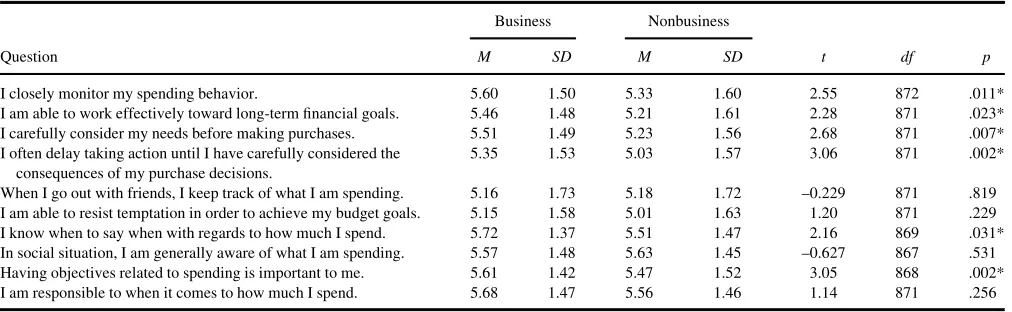
The CSSC construct was used to determine whether dif-ferences exist between business and nonbusiness majors in their consumer spending self-control, as stated in H1b. Business students scored significantly higher on the CSSC scale (MD5.54) than the nonbusiness students (MD5.17),
t(872) D 3.23, p <.001. Table 3 presents the results for
each question.
H2tested for a significant association between students’ fiscal ideology and their own personal financial self-control. This hypothesis was tested by combining business and non-business majors’ responses. The six macro fiscal ideology statements were summed and divided into an overall mean and compared to the overall mean of the ten questions from the psychometrically validated CSSC scale. The mean for fiscal ideology was 4.64 (SD D1.07), for the CSSC scale mean was 5.43 (SDD1.23). The Pearson correlation was used to test the association, as both scales were treated as interval. A significant correlation (r) of .186 (p<.000) was found between fiscal ideology and personal financial self-control. The result supports the hypothesis that student rat-ings on fiscal ideology would relate positively with student ratings on financial self-control. In other words, students reporting high levels of personal spending control were also significantly more likely to report more conservative fiscal ideology. Table 1 presents how each major is ranked on the two constructs and provides insight on how each may be characterized based on fiscal conservatism.
H3aandH3bexamined whether significant differences in fiscal conservative ideology occur between business and nonbusiness majors between their junior to senior years.
H3awas evaluated with an independent-samples t-test to compare the differences between junior and senior level business students. No significant increase (pD.50) in fiscal ideology was found from their junior level (M D4.87) to senior level class standing (MD4.94) based on their busi-ness educational experiences. H3b compared senior non-business majors with juniors and also showed no significant (pD.264) change in their fiscal ideology.
TABLE 3
Independentt-Test Results for (CSSC) Consumers’ Spending Self-Control
Business Nonbusiness
Question M SD M SD t df p
I closely monitor my spending behavior. 5.60 1.50 5.33 1.60 2.55 872 .011* I am able to work effectively toward long-term financial goals. 5.46 1.48 5.21 1.61 2.28 871 .023* I carefully consider my needs before making purchases. 5.51 1.49 5.23 1.56 2.68 871 .007* I often delay taking action until I have carefully considered the
consequences of my purchase decisions.
5.35 1.53 5.03 1.57 3.06 871 .002*
When I go out with friends, I keep track of what I am spending. 5.16 1.73 5.18 1.72 –0.229 871 .819 I am able to resist temptation in order to achieve my budget goals. 5.15 1.58 5.01 1.63 1.20 871 .229 I know when to say when with regards to how much I spend. 5.72 1.37 5.51 1.47 2.16 869 .031* In social situation, I am generally aware of what I am spending. 5.57 1.48 5.63 1.45 –0.627 867 .531 Having objectives related to spending is important to me. 5.61 1.42 5.47 1.52 3.05 868 .002* I am responsible to when it comes to how much I spend. 5.68 1.47 5.56 1.46 1.14 871 .256
Note. Responses were rated on a 7-point Likert-type scale ranging from 1 (disagree) to 7 (agree).*p<.05.
H4aandH4bexamined whether significant differences in CSSC occur between students’ junior and senior years.
H4awas evaluated with an independent-samples t-test to compare the differences between junior and senior level business students. No significant increase (pD.804) based on the CSSC from their junior-level (M D5.54) to senior-level class standing (MD5.58) was found. There was also no significant difference in personal financial viewpoints among nonbusiness juniors (M D 5.38) and seniors (MD5.21). Although the findings are not significant at the .05 level (p D.07) there is a noted inverse change in the means from the junior to senior year among the nonbusi-ness majors.
The gender gap was examined (Hypothesis 5) for all sampled students with the use of an independent samples
t-test. This test shows that gender had a significant effect,
t(870) 5.70,p<.001 on macro fiscal conservative ideology as postulated in H5 with male (M D 4.73) scores higher than female (M D4.31) scores. No significant differences by gender were found (pD.245) on the consumer spending self-control.
H5a indicates that when male business students were compared to male nonbusiness students there was a signifi-cant difference,t(496) D3.85,p <.001), which indicates
male business students (MD5.35) held significantly stron-ger views on fiscal ideology than their male nonbusiness counterparts (MD4.93). Similarly, male business students scored significantly higher (MD5.58) on CSSC than their male nonbusiness (MD5.29) counterparts,t(496) D3.77,
p D .031). Likewise, an independent samples t-test was applied to testH5b. Female business students also held sig-nificantly stronger views on fiscal ideology (MD4.07) than female nonbusiness students (M D 3.68), t(372) D 4.26,
p <.000. On CSSC, female business student scores were significantly higher (M D 5.50) than nonbusiness women (MD5.27),t(496)D3.85,pD.04.H5creveals that male business students (M D 4.65) held significantly higher views on macro conservatism versus female business stu-dents (M D3.92),t(482) D4.19,p <.001. For CSSC, no
significant differences were found between males and females (pD.453).H5dshowed similar results. Male non-business students scored significantly higher (MD5.16) on macro conservatism than did their female counterparts (M D 4.54), t(377) D 2.21, p D.028. Nonbusiness men showed no significant difference compared with nonbusiness women on the CSSC scale (pD.873).
FINDINGS
We found a significant relationship between students’ atti-tudes and opinions on fiscal conservatism (both ideologi-cally and in terms of their personal spending behavior) among both business and nonbusiness students. Business students expressed more conservative views on both
constructs overall. Further, students’ fiscal ideology was found to be positively correlated with their personal spend-ing self-control, demonstratspend-ing that students’ own actions regarding money are in fact related to their larger macro fis-cal beliefs. Neither business nor nonbusiness students appear to change their fiscal views as they matriculate from their junior to senior years. Instead, these student views appear to be predetermined by a self-selection process before they enter the college of their choice. The student’s perceptions of the inferred or explicit ideology of a college and its faculty may provide the basis for initial attraction.
For instance, students may be attracted to a business pro-gram prior to declaring their major, reflecting their pre-existing fiscally conservative views. Once enrolled in the business school, these views are often reinforced. Perhaps students’ sense or become cognizant of how a fiscally con-servative perspective can improve their lives based on entry requirements to basic freshman and sophomore accounting, economics, and personal finance courses. These courses may be pivotal in attracting students into the college of business by presenting a positive perspective on fiscal con-servatism. A student’s fiscal disposition may also have come from a variety of sources including positive personal business experiences, such as, exposure to family busi-nesses, high school employment, news media, and a wel-coming and social business environment.
University administrators, faculty, and the business com-munity may wish to acknowledge and assess how best to position themselves based on students’ attitudes and opinions toward fiscal conservatism. In other words, do universities and colleges want to appear more liberal or fiscally conserva-tive in order to attract their targeted community and student constituents? As noted earlier, Haws et al. (2012) provided a validated construct for measuring students’ attitudes and opinions on their personal CSSC. Six of the 10 statements indicate significant differences between business and non-business majors, with non-business majors expressing more per-sonal financial self-control on all six statements than their nonbusiness counterparts atp<.05. It should be noted that
several of the statements, where no differences were found between business and nonbusiness students, are based on the social dimension of this scale. It appears that both business and nonbusiness students find it difficult to deal with their lack of financial control in social situations, even while cog-nizant of their personal fiscal responsibilities. Interestingly, Table 1 shows that the more internally and quantitatively focused business majors (economics, information systems, finance, and accounting) expressed higher levels of agree-ment on both macro and micro fiscal conservatism measures than the more socially oriented business majors such as man-agement and marketing.
The consequences of poor control over spending are obvious. Effective means to educate and increase spending self-control are necessary to avoid detrimental financial, psychological, and social consequences (Bearden & Haws, THE IMPACT OF A BUSINESS EDUCATION ON FISCAL CONSERVATISM 311
2012). Such education regarding personal spending behav-iors for nonbusiness students might prove valuable as les-sons for their personal growth. Our findings also reveal a significant gender gap based on macro fiscal conservative ideology between all male and female students surveyed. Male business students held significantly stronger views on conservative fiscal ideology than did female business stu-dents, while no differences were observed on the CSSC scale. Similarly, male nonbusiness students scored signifi-cantly higher on fiscal ideology than did female nonbusi-ness students, with no significant differences between the nonbusiness men and women on the CSSC scale. Further, while men held significantly stronger views on both fiscal ideology and CSSC than women, business women scored significantly higher on both measures than their nonbusi-ness female counterparts.
LIMITATIONS AND FUTURE RESEARCH
Demographic trends point to an increasing number of women in proportion to male students enrolled in business courses. More men are readily observed in information sys-tems, business economics, and finance courses and more women in marketing and management programs. The demographic trend portends changes in attitudes and opin-ions concerning fiscal conservatism and its impact on busi-ness education because women were found to be less fiscally conservative than men. This is supported by May et al. (2014), as they found that male and female doctoral economists adopted views that were different in terms of free market versus government involvement. We found that male and female undergraduates also differed in terms of their views on fiscal conservatism. Future researchers should address why that is. Do young women have different views on fiscal conservatism before entering the business school, or do they process business courses in a different manner than their male colleagues? Are women with stron-ger views of fiscal conservatism more likely to succeed in a business environment? As May et al. concluded, the more liberal views on economic issues may lead female econo-mists to be under-represented and underpromoted among faculty in leading research institutions.
This study was conducted regionally with students from a large southeastern public university. Survey samples from different geographical regions of the United States and internationally should be employed in future research in order to generalize the study’s results, The attitudes of stu-dents at private universities, which may or may not explic-itly endorse particular ideological points of view, may be compared with their publically funded counterparts. Also, more research is needed to determine whether or not the perceived ideological reputation of a college or university influences hiring faculty applicants and the subsequent assessment of those candidates.
Regarding the survey instrument, the impact of a busi-ness education on conservatism was evaluated using only the comprehensive differences between junior and senior level students, while a count of student hours may provide a more precise measure. Age, employment status, and pro-fessional occupation should be assessed for any interactive effect that these constructs may have on ideological conser-vatism and personal spending habits. Further investigation into how and why views toward fiscal conservative interact with gender may help in understanding the role of business in higher education. Future researchers should investigate whether business professionals score higher on these meas-ures than nonbusiness professionals. Are certified public accountants, market researchers, and actuaries more ideo-logically and monetarily conservative than physicians, law-yers, artists, and educators? Will fiscal conservatism lead to higher levels of personal and professional success within occupational fields?
Further research is needed to investigate the impact of fiscal conservatism with achievement and success in busi-ness, financial well-being and employee ratings. The ori-gins of fiscal ideology and spending control need to be identified as to whether they are influenced or determined by parents, family, cultural influences, or by the business environment. Fiscal conservatism may lead to developing a more successful business person. The question here is, can business education teach it?
REFERENCES
Bafumi, J., & Shapiro, R. Y. (2009). A new partisan voter.The Journal of Politics,71, 1–24.
Ball, J. A. (2012). The gender gap in undergraduate business programs in the United States.Journal of Education for Business,87, 260–265. Bearden, W. O., & Haws, K. L. (2012). How low spending control harms
consumers.Journal of the Academy of Marketing Science,40, 181–193. Bielinska-Kwapisz, A., & Brown, F. W. (2013). Differential gender
perfor-mance on the Major Field Test–Business.Journal of Education for Busi-ness,88, 159–166.
Caputo, D. (2010). Gender differences in assessing essential business information systems technology skills.International Journal of
Man-agement and Information Systems,14, 31–37.
Carnegie Foundation for the Advancement of Teaching. (1994).A classifi-cation of institutions of higher educlassifi-cation. Princeton, NJ: Author. Carney, D. R., Jost, J. T., Gosling, S. D., & Potter, J. (2008). The secret
lives of liberals and conservatives: Personality profiles, interaction styles, and the things they leave behind. Political Psychology, 29, 807–840.
Chen, H., & Volpe, R. P. (2002). Gender differences in personal financial literacy among college students. Financial Services Review, 11, 289–307.
Ford, M. W., & Kent, D. W. (2009). Gender differences in student financial market attitudes and awareness: An exploratory study.Journal of Edu-cation for Business,85, 7–12.
Hamilton, R. F., & Hargens, L. (1993). The politics of professors: Self-identifications, 1969–1984.Social Forces,71, 603–627.
Haws, K. L., Bearden, W. O., & Nenkov, G. Y. (2012). Consumer spend-ing self-control effectiveness and outcome elaboration prompts.Journal
of the Academy of Marketing Science,40, 695–710.
Hussar, W. J., & Bailey, T. M. (2013).Projections of education statistics to 2021. NCES 2013-008. Washington, DC: National Center for Education Statistics.
Kaenzig, R., Anderson, S., Hyatt, E., & Griffin, L. (2006). Gender differen-ces in students’ perceptions of group learning experiendifferen-ces.Academy of
Educational Leadership Journal,10, 119–127.
Kaenzig, R., Hyatt, E., & Anderson, S. (2007). Gender differences in col-lege of business educational experiences.Journal of Education for Busi-ness,83, 95–100.
Kreiss, D., & Tufekci, Z. (2013). Occupying the political: Occupy Wall Street, collective action, and the rediscovery of pragmatic politics.
Cul-tural Studies–Critical Methodologies,13, 163–167.
Ladd, C., & Lipset, S.M. (1975).The divided academy: Professors and
politics. New York, NY: McGraw-Hill.
Lipset, S. M., & Altbach, P. G. (1966). Student politics and higher educa-tion in the United States.Comparative Education Review,10, 320–349. May, A., McGarvey, M. G., & Whaples, R. (2014). Are disagreements
among male and female economists marginal at best? A survey of AEA members and their views on economics and economic policy.
Contem-porary Economic Policy,32, 111–132.
McInerney, M. L., Mader, D. D., & Mader, F. H. (2010). Gender differen-ces in responses to hypothetical business ethical dilemmas by business undergraduates.Journal of Diversity Management,5, 37–41.
Merriam-Webster. (2012).2012 Word of the year. Retrieved from http:// www.merriam-webster.com/info/2012words.htm
Nunnally, J. C., Bernstein, I. H., & Berge, J. M. T. (1967).Psychometric
theory. New York, NY: McGraw-Hill.
Rasmussen Reports. (2012)Questions – Capitalism. Retrieved from http: www.rasmussenreports.com/public_content/business/econ_survet_2012 Rothman, S., Lichter, S. R., & Nevitte, N. (2005, March). Politics and
professional advancement among college faculty.The Forum,3(1), Article 2.
Weatherford, M. S. (1983). Evaluating economic policy: A contextual model of the opinion formation process. The Journal of Politics,45, 866–888.
Woessner, M. (2012). Rethinking the plight of conservatives in higher education. Academe, 98(1). Retrieved from http://www. aaup.org/article/rethinking-plight-conservatives-higher-education#. VVoz5vlVhBc
Yau, H. K., & Cheng, A. L. F. (2012). Gender difference of confidence in using technology for learning. Journal of Technology Studies,38(2). Retrieved from http://scholar.lib.vt.edu/ejournals/JOTS/v38/v38n2/yau. html
Zipp, J. F., & Fenwick, R. (2006). Is the academy a liberal hegemony? The political orientations and educational values of professors.Public Opin-ion Quarterly,70, 304–326.
THE IMPACT OF A BUSINESS EDUCATION ON FISCAL CONSERVATISM 313