In Search for Anchors
The Fundamental Motivational Force in Compensating
for Human Vulnerability
Bagus Riyono
Universitas Gadjah Mada, Yogyakarta
Fathul Himam
Universitas Gadjah Mada, Yogyakarta
Subandi
Universitas Gadjah Mada, Yogyakarta
Gadjah Mada International Journal of Business
Vol. 14, No. 3 (September - December 2012): 229 - 252
Abstract: The purpose of this study is to develop a new integrative theory of motivation drawn from the existing theories and data. The method used is a combination of meta-ethnography and grounded theory. The second phase of the study employed a thought experiment to test the newly developed theoretical propositions of motivational force. The first phase of the study revealed a central phenom-enon for the occurrence of motivational force, i.e. “In Search for Anchors,” which is a result of the paradox between freedom to choose and human vulnerability. “Freedom to choose” is the central factor of a motivational model that includes “urge,” “challenge,” “incentive,” and “meaning.” These five factors are motivational sources, which have holistic-dynamic-integrative interaction. Human vulnerability is the other side of the motivational model that comprises risk, uncertainty, and hope that ignite motivational force. The dynamic interaction of risk, uncertainty, and hope is represented in a mathematical formula that produces the strength of the force, (R – H)2 x U, which can be potrayed in a “twin-peak” curve. The thought experiment was conducted to test the hypothetical formula. The result shows that the “twin-peak” hypothesis is supported but the shape of the curve is found to be not symmetrical. The data show that hope is the strongest motivational force, therefore the formula is modified into = (R – U)2 x H. The implication of the study and the utility of the new theory are discussed.
Abstrak: Penelitian ini bertujuan untuk mengembangkan sebuah teori motivasi baru yang integratif, yang disusun berdasarkan teori-teori yang sudah ada dan data-data penelitian yang telah tersedia. Untuk itu diaplikasikan sebuah metode yang merupakan gabungan dari meta-ethnography dan grounded theory. Pada tahap ke dua dari studi ini, dilakukan eksperimen dengan metode thought experiment untuk menguji proposisi teoritis dari teori yang baru dirumuskan mengenai motivational force. Pada tahap pertama, studi ini mengungkap sebuah fenomena sentral untuk terjadinya motivational force, yaitu “In Search for Anchor,” yang merupakan sebuah resultan dari sebuah paradoks antara freedom to choose dan human vulnerability. “Freedom to choose”
Kelima faktor tersebut adalah merupakan sumber-sumber motivasi, yang memiliki sifat hubungan yang
“holistic-dynamic-integrative.” Human vulnerability (ketidakberdayaan manusia) adalah sisi lain dari model motivasi tersebut yang terdiri dari risk, uncertainty, dan hope, yang memicu kekuatan motivasional (mo-tivational force). Dinamika interaksi antara risk, uncertainty, dan hope dapat direpresentasikan oleh rumus matematis yang menghasilkan kekuatan motivasional, yaitu: (R – H)2 x U, yang dapat digambarkan ke
dalam kurva yang berpuncak ganda. Thought experiment dilakukan untuk menguji rumus hipotetis tersebut. Hasilnya menunjukkan bahwa puncak ganda yang dihipotesiskan didukung data, namun ditemukan bahwa bentuk kurva tidak simetris. Data menunjukkan bahwa variabel hope merupakan faktor terkuat dalam persamaan tersebut sebagai kekuatan motivasional. Oleh karena itu rumus matematis mengenai kekuatan motivasional dimodifikasi menjadi = (R – U)2 x H. Implikasi dari hasil studi ini dan kemanfaatan dari
teori baru ini dijabarkan dalam bagian akhir artikel ini.
Introduction
Historians and scholars of social sci-ences are competing to explain the phenom-ena of the emergence and advancement of civilizations. Classical explanations usually provide arguments about the geography, cli-mate, and various other geopolitical reasons to trigger advancement of a nation (Khaldun 1377; McClelland 1961). In a more general context, the question that arises is “what kind of forces are able to drive a nation to catch up and race to get ahead?.” Many countries in the world have shown surprising rapid progress. In the 1980s Japan astonished the world with the success of their economy which was able to defeat America (Kondo 1991); Korea in the 1990s showed their “claws” and was able to compete with Japan in the automotive and electronic industries, and the era of the 2000s was marked by China’s “miracle” (Naisbitt and Naisbitt 2010).
Experts in social sciences (Khaldun 1377; McClelland 1961; Smith 1776; Weber 1930) agree that there is a force that drives
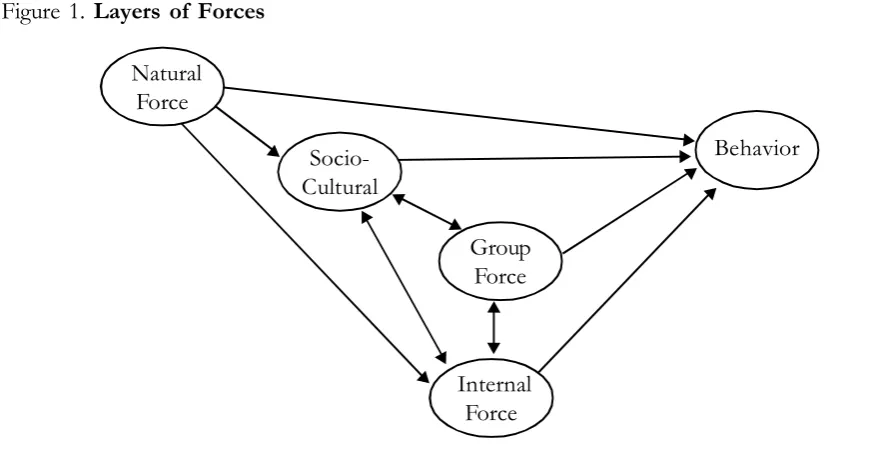
people to go forward, both for their own suc-cess or collectively in building a civilization. History shows that nations in this world al-ternately rise and fall, in power and oppressed (Durkheim and Mauss 1971; Khaldun 1377). The discourse about the force has four layers of analysis, namely natural force, socio-structural force, group force, and internal force. Psychology has focused on explaining the dynamics of the internal force. The indi-vidual is the main actor in the progress of human civilization. All other forces serve only as an antecedent that would eventually cul-minate in triggering the internal force. Interconnectivity between the four layers of these forces can be illustrated in Figure 1, and referred to as “Layers of forces.”
The notion of the force in terms of human behavior is described by Kurt Lewin as follows: “Behavior on the part of a person is assumed to be the result of field of forces each of which has direction and magnitude” (in Vroom 1964: 18). In essence, the force is something that directs human behavior with a specific intensity and direction. The con-cept of the force in the discipline of
psy-Figure 1. Layers of Forces
chology is implicitly included in the dynam-ics of motivation. However, motivation as a psychological construct has a broad meaning and scope. It is associated with other con-structs that are considered as the underlying factors such as, “motive” (McClelland 1966; 1987; Atkinson 1957), “needs” (Maslow 1943), “goals” (Locke and Latham 1990), “reinforcement” or “feedback” (Komaki 1978; Komaki et al. 1982; Komaki 1986; Komaki et al. 1989; Komaki et al. 1986), and “valence” and “expectancy” (Vroom 1964; Wanous et al. 1983).
As a psychological construct, motiva-tion has two meanings associated with the problems that will be solved. The first mean-ing of motivation is “somethmean-ing to account for an individual’s selection of one path of action among a set of possible alternatives” (Atkinson 1957: 359). This first meaning is hereafter referred to as a “motivation as a choice.”The second meaning of motivation is “the arousal or energizing of the organism. What conditions instigate action, determine its duration or persistence and finally its ces-sation. The phenomena to be explained in-clude the level of activity of the organism and the vigor of amplitude of its behavior” (Vroom 1964: 2). This second meaning is, from now on, referred to as “motivation as a force” or simply “motivational force.”
Until the beginning of this 21st century, motivation was still ranked as the second most widely written about topic, after the topic of methodology (Cascio and Aguinis 2008; Latham and Pinder 2005). The journal articles that were reviewed showed that there is no common ground to explain what could be “responsible” for the emergence of human behavior. This problem has lasted for more than 40 years, since the 1960’s (Vroom 1964) until recently (Latham and Pinder 2005).
Some of the issues concering the current mo-tivation theories are elaborated in the fol-lowing literature reviews.
Maslow’s Need Hierarchy Theory is well known for its simplicity and intuitive notion of human nature. The fundamental proposi-tion of Maslow’s theory is: human behavior is driven by their needs. Here is Maslow’s strong statement about the drive of human needs, “If we are interested in what actually vates us, and not in what has, will, or might
moti-vate us, then a satisfied need is not a motivator.”
(Maslow 1943: 393). Thus, according to Maslow, every form of human behavior is done in order to fulfil or to satisfy certain needs. Once these needs are satisfied they will no longer drive behavior, no longer mo-tivate.
For Maslow everything about human behavior is driven by needs, even beyond the five basic needs. He also mentioned about the need for curiosity, aesthetic needs, etc, (Maslow 1943). However, Maslow faces a problem when he tries to explain “self-actu-alization.”
“The clear emergence of these needs rests upon prior satisfaction of the physiological, safety, love, and esteem needs. We shall call people, who are satisfied in these needs, basically satisfied people, and it is from these that we may expect the fullest (and healthiest) creativeness. (Maslow 1943: 383)”
not found a conclusive explanation for it. He wrote “it remains a challenging problem for research” (Maslow 1943).
The implication of Maslow’s theory for application in the organizational setting is as follows. When management initiates an in-centive program, with a range of different benefits, it can be understood from the per-spective of needs theory. For example, in deciding what kinds of benefit should be of-fered to employees, management can consider the need level of the employees. For lower to middle level employees, the needs will include survival and safety, for example: food, hous-ing, protection, etc. Then for the next level of needs they will appreciate some social gath-ering, social activities like “family day,” etc. Above that, their esteem needs can be satis-fied with programs such as “employee of the month,” promotion and so on. However, it will be difficult for management to manage the employees who are already at the level of self-actualized person.
The other competing perspective on human motivation, which is widely applied in organizational setting, is the behavioral perspective, mainly based on Skinnerian theory of behavior modification (Skinner 1953). The basic assumption of the behav-ioral perspective is that human behavior oc-curs as a response to past experience. More specifically, reinforced past experience will shape future behavior, and reinforcement given to certain behavior will cause that be-havior to persist. Skinner perceived a human being as “a machine” that can be programmed to go in a certain direction. Furthermore Skin-ner denied the existence of “free will” within human personality.
”It was not long before the additional step was taken…which produced the fully-fledged doctrine of ’man a machine’,…machine has become lifelike
and living organisms have been found to be more like machines.” (Skinner 1953: 46)
The theoritical problem rests on the denial of the internal psychological dynam-ics, which represent the “fee will” of human beings. Actually the proposition of Skinne-rian theory also explains that organisms pos-sess what is called “random behavior,” which is the original behavior before the organism experiences any reinforcement intervention. The notion of “random behavior” is similar to the characteristics of “free will,” so actu-ally Skinner cannot fully explain the dynamic of human behavior without considering the existence of “fee will.” As a result of this denial, behavioral approach can only explain and predict human behavior within a limited context and time (Dipboye et al. 1994).
Skinnerian thinking has a strong influ-ence on “scientific management perspective” or, according to McGregor, it is the basis for a “Theory X” perspective in managing hu-man resources in an organizational setting. Even though a lot of critics already addressed these views of human behavior, the behav-ioral approach can be found even in recent management application such as in reward policy or performance management strategy. The problem arises when those strategies start to provoke protest among labor unions be-cause they neglect the psychological wellbeing of the workers.
at-tempted to investigate them empirically (Eisenberger and Cameron 1996; Eisenberger 1999; Payne 1970; Petri and Govern 2004; Lepper et al. 1999). Some other researchers recognize that the intrinsic and extrinsic mo-tivation coexist in facilitaing behavior (Hoekman et al. 2005; Deci et al. 1999b; Lindenberg 2001; Xiang et al. 2005).
Other conflicting explanations for mo-tivational force are between behavioral theo-ries and cognitive theotheo-ries, e.g. goal-setting theory. Goal-setting theory believes in inter-nal forces in the form of goals and commit-ment, which are responsible for the emer-gence of motivated behavior (Latham and Baldes 1975; Locke 1980; Locke and Latham 1990). Goal-setting theory holds that the source of one’s motivation is the presence of challenging goals that ignite passion to achieve them. By contrast, behaviorism ar-gued that the motivation emerges when some-one gets feedback on his work, which rein-forces the individual to redo what they have
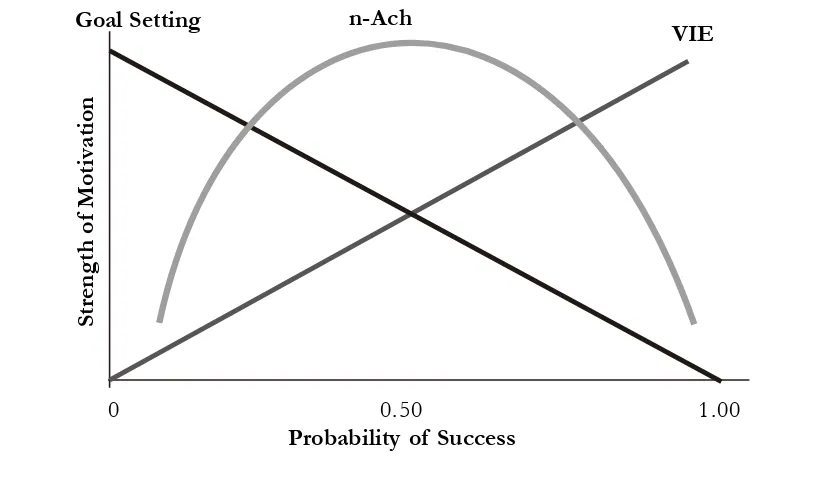
done before (Komaki et al. 1978; Komaki et al. 1980; Komaki 1981; Komaki et al. 1989). Confusion and contradictory proposi-tions of achievement motivation theory, goal setting and VIE theory, are illustrated in Fig-ure 2. Goal setting theory assumes that the strength of motivation will be higher with the smaller probability of success, while achieve-ment motivation theory claims that a “middle way” is the best, when the probability of suc-cess is 50:50. On the other side, VIE theory claims that the higher probability of success will increase the strength of the motivational force. Each of the conficting theories has sound arguments and are supported by em-pirical data. It is not easy to explain these contradictions in terms of existing perspec-tives. Therefore, a new integrating theory is needed to solve the problems.
There are two possible explanations when there are three things that are contra-dictory, but each is claimed to be correct. The first possible explanation is that there is only
Figure 2.Conflicting Propositions of n-Ach, Goal-Setting, and VIE Theory
Goal Setting n-Ach VIE
St
re
ng
th
of
M
ot
iv
at
ion
Probability of Success
one correct theory and the others are wrong, so we need to strengthen the correct propo-sition with more evidence, and argue that the other ones are wrong, with sufficient evidence as well. The second possible explanation is that all theories could be correct, but each approached the phenomenon from different perspectives. It is like the metaphor of three blind men who were asked to describe an el-ephant. Each one found evidence but the evidence was understood or interpreted dif-ferently. In other words, each theory is only a fragment of the whole truth.
This study aims to dig deeper into the concepts about motivation in order to for-mulate a new theory about the force that is more essential (atomic theory), through a multi-paradigm and multi-method approach. This study will go beyond the level of under-standing of the contemporary theories of mo-tivation. This is done in order to find the un-derlying principles of motivational dynamics through de-construction and re-construction of psychological constructs concerning the motivational force. Thus, the research ques-tion is, “what kinds of psychological charac-teristics that are responsible for the emergence of motivational force?”
Method
This research was conducted by com-bining the approaches of radical humanist, interpretive, and functionalist (Gioia and Pitre 1990). Radical humanist approach through critical analysis of the established theories is conducted to gain a new perspective in un-derstanding the dynamics of motivation and its supporting constructs. An interpretive approach is applied through analyzing primary data on experiences of motivated behavior, which are collected to obtain a deeper un-derstanding of the dynamics of motivation.
A functionalist approach is applied to test the newly constructed theoretical proposition.
The meta-ethnography technique (Noblit and Hare 1988) is an appropriate technique to represent the radical humanist approach, namely to critically analyze and re-interpret the texts that have been formulated in the conventional theories of motivation, to understand the psychological characteris-tics of the motivated behavior. The expected outcome of this procedure is the formulation of the psychological characteristics associ-ated with the emergence of the force in the dynamics of motivated behavior.
An interpretive approach was used by conducting grounded theory research (Strauss and Corbin 1990), namely to understand the characteristics of the psychological situation of motivated behavior experiences. The grounded theory technique will produce data in the form of transcripts of in-depth inter-views, which are illustrations of motivated behavior experienced by the respondents of the study.
Data obtained through meta-ethnogra-phy techniques will be analyzed and con-firmed by data obtained through the tech-nique of grounded theory. Analysis was per-formed back and forth to achieve satisfac-tory understanding (to reach saturation) in answering the research question. Thus the techniques of meta-ethnography and grounded theory are integrated in the process of analyzing data through open coding, axial coding and selective coding. The integration of these two techniques, as a multi-method approach, is hereafter called the
meta-ethno-graphical-grounded-theory approach.
a thought experiment study. The thought ex-periment was conducted among university students. There were four studies conducted, with numbers of participants for each study being: 51, 40, 82, and 54 students. Partici-pants were second year students, so that they were familiar with the learning process in the university.
Treatments for these thought experi-ment studies are scenarios concerning class situations, which characteristics are varied in terms of probability for success. There are three themes of the scenarios: (1) grading style (applied in two studies); (2) teaching style; and (3) class assignment design.
The procedure of the study is as fol-lows: (1) participants are introduced to five scenarios of class situations; (2) participants are asked to rate the scenarios based on how much they like each of them; (3) participants are asked to rate the scenarios based on the strength of their tendency to choose; (4) par-ticipants are asked to rate the scenarios based on how strong they invoke motivation to learn, using a multiple choice scale; (5) par-ticipants are asked to rate the scenarios based on how strong they invoke motivation to learn, using a forced choice scale. Procedure (2) and (3) measure motivation as a choice, while procedure (4) and (5) measure motiva-tion as a force or motivamotiva-tional force.
Results
After reinterpretation of the constructs that are believed to trigger motivation, five themes are formulated, each of which has distinctive psychological characteristics. These themes are explored one by one along with thematic logic that gives the arguments for the uniqueness of each theme. The five themes that emerged were named according
to the nature of their psychological charac-teristics, namely: (1) urge, (2) freedom to choose, (3) challenge, (4) incentive, and (5) meaning.
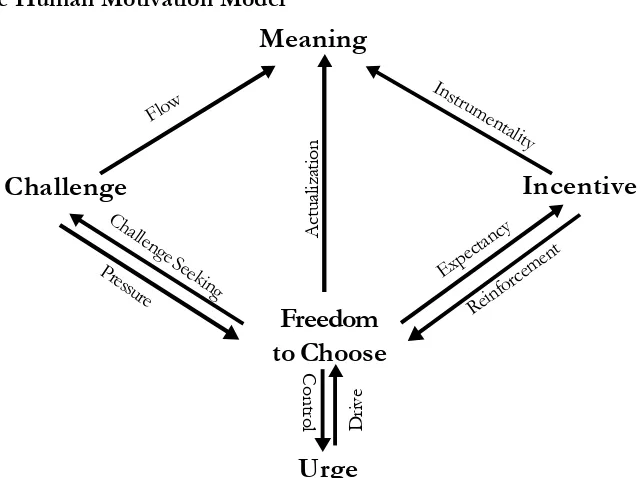
Urge is an internal force that drives in-dividuals to act. Urge includes the constructs of instinct, needs deprivation, revenge, and interest. Freedom to choose is characterized by situations that enable individuals to act with-out depending to others. It comprises the con-structs of autonomy, independence, self-regulation, and self-determination. Challenge
is a stimulation from the environment that triggers individuals to respond. Six constructs have this characteristic, i.e. difficult goal, demand, inequity, trust, responsibility, and competition. Incentive is something that is re-ceived as a consequence of the individual behavior, which attracts the individual to con-tinue or redo what is done before. Incentive includes reward, constructive feedback, sup-port, and achievement. The fifth theme is
meaning, which is the intrinsic value of
cer-tain behavior so that it is worth doing. Mean-ing includes enjoyment, self-efficacy, self-ac-tualization, contribution, and valence.
The five themes, which emerged as the result of open coding analysis, are motiva-tional sources. Further analysis was under-taken through axial coding to integrate these themes in order to develop a dynamic model of motivation. Axial coding is done by ex-ploring the nature of relationships of each motivational source with other motivational sources. The nature of these relationships is represented by vector constructs, i.e. con-structs that have magnitude and direction.
emergence of motivation, process theories explain “how” the variables relate to each other to ignite motivational force. For ex-ample, urge is a source of motivation that has the characteristic of “push.” A vector construct that corresponds to “push” is “drive,” so urge is a source of motivation that
drive other source so that it is activated. In this case urge drive freedom to choose to be active. On the other hand, freedom to choose has the capability to control urge, and so on. The result of axial coding analysis is illus-trated in Figure 3 as an integrated human mo-tivation model.
Table 1. Summary of Constructs Related to Motivational Force
Themes Constructs Psychological Characteristics
Urge Instinct Internal forces that drive individual to act.
Need deprivation Revenge
Interest
Freedom Autonomy A situation that enables individual to act
to choose Independence without depending to others.
Self-determination Self-regulation
Challenge Difficult goal Stimulation from the environment that
Demand triggers individual to respond.
Inequity Trust
Responsibility Competition
Incentive Reward Something that is received as consequences
Constructive feedback of the individual behavior, which attracts
Support the individual to continue or redo
Achievement what is done before.
Meaning Enjoyment Intrinsic values of certain behavior so that
Self-efficacy it is worth doing.
The formulation of the human motiva-tion model still leaves one problem. The ex-planation provided by the human motivation model is still limited to the dynamics of the motivational sources. Further questions that need to be answered are, how does the moti-vational sources ignite motimoti-vational force, un-der what conditions, and how it is structured. Further analysis will explore and map the components and structure of the force, which in this paper is called the “anatomy of the force.”
The method in conducting the deeper analysis to address these problems is selec-tive coding. Selecselec-tive coding is a method on qualitative data analysis to find a central phe-nomenon of the issues under study. Central phenomenon, in this case, is the essence of all phenomena that have been discussed in the human motivation model. Each theme that has been described in the model is ex-plored in more depth (scrutinized), to iden-tify the most fundamental psychological char-acteristics that are responsible for the dynam-ics of motivated behavior.
To do scrutiny on these themes, sev-eral layers of questions on “why,” “what,” “when,” and “how,” are posed to the situa-tions that occur on each theme. The process of questioning is considered sufficient (satu-rated) when answers are repeating, or cycle back to previous answers. For example, why does urge drive an individual to act? Because it poses a threat to existence, if you do not fulfill your needs you won’t survive. Thus, there is a risk of survival. People always have unfulfilled needs, but yet are not always mo-tivated, so when do they motivate? Motiva-tional force emerges when there is an oppor-tunity. Although it is not always certain, but as long as there is hope, opportunity will be worth pursuing.
The result of the selective coding ar-gues that all of the motivational sources within the human motivation model possess three fundamental psychological characteris-tics, i.e. risk avoidance, uncertainty tolerance, and hope reliance. Thus the essence of moti-vational force is the presence of risk, uncer-tainty, and hope. These basic ingredients of Figure 3. The Human Motivation Model
motivational force are intertwined with one another so that they trigger (ignite) the force to act, a power to act.
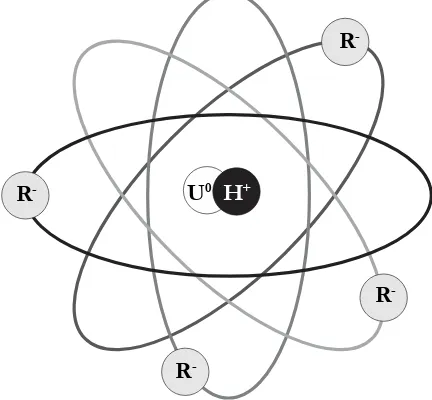
The dynamic interaction of risk, uncer-tainty, and hope is illustrated in Figure 4 as an atom-like relationship between electron, proton, and neutron. Therefore, it is called an atomic theory of motivation, which means a theory on the basic ingredients of motiva-tional force. The three components that are integrated as a structure of motivational force are also called “the anatomy of the force.”
Anatomy of the force explains what and how motivational force emerges within individual. It is also explains when any motivational sources become active and effective in in-voking motivational force.
To be able to predict the strength of motivational force that works in an indi-vidual, the three elements (risk, uncertainty, and hope) need to be taken into account in an integrative formula. In other words, the strength of motivational force is the product of the interaction of these three essential ele-Figure 4. Anatomy of the Force as “The Atomic Theory of Motivation”
Figure 5.Hypothetical Profile of the Strength of the Force R
-R
-R
-R- U0 H+
St
re
ng
th
th
e F
or
ce
High Risk
ments of risk, uncertainty, and hope. Inter-action of the three elements must reside in a certain area of balance, because if there were an extreme imbalance, it would weaken the motivational force. The principle of “bal-ance” is in line with the results of the study by Carroll and Alexandris (1997) who exam-ined the interactive relationship between “per-ception of constraints” with “strength of mo-tivation.”
To measure a construct we need to ap-ply mathematical logic. From the perspective of mathematical logic, hope and risk are in-versely proportional, i.e. the greater the risk the smaller the hope, and vice versa. When there are both hope and risk, there will be uncertainty as well. When the magnitude of risk and hope are equal, then there is a 50-50 chance, a condition that has the highest or maximum level of uncertainty. The maximum or minimum conditions of each of these three elements are extreme situations that lead to weak or absence of motivational force.
Using that logical explanation, the strength of the force can be plotted to a pro-file, which illustrates the variability or fluc-tuation of motivational force as a result of the interaction between risk, hope, and un-certainty. The hypothetical profile is shown in Figure 5.
The profile shows three extreme posi-tions where the strength of motivational force is near zero. These conditions are: (1) when there is no hope or maximum risk, which is identical to a condition of self-helplessness (Seligman 1990); (2) when there is maximum uncertainty (50-50 chance), when an indi-vidual becomes fatalistic; and (3) when there is no risk, that also means no uncertainty, a situation when individuals are in a comfort zone. On the other hand, the profile also shows twin peaks that indicate two situations
of optimum strength for motivational forces. These situations have the psychological char-acteristics of: (1) optimum challenge, when risk is higher than hope; and (2) optimum opportunity, when hope is stronger than risk. The mathematical equation for the profile is as follows:
Up to this point, there are still two more steps in order to complete the theory build-ing. First, it is necessary to integrate the hu-man motivation model and the anatomy of the force into one conceptual understanding. This one conceptual understanding is the ex-pected final result of the selective coding analysis, which is called the central phenom-enon. If we understand that there are a hu-man motivation model and an anatomy of the force, what could be the one central phe-nomenon underlying this motivational dy-namics? What is expected as a result of fur-ther analysis is a single statement that can explain the whole phenomenon of motiva-tional force, which includes the human moti-vation model and anatomy of the force.
Second, the proposition of the strength
of the force needs to be confirmed by be-havioral indicators. How does the formula ap-plied to real life events? How can we collect data to support this theoretical proposition? In order to answer these questions, the thought experiment is conducted. The thought experiment provides opportunity to test a theory by simultaneously refutes the theories that exist, and build a new theory through a process known as “mutual exclu-sion” (Wikipedia 2010).
Before presenting the results of the thought experiment, the following paragraphs
explain the further selective coding analysis to reach the understanding of the central phe-nomenon. The analysis start with posing a question concerning the anatomy of the force, “if anatomy of the force is about integrated process of the emergence of the force, so what is that process called?” In other words, “what is the underlying phenomenon of risk, uncertainty, and hope?”
Risk avoidance, uncertainty tolerance, and hope reliance indicate something con-cerning human existence. If an individual is in fact always concerned with risk, uncer-tainty, and hope in their life, it means that they have no firm and certain fate for their existence. This phenomenon shows the vul-nerability of human beings. On the other side, a human being also possesses freedom to choose, the central point of the human moti-vation model. This paradox of existence leads to the behavioral dynamics of utilizing free-dom to choose to compensate for human vul-nerability. In compensating for their vulner-ability, a human being is pursuing something
to hold on to. Something or someone that can help one to gain stability is called “an anchor” (Google dictionary 2010). Thus, the purpose of these behavioral dynamics is searching for anchors. Anchors create a psychological state of balance and stability.
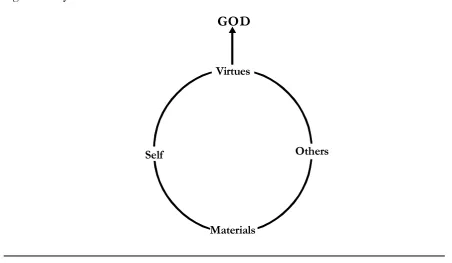
Anchors are something that one can rely on in facing the uncertain future, avoiding risk, and providing hope. Anchors can be cat-egorized into materials, self, others, and be-lieving in virtues. For those who believe in God, virtues themselves are anchored to God. Therefore, God is the ultimate anchor. It is only logical, for those who believe, that the ultimate power of God is the perfect an-chor, upon which a human being can rely without any doubt. Relying on the ultimate power of God will enable a peaceful psycho-logical state in an individual, and at the same time provide fearless strength of motivational force as well. Figure 6 illustrates the layer of anchors in its ideal structure, which will pro-vide authentic happiness and great strength of motivational force.
Figure 6. Layers of Anchors
GOD
Virtues
Materials
Self Others
A problem arises when the structure of anchors within an individual is shifted or in-complete. Those people who “play god” might also put God as their anchor, but they put “self ” to be in direct relationship with God instead of “virtues.” If an individual does this, they automatically put “virtues” under “self,” meaning that they make “vir-tues” to submit to the “self,” and “others” as the object to be manipulated by “self.”
If individuals do not believe in God, their layer of anchors is like a floating circle, which swings up and down and creates a psy-chological state of relentless confusion. At some point in time, they will be very certain of themselves, but at other times they will feel so helpless and confused about life. The happiness that they sometimes feel is illusive, not authentic. The motivational force that emerges within them is up and down, and cannot be relied on.
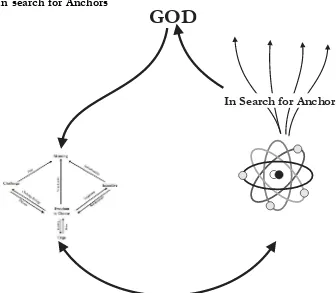
Figure 7 illustrates the summary of the new theory of motivational force. The final result for this study, which is aimed at build-ing an integrated theory of motivational force, is called “In search for anchors: the funda-mental motivational force in compensating for human vulnerability.”
The overall dynamics of human be-havior from the perspective of this theory are as follows. A human being as a creature of God is granted a freedom to choose to lead their life within the dynamic of human moti-vation model. Human freedom is the overt psychological characteristic that is innate in every individual. However, there is another side of human nature in terms of their future existence, which is characterized by risk, un-certainty, and hope. This covert characteris-tic of human being indicates the vulnerabil-ity of their existence. Consciously or not, in-dividuals realize this paradox of existence Figure 7.In search for Anchors
GOD
Figure 8. Empirical Profiles as the Results of Multiple-Choice Scale
Table 2. Summary of Friedman Test for Significance of the Strength of the Force Profile
No Scenario N X2
1* 2*
1 Grading style (study 1) 51 39,4** 15,3**
2 Grading style (study 2) 40 36,0** 43,9**
3 Teaching style 82 58,5** 85,6**
4 Class assignment design 54 20,6** 4,4
* 1 = measured by multiple choice; 2 = measured by forced choice ** Significance at the level of p < 0,01
24 27 3 33 36 39
M
ai
n
E3 D3 C3 B3 A3
Figure 8 (Continued)
27 30 33 36 39 42
M
ai
n
E3 D3 C3 B3 A3
Study 2
28 40
M
ai
n
E3 D3 C3 B3 A3
Study 3
24 26 30 34 38
36
Figure 9. Empirical Profiles as the Results of Forced-Choice Scale
Figure 8 (Continued)
M
ai
n
E3 D3 C3 B3 A3
Study 4
38
28 36
34
32
30
26
M
ai
n
E3 D3 C3 B3 A3
2.5
1.25 2.25
2
1.75
1.5
1
Figure 9 (Continued)
M
ai
n
E3 D3 C3 B3 A3
3
2.5
2
1 1.5
Study 2
M
ai
n
E3 D3 C3 B3 A3
1
Study 3
within themselves. This paradox creates in-stability within the human psyche that ignites a force to compensate. In compensating for the instability of their existence, human be-ings are always in search for anchors, which guide their day-to-day behavior in their life. Happiness or despair is determined by how an individual selects and structures their an-chors.
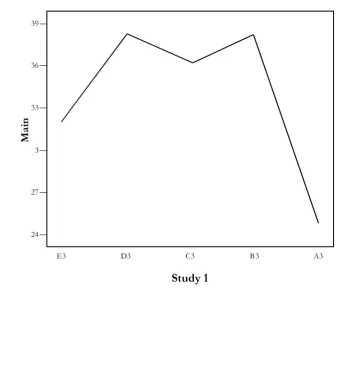
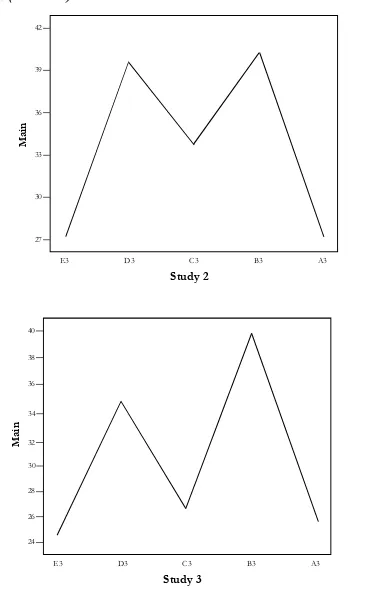
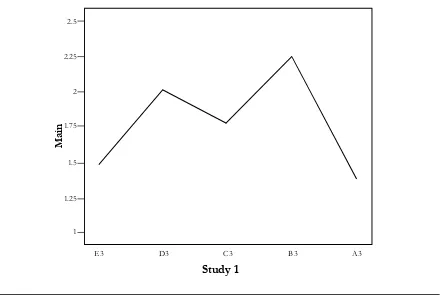
Since the theory building is complete, the next paragraphs report the results of the thought experiment in testing the hypothesis on the formula of the strength of the force. The overall results of the four studies sup-port the hypothesis, as shown in Table 2. There are eight empirical profiles of strength of the force resulting from the four studies. All profiles, except one, show significant trends according to the Friedman test (Fried-man 1937).
The empirical profiles of the strength of the force are shown in Figure 8 and Figure 9. Figure 8 shows the empirical profiles as the results of multiple-choice scale, while Fig-ure 9 shows the empirical profiles as the re-sults of forced-choice scale.
The empirical profiles show slightly dif-ferent trends compared to the hypothetical profile. The results of Studies 1, 2, and 3 con-sistently indicate that the point of optimum opportunity is higher than the point of opti-mum challenge. They also show that the points of 50-50 chance are not as low as the hypothesis. Although it is also significant in terms of the trend of the profile, Study 4’s result shows a different shape of a profile.
Figure 9, which shows the results of a forced-choice scale measurement, confirms the results measured by the multiple-choice scale (Figure 8). However, Study 4 at this
M
ai
n
E3 D3 C3 B3 A3
1.6
Study 4
1.7 1.8 1.9 2 2.2 2.3
point does not pass the significance test, al-though it resembles the shape of the results of the other studies. Further analysis is con-ducted to find the source of the anomaly in Study 4. Content analysis on the reasons to the ratings is done upon the data collected in Study 4. There is a theme emerges in the rea-sons or explanation of the ratings for every scenario that is posed in Study 4. On every explanation of the ratings, the participants of the study make a statement that corre-spond to the existence of hope. Here are some statements concerning the scenarios of class assignment in study 4:
“the more difficult the assignment the more effort is needed, such as study harder”
This study has succeeded in building a new theory of motivational force, which has three levels of analysis. The first level, which is the most overt in nature, is the reconstruction of contemporary theories of motivation into a holistic-dynamic-integrative human moti-vational model. On the second level of analy-sis, this study has developed an understand-ing of the other side of human life, which is more covert in nature, in a form of anatomy of the force that comprises risk, uncertainty, and hope. On the final analysis, at a more philosophical level, it is found that there is an underlying dynamic of human behavior, which is called in search for anchors.
On the second phase of the study, the hypothesis derived from the theory of the anatomy of the force was tested and sup-ported by empirical data. However, the
em-pirical results suggest that there is a refine-ment needed for the theory of the strength of the force. The bolt message conveyed by the empirical data is that out of the three el-ements of the anatomy of the force, hope stands out to be the most significant factor that is responsible for the emergence of the force. To comply with what the empirical data suggest, the formula of the strength of the force is modified as follows:
The modified formula states that: (1) Hope is the most significant factor of moti-vational force, i.e. when there is no hope there will be no motivational force as well; (2) Risk and uncertainty are interacting with each other as when uncertainty reaches the maxi-mum, it will be the same as the risk, and therefore it will hamper the motivational force; (3) Risk and uncertainty are prerequi-sites for motivational force, and they are two-in-one in nature, i.e. when there is no risk there will be no uncertainty, vice versa. There-fore, the absence of either one will extinguish the motivational force. The new profile of the strength of the force as a result of the modified formula is illustrated in Figure 10.
The final profile of the strength of the force shows five points that indicate five psy-chological states related to the magnitude of the force. Psychological state I is character-ized by the absence of hope. It is the psycho-logical state of learned helplessness. Psycho-logical state II is characterized by a high level of risk and uncertainty, with sufficient amount of hope. This situation is called the psychological state of optimum challenge. The psychological state III is characterized by a situation with a 50-50 chance. It does not matter what you do, the chance is 50-50.
Figure 10.The Modified Profile of the Strength of the Force Based on Empirical Testing
It is called the psychological state of fatalist. The highest point in the profile (IV) is called the psychological state of optimum opportu-nity. It is characterized by high hope with sufficient amount of risk and uncertainty that create excitement. The psychological state V is characterized by the absence of risk, which is known to be the psychological state of comfort zone.
The concept of RUH (Risk, Uncertainty, Hope) is quite practical for describing, ex-plaining, and predicting situations in terms of their motivational force capability. For ex-ample when an organization initiates a moti-vational program, it should contain RUH as the basic ingredients of the prescription to work. When parents are having problems with their children’s motivation to study, they could analyze whether studying for the kid con-tained RUH or how strong does the RUH chemistry exist.
Conclusion
This study has formulated a new per-spective and a working theory of human mo-tivation. Since the new theory is built based on the existing theories and empirical data, it is a meta theory which focuses on the essence of motivational dynamics. The newly formu-lated theory is named ‘RUH theory’, which stands for Risk, Uncertainty and Hope as the fundamental dynamics of motivational force. In one sentence the theoretical proposition can be stated as follows: “Motivation will emerge when a person or a group of people forsee that there is risk to avoid, and at the same time they have hope to pursue under an uncertain situation.”
The application of RUH Theory in the organizational setting is very practical and yet fundamental. For example when a new policy is developed to change organizational
cul-St
re
ng
th
of
th
e
For
ce
ture, the management should consider whether the new culture possess the nuance of RUH in the eyes of the employee. In other words, management should communicate that there are risks to avoid if they remain in the existing organizational culture, so that they have a reason to change. On the other hand management also needs to admit that they cannot guarantee that the change will be smooth with no obstacles or problems along the way. However, management also has to show confidence not based on certainty or promise, but based on hope, which is a
strong belief that “We” can acheive a better tomorrow together.
This study is focusing on theory-build-ing, therefore it is limited to conceptual dis-cussion. The practical application of the theory needs to be studied further. On the methodological perspective, further studies are going to apply laboratory experiments or field experiements, in order to gain empirical support for the theory. The topics and con-text of the further studies will include moti-vation in a work setting, family relationships, and social interaction.
References
Atkinson, J. W. 1957. Motivational determinants of risk-taking behavior. Psychological Review 64 (6): 359-372.
Carroll, B., and K. Alexandris. 1997. Perception of constraints and strength of motivation: Their relation-ship to recreational sport participation in greece. Journal of Leisure Research 29 (3): 279-299. Cascio, W. F., and H. Aguinis. 2008. Research in industrial and organizational psychology from 1963 to
2007: changes, choices, and trends. Journal of Applied Psychology, 93(5), 1062-1081.
Deci, E.L., Koestner, R., and R. M. Ryan. 1999a. A meta-analytic review of experiment examining the effects of extrinsic rewards on intrinsic motivation. Psychological Bulletin 125 (6): 627-668.
Dipboye, R. L., C. S. Smith, and W. C. Howell. 1994. Industrial and Organizational Psychology, An Integrated Approach. Fort Worth: Harcourt Brace College Publishers.
Durkheim, E., and M. Mauss. 1971. Note on the notion of civilization. Social Research 38 (4): 808-813. Eisenberger, R. and J. Cameron. 1996. Detrimental effects of reward: reality or myth? American Psychologist
51 (11): 1153-1166.
Eisenberger, R., W. D. Pierce, and J. Cameron. 1999. Effects of reward on intrinsic motivation – negative, neutral, and positive: Comment on Deci, Koestner, and Ryan (1999). Psychological Bulletin 125 (6): 677-691.
Friedman, M. 1937. The use of ranks to avoid the assumption of normality implicit in the analysis of variance. Journal of the American Statistical Association 32 (200): 675–701.
Gioia, D. A., and E. Pitre. 1990. Multiparadigm perspectives on theory building. Academy of Management Review 15 (4): 584-602.
Hoekman, K., J. McCormick, and K. Barneet. 2005. The important role of optimism in a motivational investigation of the education of gifted adolescent. The Gifted Child Quaterly 49 (2): 99-110. Khaldun, Ibn. 1377. Muqaddimah: An Introduction of History (F. Rosenthal, Trans.). New Jersey: Princeton
University Press.
Komaki, J. 1981. A behavioral view of paradigm debates: let the data speak. Journal of Applied Psychology,
66 (1): 111-112.
Komaki, J. L. 1986. Toward effective supervision: an operant analysis and comparison of managers at work. Journal of Applied Psychology 71 (2): 270-279.
Komaki, J. L., R. L. Collins, and P. Penn. 1982. The role of performance antecedents and consequences in work motivation. Journal of Applied Psychology 67 (3): 334-340.
Komaki, J., K. D. Barwick, and L. R. Scott. 1978. Behavioral approach to occupational safety pinpointing and reinforcing safe performance in a food manufacturing plant. Journal of Applied Psychology 63 (4): 434-445.
Komaki, J., A. T. Heinzmann, and L. Lawson. 1980. Effect of training and feedback: Component analy-sis of a behavioral safety program. Journal of Applied Psychology 65 (3): 261-270.
Komaki, J. L., M. L. Desselles, and E. D. Bowman. 1989. Definitely not a breeze: extending an operant model of effective supervision to teams. Journal of Applied Psychology 74 (3): 522-529.
Komaki, J. L., S. Zlotnick, and M. Jensen. 1986. Development of an operant-based taxonomy and observational index of supervisory behavior. Journal of Applied Psychology 71 (2): 260-269.
Kondo, Y. 1991. Human Motivation: A Key Factor for Management. Tokyo: 3A Corporation.
Latham, G. P., and J. J. Baldes. 1975. The “practical significance” of Locke’s theory of goal setting. Journal of Applied Psychology 60 (1): 122-124.
Latham, G. P., and C. C. Pinder. 2005. Work motivation theory and research at the dawn of the twenty-first century. Annual Review of Psychology 56: 485-516.
Lepper, M. R., J. Henderlong, and I. Gingras. 1999. Understanding the effects of extrinsic rewards on intrinsic motivation—uses and abuses of meta-analysis: Comment on Deci, Koestner, and Ryan (1999). Psychological Bulletin 125 (6): 669-676.
Lindenberg, S. 2001. Intrinsic motivation in a new light. KYKLOS 54: 317-342.
Locke, E. A., and G. P. Latham. 1990. A Theory of Goal Setting and Task Performance. Englewood Cliffs, New Jersey: Prentice Hall.
Locke, E. A. 1980. Latham versus Komaki: A tale of two paradigms. Journal of Applied Psychology 65 (1): 16-23.
Maslow, A. H. 1943. A theory of human motivation. Psychological Review 50: 370-396. McClelland, D. 1961. The Achieving Society. New York: The Free Press.
McClelland, D. 1966. That urge to achieve.THINK Magazine 32 (6): 19-23. McClelland, D. 1987. Human Motivation. New York: Cambridge University Press.
Naisbitt, J., and D. Naisbitt. 2010. China’s Megatrends: 8 Pilar yang Membuat Dahsyat China (H. Prasetyo, Trans.). Jakarta: Gramedia.
Payne, R. 1970. Factor analysis of a Maslow-type need satisfaction questionnaire. Personnel Psychology 23: 251-268.
Petri, H. L., and J. M. Govern. 2004. Motivation: Theory, Research, and Application (5th ed.). Betmont: Thomson,
Wadsworth.
Schulze, G. G., and B. Frank. 2003. Deterrence versus intrinsic motivation: experiemental evidence on the determinants of corruptibility. Economics of Governance 4: 143-160.
Seligman, M. E. P. 1990. Learned Optimism. New York: Alfred A. Knopf, Inc. Skinner, B. F. 1953. Science and Human Behavior. London: The Free Press.
Smith, A. 1776. An Inquiry into the Nature and Causes of The Wealth of Nations. London.
Strauss, A. L., and J. Corbin. 1990. Basics of Qualitative Research: Grounded Theory Procedures and Technique.
Newbury Park: Sage Publications.
Thompson, B. R., and H. J. Thornton. 2002. The transition from extrinsic to intrinsic motivation. Education
122 (4): 785-792.
Vansteenkiste, M., and E. L. Deci. 2003. Competitively contingent rewards and intrinsic motivation: can loosers remain motivated. Motivation and Emotion, 27 (4): 273-299.
Vroom, V. H. 1964. Work and Motivation. New York: John Wiley and Sons, Inc.
Wanous, J. P., T. L. Keon, and J. C. Latack. 1983. Expectancy theory and occupational/organizational choices: a review and test. Organizational Behavior and Human Performance 32: 66-86.
Weber, M. 1930. Protestant Ethics and The Spirit of Capitalism. London: HarperCollins Academic.
Wiest, D. J., E. H. Wong, Cervantes, L. Craik, and D. A. Kreil. 2001. Intrinsic motivation among regular, special, and alternative education high school students. Adolescence 36 (141): 111-126.
Wikipedia. 2010. Thought Experiment. Retrieved from: http://en.wikipedia.org/wiki/Thought_experiment.
Wood, R. E., B. M. Kakabeeke, S. Debowski, and M. Frese. 2000. The impact of enactive exploration on intrinsic motivation, strategy, and performance in electronic search. Applied Psycology: an International Review 49 (2): 263-283.