CBB Working Paper 2002-6
AN EMPIRICAL EXAMINATION OF THE RELATIONSHIP
BETWEEN COMMERCIAL BANKS AND CREDIT UNIONS IN
A SMALL OPEN ECONOMY
BY
ANTON BELGRAVE, ROLAND CRAIGWELL AND WINSTON MOORE
CENTRAL BANK OF BARBADOS
Research Department
AUGUST 2002
AN EMPIRICAL EXAMINATION OF THE RELATIONSHIP BETWEEN
COMMERCIAL BANKS AND CREDIT UNIONS IN A SMALL OPEN
ECONOMY
Anton Belgrave, Roland Craigwell, and Winston Moore
Research Department, Central Bank of Barbados,
1016, Spry Street, Bridgetown, Barbados.
Abstract
This study empirically examines the relationship between commercial banks and credit unions
using panel data in a typical small open economy. Unlike previous studies, which were largely
static in nature, the paper accounts for the dynamic interaction between commercial banks and
credit unions using an autoregressive distributed lag framework. Two hypotheses are examined:
first, whether commercial bank competition influences credit union activity and second, whether
credit union competition impacts on commercial banks’ decision making processes. The study
found that credit unions and banks are not directly competitive, in the sense that the actions of
credit unions do not influence commercial banks’ reactions and vice versa.
JEL classification: L4, L1
Keywords: Credit unions, competition, commercial banks, panel models
Introduction
This paper presents an empirical analysis of the relationship between commercial banks
and credit unions in a small, open, developing economy. A credit union is a financial
co-operative that is owned and controlled by its members. Therefore, its primary objective is to
serve its members. Members are encouraged to save principally through the purchase of shares
in the union, thus contributing to a pool of funds from which low-cost loans can be made
difference between the interest received on loans and paid on deposits providing the main source
of income. Given their structure credit unions don’t have such an objective function, as they are
unlikely to simultaneously maximise the dividend paid to members, while simultaneously
minimising the rate on loans.
Despite these differences, commercial banks and credit unions compete for the same pool
of depositors and prospective borrowers. Testimony to this is given by the constant complaints
of bankers regarding the growth of credit unions (see Section 1 below. Yet, there is surprisingly
little evidence of competitive tension between credit unions and the banking sector. In fact, most
of the research of the interaction between credit unions and commercial banks has been
undertaken using data from the United States (US). Emmons and Schmid (2000) who estimated
a dynamic theoretical model of competition between banks and credit unions, made two
intriguing predictions: some households respond to increased concentration among local banks in
the current period by transferring accounts to credit unions in the next period, ceteris paribus,
and that the higher the participation rate at credit unions in a given year, the larger the
concentration in the commercial banking market in the following year, all else held constant. In
short, credit unions and banks in the US are direct competitors in the local household deposit
market. Feinberg (2001), utilising a modified version of the dominant firm-price leadership
model, concentrates on the impact that credit unions have on the market power of commercial
banks. Using a similar panel data methodology as Emmons and Schmid, his results revealed that
the unsecured rates of banks are negatively influenced by the share of market deposits held by
credit unions in the US.
In an earlier US study, Rhoades (1987), though not dealing strictly with bank-credit
union interaction, but rather with bank- non-bank tension, found that when he regressed bank
relationship existed between commercial banks’ profit performance and the various indices of
concentration, which attempted to measure the presence and importance of non-bank depository
institutions. Similarly, Mushinski (1999), in the only available study on a developing country
(Guatemala), argues that banks and credit unions serve distinct markets and the markets catered
for by credit unions, would not be served in their absence. He found that credit unions appear to
lend more to households with less desirable forms of credit and therefore are not direct
competitors for commercial banks.
This paper adds to this sparse empirical literature by examining the relationship between
commercial banks and credit unions in the Caribbean island of Barbados, utilising panel data.
The major contributions of the study are that it undertakes the analysis using data from a typical
small open economy and accounts for the dynamic interaction between commercial banks and
credit unions using an autoregressive distributed lag framework. Nearly all the previous work
was based on data from the US and were essentially static models.
The structure of the paper is as follows. Section 1 provides some background analysis of
the development of credit unions and banks in Barbados. Section 2 outlines the conceptual
framework utilised in the study, while Section 3 describes and analyses the data. Section 4
discusses the empirical results and Section 5 summarises the main findings.
1.
Background
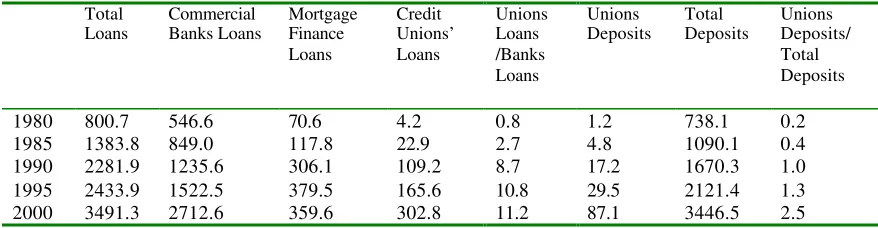
Commercial banks are the most important lenders in the Barbadian financial system,
followed by mortgage lenders and finally credit unions (see Table 1). However, in examining
the loans’ shares over time it is clear that credit unions’ growth has exceeded that of both banks
restrictions on the commercial banking sector and tax incentives for credit unions led to credit
unions’ loans, as a percentage of commercial banks’ loans, expanding from 0.8% in 1980 to just
under 10% in 1990. This rise in credit unions’ share of the lending market continued into the
1990s- albeit at a significantly reduced rate - with total credit unions’ loans reaching 11.2% of
total commercial banks’ loans by the end of 2000. However, the 1990-92 recession led to a
sharp decline in the credit unions’ rate of expansion, as a combination of high unemployment,
salary cuts, and the introduction of new products by the commercial banks resulted in a
moderation of asset growth. A similar pattern is revealed in examining the deposits data with
unions’ share of total deposits rising from a negligible 0.2% in 1980 to 2.5% by 2000. Credit
union membership growth rates are even more dramatic, increasing from under 7% of the total
labour force in 1980 to 68% at the end of 2000. Indeed, Williams (1996, pp.11) has argued that
“one of the major outcomes of the performance of commercial banks in the Caribbean has been
the loss of market share to non-banks.” The growth of the credit union movement has attracted
the regulatory attention of the Central Bank of Barbados, with some officials arguing for
enhanced regulation of the credit union sector (Hinds and Chase, 1997). Hinds and Chase assert
that while still endeavouring to meet the needs of the poor, the movement had become very
sophisticated, offering a range of credit services and “competing directly with the established
banking sector”. They note that credit unions now offer automatic teller machine facilities,
credit cards, mortgage loans, small bus iness loans, chequing facilities, and bill paying services.
2.
Conceptual Framework
The predominant empirical and regulatory approach to banking competition has been the
bank market structure, including those relating to market concentration, are good indicators of
the intensity of competition (Scherer and Ross 1990, pp. 4-7). In essence, a higher market
concentration means larger prices for financial services and, consequently, bigger bank profits.
The theoretical models specified in the study follows Rhoades (1987), who includes a
Herfindahl-Hirshman index of market concentration, consisting of commercial banks and credit
unions’ share of total market deposits (MPbu), commercial banks’ share of total commercial bank
and credit union deposits (MPb) and credit unions’ share of commercial bank and credit union
deposits (MPu). If credit unions are important competitors for commercial banks' business, then
MPbu should be an influential determinant of commercial banks' profit performance, and be
negatively related to commercial banks’ profitability, since its inclusion in the profit function is
likely to erode the ability of banks to earn monopoly profits. However, MPb should be positively
associated with commercial banks’ profitability because as concentration within the banking
sector rises, the ability of banks to reap monopoly profits expands. Similarly, if commercial
banks significantly affect credit unions’ activity then MPbu is likely to be an important
determinant of credit unions’ performance (profitability, efficiency and interest rate spread). It is
expected that MPbu should be negatively correlated with credit unions’ profitability, since as
credit unions gain market share their profitability should increase. On the other hand, MPbu is
likely to cause inefficiency and interest rate spreads to contract. MPu is expected to be positively
associated with credit union profitability, and negatively correlated with inefficiency and interest
rate spreads. Ideally, different measures of market concentration should not lead to dissimilar
findings, or the robustness of the results would have to be called into question. Thus, using loans
rather than deposits as the unit of measure of market concentration in constructing MPbu, MPb
To look formally at the interaction between commercial banks and credit unions their
objective functions must be defined. For commercial banks, it is customary to assume that banks
are profit maximisers and incorporate such variables as inefficiency (Ine), market power (MPb)
and the amount of loans (L) into the profit function specification (see Moore and Craigwell,
2000). This standard specification is adopted, but extended to include a variable that represents
credit union competition (MPbu) to determine whether commercial banks profit performance is
better explained by measures of market structure that take into account the presence of credit
unions. Mathematically, the model is as follows:
) , , , (
− + + −
= b b b bu
b f Ine L MP MP
π (1)
where πb represent commercial banks profitability, and the subscripts b and u represent banks
and credit unions, respectively. A priori, an expansion in the market power and loan portfolio of
banks are expected to positively influence commercial banks’ profitability, while increased
inefficiency and total market concentration should reduce the rate of return obtained by
commercial banks.
Defining the objective function of a credit union is, however theoretically and
empirically, more problematic. As noted by many authors (for example, Smith, Cargill and
Mayer, 1981; Smith, 1984), the standard theoretical treatment of financial intermediaries as
profit maximisers cannot be applied directly to credit unions since the members of a credit union
provide both the demand for and the supply of loanable funds. That is, a credit union
intermediates between its member-savers and its member-borrowers. In this situation, it is not
likely that a credit union can maximise its dividend rate for savers and minimise its loan rate for
borrowers at the same time.
Because there is no generally accepted theory of credit union behaviour, three objective
each specification including a variable that captured bank competition. As a result, the function
for a profit maximising credit union (Hempel and Yawitz, 1977) can be formally written as
follows:
In this model, the union market power (MPu) and loans (Lu) are expected to positively affect
credit union profitability, while an increase in total market concentration and inefficiency are
likely to decrease union profits.
Postulating cost minimisation, the union's objective function can be expressed in the
following way:
An expansion in the market power of credit unions is expected to lower the costs of credit unions
(Cu) due to benefits from returns to scale. In contrast, as the loan portfolio of the credit union
expands, its costs should rise as well, because more resources have to be used to service the now
larger lo an portfolio. The effect of increasing total market concentration on the credit union’s
costs is expected to be positive, since this forces the credit union to incur higher expenditure as it
attempts to augment the services offered to maintain its share of the deposit (loan) market.
An interest rate spread model, which posits that credit unions try to minimise the
difference between interest received and interest paid is also analysed, and is shown below:
)
A priori, an expansion in the union’s market power is expected to reduce interest rate spreads
(Spreadu) while credit union inefficiency, loan portfolio and the total market concentration all
3.
Data Description
The main sources of the data used in this study are the Co-operatives Department of Barbados,
which compiles quarterly balance sheet and income and expenditure statement information for
all 42 credit unions, and the Central Bank of Barbados which collects similar data for all 7
commercial banks. Complete quarterly information on the credit unions and commercial banks
operating in Barbados was available from 1994 to 2000 and this is the period that this paper
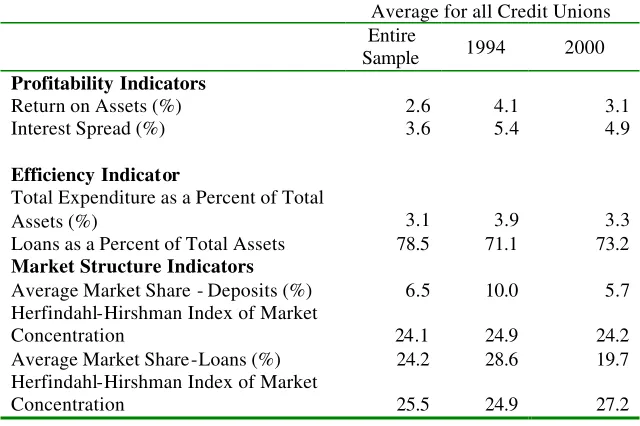
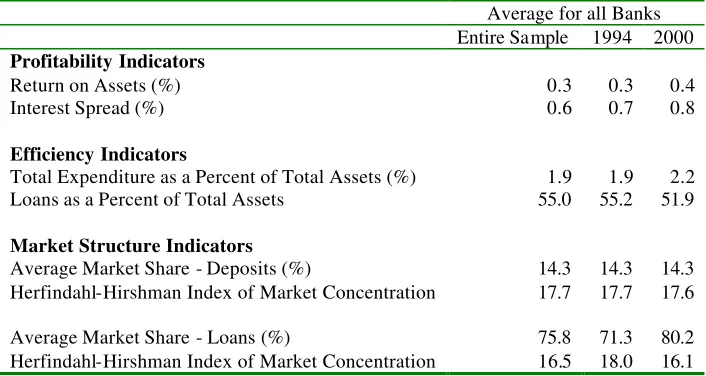
utilises. Summary statistics of this data are given in Tables 2 and 3.
Profitability in both financial institutions is measured by net income after taxes expressed
as a percentage of total assets. Inefficiency is total expenditure as a percentage of total assets,
loans was also calculated as a percentage of total assets, and the interest rate spread is the
difference between interest income and interest expenditure as a percent of total assets. The
competition variables are measured as described above in Section 2.
4.
Econometric Results
Generally one would expect that the relationship between commercial banks and credit unions is
dynamic, that is, current levels of credit union competition, for example, are likely to impact on
commercial bank profitability in the future. Hence a dynamic approach to econo metric
modelling is employed, using the Hendry General-to-Specific methodology. This process
requires an over-specified model (of lag order four due to the frequency and span of the data),
which is then reduced to a more parsimonious version by removing variables that do not
significantly contribute to the explanation of the dependent variable. However, before this was
undertaken, the data was tested for poolability using a Chow test (see Baltagi, 1995). The results
indicate that the calculated F-statistic is greater than the critical F-value for all the models. Thus,
that the data is poolable. All estimations used generalised least squares with cross sectio n
weights and were done in the software package EVIEWS 3.1. White’s
Heteroskedasticity-Consistent standard errors are reported and the residuals from all the models did not exhibit
serious problems of serial correlation. In addition, the profit and interest rate spread models
explained a significant proportion of the variation in these variables while the cost model had a
much lower Adjusted R-squared, suggesting at first glance, that credit unions objective function
may be more related to profit maximisation or spread minimisation than cost minimisation.
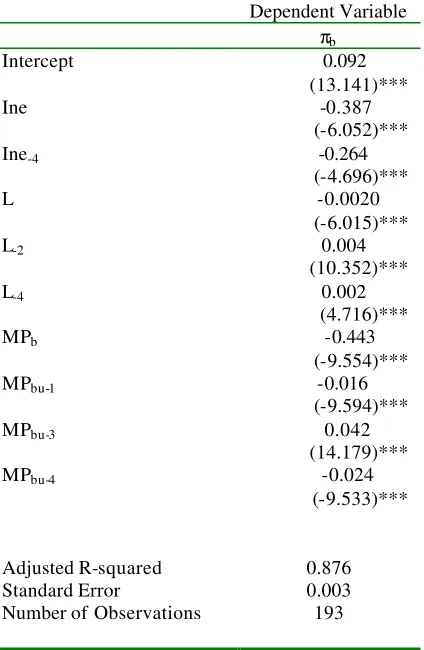
Table 4 gives the results for the commercial banks profit function where deposits is the
concentration measure used. The non-market structure variables all have their a priori signs.
The inefficiency variable was found to have a negative long run impact on commercial bank
profitability. Therefore, a reduction in commercial bank inefficiency should increase
commercial banks’ rates of return. The coefficient on the loans variable indicates that an
expansion in a commercial bank’s loan portfolio raises commercial bank profitability in the long
run. The negative long run effect of the MPb variable is, on the other hand, counterintuitive, as it
implies that commercial banks’ profitability is significantly reduced by an expansion in the
concentration of the banking sector. Similarly, MPbu also has the wrong sign in that the
regression suggests that the long run impact of an increase in MPbu on commercial bank
profitability is positive (0.002). The Wald test for the joint significance of the coefficients of
MPbu does not reject the null hypothesis that the coefficients are all equal to zero, implying that
the long run effect of MPbu is statistically insignificant. These findings imply that the Barbadian
banking sector does not compete directly with the credit union movement and hence do not
constitute much of a foil to commercial banks’ market power.
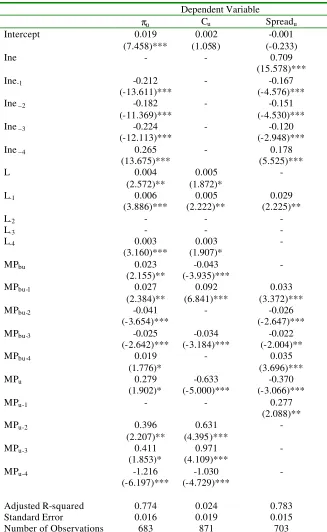
The results of the three credit union equations (with deposits as the concentration
but led to a widening of spreads, as credit unions were less able to minimise the cost of
borrowing to their members. An increase in the amount of loans implied a long-run expansion in
union profits, interest rate spreads and costs.
Examining the credit union profit function (Column 2), the long run coefficient of MPu
possess the wrong sign, suggesting that contrary to expectation, an increase in concentration
among credit unions indicates a reduction in union profitability. A similar unexpected result was
recorded for the long-run coefficient of MPbu, which while marginal (0.003), possesses a positive
rather than a negative sign. A Wald test for the joint significance of the coefficients of the MPbu
variable implies a rejection of the hypothesis that the coefficients are jointly zero, suggesting
that the long-run coefficient is indeed significant. This finding indicates that banks are not in
fact, important competitors to credit unions.
Empirical estimates of credit unions as cost minimisers (Equation 3) are presented in
Column 3 of Table 5. For the control variable MPu, the negative and significant (according to
the Wald test of joint significance) long-run effect implies that larger credit unions tend to have
higher expenditure to total asset ratios in accordance with a priori expectations. As anticipated,
an increase in MPbu also leads to a significant rise in credit union inefficiency in the long run.
While the signs of the coefficients are in accord with expectations, the ability of the equation to
explain the variation in the data is quite low as demonstrated by the low R2 (0.024).
Column 4 of Table 5 gives the empirical estimates of Equation 4 – the credit union
interest rate spread equation. In line with a priori expectations, the control variable MPu is
negative in the long-run, suggesting implying that as credit unions concentration rises, this tends
to lead to a reduction in interest rate spreads. This gives support to the hypothesis that larger
credit unions are more efficient and are better able to lower the cost of borrowing to members.
significant) long-run effect (0.002). This could mean that a reduction in the relative market
power of credit unions results in a small increase in credit unions’ spreads. Of the three
equations that attempt to explain credit union behaviour, the interest rate spread equation
performs best, in the sense that the R2 is relatively high (0.78), while the signs are in accord with
expectations.
The three credit union equations were also estimated using the data on only the 12 largest
unions to assess whether the impact of commercial banks’ competition on credit unions
depended on the size of the union (see Table 6). The main difference observed was that only one
of the MPbu variables was significant in the credit union interest rate spread equation. These
results could be interpreted to mean that the interest rate spreads of large credit unions tend not
to be significantly influenced by the decisions of commercial banks. This finding is in
accordance with the previous inferences that credit unions seem to serve a particular segment of
the financial market not already served by commercial banks.
Equations 1, 2, 3 and 4 were reestimated using the loans data to form
Herfindahl-Hirshman indices of concentration. These results were largely identical to those reported for the
deposits data and are not reported here, but are available from the authors.
5.
Conclusions
The goal of this article was to empirically examine the relationship between commercial
banks and credit unions. This is done using quarterly firm- level credit union and commercial
bank data from the Caribbean island of Barbados over the period 1994-2000. The approach used
attempted a first look at how competition from credit unions affected commercial banks
objective function and similarly how competition from commercial banks influenced credit
modelled as profit maximising entities. However, since previous theoretical studies on credit
unions have used a variety of objective functions, this study examined three of these many
specifications – profit maximisation, cost minimisation and spread minimisation.
The results of the study indicate that credit unions do not act as a significant foil to the
market power of commercial banks. Examining the influence of commercial banks on the
operations of credit unions, the study also found that increased commercial bank competition did
not impact on credit unions’ behaviour either. While tentative, these results would lead to the
conclusion that over the 1993-2000 period of the study, the credit union and commercial banks
effectively served non-overlapping and hence non-competing markets. In this regard, the
findings are similar to Mushinski(1999), the only other study done in a developing country.
However, one caveat which arises, is that the study did not cover the 1980s period when credit
union growth was fastest due to the unavailability of data. Thus the findings should be
considered a first step in examining the interaction between commercial banks and credit unions.
References
Baltagi, B.H. (1995), Econometric Analysis of Panel Data, John Wiley and Sons Ltd., Baffin
Lane , Chichester, England.
Emmons, W.R. and F. A. Schmid (2000), “Bank Competition and Concentration: Do Credit
Unions Matter?”, Federal Reserve Bank of St. Louis Review, May/June, pp. 29-43.
Feinberg, R.M. (2001), “The Competitive Role of Credit Unions in Small Local Financial
Services Markets”, The Review of Economics and Statistics, August, pp. 560-563.
Hinds, D. and K. Chase (1997), “Credit Unions in Barbados: A Case for Enhanced Regulation”,
Hempel, G., and J. Yawitz (1977), Financial Management of Financial Institutions, Prentice-
Hall.
Mushinski, D. (1999) “An Analysis of Offer Functions of Banks and Credit Unions in
Guatemala”, Journal of Development Studies, Vol. 36, No. 2, December, pp. 88-112.
Moore, W. and R. Craigwell (2000), “Market power and interest rate spreads in the Caribbean”,
mimeo, Central Bank of Barbados, Bridgetown, Barbados (forthcoming in the
International Review of Applied Economics).
Rhoades, S.A. (1987), “The Effect of Nonbank Thrift Institutions on Commercial Bank Profit
Performance in Local Markets”, Quarterly Review of Economics and Business, Spring,
Vol. 27, pp. 16-28.
Smith, D. J., T. Cargill, and R. Mayer (1981),“An Economic Theory of a Credit Union”, Journal
of Finance, Vol. 36, pp. 519-528.
Smith, D. (1984), “A Theoretic Framework for the Analysis of Credit Union Decision Making”,
Journal of Finance, Vol. 39, pp. 1155-1168.
Williams, M. (1996), Liberalising a Regulated Banking System: The Caribbean Case, Avebury,
Table 1
Summary of Credit Unions and Commercial Banks Loans and Deposits Data
Total Loans
Commercial Banks Loans
Mortgage Finance Loans
Credit Unions’ Loans
Unions Loans /Banks Loans
Unions Deposits
Total Deposits
Unions Deposits/ Total Deposits
1980 800.7 546.6 70.6 4.2 0.8 1.2 738.1 0.2 1985 1383.8 849.0 117.8 22.9 2.7 4.8 1090.1 0.4 1990 2281.9 1235.6 306.1 109.2 8.7 17.2 1670.3 1.0 1995 2433.9 1522.5 379.5 165.6 10.8 29.5 2121.4 1.3 2000 3491.3 2712.6 359.6 302.8 11.2 87.1 3446.5 2.5
Table 2
Summary Statistics on Credit Union Activity in Barbados
Average for all Credit Unions Entire
Sample 1994 2000
Profitability Indicators
Return on Assets (%) 2.6 4.1 3.1
Interest Spread (%) 3.6 5.4 4.9
Efficiency Indicator
Total Expenditure as a Percent of Total
Assets (%) 3.1 3.9 3.3
Loans as a Percent of Total Assets 78.5 71.1 73.2
Market Structure Indicators
Average Market Share - Deposits (%) 6.5 10.0 5.7 Herfindahl-Hirshman Index of Market
Concentration 24.1 24.9 24.2 Average Market Share-Loans (%) 24.2 28.6 19.7 Herfindahl-Hirshman Index of Market
Concentration 25.5 24.9 27.2
Source: Supervisor of Credit Unions
Notes: Herfindahl-Hirshman Index is calculated using total
deposits/loans and is defined as follows:
∑
=
n
1 i
2 i
a *
100 where ai is
Table 3
Summary Statistics on Commercial Bank Activity in Barbados
Average for all Banks Entire Sample 1994 2000
Profitability Indicators
Return on Assets (%) 0.3 0.3 0.4
Interest Spread (%) 0.6 0.7 0.8
Efficiency Indicators
Total Expenditure as a Percent of Total Assets (%) 1.9 1.9 2.2 Loans as a Percent of Total Assets 55.0 55.2 51.9
Market Structure Indicators
Average Market Share - Deposits (%) 14.3 14.3 14.3 Herfindahl-Hirshman Index of Market Concentration 17.7 17.7 17.6 Average Market Share - Loans (%) 75.8 71.3 80.2 Herfindahl-Hirshman Index of Market Concentration 16.5 18.0 16.1
Source: Central Bank of Barbados
Notes: Herfindahl-Hirshman Index is calculated using total
deposits/loans and is defined as follows:
∑
=
n
1 i
2 i
a *
100 where ai is the
Table 4
Estimation Results:
The Impact of Credit Union Activity on
Commercial Bank Profitability
Dependent Variable
πb Intercept 0.092
(13.141)***
Ine -0.387
(-6.052)***
Ine-4 -0.264
(-4.696)***
L -0.0020
(-6.015)***
L-2 0.004
(10.352)***
L-4 0.002
(4.716)***
MPb -0.443
(-9.554)***
MPbu-1 -0.016
(-9.594)***
MPbu-3 0.042
(14.179)***
MPbu-4 -0.024
(-9.533)***
Adjusted R-squared 0.876
Standard Error 0.003
Number of Observations 193
Table 5
Estimation Results:
The Impact of Commercial Banks on Credit Unions
(Entire Sample)
Adjusted R-squared 0.774 0.024 0.783
Standard Error 0.016 0.019 0.015
Table 6
Estimation Results:
The Impact of Commercial Banks on Credit Unions
(12 Largest Unions)
Dependent Variable
Adjusted R-squared 0.676 0.371 0.885
Standard Error 0.010 0.016 0.014