Volume 4, Number 1, June 2015 ISSN : 2088-9976
Contents
The Impact of Special Autonomy on the Convergence of Regional Economic Growth in Aceh, Indonesia
41 - 55
41
The Impact of Special Autonomy on the Convergence of Regional
Economic Growth in Aceh, Indonesia
Teuku Zulham, Said Muhammad, Raja Masbar, Sirojuzilam
Department of Economic Development, Faculty of Economics, Syiah Kuala University, Banda Aceh, Indonesia
Abstract: This study aims to assess the impact of special autonomy on the convergence of regional economic growth in Aceh, as well as factors that affect the convergence of economic growth before and after the enactment of special autonomy in Aceh. The independent variable in this study is the initial GDP per capita, working population, poor people, school duration, life expectancy, gross fixed capital formation, local revenue, equalization fund, and total receipts. The dependent variable is economic growth. The data used is secondary data in the form of panel data of the 23 districts / cities in Aceh from 1991 to 2012. The model used is panel data regression model which are grouped into two part of analysis which is before special autonomy (1991-2001) and after special autonomy (2002-2012). The estimation results indicate that there is sigma convergence of Aceh's regional economic growth which is shown by the decreasing value of standard deviation from 0.7698 before special autonomy to 0.5411 after special autonomy. In absolute terms, it is also ensued that there is a significant convergence of regional economic growth in Aceh in which the value of half-life of convergence to non-oil is about 27 years. While the speed of convergence after the special autonomy is increased. Conditionally, the exogenous variables that have a significant effect was only local revenues and school duration. Entire period takes 30 years half-life convergence with the speed of convergence on average 2.30 percent per year towards a steady state. The development program in the future should be oriented in creating many more employment opportunities, reducing poverty significantly, the enhancement of life expectancy, increasing people’s education to a higher level, as well as reducing the development gap in each district in Aceh.
Keywords: Convergence, Speed of Convergence, Half-Life of Convergence, Special Autonomy, the Regional Economic Growth
Introduction
Essentially Economic development is an attempt of utilizing existing resources in an area to be used optimally for the welfare of the region and also its society. It is characterized by an increase in income per capita and also the expected reduction in the income distribution gap between high income groups with the low income group between regions. In addition, economic development expected to increase the number of working population (reduced unemployment), quality and quantity of education, health status and reduced poverty.
The Development and relatively high economic growth become meaningful when it can deliver an equitable development to the region and its inhabitants. Otherwise, it can lead to a relatively higher inequality, this is why the following expression appears "the rich get richer, the poor getting poorer" or "advanced regions grow forward, backward regions are not getting ahead". Besides, it also affects the increasing number of unemployment, school dropout rates, mortality, poverty, and etc.
42
The regional development is very important because the achievement in national development is the accumulation of the results achieved in regional development. Therefore, the performance development of a country is determined by the development in each region. If the entire region succeeded in increasing income per capita, productivity, employment, poverty reduction, etc., hence a country succeeded in improving welfare. However, in reality, there are provinces that left behind and unable to align their regions with other provinces in the country. Similarly, there are districts / cities that incapable to catch up with the district / city in the province, then it is called as divergence. In contrast, there are regions are able to catch up and align themselves with other regions which were first developed then the gap between regions diminished, this is called convergence.
Convergence theory stated that the level of welfare experienced by the developed countries and developing countries at a time will converge (meet at one point) and there will be catching up effect that is the condition in which the developing countries succeed in chasing the developed countries. It is based on the assumption that the developed countries will suffer steady state condition that is a condition in which existing additional investment do not increase the income thus income levels cannot be increased anymore. Meanwhile, developing countries which have the additional investments to add up its revenue will continue to pursue and eventually will match the income of developed countries or catching up effect will occur (Barro and Sala-i-Martin, 1992; Valdes, 2003).
Convergence generally consists of sigma convergence (σ-convergence) and beta convergence ( -convergence). Sigma convergence is the most conventional measure in assessing the regional disparities at a certain period and also called static analysis tools. Barro and Sala-i-Martin (1992, 1995) measured the sigma convergence through dispersion that occurs between regions. This view was called σ-convergence that measured by the standard deviation of real income per capita among regions. If the dispersion of real income per capita among regions decreased, there is a slowdown in economic growth or, in other words poor regions progressively chasing rich regions.
Barro and Sala-i-Martin (1992, 1995) stated that the convergence occurs when the poor regional economy tends to grow faster than the rich region. This indicates the presence of a negative relationship between incomes per capita at the beginning of the period with economic growth. This opinion is called beta convergence ( -convergence) which is also called dynamic analysis tools. The speed of convergence can be determined by analyzing the -convergence, through the concept of half-life convergence which means the time required to close half of the initial gap.
43
The speed of convergence of a region is associated with the system of governance and the development carried out. Decentralized Development will accelerate the convergence process. Decentralization that has been implemented in Indonesia based on Law No. 22 of 1999 regarding Local Government and the Law No. 25 of 1999 regarding Center and Regional Financial Balance. Furthermore, the law was revised by Law No.32 of 2004 regarding Local Government and the Law No.33 of 2004 on Center and Regional Financial Balance. Special autonomy is a part of local autonomy or decentralization. Regions that have special status and granted special autonomy besides regulated by Local Government Law also enacted special provisions as regulated in other laws.
For some reason, in Indonesia there were three special autonomous regions, one of them is Aceh. Special autonomy granted to Aceh is based on Law No. 18 of 2001 on special autonomy for Aceh. The provision of special autonomy for Aceh province was intended to achieve justice, upholding the rule of law, respect for human rights, the acceleration of economic development, improving the welfare and advancement of society, in the context of equality and balancing advancement with other provinces. Further, Law No. 11 of 2006 regarding Aceh Government was issued, which is widely known by the term of UUPA. The existence of UUPA is expected to be utilized for the greater prosperity of Aceh to accelerate the realization of righteous welfare in Aceh, so the development between regions will be balanced or going towards the convergence of economic growth between regions, and there are no demands to separate from the Republic of Indonesia (NKRI).
According to the research of Ardi (2003) within a period of 18 years development (1983-2000) has shown a trend of economic convergence of district / city GDP per capita to the province GDP per capita. How the condition of that convergence after the special autonomy in Aceh is set in 2001? In addition, Vidyattama (2013) in his article reveals that inequality in GDP per capita in the district / city level is higher than at the provincial level for the duration of decentralization in Indonesia as measured from Williamson Index by the Human Development Index (IPM) and produces an assessment absolute convergence and conditional convergence. How is the state of convergence of regional economic growth in Aceh before and after the implementation of special autonomy? It is interesting to be researched, so that the achievement of the convergence of regional economic growth in Aceh can be evaluated. In along with the speed of convergence, the time required to close half of the initial gap (half-life of convergence), and the influence of exogenous variables (socioeconomic) on regional economic growth in Aceh.
A wide range of data obtained from the Central Statistics Agency (BPS) of Indonesia in 2014 showed that the Aceh development achieved have generally increased, but the majority remained below the national standard, despite local revenue increased. Naturally when local revenue increases, income per capita increases, education increase, health improves, the number of people working increased or unemployment decreases, the poverty rate decreased, gross fixed capital, formation (investment) area increases, the total funds received increases, and etc. The economic growth will increase accordingly. Thus the positive impact from all of those things is the convergence of regional economic growth in Aceh. Conversely, if the independent variables do not have a positive impact, there will be a divergence of regional economic growth in Aceh.
Another comparison can be seen from the Human Development Index (IPM). IPM figures of Aceh province are a reflection of the life expectancy of society, the average school duration, literacy rates, and purchasing power parity among districts / cities in Aceh. IPM figures in Aceh province during period 2006 - 2012 is always lower than the national average and tend to be divergent. This indicates that human development in Aceh is still lagging behind compared to the national average. In other words, the development of the health sector, education and the economy is still sluggish in Aceh when compared with the national average.
44
sector run by domestic and foreign investors. Industrial sector activities and export trading is relatively low when compared with neighboring regions, North Sumatra. In addition, the role of government spending has not significantly affected the increase in purchasing power. However, this requires a more in-depth study to determine the factors that affect the low purchasing power of the people in Aceh when compared with the national average.
On the other hand, the labor force participation rate also plays a role in increasing output or economic growth of a region. When the working population is increase then the unemployment rate is decrease thus accelerating the convergence achievement of regional economic growth. Likewise, the unemployment rate, more the number of people unemployed it would lead convergence of economic growth in the region goes slow. Labor is a major production inputs other than capital and technology, thereby increasing the quantity and quality of labor is absolutely necessary.
The Data of the development of Labor Force Participation Rate (LFPR) and Unemployment Rate (TPT) of Aceh and national level show that the LFPR in Aceh is lower than the national average and also tend to be slightly divergent. Meanwhile TPT of Aceh was higher than the national average and tend to be divergent broadening, in other words unemployment in Aceh is likely to increase in 2012. Similarly, the percentage of poor people in Aceh is still high when compared with the national average, although the percentage declined throughout the year, but the decrease was not significant. This means that the problem of poverty is still an obstacle in moving towards the regions convergence or to catch up region backwardness.
The speed convergence of the regional economic growth in Aceh is inseparable with the convergence of economic growth among some districts / cities in Aceh. From several districts / cities in Aceh seen an existence inequality of growth rate of socio-economic variables achievement before and after the special autonomy, which is working population. Processed data from BPS Aceh shows that there is a gap between the growth rate of the working population among districts / cities before and after the special autonomy. In other words, there are districts / cities with rapid growth rate of working population after special autonomy for example Bener Meriah, Aceh Jaya, Pidie Jaya and Aceh Tamiang. Meanwhile, other districts / cities growth rate of the working population after the special autonomy is still low, for example Subulussalam, Sabang, Aceh Singkil and Gayo Lues.
Likewise to the rate of poor population, although the overall is decline after the special autonomy in Aceh, but there is districts / cities that show slow declining movement such as Aceh Singkil. In the other hand, there are districts / cities that have a rapid reduction in the increment rate of poor people in their region such East Aceh, Aceh Tengah and Sabang. Furthermore, according to the Local revenue (PAD), there is inequality between districts / cities in Aceh in achieving revenue growth. There is a district / city that experiencing rapidly increase of local revenue after special autonomy such Southwest Aceh, Simeulue and Aceh Tamiang. Nevertheless, some districts / cities experienced slow increase of local revenue (PAD), and even some districts / cities experienced decline of local revenue (PAD) after special autonomy, such Aceh Utara, Gayo Lues, Pidie Jaya, and Sabang.
There is also a gap in economic growth among districts. The data from BPS showed that there is a district that has declined their regional economic growth after special autonomy such South Aceh, East Aceh, West Aceh, North Aceh and Aceh Jaya. In the other hand, there are districts that experiencing the increase of their economic growth such Banda Aceh and Sabang. While the districts that rise slow are southwest Aceh, Aceh Besar and Lhokseumawe.
45 Previous Studies
Barro et al (1991) conduct a study regarding convergence with the framework of neoclassical growth models on the 73 regions in Western Europe since 1950. The results show that there is a convergence between regions, although does not fit with the initial hypothesis which stated that b is constant as time passes. In the subsequent model used of dummy regions (fixed effect model) also confirmed the previous model, which is the occurrence of convergence in income per capita across regions. In the final model is to involve sectoral dummy variables, showed that b is constant as time passes.
Akita and Lukman (1995) on the study of regional convergence in Indonesia, using Williamson index, variation of size coefficient, to see the changes in regional disparities at the provincial level during 1975-1992, the findings show a large decline in GDP per capita inequalities between regions.
Furthermore, the same study conducted by Sala-i-Martin (1996) b-convergence and s-convergence using the Summers-Heston data (1988) which involves 110 countries in the world. Using data from 1960 to 1990, Sala-i-Martin did not find any absolute b-convergence and s-convergence. Furthermore, by using some of the control variables discovered the existence of conditional b-convergence, with the speed of conditional convergence of 2 percent per year. At the same time also found the existence of s-convergence, although the process of s convergence stopped in the mid-1970s. In the subsample of OECD countries such Japan, USA, Germany, UK, France, Italy, and Spain found the existence of absolute and conditional b-convergence.
While the research conducted by Garcia-Garcia and Soelistianingsih (1998) resulted the first estimation of speed convergence ( -convergence) of Indonesia provincial revenues from 1975 to 1983, which confirmed a statistically significant convergence of GDP per capita and estimated its speed to about 2 percent. This speeds implied that the convergence process will be at the midpoint after 35 years, or in other words that the regional disparities were observed (i.e. the average deviation from the mean) would be roughly divided into two in the period.
The findings of Garratani and Soeroso in Wibisono (2003) through the application of the neoclassical model, found that the factors of production move in accordance with the predictions of the neoclassical model. But they also show that the attractiveness of potential areas has led to instability and divergence among regions when the model dynamically resolved. Simulation government intervention through policies that encourage the growth of capital in underdeveloped regions will produce the opposite effect and encourage convergence.
The research of convergence in Aceh by Ardi (2003) found that in the development period of last 18 years 1983-2000, have shown a trend of economic convergence of GDP per capita from the districts to the GDP per capita of the province, with comparative figures GDP per capita of the richest districts with the poorest districts of 12.39 in 1983 to about 7.28 in 2000.
Finally, a study conducted by Vidyattama (2013) concludes that the regional convergence during and after the commencement of decentralization in Indonesia shows some tendency to increase GDP per capita, but the condition of IPM convergence is still questionable. There are some indications that the new district formed during the decentralization initially had a high growth rate, due to new investments in building of new government, but this trend seems to have fades quite quickly.
Research Methodology
46
/ city from spreading out, the data before spreading out were estimated by BPS Aceh (back casting) either before and after the special autonomy.
The data used in this study was Panel data or pool data, the combination of time series and cross-section data during 1991-2012. The data studied as economic variable is economic growth that is gross domestic product (GDP) at constant prices (ADHK) of 2010 non-oil, GDP per capita, gross fixed capital formation (GFCF), Local Revenue (PAD), equalization funds, and total receipts. While categorized as social variable such the number of working population, the average of school duration, the number of poor people, and life expectancy.
The analysis model used in this study is convergence model with panel data regression analysis approach is accompanied by testing analysis tools used. Panel data regression model was conducted to see the effect of independent variables on the dependent variable as hypothesized. So to determine the convergence of regional economic growth and speed of convergence as well as the time required to close half of the initial gap (half-life of convergence) as hypothesized, then the estimation performed with convergence model.
Sigma Convergence ( -convergence)
Sigma convergence describes the dispersion between the cross section data. Convergence is derived from the standard deviation of the logarithm of real GDP per capita. Convergence occurs when the dispersion between the economies has declined as time passes. If the value of the dispersion (coefficient of variation) in real GDP per capita at the beginning across district decreased, meaning a reduction of regional disparities in the study period. In other words, in the period, economic growth in poor regions increased over the previous year so that it can begin to catch up economic growth of developed regions. Hence it can be said the convergence of economic growth across districts in Aceh occur.
Tool to determine the sigma convergence used the value coefficient of variation (CV) with the formula as follows (Lei and Yao, 2008):
� = √∑(��−�̅)�
�̅ (1)
Where yi is the GDP per capita of districts, ӯ is GDP per capita of province. The model is to answer the first hypothesis which states that the occurrence of convergence of regional economic growth in Aceh based on sigma.
Absolute Beta Convergence (Absolute -convergence)
To complete the static sigma convergence, can also be measured beta dynamic convergence. Beta convergence consists of absolute convergence and conditional convergence. Absolute convergence obtained from the Data of economic growth as the dependent variable and initial GDP per capita as independent variables, for those use of panel data regression. To measure the absolute convergence, used panel data regression equation as follows:
�� � .� −�� � .�−
� = + �� ��.�−1 + �.� (2)
Where y is income per capita, i indicate the region, T shows the number of time periods from the early years of the study (t-1) until the end of the T, is a constant, and is the coefficient of initial income per capita. If the value of the coefficient is negative or less than zero means the convergence, and if positive means the divergence of economic growth. This model formerly used to prove the first hypothesis in this study. For operational study, the equation model (2) is changed to:
lnPEit = + lnPDRBPKi,t-1 + eit (3)
47
Conditional Beta Convergence (Conditional -convergence)
To determine the conditional convergence then use panel data regression also with some additional control variables (variables other than economic growth and GDP per capita) is also known as an exogenous variable. Exogenous variables in this study categorized as social variables which is the number of people working, the number of poor people, average school duration, and life expectancy. Economic variables such as Gross Fixed Capital Formation (GFCF), and Local Revenue (PAD).
Estimation used to measure conditional convergence is the equation of panel data regression from Baro and Sala-I-Martin (1991, 1992, 1995, and 2004) and some applications of other researchers with the following equation:
�� � .� −�� � .�−
� = + �� ��.�−1 + ∑ =1� � (�.�−1) + �.� (4)
With �,�−1 are exogenous variables that are expected to contributed to economic growth in addition to the income per capita.
Moreover, other methods for measuring beta convergence ( -convergence) generally requires estimation of growth equation as follows: (Monfort, 2008)
ln(Δyi,t) = + ln(yi ,t-1) + Zi,t + ui,t (5)
Where yi, t and Δyi, t is the growth rate of Gross Domestic Product (GDP) per capita of region i of time t; Zi, t are other factors that affect the rate of economic growth; ui, t is the standard error term; , , are parameters to be estimated.
Other measurements to determine the conditional convergence is the estimation formula written by Lall and Yilmaz (2001) with panel data regression equation as follows:
� � �� = − � � ��−1 + �−1 + + �� (6)
Known yit is regional income per capita growth; Z is a vector of additional regional
characteristics k such as human capital and public capital; D is a vector of regional dummy variables. T is a vector of dummy variables of time t.
Based on the equation (4), (5) and (6), then the estimation model used in this study operations, is as follows:
lnPEit= + 1lnPDRBPKit-1+ 2lnPBit+ 3lnPMit+ 4lnLSit +
5lnHHit+ 6lnPMTBit+ 7lnPADit+ 8lnDPit+ 9lnTPit + (7)
10Dit + eit
With known is a constant; 1,2, .. n is a parameter or coefficient of elasticity of each variable; PEit is economic growth in region i in year to t; PDRBPKi,t-1 is the GDP per capita of
region i in the beginning of the sample period; PBit was working population in region i in year t;
PMit is poor people in region i in year t; LSit is school duration in region i in year t; HHit is life expectancy in the region i in year t; PMTBit is gross fixed capital formation in the region i in year t; PADit is local revenue in region i in year t; DPit is equalization funds in the region i in year t; TPit is total receipts in the region i in year t; Dit is a dummy variable in region i in year t where 0 before special autonomy and 1 after special autonomy and Eit as an error term.
48
if positive means having a positive relationship with economic growth, and if it is negative means negatively related to economic growth. While the coefficient of lnPDRB per capita at beginning when negative sign means there is a convergence of regional economic growth in Aceh conditionally. Indicates, regions that are lagging behind would catch up, while developed regions will run stable, so in accordance with the process of running time, the gaps between regions diminishing lead to one point that is steady state, which relatively occurs equitable economic growth. Conversely if the positive sign means there is a divergence of economic growth, which means that the gap between the regions broaden. This model once used to prove the hypothesis in this study that regional economic growth convergence occurs after the introduction of special autonomy in Aceh either sigma, absolute beta, or conditional beta.
Speed of convergence can be known through the coefficient of lnPDRB per capita at the beginning reflecting elasticity of lnPDRB per capita at beginning affects economic growth. While the time required to close half of the initial gap (half-life of convergence) can be determined by the formula log (0.5) / log (1- ) (Sari, 2010). Overall estimation is done with the aid of Eviews 7.0 software data processing.
Result And Discussion
Sigma Convergence Analysis (σ-Convergence)
As explained previously, that sigma convergence is a measure used to compute the level of regional gap in a given period and is also called static analysis tools. Sigma convergence measured by the standard deviation of real income per capita among regions. If the dispersion of real income per capita among regions decreased, there is a slowdown in economic growth, or in other words the poor areas increasingly pursuing rich areas.
Based on the data processed, we can conclude that there has been a sigma convergence between regions in Aceh before the special autonomy. Dispersion in real GDP per capita among districts / cities in general looks standard deviation fell from 0.89 in 1991 to 0.658 in 2001, and the coefficient of variation fell from 0.382 in 1991 to 0.306 in 2001 (before the special autonomy). There is a slight increase occurred in 1998 dan1999 caused by economic crisis that hit Indonesia after the expiration of orde baru, thus causing economic divergence.
After special autonomy standard deviation value has declined from 0.673 in 2002 to 0.412 in 2012 or variance decreased from 0.29 into 0.20. However, there is a small increase in the value of the variance in 2004 it is caused by the tsunami so there was a slight divergence in the regional economy of Aceh. The average value of standard deviations before special autonomy 0.7698 fell to 0.5411 after the special autonomy.
Overall from 1991 to 2012 there has been a convergence of regional economic growth in Aceh. It can be concluded that inequalities of economic growth between regions in Aceh diminishing. It means the disparities of economic development between districts / cities in Aceh are relatively more equitable. In other words, the economic growth between regions in Aceh led to converge. The estimation results, proved that sigma convergence occurred in regional economic growth in Aceh before and after the special autonomy.
Beta Absolute Convergence Analysis (Absolute -Convergence)
49
suitability of the model used or the selection of the best models. Panel regression model is done by adding a dummy variable (D) before special autonomy = 0 (period 1991-2001) and after special autonomy = 1 (period 2002-2012).
In the assessment of this analysis, the convergence of regional economic growth in Aceh absolutely and conditionally can be seen from a period of analysis of 1991-2001 (before special autonomy) and 2002 to 2012 (after the special autonomy). Variable GDP per capita and economic growth seen from one side of which is sourced from non-oil and gas at constant prices in 2000, due to non-oil sources have been representing the whole of the indicator variables.
In absolute convergence model, variables estimated only GDP per capita at beginning of years as independent variable and economic growth as the dependent variable. In this analysis can be reviewed in the estimation results of absolute convergence of regional economic growth in Aceh before and after special autonomy.
Absolute Convergence of Regional Economic Growth in Aceh before Special Autonomy (Period 1991-2001)
The regression estimation result of initial GDP per capita with the non-oil economic growth of fixed effects method, show that the convergence of regional economic growth in Aceh. It was shown a negative number on the coefficient of lnPDRB per capita beginning of -0.02317 and statistically significant at = 0.001 with t count> t table (3.849443> 3.32940). The estimation results can be seen Table 1.
Table 1. The Estimation Results of Absolute Convergence Regression Panel Fixed Effect model period of before Special Autonomy (1991-2001) Non-Oil
Variable Coefficient Std. Error t-Statistic Prob.
C 0.690670 0.704303 9.806431 0.0000
LOG(PDRBPK0_NM?) -0.023170 0.601905 -3.849443 0.0002
Fixed Effects (Period)
1991--C 0.869051
1992--C 1.229051
1993--C 1.539051
1994--C 1.902964
1995--C 1.481660
1996--C 1.460356
1997--C 0.497747
1998--C -1.928340
1999--C -3.632253
2000--C -1.722688
2001--C -1.696601
Effects Specification
Period fixed (dummy variables)
R-squared 0.036764 Mean dependent var 4.267036
Adjusted R-squared 0.033878 S.D. dependent var 3.143257
S.E. of regression 2.555943 Akaike info criterion 4.760989
Sum squared resid 1574.416 Schwarz criterion 4.928581
Log likelihood -590.2651 F-statistic 12.73787
Durbin-Watson stat 1.079723 Prob(F-statistic) 0.000000
50 Models formed can be written as follows:
LnPE_NM = 0,69067– 0,02317 LnPDRBPK0_NM
(0,000) (0,000)
Absolute Convergence of Regional Economic Growth in Aceh after Special Autonomy (Period of 2002-2012)
The estimation results of the convergence of regional economic growth non-oil after special autonomy in Aceh, can be seen in Table 2. Based on the estimation shown there is an absolute convergence of regional economic growth in the non-oil after the special autonomy in Aceh. This is shown by the negative coefficient of initial income per capita of -0.091487 and statistically significant at = 0:05 in which the value of 3.350828 t> t table 3.32940. The average speed of convergence of economic growth is 9.1 percent per year. In addition, the time required to close half of the initial gap between regions in Aceh after special autonomy was 7.2 years.
Briefly models formed can be written:
LnPE_NM = 0,538113– 0.091487 LnPDRBPK0_NM
(0,0379) (0,0495)
Constants value of 0.538 means that without the influence of the initial income per capita, the regional economic growth of non-oil after the special autonomy in Aceh average is 0.538 percent per year. Adjusted R-squared of 18.00 percent means that the variable factors other than initial GDP per capita affecting regional economic growth in Aceh as 82 percent were not included in this model. Thereby has been proven in this research the existing of absolute beta convergence of regional economic growth in Aceh before and after the special autonomy.
Table 2. The Estimation Result of Absolute Convergence Regression Panel with Fixed Effect Method Period after Special Autonomy (2002-2012) Non-Oil
Variable Coefficient Std. Error t-Statistic Prob.
C 0.538113 2.577290 4.087905 0.0379
LOG(PDRBPK0_NM?) -0.091487 1.799912 -3.350828 0.0495
Fixed Effects (Period)
2002--C -2.385731
2003--C -1.617036
2004--C 0.481225
2005--C -4.432688
2006--C 9.639051
2007--C 1.005573
2008--C -0.692253
2009--C -0.757905
2010--C -0.448775
2011--C -0.474427
2012--C -0.317036
Effects Specification
Period fixed (dummy variables)
R-squared 0.215824 Mean dependent var 5.251818
Adjusted R-squared 0.180032 S.D. dependent var 7.232519
S.E. of regression 6.549199 Akaike info criterion 6.642832
Sum squared resid 10336.97 Schwarz criterion 6.810423
Log likelihood -828.3182 F-statistic 6.029900
51
Conditional Beta Convergence Analysis (Conditional -Convergence)
Conditional convergence is used to see the relationship of independent variables which is exogenous except initial GDP per capita effect on the convergence of regional economic growth. Exogenous socioeconomic variables related in this study there are eight independent namely the working population (PB), poor people (PM), the average of school duration of the adult population (LS), the life expectancy of the population (HH), fixed capital formation gross (GFCF), Local revenue (PAD), the equalization fund/ central government transfers (DP), and the total funds received as a whole districts / cities and total revenues (TP) for the province of Aceh.
Conditional Convergence of Regional Economic Growth in Aceh Before Special Autonomy (Period 1991-2001)
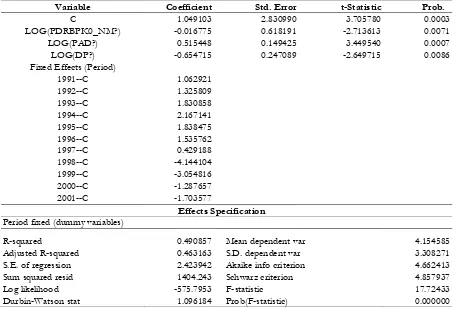
The regression results show that the fixed effect model of conditional convergence of regional economic growth before special autonomy in Aceh is characterized by a negative value in the coefficient of lnPDRB initial per capita of -0.016775 and statistically significant at = 0:05 2.713613 where t count> t table 1.96938 ( see Table 3). While the constant value of 1049 means that regional economic growth in Aceh will grow by 1.05 percent when the independent variable equals to zero. The average speed of convergence of regional economic growth is 1.67 percent per year, while the time required to cover half of the initial gap was 40.97 years, or about 41 years.
Exogenous variables affecting regional economic growth conditionally before special autonomy is local revenue (PAD) and significant at = 0:05 in which the partial value of t count> t table (2.713613> 1.96938) and the PAD parameter is positive with a coefficient of elasticity 0.5154. This figure means that every 1 percent increase in local revenue would raise regional economic growth in Aceh of 0.51 percent (ceteris paribus).
Despite the equalization funds variable (DP) also shown a significant level is at = 0:05 where value of t count 2.649715 t> t table 1.96938, but variable parameter of equalization fund is negative by -0.6547. It means that every 1 percent increase in the equalization funds would reduce the rate of regional economic growth of 0.65 percent (ceteris paribus). This indicates that the equalization funds obtained from the center has not been able to boost economic growth in the period before autonomy. This is reasonable because in the period 1991 - 2001 the security situation in Aceh relatively unfavorable especially in conducting investment activities.
Briefly models formed can be written as follows:
LnPE = 1,0491– 0.0167 LnPDRBPK0 + 0,5154 LnPAD – 0,6547 LnDP
52
Table 3. The Estimation Results of Conditional Convergence of Regional Economic Growth in Aceh before Special Autonomy (1991 - 2001)
Variable Coefficient Std. Error t-Statistic Prob.
C 1.049103 2.830990 3.705780 0.0003
LOG(PDRBPK0_NM?) -0.016775 0.618191 -2.713613 0.0071
LOG(PAD?) 0.515448 0.149425 3.449540 0.0007
LOG(DP?) -0.654715 0.247089 -2.649715 0.0086
Fixed Effects (Period)
1991--C 1.062921
1992--C 1.325809
1993--C 1.830858
1994--C 2.167141
1995--C 1.838475
1996--C 1.535762
1997--C 0.429188
1998--C -4.144104
1999--C -3.054816
2000--C -1.287657
2001--C -1.703577
Effects Specification
Period fixed (dummy variables)
R-squared 0.490857 Mean dependent var 4.154585
Adjusted R-squared 0.463163 S.D. dependent var 3.308271
S.E. of regression 2.423942 Akaike info criterion 4.662413
Sum squared resid 1404.243 Schwarz criterion 4.857937
Log likelihood -575.7953 F-statistic 17.72433
Durbin-Watson stat 1.096184 Prob(F-statistic) 0.000000
Simultaneously all independent variables (PAD and equalization funds) significantly affect the dependent variables (economic growth) is statistically at = 0:05 in which the value of F test> F table (17.72433> 2.058728). Other exogenous variables did not significantly influence regional economic growth in Aceh. Adjusted R-Square of 0.4632 means that the independent variables affect regional economic growth in Aceh amounted to 46.32 per cent, in other words amounted to 53.68 percent influenced by other variables that were not estimated in this model.
Conditional Convergence of Regional Economic Growth in Aceh after Special Autonomy (Period 2002-2012)
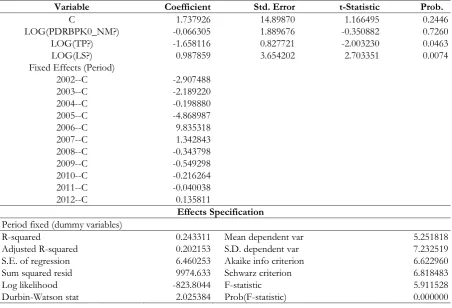
After the special autonomy, also occur conditional convergence of regional economic growth in Aceh, but the average value of the speed of convergence is 6.63 percent per year higher than before the special autonomy. The time required to cover half of the initial gap was 10.10 years, or about 10 years is also faster than before autonomy. The regression results show that the fixed effect model of conditional convergence of regional economic growth in Aceh is indicated by a negative value of the coefficient of LnPDRB initial per capita as -0.06630. However, the p-value of 0.7260 and t p-value count 0.35088 < t table 1.65090 means not significant at = 0.1.
53
funds outflow in Aceh amounted to 71.17 percent, while the total inflow of funds amounted to 28.83 per cent(Bank Indonesia: “Kajian Ekonomi Regional Provinsi Aceh oleh Bank Indonesia”, 2013).
However, the average of school duration (LS) positively and significant effect at = 0:05 where t value count 2.703351 > t table 1.96938. This may be caused by the existence of funds that must be plotted for the education sector by 30 percent of the special autonomy fund.
Simultaneously all independent variables (total revenues and school duration) significantly affect the dependent variables (economic growth) is statistically at = 0:05 in which the value of F test> F table (5.911528> 2.058728). Other exogenous variables did not significantly influence of Aceh regional economic growth. Adjusted R-Square value of 0.202153 means that independent variables affect regional economic growth in Aceh amounted to 20.21 per cent, in other words amounted to 79.79 percent influenced by other variables that were not estimated in this model. The estimation equation can be formed:
LnPE = 1,7379– 0.0663 LnPDRBPK0– 1,6581 LnTP + 0,9878 LnLS
(0,244) (0,726) (0.046) (0.007)
Table 4. The Estimation Result of Conditional Convergence of Regional Economic Growth in Aceh after Special Autonomy (2002 - 2012)
Variable Coefficient Std. Error t-Statistic Prob.
C 1.737926 14.89870 1.166495 0.2446
LOG(PDRBPK0_NM?) -0.066305 1.889676 -0.350882 0.7260
LOG(TP?) -1.658116 0.827721 -2.003230 0.0463
LOG(LS?) 0.987859 3.654202 2.703351 0.0074
Fixed Effects (Period)
2002--C -2.907488
2003--C -2.189220
2004--C -0.198880
2005--C -4.868987
2006--C 9.835318
2007--C 1.342843
2008--C -0.343798
2009--C -0.549298
2010--C -0.216264
2011--C -0.040038
2012--C 0.135811
Effects Specification
Period fixed (dummy variables)
R-squared 0.243311 Mean dependent var 5.251818
Adjusted R-squared 0.202153 S.D. dependent var 7.232519
S.E. of regression 6.460253 Akaike info criterion 6.622960
Sum squared resid 9974.633 Schwarz criterion 6.818483
Log likelihood -823.8044 F-statistic 5.911528
Durbin-Watson stat 2.025384 Prob(F-statistic) 0.000000
Thus the hypothesis in this study proved that there is a convergence of regional economic growth in Aceh conditionally before and after special autonomy.
Conclusion
54
Before special autonomy, exogenous variables that have a positive influence and significant impact on regional economic growth of conditional convergence in Aceh is local revenue (PAD), while the associated show negative and significant is variable equalization funds. In other words, the equalization funds received in Aceh have not been able to boost regional economic growth in Aceh. After special autonomy, independent variables which give a positive and significant impact is the average of school duration, while the associated show negative and significant is variable equalization funds. In other words, the equalization funds received after special autonomy also not been able to increase regional economic growth of Aceh.
To accelerate the convergence of regional economic growth in Aceh, as well as to reduce the disparities between districts / cities in Aceh, the program of future development should be oriented to the distribution of development among districts / cities to build a quality of infrastructure such as roads, electricity, water supply, irrigation, especially in the south-west region and the highlands / mountains and islands.
In connection with the variable of working population, poor people , life expectancy, Gross fixed capital formation and total receipts of provinces and districts / cities in Aceh were able to boost economic growth, the necessary policies of government (executive and legislative) that lead to a policy of non-economic commitments and the seriousness of the government , and also the harmony of superiors and subordinates government as well as all stakeholders to maintaining the security and convenience in Aceh.
Further research is needed to explore each of the variables that are not related and do not significantly affect the economic growth in Aceh by specialize in one variable and one area but explored in greater depth the causes of insignificant in their respective districts / cities in Aceh in the study of grounded research.
This research will be more complete if it is associated with the corresponding relationships between neighborhood effect in achieving the convergence of regional economic growth between districts / cities in Aceh. However, in this study was not conducted due to the limited time to find data supporting and infrastructure of the region as well as inter-regional trade in 23 districts / cities in Aceh from the time period of before and after the special autonomy.
References
Agarwalla, A and Pangotra, P. (2011). “Regional Income Disparities in India and Test for Convergence –1980 to 2006”. Working Paper Series. No.2011-01-04. HMA. India
Akita, T. and Alisjahbana, A.S. (2002). “Regional Income Inequality in Indonesia and The Initial Impact of The Economic Crisis”, Bulletin of Indonesian Economic Studies 38 (2): 201–22. Akita, T. and Lukman, R.A. (1995). “Interregional Inequalities in Indonesia: A Sectoral
Decomposition Analysis for 1975–92”, Bulletin of Indonesian Economic Studies 31(2): 61–81. Ardi (2003). “Prospek Konvergensi Ekonomi Antar Daerah Dalam Era Otonomi Khusus di
Provinsi Nanggroe Aceh Darussalam”. Tesis. Program Pasca Sarjana Universitas Syiah Kuala, Darussalam Banda Aceh.
Azwar, (2013). “Kesenjangan Pertumbuhan Ekonomi Antarwilayah di Propinsi Aceh”, Disertasi. Program Doktor Ilmu Ekonomi, Program Pasca Sarjana Universitas Syiah Kuala, Banda Aceh.
Badan Pusat Statistik bekerjasama dengan Bappeda Provinsi Aceh. Aceh Dalam Angka, Pendapatan Regional Aceh, berbagai tahun. BPS Banda Aceh .
Barro, R. J., X. Sala-i-Martin., O. J. Blanchard, R. E. Hall (1991). “Convergence across states and regions.” Brooking papers on economic activity. Vol.1991.p.107-182
Barro, Robert J and Xavier Sala-i-Martin. (1992). “Convergence”. The Journal of Political Economy. Vol. 100, No. 2. April 1992. P.223-251
Barro, Robert J and Xavier Sala-i-Martin. (1995). Economic Growth. New York: McGraw-Hill International Editions.
55
Press Cambridge. Massachusetts, London. England.
Chi-Keung, M.L. (2000). “New Evidence about Convergence across State”. International Research Journal of Finance and Economics. Issues 27 (2009), p. 7-18.
Ekananda, Mahyus (2006). Analisis Data Panel: Estimasi dengan Struktur Varian-Covarian Residual. Jakarta: Program Pasca Sarjana Universitas Indonesia.
Garcia-Garcia, J. and Soelistianingsih, L. (1998) “Why do differences in provincial incomes persist in Indonesia?”, Bulletin of Indonesia Economic Studies 34 (1): 95–120.
LeSage, J.P. (1999), Spatial Econometrics, The Web Book of Regional Science, Regional Research Institute, West Virginia University, Morgantown WV.
Lei, C.K and Yao, S. (2008). “On Income Convergence among China, Hongkong and Macau”. The World Economy. Jurnal Compilation. Blackwell Publishing Ltd. P.345-366
Manfort, Philippe, (2008). “Convergence of UE Region Measure and Evolution”. Working Papers. European Union Regional Policy. No.01/2008.
Sala-i-Martin, X. (1996). “Regional Cohesion: Evidence and Theories of Regional Growth and Convergence”, European Economic Review 40: 1325–52.
________________(1996). “The Classical Approach to Convergence Analysis.” EconomicJournal. Vol. 106. P. 1019-1036
Sari, Novita. (2010). “Konvergensi Perekonomian di Indonesia: Setelah Otonomi Daerah”. Tesis. Sekolah Tinggi Ilmu Statistik. Jakarta.
Sirojuzilam dan Kasyful Mahalli. (2011). REGIONAL. Pembangunan, Perencanaan, dan Ekonomi. USU Press, Medan.
Sirojuzilam (2011). Problematika Wilayah Kota dan Daerah. USU Press, Medan.
Todaro, M.P and Smith S.C. (2012). Economic Development. Library of Congres Cataloging in Publication Data. Addition – Wesley.
Undang-undang, No.44 Tahun 1999 tentang Penyelenggaraan Keistimewaan bagi Provinsi Daerah Istimewa Aceh.
_____________, No.22 Tahun 1999 tentang Pemerintah Daerah
_____________, No.25 Tahun 1999 tentang Perimbangan Keuangan Pusat dan Daerah _____________, No.32 Tahun 2004 tentang Pemerintah Daerah
_____________, No.33 Tahun 2004 tentang Perimbangan Keuangan Pusat dan Daerah
_____________,No.29 Tahun 2007 tentang Pemerintahan Provinsi Daerah Khusus Ibu kota Jakarta sebagai Ibu kota Negara Kesatuan Republik Indonesia.
______________, No.18 Tahun 2001 tentang Otonomi Khusus bagi Provinsi Nanggroe Aceh Darussalam.
______________, No. 21 Tahun 2001 tentang Otonomi Khusus bagi Provinsi Papua. ______________, No, 11 Tahun 2006 tentang Pemerintahan Aceh
Vidyattama, Yogi. (2013). “Regional Convergence and The Role of The Neighbourhood Effect in Decentralised Indonesia”. Bulletin of Indonesian Economic Studies. Vol.49. No.2. p:193-211.
Wibisono, Yusuf. (2003). “Konvergensi di Indonesia: Beberapa Temuan Awal dan Inplikasinya”. Jurnal