ASEAN
Tourism Investment
Design and Layout
Sasyaz Kreatif Sdn. Bhd. (154747-K) Printer
Sasyaz Holdings Sdn. Bhd. (219275-V) [email protected]
Copyright © ASEAN National Tourism Organisations Published by :
ASEAN National Tourism Organisations First published April 2008
C o n t e n t s
Page
Preface
5
Asean Fast Fact
6
Brunei Darussalam
7
Cambodia
11
Indonesia
31
Lao PDR
67
Malaysia
81
Myanmar
115
Philippines
137
Singapore
199
Thailand
225
P r e f a c e
Tourism is one of the main priority sectors for ASEAN economic integration as envisaged in the Vientiane Action Programme (VAP). The ASEAN National Tourism Organizations (ASEAN NTOs) formulated a Plan of Action for ASEAN Co-operation in Tourism which includes the facilitation of investment within the region. Tourism has become a key industry and an important generator of income and employment for countries in the region. The rapid growth of tourism in recent years has attracted the interest of potential investors who are keen to be involved in this industry.
One of the measures under the Implementation of Roadmap for Integration of Tourism Sector (Tourism Investment) is the Incentives for Development of Tourism Infrastructure (Measure no. 20). The objective of this measure is to provide incentives for the development of tourism infrastructure so as to encourage private investment in the ASEAN countries coming from investors within and outside the region. To encourage tourism investment in the region, the ASEAN Tourism Investment Guide (ATIG), which was first produced in 1998, has been updated.
The Guide contains information on the 10 ASEAN Member Countries, namely, Brunei Darussalam, Cambodia, Indonesia, Lao PDR, Malaysia, Myanmar, Philippines, Singapore, Thailand and Viet Nam, which includes:
1) Country Information 2) Investment Climate
3) Economic Indicators & Policies 4) Financial Framework
5) Statutory Requirements 6) Relevant Agencies
A s e a n F a s t F a c t
ASSOCIATION OF SOUTHEAST ASIAN NATIONS
(ASEAN)
Establishment : 8 August 1967
Member Countries : Brunei Darussalam, Cambodia,
Indonesia, Lao PDR, Malaysia, Myanmar, Philippines, Singapore, Thailand and Viet Nam
Population : 560 million (2006)
Size/Length : A total area of
4.5 million square kilometres
Combined Gross Domestic Product : USD 1,100 billion (2006)
Total trade : USD 1,400 billion (2006)
Per Capita Income : USD 1,900 (2006)
Population Growth Rate : 1.9% (2007)
Estimated Tourist Arrival : 61 million (2007)
Estimated Intra-ASEAN Travel : 43 percent of total tourist arrivals (2007)
C o u n t r y I n f o r m a t i o n
Just 443 km north of the Equator, Brunei’s 5,765 sq km land area is wedged between the Malaysian Borneo states of Sabah and Sarawak. Rainfall and humidity are high with temperatures averaging 28oC throughout the year. Yet Brunei rests outside the tropical typhoon and earthquake belts.
Brunei is comprised of four districts – Temburong, Tutong, Belait and Brunei Muara. The nation’s riverfront capital, Bandar Seri Begawan, is in the Brunei-Muara district. The population is comprised of Malays, Chinese, Indians and members of indigenous tribes. Bahasa Melayu is the official language but English is widely spoken and understood.
The country is ruled according to Islamic values and traditions by the present Monarch, His Majesty Sultan Haji Hassanal Bolkiah Mu’izzaddin Waddaulah, the 29th ascendant of the world’s oldest reigning royal line. Brunei embraces the Malay Muslim Monarchy methodology with over 600 years of recorded history.
I n v e s t m e n t C l i m a t e
Brunei Darussalam practices a liberal investment approach whereby the through the Ministry of Industry and Primary, the Investment Incentives Order 2001 which offers investment incentives in the form of tax exemption.
E c o n o m i c I n d i c a t o r s a n d P o l i c i e s
Brunei Darussalam is still very much dependent on revenues from crude oil and natural gas to finance its development programmes. Aside from this, Brunei Darussalam also receives income from rents, royalties, corporate tax and dividends. Due to the non-renewable nature of oil and gas, economic diversification has been in Brunei. In the Seventh National Development Plan, 1996 – 2000, the government has allocated more than $7.2 billion for the implementation of various projects and programmes.
Brunei Darussalam is the third largest oil producer in Southeast Asia and it produced 163,000 barrels per day. It is also the fourth largest producer of liquefied natural gas in the world.
F i n a n c i a l F r a m e w o r k
Brunei Darussalam embraces Five Year National Development Plans for development of all infrastructure projects including tourism projects.
R e l e v a n t a g e n c i e s
A r e a s / l o c a t i o n f o r t o u r i s m i n v e s t m e n t
Areas identified for the tourism investment are as
follows:-a) Aquaculture Recreational Resort (Semaun Holdings Sdn Bhd): Tunggulian Beach area, Kuala Belait district.
b) Brunei Darussalam National Aquarium Project (Fisheries Department, Ministry Industry and Primary Resources): Meragang area, Brunei Muara district.
Government/public investors related to tourism infrastructure projects to identify the direction of tourism investment based on the National Plans of the respective Member Countries
a) Brunei Darussalam National Aquarium Project (undertaken by the Fisheries Department, Ministry of Industry and Primary Resources)
Brunei Darussalam used to have a national aquarium called the National Hassanal Bolkiah Aquarium located at the centre of town. The aquarium has been used as a vehicle to create awareness among the public especially among the school children on the diversity of our aquatic resources. However it has made way to a new Royal Regalia Building in the early nineties.
The theme of the aquarium will be based around Brunei Darussalam’s aquatic heritage, both freshwater and marine. Brunei offshore waters are located in the “coral triangle of biodiversity”, an area that contains the most biodiversity coral reefs in the world. The aquarium will not only showcase Brunei Darussalam’s aquatic biodiversity but will contribute to its understanding, appreciation and conservation through innovative displays, education programmes and research.
The preferred Development Strategy for Brunei Darussalam would be: A medium sized institutional aquarium
An investment level of between B$25 million and B$35 million Showcasing Brunei Darussalam’s aquatic biodiversity
Good research, educational and conservation facilities
b) Aquaculture Recreational Resort (joint venture with Semaun Holdings Sdn Bhd)
The proposed project will be based on the BOOT concept (Build Operate, Own and Transfer). The approach will be a joint venture with local/foreign investor and the project will consist of facilities such as
Driving range & 9 hole golf course
Public utilities and facilities – Car park, Swimming pool, Tennis Court,Playground and etc
Shops and Restaurants Chalets and Hostels
C o u n t r y I n f o r m a t i o n
1 . G e o g r a p h y a n d C l i m a t e G e o g r a p h y
Cambodia, which is physically located in Southeast Asia, occupies a total area of 181,035 square kilometers. It is commonly borderd to the north by Thailand and Laos, to the east by Vietnam, to the south by Vietnam and Gulf of Thailand, and to the west by the Gulf of Thailand and Thailand.
Geographically speaking, Cambodia is divided into six major regions: the western and northwestern mountains rich in tropical forest, wildlife and fruit trees, the northeastern plateau abounding with tropical forest, wildlife, waterfalls, diamonds and magic, the central plain known as a large area of flat land for cultivating mainly rice, corns and beans, for flavoring fish and mangrove, there’s the western and southwestern coastal plain popular with tourists who sunbath on the sandy beaches, and who consume seafood, the western and northeastern valleys suitable for the development of hydro-electric power, and the peninsula suitable for tin mining, rubber cultivation and fishing.
C l i m a t e
Cambodia has a tropical monsoon climate with two seasons: a wet season from May to October and a dry season from November to May. The annual average temperature is about 27.7 degrees centigrade, and the average temperature exceeds 30 degrees centigrade in the hottest months, April and May.
2 . P o l i t i c a l S y s t e m
Cambodia is a constitutional monarchy. The present King, His Majesty Norodom Sihamoni, acceded to the throne in 2004.
The Constitution stipulates that Cambodia adopts a policy of liberal democracy and pluralism, and that the Cambodian people are masters of the country. The Constitution also sets out that the power of the Legislative, Executive and Judicial branches shall be separated.
3 . S o c i a l C l i m a t e P o p u l a t i o n
The estimated national population in 2006 is 14 million with a growth rate of 1.8 %. Phnom Penh, the capital and the largest city, has a population of 1,169,800.
E t h n i c G r o u p s
R e l i g i o n
Buddhism is established as a national religion by the Constitution (Article 43, The Constitution) and 90 % of the population is Buddhist. Other religions practiced in Cambodia include Islam, Christianity and others.
L a n g u a g e
Khmer is the official language in Cambodia. English is very popular with Cambodian people for communicating with foreigners in administrative, commercial, diplomatic, economic, industrial, and tourist affairs. The older people educated at their local comprehensive school can speak French. Khmer-English road and street signs are found nationwide.
E d u c a t i o n S y s t e m
The educational system in Cambodia consists of elementary school (grade 1 to 6), junior high school (grades 7 to 9), senior high school (grades 10 to 12) and university and other institutions of higher education. Compulsory education is until grade 9.
C u r r e n c y
Although the official national currency is the Riel, US dollars are commonly used in business and commercial transactions.
T o u r i s m
The tourism sector is in boosting economic growth and in providing employment to a large number of Cambodians in numerous related fields – hospitality, transport and others. Cambodia has attracted 1.7 million international visitors in 2006, with an increase of 19.59% over 2005 and the total tourism receipt was US$1,049 million. In 2007, Cambodia received 2 million tourists, increased 19% with tourism revenue US$1.400 million and providing 300,000 employment.
L e g a l H i e r a r c h y
In the current legal system in Cambodia, the hierarchy of laws and regulations is understood as shown in table below.
L e g a l H i e r a r c h y i n C a m b o d i a
1) The Constitution: The Supreme Law of the Kingdom of Cambodia
2) Treaties and Convention: According to Article 26 of the Constitution, the King shall sign and ratify
international treaties and conventions, following the approval of the National Assembly. After such
ratification, international treaties and conventions shall become one of the bases for judicial decisions.
3) Laws (Chhbab): Laws adopted by the National Assembly
4) Royal Decree (Reach Kret): To be issued under the name of the King for executing his constitutional
powers
5) Sub-Decree (Anu-Kret): To be signed by the Prime Minister and countersigned by the Minister(s) in charge
after adoption by the Cabinet Meeting. The Prime Minister can use this in exercising his own regulatory
powers.
6) Ministerial Order (Prakas): To be issued by members of the government in exercising their own regulatory
powers.
7) Decision (Sechdei Samrech): Individual decision of the Prime Minister and Decision (Prakas-Deika) of a
Minister or a Governor, which is used in exercising his own regulatory powers.
8) Circular (Sarachor): In general, to be issued by the Prime Minister as head of government, and by a
minister as an official of the ministry either to explain or clarify certain legal regulatory measures or to
provide instructions.
L e g i s l a t i o n P r o c e s s
The process of legislation by a member of the National Assembly is shown in the flow chart as in below figure. After the adoption by the National Assembly, the Senate reviews the law, followed by the Royal Decree of the King to promulgate the Law. P r o c e s s o f L e g i s l a t i o n b y M e m b e r o f N a t i o n a l A s s e m b l y
4 . I n t e r n a t i o n a l R e l a t i o n s F o r e i g n P o l i c i e s
The Constitution declares a policy of permanent neutrality and non-alignment for Cambodia. The Kingdom of Cambodia follows a policy of peaceful co-existence with its neighbors and with all other countries throughout the world, shall not invade any country, or interfere in any other country’s internal affairs, directly or indirectly, and shall solve all problems peacefully with due respect for mutual interests. The Kingdom of Cambodia shall not joint in any military alliance or military pact that is incompatible with its policy of neutrality.
5 . M e m b e r s h i p i n M a j o r I n t e r n a t i o n a l O r g a n i z a t i o n s
Organization Member Since
International Telecommunication Union (ITU) 1952
United Nations (UN) 1955
Asian Development Bank (ADB) 1966
Universal Postal Union (UPU) 1969
International Bank for Reconstruction and Development (IBRD) 1970
International Development Association (IDA) 1970
World Tourism Organization (UNWTO) 1975
World Intellectual Property Organization (WIPO) 1995
International Finance Corporation (IFC) 1997
Multilateral Investment Guarantee Agency (MIGA) 1999
Association of Southeast Asian Nations (ASEAN) 1999
International Labour Organization (ILO) 1999*
World Customs Organization (WCO) 2001
World Trade Organization (WTO) 2004
International Centre for Settlement of Investment Disputes (ICSID) 2005
I n v e s t m e n t C l i m a t e
1 . I n v e s t m e n t T r e n d
Investments projects, approved by the Council for the Development of Cambodia (CDC) to grant investment incentives, consist of Cambodian capital and foreign capital. In 1995, one year after the enactment of the Law on Investment, the investment amount approved by the CDC totaled some 2.3 billion dollars. The figure has remained from 200 to 250 million dollars in recent years, and the cumulative investment approval is a combined 7.3 billion dollars over the period from 1995 to 2005.
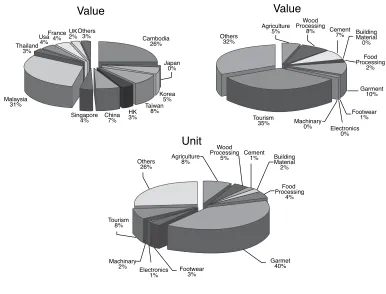
Of the cumulative FDI (Foreign Direct Investment) approved in this period, the largest share was from Malaysia (31 %), which in the early years was the source of extensive investment in the field of resource development, including rubber, and tourism. Malaysia is followed by Singapore at 26 %. The other major sources are Taiwan, South Korea, Hong Kong, and China, whose investment comes mainly from garment industry companies.
As for the composition by industrial sub-sector, investment in the service sector accounts for more than 60 % of the cumulative total owing to extensive investment in the tourism industry in the initial days. Investment in the manufacturing sector accounts for about 35 %, of which 10 % is of the garment industry. Although investment in the garment industry during the period is by no means large on a monetary basis, the more than 400 investments in the industry account for more than 40 % of the total number of investment projects.
C D C - a p p r o v e d I n v e s t m e n t T r e n d b y C o u n t r y i n C a m b o d i a
C D C - a p p r o v e d I n v e s t m e n t T r e n d b y I n d u s t r y i n C a m b o d i a
Source: CDC (he Council for Development of Cambodia)
A c c u m u l a t i o n o f C D C - a p p r o v e d I n v e s t m e n t b y C o u n t r y a n d b y I n d u s t r y i n C a m b o d i a ( 1 9 9 5 ~ 2 0 0 4 )
Thailand 3% Value Value Unit Usa 4% France 4% UK
2%Others3% Cambodia 26% Others 32% Agriculture 5% Wood Processing
8% Cement7% Building Material 0% Food Processing 2% Garment 10% Footwear 1% Electronics 0% Machinary 0% Tourism 35% Others 26% Wood Processing
5% Cement1% Building Material 2% Food Processing 4% Garmet 40% Footwear 3% Electronics 1% Machinary 2% Tourism 8% Agriculture 8% Japan 0% Korea 5% Taiwan 8% HK 3% China 7% Singapore 4% Malaysia 31%
E c o n o m i c I n d i c a t o r s a n d P o l i c i e s
1 . G r o s s D o m e s t i c P r o d u c t G D P T o t a l
GDP has shown continuous growth in recent years, with real growth rates of 7.7% in 2001, 6.2% in 2002, 8.6% in 2003, 10.0% in 2004 and 13.4% in 2005 and 9% in 2006. The nominal GDP was 25,350 billion Riels (approximately 6.2 billion US Dollars) in 2005 compared with 21,141 billion Riels in the previous year. These figures, however, should be interpreted with caution in view of the statistical issues involved in the revision of GDP estimates. If adjusted for statistical changes introduced in 2005, the real GDP growth for 2005 was 9.8%, compared with the earlier reported real GDP growth of 7.1% in 2003 and 7.7% in 2004 (calculated as the rate of US$1=4000 Riel).
Per capita GDP in dollar terms has steadily increased since 1998 when the Riel greatly depreciated against the dollar. Per capita GDP in 2005 was 395 US dollars, an increase of 11% from 356 US dollars in 2004, and Per capita GDP in 2006 was 513US increased 13% compared with 2005.
G D P b y E x p e n d i t u r e s
consumption has been maintained over the years. In 2005, private consumption growth accounted for 10.6 of the 13.4 points in the GDP growth rate.
Exports are another main contributor to GDP, as their share in total GDP incrementally grew to 70.9% in 2005. However, net exports (exports less imports) have always been negative because imports have continuously exceeded exports. Gross fixed capital formation maintained strong growth, increasing its share of total GDP from 16.9% in 2000 to 20.78% in 2005 and contributing much to GDP growth.
G D P b y E x p e n d i t u r e s , S h a r e a n d C o n t r i b u t i o n ( A t C o n s t a n t 2 0 0 0 P r i c e s )
The services sector has had a relatively stable share, between 36% and 38%, in the recent years. The services sector grew by 12.1% in 2005, accounting for 36.2% of total GDP in constant 2000 prices. Tourism continues to be the main contributor to growth in the services sector, with revenue from overseas tourists increasing by 20% in 2006. Hotels, restaurants and other services directly benefit from tourism growth and infrastructure development.
The number of tourists visiting Cambodia reached 1.7 million in 2006. Tourism contributed to strong growth in the hotel and restaurant industry (17.3%), transport and communications (13.1%) and other services (17.7%). Tourism has forward and backward linkages with the service sector in general. Thus the beneficiaries will not be just travel, hotel, restaurant and tourist establishments, but also enterprises engaged in retail trade, transportation, communications and finance.
C o m p o s i t i o n o f G D P b y I n d u s t r y
Source: Ministry of Economy and Finance (MEF)
P o l i c i e s T o w a r d s F o r e i g n D i r e c t I n v e s t m e n t ( F D I )
In the Second Socio-Economic Development Plan 2001-2005, the Cambodian government regards foreign direct investment (FDI) as a major engine for economic development. From the viewpoint of the legal framework in Cambodia, laws and regulations governing FDI in Cambodia are basically designed to encourage investments. As the Law on Investment stipulates, FDIs are treated in a non-discriminatory manner except for land-ownership and allowed to invest freely in many areas. Under the current Law on Investment, the investors, who are given Final Registration Certificates, will be entitled to various incentives.
In addition, the Cambodian government has been improving their investment facilitation services. For example, the Government decided in 2005 to establish the Cambodian Special Economic Zone Board (The CSEZB) under the Council for the Development of Cambodia (CDC) to promote the special economic zone (SEZ) scheme in Cambodia. Administered by the CSEZB, the Special Economic Zone Administration is to be established in authorized SEZs and provide one-stop service to zone investors from the registration of investment projects to routine export-import approvals.
G o v e r n m e n t A t t i t u d e s
International assistance remains a vital component in overcoming the challenges faced in Cambodia’s development. Nonetheless, private sector investment will become increasingly important for the country as the private sector assumes its position as the main engine for economic growth in Cambodia. To this end, the Royal Government of Cambodia sees private sector investment as integral to development of fully democratic and prosperous Cambodia in the years ahead.
The government is fully aware that if the country is to achieve its development goals, it cannot rely on foreign aid and assistance indefinitely, and that real economic growth and development lie in the private sector. Consequently, a program of reform is now being undertaken by the government in order to create a conductive environment for private sector investment. In 1994, the Law on Investment of the Kingdom of Cambodia was passed with the aim of streamlining the foreign investment regime and providing generous and competitive concessions for direct private sector investment.
F o r e i g n I n v e s t m e n t P o l i c y
The government provides investors with a guarantee neither to nationalize foreign-owned assets, nor to establish price controls on goods produces and services rendered by investors, and to grant them the right to freely repatriate capital, interest and other financial obligations.
Investors can set up 100% foreign-owned investment projects and employ skill workers from overseas, in cases where these workers cannot be found in the domestic labor force.
In order to facilitate investors in their applications for investment approval, the government has established an institution to oversee investment policy and strategy called the Council for the Development of Cambodia (CDC).
Cambodia has obtained “Generalized System of Preferences (GSP)” and “Most Favored Nation (MFN)” status from its major trading partners, including the European Union, the USA, Japan, Canada and Australia.
Apart from facilitation and support at the national level, attention is also being given by the government to opening up access to international sources of finance for private sector investment. Cambodia is already a member of the IFC, MIGA, and ICSID (International Centre for Settlement of Investment Disputes). It has also signed agreements with the ADB providing private sector investors with the opportunity to obtain funding for their investment projects from this international financing institution.
T o u r i s m I n v e s t m e n t P o l i c y
• Develop a sound tourism investment policy and poverty reduction policy
• Encourage investment in tourism businesses that support the National Social Economic Development Plan, which emphasized on the development of high quality business.
• Encourage investment by local communities in various forms of tourism management through the use of low interest loans.
• Encourage private business organization of pro poor tourism development. • Promote investment in producing essential goods, supplies and equipment to
support tourism activities and services in order to help reduce imports.
• Support investment in the production of reasonable priced international standards good, appliances and equipment for use tourism entrepreneurs. P r o P o o r T o u r i s m I n v e s t m e n t P o l i c y
Investment policies for tourism development are encouraged and support in areas: • With high poverty levels and existing or potential tourism.
• Seeking to encourage tourism for rural development and cross economic linkages.
• Where tourism can contribute to the local economic growth.
• Where environmentally friendly forms of tourism can contribute to cultural and natural resource preservation conservation and sustainable use.
R e g u l a t o r y F r a m e w o r k f o r I n v e s t m e n t
In Cambodia, the FDI is free to implement, except in those areas prohibited or restricted for foreigners. It has to only be registered at the Ministry of Commerce and obtain relevant operating permits. However, if the foreign investors seek investment incentives, they have to apply for the investment registration which can be obtained through the CDC or the Provincial-Municipal Investment Sub-Committee (PMIS). The application for the investment registration can be made either before or after the incorporation (or a registration within the Ministry of Commerce).
The investment license scheme was originally regulated by the “Law on Investment”, which was promulgated in August 1994. In March 2003, in order to make the licensing schemes to be simpler and more transparent, predictable, automatic and non-discretional, the original Law on Investment was amended substantially by the “Law on the Amendment to the Law on Investment”.
In addition, the “Sub-Decree on the Establishment of the Sub-Committee on Investment of the Provinces-Municipalities of the Kingdom of Cambodia” was issued in February 2005 to regulate the licensing scheme for investment less than two million US Dollars. The “Sub-Decree No. 111 on the Implementation of the Law on the Amendment to the Law on Investment” was also issued in September 2005. (For more information, contact CDC).
L a b o r P o l i c i e s
Cambodia’s low labor costs are attractive to foreign investors. About 45% of Cambodia’s population of 12 million is of working age, while over 60% of the workforce comprises women.
Investors are permitted to bring into Cambodia foreign nationals who are qualified managerial personnel, technical personnel, and skilled workers.
A law on Immigration was passed by the National Assembly on 26 August 1994. According to article 28 of the Law, foreigners who have already received a “letter of investment approval” from the CDC, will be allowed to stay in Cambodia, together with their families, for a period stated in the letters of investment approval.
G o v e r n m e n t / p u b l i c I n v e s t o r s R e l a t e d
t o T o u r i s m I n f r a s t r u c t u r e P r o j e c t
1 . R e s p o n s i b l e O r g a n i z a t i o n
The CDC is the sole and One-Stop Service organization responsible for the rehabilitation, development and oversight of investment activities. The CDC is responsible for the evaluation and the decision-making on all rehabilitation, development and investment project activities (Article 3, the Law on Investment).
However, the CDC shall submit for the approval of the Council of Ministers any of the following investment projects involving the following (Article 11, “Sub-Decree No.147 on the Organization and Functioning of the Council for the Development of Cambodia”).
• Capital investment of US$ 50 million and above • Politically sensitive issues
• Exploration and the exploitation of mineral and natural resources • Possible negative impact on the environment
• Long-term development strategy
• Infrastructure projects such as projects on the basis of Build-Own-Transfer (BOT), Build-Own-Operate-Transfer (BOOT), Build-Own-Operate (BOO) or Build-Lease-Transfer (BLT)
2 . I n v e s t m e n t P r o m o t i o n a n d I n c e n t i v e s
The Law on Investment provides the following incentives to investment projects in Cambodia:
• A corporate income tax of 9% except for the exploration and exploitation of natural resources, including timber, oil and gas, gold, and precious stones. • A corporate tax exemption of up eight years is depending on the characteristic of
the project and the priorities of the government. • Losses carried forward for up to five years.
• Non-taxation on the distribution of dividends, profits or proceeds of investments, whether transferred abroad or distributed within the country.
• 100% import duty exemption on construction materials, means of production, equipment, intermediate goods, raw materials and spare parts used by:
n An export-oriented project with a minimum of 80% of the production set
apart for export,
n Projects located in the designated Special Promotion Zone (SPZ)
• 100% exemption of export tax, if any
3 . I n v e s t m e n t G u a r a n t e e s
The Law on Investment guarantees the investment as follows:
• A foreign investor shall not be treated in any discriminatory way by reason only of the investor being a foreign investor, except in respect of ownership of land. • The Royal Government shall not undertake a nationalization policy that would
adversely affect private properties of investors in Cambodia.
• The Royal Government shall not fix the price or fee of the products or services of a Qualified Investment Project.
• The Cambodian Government shall permit investors to purchase foreign currencies through the banking system and to remit abroad these currencies for the following purposes:
n Payment for imports and repayment of principle and interest on international
loans.
n Payment of royalties and management fees n Remittance of profits
n Repatriation of invested capital
The Law on Investment contains a number of important guarantees for investors, as follows:
• Equal treatment of all investors.
• No nationalization adversely affecting the property of investors. • No price controls on foreign currencies abroad
4 . O u t l i n e o f I n v e s t m e n t L i c e n s i n g S c h e m e
• “The Law on the Amendment to the Law on Investment” of 2003 was made to adopt the automatic approval system of the investment projects, which must be completed within 31 working days after the receipt by the CDC or PMIS of the investment application, unless they are among the fields prohibited in the negative list or investment project related to the national interest/ environmental sensitivity.
• An investment license or approval will be issued not to an investor or investing enterprise but to a project. A project which receives the investment license is called a Qualified Investment Project (or “QIP”).
• The Law governs all Qualified Investment Projects (or “QIPs”) and defines the procedures by which any person establishes a QIP.
• The investment incentives are granted automatically.
• The CDC is expected to act as One-Stop Shop and obtain all of necessary licenses required from relevant ministries entities listed in the conditional registration certificate for investment on behalf of the investment applicant.
5 . I n v e s t m e n t L i c e n s i n g P r o c e d u r e s
The investment license application process until obtaining a Final Registration Certificate (FRC) is shown in Table IV-3 below (Article 7, the Law on Investment).
Party to Take Action
Applicant
The CDC or PMIS
The CDC or PMIS
The CDC or PMIS
Process
Submission of an Investment Proposal to
the CDC or PMIS
1) Issuance of “Conditional
Registration Certificate” (CRC)
- if the Investment Proposal
contains all the information
required, and
- if the proposed activity is not in
the Negative List or not related to
national interest/ environmental
sensitivity
2) Issuance of “Letter of
Non-Compliance”
- If the Investment Proposal does
not satisfy the above condition
If a CRC or Letter of Non-Compliance
is not issued within 3 working days, the
CRC shall be considered automatically
approved.
Obtains all of the licenses from relevant
ministries-entities listed in the CRC on
behalf of the Applicant.
Issuance of a “Final Registration
Certificate” (FRC)
Condition/ Remarks
Use a completed Application Form*
Payment of Application Fee of 7,000,000
Riels
To be Issued within 3 working days after
submission of the Investment Proposal
The CRC specifies the approvals,
authorizations, clearances, licenses,
permits or registrations required for the
QIP to operate, as well as the government
entities responsible to issue such
approvals, etc.
The CRC confirms the incentives to which
the QIP is entitled and recognize the
statutes of the legal entity.
Letter of Non-Compliance shall clearly
state the reasons why the Investment
Proposal was not acceptable and the
additional information required for enabling
the CDC or PMIS to issue a CRC.
All government entities responsible for
issuing an authorization, clearance,
license, permit or registration listed on
the CRC shall issue those no later than
the 28th working day from the date of the
CRC.
To be issued within 28 working days of the
issuance of the CRC.
The date of issuance of the FRC shall be
6 . A p p l i c a t i o n P r o c e s s f o r I n v e s t m e n t L i c e n s e T r a n s p a r e n c y
Sectors in which investment is strongly encouraged: • Pioneer and/ or high-technology industries • Job creation
• Export-oriented industries • Tourism industry
• Agro-industry and processing industry • Infrastructure and energy
• Provincial and rural development • Environmental protection, and
• Investment in the Special Promotion Zone (SPZ)
According to Sub-Decree No. 053 ANKR BK, 11 June 1999, Investment capital should be excess of US$1,000,000 for any domestic or foreign investment project.
Investment sectors in which special incentives do not apply include the exploitation of natural resources, with the exception of oil and natural gas exploration. All fuels, lubricants and other petroleum-based products used as raw materials or intermediate goods are not eligible for exemptions from import duties.
7 . N a t i o n a l T r e a t m e n t
Following sectors are subject to local equity participation: Gemstones, clay bricks both hollow and solid, tiles, rice milling, wood and stone carving, and silk-wear.
There is no limitation on foreign firms’ access to sources of finance on the basis of their nationality.
8 . T a x a t i o n
Most foreign investment and foreign investors will be affected by the following taxes:
• Tax on Profit • Minimum Tax
• Various withholding taxes (e.g. Tax on profit withholding obligations) • Value Added Tax
• Turnover Tax • Import Duties
• Salary Tax on Cambodian and expatriate employees
There are various other taxes affecting certain categories of investor including: • Specific Tax on Certain Merchandise and Services
Tax
Profit Tax (Article 1 – 23, Chapter 1)
• For legal person
• Oil and natural gas production sharing contract and the exploitation
of natural resource including timber, ore, gold, and precious stones.
Minimum Tax (Article 24, Chapter 1)
• To be applied only for the real regime
• If the profit tax amount exceeds 1% of annual turnover, the
taxpayer pays only the tax on profit.
Withholding Tax (Article 25 – 28, Chapter 1)
• Income received by individuals for services such as management,
consulting, etc.
• Payment of royalties for intangibles and interests in mineral
resources
• Payment of interest by a resident taxpayer carrying on business,
other than domestic banks or financial institutions
• Income from the rental of movable or immovable property
• Interest payment by domestic banks to residents with fixed term
deposit account
• Interest payment by domestic banks to residents with non-fixed
term deposit account
• Payment to non-residents : Interest, royalties, rent and other
income connected with the use of property, dividends, payment for
management or technical services
Tax on Salary (Article 40 – 54, Chapter 2)
To be withheld monthly by employers
• 0 Riels – 500,000 Riels (Approx. USD 125 or less)
• 500,001 Riels – 1,250,000 Riels (Over 125 - 312.5)
• 1,250,001 Riels – 8,500,000 Riels (Over 312.5 - 2,215)
• 8,500,001 Riels – 12,500,000 Riels (2,215 - 3,125)
• Over 12,500,000 Riels (Over 3,125)
• For fringe benefits
• Non-residents
Rates
20% (unless investment incentive
rate of 9% or 0% are applied)
30%
1% of annual turnover
15%
10%
6%
4%
14%
0%
5%
10%
15%
20%
20% on market value
Tax
Value Added Tax (Article 55 – 84, Chapter 3)
• Taxable person: Any person subject to the real regime system
• Registration: All companies must complete registration for VAT before
commencing business. Others must register within 30 days after their
taxable turnover for the preceding consecutive three months exceeds;
- 125 million Riel for goods
- 60 million Riel for services
• Taxable supply:
- Supply of goods or services by a taxable person in Cambodia
- Appropriation of goods for his own use by a taxable person
- Making of a gift or supply at below cost of goods or services
- Import of goods into Cambodia
• Standard tax rate
• Tax rate for the goods exported from Cambodia and services executed
outside of Cambodia
• Input tax credit is deductible against the output tax amount.
• Monthly filing: The VAT declaration must be submitted on or before the
20th day of the following month.
Other taxes (Article 85, Chapter 4)
Specific Tax on Certain Merchandise and Services
• Tickets for local and international air transportation
• Local and international telecommunication
• Beverage
• Tobacco, entertainment, large automobile, motorcycles from 125 cc
upwards
• Petroleum products, automobile more than 2,000 cc
Property Transfer Tax
For the transference of ownership of real property and certain types of vehicles
as a result of direct transfer or a contribution of share capital to an enterprise
• Prohibited to issue certificates of ownership of property until the
Property Transfer Tax has been paid.
Tax on Unused Land
• Committee for Evaluation of Undeveloped Land, in cooperation with
municipal and provincial authorities, decides whether a plot is “unused”
or not and the amount of tax liability.
• Taxable for the portion over 1,200 square meters.
Patent Tax
• For annual business registration
Tax on House and Land Rent
Import Duty
Export Duty
Rates
10%
0%
10%
3%
20%
10%
30%
4% on transfer value
2% on the assessed value of
unused land
Approx.
USD300-10% of the relevant rental fees
Varies
(4 bands – 0, 7, 15 and 35%)
R e l e v a n t A g e n c i e s
The Council for Development of Cambodia - Cambodian Investment Board (CIB) Government Palace, Sisowath Quay, Wat Phnom, Phnom Penh, Cambodia Tel : (855) 23 981 154 Fax : (855) 23 428 426 E-mail : [email protected]
Website : www.cambodiainvestment.gov.kh
Cambodian Special Economic Zones Board (CSEZB)
Room 7-8 C, Government Palace, Sisowath Quay,
Wat Phnom, Phnom Penh, Cambodia Tel : (855) 23 992 355 Fax : (855) 23 992 355 E-mail : [email protected]
Ministry of Commerce No. 20A-B Norodom Blvd. Phnom Penh, Cambodia Tel : (855) 23 426 024 Fax : (855) 23 426 024
E-mail : [email protected]
(ASEAN and International Org. Dept)
[email protected] (Internal Trade Dept.)
[email protected] (Camcontrol Dept.)
Ministry of Economy and Finance No.60, Street 92, Khan Daun Penh Phnom Penh, Cambodia
Tel : (855) 23 428 960/428 634 /428 635
Fax : (855) 23 427 798 Website : www.mef.gov.kh
Customs and Excise Department No. 6-8 Norodom Blvd.,
Phnom Penh, Cambodia Tel : (855) 23 214 065 Fax : (855) 23 214 065 E-mail : [email protected] Website : www.customs.gov.kh
Ministry of Tourism No.3 Monivong Blvd., Phnom Penh, Cambodia
Tel : (855) 23 212 837 / 213 741 Fax : (855) 23 217 503 / 220 704 E-mail : [email protected]
Website : www.mot.gov.kh
O t h e r P u b l i c I n s t i t u t i o n s Municipality of Phnom Penh
No. 69, Monivong Blvd., Phnom Penh, Cambodia
Tel : (855) 23 722 054/426 101 Fax : (855) 23 724 156
C o u n t r y I n f o r m a t i o n
1 . G e o g r a p h i c a l a s p e c t s a n d B a c k g r o u n d I n f o r m a t i o n
The Republic of Indonesia is the largest archipelago country in the world and the largest country in ASEAN, comprising 17.508 islands stretching along 5.120 Kilometers from east to west and 1.760 Kilometers from north to south. The islands scatter over more than one tenth of the equator between Southeast Asia and Australia, covering a land area of round 2 million square kilometers and territorial waters nearly four times of that size. There are about 400 mountains, most of which are volcanoes, either active or inactive ones, forming mountain ranges along the array of islands on the southern archipelago.
Kalimantan is the only island where volcano does not exist. Instead is has a dense tropical rainforest naturally develop on the middle range and peat swamp ecosystems on the Lowlands. The highest summit of the archipelago is Mount Jayawijaya, it is about 5.000 m above sea level, where the only snow in Indonesia can be found there. With such a diverse landscape, the country is endowed with tourism assets with strong developmental potential. Indonesia is the fourth most populous nation in the world with a total population of about 222 million in 2005. The most heavily populated island is Java with an average of 870 inhabitants per square kilometer.
The population consists of more than 300 ethnic groups speaking different language and dialects. The national language is Bahasa Indonesia, while English are widely used for business purpose and on the Tourism industry.
2 . T o u r i s m R e l a t e d I n f r a s t r u c t u r e T r a n s p o r t a t i o n S y s t e m
A i r l i n e a n d A i r p o r t s
The domestic airline industry in Indonesia is growing rapidly, particularly the budget airlines. Their tickets are inexpensive and they also have as many flight routes as the national carries. Due to the recent airline accidents, domestic airlines have begun implementing stricter safety regulations deemed mandatory by the government.
The high growth of domestic airlines can be seen by the number of passengers that increased more than 300% since 2001. This enabled the domestic airlines to introduce new aircrafts to their fleet, and even buying the latest version in substantial numbers; thus increasing seat capacity and safety for the passengers. Below are airlines providers in Indonesia:
8. Deraya Air Taxi 9. GT Air
10. Garuda Indonesia 11. Dirgantara Air Service 12. Indonesia Air Transport 13. Indonesia AirAsia 14. Kalimantan Air Services 1. Air Regional
2. Airfast Indonesia 3. Airmark Indonesia 4. Auvia Air
T h e I n t e r n a t i o n a l A i r p o r t L i s t i n I n d o n e s i a :
LOCATION
Bandung, West Java
Cengkareng, Banten/Jakarta
Jakarta
Surabaya, East Java
Surakarta (Solo), Central Java
Banda Aceh
Batam, Riau Islands
Medan, North Sumatra
Palembang, South Sumatra
Pekanbaru, Riau
Balikpapan, East Kalimantan
Banjarmasin, South Kalimantan
Pontianak, West Kalimantan
Manado, North Sulawesi
Denpasar, Bali
Kupang, East Nusa Tenggara
Ambon, Maluku
Biak, Papua
Semarang, Central Java
Jogja
Makassar
NAME OF AIRPORT
Husein Sastranegara International Airport
Soekarno-Hatta International Airport
Halim Perdanakusuma International Airport
Juanda International Airport
Adisumarmo International Airport
Sultan Iskandar Muda International Airport
Hang Nadim Airport
Polonia International Airport
Sultan Mahmud Badaruddin II Airport
Sultan Syarif Kasim II Airport
Sepinggan International Airport
Syamsuddin Noor Airport
Supadio Airport
Sam Ratulangi Airport
Ngurah Rai Airport
El Tari Airport
Pattimura Airport
Frans Kaisiepo Airport
Achmad Yani Airport
Adisucipto Airport
Hasanuddin Airport
N u m b e r o f A i r l i n e P a s s e n g e r i n I n d o n e s i a 15. Kartika Airlines
16. Lion Air
17. Mandala Airlines 18. Manunggal Air Services
19. Merpati Nusantara Airlines 20. Nurman Avia
21. Papua Indonesia Air System
S e a P o r t s
Ferry lines in Indonesia are supported by 168 ships and 7 water trucks, of which 91 were owned by the private sectors and the rest owned by the state-run company. The number of harbors being called fell to 277 locations with a frequency of 23 times.
PELNI as the biggest passenger ship company in Indonesia has various route across major ports in Indonesian provinces. Its fleets has modern passenger ships consisted of 20 German built passenger ship.
T h e I n t e r n a t i o n a l S e a p o r t L i s t i n I n d o n e s i a :
LOCATION
Batam
Tj Uban
Tj Pinang
Medan
Sibolga
Dumai
Padang
Jakarta
Bali
Jayapura
Bitung
Karimun
Semarang
Kupang
Pare
Makasar
Nusa Tenggara Timur
NAME OF SEAPORT
Sekupang, batu Ampar, Nongsa, Marina Teluk Senimba, Batam Centre
Bandar Bintan Telani, Bandar Sri Udana Lobam
Sri Bintan Pura
Belawan
Sibolga
Yos Sudarso
Teluk Bayur
Tanjung Priok
Padang Bai, Benoa
Jayapura
Bitung
Tanjung Balai
Tanjung Mas
Tenau
Pare
Soekarno Hatta
Maumere
R a i l w a y
Railway in Indonesia is operated by PT Kereta Api Indonesia (KAI). It is the sole operator of public railways in the country. The railway lines cover most of Java and parts of Sumatra. The total number of trackage laid in Indonesia is 7,583 km
All locomotives of the PT KAI are dieses engined. Most new locomotives use electric transmission. A total of 451 locomotives are in the books.
R o a d s
L e n g t h o f R o a d s b y T y p e o f S u r f a c e ( K m ) 2 0 0 4 : TYPE OF SURFACE
Asphalted
Non asphalted
Others
Total
KM
206.144
139.630
27.155
372.929
Source: Transportation and Communication Statistic 2005 (BPS)
I n v e s t m e n t C l i m a t e
1 . F o r e i g n I n v e s t m e n t P o l i c y
The Government has opened widely most investment sectors for the foreign as well as the domestic investors, and it will add more investment sectors to be promoted as open sectors including tourism sector.
These investment sectors are stipulated in the Investment Negative List.
2 . R e g u l a t i o n f o r F o r e i g n I n v e s t m e n t
Foreign Investment law No. 25 Year 2007 is an umbrella for the foreign and domestic investment in Indonesia. Foreign investment must be incorporated under Indonesian Corporate Law No. 40 Year 2007 as a Perseroan Terbatas (PT) which is a limited liability company. And the domicile of the company should be in Indonesia unless provided otherwise by the law. The life of company is 30 years and can be extended for another 30 years. The life of Permanent License/ Izin Usaha Tetap (IUT) is unlimited as long as the company in operation and for the old IUT, the renewal is also for unlimited years.
The Investment Coordinating Board (BKPM) is the Government Agency that is responsible for the investment policy and investment approval. Every investor must review and comprehend the Government Regulation (Peraturan Presiden) No.76, No. 77 of 2007 and No. 111 of 2008 on Investment that are open, or open with certain conditions or closed for investment.
BKPM supports any effort to improve Indonesia’s competitiveness in the region including to simplify and to shorten investment license procedures. BKPM has confirmed its strategy to shorten the investment approval to 10 working days.
There are two criteria for foreign investment in tourism industry:
• Hotel (3 Star-5 Star), • Tourism area, • Tour Operator, • Resort,
• Tourism Information Business, • Golf Course,
• International Hotel Operator, • MICE Project
b. Closed and Open category with some condition (Tertutup Dan Terbuka Dengan Syarat).
Maximum foreign equity is 50%. The balance of equity will be reserve for local investor. It includes:
• Hotel (1 star-2 star), Melati, Motel, Home Stay, • Food and Beverages Business;
• Theme Parks, recreational camps, spa, etc. 3 . F o r e i g n I n v e s t m e n t L e v e l
Compared growth of foreign investment in tourism industry in 2007 with the same period (January-December) in 2006, it has increased by 37.84 % in 2007 from 74 projects in 2006 to 102 projects in 2007.
4 . G o v e r n m e n t - t o - g o v e r n m e n t A g r e e m e n t s R e l e v a n t t o T o u r i s m
Indonesia is a member of the following international / regional initiatives in tourism:
• World Tourism Organization (WTO)
• Brunei-Indonesia-Malaysia-Phillipines East ASEAN Growth Area (BIMP-EAGA)
• Indonesia-Malaysia-Thailand Growth Triangle (IMT-GT) • Indonesia-Malaysia-Singapore Growth Triangle (IMS-GT)
BKPM’s source
FOREIGN INVESTMENT TOURISM PROJECT, 2006-2007
2006 2007
US$ Million 268.3 354.8
F o r e i g n I n v e s t m e n t T r e n d s
5 . P o t e n t i a l L o c a t i o n s f o r T o u r i s m R e l a t e d I n v e s t m e n t The Investment Coordinating Board which foreign investment stated in Indonesia needs USD 426.3 Billion of new investment until 2009, Including USD 150 billion for infrastructure development. Foreign Investments in tourism industry are welcome to invest in infrastructure projects such as hotel and restaurant, recreational and entertainment service and a host of other services.
T o u r i s m i n v e s t m e n t p r o j e c t s w h i c h a v a i l a b l e i n s e v e r a l p r o v i n c e s a r e :
NO. PROVINCE
1. West Sumatra
2. Riau Islands
3. Lampung
4. Jakarta
5. West Java
6. Central Java
7. Yogyakarta
8. East Java
9. Bali
OPPORTUNITIES
Upper lake, Lower lake, Agro city of Solok Regency, sea tourism, cottage in Mentawai
island regency, Air Manis plain, coast and tourism area of Padang City
Beach, Lake, amusement center, shopping center, golf, hotel
Eco tourism, Agrotourism, resorts, tourism facilities, villas, homestays.
Thousand Island, tourism project
Cottages, guest house, camping ground, spa, outbound facilities, improvement for
existing tourism facilities, restaurant, convention hall.
Park of World Wonders, Taman Kartini restoration project, Batik center in Laweyan,
recreation park, Marine Tourism, Eco-tourism, antique train tour, resorts, MICE facilities,
surfing facilities, golf course.
Turi Agro tourism, Tambak Boyo Water Park
Accommodation and transportation
Marine Tourism, Hotels, Amusement/ Recreational park, Agro tourism, Forest Tourism,
Rafting, horse’s recreation
NO. PROVINCE
10. South Kalimantan
11. East Nusa Tenggara
12. West Nusa Tenggara
13. North Sulawesi
14. South Sulawesi
15. Papua
OPPORTUNITIES
Resort, recreational business.
Nautical tourism, coastal tourism, eco-tourism, cultural tourism
Hotel, transportation
Agro Tourism, Marine Tourism
Infrastructure, Marine Tourism
Cultural tourism, sea tourism transport, Agriness national ocean park, marine tourism
6 . M a i n T o u r i s m A r e a s
West Sumatra
TOP 5 Tourism Destinations: 1. Anai Valley Water fall
2. Lembah Harau National Park 3. Maninjau Lake
4. Siberut and Mentawai Island 5. Sianok Valley
Other Destinations:
1. Aditya Warman Museum 2. Alamanda Hot Spring 3. Air manis Beach 4. Batu Sangkar 5. Bungus Beach 6. Fort de Kock fortress 7. Padang Panjang 8. Pandai Sikek village 9. Solok
10. Teluk Bayur
Riau Island
TOP 5 Destination: 1. Lagoi
(Bintan Beach International Resort) 2. Tanjung Pinang
3. Nagoya 4. Nongsa 5. Tanjung Balai
Other Destinations: 1. Trikora Beach 2. Pasir Panjang Beach 3. Lubuk Karimun Beach 4. Senggarang Temple
5. Raja Haji Fii Sabilillah Monument 6. Pangkil Besar Beach
7. Sebong Bay 8. Penyengat Island 9. Karimun Island 10. Natuna Island
Lampung
TOP 5 destinations:
1. Way Kambas National Park
2. South Bukit Barisan National Park 3. Ranau Lake
4. Mount Krakatau 5. Pasir Putih Beach
Other Destination:
1. Merak Belatung Beach 2. Olden Times site in Jabung 3. Way Rarem Dam
4. Kalianda Resort 5. Marina Beach 6. Laguna Helau 7. Canti Village
8. Curup Selampang Waterfall 9. Curup Tujuh Waterfall 10. Tirta Gangga Lake
Jakarta
TOP 5 Destinations:
1. National Monument (Monas) 2. Seribu Island
3. Dunia Fantasi Theme Park 4. Sunda Kelapa Port
5. National Museum
Other Destinations: 1. Jakarta Kota old city 2. Jakarta History Museum 3. Wayang Museum
4. Fatahillah Temple 5. Maritime Museum 6. Glodok
7. Banteng Square
8. Satriamandala Museum 9. Taman Mini Indonesia Indah 10. Ismail Marzuki Park
West Java
TOP 5 Destinations:
1. Mount Tangkuban Perahu 2. Pangandaran
3. Puncak
4. Kampung Naga 5. Cipanas
Other Destinations:
1. Keraton Cirebon Palace 2. Cangkuang Temple 3. Ciater hot spring 4. Ratu Port
5. Mount Papandayan 6. Mount Gede Pangrango 7. Bogor Palace
8. Bogor Botanical Garden 9. Lembang
10. Batu Hiu Beach
Central Java
TOP 5 Destinations: 1. Borobudur Temple 2. Prambanan Tempe 3. Karimun Jawa Island 4. Dieng Pletau
5. Keraton Palace
Other Destinations: 1. Jatijajar Cave
2. Karangbolong Beach 3. Demak Mosque 4. Ketep
5. Teluk Penyu Beach 6. Mendut Temple 7. Kudus Mosque Tower 8. Kopeng
9. Train Museum 10. Sangiran Museum
Yogyakarta
TOP 5 Destinations: 1. Keraton Palace 2. Mount Merapi 3. Malioboro Street 4. Parangtritis Beach 5. Kaliurang
Other Destination: 1. Kota Gede Old City 2. Parangkusumo Beach 3. Baron Beach
4. Jogja Kembali Monumen 5. Beringharjo Market 6. Vredeburg Fortress 7. Great Mosque 8. Paku Alaman Palace 9. Ulen Sentalu Museum 10. Gembira Loka Zoo
East Java
TOP 5 Destinations: 1. Mount Bromo 2. Malang
3. Baluran National Park 4. Alas Purwo National Park 5. Meru Betiri National Park
Other Destinations: 1. Jago Temple 2. Trowulan Temple 3. Sunan Giri Grave
4. Jelesveva Jayamahe Museum 5. Surabaya Zoo
6. Ampel Mosque 7. Madura Island 8. Singosari Temple 9. Selekta
10. Surabaya old city
Bali
TOP 5 Destinations: 1. Kuta Beach 2. Sanur Beach 3. Nusa Dua 4. Besakih Temple
Other Destinations: 1. Tanjung Benoa 2. Seminyak
3. Uluwatu Temple 4. Bedugul
5. Jimbaran Beach
6. West Bali National Park 7. Mount Agung
8. Lovina Beach 9. Batur Lake 10. Nusa Penida
West Nusa Tenggara TOP 5 Destinations: 1. Mount Rinjani 2. Segara Anak Lake 3. Sengigi Beach 4. Gili Island 5. Moyo Island
Other Destinations: 1. Gili Meno 2. Gili Air 3. Gili Trawangan 4. Segara Muncar 5. Sade Village 6. Narmada Park 7. Sasak Village 8. Desa Selong Beach 9. Praya
10. Maru Betiri Village
East Nusa Tenggara TOP 5 Destinations: 1. Kelimutu Lake
2. Komodo National Park 3. Lembata Island
4. Lamalera Village 5. Ende
Other Destinations:
1. Jopu/ Tenda Traditional Village 2. Riung Sea Park
3. Bena Megalith Village 4. Flores Sao Resort 5. Adegai-Alor Beach 6. Mount Egon 7. Babi Island
8. St Joseph Cathedral in Maumere 9. Alor Island
10. Paga Beach
South Kalimantan TOP 5 Destinations: 1. Banjarmasin 2. Martapura 3. Kota Baru 4. Floating Market 5. Loksado
Other Destination: 1. Riam Kanan Lake
2. Sabilal Muhtadin Mosque 3. Kenanga Village
4. Palaihari Nature Conservation 5. Prince Suriansyah grave 6. Barito River
7. Mount Kapur 8. Martapura River 9. Amuntai
10. Kandangan
South Sulawesi TOP 5 Destinations: 1. Tana Toraja 2. Selayar Island 3. Losari Island 4. Kayangan Island 5. Bantimurung
Other Destinations:
1. Balla Lompoa Museum (Sultan Gowa Palace) 2. Fort Rotterdam fortress 3. Kuri Island
4. Bira Beach
5. Taka Bone Rate Island 6. Tempe Lake
7. Toddjo Village Argo Tourism 8. Pattunuang Cave
9. Mandala Monument 10. Batara Guru Museum
(Royal Luwu Palace)
Other Destinations: 1. Bantenan Beach 2. Tomohon
3. Bogani Nani Wartabone National Park
4. Tangkoko National Park 5. Sangihe and Talaud Island 6. Mount Lokon
7. Lanu Lake 8. Rurukan Village 9. Amurang Bay
10. Sawangan Archeology site
Papua
TOP 5 Destinations: 1. Sentani Lake
2. Lorentz National Park 3. Mount Cartenz 4. Baliem Valley 5. Tanjung Ria Beach
Other Destinations: 1. Lorentz National Park
2. Cendrawasih Bay National Park 3. Wusar National Park
4. Mariadei Beach 5. Kaimana
6. Mc Arthur Monument 7. Mount Jaya Wijaya 8. Casuarina Beach 9. Aihima (Aihima bridge) 10. Asmat ethnic Village
E c o n o m i c I n d i c a t o r s a n d P o l i c i e s
1 . S t a t i s t i c a l I n f o r m a t i o n
T o u r i s t A r r i v a l s i n 2 0 0 0 - 2 0 0 7
2000 5.064.217 1.135,18 92,59 12,26 5.748,80
2001 5.153.620 1.053,36 100,42 10,49 5.428,62
2002 5.033.400 893,26 91,29 9,79 4.496,13
2003 4.467.021 903,74 93,27 9,69 4.037,02
2004 5.321.165 901,66 95,17 9,47 4.797,88
2005 5.002.101 904,00 99,86 9,05 4.521,89
2006 40871.351 913,09 100,48 9,09 4.447,98
2007 5.505.759 970,98 107,70 9,02 5.345,98
Year
International
Visitors Per Visit Per Day Day (s)
Foreign Exchange
Income (Million) US$ Avg Stay
in Averege Expenditure/
T o p 5 M a r k e t ( N u m b e r o f t o u r i s t s ) i n 2 0 0 3 – 2 0 0 7
Country 2003 2004 2005 2006 2007
Singapore 1,469,282 1,644,717 1,417,803 1,401,804 1,466,416
Malaysia 466,811 622,541 591,358 769,988 941,202
Japan 463,088 615,720 517,879 419,213 593,784
Taiwan 381,877 384,226 247,037 236,384 236,912
Australia 268,538 406,389 391,862 226,981 313,881
T o p 5 R e v e n u e M a r k e t s ( U S $ M i l l i o n ) i n 2 0 0 3 – 2 0 0 6 2003 2004 2005 2006
Singapore 791,72 752,94 689,73 711,86
Japan 447,66 546,15 521,63 405,95
Australia 299,19 469,27 462,48 301,96
Taiwan 411,41 287,29 288,71 172,23
Malaysia 325,89 318,49 273,66 365,59
A v e r a g e e x p e n d i t u r e f r o m To p 5 h i g h e s t ( U S $ ) i n 2 0 0 3 – 2 0 0 6
2003 2004 2005 2006
Holland 1.171,46 1.365,35 1.454,95 1.365,91
USA 1.195,25 1.310,47 1.333,94 1.462,74
Germany 1.182,64 1.245,82 1.205,82 1.119,72
UK 1.087,22 1.179,65 1.169,95 1.246,45
Australia 1.114,15 1.154,32 1.136,32 1.330,31
M o d e o f T r a n s p o r t a t i o n
Visitor arriving by air in 2006 made up 57.94 % to the total while the number of arrival by sea recorded at 41.44 % and by land is 0.62 %. Arrival by air predominated by visitors from Asia (including ASEAN) is 64.82 %, followed by visitors from Europe is 20.77 %. Visitor arrival by sea mostly come from Asia (including ASEAN) that is 87.68 %, among others were from Singapore 61.09 %, Malaysia 14.35 % and Korea 8.04 %. Similarly, visitor arrival by land which was accounting for 0.62 %, was predominated by ASEAN visitors (81.59%).
P u r p o s e o f V i s i t
T r a v e l A r r a n g e m e n t
More than seventy percent of visitors (78.78%) traveled independently, while 21.22% are using package tour. The proportion of visitors using package tour decreases over the previous year. Consequently, there were more visitors traveled independently.
A c c o m m o d a t i o n U s e d
Visitors mostly stayed in hotels (74.98%), while those who stayed at residence of friends were relatively small, only 6.07% to the total. Other accommodation enjoyed 18.95%. It showed that hotel is still the preferred accommodation of the visitors during their stay in Indonesia.
L e n g t h o f S t a y
The average length of stay of visitor was 9,09 days, or experienced a decrease of 0.07 day over the previous year. In terms of the longest stay, visitors from Netherlands stayed the longest that is 20.45 days, followed by Austria is 18.28 days. Singaporean stayed the shortest days which is 4.34 days.
T o u r i s m R e v e n u e a n d E x p e n d i t u r e
Total revenue from tourism in 2006 recorded as much as US$ 4,447.98 Million or decreased by 1,63 % over the 2005. The biggest shares were contributed by visitors from Singapore at 16.00 % to the total revenue. The revenue from Japanese which has recorded at 9.13 % to total was the second biggest contributor.
Visitor expenditure per visit had reached US$ 913.09 or experienced a increase by 1.01% over the year 2005. The average expenditure per visitor per day was US$ 95.21 or increased by 2.07% over the year 2005.
D i s t r i b u t i o n o f E x p e n d i t u r e
Pattern of distribution of visitor expenditure were as followed: accommodation recorded the biggest receipt of all type of expenditure by absorbing 45.14 % to the total, followed by food and beverage 20.01 % and shopping 13.01%.
A c c o m m o d a t i o n
N u m b e r o f w o r k e r s i n c l a s s i f i e d a n d n o n c l a s s i f i e d h o t e l i n I n d o n e s i a i n 2 0 0 6
Classified Non Classified Total
135,112 67.366 227,499
Source: Hotel and Other Accommodation Statistic in Indonesia
2 . T o u r i s m M a n p o w e r B a s e a n d C o m p e t e n c i e s
The average wage rate in the tourism industry is relatively low compared to the other countries. Experienced or qualified management personnel, however have salaries comparable with other countries because of the shortage of experienced local staff.
3 . S u m m a r y o f t h e S t a n d a r d a n d L i v i n g C o s t a n d E x p o r t C o m m o d i t i e s
Employment 108 million people
Unemployment 12.5%
GDP per Capita US$ 3.800
GDP-Real Growth Rate 5.4%
E x p o r t b y M a i n C o m m o d i t i e s i n 2 0 0 5 ( M i l l i o n U S $ )
COMMODITY GROUP VALUE
Mineral fuels, lubricants, and Related materials 23,716.8
Manufactured goods classiies chiely by materials 14,401.5 Machinery and Transport equipment 13,602.3 Miscellaneous manufactured articles 10,272.4 Raw materials, inedible 9,016.7
Source: BPS in figures 2005; 2006
4 . I n f o r m a t i o n o n t h e E x c h a n g e R a t e S y s t e m
The Rupiah (Rp) is based on floating system, with the latest exchange rate at Rp.9.200, - to US$1
F i n a n c i a l F r a m e w o r k
1 . P o l i c y o n R e p a t r i a t i o n o f P r o f i t / C a p i t a l R e m i t t a n c e o f E a r n i n g s
INCOME RANGE (MILLION RUPIAH) MARGINAL RATE (%)
0 – 25 10
25 – 50 15
Above 50 30
Expenses are normal operating expenses of a company but there are some expenses that can not be included for tax purposes:
• Fringe Benefits (what the company pays on behalf of the employee that the employee would normally pay for himself/herself).
• Fines and interest for late reporting/payment of taxes.
• Vacation airfares, housing and schooling for expatriates staff and families.
Taxes are paid throughout the year to maintain even flow of funds into the State treasury and maintain a reasonably even cash flow for the company. One twelfth of the tax due for the previous year is paid each month in the current year less corporate tax withheld by third parties. When there import into Indonesia there is corporate tax withheld by Customs and paid to the Tax
Office on your behalf.
• Sales tax on luxury goods seated at rates of 10%, 20%, 30% and 35% is imposed on certain Luxury Goods.
• Custom duty, most duties range between 5% and 40%. The minimum rate is zero and the maximum is 200.
• Service tax, service tax or sales is not implemented wide but can be imposed by local authorities o certain services such as those of hotels and restaurant.
T a x a t i o n o f I n d i v i d u a l
For tax purpose, an individual is assessed either as a resident. Resident is determined by the length of presence (more than in 12-month period or the time test stated in the relevant treaty)
2 . T a x a t i o n S y s t e m
C o r p o r a t e T a x a t i o n
Corporate Taxation operates as self-assessed taxation system that similar to many other countries. Rates are stepped and top out at 30% of taxable income. Expenses are deducted from revenue to arrive at taxable income. Indonesian GAAP (Generally Accepted Accounting Principles) is very similar to those of other countries. Revenues are revenues in any language and should be declared and can be subject to tax audit. Reimbursements are not considered as revenue, but any mark-up will be.
The following table indicates the rates for residence:
INCOME RANGE (MILLION RUPIAH) MARGINAL RATE (%)
0 – 25 10
25 – 50 15
Above 50 30
Non residents are subject to a flat rate of 20% on gross income, in accordance to treaty protection.
T a x a b l e I n c o m e
Any increase in economic prosperity received or accrued by a tax payer, whether originating in or outside Indonesia. That many may be used for consumption or to increase the recipient wealth in whatever name and form is taxable. It includes wages, salary, commissions, bonuses, lottery, prizes, interest, dividends etc.
Special tax treatment applies to the following income:
• Benefits-in-kind are not taxable in the hands of the recipient unless provided by a body tha