TOURISM DEVELOPMENT AND ECONOMIC GROWTH
IN DEVELOPING COUNTRIES
E. M. Ekanayake, Bethune-Cookman University
Aubrey E. Long, Bethune-Cookman University
ABSTRACT
The objective of this study is to investigate the relationships between tourism development and economic growth in developing countries using the newly developed heterogeneous panel cointegration technique. This study examines the causal relationship between tourism development and economic growth using Granger causality tests in a multivariate model and using the annual data for the 1995–2009 period. The study finds no evidence to support the tourism- led growth hypothesis. The results of the FMOLS show that, though the elasticity of tourism revenue with respect to real GDP is not statistically significant for all regions, its positive sign indicates that tourism revenue makes a positive contribution to economic growth in developing countries. The results of the study suggest that governments of developing countries should focus on economic policies to promote tourism as a potential source of economic growth.
JEL: F43, L83, O40
KEYWORDS: Tourism, economic growth, panel cointegration, causality
INTRODUCTION
ourism industry has emerged as one of the leading service industries in the global economy in
T
recentdecades. Economic flows generated by international tourism have become vital factors in economic growth and
international economic relations in many developing countries. For example, according to the World Tourism Organization (2010), as a result of an ever increasing number of destinations opening up and investing in tourism development, modern tourism has become a key driver for socio-economic progress through the creation of jobs and enterprises, infrastructure development, and the export revenues earned. In addition, the contribution of tourism to worldwide economic activity is estimated at some 5% while its contribution to employment is estimated in the order of 6-7% of the overall number of direct and indirect jobs worldwide. According to the World Tourism Organization, between 1970 and 2009, there was a 48-fold increase in international tourism receipts rising from
US$17.9 billion in 1970 to US$852 billion in 2009.
The importance of the tourism sector can further be understood based on recent statistics available from the World Travel & Tourism Council. According to the World Travel & Tourism Council's latest economic impact report (
The World Travel & Tourism Council, 2011)
, the industry’s direct contribution to global GDP increased by 3.3% in 2010 to US$1,770 billion and is expected to rise further by 4.5% to US$1,850 billion in 2011, creating an additional 3 million direct industry jobs. In addition, taking into account its wider economic impacts, travel and tourism’s total economic contribution in 2011 is expected to account for US$5,987 billion or 9.1% of global GDP, and for 258 million jobs. The report also predicts that the direct contribution of travel and tourism to GDP is expected rise by 4.2% annually to US$2,860.5 billion (in constant 2011 prices) in 2021. In addition, the total contribution of travel and tourism to employment, including jobs indirectly supported by the industry, is forecast to be 258.6 million jobs (8.8% of total employment), visitor exports are expected to generate US$1,162.7 billion (5.8% of total exports), and total industry investment is estimated at US$652.4 billion or 4.5% of total investment in 2011.Thus the tourism sector has become increasingly important industry to many developing countries as a source of revenue as well as a source of employment. Tourism generates a vital amount of foreign exchange earnings that contributes to the sustainable economic growth and development of developing countries. Given its increasing importance in the global economy, tourism sector has gained much attention in recent academic literature. According to Balaguer and Cantavella-Jorda (2002), international tourism would contribute to an income increase at least in two different ways as the export-led growth hypothesis postulates. First, enhancing efficiency through competition between local firms and the ones corresponding to other international tourist destinations, and second, facilitating the exploitation of economies of scale in local firms. The objective of this study is to investigate the relationships between tourism development and economic growth in developing countries. This study examines the causal relationship between tourism development and economic growth in developing countries in a multivariate model using the annual data for the 1995–2009 period.
The remainder of the paper is organized as follows: Section 2 provides a brief literature review. In Section 3, the empirical framework of the current study is set out by specifying model as well as the econometric methodology. Section 4 discusses the variable definitions and outlines the data sources. Empirical results of panel unit root tests, panel cointegration tests, and error-correction model estimates are presented in Section 5. The last section, Section 6 presents a summary and a brief conclusion as to the results obtained in this study.
REVIEW OF LITERATURE
There are a large number of studies done on tourism and economic growth. These studies can be grouped into two broad categories, namely, single-country studies and country-group studies. Due to the limitation of resources, this review is limited to some of the most recent studies. The empirical results from previous studies on the causal relationship between tourism expansion and economic growth are mostly mixed. For example, Kreishan (2010), Lee and Chang (2008), Kim, et al. (2006), Dritsakis (2004), Durbarry (2004), and Balaguer and Cantavella-Jorda (2002) find evidence supporting the tourism-led economic growth hypothesis. The economic-driven tourism growth hypothesis is supported in studies by Katircioglu (2009), Oh (2005), Narayan (2004), and Lanza et al. (2003). Although relatively few, the reciprocal hypothesis is still supported by, for example, Arslanturk, et al. (2011), Kim, et al. (2006) and Shan and Wilson (2001). The Granger causality test has been widely used in the literature in analyzing the relationship between tourism and economic growth. For a comprehensive survey of current literature on tourism demand and is impact on the economy, please see Song and Li (2008) and Li, Song, and Witt (2005).
A recent study by Schubert, Brida, and Risso (2011) examines the impacts on economic growth of a small tourism-driven economy caused by an increase in the growth rate of international tourism demand. The study uses annual data of Antigua and Barbuda from 1970 to 2008. The model shows that an increase in the growth of tourism demand leads to transitional dynamics with gradually increasing economic growth and increasing terms of trade. The authors perform a cointegration analysis to look for the existence of a long-run relationship among variables of economic growth, international tourism earnings and the real exchange rate. The exercise confirms the theoretical findings.
Arslanturk, Balcilar, and Ozdemir (2011) investigates the causal link between tourism receipts and GDP in Turkey for the period 1963-2006. The study uses the rolling window and time-varying coefficients estimation methods to analyze the Granger causality based on Vector Error Correction Model (VECM). The findings of the paper indicate that there is no Granger causality between the series, while the findings from the time-varying coefficients model based on the state-space model and rolling window technique show that GDP has no predictive power for tourism receipts. However, tourism receipts have a positive– predictive content for GDP following early 1980s.
A study by Kreishan (2010) examines the causality relations between tourism earnings and economic growth for Jordan, using annual data covering the period 1970-2009. The findings of the study showed that there is a positive relationship between tourism development and economic development in the long-run. Moreover, the Granger causality test results revealed the presence of unidirectional causality from tourism earnings to economic growth. In a similar study, Zortuk (2009) focuses on investigating the contribution of tourism sector to economic growth in Turkey. The data pertaining to 1990Q1 and 2008Q3 periods were used in the study and the relationship between the expansion in tourism and economic growth was investigated using granger causality test based on vector error -correction model and finds evidence for unidirectional causality from tourism development to economic development exists between the two variables.
Katircioglu (2009) employs the bounds test for cointegration and Granger causality tests to investigate a long-run equilibrium relationship between tourism, trade and real income growth, and the direction of causality among themselves for Cyprus. Data used in the study are annual figures covering the period 1960–2005. The results of the study reveal that tourism, trade and real income growth are cointegrated; thus, a long-run equilibrium relationship can be inferred between these three variables. In addition, Granger causality test results suggest that real income growth stimulates growth in international trade (both exports and imports) and international tourist arrivals to the island.
A study by Lee and Chang (2008) applies the new heterogeneous panel cointegration technique to re-investigate the long-run comovements and causal relationships between tourism development and economic growth for OECD and non-OECD countries (including those in Asia, Latin America and Sub-Sahara Africa) for the 1990–2002 period. The study finds that tourism development has a greater impact on GDP in non-OECD countries than in OECD countries, and when the variable is tourism receipts, the greatest impact is in Sub-Sahara African countries. Additionally, in the long run, the panel causality test shows unidirectional causality relationships from tourism development to economic growth in OECD countries, bidirectional relationships in non-OECD countries, but only weak relationships in Asia.
Sequeira and Nunes (2008) use panel data methods to study the relationship between tourism and economic growth. The study uses annual data for a group of countries covering the period 1980-2002 and shows that tourism is a positive determinant of economic growth both in a broad sample of countries and in a sample of poor countries. However, contrary to previous contributions, tourism is not more relevant in small countries than in a general sample.
Employing the Engle and Granger two-stage approach and a bivariate VAR model of real aggregate tourism receipts and real GDP, Oh (2005) investigates the causal relations between tourism growth and economic expansion for the Korean economy. Using quarterly data from 1975Q1 to 2001Q1, the results of cointegration test indicate that there is no long-run equilibrium relationship between these two series. In addition, the results of Granger causality test imply the existence of a one-way causal relationship in terms of economic-driven tourism growth. The hypothesis of tourism-led economic growth, therefore, is not held in the Korean economy.
As pointed out by Po and Huang (2008), since the relationship between tourism and economic growth is inherently a long-term one, a biased estimate may be the result of an insufficiently large sample size in the time series, the existence of structural changes, or short-term economic fluctuations. To tackle the insufficient sample size problem, researchers have started to use panel data. In this article we employ recently developed panel data techniques and closely follow empirical growth literature to test the influence of tourism development on economic growth in a broad panel data. Our panel data set includes 140 developing countries and 15 years covering the period from 1995 to 2009.
METHODOLOGY
Model Specification
This section discusses the model specifications to examine the relationship between tourism development and economic growth. The model is derived, in conventional manner, from a production function in which tourism receipts is introduced as an input in addition to labor and domestic capital.
In the usual notation the production function can be written as follows:
Y = f (L, K, TR) (1)
where Y is the real gross domestic product (GDP) in constant 2000 dollars, L is the labor force in millions, K is the real gross fixed capital formation (K) in constant 2000 U.S. dollars, and TR is the real tourism receipts in constant 2000 dollars.
The data is compiled within a panel data framework in light of the relatively short time span of the data. Assuming (1) to be linear in logs, the estimated model can be written as:
lnYit =αi+δit+β1i ln Lit+β2i ln Kit+β3i lnTRit+εit (2)
where i = 1, 2, 3, ...., N for each country in the panel and t = 1, 2, 3, ...., T refers to the time period. Our panel data set includes 140 countries and covers 15 years from 1995 to 2009. According to economic theory, the expected signs of the coefficients β1 and β2 are positive. If tourism is expected to contribute to
economic growth, the expected sign of β3 is positive. The parameters
α
i andδ
i allow for country-specificfixed effects and deterministic trends, respectively while
ε
it denote the estimated residuals whichrepresent deviations from the long-run relationship.
Panel Unit Root Tests
p ∆y
i,t =αi +βi yi,t −1+
∑
ρij ∆yi,t − j +εi,ti
=
1,2,3,...., N
t
=
1,2,3,....,T
(3) j =1where yi,t stands for each variable under consideration in our model,
α
i is the individual fixed effect, and pis selected to make the residuals uncorrelated over time. The null hypothesis is that
β
i=
0
for all i versusthe alternative hypothesis that
β
i<
0
for some i. The IPS statistic is based on averaging individualAugmented Dickey-Fuller (ADF) statistics and can be written as follows:
1
N=
∑
tiT (4)t
N
i=1where
t
iT is the ADF t-statistic for country i based on the country specific ADF regression, as in Eq. (3).IPS show that under the null hypothesis of non-stationary in panel data framework, the t statistic follows the standard normal distribution asymptotically. The standardized statistic
t
IPS is expressed as:1
Nn t
− ∑E[tiT ρi= 0]t
IPS = N i
=1
(5)
1
∑
N Var[tiT
ρ
i=
0]
N i
=1Panel Cointegration Tests
We investigate the existence of cointegrating relationship using the standard panel tests for no cointegration proposed by Pedroni (1999, 2004). These tests allow for heterogeneity in the intercepts and slopes of the cointegrating equation. Pedroni’s tests provide seven test statistics: Within dimension (panel tests): (1) Panel
ν
-statistic; (2) Panel Phillips–Perron type ρ-statistics; (3) Panel Phillips–Perron type t-statistic; and (4) Panel augmented Dickey–Fuller (ADF) type t-statistic. Between dimension (group tests):(5) Group Phillips–Perron type ρ-statistics; (6) Group Phillips–Perron type t-statistic; and (7) Group ADF type t-statistic. These statistics are based on averages of the individual autoregressive coefficients associated with the unit root tests of the residuals for each country in the panel. All seven tests are distributed asymptotically as standard normal. Following Pedroni (1999, 2004), the heterogeneous panel and heterogeneous group mean panel of rho (ρ), parametric (ADF), and nonparametric (PP) statistics are calculated as follows:
Panel
ν
- statistic:Z
νN T
ˆ
−2 2 −1
(6a)
= ∑∑L
11ieˆit−1 i =1 t =1
Panel ρ - statistic:
N T
ˆ
−2 2 −1 N Tˆ
−2ˆ
(6b)
Zρ = ∑∑L11ieˆit−1 ∑∑L11i(eˆit−1 ∆eˆit− λi )
Panel ADF - statistic:
DATA SOURCES AND VARIABLES
Annual data from 1995 to 2009 were obtained from the World Bank Development Indicators database for 140 developing countries. Additional information is collected from the United Nations Conference on Trade and Development (UNCTAD) database at http://unctadstat.unctad.org. The list of the countries is presented in the Appendix. The data is compiled within a panel data framework in light of the relatively short time span of the data. The multivariate framework includes the real GDP in constant 2000 U.S. dollars, the real gross fixed capital formation in constant 2000 U.S. dollars, the labor force in millions, and the real international tourism receipts in constant 2000 U.S. dollars. The real gross fixed capital formation in constant 2000 U.S. dollars series was calculated in two steps: First, since the information on gross fixed capital formation was given as a share of GDP, nominal gross fixed capital formation was calculated by multiplying the gross fixed capital formation to GDP share by nominal GDP. Second, the nominal gross fixed capital formation series was deflated by the GDP deflator (2000 = 100) to derive the real gross fixed capital formation in constant 2000 U.S. dollars. The real international tourism receipts in constant 2000 U.S. dollars was derived by deflating the nominal international tourism receipts by the GDP deflator.
EMPIRICAL RESULTS
Panel Unit Root Tests
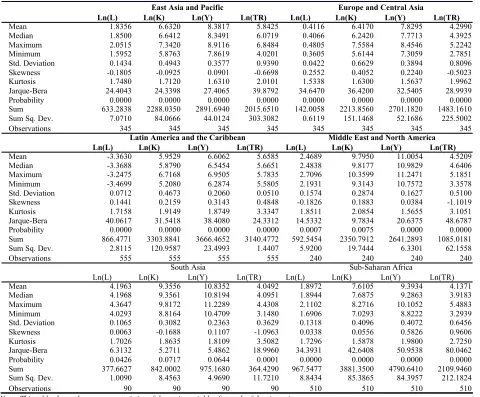
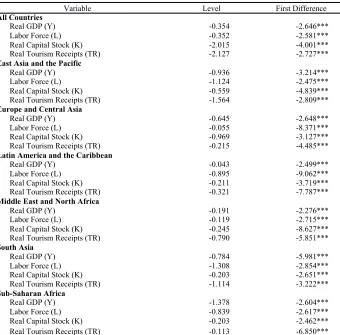
The starting point of our econometric analysis is to check whether the variables included in Equation (1) contain panel unit roots. In other words, in Equation (1), we need to check whether [Y, L, K, TR] contains a unit root. While there are several panel unit root tests are available, this study uses the IPS unit root tests. In order to compare the results for different regions, the total sample was sub-divided into six regions, namely, East Asia and the Pacific, Europe and Central Asia, Latin America and the Caribbean, Middle East and North Africa, South Asia, and Sub-Saharan Africa. The regions were defined using the classifications used by the World Bank. Table 1 shows the summary statistics of the main variables for each of the six regions. Table 2 reports the results of these panel unit root tests which include individual effects. The panel unit root tests indicate all the variables are integrated of order one.
Panel Cointegration Tests
With the respective variables integrated of order one, the heterogeneous panel cointegration test advanced by Pedroni (1999, 2004), which allows for cross-section interdependence with different individual effects, is performed and the results are presented in Table 3. Though the panel cointegrations tests were performed for all six regions and for all countries, only the results for the full sample are presented in Table 3. The results for both within and between dimension panel cointegration test statistics are given in the table. All seven test statistics reject the null hypothesis of no cointegration at the 1% significance level, indicating that the four variable are cointegrated.
Table 1: Basic Summary Statistics
East Asia and Pacific Europe and Central Asia
Ln(L) Ln(K) Ln(Y) Ln(TR) Ln(L) Ln(K) Ln(Y) Ln(TR)
Mean 1.8356 6.6320 8.3817 5.8425 0.4116 6.4170 7.8295 4.2990 Median 1.8500 6.6412 8.3491 6.0719 0.4066 6.2420 7.7713 4.3925 Maximum 2.0515 7.3420 8.9116 6.8484 0.4805 7.5584 8.4546 5.2242 Minimum 1.5952 5.8763 7.8619 4.0201 0.3605 5.6144 7.3059 2.7851 Std. Deviation 0.1434 0.4943 0.3577 0.9390 0.0422 0.6629 0.3894 0.8096 Skewness -0.1805 -0.0925 0.0901 -0.6698 0.2552 0.4052 0.2240 -0.5023 Kurtosis 1.7480 1.7120 1.6310 2.0101 1.5338 1.6300 1.5637 1.9962 Jarque-Bera 24.4043 24.3398 27.4065 39.8792 34.6470 36.4200 32.5405 28.9939 Probability 0.0000 0.0000 0.0000 0.0000 0.0000 0.0000 0.0000 0.0000 Sum 633.2838 2288.0350 2891.6940 2015.6510 142.0058 2213.8560 2701.1820 1483.1610 Sum Sq. Dev. 7.0710 84.0666 44.0124 303.3082 0.6119 151.1468 52.1686 225.5002 Observations 345 345 345 345 345 345 345 345
Latin America and the Caribbean Middle East and North America Ln(L) Ln(K) Ln(Y) Ln(TR) Ln(L) Ln(K) Ln(Y) Ln(TR)
Mean -3.3630 5.9529 6.6062 5.6585 2.4689 9.7950 11.0054 4.5209 Median -3.3688 5.8790 6.5454 5.6651 2.4838 9.8177 10.9829 4.6406 Maximum -3.2475 6.7168 6.9505 5.7835 2.7096 10.3599 11.2471 5.1851 Minimum -3.4699 5.2080 6.2874 5.5805 2.1931 9.3143 10.7572 3.3578 Std. Deviation 0.0712 0.4673 0.2060 0.0510 0.1574 0.2874 0.1627 0.5100 Skewness 0.1441 0.2159 0.3143 0.4848 -0.1826 0.1883 0.0384 -1.1019 Kurtosis 1.7158 1.9149 1.8749 3.3347 1.8511 2.0854 1.5655 3.1051 Jarque-Bera 40.0617 31.5418 38.4080 24.3312 14.5332 9.7834 20.6375 48.6787 Probability 0.0000 0.0000 0.0000 0.0000 0.0007 0.0075 0.0000 0.0000 Sum 866.4771 3303.8841 3666.4652 3140.4772 592.5454 2350.7912 2641.2893 1085.0181 Sum Sq. Dev. 2.8115 120.9587 23.4993 1.4407 5.9200 19.7444 6.3301 62.1558 Observations 555 555 555 555 240 240 240 240
South Asia Sub-Saharan Africa
Ln(L) Ln(K) Ln(Y) Ln(TR) Ln(L) Ln(K) Ln(Y) Ln(TR) Mean 4.1963 9.3556 10.8352 4.0492 1.8972 7.6105 9.3934 4.1371 Median 4.1968 9.3561 10.8194 4.0951 1.8944 7.6875 9.2863 3.9183 Maximum 4.3647 9.8172 11.2289 4.4308 2.1102 8.2716 10.1052 5.4883 Minimum 4.0293 8.8164 10.4709 3.1480 1.6906 7.0293 8.8222 3.2939 Std. Deviation 0.1065 0.3082 0.2363 0.3629 0.1318 0.4096 0.4072 0.6456 Skewness 0.0063 -0.1688 0.1107 -1.0963 0.0338 0.0556 0.5826 0.9606 Kurtosis 1.7026 1.8635 1.8109 3.5082 1.7296 1.5878 1.9800 2.7250 Jarque-Bera 6.3132 5.2711 5.4862 18.9960 34.3931 42.6408 50.9538 80.0462 Probability 0.0426 0.0717 0.0644 0.0001 0.0000 0.0000 0.0000 0.0000 Sum 377.6627 842.0002 975.1680 364.4290 967.5477 3881.3500 4790.6410 2109.9460 Sum Sq. Dev. 1.0090 8.4563 4.9690 11.7210 8.8434 85.3865 84.3957 212.1824 Observations 90 90 90 90 510 510 510 510
Note: This table shows the summary statistics of the main variables for each of the six regions.
Table 2: Panel Unit Root Tests Results
Notes: This table presents the results of the IPS panel unit root and stationary tests as proposed by Im, Pesaran and Shin (2003). Panel unit root test includes intercept and trend. The null hypothesis of unit root (non-stationary) is used. *** indicates the statistical significance at the 1 percent level of significance.
Table 3: Heterogeneous Panel Cointegration Test Results (Full Sample)
Panel cointegration statistics (within-dimension) Test Statistic Group PP type t-statistic -10.452 (0.000)*** Group ADF type t-statistic -3.143 (0.000)***
Notes: Of the seven tests, the panel v -statistic is a one-sided test where large positive values reject the null hypothesis of no cointegration whereas large negative values for the remaining test statistics reject the null hypothesis of no cointegration. The number of lag length was selected automatically based on SIC with a maximum lag of 15. The figures in the parentheses are p-values. *** indicates the statistical significance at the 1 percent level of significance.
Granger Causality Tests
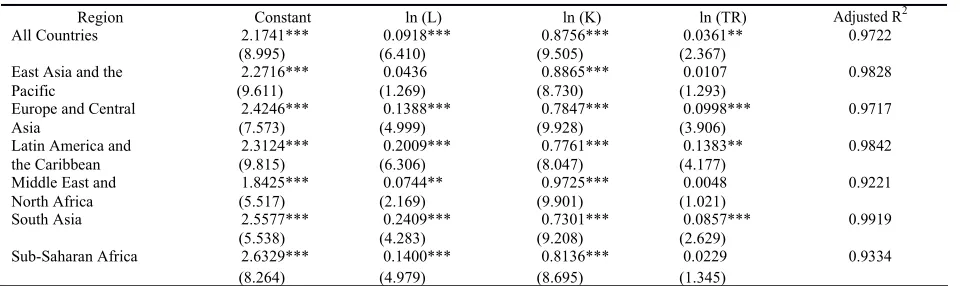
Table 4: Panel FMOLS Long-Run Estimates
Region Constant ln (L) ln (K) ln (TR) Adjusted R2 All Countries 2.1741*** 0.0918*** 0.8756*** 0.0361** 0.9722
(8.995) (6.410) (9.505) (2.367)
East Asia and the 2.2716*** 0.0436 0.8865*** 0.0107 0.9828 Pacific (9.611) (1.269) (8.730) (1.293)
Europe and Central 2.4246*** 0.1388*** 0.7847*** 0.0998*** 0.9717 Asia (7.573) (4.999) (9.928) (3.906)
Latin America and 2.3124*** 0.2009*** 0.7761*** 0.1383** 0.9842 the Caribbean (9.815) (6.306) (8.047) (4.177)
Middle East and 1.8425*** 0.0744** 0.9725*** 0.0048 0.9221 North Africa (5.517) (2.169) (9.901) (1.021)
South Asia 2.5577*** 0.2409*** 0.7301*** 0.0857*** 0.9919 (5.538) (4.283) (9.208) (2.629)
Sub-Saharan Africa 2.6329*** 0.1400*** 0.8136*** 0.0229 0.9334 (8.264) (4.979) (8.695) (1.345)
Notes: The figures in parentheses are absolute values of t-statistics. *** and ** indicate the statistical significance at the 1 percent and 5 percent level, respectively.
The Engle and Granger (1987) two-step procedure is undertaken by first estimating the long-run model specified in Eq. (2) in order to obtain the estimated residuals. Next, defining the lagged residuals from Eq. (2) as the error correction term, the following dynamic error correction model is estimated:
p p p p
where is the first-difference operator, p is the lag length set at two based on likelihood ratio tests,
ε
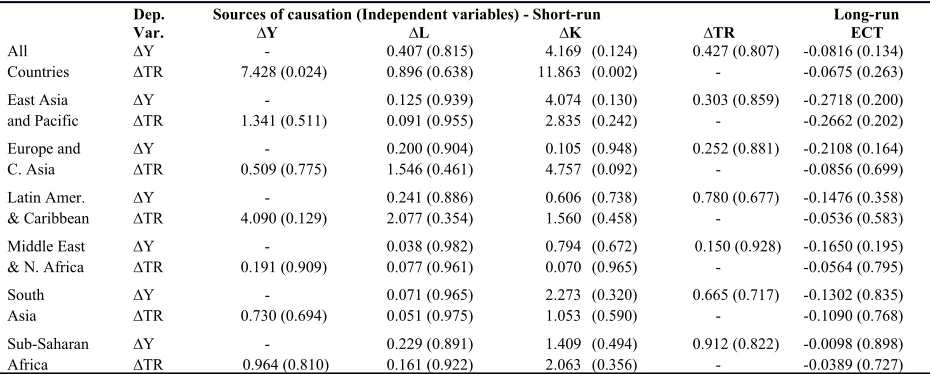
itare the residuals of the individual FMOLS long-run relations in Table 4, and u is the serially uncorrelated error term. Based on the above four equations, short-run causality is determined by the statistical significance of the partial F -statistics associated with the corresponding right hand side variables. Long-run causality is revealed by the statistical significance of the respective error correction terms using a t-test.
SUMMARY AND CONCLUSIONS
The objective of this study is to investigate the relationships between tourism development and economic growth in developing countries using the newly developed heterogeneous panel cointegration technique. This study examines the causal relationship between tourism development and economic growth using Granger causality tests in a multivariate model and using the annual data for the 1995–2009 period. The study uses a sample of 140 developing countries. The sample of countries were grouped into six major regions following the classification used by the World Bank, in order to compare any differences of findings between regions. The multivariate framework includes the real GDP in constant 2000 U.S. dollars, the real gross fixed capital formation in constant 2000 U.S. dollars, the labor force in millions, and the real international tourism receipts in constant 2000 U.S. dollars.
The panel unit root tests indicate all the variables are integrated of order one. The panel cointegrations tests show that all seven test statistics reject the null hypothesis of no cointegration at the 1% significance level, indicating that the four variable are cointegrated. The results of the FMOLS show that, though the elasticity of tourism revenue with respect to real GDP is not statistically significant for all regions, its positive sign indicates that tourism revenue makes a positive contribution to economic growth in developing countries. The results of the study suggest that governments of developing countries should focus on economic policies to promote tourism as a potential source of economic growth. The study finds no evidence to support the tourism-led growth hypothesis.
Table 5: Panel Granger Causality Test Results
Dep. Sources of causation (Independent variables) - Short-run Long-run
Var. ∆Y ∆L ∆K ∆TR ECT
All ∆Y - 0.407 (0.815) 4.169 (0.124) 0.427 (0.807) -0.0816 (0.134) Countries ∆TR 7.428 (0.024) 0.896 (0.638) 11.863 (0.002) - -0.0675 (0.263) East Asia ∆Y - 0.125 (0.939) 4.074 (0.130) 0.303 (0.859) -0.2718 (0.200) and Pacific ∆TR 1.341 (0.511) 0.091 (0.955) 2.835 (0.242) - -0.2662 (0.202) Europe and ∆Y - 0.200 (0.904) 0.105 (0.948) 0.252 (0.881) -0.2108 (0.164) C. Asia ∆TR 0.509 (0.775) 1.546 (0.461) 4.757 (0.092) - -0.0856 (0.699) Latin Amer. ∆Y - 0.241 (0.886) 0.606 (0.738) 0.780 (0.677) -0.1476 (0.358) & Caribbean ∆TR 4.090 (0.129) 2.077 (0.354) 1.560 (0.458) - -0.0536 (0.583) Middle East ∆Y - 0.038 (0.982) 0.794 (0.672) 0.150 (0.928) -0.1650 (0.195) & N. Africa ∆TR 0.191 (0.909) 0.077 (0.961) 0.070 (0.965) - -0.0564 (0.795) South ∆Y - 0.071 (0.965) 2.273 (0.320) 0.665 (0.717) -0.1302 (0.835) Asia ∆TR 0.730 (0.694) 0.051 (0.975) 1.053 (0.590) - -0.1090 (0.768) Sub-Saharan ∆Y - 0.229 (0.891) 1.409 (0.494) 0.912 (0.822) -0.0098 (0.898) Africa ∆TR 0.964 (0.810) 0.161 (0.922) 2.063 (0.356) - -0.0389 (0.727)
Notes: The figures in the parentheses are the probability of rejection of Granger non-causality. Estimates are based on the panel data for the period 1995-2009.
REFERENCES
Arslanturk, Y., Balcilar, M. and Ozdemir, Z. A. (2011). Time-varying linkages between tourism receipts and economic growth in a small open economy. Economic Modelling, 28(2), 664-671.
Balaguer, J. and Cantavella-Jorda, M. (2002) . Tourism as a long-run economic growth factor: The Spanish case. Applied Economics, 34, 877–884.
Dritsakis, N. (2004). Tourism as a long-run economic growth factor: An empirical investigation for Greece using a causality analysis. Tourism Economics, 10, 305–316.
Durbarry, R. (2004). Tourism and economic growth: The case of Mauritius. Tourism Economics, 10, 389–401.
Engle, R. F. and Granger, C. W. J. (1987). Cointegration and error correction: Representation, estimation, and testing. Econometrica, 2, 251–276.
Im, K. S., Pesaran, M. H., and Shin, Y. (2003). Testing for unit roots in heterogenous panel. Journal of Econometrics, 115, 53–74.
Katircioglu, S. T. (2009). Revisiting the tourism-led-growth hypothesis for Turkey using the bounds test and Johansen approach for cointegration. Tourism Management, 30, 17–20.
Kim, H. J., Chen, M. H., and Jang, S. C. (2006). Tourism expansion and economic development: The case of Taiwan. Tourism Management, 27(5), 925–933.
Kreishan, F. M. M. (2010). Tourism and Economic Growth: The Case of Jordan, European Journal of Social Sciences, 15 (2), 229-234.
Lanza, A., Templec, P., and Urgad, G. (2003). The implications of tourism specialization in the long-run: An econometric analysis for 13 OECD economies. Tourism Management, 24, 315–321.
Lee, C. C. and Chang, C. P. (2008). Tourism development and economic growth: A closer look at panels,
Tourism Management, 29, 180–192.
Levin, A. and Lin, C. F. (1993). Unit root tests in panel data: asymptotic and finite-sample properties. Unpublished manuscript, University of California, San Diego.
Levin, A., Lin, C. F., and Chu, C. S. (2002) . Unit root tests in panel data: Asymptotic and finite-sample properties. Journal of Econometrics, 108(1), 1–24.
Li, G., Song, H., and Witt, S. F. (2005). Recent developments in econometric modeling and forecasting.
Journal of Travel Research, 44, 82–99.
Narayan, P. K. (2004). Economic impact of tourism on Fiji’s economy: Empirical evidence from the computable general equilibrium model. Tourism Economics, 10, 419–433.
Oh, C. O. (2005). The contribution of tourism development to economic growth in the Korean economy.
Pedroni, P. (1999). Critical values for cointegration tests in heterogeneous panels with multiple regressors.
Oxford Bulletin of Economics and Statistics, 61, 653–670.
Pedroni, P. (2000). Full modified OLS for heterogeneous cointegrated panels. In Advances in
Econometrics: Vol. 15. Nonstationary panels, panel cointegration and dynamic panels, 93–130. JAI Press.
Pedroni, P. (2004). Panel cointegration: Asymptotic and finite sample properties of pooled time series tests with an application to the PPP hypothesis. Econometric Theory, 20(3), 597–625.
Po, W-C. and Huang, B-N. (2008). Tourism development and economic growth – a nonlinear approach.
Physica A, 387, 5535–5542.
Vanegas, M. and Croes, R. R. (2003). Growth, development and tourism in a small economy: Evidence from Aruba. International Journal of Tourism Research, 5, 315–330.
Schubert, S. F., Brida, J. G. and Risso, W. A. (2011). The impacts of international tourism demand on economic growth of small economies dependent on tourism. Tourism Management, 32, 377-385.
Shan, J. and Wilson, K. (2001). Causality between trade and tourism: empirical evidence from China.
Applied Economics Letters, 8, 279–283.
Song, H. and Li, G. (2008). Tourism demand modelling and forecasting - A review of recent research.
Tourism Management, 29, 203–220.
The United Nations Conference on Trade and Development database at http://unctadstat.unctad.org.
The World Tourism Organization (2010), Tourism Highlights, 2010 Edition.
The World Travel & Tourism Council (2011), Travel & Tourism Economic Impact 2011.
WTO. (2010). Yearbook of tourism statistics. Madrid: World Tourism Organization.
WTTC. (2011). Annual reports, progress and priorities 2009-10. The World Travel and Tourism Council.
Zortuk, M. (2009). Economic impact of tourism on Turkey’s economy: evidence from cointegration tests.
International Research Journal of Finance and Economics, 25, 231-239.
BIOGRAPHY
Dr. E. M. Ekanayake is an Associate Professor of Economics at Bethune-Cookman University, Daytona Beach, Florida, USA. He earned his Ph.D. in Economics at the Florida International University, Miami in 1996. He has many publications to his credit. Contact information: School of Business, Bethune-Cookman University, 640 Dr. Mary McLeod Bethune Blvd., Daytona Beach, FL 32114, USA. Phone: (386) 481-2819. E-mail: [email protected].
Dr. Aubrey E. Long is a Professor and the Dean, School of Business at Bethune-Cookman University, Daytona Beach, Florida, USA. He earned his Ph.D. at the Ohio State University. Contact information: School of Business, Bethune-Cookman University, 640 Dr. Mary McLeod Bethune Blvd., Daytona Beach, FL 32114, USA. Phone: (386) 481-2801. E-mail: [email protected].