CAPACITY BUILDING OF THE INDONESIAN GOVERNMENT AGENCY STAFF BY THE MASTER PROGRAM ON INTEGRATED LOWLAND
DEVELOPMENT AND MANAGEMENT by
Robiyanto Hendro Susanto1) Bart Schultz 2)
F.X. Suryadi 3)
1) Professor Soil Sciences and Water Management, Sriwijaya University, South Sumatra, Jl. Padang Selasa No 524 Palembang, Indonesia, email: [email protected] 2) Professor Land and Water Development, UNESCO-IHE, Delft, the Netherlands 3) Senior Lecturer Land and Water Development, UNESCO-IHE, Delft, the Netherlands
ABSTRACT
There are many districts and cities related to lowland conservation and development throughout Indonesia. Large lowland areas exist along the coasts, in river floodplains and inland depressions. Most of these lowlands are in their natural state; parts have been reclaimed, primarily for agricultural uses. Urbanization and industrialisation take place, especially in the lowlands in densely populated areas.
Because of its population growth, the increase in the standard of living, the need for food self sufficiency, land use change and the on going urbanization in lowland, flood prone areas, the Indonesian government is putting a lot of effort in the future development of the lowlands based on an integrated approach. This effort will cover rural as well as urban development in lowland areas. However, there is a substantial shortage of skilled staff to take care for the development. These are including the required policies and approaches, the resulting plans and planning and the actual design, operation, maintenance and management of the required programs and projects.
Therefore since 2006, the Government of Indonesia, through its National Development Planning Agency – BAPPENAS – has requested the Sriwijaya University (UNSRI) in Palembang South Sumatra to develop jointly with UNESCO-IHE, Delft, the Netherlands a double Master Degree Program on Integrated Lowland Development and Management Planning for government staff at ministerial, provincial, district and city level, in charge of or involved in activities with respect to lowland development and management. BAPPENAS finances the 6 months of English course and the first year study on Environmental Management in Indonesia and the Netherlands Education Support Office (NESO) Indonesia gives support for the second year study on Hydraulic Engineering, Land and Water Development at the UNESCO-IHE, Delft, the Netherlands.
So far two batches of in total 21 students have obtained their MSc degree, two groups of in total 21 students are following the third and fourth programmes, and one group of 11 students is in the English Training class. The participants come from 11 districts and 14 cities in Indonesia. Most of the participants are from Ministries or Agencies related with Public Works, Forestry, Environmental Protection, and Agriculture.
Keywords:
INTRODUCTION
Lowlands can be found all over the world, along the coasts, in river floodplains and as inland depressions. Generally they are by their nature sensitive areas with a high ecological value. Due to their physical conditions and environmental value they are basically unsuitable for development. However, due to the in many cases strategic location and high potential for agricultural exploitation there is often a tremendous pressure to develop these areas for various types of land use. We therefore may observe on the one hand a rapid population growth, a significant increase in agricultural exploitation, urbanisation and industrialisation in lowland areas. On the other hand there is an increased need to prevent further environmental degradation and to achieve a sustainable development.
The lowlands in Indonesia cover a total area of 33.4 million hectares (ha) (Table 1). They are mainly located at Sumatra, Kalimantan, Sulawesi and Papua (Figure 1). With respect to the physical conditions in the lowlands an important distinction can be made in tidal lowlands (Pasang surut) and in non-tidal lowlands (Lebak). The tidal lowlands cover 20 million ha and the non-tidal lowlands14 million ha. Out of the total area 4.2 million ha has been reclaimed, primarily for agricultural exploitation. Spontaneous settlers have reclaimed 2.4 million ha and Government has reclaimed 1.8 million ha. Still some 5 million ha suitable for low-cost development can be reclaimed. The remaining (major) part of the lowlands may be considered unsuitable for reclamation, either due to the high environmental value, or due to the occurrence of (deep) peat soils (...).
Other types of land use in the lowlands are for: animal husbandry, aquaculture, adaptation to nature - floating nurseries, eco-tourism, wood industry (Acacia) and infrastructure.
Table 1 Area of the lowlands in Indonesia (Ministry of Public Works, 1996)
Total lowland area in ha and % of total
Tidal Non-tidal Total
Location
million ha % million ha % million ha %
Sumatra
Figure 1. The lowlands in Indonesia
In 1996 the distribution of the lowlands on the different isles and districts (Kabupaten) was as follows (Ministry of Public Works, 1996; Direktori Kabupaten Kota, 2005):
Sumatra (36 districts):Nangroe Aceh Darussalam (Aceh Selatan, Aceh Timur, Aceh Barat, Aceh Utara); Sumut (Tap-Sel, Labuhan Ratu, Asahan, Karo, Deli Serdang, Langkat); Sumbar (Pesisir Selatan, Agam, Padang Pariaman, Lima Puluh Kota); Riau (Indra Giri Hulu, Indra Giri Hilir, Kep. Riau, Bengkalis, Kodya Pekan Baru); Jambi (Kerinci, Sarko, Batanghari, Tjg. Jabung, Bunga Tebo); Sumsel (Ogan Komering Ulu, Ogan Komering Ilir, Muara Enim, Musi Rawas, Musi Banyuasin, Bangka, Kodya Palembang); Bengkulu (Bengkulu Selatan, Bengkulu Utara); Lampung (Lampung Selatan, Lampung Tengah, Lampung Utara);
Kalimantan (23 districts):Kalbar (Sambas, Pontianak, Ketapang, Kapuas Hulu); Kalsel (Tanah Laut, Kota Baru, Banjar, Barito Kuala, Tapin, Hulu Sungai Selatan, Hulu Sungai Tengah, Hulu Sungai Utara, Tabalong); Kalteng (Kota Waringin Barat, Kota Waringin Timur, Wilayah Katingan, Kapuas, Barito Selatan, Barito Utara, Barito Timur, Wil. Kahayan Gunung Mas, Kodya Palangkaraya); Kaltim (Pasir, Kutai, Kodya Samarinda);
Sulawesi (29 districts): Sulut (Garontalo, Bolang Mongondow, Minahasa, Sangihe Talaud); Sulteng ( Banggai, Poso, Donggala, Bual Toli-Toli); Sultra (Buton, Muna, Kendari, Kolaka); Sulsel (Selayar, Bulu Kumba, Bantaeng, Jeneponto, Takalar, Sinjai, Maros, Pangkajene Kepulauan, Barru, Soppeng, Wajo, Sidenreng Rappang, Pinrang, Luwu, Poliwali Mamasa, Majenu));
Papua (1 district):Merauke.
After the autonomy New Districts and Cities with lowlands have been established. This has in general terms resulted in the following changes:
In 1991/1992: 17 provinces, 89 districts with lowlands;
In 2001 - 12 new cities, 2002 – 32 new districts and 4 new cities, 2003 – 24 new districts; In 2004 – 348 districts and 86 cities.
Lowland
In 2010 – 440 districts and cities with more then 150 related with lowlands
The distribution of lowland cities and districts in 2010 within 440 cities and districts can be seen in Appendix Table IV.
There have been several periods during which reclamation and development activities in the lowlands were concentrated. The following may be mentioned:
Spontaneous development since the 1930s;
Government reclamations during the 1970s, mostly for transmigration and for the food-estate crops program (Table 2);
Private sector development since the 1980s;
Since the 1980s largely uncontrolled expansion of estates, spontaneous developments and logging.
An initiative for One Million ha development project in Central Kalimantan in 1996
The optimalization and upgrading of lowland schemes since 2003 New authonomous districts/ cities within the lowlands areas since 2000
Table 2 Areas reclaimed by the Government in ha and in % of total (Ministry of Public
Total 835,200 2.5 479,670 1.3 1,314,870 3.8
Three major issues which are facing and of important in Indonesia: Food security, Energy availability, and Environmental issue.
With respect to food security in Indonesia substantial changes from agricultural land use to non - food crop uses are going on. The following changes may be mentioned:
At Java annually on average 40,000 ha of irrigated land is converted to non-agricultural land use;
Out of the 3 million ha irrigated land the area with a good irrigation performance is only 800,000 ha. In the remaining area the conditions are not optimal, because of water shortage during droughts or due to flooding;
There are substantial losses in harvest due to droughts or floods at an area of on average 90,000 ha per year;
Droughts in 1991, 1994 and 1997 resulted in a required import of 4,5 million ton of rice in each of these years;
In addition to the mentioned reclamation activities there have been several relevant activities and involvements in the lowlands, such as:
Activities by donors like the World Bank, Directorate General of International Cooperation (DGIS), the Netherlands, Asian Development Bank (ADB), Japanese Overseas Economic Cooperation Fund (OECF);
Telang-Saleh / ISDP / Agriculture projects (1993 - 1996);
Mega 1 million ha reclamation project in Central Kalimantan (1995/1996);
Project on preparation of Technical Guidelines and the project Land and Water Management Tidal Lowlands (LWMTL) (2002 - 2004). Cooperation between the government of Indonesia - Ministries of Public Works and Agriculture - with the Sriwijaya University and the government of the Netherlands Rijkswaterstaat -UNESCO-IHE - Arcadis Euroconsult;
Land and Water Management Tidal Lowlands (LWMTL, 2005-2006) and Strengthening Tidal Lowlands (STLD, 2007-2008), the cooperation of Ministry of Public Works, Directorate General of Water Resources, Ministry of Agriculture, Local Governments of Indonesia, Rijkwaterstaat and Partner for Water
Non-tidal lowlands optimisation (2003 - present) from the Ministry of Agriculture; Establishment of the Directorate of Swamp, Ministry of Public Works and of the
Directorate of Land and Water Management, Ministry of Agriculture in 2005. National Lowlands Development Strategy (NLDS, 2007-2008)
Wadclimat (2009-2012)
The results of and experiences obtained in the projects may be summarised as follows: Partial successful development in the lowlands;
Constraints: unrealistic initial targets, poor site selection, top-down approach, poor conditions for the settlers, especially in the initial stage;
Promising results with upgrading and integrated lowlands ‘second stage’ development projects and participatory approaches in food crop production in Telang area, South Sumatra, ; ie: paddy of 7 ton/ha in the first season, 4 ton/ha in the second season, and corn of 2 ton/ ha as the third crop.
Recommendations on improved development; Lack of synergism - planning-coordination.
Lack of knowledgeable and skill full staff at different level of government institution
The present situation of the lowlands may be characterised as follows: Misinterpretation of achievements and potentials;
Unused potentials in the existing schemes; Uncontrolled development and destruction; Environmental criticism;
Trauma of the one million ha peat reclamation project at Central Kalimantan; Political support lost and programs completed;
Drainage specific know-how lost due to political changes and reforms; Lack of coordination and planning.
If we look at the lowlands in perspective, the following items are of relevance:
Encouraging developments in agricultural exploitation with respect to food crops, estate crops, aquaculture and wood production;
The potential for rational food production in the lowland areas;
The importance of regional development; The need for integrated water management;
The need to pay due attention to the environmental aspects;
The need for integrated planning, implementing, organizing, controlling; Degraded wetland forests versus clean development mechanism (CDM); The existence and protection of undisturbed wetland forests - bio diversity; Climate Change, sea level rise, and vulnerable population in the lowland.
The above observations result in a set of issues that will play an important role in future lowland development and management, in which we really need many knowlegeable and skillfull staff, like:
Integrated agricultural development - on-farm practices, harvesting, processing, and marketing - based on a multi stake-holders participation;
New agricultural developments, like the introduction of mechanisation, cultivation of second crops, and there impacts on production and farming systems;
Modernization of the water management systems - and the need for sustainable operation and maintenance;
The need for conservation of lowland areas with a high environmental value; Socialization and implementation of farming system technology;
Integrated regional development, for example the development of the South Sumatra Eastern Corridor in Banyuasin District; integrated food crops and area development in Barito Kuala, South Kalimantan as well as in Kubu Raya (West Kalimantan), Indra Giri Hilir (Riau) and Tanjung Jabung Timur (Jambi) districts; Transfer of knowledge, science and technology, best practices from a success story
area to other areas.
The conditions that are needed and will contribute to future developments and a sustainable management of the lowlands may be summarised as follows:
Political support, at the different government levels; Data availability (maps) and planning mechanisms;
The approach of lowland development as part of Integrated Water Management; Recognition of the uniqueness of lowlands and the requirement of adapted
approaches;
Appropriate drainage institutions and well established water user associations; Development and management based on a participatory approach.
Based on the observations and developments as outlined before some recommendations for the long term and the short term may be formulated. In formulating the recommendations for the short term, the long-term perspective has been taken into account. The recommendations concern:
Recommendations for the long term:
policy: natural resource management;
sector: agriculture (food crops, estate crops, fisheries), forestry, tourism;
spatial: national, regional, river basin, and ecosystem unit (ie. Delta);
infrastructure: road infrastructure development to complement the water infrastructure for productive areas;
Recommendations for the short term:
priority to agricultural development in promising existing schemes;
to stop uncontrolled developments and degradation;
to upgrade the database;
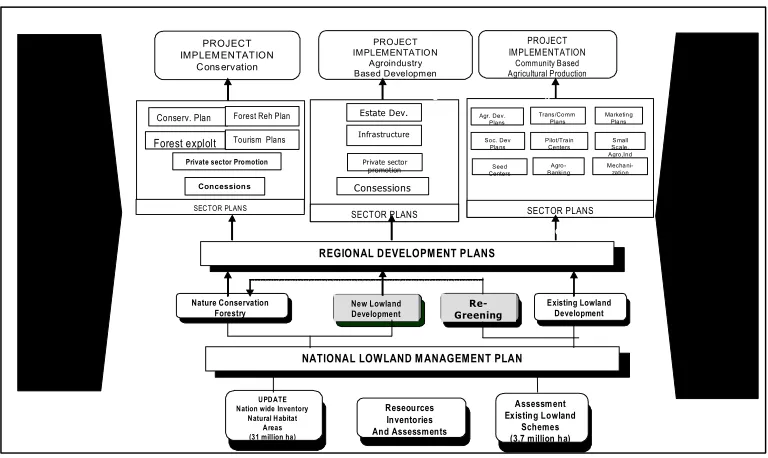
coordination and careful planning of future developments in the lowlands, for example based on an Integrated Lowland Management Plan. An example of such a plan is given in Figure 2;
to obtain political support, for example by activities like:
National Lowlands Training for university staff and staff of the Ministry of Education, Directorate General of Higher Education (DGHE), 2002 and 2003;
Visit of President Megawati to Telang I area in March 2003
visit of the Joint Steering Committee Indonesia & the Netherlands to the lowlands at September 25, 2003;
visit of Komisi II (Finance) DPR RI to Telang I at October 7, 2003;
visit of the Director General Machinery of the Ministry of Agriculture at June 7, 2003;
National Workshop & Seminar on Lowlands Development & Food Security in Kandangan, South Kalimantan, October 11-12, 2004;
Issue of Government law of UU 41/2009 and PP 01/2011 about the protection of productive land for food production;
Lowlands-Wetlands Data Information Centre: regional, national, and international collaboration.
Figure 2 Example of the development of an Integrated Lowland Management Plan
The development of an Integrated Lowland Management Plan such as Figure 3, involves several inter-related steps. These steps may be summarised as follows:
Timeframe:long-term: goals time-frame;short-term: pragmatic action plan; Defining of roles and responsibilities:
role of Government, Institutions, NGOs;
role of farmers, farmers group, and water users associations (WUA, P3A);
private sector, financing agencies;
Pre- Feasibilities Priority ranking - Packaging
Integrated planning: infrastructure (storage, roads, bridges, jetties, canals, housing); financing aspects; communication, institutions, training centres, banks, social engineering; Capacity building, training, and extension:
capacity building program especially for: farmers, set-up of water user associations (P3A) and farmers groups (KT), agricultural extension services, consultants, contractors and manufacturers, government staff, especially in public works and agriculture at district, province and central government level, university, educational institutions, research institutions;
Double Degree on Integrated Lowland Development and Management Planning (DD-ILDM).
THE DOUBLE DEGREE MASTER PROGRAM ON INTEGRATED LOWLAND DEVELOPMENT AND MANAGEMENT PLANNING (DD-ILDM)
The on going Double Degree Master program on Integrated Lowland Development and Management Planning (DD-ILDM), since 2007, is based on the considerations as explained underneath.
Vision
To be a competent and excellent post-graduate program on Integrated Lowland Development and Management Planning with well-established university-industry-government-social linkages, and state-of-the art facilities for research and development.
Mission
To assess and assure a program strengthened under the DD-ILDM that runs in line with the capacity building policy and paradigms of BAPPENAS and the Directorate General of Higher Education (DGHE), Ministry of National Education, as well as with the accreditation requirements for UNSRI in the Indonesian university system and for UNESCO-IHE in the Dutch university system;
To establish an academic education program based on a teaching, exercises and research (desk, field and laboratory) approach;
To contribute to the development of the local economy through university, local government, industry and social linkages.
Goals
The goals for the DD-ILDM program are the following:
To become an established post-graduate program on Integrated Lowland Development and Management Planning in order to fulfil the needs of government institutions and the private sector by education of qualified MSc graduates in the field of integrated lowland management. These graduates will have to be able to fulfill the needs of the market (government, business, industry) in line with the development of the Indonesia, Malaysia, Thailand (IMT-GT) and the Singapore, Johor, Riau (SIJORI) Growth Triangles, the Asian Free Trade Area (AFTA) and the World Market;
To prepare well-established university-business-government linkages for undertaking collaborative research;
To improve the existing graduate study in environment management; To improve the capacity and performance of laboratory units;
To contribute to the autonomous operation of the Sriwijaya university.
Objectives
The objectives for the DD-ILDM program are the following:
To establish and support the education of a Master program on Integrated Lowland Development and Management Planning;
To educate qualified MSc graduates with the following characteristics:
duration of the study 2 years;
an academic index of 2.75 or higher;
able to compete at the global markets;
To establish a cooperation between UNSRI, Indonesia and UNESCO-IHE, the Netherlands and to link both institutions in order to provide a platform for alumni, staff, students, and other researchers to exchange information through seminars, workshop, ICT, etc.;
To establish a qualified institution in Integrated Lowland Development and Management Planning at the Graduate School of Sriwijaya University;
To improve the English capability of the participants upto a professional level.
Basic competency
The DD-ILDM program builds on the recognition that in Indonesia not only lowlands cover a large area of 33.4 million ha, but that they also play an important role in the natural and human environment. As such, decisions made on lowlands by lowland environmentalists, lowland planners, as well as lowland developers might have major consequences for both society and environment. Therefore, the DD-ILDM program is expected to yield graduates of high quality in the development and management of lowland areas by applying integrated approaches to development planning, program initiating and management of lowland areas as well as in handling complicated questions, in line with the mission and goals of the study program.
The Integrated Lowland Development and Management Planning specialist is concerned with the development, adaptation and management of lowland areas. This implies:
Ecosystems and water resources aspects of sustainable lowland management; Development of integrated land use development and management plans;
Development, operation and maintenance of water management and flood protection schemes;
Preparation and implementation of land reclamation and land consolidation programs.
Integrated lowland development and management plans and designs can be based on the management capacity and development constraints. Therefore it is of major importance that prior to the preparation of technical designs, concepts are formulated for the system management, based on which the preparation of regional development and land use plans, the selection of water management methods, flood protection, development of infrastructure, as well as organisation and financing systems can be determined.
Description of the DD-ILDM program
Aim of the course
development and management within a hydraulic engineering environment. Given the broad field, the program aims at conveying the knowledge that is required to fulfil the needs and requirements of users and/or users groups of lowland areas within its physical and non-physical environment. The curriculum of the program concentrates on the development as well as on the management and adaptation of land and water resources in lowland areas for the different types of land use, with a main focus on the land use for agriculture. The DD-ILDM program aims at civil, agricultural and environmental engineers, who are already specialised in water management (irrigation, drainage) and/or in integrated lowland development/management.
Approach to the program
Given the importance of both technical and non-technical aspects in integrated lowland development and management, the DD-ILDM program aims at presenting the knowledge and skills following an integrated approach through integration of:
Technology and environment, including social, economic, legal and other aspects; Technology and management capability, stressing the importance of management in
system performance and development;
Agricultural, civil engineering and environmental aspects of integrated lowland development and management.
This approach will be introduced gradually, culminating in the group work, in which all aspects of integrated lowland development and management, as presented in the technical and non-technical subjects, will be considered in drafting a concept with alternatives for a specific integrated lowland development and management plan. The group work is followed by individual MSc research in the field of integrated lowland management, which will have to result in a thesis that has to be presented and defended.
Structure of the program
The DD-ILDM program offers a 24-month double degree of Master of Science (Magister Sains, M.Si) and Master of Science (MSc) to be completed at Pascasarjana UNSRI in predominantly the first year and at UNESCO-IHE predominantly in the second year. The Master program can start in February and be completed in January of the next two yeras. This program can be repeated on an annual basis. Preceding to the programs a selection procedure has been developed by BAPPENAS, including administrative and academic screening, a Academic Potential Test (TPA), a TOEFL test and additional training in English, if required (TOEFL score below 550). In addition STUNED scholarship provided by NESO provided selection procedure before granting permission for departure to the Netherlands. The academic screening will be jointly done by UNSRI and UNESCO-IHE and be based on their standard admission criteria.
Graduates will obtain an MSc-degree on Integrated Lowland Development and Management Planning of UNSRI and in Water Science and Engineering, Specialisation Hydraulic Engineering - Land and Water Development of UNESCO-IHE. These degrees are awarded to participants who have successfully completed both course works and the research-based MSc thesis.
development and management the DD-ILDM program is designed to meet the specific issues, where an interaction between design and management is the prerequisite for sustainable development of lowland areas.
The lectures, exercises, field and laboratory work at UNSRI are organised in semesters. At UNESCO-IHE there will be time blocks of two times three weeks (‘Modules’) followed by one week examination period (altogether 7 weeks), while a development from generalist to specialist subjects goes together with increased emphasis on individual activities, culminating in the MSc Research thesis at the end of the program. The semesters, modules and contents of the program are described in Annex IV.
Appendix Table I presents the overview of the scheduling of the semesters and modules in time for the academic year 2010-2013. The corresponding topics (subjects) and their study load hours (SLH) within the semesters and modules are presented in the detailed descriptions. All semesters and modules will be evaluated. Evaluation can take place in the form of exercises, tests and/or examinations (written or oral), and are all compulsory. In the semester system at UNSRI, evaluation takes place during the whole period of each semester, in line with the lecture, in the form of the following components: attendances, assignments, quizzes, laboratory and/or fieldwork reports, papers, midterm exams, and final exams. The final mark of each course will be weighted according to such components and to the number of credit hours of the course. At UNESCO-IHE tests and examinations are scheduled at the end of each ‘two module time blocks’ (6 weeks) on the 7th, examination week. Every module will finally result in one weighted so called ‘module mark’. How a subject is evaluated and the weight that the subject has in the ‘module mark’ is described in the detailed descriptions that will be explained to the participants in the handbook. During the program a number of fieldtrips will be organised. In addition there will be an extended fieldtrip through a lowland area that will be example area for the group work as well. Other fieldtrips are scheduled during the program and are organised in the frame of different subjects. For all fieldtrips the participants obtain credit points.
Learning objectives
The DD-ILDM program takes full account of the multi-disciplinary character of human activities dealing with lowlands and water. It also recognises the modern role of professionals involved in the manifold tasks from assessment to implementation and to operation and maintenance in lowland areas. In order to operate within an increasing complex kaleidoscope of existing specialities, these professionals are expected to take up the added duty of developing a broader understanding of the social, economic and environmental implications of water and environment related activities.
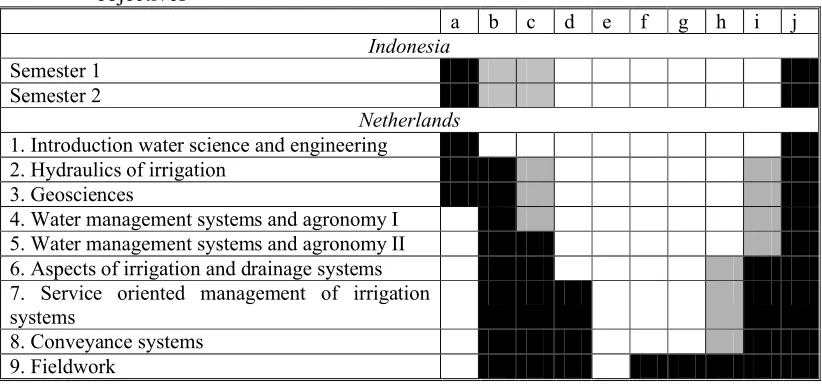
Upon completion of the DD-ILDM program, the graduates should (Table 3): a. Have in-depth understanding and specific knowledge of:
the current concepts and theories of irrigation, drainage, and land reclamation and land consolidation technology to support a sustainable development of lowlands with different types of land use;
the multi-disciplinary involvement in the water sector linkages with the wider aspects of society, economy and the environment;
b. Master the major hydraulic and environmental engineering aspects and hydrological methodologies, as well as applications for irrigation, drainage and flood protection schemes, including techniques for data collection, processing and analysis, and modelling techniques;
c. Be able to contribute to the planning, design, development and implementation (action plan for the realisation) of the hydraulic infrastructure for lowland development and management schemes;
d. Be able to advise developers, system managers and water users on the operation and maintenance aspects of the water management schemes;
e. Have knowledge of contemporary research questions and the relevant literature in the field of integrated lowland development;
f. Be able to formulate and conduct hydraulic and environmental engineering research, plan development and designs in the field of integrated lowland development, experiments and tests for both practical and scientific purposes, either independently or within a team-based framework;
g. Be able to critically judge and evaluate their own work and results, as well as the information of prior research or investigations, plans and designs;
h. Be able to adequately communicate methodology, research results, plans, designs, evaluations, conclusions and recommendations in written, oral and graphical form to a wide variety of audience;
i. Be able to formulate and evaluate a concept with its alternatives for integrated lowland development for areas with different type of land use and assess the technical and economic feasibility, as well as the environmental sustainability of the proposed integrated lowland development and/or management plans;
j. Have adopted the academic attitude and learning skills to enhance and broaden the acquired knowledge and application skills in a largely independent manner.
Table 3 Relationship between the DD-ILDM program components and learning objectives
a b c d e f g h i j
Indonesia
Semester 1 Semester 2
Netherlands
1. Introduction water science and engineering 2. Hydraulics of irrigation
3. Geosciences
4. Water management systems and agronomy I 5. Water management systems and agronomy II 6. Aspects of irrigation and drainage systems 7. Service oriented management of irrigation systems
a b c d e f g h i j
Indonesia
10. Groupwork
11. MSc research inception phase
Netherlands
12. MSc research, thesis writing
Key: Black-objectives of primary focus; Grey -objectives of secondary focus
.
Implementation of the DD-ILDM programThe DD-ILDM program will be jointly implemented by Sriwijaya University (UNSRI) Graduate School on Environment Management, Integrated Lowland Development and Management Planning and UNESCO-IHE, Department of Water Engineering, Core Hydraulic Engineering - Land and Water Development. Support to the implementation have been obtained from:
Institutional support. Support of this DD-ILDM program is given firstly by the cooperating institution of UNSRI and UNESCO-IHE;
Professional support. Professional supports are awaited from several professional institutions, e.g. ICID, KNI-ICID, World Water Forum, HATHI (Association of Indonesian Hydrological Engineering), etc.;
International cooperation in research. Latest international cooperation in research conducted by Sriwijaya University with international agents concerns:
Land and Water Management Tidal Lowlands (LWMTL), Rijkswaterstaat, UNESCO-IHE, Arcadis Euroconsult, Ministry of Public Works, Ministry of Agriculture, Local Government of Banyuasin, South Sumatra Province, and the Lowlands-Wetland and Coastal Area Data and Information Centre;
Development of Replanting Technology and A CDM Model of Mangrove Forrest for Supporting Mangrove Forrest Rehabilitation Program in Tsunami Devastated Areas, JSPS – DGHE Joint Research Project 2006 – 2008, Saga University, Japan;
The Study on Comprehensive Water Management of Musi River Basin in the Republic of Indonesia, JICA and Directorate General of Water Resources, Ministry of Settlement and Regional Infrastructure the Republic of Indonesia;
Latest collaboration in capacity building and research projects of the Core Hydraulic Engineering - Land and Water Development concerns:
Land and Water Management Tidal Lowlands (LWMTL); and Strengthening Tidal Lowland Development (STLD);
Water Saving Yellow River (EU-funded project with several EU and Chinese partners);
Capacity building on the implementation of the European Water Framework Directive for government staff of Hungary;
Polders of the World (long term research);
Integrated aspects of lowland development, water management and flood protection. Several MSC and PhD studies.
The quality control systems as prevailing for the programs in both institutes will be applicable to this program as well.
Program committees
Responsibility for the up to standard implementation of the DD-ILDM program rests within UNSRI with the Head of the Study Program, the Vice Director for Academic Affairs of the Graduate School and the Vice Rector for Academic Affairs of UNSRI. Within UNESCO-IHE the responsibility for the up to standard implementation of the DD-ILDM program rests with the program committee of the Water Science and Engineering Program. The final responsibility rests with the Academic Board of UNESCO-IHE.
Lecturers
One of the concerns of this DD-ILDM program as mentioned in the objectives is to improve the English capability of the participants upon completion of this program to deal with the global market. In order to achieve such objective, during this program, not only the students will be taught by qualified lecturers but also such lectures be conveyed in English. Therefore, the lecturers of this program, especially those who serve at UNSRI must meet with the following criteria:
Hold relevant S3 degree or at least relevant S2 degree with prominent experience in lowland areas;
Have sufficient level in both spoken and written English;
Able to provide course materials in standard-academic written English;
Able to provide examination materials in English and to do evaluations accordingly;
Upon request, able to serve as advisory committee members for MSc thesis work.
Academic facilities
Facilities provided by the Graduate Program of Sriwijaya University for the DD-ILDM program to support international classes, will include: New libraries with international corners; Laboratories; Experimental stations (at lowland areas); Classes equipped with audio-visual aids; Books, software and other references; ICT facilities (to be completed to support tele-conferences); Hotspots internet connections; E-learning facilities; Language labs, etc.
Within UNESCO-IHE participants will have free access to: The library and the library of Delft University of Technology; Hydraulic laboratory facilities; Fieldwork facilities; Classes equipped with audio-visual aids; Books, software and other references; ICT facilities (including distant learning and tele-conference facilities); Internet connections; I-learning facilities.
Profile of participants and admission criteria
Participants for this proposed DD-ILDM program, according to the regulations set forth by Pusbindiklatren BAPPENAS, are:
Officials of ministries, provincial, district or city governments working favourably at planning units;
or an equivalent degree; Aged 38 years or younger;
Have an academic index of 2.75 at S1 degree or higher; Have been working as government official for at least 3 years; Proposed officially by his/her superior;
Have an academic potential test (TPA) of 565 or higher;
Have a TOEFL score of at least 450 to join an English for Academic Purpose (EAP) training;
Have a TOEFL score of at least 550 during or after the EAP training;
Willing to work at fields relevant to his/her degree upon completion of the program; Fulfil other requirements stated in the ‘Guidelines of the Education and Training
Program for the Planners’.
DISCUSSION ON THE ON GOING DD-ILDM PROGRAM : THE ALUMNI, STUDENTS, PROSPECTIVE CANDIDATE, AND THE FUTURE OF LOWLAND DEVELOPMENT IN INDONESIA
If we look at the Table Appendix ... as the origin of candidates for the double degree program on Integrated Lowland Development and Management Planning, there are numerous cities and districts all over Indonesia related with lowland management. This can be as the urban lowland as well as the rural areas both at the provincial level and cities or districts governments responsibility.
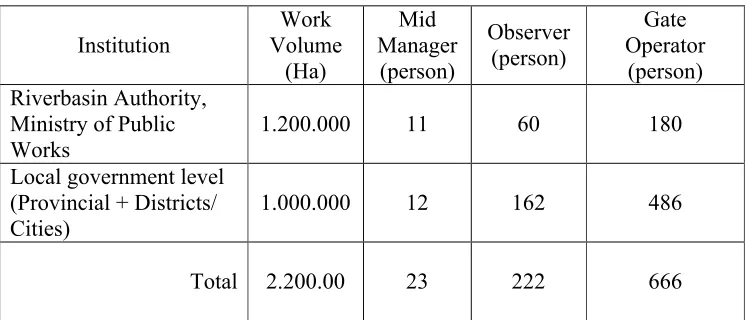
If we consider the Directorate General of Water Resources, Ministry of Public Works, as a case study in calculating the needed staf on lowland management. The following Table .. and Table ... can give an idea about the man power needed. The target area of reclaimed lowlands taking into account on this estimate is 2.200.000 ha both at the central and local government responsibility.
Table ... below shows an estimate number of skillful staff at the national, provincial, city/district level to manage the reclaimed lowlands environments in Indonesia (Simanjuntak, 2011). From Table ..., there are 23 mid managers for operational responsibility needed which need a Master Degree education level.
Overall skillfull staff 905
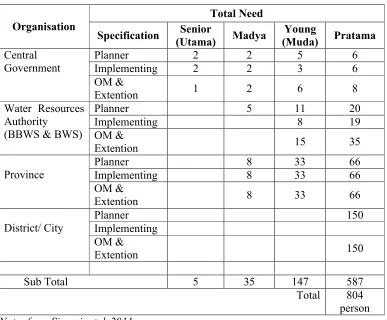
Table ... give more information on functional skillfull staff at central government, watershed authority, provincial government, district/ city government needed in relation with urban drainage and rural drainage responsibility. From this table there are 40 person at prime/ mid level which might need the Master Degree education level.
So, if we combine Table ... and Table .... to see the required staff for operational and functional purposes in the Water Resources Department of the Ministry of Public Works for a given area, there are at least 63 staff with Master degree education level needed.
Table 5. Summary of functional skillfull staff on lowlands related water resources in Table 5. Man power need at different level of organization in Indonesia
Total Need Organisation
Specification Senior
(Utama) Madya
Young
(Muda) Pratama
Planner 2 2 5 6
Implementing 2 2 3 6
Central Government
OM &
Extention 1 2 6 8
Planner 5 11 20
Implementing 8 19
Water Resources Authority
(BBWS & BWS) OM &
Extention 15 35
Planner 8 33 66
Implementing 8 33 66
Province
OM &
Extention 8 33 66
Planner 150
Implementing District/ City
OM &
Extention 150
Sub Total 5 35 147 587
Total 804
person Note: from Simanjuntak 2011
The thesis titles of the DD-ILDM participants for example can be seen in Table ..., which covered a wide range of topics from the engineering aspects to the financial aspects of water management in the lowlands. There are still numerous subject can be studied as the problems may arise else where in Indonesia. Urban drainage and rural drainage is affecting each other, a succes at the rural development areas will reduce the movement of rural people to the urban (city) areas. Water management issues at rural and urban areas need to be solved simultaneously.
Since the total participants of this DD-ILDM program is only 51 people so far, we might conclude that this program still need to be continued for years to come. Treasure study for the alumni showed that most of the alumni are promoted to do a more challenging jobs (Table ...). English language capability of the DD-ILDM alumni is really another positive point such that at any events using the english language, i.e. International Seminar/Workshop, Foreign delegate meetings, they will be invited
Tabel 6. Participants of double degree program on Integrated Lowland Development and Management, Universitas Sriwijaya, Unesco-IHE – Netherlands, Bappenas of Indonesia, STUNED
Year Number
(person) Origin of Participants Remarks
2007/2009 10 West Sumatera (1), South
Sumatra (7), Banten (1), Lampung (1)
10 graduated from Unesco-IHE and Unsri in 2010
2008/2010 10 Jakarta (2), East Java (1), West Java (2), Central Java (1), Lampung (1), South Sumatera (2)
10 graduated from Unesco-IHE and Unsri in 2011
2009/2011 11 Jakarta (4), Central Java (1), East Java (1), Lampung (1), Riau Island (1), South Sumatera (3)
CONCLUSION AND REMARKS
There have been substantial role of the alumni of this program upon their study completion at their office (see Table ...). The responsibility to involve on lowland development and management at the urban and rural areas is increased. Most of the alumni are working and applying the knowledge which they gained during their study and research works.
Since the target of local government in all over of Indonesia (Table ....) and the available alumni (Table...) are still lacking, it is adviseable that this DD-ILDM program need to be continued and supported.
REFERENCES
Annual report of DD-ILDM to Bappenas Republic of Indonesia. 2010
BAPPENAS, Departmen Pertanian, USAID, DAI food policy advisory team. 2002. Does Indonesia face a food security time bomb?Indonesian Food Policy Program. Working paper no. 11, Jakarta, Indonesia.
Ditjen Pengairan, Departemen Pekerjaan Umum, 1996. Potensi dan Kendala dalam Pengembangan Daerah Rawa Indonesia.
Ditjen Pengairan, Departemen Pekerjaan Umum. 2004. Strategi Pengembangan dan Pengelolaan Sumberdaya Air di Indonesia.
Direktorat Rawa dan Pantai, Departemen PU, 2009. Potensi dan tantangan pengembangan rawa Indonesia. Makalah pada Seminar Lokakarya Pengelolaan Rawa dalam Mendukung Ketahanan Pangan Nasional. Hotel Nikko Jakarta. Kedepitian Bidang Koordinasi Infrastruktur dan Pengembangan Wilayah, Kementrian Koordinasi Bidang Perekonomian
Sriwijaya University and Unesco-IHE. 2010. Hand book of DD-ILDM 2010-2013
Handbook of DD-ILDM 2010-2013...
Houterman J, Djoeachir M., R.H. Susanto and Steenbergen F.V. 2004. Water Resources Management During Transition and Reform in Indonesia ; Toward an Integrated Perspective on Agricultural Drainage (The World Bank; Agriculture and Rural Development Working Paper 14).
IISP – Telang Saleh, 1996. Final Report of Integrated Irrigation Sector Project.
Inoed, A dan A.R. Hasan. 2008. Visi Misi Banyuasin 2003-2008 dalam bentuk Visi Misi Banyuasin 2008-2013. Pangkalan Balai – Banyuasin, Sumatera Selatan, Indonesia.
Land and Water Management Tidal Lowlands (LWMTL). 2006. Final Activities Report. Report of the Joint Indonesian - Netherlands Working Group, Jakarta, Indonesia. Litbang Departemen Pertanian, 2007. Ketahanan Pangan Nasional dan Produksi Beras
Indonesia
Menko Ekonomi, Deputi Infrastruktur. 2009. Koordinasi Infrastruktur Pengembangan Wilayah untuk Ketahanan Pangan. Makalah pada Seminar Lokakarya Pengelolaan Rawa dalam Mendukung Ketahanan Pangan Nasional. Hotel Nikko Jakarta. Kedepitian Bidang Koordinasi Infrastruktur dan Pengembangan Wilayah, Kementrian Koordinasi Bidang Perekonomian
Ministry of Public Works, 1984. Nation wide inventory of coastal and near coastal swamp lands in Sumatra, Kalimantan and Irian Jaya.
PRCUD 2011. Urban Planning and Climate Change in Indonesia: Roundtable Forum on the Pacific Rim Council on Urban Development. Final report. Palembang, 24-27 July 2011
Schultz B. 2006. Development of tidal lowlands. Potentials and constraints of the tidal lowlands of Indonesia. In: Proceedings one-day seminar on Sustainable tidal lowland management. pilot areas Telang and Saleh, 23 August 2006, Jakarta, Indonesia.
Simandjuntak, R. P. 2011. Peningkatan Kompetensi Sumberdaya Manusia Pengelolaan Sistim Tata Air Rawa Pasang Surut dalam Rangka Ketahanan Pangan Nasional. Pidato Ilmiah disampaikan sebagai syarat untuk Menjadi Widiaiswara Utama di Pusdiklat PU, September 2011.
Suprianto, H, G. I. Sumarjo, R.H. Susanto, FX. Suryadi, B. Schultz. 2006. Potentials and constraints of water management measures for tidal lowlands in South Sumatra, Case study in a pilot area in Telang I. 9th Inter-Regional Conference on Environment-Water, Delft, the Netherlands.
Suprianto H., Ravaie E., S.G. Irianto, R.H. Susanto., Schultz B., Suryadi F.X., dan Eelaart A.V. 2009. Land and water management of tidal lowlands: Experiences in Telang and Saleh, South Sumatera (Irrigationand drainage Jurnal 2009 – on line, Wiley InterScience (www.interscience .wiley.com).
Susanto, R.H. dan Muslimi. 1997. Water resources development and possible cropping pattern on the reclaimed tidal swamps in Indonesia. Paper for the 7th International Drainage Workshop, Penang, Malaysia.
Susanto, R.H. 2001. Management of deltaic areas for a sustainable development: A Case Study In South Sumatra Region. Invited paper for International Workshop on Optimizing Development and Enviromental Issues at Coastal Area. Jakarta. Susanto, R.H., 2003. Agricultural Drainage Towards an Interdisciplinary and
Susanto, R.H. 2010. ...pidato GB ...
Appendix Table 1. Bar charts of Program for Group IV of DD-ILDM, 2010 – 2012: On going Program (2010 – 20113)
Year 2010 2011 2012 201
3
Activity Month 6 7 8 9 10 11 12 1 2 3 4 5 6 7 8 9 10 11 12 1 2 3 4 5 6 7 8 9 10 11 12 1 2
Period in Indonesia Credit
points
Institution
Scholarship announcement & application (December 31, 2009)
BAPPENAS & STUNED
Selection: administrative + academic requirements
UNSRI &
UNESCO-IHE
TOEFL test BAPPENAS
– UNSRI
EAP training BAPPENAS
– UNSRI
Course work Semester I
Ecostatistics (PL611) 3 UNSRI
Lowland environmental science (PL612)
2 UNSRI
Environmental values & ethics (PL613)
2 UNSRI
Environmental law (PL614) 2 UNSRI
Environmental sociology (PL615)
2 UNSRI
Resource economics (PL626)
Research methods (PL627) 2 UNSRI
Course work Semester II: Environmental management system (PL636)
2 UNSRI
Integrated aspects of lowland management
3 UNSRI &
UNESCO-IHE Managing, organization and
change in lowland schemes
3 UNSRI &
UNESCO-IHE
Lowland hydrology 2 UNSRI &
UNESCO-IHE
Year 2010 2011 2012 201
3
Activity Credit
points
Month 6 7 8 9 10 11 12 1 2 3 4 5 6 7 8 9 10 11 12 1 2 3 4 5 6 7 8 9 10 11 12 1 2
Soil and water data collection, monitoring and evaluation
2 UNSRI &
UNESCO-IHE
TOEFL- IELTS Test by STUNED
Stuned
Second interviews by NEC Stuned
Period in the Netherlands Institution
Introduction to water science and engineering
5
Applied hydraulics 5 UNESCO-IHE
Geosciences 5
UNESCO-IHE Water management systems
and agronomy I
5
UNESCO-IHE Water management systems
and agronomy II
5
UNESCO-IHE Important aspects of
irrigation and drainage
5
UNESCO-IHE Service oriented
management of irrigation systems
5
UNESCO-IHE
Conveyance systems 5
UNESCO-IHE
Field work 2
UNESCO-IHE Field trips in the
Netherlands
UNESCO-IHE
Period in Indonesia
Field trips 3 UNSRI
Groupwork 5 UNSRI &
UNESCO-IHE MSc thesis work (PL731)
(Inception report)
12 UNSRI &
UNESCO-IHE
MSc thesis 24 UNSRI &
UNESCO-IHE
Diploma awarding UNSRI &
AppendixTable II. Graduates of the first and second Double Degree MSc Programme on Integrated Lowland Development and Management Planning
GROUP NAME TITLE OF MSC THESIS PRESENT POSITION
Mrs. Dewi Sartika Water management service fee for optimal operation and maintenance of canal systems in tidal lowlands. Case study Telang I. South Sumatra (distinction)
SubBid Pembangunan dan Peningkatan, Dinas PU Cipta Karya dan Pengairan, Kab. Musi Banyu asin
Rahmadi The Effect of Climate Change and Land Subsidence on Water Management Zoning In Tidal Lowlands. Case Study Telang I, South Sumatra (distinction)
GIS expert for WACLIMAD project under World Bank-BAPPENAS
Mrs. Wiwin Estiningrum Impact of City Development on Urban Drainage and Flood Protection in Metro City
Kasubbid Bidang Litbang Pemerintahan dan Sosial Budaya, BAPPEDA Kota Metro
Mrs. R.A. Marlina Sylvia Options for water management and flood protection of agropolitan Gandus for agricultural development
Staf PU Bina Marga dan PSDA kota Palembang, Bidang pengendalian banjir dan drainasi
Mrs. Eka Gustini Palembang urban drainage and flood protection development. Case study Jakabaring
Staf PU Bina Marga dan PSDA kota Palembang, Bidang pengendalian banjir dan drainasi
Mrs. Resza Dwi Artha Water management for acid sulphate soils in lowland areas. Case study in Patra Tani Muara Enim
Kasi Migas, Dinas Pertambangan dan Energi, Kab. Muara Enim
Mrs. Flora Prima Syntha Optimizing operation and maintenance for urban drainage system. Case Study: Sub Catchment Bendung Palembang City, South Sumatera.
KaSubBid Perekonomian BAPPEDA, Kab. Limapuluh Kota Sumatra Barat
Akbar Saefudin Land and water evaluation of lowland areas. Case study: lowlands in North Eastern Muara Enim Region, Indonesia
KaSubBid Renstra BAPPEDA, Kab. Muara Enim
Taufik Syahzaeni Urban drainage and flood protection in Tangerang City Staf Badan Lingkungan Hidup Kota Tengerang I
Ahmad Fadilan Regeneration options for peat forest. Case study Marang Kepayang, South Sumatera, Indonesia
Perwira POLRI, Staf Pribadi KAPOLRI Bidang Hubungan Luar Negeri
Albert Reinaldo Evaluation of urban drainage and flood protection system in North Jakarta. Case study Papanggo Areas
Pembinaan Teknik, Monev, Bantuan teknis bidang drainasi , Subdit Drainasi, Direktorat Pengembangan Penyehatan Lingkungan Pemukiman, Dit Jen Cipta Karya, Kemen. PU
Muhd. Thursina Cahya Evaluation of drainage system performance in Bandar Lampung City. Case study in Sub District Tanjung Karang Pusat
Ka.SubBag Penyusunan Rencana Kegiatan pada BAPPEDA kab Lampung Selatan
Eldowan Arief Developing Lubuklinggau Drainage Masterplan
Mrs. Esty Nayadiah Analysis and evaluation of urban drainage and flood protection problems in Surabaya. Case study: East Surabaya
Menyusun program lingkungan hidup dan tata ruang wilayah, Staf BAPPEDA Kota Surabaya
II
Muhd. Riza Fahlefi Integration of the floodway and urban drainage system in the eastern part of Semarang Lowland Area
Mrs. Febrinasti Alia Nasrul Impacts of future changes on flood protection systems. Case study of Indonesia and the Netherlands in comparative perspective
Staf PU Bina Marga dan PSDA kota Palembang, Bidang pengendalian banjir dan drainasi
Mrs. Fetri Aswanti Optimizing water management systems in lowland areas to maximise agricultural production. Case study: Telang II, South Sumatra
Staf Bagian Perencanaan Dinas Pendapatan Daerah, Provinsi Sumatra Selatan
Lufiandi Impact of land use change on water management in Metropolitan Bandung
Staf BAPEDALDA/ BLH Jawa Barat
Mrs. Titih Titisari Danielaini
Optimizing reservoir operation, water distribution and cost-sharing system of a multipurpose reservoir. Case of Jatigede Reservoir Scheme, Indonesia
Staf Dinas Tata Ruang dan Permukiman Pemerintah Kabupaten Cianjur
Hotman Fr. Pandiangan Urban drainage and flood protection in Jakarta City, Indonesia. Case study: Ciliwung River – West Banjir Canal
Appendix Table III. Students of the third and fourth Double Degree MSc Programme on Integrated Lowland Development and Management Planning
GROUP NAME WORKING TITLE OF MSC THESIS PREVIOUS POSITION
Aditya Sidik Waskito Hydraulic and performance analysis of water management in tidal lowlands. Case study: Telang I, South Sumatra (after STLD Programme)
Staf Sekretariat Direktorat Jendral Sumber Daya Air Kementerian
Andi Irawan Analysis and development of urban drainage and flood protection in Tanjung Pinang City, Riau Islands Province
Plt. Kepala Sub Bidang Penegakan Hukum Badan Lingkungan Hidup Prov. Kepulauan Riau
Aris Fajar Suryono Water management zoning in tidal lowlands based on hydraulic performance and land subsidence. Case study: Delta Saleh, South Sumatera
Staf Direktorat Rawa dan Pantai, Direktorat Jenderal Sumber Daya Air, Kementerian Pekerjaan Umum
Mrs. Esty Siske Setioriny
Optimisation of water management for pulpwood production Staf Balai Perbenihan Tanaman Hutan Sumatera, Kementeerian Kehutanan
Yosiandi Wicaksono Hydraulic modelling for improvement of tertiary canals and its effect on the implementation of water management systems in the Telang II Scheme
Staf Direktorat Bina Pengelolaan Air, Direktorat Jenderal Sumber Daya Air, Kemeterian Pekerjaan Umum
Mrs. Yulia Mariska Urban drainage and flood protection development in Prabumulih City, South Sumatera. Case study in Kelekar River
Staf Badan Perencanaan Pembangunan Daerah Kota Prabumulih, Prov. Sumatera Selatan
Adi Kunarso Improvement of water management at tertiary level for increasing pulpwood production in tidal lowlands
Peneliti Pertama Balai Penelitian Kehutanan Palembang, Kementerian Kehutanan
III
Windiyanto Nugroho Analysis and evaluation of flood protection development in Kudus Regency. Case study: Srep Sub-river Basin
Staf Dinas Pertanian, Perikanan dan Kehutanan Kabupaten Kudus, Prov. Jawa Tengah
Dadang Nurdin Staf Dinas Kehutan Pemerintah Kabupaten Garut, Jawa
Barat
Aries Purwanto Staf Dinas Lingkungan Hidup, Pertambangan Pemerintah
Kabupaten Karawang, Prov.
Rini Yuniati Staf PHKA Jambi, Kenterian Kehutanan
Djoko Purnomo Staf Dinas Lingkungan Hidup Pemerintah Kota Magelang,
Jawa Tengah
Rahmat Ruzniar
Penyuluh Pertanian, Perikanan, Kehutanan dan Tanaman Pangan, Pemerintah Kota Singkawang, Prov. Kalimantann Barat
Evi Damayanti Staf Balai Taman Nasional Way Kambas, Lampung.
Kementerian Kehutanan IV
Andri Tri Atmojo
Titles of MSc theses to be decided in July - August 2012
Trisia Ranti Fani Staf Dinas Kehutanan Perintah Provinsi Sumatera Selatan
A. Saifullah Staf Balai Pemantauan Pemanfaatan Hutan Produksi Wily.
V, Palembang, Sumsel. Kementerian Kuhutanan
Ujang Wisnu Barata Staf Balai Besar Taman Nasional Gunung Leuser, Medan,
Sumatera Utara. Kementerian Kehutanan Maruddin Fernandus
Marpaung
Staf Balai Rawa, Pusat Litbang SDA Banjarmasin, Badan Litbang Kementerian PU
Wahidah Wahyu Ramadhani
Subdit. Operation and Maintenance, Ministry of Public Works
Appendix Table IV. Lowlands related Cities (Urban Drainage) and Districts (Rural Drainage) in 5 big island of Indonesia
NO. Island Province District/ City
Nangroe Aceh Darussalam Aceh Timur, Aceh Utara, Kota Langsa, Banda Aceh,
Sumatera Utara Tapanuli Selatan, Labuhan Ratu, Asahan, Karo, Deli Serdang, Serdang Bedagi, Langkat Sumatera Barat Pesisir Selatan, Agam, Padang Pariaman, Lima Puluh Kota
Riau Siak, Indra Giri Hulu, Indragiri Hilir, Pelalawan, Dumai, Kodya Pekan Baru, Rokan Hilir Riau Island (Kepri) Tanjung Pinang, Batam
Jambi Kerinci, Sarko, Batanghari, Tanjung Jabung Barat, Tanjung Jabung Timur, Bungo, Tebo
Sumatera Selatan Ogan Komering Ulu, Ogan Komering Ilir, Muara Enim, Musi Rawas, Musi Banyuasin, Banyuasin, Kodya Palembang
Bangka Belitung Bangka, Bangka Selatan,
Bengkulu Bengkulu Selatan, Bengkulu Utara 1. Sumatera
Lampung Lampung Selatan, Lampung Tengah, Lampung Utara Kalimantan Barat Sambas, Pontianak, Kubu Raya, Ketapang, Kapuas Hulu
Kalimantan Selatan Tanah Laut, Kota Baru, Banjar, Barito Kuala, Tapin, Hulu Sungai Selatan, Hulu Sungai Tengah, Hulu Sungai Utara, Tabalong
Kalimantan Tengah Kota Waringin Barat, Kota Waringin Timur, Wilayah Katingan, Kapuas, Barito Selatan, Barito Utara, Barito Timur, Wil. Kahayan Gunung Mas, Kodya Palangkaraya
2. Kalimantan
Kalimantan Timur Pasir, Kutai, Kodya Samarinda
Sulawesi Utara Bolang Mongondow, Minahasa, Sangihe Talaud Gorontalo
3. Sulawesi
Sulawesi Utara Buton, Muna, Kendari, Kolaka
Sulawesi Selatan Selayar, Bulu Kumba, Bantaeng, Jeneponto, Takalar, Sinjai, Maros, Pangkajene Kepulauan, Barru, Soppeng, Wajo, Sidenreng Rappang, Pinrang, Luwu, Poliwali, Mamasa, Majenu, Ujung Pandang
Papua Merauke, Mappi, Boven Digoel, Asmat, Mimika, Nabire, Waropen, Memberamo Raya, Sarmi, Keerom 4. Papua
Papua Barat Faf-Fak, Kaimana, Manokwari, Sorong, Sorong Selatan, Teluk Bintani, Teluk Wondana, Kota Sorong
DKI. Jakarta North Jakarta, Central Jakarta,
Banten Tanggerang
West Java Karawang, Bekasi,Cirebon, Central Java Semarang, Pemalang, Kudus, Banjar 5. Java