PANEL PENILAI / PANEL OF REVIEWERS
Professor Dr. Ishak Yussof
Professor Dr. Norman Salleh
Professor Dr. Rahmah Ismail
Associate Professor Dr. Aini Aman
Associate Professor Dr. Aisyah Abdul Rahman
Associate Professor Dr. Azhar Ahmad
Associate Professor Dr. Azman Ismail
Associate Professor Dr. Basri Abdul Talib
Associate Professor Dr. Che Aniza Che Wel
Associate Professor Dr. Doris Padmini Selvaratnam
Associate Professor Dr. Hawati Binti Janor
Associate Professor Dr. Madeline Berma
Associate Professor Dr. Maisarah Ahmad
Associate Professor Dr. Mariani Abdul Majid
Associate Professor Dr. Mohamat Sabri Hassan
Associate Professor Dr. Mohd Azlan Shah Zaidi
Associate Professor Dr. Mohd Hizam Hanafiah
Associate Professor Dr. Nor Asiah Omar
Associate Professor Dr. Nor Liza Abdullah
Associate Professor Dr. Norazlan Alias
Associate Professor Dr. Norlida Hanim Mohd Salleh
Associate Professor Dr. Romlah Jaafar
Associate Professor Dr. Rosmah Mat Isa
Associate Professor Dr. Ruhanita Maelah
Associate Professor Dr. Ruzita Abdul Rahim
Associate Professor Dr. Shahida Shahimi
Associate Professor Dr. Sofiah Md Auzair
Associate Professor Dr. Syed Shah Alam
Associate Professor Dr. Zafir Mohd Makhbul
Associate Professor Dr. Zakiah Mohammaddun Mohamed
Associate Professor Dr. Zizah Che Senik
Associate Professor Dr. Zulkefly Abdul Karim
Dr. Norazila Mat
Dr. Norida Basnan
Dr. Norlin Khalid
Dr. Norsiah Aminudin
Dr. Roshayati Abdul Hamid
Dr. Rosiati Ramli
Dr. Rozita Amiruddin
Dr. Rubaayah Yaakob
Dr. Shifa Mohd Nor
Dr. Zaleha Yazid
Mr. Ahmad Raflis Che Omar
TABLE OF CONTENT
Quality of Human Resources and Application of Income Tax Accounting at Construction Company in
Palembang City ... 3
Pension Fund Investment in Nigeria: Islamic Perspective ... 21
Kajian Penggunaan Tajuk dalam Penyata Kewangan di Malaysia ... 31
Internet Financial Reporting of Malaysian Companies - A Study of Preparers’ Perception ... 49
Detecting Earnings Manipulation by Malaysian Public Listed Companies: The Reliability of Beneish Mscore Model ... 67
The Implementation and Disclosure of Corporate Social Responsibility (CSR) in Indonesian Banking Industries... 82
The Effect of Internal Audit Quality on Good University Governance and its Implications on The Quality of Education Operation that Contributes to Graduates Quality: A Case Study at Private Higher Educations in Region III Of West Java Indonesia ... 98
The Effect of General Allocation Fund (DAU) and Regional Real Income (PAD) on the Regional Expenditures (Empirical Studies of the Government District/city of the Province of Bengkulu) ... 117
Determinants Company Conditions in Disclosure Corporate Social Responsibility: Case Study in High Profile Indonesian manufacturing companies ... 138
Preliminary Analysis on Related Party Transactions in Corporate Circulars ... 146
The investigation of the credit risk and its role in cash flows, macroeconomic factors and competition in Iranian banking industry ... 158
The Influencing of Local Parliaments (DPRD) Control Function on Good Government Governance (GGG) with their knowledge about budget as a moderating variable (study on local parliaments of Bengkulu Province 2009-2014). ... 165
Discharging Accountability through Governance: Cases from Waqf Institutions in Indonesia... 181
Ownership Structure and Risk Taking of Malaysian Banking Institutions ... 193
The Effect of Disclosure Corporate Social Responsibility (CSR) Against Corporate Value with Price Earnings Ratio as Moderating Variables on The Main Sectors ... 212
The Determinant Factors of Indonesian Public Listed Companies’ Debt Policy ... 227
The Influence of Internet Financial Reporting and Degree of Information Disclosure on Company’s Website to the Frequency of Stock Trading on Trading, Services, and Investment Company Listed on Indonesian Stock Exchange ... 253
Combined Effect of Executive Stock Option Granting and Blockholder Ownership on Firm Performance in Malaysia ... 265
The Role and Influence of Corporate Leader Values on Corporate Governance Mechanisms and Financial Reporting Quality... 276
The Effect of Board Diversity, Multiple Directorships and Ownership Structure on Firm Performance. 356
The impact of Corporate Governance on Dividend Payment Policy: empirical evidence from Iranian Listed Companies... 380 Establish a Balance Scorecard Approach to Enhance Zakat Distribution System in East Coast Region . 391
Corporate Governance and Firm Value: Evidence from Iranian Listed Companie... 406 Financial literacy and communication of financial ratios ... 417 The Relationship between Intensity of Competition, Delegation of Authority, Management
Accounting and Control Systems Changes, Organizational Performance (Empirical Study in
The Relationship between Intensity of Competition, Delegation of
Authority, Management Accounting and Control Systems
Changes, Organizational Performance (Empirical Study in
Manufacturing Companies Listed in Indonesian Stock Exchange)
Lukluk Fuadah, SE. MBA, Akt.
Economics Faculty, University of Sriwijaya, Palembang.
Jl. Raya Prabumulih-Indralaya 30662, Indralaya
(+62711) 580964, 580646 Fax (+62711) 580646
[email protected]
Prof. Muhammad Nasir, MSi, Ph.D, Akt
Dr. Jaka Isgiyarta, MSi, Akt
Jl. Prof. Sudarto, SH. Tembalang Semarang. 50275
(+6224) 76486851, 76486853 Fax (+6224) 76486852
Faculty of Economics and Business, University of Diponegoro,
[email protected]; [email protected]
Abstract: The aim of this study is to investigate the relationship between intensity of competition and organizational performance through delegation of authority, changes in management accounting and control systems. Data of this study was collected from survey to chief financial officers or controller or accounting manager from manufacturing companies listed on the Indonesian Stock Exchange. From 477 questionnaires were distributed and 115 respondents were returned, only 108 respondents used in data analysis. This study used Structural Equation Model (SEM) by using AMOS 19 program software. The findings from this study showed that the intensity of competition and organizational performance was not significance. However, other results from the relationship among intensity of competition, delegation of authority, management accounting and control systems changes, and organizational performance have positive relationship and significance.
Keywords: Intensity of Competition, Delegation of Authority, Management Accounting and Control Systems, Organizational performance.
1. INTRODUCTION
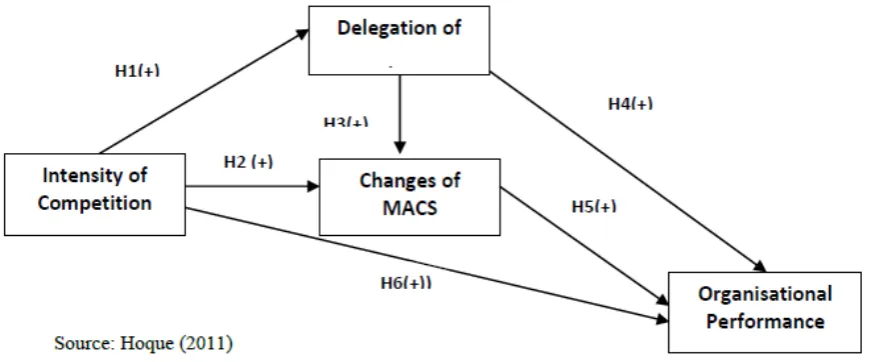
This study replicates the model developed in Hoque’s (Hoque, Z. 2011. The relations among competition, delegation, management accounting systems changes and performance: A path model.
440
organizational performance in Manufacturing Companies Listed in Indonesian Stock Exchange. In globalization, manufacturing companies face higher competition from other countries especially after ASEAN Free Trade Area (AFTA) on 2004. As a one of ASEAN countries, manufacturing companies in Indonesia face higher competition. It is important to investigate the role of changes in management accounting and control systems in manufacturing companies listed in Indonesian Stock Exchange.
2. LITERATURE REVIEW
2.1. The relationship between intensity of competition and delegation of authority
Market competition is one of key element from company’s external environment (Krishnan 2005); (Krishnan et al. 2002); (Libby & Waterhouse, 1996); (Mia and Chenhall, 1994). Intensity of competition has big influence in internal organization (Khandwalla, 1972); (Lawrence and Lorsch 1967). Galbraith (1977) stated that external variable is uncertainty environment for instance intensity of competition. Galbraith (1977) also explained that companies have multiple responds for uncertainty environment, one of these is to delegate their authorities.
Based on organizational theory, in competitive environment tend to delegate authority from senior managers to lower managers (Burns and Stalker, 1961) dan (Chandler, 1962). In organizational theory has premised that environment has relationship with organization structure (Gordon and Narayanan, 1984). From previous researchers such as Prendegast (2002), Waweru, (2008), dan Waweru and Uliana (2008) found that there is a positive relationship between intensity of competition and delegation of authority. This idea is formally expressed in the following hypothesis:
H1: Intensity of competition has positive relationship with delegation of authority.
2.2. The relationship between intensity of competition and Management Accounting and Control Systems Changes (MACS)
Contingency Theory stated that company more effective if management control system was designed suit with contextual variables such as uncertainty environment for example intensity of competition. From management accounting literature environment is one of factor determine design of management accounting and control systems that useable for company (Ezzamel 1990); (Gordon and Miller 1976).
Based on proposition (Chenhall 2003) described that the more uncertain the external environments, the more open and externally focused on management control systems. Prior researches that used contingency theory explain that firms today need changes in management accounting and control system due to higher competition Khandwalla (1972), Mia (1993), Mia and Chenhall (1994), Libby and Waterhouse, (1996), Mia and Clarke, (1999), Hoque et al. (2001), Williams and Seaman, (2001), Baines and Langfield Smith, (2003), Waweru et al. (2004), Krishnan (2005), Isa et al. (2005), Agbejule and Burrower (2007), Abdel-Kader and Luther (2008), Tuanmat et al. (2010), Hoque, (2011), Hammad et al. (2013), Mohamed (2013). In conclusion, the prediction that increased competition is likely to lead a firm to increase of changes in management accounting and control systems, this idea is formally expressed in the following hypothesis:
H2: Intensity of competition will be positively associated with changes in management accounting and control systems.
2.3. The relationship between Delegation of Authority and Changes of Management Accounting and Control Systems (MACS)
441
and services so that appropriate decisions can be made to meet local needs.
Gul and Chia (1994), Abernethy and Bouwens (2005), Waweru, (2008), Waweru dan Uliana, (2008), Soobaroyen and Poorundersing (2008), Chenhall (2008), Abdel-Kader dan Luther (2008), Verbeeten, (2010), Ajibolade (2013), Hammad et al. (2013) showed that a positive relationship between decentralization and MACS changes. This idea is formally expressed by the hypothesis is as follows:
H3: Delegation of authority is positively associated with changes in Management Accounting Control System.
2.4. The relationship between delegation of authority and organizational performance
More delegation provides incentive to lower manager to make economical decision and result in increasing organizational performance (Prendergast, 2002). With Delegation of authority, local or lower managers may respond timely to their local customers and they do not have to wait for approval from a higher authority for business decisions.
Based on Chenhall, (2003) and Otley, (1980) stated that contingency theory from management accounting if organization use management accounting and control systems fit in organization factors such as decentralization have better performance. Previous researches showed that there is a positive relationship between delegation of authority and organizational performance (Manfield and Alam 1985), (Miah and Mia 1996), (Danersen 2001) dan (Hoque, 2011). Based on explanation above, it can be develop a hypothesis as follow:
H5: Delegation of authority has positive associated with organizational performance.
2.5. The relationship between Management Accounting and Control Systems changes and organizational performance
Changes in management accounting and control systems allow managers to obtain information needed for successful economical decision making (Chenhall and Morris, 1986); (Mia and Chenhall, 1994). Contingency theory of management accounting suggests that companies are likely to have high performance if they implement and use management accounting and control systems that suit their social environmental situations and organizational (Chapman 1997); (Chenhall 2003); (Chenhall and Chapman, 2006); (Otley 1980). Based on contingency theory stated that how greater use of management control system was a response to interdependence and this information assisted in maintaining high performance (Chenhall 2003).
There is also an increasing recognition in the literature of management accounting that companies tend to apply the accounting innovation or changes in management accounting control system which exists to enhance the decision making as well as the performance of the company (Abernethy and Bouwens, 2005). Prior studies showed that changes in management accounting and control system is associated with organizational performance for example (Mia and Chenhall 1994); (Mia and Clarke 1999); (Williams and Seaman 2002); (Ismail and Isa 2011) and (Hoque 2011). In conclusion, it can be developed a hypothesis as follow:
H5: Management accounting and control system changes will be positively related to organizational performance.
2.6. The relationship between intensity of competition and organizational performance
Prior researches from Govindarajan (1984), Mia and Clarke, (1999) and Hoque, (2011) showed that there is positive relationship between intensity of competition and unit business performance . However the result study from (Khandwalla 1972) showed that intensity of competition had negatively associated with organization performance. The above discussion suggests that the increase of intensity of competition, the increase organization performance should also increase. Stated formally in the form of the following hypothesis:
H6: Intensity of competition has positive relationship with organizational performance.
Figure 1. Research Model
3. METHODOLOGY
3.1. Population and Sample
Participants of this study are financial controller or chief financial officer or accounting managers. The amount of manufacturing firms which listed in Indonesian Stock Exchange is about 149 based on Indonesian Capital Market Directory. The questionnaires were sent to all manufacturing companies. Sample in this study was the total completed questionnaires returned from survey. Data was collected by sending questionnaires by mail and contact persons who sent directly to manufacturing companies that listed in Indonesian Stock Exchange.
The reasons choose manufacturing companies as sample. Firstly, because manufacturing companies in Indonesian Stock Exchange especially from Indonesian Capital Market Directory is categorized as a big company (Lau and Sholihin 2005). These companies tend to use Management Accounting and Control Systems. Other reason is to avoid bias from Industrial effect.
3.2. Variable Research and Instrument Research 3.2.1. Intensity of competition
This variable used Khandwalla (1972) measurement which has five categories such as raw materials, technical personnel, selling, and distribution, quality and variety of product and price. Several researchers used this measurement (Mia and Chenhall 1994); (Libby and Waterhouse 1996); (Hoque et al. 2001).
3.2.2. Delegation of Authority
3.2.3. Changes of Management Accounting and Control Systems
Libby and Waterhouse (1996) developed management accounting and control system changes measurement. This measurement consist of twenty three items which divide into five categories of planning, controlling, costing, directing and decision making. This measurement was used by several studies (Libby and Waterhouse 1996); (Williams and Seaman 2001); (Williams and Seaman 2002); (Sulaiman and Mitchell 2005); (Isa 2007); (Isa 2009); (Verbeeten 2010); (Ajibolade et al. 2010).
3.2.4. Organizational Performance
Organizational performance is indicator successful level to achieve company goal.
Govindarajan, 1984 states that organizational performance is not only financial but also non financial performance in the company. This instrument was developed by (Govindarajan 1984). This
measurement consists of ten categories such as operating profit, return on investment, sales growth rate, market share, cash flow from operation, new product development, market development, research and development, cost reduction programs, personnel development. already used by several researchers such as (Abernethy and Stoelwinder 1991); (Chenhall and Langfield-Smith 1998); (Govindarajan and Fisher 1990); (Hoque and James 2000), Hoque (2011).
3.3. Analysis
Data analysis used Structural Equation Model (SEM) with AMOS (Analysis of Moment Structure) 19 software program. Structural Equation Model (SEM) is the combination between factor analysis and all equation model (Ghozali 2011). Structural equation is figured by path diagram that represent from theory. In other word latent variable is figured out to path diagram from theory. Furthermore, goodness of fit model is will done. If it is fit, it will explain the result and discussion
(Ghozali, 2011).
4. EMPIRICAL RESULT
Total questionnaires were about 447 questionnaires which were sent to financial controllers or chief financial officers or accounting managers (each firm is sent 3 questionnaires). The questionnaires were distributed in early September 2012 until mid February 2013. The total resulted
in only 115 completed responses. Of 115 returned questionnaires, seven (7) responses were not fully completed and therefore were not useable. Thus, the usable response for this study analysis is about
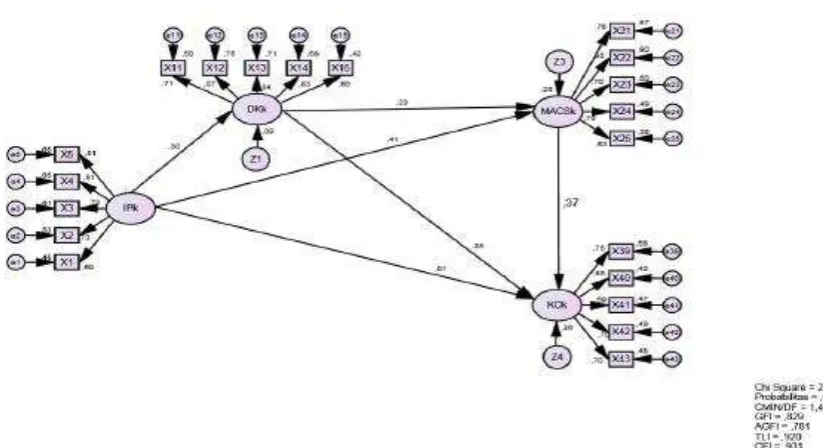
Figure 2. The Result Research from AMOS
IPk = intensity of competition, DKk = delegation of authority, MACSk = changes in management accounting and control systems, KOk = organizational performance.
Table 1. Goodness of Fit Model
Table 1 showed that all the evaluation of goodness fit indexes were good, except for GFI and AGFI are categorized in marginal level. The goodness fit of model based on the criteria (cut off value). Chi square from full model result is smaller than chi square table as 305,041. All values are required range which means that all indicator was used in model is sufficient enough to test the hypothesis.
Table 2 showed that all hypotheses are accepted or supported, except for the relationship between intensity of competition and organizational performance is not supported. The finding of this study confirm the argument and support in organization theory which states that the environment of high competition emphasizes top managers or senior managers to delegate more authority to lower level managers (Burns and Stalker, 1961; Chandler , 1962) . This is because local managers or lower level managers more aware of the actual conditions that exist on a local company with more detail. In addition, lower level managers making decisions quicker and better. This is done to respond to the competition included in an uncertain environment so as to respond to the uncertainty will be delegation of authority. This finding is not support to Hoque’s finding.
The finding of this study confirm the basic premise of contingency theory (states that the company will be more effective if the management control system designed in accordance with contextual variables such as environmental uncertainty is an example of the intensity of competition. The environment is one of the factors determining the design of management accounting control systems which are used by the company based on the literature of management accounting and control, (Ezzamel, 1990), (Gordon and Miller, 1976). This result indicates that increased competition is positively related to the greater number of MACS chaanges, this finding support to Hoque (2011). This finding supports the contingency theory which states that decentralization is the delegation of authority related to the characteristics of management control systems (Chenhall, 2003). Decentralization also gives more responsibility and control for managers in operations and requires greater information as well (Waterhouse and Tiessen, 1978). The finding from Hoque (2011) is supported by this study.
Research and empirical finding support the results of this study in line with contingency theory argument. Based on (Chenhall, 2003) and (Otley, 1980) states the contingency theory of management accounting that when organizations implement management accounting and control systems in accordance with organizational factors such as decentralization will have a better performance. It is intended that the company will respond quickly and make decision directly related to management accounting and control systems. This empirical evidence from this research is supported by Hoque (2011).
Research and empirical findings support the results of this study in line with the argumentation Contingency Theory. It state that companies act more effectively if they apply and use management accounting control systems in accordance with organizational situations and social environment (Chapman, 1997); (Chenhall, 2003); (Chenhall and Chapman, 2006); (Otley, 1980). From the finding of this study indicate that the higher changes in management accounting and control systems, the higher performance of the organization.
This finding do not support prior studies that have been done by Mia and Clarke (1999), Hoque (2011) and Govindarajan (1984) which states that there is a positive relationship between the intensity of competition with organizational performance. This finding of this study supports
Khandwalla (1972
)
. Khandwalla (1972)
in the United States state that a negative relationship between firm profitability and the level of product, as well as the network of market competition.5.
CONCLUSION
The intensity of competition is an environmental factor that cannot be controlled. In the face of competition intensity manufacturing companies will usually do the delegation of authority in its operation and a tendency to make changes in management accounting and control systems. This is
done by companies to maintain or achieve a competitive advantage compared to its competitors. The results showed that the relationship between the intensity of competition with the delegation of authority, change management and accounting control systems showed positive results and significant. On the relationship between the delegation of authority and organizational performance, and the relationship between changes in management accounting control systems and organizational performance showed significant results.
The limitation of this study is in the fit test models show result in marginal. Limitations on the level of
square multiple correlation (R square- R2), which indicates the ability to explain of the variables is still relatively low, which means there are other variables that have the potential to be further investigated. Therefore the suggestion of future research needs to consider other variables to
be studied as an example of information technology and organizational variables such as culture.