23
http://puslit2.petra.ac.id/ejournal/index.php/ing
Juncture Patterns of the Surabaya-
citizen’s Speech
Karsono, O.M.F.
Chinese Department, Petra Christian University, Siwalankerto 121- 131 Surabaya, INDONESIA e-mail: [email protected]
ABSTRACT
In this paper, the researcher examines juncture patterns of Chinese language of Surabaya citizens who do not use Bahasa or Indonesian language as their mother tongue. The purpose is to see whether juncture patterns of local citizens can resemble the native speakers. The method that is used here is qualitative approach. The research on these juncture patterns is expected to contribute to the pattern map of the Surabaya citizen‟s speech in order to develop the Phonology Theory of Juncture. Based on the analysis of ten respondents, producing nine declarative sentences, seven interrogative sentences, six imperative sentences, and four exclamatory sentences, juncture patterns happen sometimes after a subject, after a predicate, between two words, and sometimes between two syllables within a word. Juncture happens before a word when the word is emphasized. The second finding is that juncture between syllables in a word is not always shorter than the one that happens between two words. The last finding is that there are two kinds of juncture, stopping and continuing juncture.
Key words: Pattern, juncture, Chinese language, sentence.
INTRODUCTION
It is generally known that one of the language functions is to communicate. It can be differentiated into the written and the spoken. In written language, punctuation marks are important. Two sentences that consist of the same words in the same sequence can have a different meaning, based on the punctuation mark used (Alwi, Dardjowidjojo, Lapoliwa, & Moeliono, 2003, p. 84). In tone-language like Chinese, besides having tone, intonation, and stress that determine a sentence meaning, another influential element is the juncture. The function of suprasegmental element of juncture to the Chinese language in determining a sentence meaning can be seen in the following examples:
(1) bú gào nǐ bú shì rén 不35 告51 你214√ 不35是51人35。 „Not reporting you not human‟.
If the juncture in sentence (1) exists between the word nǐ (你) [you] and bú (不) [not], it will make sentence (1a)
(1a) bú gào nǐ / bú shì rén 不35 告51 你214√ / 不35 是51人35。 ˈnot reporting you /is not humanˈ.
Sentence (1a) means „not reporting you, is not human.‟ Another meaning occurs when a juncture exists between the word gào (告) [reporting] and nǐ (你) [you], it will make sentence (1b)
(1b) bú gào / nǐ bú shì rén 不35 告51 / 你214√ 不35 是51人35。
ˈnot reporting / you are not a humanˈ
Sentence (1b) means „when you are not reporting, you are not a human.‟ It is clear that juncture in a statement
influences its meaning. According to Xíng (2001), a juncture in Chinese language has two functions. First is grammatical juncture, which appears in a natural statement. Second is logical juncture, which occurs in a sentence to signalize the speaker‟s purpose (p. 110). Since a juncture can influence the meaning of a sentence, the researcher will examine the juncture patterns.
Related to the type of sentence, according to Hú (2006), a sentence is a language unit that can reflect a speaker‟s purpose clearly while communicating (p. 80). The meaning of a sentence is based on the context of the communication and the speaker, while the type of the sentence, used in the communication, includes declarative, interrogative, imperative and exclamatory sentences. Therefore, the researcher examines juncture patterns of Surabaya citizen related to those four types of sentence. Respondents are Surabaya citizen, who are chosen based on a pre-survey that the people in this region have various strong local dialects especially the „Suroboyoan‟ dialect. Their utterances are examined to understand whether they have diverse variation of juncture patterns or not.
JUNTURE IN CHINESE LANGUAGE (Tíngyán / 停延)
A Juncture in Chinese language is termed tíngyán (停延). This term means when we speak loudly, a juncture happens within a paragraph or a sentence. There are two kinds of juncture in Chinese language. The first is continuing juncture or yánlián (延连) which occurs because of a prolonged sound (音长). The second is tíngdùn (停顿) or stopping juncture which occurs because of an absent sound. Continuing juncture or yánlián (延连), based on the time lapse, is distinguished into two types of sound connection, short and long. Stopping juncture or tíngdùn (停顿) is also distinguished into tíngxiē (停歇) and dùnxiē (顿歇). The sound fragmentation in a sentence is called dùnxiē (顿歇), while the fragmentation that occurs in a bigger unit language like in sentence combinations or paragraphs is called tíngxiē (停歇). Generally, the time lapse in tíngxiē (停歇) lasts longer than in dùnxiē (顿歇). These juncture arrangements are frequently functioned to differentiate speech meaning (Wú, 2000, p. 37). Junctures occur more frequently in Chinese language than in English. This happens because the more junctures occur, the more it can emphasize the meaning and the feeling of the speaker. Stopping juncture or tíngdùn (停顿) happens because of physical human needs. This juncture is needed by the speaker to take breath, or to express feeling so that the addressee has time to understand the intended meaning of the discourse.
The junctures here are similar to break or joint in the discourse of Indonesian language.Chaer (2007) says that a juncture is called a break because a stop happens, and it is called a joint because between the connection of one element and another the stopping process exists (p.122). A juncture in every language has its own characteristics, clear or unclear (Marsono, 2006, p. 117). According to its position within a context of a sentence, a juncture can be distinguished into internaljuncture or in Chinese language nèibù tíngdùn (内部停顿) and open juncture or wàibù tíngdùn (外不停顿) (Wú, 2000, p. 41). An internal juncture separates one syllable from another, within a word, and it is commonly put in with a tally mark (+). For example sentence (2) and (3)
(2) xiàn+zài (现在) „now‟
(3) diàn+dēng (电灯) „lamp‟
An open juncture shows a greater boundary than a syllable, which is usually still distinguished into a juncture between words in phrases, marked with an inverted slash (/); a juncture between phrases in a clause, marked with a double inverted-slash (//); and a juncture between sentences in a
If a longer juncture occurs between the word yú andgāng, the sentence has a meaning „Where did you buy this fish?‟ If a long juncture appears between the words gāng and zài, the sentence has another meaning „Where did you buy this aquarium?‟ An open juncture between words in a phrase Because a juncture can influence the meaning of a sentence, it is necessary to examine how it affects the discourse of Surabaya citizen.
According to its function in a sentence, there are two kinds of juncture in Chinese language, grammatical juncture and stress meaning juncture. Grammatical juncture reflects the grammatical relationship in a discourse sentence (Hú, 1993, p. 147; Xíng & Wàng, 2009, p. 141). First, this grammatical juncture in a written language can be expressed with reading marks, like commas, periods, etc. The duration of the juncture is symbolized with the reading marks. For example juncture time of a stop (.), question mark (?), and shout-out marks (!) are longer than semi-colons (;) or colons (:) (Huáng & Liào, 2005, p. 124). This juncture is used to differentiate the types of words, word meaning, and language structures which produce different meanings. A clear example is shown in the following example (Hú,
from Xiaoli ‟ (“gēn” is a preposition)
(8) Wǒ gēn tā xué yīng yǔ, nǐ gēn Xiǎo lǐ xué
„I and him learn English // you and Xiaoli learn France‟
Secondly, a stress meaning juncture is used to emphasize the intended meaning, or the emotion of the speaker.
SEMANTIC IN CHINESE LANGUAGE
which has meaning. For example, the word mǎhu (马虎) is a morpheme with a phonological form mǎhu which means „not serious‟. This is a combination form of phonemes with a meaning, and cannot be separated into smaller language units with meaning.
A morpheme also represents the smallest bounding of phonological and semantic elements, and it is the smallest grammatical part of a language. The morpheme of spoken Chinese language is shown as syllable, while in written language it is shown as a Chinese character. A morpheme in Chinese language usually consists of one syllable and one word in its written language. Nonetheless, there are morphemes with two or more syllables; and when those are written, the words consist of two or more Chinese characters. For example in sentence (11) (Hú, 1993, p. 231). (9) Lǔ Xùn / Bīng Xīn /Zhū Zì qīng / de / zuò pǐn /shì
/wǒ /men /de /fàn /běn
鲁迅 / 冰 心/ 朱自 清 / 的/ 作品 / 是 / 我 /
们 / 的/ 范 / 本
In the above sentence, the words Lǔ Xùn, Bīng Xīn are morphemes consisting of two syllables, while Zhū Zìqīng is a morpheme consisting of three syllables. Those mor-phemes, although consisting of more than one syllable, only have one meaning. we can extend it by adding a certain language component. If the extension changes the meaning, the phoneme unit is a word. For example, a phoneme combination mǎlù (马路), when it is added with a language component de (的), it will result in a sound of language component mǎ de lù which means „horse trail‟, while the actual meaning is „highway‟.
Chinese words, according to the structure, are divided into three kinds, single morpheme words, two or more
morphemes words, and abbreviation words (Liú, Pān, &
Gù, 2001, p.10). Single morpheme words are constructed by one morpheme, generally consist of one syllable. These kinds of words dominated the ancient era. Along with the modernization, nowadays, double morpheme words are on the top list. Single morpheme words, when they are spoken, consist of one syllable, and in the written form, consist of one Chinese character. Words with single morphemes are generally used to express daily-life items (for example the
words mǎ / 马„horse‟, māo / 猫 „cat‟, tiān / 天 „day‟)
(Xíng, 2003, p. 126).
Beside of consisting one syllable, there are single morpheme words that also consist of two or more syllables. Multi morpheme words are usually derived from foreign language like luóji (逻辑) „logic‟. There are words that also
consist of two syllables with identical consonant sound (fǎngfú/ 仿佛 „resemble‟), or words with identical vocal sound like (hútu / 糊涂 „spider‟), or inherited ancient words
like (zhóulǐ/ 妯娌 „a term of the relationship between older brother‟s wife and younger brother‟s wife‟) (Liú, et al., 2001, p. 11).
Words consisting of two or more morphemes, observed from the construction method, can be distinguished into repeating words, decendant words, and substraction or combination words. Like the word bàba (爸爸) „father‟, or the repetition of two morphemes behind another morpheme, like liàng jīngjīng (亮晶晶 ) „shining‟. Repeating words can also be constructed by adding another word that has no meaning, like huāngli huāngzhang (慌里慌张) „nervous‟.
Decendant words are constructed by combining the root-word with affixes, like dúzhe (读者) means „book reader‟.
The word in front, dú (读), is the prominent word, while the supplement is functioned as a syntax that limits or broadens the original meaning of the root-word. Substraction words are constructed by omitting several morphemes, like chūzhōng 初中 which is a substraction of chūjízhōngxué 初级中学 (junior high shool).
SYNTAX IN CHINESE LANGUAGE
A sentence is the smallest language unit in the form of written or spoken to express a complete thought. Types of sentences in Chinese language can be reviewed from the (a) number of clauses, (b) syntax structure (c) element com-pleteness, and (d) arrangement of subject and predicate. Since in this paper the researcher only examines the juncture pattern of sentences related to the distribution of the syntax characteristics, the explicated theories are only used around the theories of sentence structure based on the syntax characteristic. According to the communicative function, as a discourse character, Chinese sentences usually are divided into (1) declarative or message sentences, (2) imperative or command sentences, (3) interrogative or question sentences, and (4) exclamatory or shout-out sentences (Fáng, 2008, p. 91).
Chinese Declarative Sentences are the sentences that narrate an event, reveal something, or comment on something. Usually they inform something new to the addressee. In written language, these sentences are most frequently used. Declarative sentences can be classified into several kinds. The important thing is that it must have words to tell something, depict something, describe something or com-ment on something (Liú et al. 2001, p. 25). Different choice of words as the marker of declarative sentences will produce different kinds of declarative sentences. Frequently these marking words are used simultaneously in a sentence.
feelings, like joy or sadness. So, a shout-out sentence is not functioned to inform something. The intonation of a shout-out sentence is usually started with an ascending tone at the beginning, and a descending tone at the end of the sentence. Words that are frequently used to express speaker feelings are a (啊), le (了), la啦 (Yè & Xú, 1997, p. 91).
RESEARCH METHOD
A descriptive method is used with qualitative approach. The basic idea of applying the method and the approach is because qualitative study can understand the plot/narration chronologically and guide the researcher to discover unexpected result during the research process (Miles & Huberman, 1992, p. 1). The researcher has made obser-vations to know which places that are usually used by the Surabaya citizen to communicate in Chinese. Persuasive approach is used in order to get data of discourse from the subjects while they are communicating in a relaxed situation. To get more people as the subjects of the research, a technique called snowball sampling is used (Dörnyei, 2007, p. 129). A stimulating technique sometimes seems like off target, but it actually conceals special purposes (Samarin, 1988, p. 162). The process of collecting discourse data goes naturally, so there are no preparations made by the
subjects. Seeing from the scope of time, this research uses synchronic approach, which refers to a research that is limited on a certain time.
Research subjects are Surabaya citizens who have or do not have identity cards, but are working in Surabaya. Furthermore, the subjects are chosen based on the ability to communicate in Chinese, those who are fluent in BT, equal to the standard examination of HSK (Hànyǔ Shuǐpíng Kǎoshì/ 汉语水平考试) level 6 to 8 (highest intermediate HSK level). The reason of applying those qualifications for the chosen subjects is that, since subjects with lower HSK are rarely able to communicate in Chinese easily although most of them still communicate in Indonesian language. The subjects may come from Chinese and non-Chinese descendants. The research data of discourse between the subject and the researcher or the subject among other subjects are transformed into transcript data. The transcript data are processed using Praat program to see the junctures, and then the observed patterns are analyzed to confirm the conclusions. The research has done the analyses of 26 sentences, but this paper only provides one example from each kind of sentences (declarative/question/ command/ shout-out).
ǒ tā
如 果 她 用 大 的 不 会 赢
Rú guǒ tā yòng dà de eh bú huì yíng. 如 果 她 用 大的 eh 不会赢
Time (s)
0 6.289
P
it
c
h
(
H
z
)
75
500 3.1446875 54_S3_RUGUO_TA_YONG_DADE__1_
Rú guǒ tā yòng dà de eh bú huì yíng.
如 果 她 用 大的 eh不会 赢
ǒ tā
如 果 她 用 大 的 不 会 赢
Fig. 1. Two Praat graphs distinguishing Stopping & Continuing Juncture
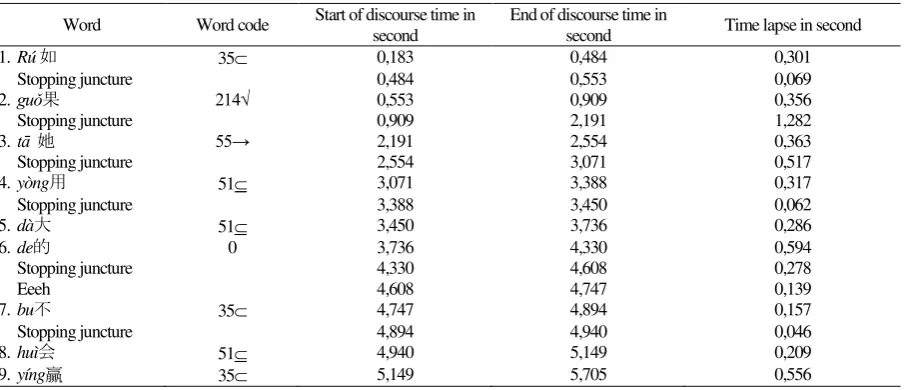
Table 1. Juncture and words spoken in Declarative sentence S3/24/KB Word Word code Start of discourse time in
second
End of discourse time in
second Time lapse in second
1. Rú如 35 0,183 0,484 0,301
Stopping juncture 0,484 0,553 0,069
2. guǒ果 214√ 0,553 0,909 0,356
Stopping juncture 0,909 2,191 1,282
3. tā 她 55→ 2,191 2,554 0,363
Stopping juncture 2,554 3,071 0,517
4. yòng用 51 3,071 3,388 0,317
Stopping juncture 3,388 3,450 0,062
5. dà大 51 3,450 3,736 0,286
6. de的 0 3,736 4,330 0,594
Stopping juncture 4,330 4,608 0,278
Eeeh 4,608 4,747 0,139
7. bu不 35 4,747 4,894 0,157
Stopping juncture 4,894 4,940 0,046
8. huì会 51 4,940 5,149 0,209
JUNTURE PATTERNS IN CHINESE SENTENCES
Here, four juncture patterns from the 26 research data are displayed and analyzed. Each sentence is displayed in two different Praat graphs to find out their types and positions.
1) Rú guǒ tā yòng dà de eeh bú huì yíng (Declarative sentence)
如 果 她 用 大 的 eeh 不会 赢。
„If she uses the big one, she won‟t win‟ (S3/24/ KB).
By comparing the two Praat displays, it can be seenthat all types of junctures are stopping junctures, because all juncture lines (left picture) show voids (right picture). Following Table 1 display juncture position with the time lapse (in seconds).
The use of junctures in S3 discourse is to emphasize the object of the sentence hence it is included in the thematic meaning and the juncture function. In this declarative sentence of S3, the juncture is functioned as the represen-tation of this game to explain that his sister cannot win, unless, marked by the juncture after the word de 的. The researcher observesthat the longest juncture occurs between the word rúguǒ 如果 and the word tā她 (1,282 seconds), and followed by the juncture between the word tā她 and the word yòng 用 (0,517 seconds). These junctures exist bet-ween an adverb and the subject. These junctures occur between three-tone words and one-tone words. It also appears between a word that consists of two syllables, like rúguǒ 如果 for 0,069 seconds; this juncture is not the
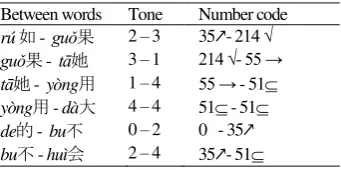
shortest time lapse. In this sentence, junctures happen not only before a four-tone word, as shown in the following Table 2.
Table 2. Juncture relationship with the Tone Words Between words Tone Number code rú如 - guǒ果 2 – 3 35↗- 214 √
guǒ果 - tā她 3 – 1 214 √- 55 →
tā她 - yòng用 1 – 4 55 → - 51 yòng用 - dà大 4 – 4 51 - 51 de的 - bu不 0 – 2 0 - 35↗ bu不 - huì会 2 – 4 35↗- 51
2) Wén Shèng, nǐ xiàn zài bú yào wán hǎo buhǎo? (Question sentence)
文 盛, 你 现 在 不 要 玩 好 不 好? „
Wén Shèng, will you please stop playing game now?‟ (S4/14/KT)
By comparing the two Praat displays, the reseracher observes that in the question sentence S4/14/KT two junctures occur, all of them are stopping junctures tíngdùn (停顿), because both juncture lines (left picture) show voids (right picture). Following Table 3 display of juncture position with the time lapse (in seconds).
Junctures in S4 discourse have affective meanings and are functioned interactively. The affective meaning is shown by the occurrence of junctures after subject and someone‟s name. (between Wén Shèng 文盛 and nǐ 你). Here, a
Wén Shèngnǐ xiàn zài bú yào wán hǎo bu hǎo?
文 盛 你 现 在 不要 玩 好 不 好?
ǐ ǎ ǎ
文 盛 你 现 在 不 要 玩 好 不 好?
Time (s)
0 2.028
P
it
ch
(
H
z)
75
500 1.0138125
S4_WENSHENG_NI_X_Z_BYW_HBH
ǐ
ǎ
ǎ
文 盛 你 现 在 不 要 玩 好 不 好?
Wén Shèng
n
ǐ
xiàn zài bú yào wán h
ǎ
o bu h
ǎ
o
?
文
盛
你
现
在
不
要
玩
好
不
好?
Fig. 2. Two Praat graphs distinguishing Stopping & Continuing Juncture
Table 3. Juncture and words spoken in Declarative sentence S4/14/KT Word Word code Start of discourse time in
second
End of discourse time in
second Time lapse in second
1. Wén 文 35 0,060 0,243 0,183
Stopping juncture 0,243 0,255 0,012
2. Shèng 盛 51 0,255 0,387 0,132
3. nǐ 你 214√ 0,387 0,502 0,115
Stopping juncture 0,502 0,514 0,012
4. xiàn 现 51 0,514 0,624 0,110
5. zài 在 51 0,624 0,746 0,122
6. bú 不 35 0,746 0,825 0,079
7. yào 要 51 0,825 0,977 0,152
8. wán 玩 35 0,977 1,128 0,151
9. hǎo 好 214√ 1,128 1,252 0,124
10. bú 不 0 1,252 1,373 0,121
juncture is used to express speaker‟s feeling that consists of stressing, in order to get his request fulfilled. Interaction function is seen from the juncture between the subject nǐ 你` and the predicate xiànzài 现在. According to the word structure, junctures happen within syllables of one word, and between two words. It also shows a tendency that junctures exist before four-tone words, as shown in the next Table 4.
Table 4. Juncture relationship with the Tone Words Between words Tone Number code Wén 文–Shèng 盛 2 – 4 35- 51 Nǐ你–xiàn 现 3 – 4 214√ - 51
3) Nǐ de gāngqín de shū gěi lǎoshī kàn, kuàidiàn! (Command sentence)
你 的钢 琴
的书给老师看, 快点!
„Show your piano book to the teacher, quick!‟ (S4/17/KP).
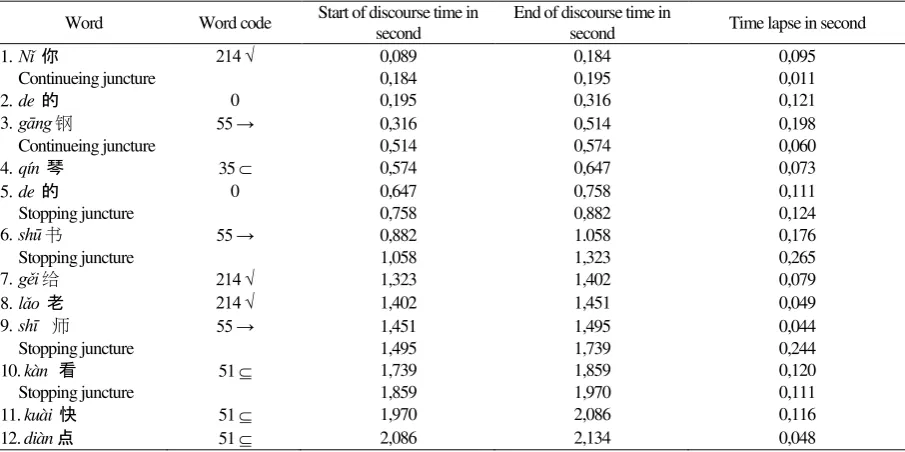
By comparing the two Praat graphs above, it is proven that in commanding sentence S4/17/KP six junctures occur; twice are continuing junctures or yánlián (延连) and the
other four are stopping junctures or tíngdùn (停顿). Continuing junctures show a constant line, both of the left or right figures, while stopping junctures show constant lines in the left figure, but voids in the right figure. Juncture positions and the time lapse of sentence S4/17/KP are shown in the next Table 5.
The researcher finds out that a continuing juncture occurs twice, between the word nǐ你
and the word de 的; between the syllable gāng 钢
and the syllable qín 琴 (from the word gāngqín 钢琴). The stopping juncture occurs four times, between the words de的 - shū书; and between the words shū书- gě i给; between the syllables shī 师 (from the word lǎoshī老师) - the word kà 看; and between the word kàn看 - the syllable kuài 快 (from the wordkuàidiàn 快点). If it is cautiously observed, the time lapse of continuing junctures is lesser than the time lapse of stopping junctures. Most of the junctures occur between words, and only once within a word consisting of two syllables, that is the word gāngqín
钢琴. Besides, junctures also tend to occur in word combinations that are followed with various tones, as shown in the following Table 6.
Nǐ de gāng qín de shū gěi lǎo shī kàn kuàidiàn! 你 的钢 琴的 书 给老 师 看, 快点!
ǐ gāng qín de shū gěi ǎshī kàn,
你 的 钢 琴 的 书 给 老师 看 快 点!
Time (s)
0 2.289
P
it
ch
(
H
z)
75 500
2.27656417 S4_NIDEGANGQIN__2_
ǐ de gāng qín de shū gěi lǎ shī kàn
你 的 钢 琴 的 书 给老 师 看 快 点!
Nǐ de gāng qín de shū gěi lǎshī kàn, kuài diàn! 你 的 钢琴 的 书 给 老师看, 快 点!
Fig. 3. Two Praat graphs distinguishing Stopping & Continuing Juncture
Table 5. Juncture and words spoken in Commanding sentence S4/17/KP Word Word code Start of discourse time in
second
End of discourse time in
second Time lapse in second
1. Nǐ 你 214 √ 0,089 0,184 0,095
Continueing juncture 0,184 0,195 0,011
2. de 的 0 0,195 0,316 0,121
3. gāng 钢 55 →
0,316 0,514 0,198
Continueing juncture 0,514 0,574 0,060
4. qín 琴 35 0,574 0,647 0,073
5. de 的 0 0,647 0,758 0,111
Stopping juncture 0,758 0,882 0,124
6. shū 书 55 → 0,882 1.058 0,176
Stopping juncture 1,058 1,323 0,265
7. gěi 给 214 √ 1,323 1,402 0,079
8. lǎo 老 214 √ 1,402 1,451 0,049
9. shī 师 55 → 1,451 1,495 0,044
Stopping juncture 1,495 1,739 0,244
10. kàn 看 51 1,739 1,859 0,120
Stopping juncture 1,859 1,970 0,111
11. kuài 快 51 1,970 2,086 0,116
Table 6. Juncture relationship with the Tone Words Between words Tone Number code
nǐ你
- de 的, 3 – 0 214 √ – 0
gāng 钢
- qín 琴 1 – 2 55 → – 35 de 的 - shū书 0 – 1 ringan – 55→
shū书–gě i给 3 – 3 55→ –214 √
shī 师 - kà 看 1 – 4 55→ – 51 kàn看- kuài 快 4 – 4 51– 51
Junctures in this S4 discourse have a thematic meaning and are functioned as an instrument. The thematic meaning can be seen from the occurred junctures, after the subject, before the predicate and before the object, which means the theme is focused on the predicate and the object. While junctures as an instrument function occur before the commanding instrument of the word kuàidiàn 快点 (quick!).
4) Wah! Lǎo shī, jiào shì li zhēn lěng a! (Shout-out sentence)
Wah! 老 师, 教 室 里 真 冷 啊!
ˈHey! Teacher, the class is really cold, yeah!ˈ (S6/39/KS)
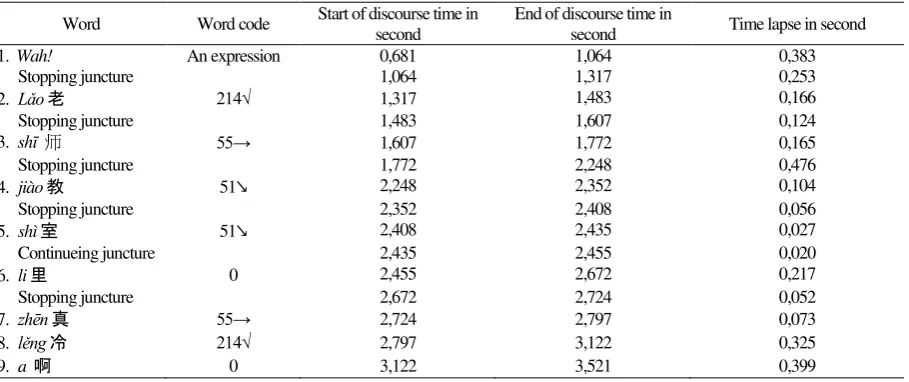
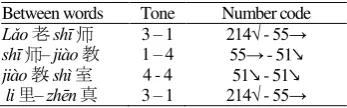
By comparing the two Praat graphs, the researcher observes that within shout-out sentence S6/39/KS, two kinds of junctures occur, once of a continuing juncture or yánlián (延连) between the word shì室 and the word li 里, and five
times of a stopping juncture or tíngdùn (停顿), between the word wah and the word Lǎoshī老师; between syllable Lǎo
老 and syllable shī师 (from the word shī老师); between the word shī老师 and the word jiàoshì 教室; between syllable jiào教and syllable shì 室 (from the word jiàoshì 教室); between the word li 里 and word zhēn 真. To know the different time lapse of these junctures, look at the following Table 7.
According to the theory of juncture, a sentence consists of two types of junctures, stopping and continuing junctures. A continuing juncture occurs only once, that is between the word jiàoshì 教室 and word li 里. Other junctures are the stopping junctures. The longest time lapse occurs between the words shī 老师 –jiàoshì 教室 lasting for 0,476 second and becomes the boundary between the subject and predicate of sentence S6/39/KS. The second longest is the stopping juncture between the shout-out word wah (hey) at the beginning of the sentence and the following words with a 0,235 second time lapse. It seems that junctures between two syllables in one word, syllable Lǎo老- and syllable shī
师 (from the word Lǎoshī 老师) are relatively longer compared to junctures between two words. A tendency of junctures also occurs in a word combination that followed by four-tone and one-tone words, which means junctures occuring at a combination of two words with the last word is spoken at tone level (5), as seen in the following Table 8.
Wah! Lǎo shī li zhēnlěng
老 师 教 室里 真 冷 啊!
` Wah! Lǎo shī jiào shì li zhēn lěng a! Wah! 老 师 教室里真 冷 啊!
Time (s)
0 4.212
P
it
ch
(
H
z)
75
500 3.18456864 TORI_137__S6_WAH_LAOSHI_JZL
` Wah! Lǎo shī jiàoshì li zhēnlěng a! Wah! 老 师 教室里真 冷 啊!
ǎ shī zhēn lěng a
老 师 教 室里真 冷 啊!
Fig. 4. Two Praat graphs distinguishing Stopping and Continuing Juncture
Table 7. Juncture and words spoken in Commanding sentence S6/39/KS Word Word code Start of discourse time in
second
End of discourse time in
second Time lapse in second
1. Wah! An expression 0,681 1,064 0,383
Stopping juncture 1,064 1,317 0,253
2. Lǎo老 214√ 1,317 1,483 0,166
Stopping juncture 1,483 1,607 0,124
3. shī 师 55→ 1,607 1,772 0,165
Stopping juncture 1,772 2,248 0,476
4. jiào 教 51↘ 2,248 2,352 0,104
Stopping juncture 2,352 2,408 0,056
5. shì 室 51↘ 2,408 2,435 0,027
Continueing juncture 2,435 2,455 0,020
6. li 里 0 2,455 2,672 0,217
Stopping juncture 2,672 2,724 0,052
7. zhēn 真 55→ 2,724 2,797 0,073
8. lěng冷 214√ 2,797 3,122 0,325
Table 8. Juncture relationship with the Tone Words Between words Tone Number code
Lǎo老- shī师 3 – 1 214√ - 55→
shī师–jiào 教 1 – 4 55→ - 51↘ jiào 教- shì 室 4 - 4 51↘ - 51↘
li 里–zhēn真 3 – 1 214√ - 55→
Function as the characteristic. Each focused theme that is emphasized has a juncture occurs in front of it. This occurs in front of the word zhēnlěng真冷ˈvery coldˈ. The junc -ture‟s meaning in this shout-out sentence is not clear, because besides occurring in front of the focused word, it also occurs at other words which should not have junctures. Junctures are functioned as a personality when its position occurs at the front of, or, before the adverbial word zhēnlěng 真冷 ˈvery coldˈ.
CONCLUSION
From the data analysis, the researcher finds out that the juncture patterns in all types of sentences (declarative/ question/command/shout-out), observed from the thematic meaning and the function, when an emphasized focus or instrument occurs in a word, then a juncture occurs before, or, at the beginning of the word. From the phonological point of view, juncture can occur between two syllables within one word, or between two words that consist of one syllable.
The junctures in Surabaya-citizen‟s speech occur more frequent between two words in a sentence than between two syllables within one word. Juncture variation exists in all types of sentences (declarative/question/command/shout-out). According to the thematic classification, both thematic and affective junctures occur as well. According to the function, there are instrument and interaction junctures The important thing is that, when a juncture occurs before the word, it is used to accentuate the meaning, for example like the meaning between a subject and a predicate, or a predicate and an object. A part of continuing juncture occurs between the combinations of two words, where the last word is a four-tone, one-tone, or light tone, or in other words the word has a high starting position (level 5). Continuing junctures have a time lapse of 0,011 to 0,066 second, but definitely those time lapses are not the shortest juncture in a sentence.
REFERENCES
Alwi, H., Dardjowidjojo, S., Lapoliwa, H., Moeliono, A.M. (2003). Tata Bahasa Baku Bahasa Indonesia (edisi ketiga). Jakarta: Balai Pustaka.
Chaer, A. (2007). Linguistik umum. Jakarta: Rineka Cipta. Dörnyei, Z. (2007). Research methods in applied linguistics:
Quantitative, qualitative, and mixed methodologies. New York: Oxford University Press.
Fáng, Y. (房玉清). (2008). Shíyòng Hànyǔ yǔfǎ (实用汉语语法). Běijīng: Běijīng Yǔyán Dàxué Chūbǎnshè.
Halliday, M.A.K., & Ruqaiya, H. (1976). Cohesion in English. London: Longman.
Hú, Y. (胡裕树). (1993). Xiàndài Hànyǔ (现代汉语). Hongkong: Joint Publishing Co., Ltd.
Hú, J. (胡吉成). (2006). Xiàndài Hànyǔ jīchǔ (现代汉语基础). Běijīng: Běijīng Dàxué Chūbǎnshè.
Huáng, B., & Liào, X. (黄伯荣、廖序东). (2005). Xiàndài Hànyǔ (现 代汉语). Běijīng: Gāoděng Jiàoyù Chūbǎnshè.
Leech, G. (2003). Semantik (P. Partana, Trans.). Yogya-karta: Pustaka Pelajar Offset.
Liú, Y. (刘月华), Pān, W. (潘文娱), & Gù, W. (故韡). (2001). Shíyòng xiàndài Hànyǔ yǔfǎ (实用现代汉语语法). Běijīng:
Shāngwù Yìnshūguǎn.
Miles, M. B., & Huberman, A. M. (1992). Analisis data kualitatif. Jakarta: Universitas Indonesia.
Marsono. (2006). Fonetik. Yogyakarta: Gadjah Mada Uni-versity Press.
Samarin,W. J. (1988). Field linguistics: A guide to linguistic field. (J.S. Badudu, Trans.). Yogyakarta: Kanisius. Wú, J. (吴洁敏). (2000). Hànyǔ jiélǜxué (汉语节律学).
Běijīng: Yǔwén Chūbǎnshè.
Xíng, F. (邢福义), & Wàng, G. (汪国胜). (2009). Xiàndài Hànyǔ (现代汉语). Wúhàn: Huázhōng Shīfàn Dàxué Chūbǎnshè.
Xíng, F. (邢福义). (2001). Xiàndài Hànyǔ (现代汉语). Běijīng: Gāoděng Jiàoyu Chūbǎnshè.
Xíng, G. (邢公畹). (2003). Xiàndài Hànyǔ jiàochéng
(现代汉语教程). Tiānjīng: Nánkāi Dàxué Chūbǎnshè.
Yè, F. & Xú, T. (叶蜚声、徐通锵). (1997). Yǔyánxué gāngyào (语言学纲要). Běijīng: Běijīng Dàxué