IOP Conference Series: Materials Science and Engineering
PAPER • OPEN ACCESS
Degradation Behaviour of Gamma Irradiated
Poly(Acrylic Acid)-graft-Chitosan Superabsorbent
Hydrogel
To cite this article: Dhena Ria Barleany et al 2018 IOP Conf. Ser.: Mater. Sci. Eng. 316 012007
View the article online for updates and enhancements.
Related content
Degradation of chitosan-based materials after different sterilization treatments A San Juan, A Montembault, D Gillet et al.
-Conformational Transition of Poly (Acrylic Acid) Detected byMicrocantilever Sensing Li Kai, Liu Hong, Zhang Qing-Chuan et al.
-1234567890‘’“”
QIR IOP Publishing
IOP Conf. Series: Materials Science and Engineering 316 (2018) 012007 doi:10.1088/1757-899X/316/1/012007
Degradation Behaviour of Gamma Irradiated Poly(Acrylic
Acid)-graft-Chitosan Superabsorbent Hydrogel
Dhena Ria Barleany1, Alpin Ilhami1, Dea Yusuf Yudanto1, Erizal2
1Department of Chemical Engineering, Faculty of Engineering, University of Sultan
Ageng Tirtayasa, Banten, Indonesia
2Centre for Application of Isotopes and Radiation, Jakarta, Indonesia
Email: [email protected]
Abstract. A series of superabsorbent hydrogels were prepared from chitosan and partially neutralized acrylic acid at room temperature by gamma irradiation technique. The effect of irradiation and chitosan addition to the degradation behaviour of polymer were investigated. The gel content, swelling capacity, Equillibrium Degree of Swelling (EDS), Fourier Transform Infra Red (FTIR), and Scanning Electron Microscopy (SEM) study were also performed. Natural degradation in soil and thermal degradation by using of TGA analysis were observed. The variation of chitosan compositions were 0.5, 1, 1.5, and 2 g and the total irradiation doses were 5, 10, 15, and 20 kGy. The highest water capacity of 583.3 g water/g dry hydrogel was resulted from 5 kGy total irradiation dose and 0,5 g addition of chitosan. From the thermal degradation evaluation by using of TGA analysis showed that irradiation dose did not give a significant influence to the degradation rate. The rate of thermal degradation was ranged between 2.42 to 2.55 mg/min. In the natural test of degradation behaviour by using of soil medium, the hydrogel product with chitosan addition was found to have better degradability compared with the poly(acrylic acid) polymer without chitosan.
1. Introduction
Absorbent hygiene products such as baby care products, feminine hygiene products and adult incontinence products are an essential part of everyday life. Baby care products include baby diapers, training pants, dry and wet baby wipes. Feminine hygiene products encompass sanitary pads, tampons, panty shields, interlabial devices, wipes and cosmetic removal pads. Adult incontinence products cover adult incontinence pads, adult pant diapers, underpads, personal/medicated wipes, and nursing pads. Amongst these products, baby diapers, sanitary pads and adult incontinence pads are the three mostly used disposable absorbent hygiene products [1].
1234567890‘’“”
QIR IOP Publishing
IOP Conf. Series: Materials Science and Engineering 316 (2018) 012007 doi:10.1088/1757-899X/316/1/012007
In modern societies, disposable diapers constitute a significant percentage of municipal solid wastes. They have been traditionally landfilled or incinerated as only limited recycling processes are being implemented in some parts of the world [5]. Diapers made from several material like synthetic pulp, polychlorine dibenzodioxins, superabsorbent gel of polyacrylic acid, and plastic. The introduction of superabsorbent polymers (polyacrylates) as a component of the diaper core in the 1980s was the most important improvement. Unlike traditional cellulose materials, polyacrylates have
the ability to retain liquid in the diaper core, keeping it away from the baby’s skin, even under pressure
[6]. However, the use of synthetic materials in this product causes some problems to the degradation process in soil. Synthetic material has resistant property to microorganism. Resistant property from synthetic material must be reduced or eliminated in order to avoid enviroment problem [7]. Technological progress and the need for alternative eco-friendly and inexpensive resources have put forward the use of natural polymers in superabsorbents. Unfortunately, the design of the hydrogels by using natural polymers usually would be biocompatible and biodegradable, but they have inferior mechanical properties compared to petroleum based polymers [8]. In recent years, modification of synthetic polymers with the natural polymers have been utilized for fabricating eco-friendly, super water absorbency, and great mechanical properties of superabsorbent hydrogels using grafting method [9].
Superabsorbents prepared with polysaccharides have attracted great attention because of their abundant resources, low production cost, and biodegradability [10, 11]. Polysaccharides are among the favourites with the main examples being starch [12], chitosan and guar gum [13]. Chitosan is a highly deacetylated derivative of chitin, shows interesting chemical, physical and biological properties [8]. Therefore, chitosan acts as a desirable backbone to graft poly(acrylic acid) forming a superabsorbent material [14]. The superabsorbent resins grafted with chitosan can absorb aqueous solutions up to hundreds of times their own dry weight [15] and should have the antibacterial activities [16]. Some synthetic materials were grafted onto chitosan with the aim to enhance the thermal and structural properties of the polymers. Two different deacetylation degree (DD%) and molecular weight of chitosan were subjected to grafting reactions with poly (n-butyl acrylate) to prepare natural/synthetic hybrid materials, then the products grafting percentage and efficiency were studied against acrylate/chitosan ratio and DD% [17]. A preparation of a porous carboxymethyl chitosan grafted poly (acrylic acid) (CMCTS-g-PAA) superabsorbent polymers with excellent properties was developed [18]. Synthesis and characterization of chitosan hydrogels, in macro- and nano-size, grafted with N-vinylcaprolactam (NVCL) using gamma radiation was recently evaluated, and the effect of dose and monomer concentration in the grafting process was studied [19]. The previous study [20] observed the effect of neutralization degree to the swelling properties of a novel poly (acrylic acid)-graft-chitosan superabsorbent hydrogel. In this study, partially neutralized acrylic acid was grafted onto chitosan backbone and the effect of some reaction conditions to the swelling capacity and degradation behaviour of grafted polymers were discussed.
This paper aims to determine the conditions that result good mechanical strength, superabsorbent property, and degradability. This paper reports the preparation of (acrylic acid)-graft-chitosan
superabsorbent hydrogels through ϒ-irradiation cross-linking procedures, besides the evaluation of
superabsorbent properties, mechanical properties, and biodegradability of hydrogels, as well as the influence of irradiation dose and chitosan composition in the reactant mixture on the properties of hydrogels. The data resulted from this research is very important and useful to predict the optimum condition in the synthesis of poly (acrylic acid)-graft-chitosan superabsorbent hydrogel with great performances in some criterias.
2. Materials and Methods
2.1. Materials
1234567890‘’“”
QIR IOP Publishing
IOP Conf. Series: Materials Science and Engineering 316 (2018) 012007 doi:10.1088/1757-899X/316/1/012007
of acrylic acid (Merck, Darmstard, Germany), and industrial grade of potassium hydroxide (NaOH) for neutrallization of acrylic acid before irradiation procedure, were purchased from Cv. Cahaya Kimia Indonesia. Distilled water was used for preparation of the hydrogel and swelling measurement.Chitosan food grade from PT. Biotech Surindo with a degree of deacetylation (DD) = 87.2% and a viscosity of 37.10 cps, glacial acetic acid from Merck, technical glycerol from Bratachem, red ginger oleoresin from PT. Lansida, and ethanol 96% from Sigma-Aldrich.Some text.
2.2. Methods
2.2.1. Preparation of poly(acrylic acid)-graft-chitosan . 85 mL of distilled water was poured into beaker glass, then 15 mL of acrylic acid solution and 5.6 g of potassium hydroxide was added until potassium acrylate was formed. Chitosan was added to this solution and mixed well with magnetic stirrer. After homogen, the reactant mixture solution was packed in a small plastic container then
irradiated with the variation of ϒ-irradiation total doses of 5 kGy, 10 kGy, 15 kGy and 20 kGy to form
poly(acrylic acid)-graft-chitosan). The hydrogels were dried by putting them into oven with the temperatur was maintained at 60oC over 24 hours. The dried hydrogels were crushed into powder size by using of a blender.
2.2.2. Gel Content Measurement. An amount of 0.01 g of hydrogel powder was measured and packed in the tea bag. Tea bag with the hydrogel powder inside was then immerse into water for 24 hours at 30oC. After this process, the tea bag then was put in the oven for 24 hours at 60oC and weighed. Gel content was calculated using the equation (1).
100 [12]. Powdered hydrogel (0.1 g) were immersed in distilled water (100 mL) at room temperature. At 30 seconds time intervals, the samples were removed from the swelling medium and blotted on a filter prior to weighing to remove excess surface moisture. The swelling ratio was calculated according to the following expression :
1234567890‘’“”
QIR IOP Publishing
IOP Conf. Series: Materials Science and Engineering 316 (2018) 012007 doi:10.1088/1757-899X/316/1/012007
% 100In this research, superabsorbent hydrogel for diaper application was made from acrylic acid, potassium
hydroxide and chitosan with gamma (γ) irradiation of Co-60 as an iniatior or crosslinking agent [21].
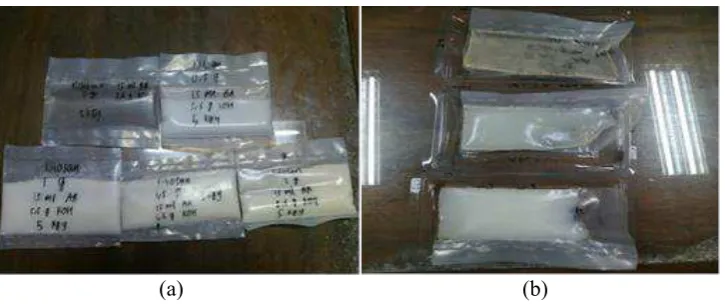
(a) (b)
Figure 1. Superabsorbent hydrogel (a) variation of chitosan (b) variation of gamma irradiation dose with 0,5 g of chitosan
From figure 1 (a), the mass variation of chitosan used in the reactant affects the hydrogel colour.
Figure 1 (b) shows how ϒ-ray of radiation makes the hydrogel texture difference. Hydrogel with high
dose of radiation has a slight white colour due to crosslinking process between chitosan and neutralized poly(acrylic acid). In low dose of ϒ-ray radiation, chitosan acts as filler because of the unperfect crosslinking reaction.
3.1. Swelling Capacity
Swelling value shows the ratio between mass of water or solution absorbed by hydrogel to mass of dry hydrogel. Swelling test can show the hydrogel performance. On swelling test, hydrogel powder was immersed into water with variation of time from 30 seconds to 240 seconds with 30 seconds of time interval.
1234567890‘’“”
QIR IOP Publishing
IOP Conf. Series: Materials Science and Engineering 316 (2018) 012007 doi:10.1088/1757-899X/316/1/012007
(a) (b)
Figure 2 Swelling capacity of superabsorbents with (a) variation of chitosan weight (b) variation of gamma radiation dose
In figure 2 (a) shows that the swelling of hydrogel decreases from 2 g of chitosan to 0 g of chitosan, meanwhile in figure 2 (b) the swelling of hydrogel increases from 20 kGy to 5 kGy with variation of time, 30 seconds to 240 seconds. Hydrogel with 240 seconds of time immersion has the greatest swelling capacity. At a longer time, the amount of water absorbed in the gel matrix would be higher . However, when it was reached a saturation condition, the gel won’t absorb more water. More chitosan presents in the reactant cause the decreasing of water swelling capacity. Like other natural polymers, at constant total dose of radiation, there will be excess chitosan in the matrix which is not crosslinked properly and fill spaces between the crosslinked-network [21].
In figure 2 (b), total dose of gamma radiation has responsible for swelling capacity. Higher dose of radiation causes the decreasing of hydrogel absorption capacity. 5 kGy of radiation result 583.3 g water/g dry hydrogel of swelling, and for 20 kGy of radiation generate 277 g water/g dry hydrogel of swelling. Total dose of radiation affects density of crosslinking reaction and absorption capacity. High density of the bond indicates small pore in the network, this may cause the difficulty for water to be absorbed inside [22].
3.2. Equilibrium Degree of Swelling (EDS)
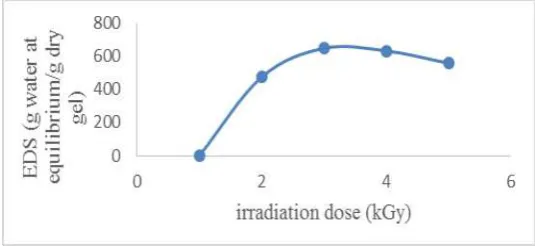
Equilibrium degree of swelling (EDS) is one of important parameters that shows swelling ratio in maximum condition. The maximum condition occures because of the hydrophilic group in hydrogel which has the hydrogen bond with water, or the hydrophilic group in hydrogel reaches the equilibrium condition. In general, every hydrogel has different value of EDS, depending on the component. Figure 3 presents the effect of dose of radiation that has measured for 24 hours at room temperature. Higher dose of radiation causes the increasing of density of the network, and as a result, the EDS value decreases.
Figure 3. EDS value at constant chitosan composition (0.5 g)
1234567890‘’“”
QIR IOP Publishing
IOP Conf. Series: Materials Science and Engineering 316 (2018) 012007 doi:10.1088/1757-899X/316/1/012007
Gel fraction is a parameter that used to evaluate the efficiency in the synthesis process of hydrogel
depending on total dose of ϒ-radiation. Gel fraction has been tested on variation of radiation doses.
Figure 4 presents how the radiation gives effect to the gel fraction. This figure shows that the gel content increases during the increasing of total dose of radiation [23].
Figure 4. Gel content (%) at variation of ϒ- radiation total dose
3.4. Functional Group Analysis with FTIR
Infrared spectroscopy or Frourier Transform Infrared (FTIR) is the instrument that is used to find the functional groups of organic, polymer or coating compunds. FTIR is able to analyze material in many forms such as liquid, solid, fiber, paste, powder, or another form. Functional groups of modificated hydrogel were confirmed by FTIR spectroscopy. Functional groups of chitosan was confirmed by the FTIR spectra study as shown in Figure 5. In figure 5 (a), the hydroxyl group appears at 3475.88 cm-1 that is bothered by weak amina groups (-NH2) at 3700 cm-1. CO at 1015.57 cm-1 indicates the bonding
1234567890‘’“”
QIR IOP Publishing
1234567890‘’“”
QIR IOP Publishing
IOP Conf. Series: Materials Science and Engineering 316 (2018) 012007 doi:10.1088/1757-899X/316/1/012007
Figure 5. FTIR spectra of (a) Chitosan (b) acrylic acid (c) poly (acrylic acid) and (d) poly (acrylic acid)-graft-chitosan
3.5. Thermal Degradation
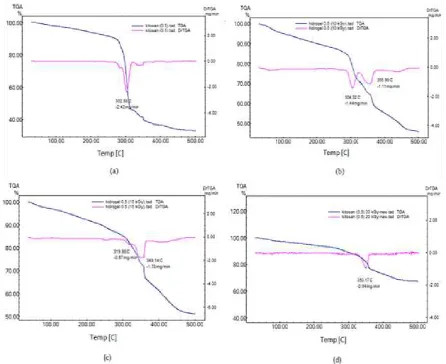
The thermal decomposition of poly(acrylic acid)-graft-chitosan was analyzed by using of TGA as shown in figure 6. High dose of radiation results the increasing of melting point temperature of the hydrogel. Melting point of the hydrogel obtained from this research for 5 kGy, 10 kGy, 15 kGy, 20 kGy variation of total dose of radiation are respectively 302.88oC, 304.32oC, 319.98oC and 350.17oC. The synthesis of hydrogel using the lowest dose (5 kGy) affects the unproper reaction during the radiation. In another word, low dose of radiation produce the hydrogel with low density of crosslink, so the hydrogel becomes more amorphous.
Derivative graph of TGA in figure 6 (a), (b) and (c) show more than one peak of endotherm decomposition, this are indicate that chitosan in the hydrogels result unstable chain during the reaction, so that the products becomes sensitive to thermal charge and easier to degrade. From the thermogram, can be concluded that rate of heating of the hydrogels from 30oC to 500oC is 10oC/minute as shown in table 1.
1234567890‘’“”
QIR IOP Publishing
IOP Conf. Series: Materials Science and Engineering 316 (2018) 012007 doi:10.1088/1757-899X/316/1/012007
Figure 6. TGA thermogram of hydrogel prodused by varied total dose of radiation (a) 5 kGy (b) 10 kGy (c) 15 kGy (d) 20 kGy
Table 1. Rate of thermal decomposition respect to the grafted hydrogel
Radiation dose (kGy) Degradation rate (mg/min)
5 2.42
10 2.55
15 2.45
20 0.94
3.6. Biodegradation Study
1234567890‘’“”
QIR IOP Publishing
IOP Conf. Series: Materials Science and Engineering 316 (2018) 012007 doi:10.1088/1757-899X/316/1/012007
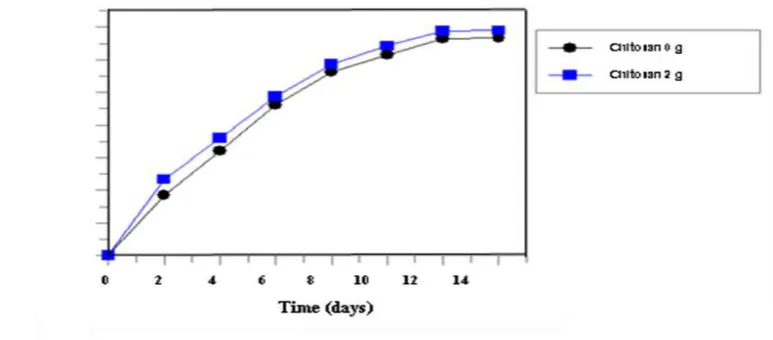
produced from pure synthetic material than hydrogel produced from synthetic material with the addition of chitosan as natural material. Like any other natural materials, chitosan is biodegradable. Microorganism activity can easily degrade chitosan in the soil. Chitosan based grafted polymer can be a solution to produce an eco-friendly superabsorbent resin for diaper application with great performance.
Figure 7. Biodegradation of poly(acrylic acid)-graft-chitosan at varied using of chitosan
Hydrogel with 2 g of chitosan has 13.8% rate of biodegradation, faster than hydrogel without chitosan which only reaches 13.3%. Hydrogel with more chitosan is easy to digest by microorganism in the soil. Microorganism activity will break the chemical bond [25]. The difference weight loss between hydrogel with chitosan and hydrogel without chitosan were not significant because some species of microorganisms in the soil can not decompose chitosan [7].
3.7. SEM Study
The surface morphology of the hydrogel was characterized by SEM at magnifications of 750x. Pore
size of modified hydrogel is ranged from 10 μm to 25 μm and was confirmed by SEM as shown in
figure 8. Hydrogel without chitosan with same composition and neutralization condition of acrylic acid has 38-39 μm of pore size. Hydrogel poly(acrylic acid)-graft-chitosan has a smaller pore than poly(acrylic acid) without chitosan. In some parts of the matrix found that chitosan filled in some pores of hydrogel and caused reduction of the hydrogel pore size.
1234567890‘’“”
QIR IOP Publishing
IOP Conf. Series: Materials Science and Engineering 316 (2018) 012007 doi:10.1088/1757-899X/316/1/012007
4. Conclusion
The best product of poly (acrylic acid)-graft-chitosan superabsorbent hydrogel obtained from this study was produced with addition of 0.5 g of chitosan and synthesize using 5 kGy total dose of ϒ-ray radiation which has reached 583.3 g water/g dry hydrogel of swelling capacity. This product has the biggest absorption capacity than the other compositions and doses. In addition, rate of thermal degradation of this superabsorbent hydrogel is 2.42 mg/min, and the biodegradation ability is better than product which irradiated with total dose of 10 kGy, 15 kGy and 20 kGy.
5. References
[1] Das D, 2014 Composite Non-Woven Materials (United Kingdom: Woodhead Publishing Limited) p 74-88
[2] Torrijos M, Sousbie P, Rouez M, Lemunier M, Lessard Y, Galtier L, Simao A and Steyer J P 2014 Waste Management 34 669-75
[3] Global Industry Analysts Inc. (GIA) 2017 Baby Disposable Diapers- Global Startegic Business
Report, [online] Available at:
http://www.prweb.com/releases/baby_disposable_diapers/premium_designer_diapers/prweb 8973346.htm [Accessed 30 Mar. 2017]
[4] Euromonitor International 2017 Nappies/Diapers/Pants in Indonesia, [online] Available at:
http://www.euromonitor.com/nappies-diapers-pants
[Accessed 30 Mar. 2017].[5] Colón J, Mestre-Montserrat M, Puig-Ventosa I and Sánchez A 2013 Waste Management 33 1097-103
[6] Kosemund K, Schlatter H, Ochsenhirt J L, Krause E L, Marsman D S and Erasala G N 2009
Regulatory Toxicology and Pharmacology 53 81-9
[7] Pradhan A K, Rana P K and Sahoo P K 2014 International Journal of Biological Macromolecules74 620-6
[8] Spagnol C, Rogdrigues F H A, Pereira A G B P, Fajardo A R Rubira A F and Muniz E C 2012
Cellulose19 (4) 1225-37
[9] Singh V, Kumar P and Sanghi R 2012 Progress in Polymer Science37 (2) 340-64
[10] Likhitha M, Sailaja R R N, Priyambika V S and Ravibabu M V 2014 International Journal of Biological Macromolecules65 500-8
[11] Huang Z, Liu S, Fang G and Zhang B 2013 Carbohydrate Polymers92 2314-20
[12] Barleany D R, Ulfiyani F, Istiqomah S, Heriyanto H, Rahmayetty and Erizal 2015 AIP Conference Proceeding 1699 2nd International Conference of Chemical and Material Engineering (ICCME) 2015 (Semarang 29-30 September Indonesia) 040008-1–040008-10 doi: 10.1063/1.4938323
[13] Glampedaki P and Duschk V 2015 Functional Finishes for Textiles (United Kingdom: Woodhead Publishing Series in Textiles) p 283-302
[14] Rusu A G, Popa M, Ibanescu C, Danu M and Verestiuc L 2016 Materials Letters164 320-4 [15] Erizal, Abbas B, Sukaryo S G and Barleany D R 2015 Indo. J. Chem. 15 (3) 281-7
[16] Barleany D R, Alim I P, Rizkiyah N, Lusi U T, Heriyanto H and Erizal 2016 Proceeding of International Conference on Technology, Innovation, and Society (ICTIS) 2016 (Padang 20-21 July Indonesia)
[17] Anbinder P, Macchi C, Amalvy J and Somoza A 2016 Carbohydrate Polymers145 86-94 [18] Chen Y, Zhang Y, Wang F, Meng W, Yang X, Li P, Jiang J, Tan H and Zheng Y 2016
Materials Science and Engineering C63 18-29
[19] Cruz A, García-Uriostegui L, Ortega A, Isoshima T and Burillo G 2017 Carbohydrate Polymers 155 303-12
[20] Barleany D R, Lestari R S D, Yulvianti M, Susanto T R, Shalina and Erizal 2017 International Journal on Advanced Science Engineering and Information Technology7 (2) 702-8
1234567890‘’“”
QIR IOP Publishing
IOP Conf. Series: Materials Science and Engineering 316 (2018) 012007 doi:10.1088/1757-899X/316/1/012007
167-71.
[23] Demeter M, Virgolici M, Vancea C, Scaresorenau A, Kaya M G A and Meltzer V 2017
Radiation Physics and Chemistry131 51-9
[24] Saruchi, Kaith B S, Jindal R and Kumar V 2015 Polymer Degradation and Stability115 24-31 [25] Mittal H, Mishra S B, Mishra A K, Kaith B S, Jindal R and Kalia S 2013 Carbohydrate