CHEMICAL AND PHYSICAL PROPERTIES OF CASSAVA STARCH–CM-CHITOSAN–
ACRYLIC ACID GEL COPOLYMERIZATION BY GAMMA IRRADIATION
Gatot Trimulyadi Rekso
Center for Application of Isotopes and Radiation, National Nuclear Energy Agency, Jl. Cinere, Pasar Jumat PO Box 7002 JKSL Jakarta 12070 Indonesia
Received January 30, 2014; Accepted March 11, 2014
ABSTRACT
Starch is a renewable natural polymer that can be decomposed easily in the environment and can be modified to various applications such as biomedical, agricultural and pharmaceutical applications. Copolymerization of
gelatinized starch–CM-chitosan and acrylic acid (AAc) in aqueous medium using γ-irradiation was carried out. The
preparation conditions, such as irradiation dose and AAc concentration were investigated. The copolymers were characterized by FTIR spectroscopy, thermo-gravimetric analysis (TGA) and scanning electron microscopy (SEM). The results show that by increasing of irradiation dose the gel fraction increases till the dose of 15 kGy. Above the stating dose the gel fraction decreases. The Equilibrium Degree of Swelling (EDS) value slightly increases with increasing irradiation dose and after dose of 15 kGy is decreasing. The swelling of starch–CM-chitosan–AAc hydro gels reduced as the gel content increases. The results indicated that the optimum condition for obtaining hydro gels with desirable properties was irradiated at dose of 15 kGy. The results indicated that SEM revealed that the higher the dose, the lower the copolymer pore size. The starch–CM-chitosan–AAc copolymers have thermal stability higher than that for starch individually.
Keywords:cassava starch; chitosan; acrylic acid; radiation copolymerization
ABSTRAK
Pati merupakan bahan polimer alam yang terbarukan serta ramah lingkungan dan dapat dimodifikasi untuk berbagai keperluan di bidang biomedis, pertanian dan farmasi. Pada penelitian ini dilakukan modifikasi pati-KM kitosan dengan asam akrilat, kopolimerisasi dilakukan dengan teknik iradiasi mempergunakan sinar gamma yang berasal dari Co-60. Parameter yang diteliti adalah dosis iradiasi dan konsentrasi asam akrilat. Pengujian dilakukan meliputi fraksi padatan dan derajat pengembangan serta karakterisasi mempergunakan peralatan FTIR spektroskopi, thermo-gravimetri (TGA) dan mikroskop elektron pemindai (SEM). Hasil yang diperoleh menunjukkan bahwa kenaikan dosis iradiasi sampai 15 kGy meningkatkan nilai fraksi padatannya dan di atas dosis tersebut mulai terjadi penurunan. Nilai derajat pengembangan sedikit meningkat dengan kenaikan dosis sampai 15 kGy dan menurun di atas dosis tersebut. Hasil ini menunjukkan bahwa dosis iradiasi terbaik adalah 15 kGy. Hasil karakterisasi dengan SEM menunjukkan bahwa pertambahan dosis iradiasi akan menyebabkan pori pori pati kopolimerisasi asam akrilat mengecil. Hasil TGA memperlihatkan bahwa pati kopolimerisasi memiliki sifat termal yang lebih baik daripada pati tak termodifikasi.
Kata Kunci:tepung singkong; kitosan; asam akrilat, kopolimerisasi radiasi
INTRODUCTION
Radiation has been recognized as a highly suitable tool for the formation of hydrogels [1-2]. Hydrogels can be defined as hydrophilic polymer networks that can retain a significant amount of water within their structures and swell without dissolving in water.
The radiation processing has many advantages such as easy process control, simultaneous cross-linking of polymer to hydrogel formation and sterility of the product and the technology is environment friendly since it leaves no residue or pollutant in the environment [3-4].
cassava starch has become an attractive candidate for the development of biomedical materials. Chitin, the most abundant naturally is undoubtedly one of the most promising and attracting resources present in quantity. Chitosan is a linier polysaccharide derived from chitin, a major component of the shell of the crustacean organisms and the second most abundant biopolymer in nature next to cellulose. In the last year chitosan has proved to be valuable product for using in different application such as seed coating, chelating and growth promoters etc. Chitosan reported to have various biological functions, for instance, antimicrobial activity, growth inhibitor of some pathogens [9].
Hydro gels can be classified as homopolymer hydrogels, copolymer hydrogels, multipolymer hydrogels or interpenetrating polymeric hydrogels. Homopolymer hydrogels are cross-linked network of one type of hydrophilic monomer unit, while copolymer hydrogels are prepared from the cross-linking of two co monomer units, one of which must be hydrophilic. Multipolymer hydrogels are formed by the cross-linking of more than three monomers, Interpenetrating polymeric hydro gels are formed by first swelling a network in a monomer after that reacting the latter to form a second interpenetrating network structure [11].
The purpose of this research is to convert natural polymers into useful products potentially applicable for agriculture application such as slow release material for NPK fertilizer. In this study, a series of hydrogels were prepared from gelatinized cassava starch mix with CM-chitosan and acrylic acid by gamma radiation-induced graft copolymerization
EXPERIMENTAL SECTION
Materials
Chitosan was extracted from shrimp shell (Penaceaus merguiensis) was obtained from Muara Karang, North Jakarta. Cassava starch was obtained from local chemical store in Jakarta, acrylic acid (p.a), NaOH (p.a), HCl (p.a), were obtained from E. Merck, Germany.
powder samples, the samples were pressed into KBr pellets and analyzed using transmission mode. For hydrogel samples, the samples were shaped into films and characterized using Attenuated Total Reflectance (ATR) technique, with 64 co-added scans and a resolution of 4 cm-1.
Thermal analysis
Thermal Gravimetric Analyzer (TGA/SDTA851) from Mettler Toledo was used to characterize the thermal properties of the samples. All experiments were done under nitrogen purge; with a flow rate of 60 mL/min. A heating rate of 10 °C/min was used for TGA experiments.
Procedure
Preparation of chitosan
White shrimp shell (Penaceaus merguiensis) was dried in vacuum oven at 50 °C for 12 h. Then the isolation of chitin by soaking the dried shrimp shell in 1N HCl at temperature of 80 °C for 3 h to remove mineral and 1 N NaOH for 5 h at 80 °C to remove protein. The dried chitin was then pulverized and reacted with 50% (w/w) NaOH in the mixing reactor at 100 °C in the ratio of 1:10 for 5 h.
Preparation of CM-chitosan
Chitosan and pure ethanol were mixed and stirred in a flask for 30 min, then 50% (w/v) NaOH solution was gradually dropped into the mixture, and stirring continued for another 20 min. Sodium mono chloric acid (SMCA) was added to the solution. The mixture was heated to 45-50 °C and continuously stirred at this temperature for 2 h. The synthesized CM-chitosan samples were filtered, washed thoroughly with water, and finally dried in a vacuum oven at 50 °C.
Fig 1. The effect on irradiation dose and acrylic acid concentration on the gel fraction value
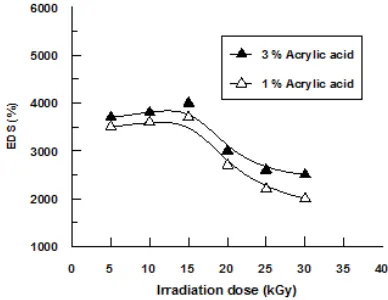
Fig 2. The effect on irradiation dose and acrylic acid concentration on the swelling behavior
nitrogen purge. The mixture was gradually heated from ambient temperature to 80 °C and held at this temperature for 1 h. The mixture was left to cool down to room temperature to yield the gelatinized starch. The obtained gelatinized starch–CM-chitosan was mixed with Acrylic acid (AAc) solution in distilled water, with the final concentration of starch and AAc at 1% and 3%, respectively. The mixture was continuously stirred to form a homogeneous blend. The mixture was then transferred into screw-capped glass tubes, exposed to gamma radiation at various doses. After irradiation, the obtained hydro gels were washed well with water and dried in a vacuum oven at 50 °C until the weight was constant.
Irradiation and drying
The above mixture was gamma-irradiated in the presence of oxygen in the gamma C0-60 source at absorbed doses of 5, 10, 15, 20, 25 kGy. After irradiation the product was dried in a vacuum oven at 50 °C for 24 h.
Gel fraction
The gel samples were wrapped into a 200-mesh than soxhlet extraction using methanol for 6 h to remove the soluble (sol) fraction. The samples were then taken out and dried in a vacuum oven at 50 °C to constant weight to gravimetrically determine the insoluble (gel) fraction using the following equation:
Gel Fraction d 100
where Wd is the weight of dried gel after extraction and Wiis the initial weight of gel before extraction.
Equilibrium Degree of Swelling (EDS)
The gel samples were immersed directly in distilled water for 72 h at ambient temperature, to reach the equilibrium state of swelling. The weight of the swollen gel (Ws) was then measured. The swollen gels were
later dried in a vacuum oven at 50 °C until the weight of the dried gels (Wd) remained constant. EDS was determined from the following equation:
EDS = Ws/ Wdx 100
RESULT AND DISCUSSION
The Gel Fraction Value
The effect of acrylic a monomer concentration on the gel fraction with concentration of 1.0% and 3.0% with variation doses of 5, 10, 15, 20 and 25 kGy is shown in Fig. 1. It can be seen that the gel fraction independent of the AAc monomer concentration. The concentration of 3% gives higher gel fraction value compare with 1%.
The effect of the total dose on the gel fraction is also presented in Fig. 1. With increasing dose, gel fraction value begins to rise until doses of 15 kGy and finally above 15 kGy decreases. This is because during the irradiation process, the energy from gamma radiation is transferred to the irradiated material, resulting in a variety of modifications that change the chemical and molecular structure of the material [12-13].
These modifications include cross-linking, degradation, grafting, crystal lattice modification, and polymerization (curing) of monomers and polymer. Generally, when a polymer is irradiated, cross-linking and degradation take place simultaneously. But the ratio of their rates depends on a number of factors, including the chemical structure of the polymer, its physical state, and the irradiation state. Polymers are generally divided into those that predominantly cross-link and those that predominantly degrade.
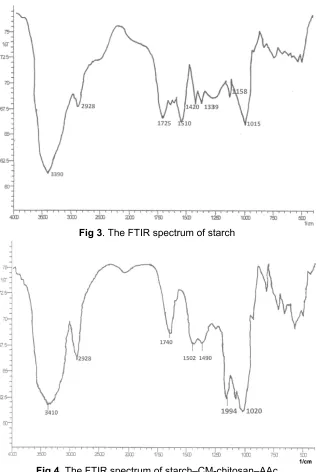
Fig 3. The FTIR spectrum of starch
Fig 4.The FTIR spectrum of starch–CM-chitosan–AAc
highest gel fraction value is 15 kGy.
Swelling Behavior
The swelling ratio of the starch–CM-chitosan–AAc hydro gels as a function of concentration of AAc (1% and 3%) and dose is presented in Fig. 2. The swelling ratio in deionizer water almost constant till irradiation dose of 15 kGy. Above 15 kGy the swelling ratio decreases with increasing dose. This is probably due to the increase of cross linking density with irradiation dose [14].
A hydrogel has the ability to absorb and hold significant amount of solvent (water) in network structure
and swelling ratio is an important property in consideration as water absorbent. Swelling ratio reflects the cross-linking of a polymer. With an increased cross-linked density, the swelling ratio usually decreases because void spaces in the polymer network are reduced for free water entrance.
Fig 5. SEM Micrographs of: starch–CM-chitosan–AAc
irradiated 5 kGy Fig 6.irradiated 15 kGySEM Micrographs of: starch–CM-chitosan–AAc
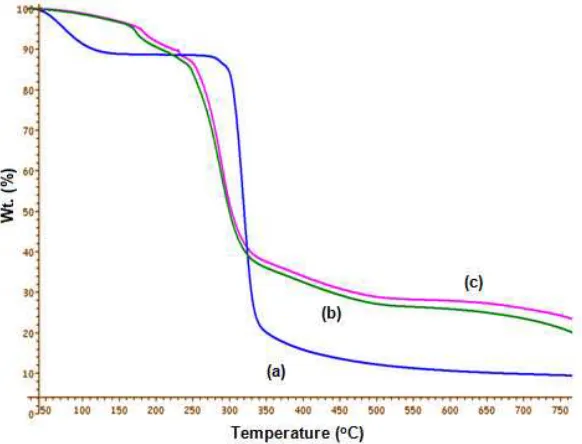
Fig 7.TGA Curves of (a) starch, (b) starch–CM-chitosan–AAc irradiated 5 kGy. (c) starch–CM-chitosan–AAc irradiated 15 kGy
creating an electrostatic repulsion which increases swelling ratio [15].
FTIR Analysis
FTIR analysis was used to provide evidences for copolymerization reaction of AAc onto starch and CM-chitosan. The FTIR spectra of the original starch, and starch–CM-chitosan–AAc irradiated 15 kGy. The spectrum of dried hydro gel are taken and comparatively shown in Fig. 3 and 4.
In the spectrum of cassava starch, the band at 2928 cm-1 is attributed to the asymmetric stretching of C–H, while the band at 1725 cm-1 is ascribed to adsorbed water and the bands at 1420 cm-1and at 1339 cm-1to the angular deformation of C–H. The C–O ether band shows stretching at 1158 cm-1 while the C–O
alcohol band shows stretching at 1015 cm-1. But in the spectrum of cassava starch/acrylic acid copolymers, a new peak at 1740 cm-1shows for the C=O stretching of carbonyl group of acrylic acid. This C=O stretching of carbonyl group peak is also found in the spectrum of acrylic acid. This result indicates that acrylic acid interacts/entraps with cassava starch.
Scanning Electron Microscopy
thermogram of starch displayed a two-stage weight loss process.
The first process started very early and slowly continued until 160 °C, indicating the evaporation of approximately 12% moisture content in starch. The second weight loss process began at about 270°C and reached its maximum rate of weight loss at roughly 320 °C. The amount of char left at 800 °C is nearly 10%. Compared with copolymers of starch–CM-chitosan–AAc irradiated 5 kGy and 15 kGy illustrated slightly different thermograms, with the first process of weight loss shifting to lower temperature (about 160 °C) and the second one shifting towards higher temperature (roughly 240 °C). A major difference took place at approximately 330 °C, where starch continued to degrade with high rate of weight loss, but copolymers of starch–CM-chitosan–AAc irradiated 5 kGy and 15 kGy did so with a gradual rate, leaving around 19% and 21% char yield, respectively. This clearly demonstrates that copolymers of starch–CM-chitosan–AAc irradiated 5 kGy and 15 kGy have different chemical structures, compared with starch, and also better thermal stability.
CONCLUSION
Copolymerization of starch–CM-chitosan–AAc hydro gel was successfully synthesized by radiation-induced cross linking. The results show that by increasing of irradiation dose the gel fraction increases till the dose of 15 kGy. Above the stating dose the gel fraction decreases. In the other hand the Equilibrium Degree of Swelling (EDS) value decreased with increasing irradiation dose and after dose of 15 kGy, decreasing of EDS low relatively.
The swelling of starch–CM-chitosan–AAc hydrogels reduced as the gel content increases. The results indicated that the optimum condition for obtaining hydrogels with desirable properties was irradiated at dose of 15 kGy. At higher doses, the gel fraction tends to diminish due to the domination of degradation over cross-linking.
Rosa, A.M., 2003, Radiat. Phys. Chem., 68 (5), 901–908.
2. Park, K.R., and Nho, Y.C., 2003, Radiat. Phys. Chem., 67 (3-4), 361–365.
3. Wach, R.A., Mitomo, H., Nagasawa, N., and Yoshii, F., 2003,Radiat. Phys. Chem.,68 (5), 771–779. 4. Yoshii, F., Zhao, L., Wach, R.A., Nagasawa, N.,
Mitomo, H., and Kume, T., 2003, Nucl. Instrum. Methods Phys., Res., Sect. B, 208, 320–324. 5. Wu, G., Long, D., Chen, S., and Yao, S., 2005,
Carbohydr. Polym., 60 (1), 61–65.
6. Chen, P., Zhang, W., Luo, W., and Fang, Y., 2004,
J. Appl. Polym. Sci., 93 (4), 1748–1755.
7. Dafader, N.C., Haque, M.E., Akhtar, F., and Ahmad, M.U., 2006, Radiat. Phys. Chem., 75 (1), 168–172.
8. Fei, B., Wach, R.A., Mitomo, H., Yoshii, F., and Kume, T., 2000, J. Appl. Polym. Sci., 78 (2), 278– 283.
9. Wasikiewicz, J.M., Yoshii, F., Nagasawa, N., Wach, R.A., and Mitomo, H., 2005, Radiat. Phys. Chem., 73 (5), 287–295.
10. Wasikiewicz, J.M., Mitomo, H., Nagasawa, N., Yagi, T., Tamada, M., and Yoshii, F., 2006,J. Appl. Polym. Sci., 102 (1), 758–767.
11. Zhai, M., Yoshii, F., and Kume, T., 2003,
Carbohydr. Polym., 52 (3), 311–317.
12. Nagasawa, N., Yagi, T., Kume, T., and Yoshii, F., 2004,Carbohydr. Polym., 58 (2), 109–113.
13. Zhang, J., Wang, Q., and Wang, A., 2007,
Carbohydr. Polym., 68 (2), 367–374.
14. Saraydin, D., Karadag, E., Işikver, Y., Şahiner, N., and Güven, O., 2004, J. Macromol. Sci. Part A Pure Appl. Chem., 41 (4), 419–431.
15. Zhan, F., Liu, M., Guo, M., and Wu, L., 2004, J. Appl. Polym. Sci., 92 (5), 3417–3421.
16. Zhou, B., 2003,J. Chem. Fert. Ind., 30, 55–56. 17. He, X.S., and Zhang, F.D., 2005, Plant Nutr. Fert.