URBAN GOVERNANCE
IN INDIA
transmitted in any form or by any means, electronic, mechanical, photocopying, micro-filming, recording or otherwise, or translated in any language, without the prior written permission of the copyright owner and the publisher. The book is sold subject to the condition that it shall not, by way of trade or otherwise, be lent, resold, hired out, or otherwise circulated without the prior publisher’s written consent in any form of binding or cover other than that in which it is published.
The views and opinions expressed in this book are author(s) own and the facts reported by them have been verified to the extent possible, and the publishers are not in any way liable for the same.
ISBN: 978-93-5128-174-0 Price: ` 890
First Published, 2016 Published by
Kalpaz Publications C-30, Satyawati Nagar, Delhi – 110052
E-mail: [email protected] Ph.: 9212142040
Printed at: G. Print Process, Delhi
Cataloging in Publication Data—DK
Courtesy: D.K. Agencies (P) Ltd. <[email protected]>
Nagaraja Rao, C., 1954- author.
Urban governance in India / C. Nagaraja Rao. pages cm
Includes bibliographical references. ISBN 9789351281740
1. Municipal government—India. 2. Urbanisation—India. 3. Urban policy—India. 4. Infrastructure (Economics)—India. I. Title.
Acknowledgement 11
Preface 13
Abbreviations 17
1. Introduction 21
Importance of Urban Governance; The Complexities of Urban Local Governance; Reforms in Urban Governance-Legislative, Administrative, Financial; Objectives of the Study; Limitations of the Study; Methodology.
2. The Concept of Urbanisation 41
BasicFeatures and Pattern of Urbanisation; Problems and Challenges of Urbanisation; Need-Based vs. Right-based Approach to Urban Development; The Emerging Urban Issues; Campaign for Housing and Secure Tenure; Water, Sanitation and Other Infrastructure.
3. Good Urban Governance: Issues and Reforms 61
Indicators of Good Governance; Salient Features of Good Urban Governance-Decentralisation, Integration of the Poor and the Marginalised, Environmental Sustainability, Municipal Finance & Resource mobilisation, Transparency and Civic Engagement, Better Municipal Management and Capacity building; Measures for Improvement of Urban Governance-Political Trust, Effective Public Service Delivery, Privatisation of Service; Reforms in Urban Local Government; Reforms in Rules and Procedures.
4. Organisation of U.L.Gs. 81
ULGs in India-Nagar Panchayats, Municipalities, Municipal Corporations; Structural Organisation of ULG-(i) Establishment Section, (ii) Accounts Section, (iii) Revenue Section, (iv) Engineering Section, (v) Town Planning Section, (vi) Health Section; Devolution of Powers and Finances to ULGs; Decentralisation of Powers.
5. Deliberative Wing vs. the Executive Wing of the Urban
Local Governments 97
6. Urban Finance and Resource Mobilisation 111
Urban Finance; Municipal Own Revenues; Financial Resources of ULGs; Internal Sources of Revenue to ULGs-Taxes, Non-Taxes, Assigned Revenues, Plan Grants and Non-plan Grants; Resource Mobilisation; Suggested Reforms in levy and assenment of property tax; Property tax Administration in Various States; Financial Decentralisation; Currents Efforts; Measures for improvement of Finances under Non-Taxes-Excess Water Charges, Drainage Cess, Market Fees and Shop Room Rents, Encroachment Fee, Advertisement Tax, Building Licence Fees, Dangerous and Offensive Trade Licence Fees, Building Penalisation Fees, Land banking Scheme, and Parking Fees; Measures for Improvement of Local Revenue Generation; Devolution of Funds.
7. Urban Infrastructure 151
Maintenance of urban infrastructure; Financing of Urban Infrastructure; Policy Alternatives and Organisational Choices; Suggested policies for Consideration; Urban Innovation; Urban Development Authorities; The Management of Urban Development-Intrinsically Inefficient Public Sector, External Obstacles, Organisational Competence and Effectiveness, Growth with Redistribution, Access to Service; Major Issues of Concern for Urban Management-Keeping Pace with Urbanisation, Project Formulation, State Intervention, Relaxation of Regulations, Institutional Framework for Integrated Urban Development, Decentralisation, Responsiveness to Citizen Satisfaction, Management Discretion, Asset Management and Service Delivery, Community Participation.
8. Accountability, Transparency, Grievance Redressal
and Service Delivery 197
Salient Features of Accountability-Constitution and Government, Financial Management, Municipal Revenue Generation, Urban Environmental Infrastructure and Services; Accountability Mechanism; Citizen Charter; Financial Accountability; Urban Service Delivery; Defects in Service Delivery-Water Supply, Sewerage, Solid Waste Management, Urban Transport and Roads; Measures to improve Urban Service Delivery; Performance Evaluation.
9. Urban Poverty Alleviation 217
for Poverty Alleviation-Strengthening of Civil Society, Formation of Self-help Groups, Financial Assistance, Urban Programme for Advancement of Household Income (UPADHI), Target, Achievement, Poverty Eradication in Kerala; Kudumbashree Scheme in Kerala; Activities of Kudumbashree Aashraya, Health Insurance, Reasons for High Success Rate in Kerala.
10. Training for Capacity Building 241
Need for capacity Enhancemens need for Training, Types of Training Role of Training Institutions.
11. Summary and Conclusion 257
It is my pleasure and privilege to place on record with grateful thanks the invaluable support and inspiration I received from Dr. Prasanna Kumar Mohanty, I.A.S. (Retd), former Chief Secretary to Government of Andhra Pradesh Hyderabad, in updating the doctoral thesis and for his valuable Preface to my book. I am thankful to Mr.G.Sai Prasad, I.A.S., Principal Secretary to Government of A.P. for encouraging me to take up this study.
I acknowledge with grateful thanks the invaluable guidance, support and constructive comments of Dr. M.A.Hussain, my Research Supervisor and Professor, Department of Political Science & Public Administration, S.V. University, Tirupati, without which the dissertation would not have been possible. I am equally grateful to Mr.D.V.Rao, Consultant, Centre for Good Governance, Hyderabad for editing the proof.
I express my profound sense of gratitude to the following academics for their cooperation and valuable suggestions:
Professor Ivaturi Ramabrahmam, Central University, Hyderabad Professor G.Gurappa Naidu, S.V.University, Tirupati.
Professor C.Venkata Subba Reddy, S.V.University, Tirupati Professor V.C.M.Rao, S.V.University, Tirupati
Professor B.Krishna Prasad, Andhra University, Visakhapatnam Professor Bhupati Rau, Director, RCUES, Osmania University, Hyderabad.
which enlightened me on certain important issues relating to urban life, Mrs. Cynthia Seelhammer, Town Manager and Mr. Tom Condit, Town Engineer, Queencreek, State of Arizona, U.S.A. for providing valuable information on funding of urban services in Queen Creek.
I am grateful to the authorities of the following institutions and libraries for having kindly permitted me to collect material from the respective institutions and libraries during the course of my research work:
• S.V.University Library, Tirupati.
• Regional Centres for Urban and Environmental Sciences, Osmania University, Hyderabad and Luknow University, Luknow.
• University of Hyderabad, Hyderabad.
• Office of the Mission for Elimination of Poverty in Municipal Areas, Hyderabad.
• Human Settlement Management Institute, HUDCO House, Lodhi Road, New Delhi.
I am thankful to Mr. Mohammad Humayun for typing the thesis with utmost care and Mr. Mohammad Iqbal Hussain for his role throughout the preparation of the dissertation. Finally I am thankful to my publishers for their unfailing cooperation.
Hyderabad-500032, C. Nagaraja Rao
Urban growth in India during the last few decades has posed several new challenges to policy-makers, planners and civicadministrators. While coping with the concentration of large numbers in cities, the urban local bodies (ULBs)must ensure that the positive effects of urbanisation are not overshadowed by itsnegative consequences.Cities throughout the world have driven growth and structural transformation during their periods of urban transition; the Indian story is no different. Contributing 62-63 to percent of GDP, Indian cities are expected to increase their contribution to 75 percent of GDP in the next two decades.However, economic growth in cities is accompanied by manycritical problems such as over-crowding, shortage of housing and basic civic amenities, pollution, congestion, environmental degradation, slums, poverty, violence, crime and social unrest. Decades of implementation of programmes of integrated development in rural areas have not been able to stop rural poverty-push and urban prosperity-pull migration to cities. In the absence of proper policiesby cities to accommodate migrants and the urban poor, the result has been the mushrooming of slums. Even posh localities in certain metropolitan cities wear a squalid look due to the haphazard growth of informal settlements around them. Until the launch of national urban missions in recent years, urban areas in India were not paid the attention they deserved, keeping in view their contribution to GDP.
result,essential services like drinking water supply, sewerage, drainage, solid waste management, street lighting, public transport, etc.are under severe strain. The urban poor and marginalised sections of the urban society suffer the most in the present state of urban affairs.They are required to meet huge coping costs, including those relating to adverse health consequencesdue to non-provision of “lifeline” services by authorities. Apart from meeting the backlog and currentneeds, Indian cities must position themselves to address the growth needs of urbanisation with adequate attention paid to problems of slums and urbanisation of poverty associated with migration and annexation of rural areas to cities. These problems are gigantic as it is projected that India’s urban population will increase from 377 million in 2011 to 814 million in 2050.
Inclusive and sustainable development of cities is a huge challenge that calls for concerted reforms in the way Indian cities are governed. Good urban governance is the key to the efficient and effective delivery of civic services to the masses. Inclusion does not occur automatically in the process of economic growth; deliberate policies are required on the part of central, state and local governments to address the problems of the slum-dwellers and the urban poor, including women, children, differently-abled and vulnerable occupational groups like street vendors. Sustainability calls for balancing the interests of the present and future generations, especially with regard the use of scarce environmental resources. Sustainable development is a continuous process that aims at meeting the needs and aspirations of the people, taking into account their social, cultural, political and economic contexts and constraints. It calls for the empowerment of the people with improved and equitable access to resources and services.The urban local bodies have to aim at providing adequate shelter andbasic minimum amenities to all the urban residents, especially the poor with focus on land tenure, affordable housing, water, sanitation, education, health, social security and livelihoods development.
organisation of municipal government; powers, functions and responsibilities of ULBs in the changing urban scenario;interactions between deliberative and executive wings in municipalities; urban finance and resource mobilisation; issues of urban infrastructure; accountability, transparency and grievances redressal in the delivery of civic services; urban poverty alleviation; and training for capacity building. This volume is expected to not only meet the needs of undergraduate and post graduate students of universities that have included Urban Governance as part of Public Administration or Public Policy programmes but also serve as a guide to municipal functionaries in the country in their day-to-day functioning.
The views presented in in this book draw from the doctoral thesis and practical experiences of the author who held several important offices in the Department of Municipal Administration and Urban Development, Government of Andhra Pradesh. The author has combined practical experiences with good theoretical understanding on urban issues, and thereby attempted to contribute to the pool of policy-relevant knowledgeto address the urban problems faced by the country.Besides dealing with the various aspects of urban governance the author rightly stresses the need forthe Governments at all levels -Central and State and Local- to recognise the importance of the urban sector for the economy and to plan cities and towns in such a way that urban areas effectively discharge their role as locomotive of economic growth and socio-economictransformation. Cities must occupy a central place in the strategy of development of the country in view of the multiplier effects they generate for growth. The author rightly suggests that governments at various levels should partner in the implementation of urban infrastructure development plans with focus on sustainable outcomes and enhancement of services to the urbanites,especially the poor and the slum dwellers.
founded on the principles good governance, the positive contribution of Urban India to the country’s socio-economic progress cannot be sustained. Reforms in governance must go hand in hand with the implementation ofurban infrastructure projects. Transparency, accountability, participation and responsiveness in service delivery are key criteria that need to be integrated to all policies, plans and programmes concerning cities. The ULBs will, need to concentrate on meticulous urban planning, development of core infrastructure to meet the backlog, current and growth needs of urbanisation, mobilisation of resources and delivery of good governance. The present volume running through 11 chapters suggests measures to address these issues. I hope this book will be of value to students, researchers, teachers, planners, policy-makers, administrators and the general readers.
Dr. P. K. Mohanty
APURMS : Andhra Pradesh Urban Reforms and Municipal Services CGG : Centre for Good Governance, Hyderabad
BPL : Below Poverty Line NSS : National Sample Survey
NSSO : National Sample Survey Organisation MDG : Millennium Development Goals UPA : Urban Poverty Alleviation
NCEUS : National Commission for Enterprises in the Unorganised Sector
IKP : Indira Kranti Padham T&C : Thrift and Credit
USEP : Urban Self Employment Programme UWEP : Urban Wage Employment Programme SHG : Self Help Group
NHG : Neighbourhood Group NHC : Neighbourhood Committee CDS : Community Development Society
MEPMA : Mission for Eradication of Poverty in Municipal Areas NAC : National Academy of Construction
SSA : SarvaSikshaAbhiyan
UPADHI : Urban Programme for Advancement of Household Income
UN : United Nations
ADS : Area Development Society CHV : Community Health Volunteer
NABARD : National Bank for Reconstruction and Development CIAL : Cochin International Airport Authority
ULG : Urban Local Government ULB : Urban Local Body
DWCUA : Development of Women and Children in Urban Areas CAA : Constitution Amendment Act
SJSRY : SwarnaJayantiShahariRozgarYojana
APUSP : Andhra Pradesh Urban Services for the Poor I.A.S. : Indian Administrative Service
CEA : Chief Executive Authority
AMRUT : Atal Mission for Rejuvenation and Urban Transformation A.P.M.Act : Andhra Pradesh Municipalities Act
D.P.H. : Diploma in Public Health
CPHEO : Central Public Health Engineering Organisation RITES : Rail India Technical and Economical Services HPEC : High Powered Expert Committee
O&M : Operation and Maintenance LIC : Life Insurance Corporation of India
HUDCO : Housing and Urban Development Corporation EMI : Equated Monthly Instalment
EGCIP : Expert Group on Commercialisation of Infrastructure Projects
IIR : Indian Infrastructure Report
IHSDP : Integrated Housing and Slum Development Programme JNNURM : Jawaharlal Nehru National Urban Renewal Mission UIDSSMT : Urban Infrastructure Development Scheme for Small
IUDP : Integrated Urban Development Programme
IDSMT : Integrated Development for Small and Medium Towns UDA : Urban Development Authority
UCD : Urban Community Development NSDP : National Slum Development Scheme DFID : Department for International Development MAPPR : Municipal Action Plan for Poverty Reduction GHMC : Greater Hyderabad Municipal Corporation IIFC : Indian Infrastructure Finance Corporation PMS : Performance Management System RTI : Right to Information
CBO : Community Based Organisation MSW : Municipal Solid Waste
A.P. : Andhra Pradesh
PMSDIP : Public Management and Service Delivery Improvement Programme
MGI : McKinsey Global Institute
CENA : Capacity Enhancement Needs Assessment NIUM : National Institute of Urban Management DPC : District Planning Committee
Introduction
Urban Governance has come to be recognised as a separate intellectual discipline, an important social science of study not only in view of the quick pace of urbanisation but also because of the special impetus that urban India needs to be given in the fast changing urban scenario. Urban governance which was a part of public administration has become a specialisation of its own and needs a special treatment, encompassing all issues relating to urban administration: management of urban development like urban crisis, accelerated urbanisation, the ideologies of the environment, the intervention of the state, urban planning, popular revolts, urban politics, urban infrastructure, growth of unorganised sector in urban areas etc. This necessitates the establishment of an efficient, effective and accountable urban local administration in the country.
Importance of Urban Governance
The importance of urban local governance is due to its proximity to the people and their problems. Urban areas have the capacity to shape and reshape the economy of the country through markets, jobs, transplants, technology, and capital, through which ULGs can strive to build a self-generating economy to keep pace with growing requirements of finance. Hence, urban governance needs a special focus and a firm place in the national agenda.
Urban population has touched 35 per cent of India’s total population as per the last census (2011). This figure is likely to touch 50 per cent in another two decades. Hence, urban administration is now concerned with two fifths of the country’s population. Administration in the modern sense is not merely maintenance of law and order and revenue administration but it has a wider meaning. To describe it simply, administration is the regulation of life in modern society, ensuring civic welfare by providing all necessities to the city dwellers to their best satisfaction. Governance in the modern sense requires that the initiatives and potential of all sections of society are allowed to fructify and maximise without any hindrance. It should provide a strong relationship between the governors and the governed. Citizen is the most important subject for good governance.
specific responsibilities to fulfil, exclusive of the control or supervision of the state government or central government. The ULGs in modern sense are not merely providers of services but facilitators and catalysts of growth and development. Since urban areas are the engines of economic growth, ULGs should exploit the potential to the fullest extent and the opportunities created by global trends. In the context of the Constitution (74th) Amendment Act, 1992, Urban Local Governments are expected to function as full-fledged Local Self-Government units, which are the foundations of democracy, providing for citizens’ participation in decision making. “There must be a felt-need for public safety, health and willingness to organise collective efforts to achieve civic services required for a healthy and bright life.”1
According to W.E. Jackson ‘Local Governance’ implies that it is concerned with localities. The term further implies “some jurisdiction or activity of public nature, it implies also the existence of authorities empowered to exercise that jurisdiction and activity.”2 A Local
government in the modern sense can be defined as the “administration of a locality by a body representing local inhabitants, possessing a fairly large amount of autonomy, raising at least a part of its revenue through local taxation and spending its income on services which are regarded as local and, therefore, distinct from state and central services.”3 “Local Government is a public organisation” authorised to
decide and administer a large range of public policies within a relatively small territory…“Health, happiness and progress towards ideal goodness depend on the efficiency of local administration.”4 The
essential attributes of local governance, according to S.R. Maheswari are: its statutory status, its power to raise finance by taxation in the area under its jurisdiction; participation of the local community in it in decision-making in specified subjects and their administration; the freedom to act independently of central control and its general purpose in contrast to single purpose character.5
Lord Ripon, the founding father of the ULG devised the concept of municipal authorities as units of self-government. His resolution of 18th May 1882 dealt with the constitution of local bodies, their functions, finances and powers and laid the foundation of local self-government in India.6 The structure of ULGs in India by and large
their problems increased from year to year and have become even more complex.
Governance at the grass-roots level is instrumental to promote people’s participation which is essential for decentralised planning.7
People’s participation, involvement and control in local level planning must be the objective in the evolution of planning methodology.8
The ULGS in India at present are not structurally, functionally and financially equipped to achieve the goal of creating conditions for healthy city life to urban dwellers by providing adequate civic and welfare services. It is, therefore, pertinent to study the present functioning of the ULGs, measures required to improve their functioning through extending administrative, financial and technical support to them. Cities need improved governance in view of the growing importance of urban areas for the country’s economy.
The growing pace of urbanisation which is an inevitable consequence of technological revolution in industry and agriculture has given rise to unprecedented urban problems. Mass illiteracy, growing unemployment, poor levels of health, housing and sanitation, inadequate urban services and other essential amenities are the common civic problems which pose great challenges to all urban managers.9
Besides, there are other urban problems in general like haphazard growth, sprawl, inadequate housing and work places, especially for the poor, insufficient land for public amenities, traffic congestion, and lack of resources to finance urban infrastructure. That is why P.K. Mohanty says that “India needs to invest in resource-generating cities, to propel a self-financed process of economic growth, powered by the forces of externalities,”10 since “Agglomeration externalities,
in conjunction with knowledge externalities, established the pivotal importance of cities in the structural transformation of nations.”11
of democracy with big territorial expanses. Hence, Urban Local Governments have to play a significant role in the life of the local population as well as the nation. As remarked by De Tocdquelli, local institutions constitute the strength of a free nation. A nation may establish a free government but without municipal institutions it cannot have the spirit of liberty. No national democracy can have a sound footing without local institutions which are actually grassroots democracies. They form an integral part of the democratic system and actively reinforce the general tenor of a country’s political liberalism.12
The everyday well-being of people depends on the quality of the services rendered by local authorities.13 Local Government creates
consciousness of the principles of management of administrative affairs and a sense of responsibility among people. “It is in the area of local politics that people most easily learn their first lesson in the act of governing themselves.”14
According to James Bryce, the best school of democracy and the best guarantee for its success is the practice of local self-government.15
“Local Bodies are important to help and to achieve the decentralisation of political power and promotion of democratic values. They are also an indispensable part of governmental machinery contributing to the efficiency at the higher echelons of government by relieving them of purely local tasks. Local Bodies are the media through which functional compartmentalisation can be canalised into a coordinated plan of all round development at the community level.”16
Municipal Administration in its present form of democratic urban local government was introduced in India by the British during the British rule to suit their requirements. They created the local institutions after the known models. The local self-government, created by the British, was undoubtedly a bold step taken by the British rulers.17
According to K.M. Panikkar, the British created civil government in this country under municipal authorities.18 Every ULG has to function
through the mechanism that constitutes the structure of the system which is subject to the input-output process by which it receives demands from the environment and responds to the demands through its output transactions.
streets and drainage maintenance and prevention of public nuisance.19
But gradually more and more subjects relating to urban development, urban development management, health activities including preventative medicines etc. were added to the subjects to be dealt with by Urban Local Governments that enhances the importance of urban local governance.
The Rural-Urban Relationship Committee set up by Government of India in 1963 pointed out that local government should play a role in the promotion of social and economic development of the local communities and be an integral part of the National Government. The Constitution (74th) Amendment Act, 1992 has fulfilled this objective, duly providing clear delineation of powers and functions. The amendment aims at making Urban Local Governments as Local Self Government units with constitutional status. The amendment has high potential to transform the society from the feudal to the democratic mode and alters the character of democracy from representative to participative. The amendment is an important initiative of the Government of India that provides a basis for State Legislatures to guide the state governments in the assignment of various responsibilities to ULGs and in strengthening municipal governance. Accordingly certain state governments including Andhra Pradesh have amended their municipal laws in order to bring them in conformity with the constitutional provisions. The CAA evinced extraordinary interest in the role of municipal governments in financing urban infrastructure and services and enhancing the quality of India’s socio-economic ethos.20 The amendment also enables people’s participation in the
The Urban Local Governments in India have been rather sluggish in their performance owing to various reasons. It is necessary to study urban administration in a wider perspective taking into consideration their assigned role in the changed urban scenario with added responsibilities, burgeoning urban population and expanding boundaries, all of which call for fresh and vital study of urban administration in the modern context. Most of the urban problems are the result of urban poverty and the inability of national, state and urban local governments to create institutions to provide sustainable solutions to poverty. But the ULGs in India have not so far addressed this important issue. Cities and towns are emerging as centres of domestic and international investment. Within this framework, urban development calls for an approach that aims to optimise the productive advantages of cities and towns, while at the same time minimise or mitigate the negative impact of urbanisation.”21 ULGs have, therefore,
to take up planning to attract domestic and foreign investment which would help to bring about the development needed for expanding cities and towns.
In order to have a well-planned, economically productive, socially just, environmentally sustainable, culturally vibrant, citizen-friendly and safe urban areas, States will have to ensure balanced development commensurate with the requirements of urbanites by promoting alternative urban centres as counter magnates; improve urban infrastructure through integrated planning; improve the quality of municipal services through strengthening citizen charter at affordable costs; local services are to be run through local management and control; ensure provision of adequate shelter and basic services for all urban dwellers.22
The Complexities of Urban Governance
Urban India faces daunting challenges, the most important of them being:
• Environmental deterioration
• Population growth due to accelerating rural urban-migration • Growing rural push and urban pull in search of employment
• Rising unemployment
• Economic deprivation, the low quality of life of slum dwellers and isolation of persons of ill-health
• Inaccessibility to improved services
The most important felt needs of the urban areas in the country are:
(1) Provision of safe drinking water, extension of distribution lines to unserved areas and replacement of faulty water supply distribution lines;
(2) Slum networking to improve civic amenities in all urban slums;
(3) Widening of all thoroughfares and providing traffic dividers with central lighting for efficient traffic management; (4) New shopping complexes to meet the requirements of
ever-increasing trade and commerce as well as providing petty shops to small traders to remove hawkers and encroachers of road margins; and
(5) Protection of environment by effective control of pollution. Urban administration today has grown, more than ever before, very big and complex requiring particular measures to enforce greater accountability to make their functioning more effective. It ignores accountability at its peril. In the light of the changing urban scenario and increased functions of the ULGs, new paths in search for better accountability of urban local administration should be explored which includes providing right leadership and drive. An integral view of accountability should be formulated and put into application. It includes the provision of necessary policy inputs by the elected body in respect of the areas of operation, gearing up official machinery to ensure the effective implementation of its decisions and instilling a sense of efficiency, purpose and economy in the functioning of the ULG.
provision of basic services and the establishment of functional linkage. Thus, urban management has a direct role in achieving national economic objectives. Urban management encompasses local goals of economic growth which means local development plan including employment generation.
Urban Local Bodies must have a mandate to take decisions to raise revenues, to deploy human resources and to deal as an equal partner with other governmental agencies if they have to carry out their tasks in achieving the set goals of urban development. These tasks are:
• Forward-planning of the over-all structure of the city/town duly anticipating development trends into workable physical patterns;
• Integrating the programming of infrastructure, so as to support development and guide into the expected patterns;
• Generation of revenue for the installation and operation of infrastructure and for the provision of services;
• Operation, maintenance, rehabilitation and the upgrading of physical infrastructure and facilities of the city; and
• Assurance of health, safety and welfare of urban residents through the application of appropriate and affordable regulatory measures.
Urban Local Governments have to undertake the above core tasks so that the urban areas function in a workable manner.
the normative principles and actual manifestation of accountability. Accountability in urban local governance is undermined by ineffective and unenlightened local political representatives and untrained official machinery, hierarchical social environment and low citizens’ participation.23 While accountability of public representatives is an
essential component, this function cannot be taken for granted. There are no specific institutions or well-defined law to ensure the accountability of public representatives. It is not wrong to say that many of them presume to be a law unto themselves. Accountability implies the responsibility of Urban Local Governments to communicate to the urbanites the activities that they carry out in their capacity as local government officials and that they are also answerable to the urbanites for their actions. Responsiveness involves representing the interests of the urbanites and acting towards improving their welfare. Kerala state enabled transparency and accountability through a vision document on decentralisation of power in the state, and through incorporating measures within the functioning of the local government units. Although Karnataka state made efforts for greater changes in the political sphere, it could not achieve the same in the administrative and fiscal areas.24
An organised system of Urban Local Government was designed for the first time in 1882 with the principle objective of providing a forum of political awareness and popular education. But the avowed objective was not fulfilled owing to several reasons. Urban Local Governments have to act as instruments of economic activity and engines of economic development, besides providing a democratic way of life at the grass-roots level to bring about the required socio-economic change for a better quality of life for all urban dwellers. They are expected to initiate strategic planning by investing human and material resources in a planned manner so that they contribute to the over-all development of the towns and cities, provide the needed civic amenities to the people and create adequate employment to the unemployed urban poor, besides indirectly helping the urban informal (unorganised private) sector. But the Urban Local Governments have failed in the objective set for due to:
(2) Haphazard and irregular peripheral growth of towns and cities bringing with them several problems of infrastructure; and
(3) Lack of motivation on the part of Municipal Governments to face the challenges of growing urbanisation.
The key issues involved in accountable, transparent and good governance are decentralisation, integration of the poor and the marginalised, environmental sustainability, mobilisation of municipal finance, civic involvement in urban affairs for better urban management and capacity building for efficient urban service delivery. The added responsibilities and functions within the domain of ULGs call for their greater accountability to urbanites (These details are dealt in greater detail in chapter on Good Urban Governance-Issues and Reforms).
Urban Local Governments (Municipalities and Municipal Corporations), a part and parcel of the three-tier system of government in the country and which are now given a constitutional status under the Constitution (74th Amendment) Act, 1992 as full-fledged local self-government units, have to perform eighteen specific functions contained in the XII schedule to the Constitution apart from their earlier role of merely providing civic amenities. The role of the ULGs in organising and regulating urban life, therefore, has now become more dynamic and responsible one than before. The question before the stakeholders of urban management is as to how far the ULGs in India are able to fulfil their constitutional obligations to the best satisfaction of urbanites in the light of their changed role.
Reforms in Urban Governance
Although the ULGs are local self-government units, the state governments exercise control over them which are legislative, administrative and financial in nature.
(1) Legislative Control
The legislative control is exercised by enacting laws; amending the statutes relating to urban local administration through putting questions; and by issuing ordinances.
(2) Administrative Control
The State Government has the power to constitute, supersede and abolish a municipal council or corporation. It has the power to fix the strength of the elected body including reservation of seats to the Scheduled Castes, Scheduled Tribes, Backward Classes and Women; it appoints the officers of the ULG and transfers them at its will; it has the power to depute officers to supervise and to conduct annual inspection of the ULGs; it modifies, suspends or cancels the resolutions of the ULGs; it can remove the Mayor, Chairperson or any elected member of the ULG for specific reasons; it has the power to approve the bye-laws passed by the urban local bodies; it can direct the ULGs as to any specific works to be executed in preference to others in public interest-this power is often exercised through the head of the district administration.
(3) Financial Control
The Government exercises financial control chiefly under three heads: Sanction of municipal budget and approval of proposals for new taxes and rates; determination of criteria for release of grants; and audit of municipal accounts through the Local Fund Audit Departments of the State Governments.
Accountability and transparency must be given adequate emphasis in the Acts governing urban areas. The village committees constituted in Karnataka in the 1983 Act were intended to be a forum where accountability could be manifested. The concept of Village Committee (Gram Sabha) was expected to function quite effectively in transparency, accountability and participation, which enabled the citizens to ventilate their preferences and needs on development activities and the activities of the local bodies. They are the only channel for the citizens to communicate with elected members and officials. The accountability level depends on the measures employed to ensure it since there is a correlation between the institutional measures and accountability of representatives and officials in governance. Political orientation and social awareness among citizens contribute to the demand for accountability. People’s active participation in local governance naturally enhances accountability in governance.
In order to bring about reforms in the functioning of Urban Local Governments to enforce an accountable administration, the Government of India has approved the National e-Governance Action Plan. The objectives of the plan are to keep the citizens informed of the local developments and provide basic municipal services such as registration and issue of birth & death certificates, payment of property tax etc. electronically and so on. The key objectives of the e-Governance initiatives include:
• Provision of single window services to urbanites;
• Enhancement of the efficiency and productivity of Urban Local Governments;
• Development of a single and integrated view of ULG information system across all the ULGs in the state;
• Provision of information management system relating to the municipal functions and plan schemes to enable effective decision-making etc.25
for implementing the Ministry’s urban sector reform agenda. This initiative is expected to enhance the capacities of the ULGs to leverage public funds for development of urban areas as well as create an environment in which the ULGs can play their role more effectively with improved efficiency duly ensuring better service delivery.26
Objectives of the Study
The primary objective of this study is to examine the functioning of the Urban Local Governments at present in India, the reasons for their inability to come up to the expectations of the citizens, the changing role of Urban Local Governments in the present urban scenario and to study the measures to improve their performance so that a better deal for the urban dwellers could be ensured keeping pace with the requirements of fast urbanisation. The main thrust of the study is to examine the responsibilities of Urban Local Governments in their everchanging role and the measures needed to enable them to fulfil their constitutional obligations.
In this study an attempt is also made to study the functioning of Urban Local Governments in India in the light of the new responsibilities added to the urban agenda, measures required for generation of additional revenues, and the method of achieving transparency and accountability through active citizen participation in the administration of Urban Local Governments, and suggest remedies for the sluggish functioning of Urban Local Governments.
Limitations of the Study
The research study is mainly concerned about measures to revamp municipal administration to suit the present needs; measures required to enable urban areas continue their positive contribution to national product; the way the ULGs have to cope with the fast urbanisation instead of making efforts to prevent urban pull and rural push through lop-sided rural development.
Methodology
The data for the study has been collected from both the primary and secondary sources and also through administering a questionnaire. The data has also been collected from the available literature: books, pamphlets, magazines, newspaper clippings, government orders, circulars as well as from the opinions of political leaders and officials dealing with urban administration.
The methodology adopted includes a review of relevant literature on urban administration, practical study of the functioning of certain municipal corporation in Andhra Pradesh, a questionnaire on the citizens’satisfaction or otherwise with the services rendered by the Urban Local Government and deficits in urban basic services etc. The study is conducted through participant observation. On the basis of the close observations of the present functioning of the ULGs the researcher, as one connected with municipal administration, has formulated the objective of the study, besides quantifying the data on the basis of the categories framed for this purpose. Both qualitative and quantitative analyses have been adopted for study.
The study confines itself to select Municipal Corporation in Andhra Pradesh mainly because the issues raised, problems encountered, challenges faced, and the solutions sought after are likely to be applicable to other similar corporations and municipalities in the country. In this sense, this study is likely to be fairly representative.
these states and there are several welcoming developments in these states which can be emulated by other states. The study also endeavours to find out the lacunae in the municipal laws that have led to the miserable failure of Urban Local Governments in certain areas in delivering goods to urban dwellers.
This study is necessitated by the fact that although several books have been written on urban governance most of them have dealt with only certain aspects of urban administration but did not cover a comprehensive view of urban governance and they pay only scant attention to the accountability of ULGs to civic welfare. Urban governance and accountability have not received adequate attention of researchers. The works on the ULGs published so far have not dealt with the civic actors and the factors responsible for the poor performance of Urban Local Governments and the measures to be contemplated to improve their performance to fulfil their constitutional obligations.
The Urban Local Governments in India should be so organised as to enable the beneficiaries of urban development contribute their share to the smooth and efficient conduct of local administration through their active participation in local affairs and in decision-making. This aspect has been dealt with in detail in the present study.
Urban Administration was not regarded as important a subject as Rural Administration in India till the ‘seventies’ of the last century since the pace of urbanisation was not so rapid till then. But during the ‘eighties’ and ‘nineties’there was rapid urbanisation due to large scale migration of people to select urban areas and forming settlements in search, particularly, of employment in the unorganised sector and perhaps a better quality of life. This rapid urbanisation has brought with it several new challenges to urban areas necessitating a better deal for urban dwellers and accountable administration in all urban areas of the country. After the enactment of the Constitution (74th Amendment) Act, 1992 (CAA), the ULGs have become State Governments writ small. In the light of the above scenario the present study examines:
• Urban Infrastructure needs for fast expanding urban areas; • The Management of Urban Development, Role of different
stakeholders and Public-Private partnership in the management of urban development;
• Resources Mobilisation, Revenue Enhancement and Property Tax Administration;
• Measures to ensure transparency and citizen participation in decision-making and administration of Urban Local Governments and effective service delivery;
• Urban Poverty and Poverty Alleviation programmes; • Training of municipal functionaries for capacity enhancement
for better performance of their tasks;
• Structure of Urban Local Governments and the Department of Municipal Administration and Urban Development; Urban Affairs; and
• New Urban Agenda in the light of the Constitution (74th) Amendment, Act, 1992.
Urban Local Governments have to cope with greater numbers, plan to provide basic services needed for a fast growing urban population, find resources to meet the cost of required urban development and maintenance of urban services, improve infrastructure, respond to urbanisation of poverty, protect and preserve urban environment and retain their competitive edge. Cities have to prepare themselves to face these enormously complex challenges systematically, effectively and efficiently. The search for additional resources of revenue to meet the ever-increasing urban challenges is, therefore, of paramount importance.
References
1. Rajendra Prasad, K., Municipal Administration in Andhra Pradesh: A Case Study of Nellore Municipality 1965—85, Doctoral Thesis, S.V. University, Tirupathi, December, 1990, p.1.
2. Jackson, W.E. The Structure of Local Government in England and Wales, Macmillan & Co., London, 1959, p.1.
4. Duane Lock Word, International Encyclopaedia of Social Sciences, Vol. ix, 1968 p. 451.
5. Maheswari S.R., Local Government in India, Lakshmi Narayana Agrawal, Agra, 1993, p. 3.
6. David Savage and Shubhagato Dasgupta, Governance Framework for Delivery of Urban Services in India Infrastructure report 2006, Oxford University Press, New Delhi, 2006, p.41.
7. G.V. Joshi, Local Governance and People’s Participation in Decentralised Planning for Rural Development, Local Government Quarterly, Vol. LXXIX, No. 2, April-June, 2009, p. 53.
8. M.L. Dantwala, Rationale and Limitation of Decentralised Planning in M.L. Dantwala and others(ed) Asian Seminar on Rural Development, Oxford and I.B.H., New Delhi, 1986, quoted by G.V. Joshi, ibid, p. 54. 9. S.N. Seth, Foreword to Urban Government and Administration in India,
Anu Books, Meerut-India, 1986, p. xvi.
10. Mohanty, P.K., in Preface to Cities and Public Policy, p. xv. 11. ibid, p. xv.
12. Maheswari S.R., Local Government in India, Lakshmi Narayana Agrawal, Agra, 1993, p. 5.
13. Venkata Rao V., A Hundred years of Local self-government in the Andhra and Madras States, Local Self-government India Bombay, 1960, p.10, quoted by Y. Adilakshmi in her doctoral thesis entitled “A Study of the Organisation and Working of Proddatur Municipality in the Cuddaph District of Andhra Pradesh, S.V. University, Tirupati, p. 4.
14. Munro W.B. and Anerist Morely, The Government of Europe, 1950, p. 272. 15. Bryce James, Modern Democracies, Max Millan, New York, 1962, p.133. 16. Report of the Rural-Urban Relationship Committee, Volume I, Government of India, Ministry of Health and Family Planning, New Delhi, 1966, p.16. 17. Bhattacharya Mohit, Management of Urban Government in India, Uppal
Publishing Company, New Delhi, 1976, p. 3.
18. Quoted by Amareswar Mishra in Urban Government and Administration in India, Anu Books, Meerut-India, 1986, p.18.
19. Ratna Swamy, Some Influences that made British Administrative Systems in India, Madras, 1956, p.161.
20. Om Prakash Mathur, Urban Finance in urban Infrastructure Report 2006, O.U.P., New Delhi, 2006, p.82.
21. Indian Urban Sector Profile, National Institute of Urban Affairs, New Delhi, 1998: xiii.
on Developments in Public Administration, April 18-20, 1999, Indian Institute of Public Administration, New Delhi.
23. V. Vijaya Lakshmi, Transparency, Accountability and Governance in Local Governance in India edited by Niraja Gopal Jayal, Oxford University Press, New Delhi, 2006, p. 385.
24. Ibid, op. cited, p. 391.
25. Hitesh Vidya & Mukesh Mathur, Implementation of e-Governance in Municipalities in India Infrastructure Report 2006, Oxford University Press, New Delhi, p.18.
The Concept of Urbanisation
The definition of urbanisation differs from country to country. In India, urbanisation is defined as the growth of cities in population. There are two significant features of urbanisation in India: one, there has been massive growth of urban population as indicated by the absolute number of people living in urban areas; two, there has been an increasing concentration of population in Class I towns, that is, towns and cities with more than one lakh population. Urbanisation is the inevitable consequence of the socio-economic changes taking place in the country. The accelerating rural-urban migration in search of better living conditions, education of children, employment in the unorganised sector, medical aid etc. have led to enormous urbanisation, particularly during the last two decades. This quick pace of urbanisation has a positive role to play since it is highly beneficial to the country’s economy as a whole but at the same time creates several problems like infrastructure deficiencies, poor quality of urban basic services, growth of overcrowded slums etc. which, if not properly and promptly addressed by the ULGs, will retard or diminish the positive role of urban India. That is why urban policies are to be viewed in the light of broader economic and social policy environment for national development.
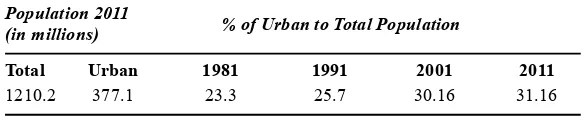
twenty-first century or even earlier. The economic base has already shifted from rural to urban centres which indicates that the future of India is inescapably urban. There has been an unprecedented shift of human settlements to select urban areas in search of better living conditions in the entire country as indicated by the steep increase of urban population from 286 million out a total population of 1029 million (27.81 per cent) in 2001 to 377.1 million out of a total population of 1210.2 million (31.16 per cent) in 2011, a net addition of 91.0 million, an increase of 3.35 per cent in proportion of urban population in the country during 2001–2011. The growth rate of population in urban areas was 31.8 per cent. There was a phenomenal growth of urban areas from 85 in 1981 to 2774 in 20111 (Census of
India 2011, Urban Growth).
Urbanisation has become the defining trend all over the world. While in 1947 India has only four cities with a population of one million and more, it has increased to 35 in 1981 and 53 in 2011.
Urbanisation involves concentration of people in high density population areas; large scale rural-urban migration of people for various reasons; shift from agricultural to non-agricultural occupations and change of land use from agricultural to non-agricultural purposes. The contribution of urban India to GDP is as follows: 1950-51: 29 per cent; 1980-81: 47 per cent; 2007: 63 per cent. This figure is likely to rise to 75 per cent by 2021, which clearly establishes the fact that cities are the places of innovation and improvement which enhance productivity and growth. While urban areas contribute 66 per cent to GDP currently, it is expected to increase to 75 per cent by 2021 which clearly indicates that India will be at the epicentre of urbanisation in the coming decades. This trend indicates that a great number of cities in India have become the centres of great human enterprise and cultural activity. Cities and towns in India are centres of cultural diversity and varied opportunities.
independence concentrated mostly on rural development since Indian economy was predominantly agricultural. But the lopsided rural development with scant attention to urban growth and development could not prevent the rural push and urban pull during the last three decades as indicated by the massive urbanisation. Many developing countries had concentrated on rural development to control migration to larger cities but in vain. Urbanisation is not only inevitable and unavoidable but is a resource. Policy-makers in India for a long time did not recognise urbanisation as a resource. If the positive aspects of urbanisation are carefully exploited it enables urban areas enhance economic growth and improves the quality of lives of millions of poor people. Rural-urban migration is not only for earnings or for better living conditions or facilities but also in response to expected earnings rather than actual earnings.
The views expressed by policy-makers, planners and political leaders perpetrated a negative view of urbanisation and developed an anti-urban mindset among the people. They ignored the fact that sustainable rural development and poverty reduction crucially depend on growth-augmenting and resource generating cities. Urban areas in India, as elsewhere, provide adequate opportunities for accelerating economic growth and poverty reduction which should not be missed. Thus, urbanisation is a positive force in the growth of national income and urban challenges are economic opportunities.
commensurate with the increasing requirements of the fast growing urban areas besides enforcing an efficient local administration which attends to local call.
Table: 2.1 Urban Population of India: 1901 – 2011
Year Urban population Percentage of Urban Decadal growth (million) to total population rate (per cent)
1901 29.9 10.8
-1911 25.9 10.3 0.4
1921 28.1 11.2 18.3
1931 33.5 12.0 19.1
1941 44.2 13.9 32.0
1951 62.4 17.3 41.4
1961 78.9 18.0 26.4
1971 109.1 19.9 38.2
1981 159.5 23.3 46.1
1991 217.6 25.7 36.4
2001 306.9 30.5 41.0
2011 377.1 31.16 22.87
Source: Ministry of Urban Affairs, New Delhi.
Table 2.2: Urban Population of India Population 2011 % of Urban to Total Population (in millions)
Total Urban 1981 1991 2001 2011
1210.2 377.1 23.3 25.7 30.16 31.16
Source: Census of India, New Delhi, 2011.
of India is, therefore, inevitably and unavoidably urban which contributes to economic growth and social justice. The unprecedented growth of towns and cities in India set new trends-social, political, cultural and environmental-in the country, which have a positive effect, if urbanisation is properly exploited. Historically cities have been the driving forces in economic and social development. Thus, sustainable urbanisation is the most pressing challenge facing the nation in our times. Therefore, governments’ focus should shift from rural to urban India. The recently introduced centrally sponsored urban development schemes like Jawaharlal Nehru National Urban Renewal Mission,
Urban Infrastructure Development Scheme for Small and Medium Towns, Integrated Housing and Slum Development Programme,
Amrutetc. are some of the appropriate steps in this direction which will enable the needed urban development to keep pace with the increasing demands of the fast expanding urban areas and burgeoning urban population.
Rapid industrialisation and the growing tempo of modernisation lead to large influx of rural migrants to towns and cities creating problems of social maladjustments.1 Since the exponential increase of
urban population cannot be controlled, the social and environmental challenges of urbanisation have to be addressed properly to cope with fast urbanisation.2
Cities provide many opportunities for social advancement and economic development under favourable conditions. India’s National Commission on Urbanisation Report (1988) stressed the role of cities as engines of economic growth, reservoirs of capital and skill, centres of knowledge and innovation, sources of formal and informal sector employment, generators of public financial resources for development, and hopes of millions of rural migrants.3 The Rural-urban Relationship
Committee in its Report describes the role of ULGs thus: (a) to function as local units of self-government;
(b) to provide local public services and convenience for healthy living, work and play;
(c) to ensure planned and regulated development of urban areas; (d) to mobilise local resources and utilise them to the maximum
(e) to promote social, economic and cultural development in an integrated manner.4
It should be the endeavour of the governments-central and state-to strengthen the ULGs by all means state-to achieve the above goals.
Over the years “The big cities attained inordinately large population size leading to virtual collapse in the urban scenario and followed by basic problems in the field of housing, slum, water, infrastructure, quality of life etc.”5
Table: 2.3 Distribution of Urban Population by Size Class of Towns
Class Population Range No. of Towns Share of Urban
Population
I. 1, 00,000 & above 300 65.20 per cent
II. 50,000 to 99,999 345 10.95 per cent
III. 20,000 to 49,999 947 13.19 per cent
IV. 10,000 to 19,999 1,167 7.77 per cent
V. 5,000 to 9,999 740 2.60 per cent
VI. Less than 5,000 197 0.29 per cent
All Classes 3,696 100 per cent
Source: Ministry of Urban Affairs, New Delhi.
Basic Features and Pattern of India’s Urbanisation
The basic features of urbanisation in India can be highlighted as the following:
• Lopsided urbanisation has induced the growth of class-I cities.
• Urbanisation has occurred without industrialisation and a strong economic base.
• Urbanisation has been mainly a product of demographic explosion and poverty induced rural-urban migration. • Rapid urbanisation has led to a massive growth of slums
followed by misery, poverty, unemployment, exploitation, inequalities, degradation in the quality of urban life.
Problems and Challenges of Urbanisation
Urbanisation in India is on the quick pace sans industrialisation, infrastructure and urban services leading to serious problems of services, housing and environment. The level of civic services in urban India is amongst the lowest in the world. Inappropriate technologies, outdated and outmoded regulatory measures, lack of foresight and comprehensive perspective of development, conservation of indigenous resources, ecological imbalance and destruction of nature pose a serious threat to sustainable urban development. The exponential population growth in most of the urban areas in the country has disrupted the quality of life, livelihood and local markets, posing a challenge to ULGs to comply with several requirements to sustain the quality of urban life.
The pattern of urbanisation in India is characterised by continuous concentration of population and activities in large cities.6 Urbanisation
managers have, therefore, to address these issues and tackle the problems created by urbanisation effectively.
Urban areas today represent high levels of social and economic inequalities and significant concentration of poverty. Thus, the current global trends in urbanisation imply nothing less than the urbanisation of poverty and social exclusion. The efforts made by governments so far to arrest urban poverty have not yielded satisfactory and expected results, and as a consequence the widening gulf between the rich and poor continues as before. If anything, it has only widened further. Now, the responsibilities of both Central and State Governments is “a rights-based and need-rights-based approach to development” which is important for both distributing development gains and ensuring equal participation of all stakeholders in the development process in order to make urban areas better dwelling places. Such an approach means continuously endeavouring to provide basic amenities, safe drinking water and sanitation for all citizens, facilities for education and healthcare, land and housing and create income generating opportunities. In short life must be made liveable.
Incorporating these rights in national policies and state legislation is critical in bringing about a fundamental change in our approach to sustainable urban development. A rights-based approach enables the generation of the political will and creation of culture of resource allocation that places the interest of the downtrodden on par with that of the upper strata of society. Different Governments have proposed different initiatives to achieve this objective. The role of urban local governments in implementing these initiatives is more important than that of the State Governments and Central Governments whose business is only to initiate and propose schemes for urban development encompassing urban poverty alleviation.