Exploring Yeh Pulu Relief
(An Iconography Approach)
I WAYAN ADNYANA1, I NENGAH SUDIKA NEGARA2, DESI IN DIANA SARI3, AA. BAGUS UDAYANA4
1, Fine Art Program, Faculty of Visual Art and Design of Indonesia Institute of Arts Denpasar 2,3,4 Design of Visual Communication, Faculty of Visual Art and Design of
Indonesia Institute of Arts Denpasar
Relief Yeh Pulu, lokasi di Desa Bedulu, Kabupaten Gianyar merupakan salah satu karya seni rupa terpenting. Relief ini merupakan pencapaian artistik puncak di era kerajaan Bali Kuna. Selain itu
juga memiliki karakter yang khas, seperti gaya figurasi yang khusus, memiliki tema spesifik, dan
keunikan pahatan. Sangat sedikit tulisan yang fokus membahas tentang topik ini. Sehingga menjadi penting untuk mengeksplorasi Relief Yeh Pulu melalui riset yang mendalam. Penelitian ini bertujuan
untuk menganalisa gaya figurasi, tema, karakter pahatan dan makna dari relief. Melalui pendekatan ikonografi Panofsky, analisis dilakukan melalui tiga tahapan, yakni praikonografi, ikonografi dan ikonologi. Analisis level pertama terfokus pada analisis karakter fisik dari relief; kedua, fokus pada konsep narasi; ketiga, terkait tentang diskursus yang melingkupi subjek kajian. Berdasar analisis
tersebut, dapat ditegaskan bahwa relief Yeh Pulu mengungkap tema kepahlawanan dunia sehari-hari
orang-orang biasa. Selain itu, dapat disimpulkan pula bahwa secara figurasi relief ini cenderung
bersifat realistik (terlihat dari proporsi yang berukuran sama dengan ukuran tubuh manusia dewasa normal), begitu juga dengan pemahatan tentang tetumbuhan yang cenderung bergaya naturalistik. Anggota peneliti di antaranya: I Nengah Sudika Negara (pengumpul data), Luh Desi in Diana Sari (layout desain), dan Anak Agung Udayana (fotografer).
Kata kunci: Ikonografi, Relief Yeh Pulu, Karakter fisik relief, Konsep narasi dan Diskursus
Yeh Pulu relief, located in Bedulu Village, Gianyar Regency, is one of the important Balinese visual art work. It serves as a proof of the ultimate artistic achievement in the ancient Balinese kingdom
era. It possesses some distinctive characteristics, such as a particular style of figuration, a specific
theme, and unique sculptural characters. There are very few articles focusing on this topic. Therefore, there is a need to explore Yeh Pulu relief by conducting anin-depth research. Based on Panofsky’s
iconography perspective, this research aims to analyze stylistic figurations of the relief, the theme,
the sculptural characters and the meaning of the depiction. Panofsky’s iconography consists of three
levels of analysis, i.e. pre-iconography, iconography and iconology. Employing his theory, the first stage of this analysis focuses on the physical characters on the relief; the second stage focuses on the concept of narration; and the third one deals with discourse around the subject of this study. The
image of Yeh Pulu relief very clearly reveals the theme of heroism found in the everyday life by
ordinary people. The result of this research is defined of the theme is reinforced by the figuration of
the relief’s subjects that tends to be realistic (using the body proportion of a normal adult human) and is complemented by carvings of plant tendrils that are nearly naturalistic in style. The research participants are I Nengah Sudika Negara (data collector), Luh Desi in Diana Sari (layout designer), and Anak Agung Udayana (photographer).
Key words: Iconography, Yeh Pulu relief, physical characters, concept of narration, discourse
BACKGROUND
Yeh Pulu relief is one of the most important artifacts of art in the history of Balinese culture. This artifact marks the aesthetic achievement of the pre-Wayang Kamasan (Kamasan puppet painting) era. It is estimated that the relief was made during the last Balinese kingdom period in around the 13th century.
The relief, which is located in Bedulu Village, Gianyar, Bali is carved on the wall of a stone cliff, and stretches from north to south. The length of the relief is about 25 meters, and the height is about 2 meters. On the farthest end of the relief, there are two hermitage caves with each having a depth of about 2 meters, a length of 2 meters and a height of 1.5 meters.
This relief has unique sculptural visuals and a
distinctive style of figuration. Although it is not finely
carved, it is quite expressive. Roughly carved parts are seen everywhere. Yeh Pulu relief is categorized as a deeply-sculptured relief with a depth of 30-60
cm. The figuration style that appears later seems to be
almost three-dimensional, due to the thickness that allows the body part to look whole. Only a little part of the body is attached to the cliff wall. The relief describes unique narrative fragments.
In addition, there are sculptural plant tendrils that are visually much different from Balinese painting ornaments of today. These tendrils barely have a
fixed pattern of decoration. This means that the
composition and motif patterns are very dynamic. The patterns of decoration are only found on the part of the reliefs depicting the house door. The patterns
are arranged in such a way to fill the pillars of the
door.
The idea proposed in some documentations on this relief, among others in Kempers’ Monumental Bali
(1977), which says that the figures on this relief are ‘puppet figures’ is somewhat inaccurate. In addition to the fact that the sculptural figures have a realistic style,
the proportions of the body (the height) resemble an adult human’s height. There are certainly many other things that must be answered in this study, including those concerning the style of the relief, the theme, the sculptural characters, and the meaning. They are
explored through field research and in-depth analysis
based on Panofsky’s iconography theory.
METHOD
The research method is part of the series of qualitative research employing Panofsky’ iconography approach, which essentially consists of stages of analysis of the visuals of Yeh Pulu relief. According to Kirk and Muller, qualitative research stems from qualitative observations that naturally emphasizes on the quality aspect as it is concerned with understanding, concepts, values and attributes inherent to the object of the research (Kaelan, 2005: 5).
This research model is not limited by variables, population, samples or hypothesis. Therefore, qualitative methods always have a holistic nature, i.e. interpretation of the data in relation to various aspects that may exist (Kaelan, 2005: 5-6). In the context of this study, the data analyzed are all scenes on the Yeh Pulu relief which has a length of about 25 meters and the average height of 2 meters. The research location is at Yeh Pulu relief site, in Bedulu Village, Gianyar, Bali.
The data in the form of Yeh Pulu relief photographs are read in the context of the Panofsky’s iconography interpretation, through three acts of interpretation (1971: 14), namely: pre-iconography (the most basic, i.e., analysis of the subject matter and expressions
(technical analysis); iconography to answer questions on narratives and visual contexts (figural style); and
iconology relating to meaning (analysis of intrinsic meaning). In other words, the aim of this study with reference to Panofsky model, is to analyze the visual aesthetics, allegories and symbols existing in the subject of the study (D’alleva, 2005: 22-23).
The iconographic analysis becomes the main emphasis because it is later intended to reveal the visual aesthetic concept shown in the analysis of the
figuration styles of the figures and the narratives of
the relief. The results of this analysis are then used as the basis for the creation of contemporary paintings, whose discussion is written in a separate article.
TECHNIQUES, STYLES AND MEANING
relief, there are stairs leading us down, located just in front of the candi bentar (temple gate).
In the analysis of the long expanse of the relief, visually (following the pattern of Panofsky’s analysis (1971: 14), at the pre-iconography stage, the focus lies in seeing and examining the technical aspect of the relief. The research technique helps reveal the type of the relief (associated with sculptural patterns), sculptural characters, and then the impression generated on the surface of the relief.
The sculptural patterns of this relief can be said
to be very expressive, in contrast with the finely
carved sculptural patterns on the relief of Borobudur Temple, which even has no trace of rough carvings
on the surface of the body of the relief figures as it is finely made. The understanding of sculptural patterns
and sculptural characters has become mixed-up, as the sculptural pattern is the character of the carving itself. Thus, in the explanation, the discussion the sculptural pattern, has basically covered the sculptural characters.
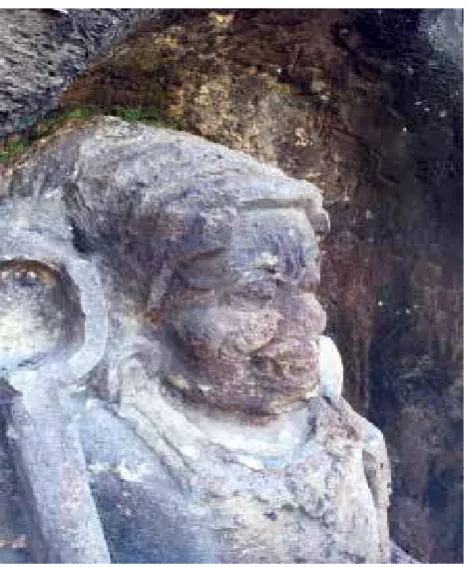
Figure 1, Expressive, rough, and massive sculptural characters on Yeh Pulu relief.
After studying the sculptural patterns on Yeh Pulu relief, the carving method used by artists at that period could be explained, especially upon seeing the trace of carving of sculptural characters that is visible
on the surface and the background of relief figures. It
seems like most of the chisel used is wide in shape, and probably there was the use of a kind of hoe (with a single sharp and pointed end) to sculpt the depth of the relief. Chisel traces are clearly seen on some
relief surfaces, including on the face of the figures
(although the chisel used on this part is smaller). However, since there are not many elaborate and small details (for example ornaments on the body of
the sculptural figures on Borobudur Temple relief),
it can be said that the chisel used is relatively wide.
The impression created by such sculptural patterns, is,
among others, the relief figures appearing to be very
expressive, solid and common-man centered. The term expressive refers to ‘expressionism’ in modern paintings. This term covers wild and free expressions. It is said to be stout as in addition to the fact that the material used is a rock cliff surface, expressive carving also gives the impression of strength. The impression of common-man centeredness relates to
the palace art style that tends to be finely made, like
the classical style of Kamasan wayang paintings that are neat, organized and full of ornaments. Yeh Pulu
relief, in contrast, presents the figures rough, even most of the figure bodies are just wrapped in kemben
(sarong).
Figure 2, The scene of tiger poaching that looks very dynamic and moving.
The solid and massive impression, is also seen from the depth of sculpture that reaches 30-50 cm. So, the
form of figuration looks almost three dimensional like the figure of a statue that clings to a long cliff.
To reach the depth of the sculpture, it can be assumed that tools other than chisels were used, such as a kind
of panyong or spindle-eyed single spur (as seen on
the relief there is a scene of a man carrying a hoe).
iconography. Panofsky mentions that at this stage one of the things to be analyzed includes the theme (the narrative) of the artwork (1971: 14). Upon observation of all the scenes, we can see that Yeh Pulu relief, which is an artifact dating back to the time of the ancient Balinese kingdom (the era before Majapahit invaded and ruled Bali in the 14th century), depicts the everyday heroism of Balinese people. This is indicated in the portrayal of a gallant man riding a horse, a hardworking homemaker woman carrying a crock, a tiger hunting scene, and also of a priest in the middle of a prayer. The representation of the sculptural subjects in the relief is very different from that in the Kamasan wayang (traditional puppets)
painting which first gained its popularity in the 15th
century (Adnyana, 2015: 70). In the Kamasan style, the paintings are medium to represent myths and such stories about the gods and the kings as the epics of Ramayana and Mahabharata.
Yeh Pulu relief is discussed in a very interesting manner in the book entitled Monumental Bali
(1977) by A.J. Bernet Kempers (134-139). Kempers describes several traditional farming tools as a visual idiom that is interesting to be discussed, such as the objects of a hoe, tuwak (traditional liquor made of palm fruit), and also objects carried on the shoulder. In this context, it then becomes clear that the theme brought up in the narrative is heroism in the everyday life. The actors in the narrative are the ordinary people. Of course, there is also a depiction of royal
figures, such as the presence of a princess (a young
lady with a crown).
The term ‘puppet figures’ for the figures on Yeh Pulu
relief, as heard by the painter Nieuwenkamp when painting Goa Gajah in 1925 (Kempers 1977: 134), is actually slightly a misnomer, if it refers to the wayang
figures in Kamasan paintings. Rather, some human figures on Yeh Pulu relief have a naturalistic style,
and they seem to be rather athletic when we look at their body anatomy and proportion. Wayang figures
tend to be ornamental, and it does not feel ideal for them to be doing the gestures of horseback riding, hunting, and other moving activities.
Ramseyer writes, “A figure of a horseman wearing
only a piece of short cloth and a belt. His long hair touches his shoulders. He rides a horse without a saddle, and is seen spurring his horse to run” (2002:
45). The relief’s subjects with a figuration that is
close to a normal human proportion, even slightly
taller, are certainly very ideal for depicting the scene of a prince riding a horse.
An art observer Moerdowo interprets the horseman as
a knight figure, who is about to propose to a princess
to marriage. On the furthest end of the relief, there
is a carving of a figure of a princess holding on to
the tail of the horse on which the knight is riding. It seems that the princess is trying to prevent the
knight from going away; she seems to be in tears,
not wanting to be left behind (Moerdowo, 1985: 52, in Adnyana, 2015: 69). The horse looks like it is just about to run when suddenly a tuft of hair on its tail is pulled by a woman. It is really not easy to depict a dynamic scene (that gives the impression of moving)
like this one if the figuration on the relief takes on the form of a flat wayang puppet.
When judged from the narrative that is brought up, it is obvious that the relief shows the heroic side of ordinary people having diverse ways of life, as seen in the scene of tiger hunting, and also in the scene where two men are carrying on their shoulder their game of a wild boar. Further, the relief also shows domesticated animals such as horses and monkeys,
including fictional animals such as various types of
reptiles.
Figure 3 A scene of a man carrying a pair of crocks on his shoulder, and a depiction of a princess (a crowned lady), with a body proportion relatively
shorter than that of a man.
any single decorative patterns used, but rather there seems to be an attempt to portray tendrils of climbing plants, such as various types of wild ferns. It is only on the doorposts that an ornamental pattern is shown, that is in the form of a decorative geometric repeating pattern (taking a shape of a circle).
These things further explain that at the level of iconology, which refers to the intrinsic meaning, it can be stated that in terms of the narrative the theme that is developed in the relief is heroism found in the everyday life. This meaning is certainly drawn from the syllogism in the pre-iconographic and iconographic analyses. The theme is also shown
in the relief’s style of figuration that is close to the
realistic style, to strengthen the heroism character itself, characterized by the moving scenes and daily activities (a horse-riding prince, a man carrying crocks, tiger hunting, men carrying a game animal slung from a pole on their shoulders, etc.).
A more conceptual thing also relates to the explanation that the heroism displayed is not royal palace-centered in nature. On the contrary, the dominating scenes are of heroic acts performed by ordinary people. They are modest and plain men and women that do not strike as members of the royal family, with the exception
the figure of the princess (a crowned lady) which
is carved near the man carrying crocks, the ascetic (crowned but demon-faced), and the prince (although
this figure is not wearing a crown, his role as a horse
rider indicates that he is a prince, because riding a horse is something a prince does, as ordinary people are always pictured walking).
CONCLUSION
Yeh Pulu relief is one of the artifacts of Indonesian art that is highly monumental. Visually, this artifact, which dates back to the time of the ancient Balinese kingdom (the era before Majapahit invaded and ruled Bali), carries the theme of heroism in the everyday life of Balinese people. This theme is apparent in the carvings of the man carrying crocks, man on horseback, men hunting an animal, a priest in the middle of a prayer, and other subjects that are related to the romantic side of Balinese people. This is in contrast to the theme that appears in the classical Kamasan wayang painting that became popular in about the next two centuries (the 15th-16th centuries), which is dominated by the theme of heroism of the knights based on Nitisastra’s literature (Ramayana
and Mahabharata).
Based on the aspects of pre-iconography and iconography, as asserted by Panofsky, we need to look at the image to understand the story and the characters, in this case to uncover allegory and symbols (D’alleva, 2005: 22-23). The image of Yeh Pulu relief very clearly reveals the theme of heroism found in the everyday life by ordinary
people. This theme is reinforced by the figuration of
the relief’s subjects that tends to be realistic (using the body proportion of a normal adult human) and is complemented by carvings of plant tendrils that are nearly naturalistic in style. The carvings are very expressive, with a rough and massive pattern. This makes the relief look even more stout and common-man centered.
The visual artistic style that takes the common man
as the subjects further refines the depiction of the
central theme of heroism of the ordinary people, and this is then taken as the concept of contemporary art creation. Paintings, which are visual art in concept, are a kind of an appropriation of the history in the past with the interpretation of the present.
ACKNOWLEDGMENT
The research ‘Exploring Yeh Pulu Relief: An Iconography Approach’ is part of a Research, Creation and Presentation of Art program funded by the Directorate of Research and Community Service, Directorate-General for Research and Development, Ministry of Research, Technology and Higher Education of the Republic of Indonesia. This article translated from bahasa Indonesia to English by Luh Windiari.
BIBLIOGRAPHY
Adnyana, I Wayan. (2015), Pita Maha: Gerakan
Sosial Seni Lukis Bali 1930-an, (dissertation), ISI
Yogyakarta, Yogyakarta.
D’Alleva, Anne. (2005), Look Again! (Art History
and Critical Theory), Pearson-Prentice Hall Inc,
New Jersey.
Kaelan, MS. (2005), Metode Penelitian Kualitatif
Bidang Filsafat, Paradigma, Yogyakarta.
Art, Harvard University Press, Cambridge, Massachusetts.
_________________, (1977), Monumental Bali, Van Goor Zonen, Den Haag
Panofsky, Erwin. 1971, Studies in Iconology, Icon Edition, Corolado.