INTRODUCTION
Up to the present, pegagan has been harvested in a natural way. In order to meet current demand inceasing its production in a large scale and cultivating high quality pegagan are prerequisite. Many medicinal mixtures of jamu contain pegagan herbal. The demand for pegagan (Centella asiatica) has reached to 100 t, and PT. Sidomuncul, for example, needs 2 t of pegagan monthly while local factories need 25 t of pegagan in a year; unfortunately, local supply is only 4 t per year. Special virtue of pegagan with its chemical content is in its saponin compound, including its asiaticoside (Matsuda, Morikawa, Ueda, & Yoshikawa, 2001) and flavonol accumulation in leaf tissues (Bidel et al., 2015). Besides enhancing the process of wound healing and asiaticoside, a bioactive compound of pegagan can also be used in curing leprosy and tubercolosis (Mangas et al., 2006; Mangas et al., 2008; Mangas, Moyano, Hernandez-Vazquez, & Bonfill, 2009). Pegagan can also be used as blood
cleaning, blood circulation speeding, kidney stone crushing, antipiretic, haemostatica, anti-bacteria, inflammation, hypotension, insecticide, anti-allergy. Saponin can also inhibit the production of excessive scar tissue (inhibit the incidence of keloid) (Mangas et al., 2008). Asiatic acid from Centella asiatica prevents memory deficits or memory increasing (Sirichoat et al., 2015) and protects against cognitive deficits (Chaisawang et al., 2017).
Some of the Indonesian herbal medicinal industries (agromedicine) state that the main obstacles of this industry are lacking of uniformity of raw material, production processes, problem solving, product expansion and marketing (Ghulamahdi, Aziz, Bermawie, & Hernani, 2007; Bermawie, Purwiyanti, & Mardiana, 2008).
Production of asiaticoside can be sped up by giving elicitor, a chemical substance produced by various sources, either biotic or abiotic, including physical factors that are able to trigger acumulation of secondary metabolite to animated organism. Methyl jasmonate is one of the elicitors which
AGRIVITA
Journal of Agricultural Science
Production Enhancement Technology of Pegagan (
Centella asiatica
)
Noverita Sprinse Vinolina1*), Marline Nainggolan2) and Rolan Siregar1)1) Department of Agrotechnology, Faculty of Agriculture University of Sisingamangaraja XII Medan, Indonesia 2) Faculty of Pharmacy University of Sumatera Utara Indonesia
ARTICLE INFO
Keywords:
Centella asiatica Harvesting Methyl jasmonate Phosphorous Production
Article History:
Received: October 12, 2014 Accepted: March 12, 2018
*) Corresponding author:
E-mail: [email protected]
ABSTRACT
has been widely used in modulating physiological incidence in various high level plants leading to the accumulation of secondary metabolite (Lambert, Faizal, & Geelen, 2011; Zhao et al., 2015). Pegagan plant grown in Deli Serdang is reported to be a potential plant which contains 2.38% of asiaticoside (Vinolina, Napitupulu, Siregar, Nainggolan, & Singh (2013). Current study was done in order to find out the effects of phosphorus fertilizer in combination withmethyl jasmonate on pegagan production harvested at different harvesting time. Thus, it could be expected that this reseach would be able to answer the questions of (1) response of the plant to the dosetime of phosphorus combined with methyl jasmonate, and (2) correct harvesting time to obtain high quality of pegagan.
The research problems were high demand for simplicia, environment factors and uniformity in quality (standardization) which needed an effort to the cultivation and optimum production, and the quality of pegagan which could be obtained by conducting some agronomic practices. The objective of study was to obtain correct phosphorus dosetime, right concentration of methyl jasmonate, interaction among phosphorus dose time and the appropriate harvesting time to obtain optimal pegagan production.
MATERIALS AND METHODS
The materials used were pegagan from Pantai Labu accession, Deli Serdang, TSP fertilizer, Urea and KCL, while the instruments needed in the research were digital scale, a digital camera, a GPS 12X12 channel Garmin, USA, some equipment for soil processing.
The research was conducted at Syahmad Village, Deli Serdang Regency, from January to October, 2013, using a Split Split Plot Design with three treatment factors: P2O5 fertilizer at 4 levels: F0 = 0 kg P2O5.ha-1, F harvesting time of 56 DAP (day after planting), H2 = harvesting time of 70 DAP, and H3 = harvesting time of 84 DAP. In order to find out the influence of the treatment on the biomass production (the leaves and petioles, roots and tendrils with their fresh weight (g) and dry weight (g). The parameter measurement described below in observation, samples were performed in triplicates. The data was then analyzed
by using a univariate analysis (F-test) at the level of 5% and data were transformed (X+0.5)1/2. Duncan’s multiple range and equation correlation regression tests were conducted when there were found significancies between treatments.
Research Activities
Land Preparation
Some implementations were carried out, starting fromland preparation, calcification, plant preparation, planting, maintenance, application of methyl jasmonate, and harvesting. Land preparation was started by weeds and tillage clearance, then plotting of 108 plots at the size of 1.0 mx 1.0 m each. Interval between the blocks was100 cm, while between the main plots was 100 cm and 50 cm as a distance between the plot. Calcification liming was done one week before planting, the dose for dolomite was 1.5 t ha-1.
Plant Preparation and Planting
The plants of Deli Serdang accession was planted along this study. In order to allow the plants form their stolons, parent plants were grown two and a half months before stolons were formed and taken for further planting as uniform seedlings. For this purpose, the plants were grown at interval of 40x40 cm. Fertilization was done at planting with appropriate doses of P treatment, a third dose of Urea 300 kg ha-1 and a dose of KCl 220 kg ha-1. Fertilizers were applied to the bolt around the planting hole.
Maintenance
Maintenance was done in a series of activities, starting from fertilizing the plants at 20 and 40 DAP by applying Urea to each plant. Watering, weeding and replanting were also done. Watering was done in the afternoon and adapted to conditions on the ground. Stitching was done 2 weeks after planting seedlings which were provided separately. Methyl jasmonate was applied to the 50-day-old plants, either in plants’ roots ± 5 cc or through the leaves around ± 5 cc per plant with a corresponding concentration of the treatment.
Harvesting
Noverita Sprinse Vinolinaet al.: Centella asiatica Production.........
Observations
Observation was done to the leaves and petioles,roots and tendrils with their fresh weight (g) and calculated as follows: harvested material was washed and drained separately into two parts, leaf and petiole; the root and tendril. The leaves and petioles, roots and tendrils of each study plot were measured initially for fresh weight. The leaf and petiole dry weight (g) were calculated by drying material in an oven set for 50°C for 3 days. The same activities were also done to measure roots and tendrils.
RESULTS AND DISCUSSION
Leaf and Petiole Fresh Weight
The highest leaf and petiole fresh weight was obtained from the treatment of 84 DAP harvesting time at the absence of methyl jasmonate (H3J0) 13.041 (± 188.511 g) and had insignificant disparity from harvesting time of 70 DAP with the giving of methyl jasmonate of 200 μM (H2J2), 11.676 (± 166.418 g), followed by 70 DAP harvesting time but methyl jasmonate was present at 100 μM (H2J1) 11.435 (± 152.057g) and 84 DAP harvesting timewhen methyl jasmonate was presented at 100 μM (H3J1) 10.408 (141.313 g). The lowest leaf and petiole fresh weight was found in the harvesting time of 56 DAP without giving methyl jasmonate (H1J0) 7.454 (± 61.670 g) (Table 1). A longer harvest time would produce more biomass, whereas a faster harvest biomass produced less, while the provision of methyl jasmonate would slightly depress growth as compared to administration of 200 and 100 µM. The interaction of these two factors gave the highest yield fresh weight of leaves and petioles, and fresh weight of roots and tendrils found in the combination without giving methyl jasmonate with harvesting time 84 DAP. Jasmonate acid (JA) and methyl ester jasmonate were derived from linolenic acid catabolism and acted as a secondary metabolite which modulates several physiological processes of plants, including aging plants (Yendo,
de Costa, Gosmann, & Fett-Neto, 2010). Without giving methyl jasmonate, the aging process did not occur and the crop harvesting age was 84 DAP, causing the accumulation of photosynthate more than harvesting time 56 and 70 DAP so that biomass fresh weight of leaves and petioles, root fresh weight, and the highest tendrils reached in this treatment combination.The treatment of harvesting time and the giving of methyl jasmonate can be seen in Fig. 1.
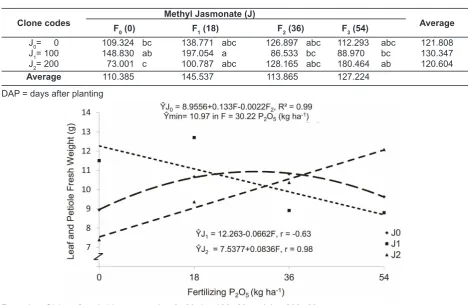
In Fig.1, the harvesting time of 56 DAP produced leaf and petiole fresh weight in the maximum of 9.44 (± 97 g) by giving methyl jasmonate of 99.75 μM. Average disparity test of the treatment of methyl jasmonate and fertilizing phosphorous in leaf and petiole fresh weight is presented in Table 2.
Table 2 indicates that the highest leaf and petiole fresh weight in the treatment of methyl jasmonate of 100 μM and phosphorous fertilizing of 18 kg P2O5.ha-1 (J
1F1) 12.698 (± 197.054 g) had insignificant disparity from the treatment of 200 μM methyl jasmonate and 54 kg P2O5.ha
-1 (J 2F3) 12.073 (± 180.464 g) phosphorous fertilizer. The lowest leaf fresh weight was obtained when methyl jasmonate was given at 200 μM but phosphorous fertilizing (J2F0) was absent in 7.389 (± 73.0 g). The interaction of these two factors significantly affected the weight of the fresh leaves and petioles per plot. On a fresh weight per largest plot in treatment provision contained methyl jasmonate 100 μM and phosphorus fertilization 18 kg P2O5.ha-1 (J
1F1) was obtained at the lowest fresh weight of 200 μM and without giving phosphorus. This can occur because jasmonate acids are organic compounds that has function to inhibit the growth of certain plant parts and very strong encourage leaf senescence (Zeneli, Krokene, Christiansen, Krekling, & Gershenzon, 2006) stated that treatment with methyl jasmonate causing terpene concentration increased (The treatment of giving methyl jasmonate and phosphorous fertilizing can be seen in Fig.2).
Table 1. Average disparity test on pegagan leaf and petiole fresh weight (g) in the interaction between the treatment of harvesting time and methyl jasmonate
Clone codes Methyl Jasmonate (J) Average
J0 = 0 µM J1 = 100 µM J2 = 200 µM
H1= 56 61.670 c 97.671 bc 73.527 c 77.623
H2= 70 115.242 b 152.057 ab 166.418 ab 144.572
H3= 84 188.511 a 141.313 ab 121.867 bc 150.564
Table 2. Average disparity test on leaves and petioles (g) in the interaction between the treatment of giving methyl jasmonate and fertilizing phosphorous
Clone codes
Methyl Jasmonate (J)
Average
F0(0) F1 (18) F2 (36) F3 (54)
J0= 0 109.324 bc 138.771 abc 126.897 abc 112.293 abc 121.808
J1= 100 148.830 ab 197.054 a 86.533 bc 88.970 bc 130.347
J2= 200 73.001 c 100.787 abc 128.165 abc 180.464 ab 120.604
Average 110.385 145.537 113.865 127.224
DAP = days after planting
Remarks: Giving of methyl jasmonate J0 = 0 μM, J1 = 100 μM, and J2 = 200 μM
Fig.2. The influence of phosphorous fertilizer in various concentrations of methyl jasmonate on leaf and
petiole fresh weight (g)
Remarks: H1 = harvesting time of 56 DAP (day after planting), H2 = harvesting time of 70 DAP, and H3 = harvesting time of 84 DAP
Fig.1. The influence of harvesting time and the giving of methyl jasmonate on leaf and petiole fresh weight (g)
Leaf and Petiole Fresh W
eight (g)
Noverita Sprinse Vinolinaet al.: Centella asiatica Production.........
In the absence of methyl jasmonate, the pegagan produced leaf and petiole fresh weight maximally at 10.97 (± 128 g) when they were fertilized with phosphorous fertilizer of 30.22 kg P2O5. ha-1. In the presence of methyl jasmonate at 100 μM, leaf and petiole fresh weight decreased when phosphorous fertilizer was given at 54 kg P2O5. ha-1 (negative linear), but the presence of methyl jasmonate at 200 μM and phosphorous fertilizer of 54 kg P2O5.ha-1 increased leaf and petiole fresh weight. In this case, there was an interaction of phosphorus and methyl jasmonate, in influencing the fresh weight of leaves and petioles. As it was already mentioned above, the provision of methyl jasmonate would affect the concentration of terpenes and interacted with phosphorus in influencing the growth. In the previous study, the elicitor treatment in vitro culture did not only increase the production of saponins but could change the stoichiometric precursor final product. Elicitation not only affected the levels of saponins but also affected the saponin biosynthesis gene expression (Kim, O. T., Kim, M. Y., Hong, Ahn, & Hwang, 2004; Mangas et al., 2006). The effect increased with increasing concentrations of elicitor (Bonfill, Mangas, Moyano, Cusido, & Palazón, 2011). In addition, it also served as a constituent of phosphorus metabolites and complex compounds, activators, cofactors or constituent of enzymes, as well as played its role in physiological processes (Salisbury & Ross, 1995). Root and Tendril Fresh Weight
Table 3 shows that the highest root and tendril fresh weight are obtained in the treatment of harvesting time of 84 DAP and without methyl
jasmonate (H3J0) 13.209 (± 194.059 g). However,
there was insignificant disparity between harvesting time of 70 DAP and when jasmonate was given at 100 μM (H2J1) 12.565 (± 190.542 g), followed by 70
DAP harvesting time with methyl jasmonate of 200
μM (H2J2) 11.562 (± 172.338 g), harvesting time of 84DAP and methyl jasmonate of 200 μM (H3J2) 11.175 (± 155.663 g) consecutively. The same
thing occurred in the growth of roots and tendrils, without giving methyl jasmonate it would produce the highest biomass weight.The lowest root and tendril fresh weight was noted from harvesting time of 56
DAP, without methyl jasmonate 0 μM (H1F0) 6.801 (± 50.383 g). Early harvesting would also affect
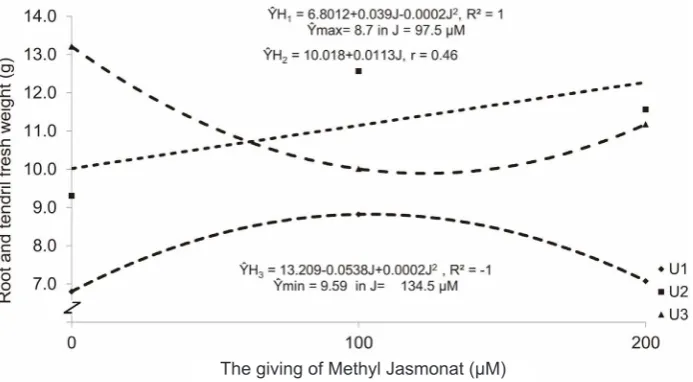
the weight of the biomass, that the weight of fresh or accumulation of photosynthate produced would also be less. There was an interaction between the harvesting and delivery of methyl jasmonate where methyl jasmonate was given at age 50 DAP (The
influence of harvesting time and the giving of methyl
jasmonate treatment can be seen in Fig.3).
Fig.3 shows that the harvesting time of 56 DAP produces maximum root and tendril fresh weight of
8.70 (± 85 g) when methyl jasmonate was given at 97.50 μM. A longer harvesting time of 70 DAP increased root and tendril fresh weight to 9.59 (± 119 g) when methyl jasmonate was given at 134.5 μM (negative linear), by giving methyl jasmonate,
suppression growth of leaves and petioles, but roots and tendrils tried to defend themselves by increasing the growth of roots and tendrils.
Leaf and Petiole Dry Weight (g)
The three treatment factors and their
interactions had insignificant influence on leaf
and petiole dry weight (g). It was assumed that concentrations of methyl jasmonate given to the plants caused a lower ability in phosphate absorbtion, especially due to aging of leaves and roots following to the methyl jasmonate application. It was obviously clear that the higher treatment was given if the faster aging process existed. Reinbothe,
C., Springer, Samol, & Reinbothe, S. (2009) stated that methyl jasmonate affecting the process of leaf aging led to cell’s death and did not significantly affect the dry weight of leaves and petioles, since
the methyl jasmonate increased plant’s resistance to environmental factors (Lambert, Faizal, & Geelen, 2011). Current study noted that the pegagan plants were severtly attacked by several diseases.
Table 3. Average disparity test of root and tendril fresh weight (g) of pegagan in the treatment of harvesting time and methyl jasmonate
Harvesting time (H) (DAP)
Methyl Jasmonate (J)
Average J0 = 0 µM J1 = 100 µM J2 = 200 µM
H1= 56 50.383 e 85.824 cde 62.266 de 66.158
H2= 70 110.264 cde 190.542 ab 172.338 abc 157.714
H3= 84 194.059 a 128.400 bcd 155.663 abc 159.374
Average 118.24 134.92 130.09
Plant growth highly depended on soil nutrients
availability; Phosphorus (as phosphate, PO43-) is
an integral component of important compounds of plant cell, especially along their life activities like carbohydrate metabolisms, photosynthesis, and energy cycles (Taiz & Zeiger, 2006). Phospate also
affected the asiaticoside content, a bioactive in
pegagan leaves, as well as asiatic acids. Vinolina, Napitupulu, Siregar, Nainggolan, & Singh (2013)
reported that the total amount of soil phosphate affected
centelloside content of the pegagan. Phosphate stimulating the roots formation led to a better ability in absorbing nutrients and water, increasing total chlorophyles, increasing photosynthesis ability to produce phosynthates and pressumably increasing the content of asiaticoside element.
Salisbury & Ross (1995) pointed out that the
plant had never changed the form of phosphate, and thus it would be in its form as phosphate, either as phosphate itself or as binding to ester. Ester phosphate might come form sugar, alcohol, acids or polyphosphate that may function intermediate way of phosphate pentosa of primary metabolite and is derived as a precusor of secondary metabolite. Pegagan mostly contains triterpenoid, a derivate of primary metabolite along the mevanolate biosynthesis to produce geraniles pyrophosphate which leads to a formation of monoterpenoid and its derivates. The pharnesyl pyrophosphate, however, increases production of sesquiterpenoid and conversion of
squalen to become triterpenoids. Vinolina, Napitupulu, Siregar, Nainggolan, & Singh (2013) noted that soil
phosphate affected the asiaticoside, madecasoside,
and asiatic acids of the dead plants.
Root and Tendril Dry Weight (g)
Table 4 shows that root and tendril dry weight taken from the harvesting time of 84 DAP was 4.521 (±
23.953 g) and had insignificant disparity to shorter of 70 DAP but had significant disparity when harvesting
timewas much shorter than 56 DAP (The disparity of harvesting time from root and tendril dry weight can
be seen in Fig. 4). The influence of harvesting time on
root and tendril dry weight was positive; the increase in harvesting time would cause root and tendril dry weight to increase. Dry weight of the roots and tendrils would increase longer harvest time. Growth continues
at harvest age of 56, 70 and 84 DAP so that biomass
will continue to increase with the accumulation of photosynthetic on increasing dry weight of roots and
tendrils (Salisbury & Ross, 1995)
Table 4. Average disparity test on root and tendril dry weight (g) of pegagan in harvesting time treatment
Harvesting time (H)
(DAP) Average
H1= 56 12.291 b
H2= 70 19.037 a
H3= 84 23.953 a
Average 18.427
DAP = days after planting
Remarks: H1 = harvesting time of 56 DAP (day after planting), H2 = harvesting time of 70 DAP, and H3 = harvesting time of 84 DAP
Noverita Sprinse Vinolina et al.: Centella asiatica Production.........
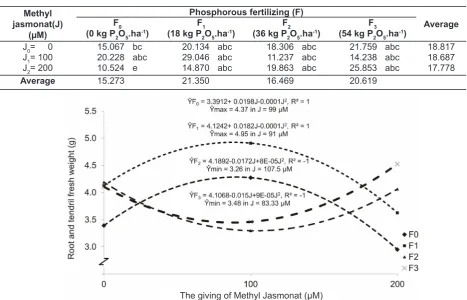
Average disparity test of methyl jasmonate and phosphorous fertilizing on root and shoot dry weight is presented in Table 5. Table 5 shows that the highest root and tendril dry weight in the combination treatment of methyl jasmonate at 100
μM and phosphorous fertilizing of 18 kg P2O5 ha -1
(J1F1) 4.909 (± 29.046 g). These treaments had
insignificant disparity from the combination of methyl jasmonate at 200 μM and phosphorous fertilizing of
54 kg P2O5 ha-1 (J
2F3), followed by methyl jasmonate
and other phosphorous fertilizing: J1F0, J0F2, J0F1, J2F2, and J2F1 which had significant disparity from other treatments. The lowest root and tendril dry weight was noted from the combination treatment
of methyl jasmonate 200 μM, without phosphorous
fertilizing (J2F0) 2.950 (± 10.5 g) which had significant disparity from other treatments. Dry weight was the lowest for the treatment of awarding methyl
jasmonate 200 μM and without giving phosphorus,
this was due to methyl jasmonate which was organic compounds formed by biosynthesis by the enzyme and served to inhibit the growth of some parts of certain plants and highly encouraged leaf
senescence (Salisbury & Ross, 1995). Fig.4. The influence of harvesting time on root and
tendril dry weight (g)
Remarks: Giving phosphorous: F0 = 0 kgP2O5.ha -1; F
1 = 18 kg P2O5.ha -1; F
2 = 36 kg P2O5.ha -1; F
3 = 54 kg P2O5.ha -1
Fig.5. The influence of giving methyl jasmonate in various dose times of phosphorous on root and tendril dry
weight (g)
Table 5. Average disparity test of root and tendril dry weight (g) in the interaction of methyl jasmonate and phosphorous fertilizing
Methyl jasmonat(J)
(µM)
Phosphorous fertilizing (F)
Average F0
(0 kg P2O5.ha -1)
F1 (18 kg P2O5.ha
-1)
F2 (36 kg P2O5.ha
-1)
F3 (54 kg P2O5.ha
-1)
J0= 0 15.067 bc 20.134 abc 18.306 abc 21.759 abc 18.817
J1= 100 20.228 abc 29.046 abc 11.237 abc 14.238 abc 18.687
J2= 200 10.524 e 14.870 abc 19.863 abc 25.853 abc 17.778
Average 15.273 21.350 16.469 20.619
The impact of methyl jasmonate on plant health and long-term anatomical and chemical changes caused by methyl jasmonate application on the growth and survival are unknown. Treatment of methyl jasmonate was proven to prevent the death of trees caused by bark beetles (Erbilgin, Krokene, Christiansen, Zeneli & Gershenzon, 2006).
Phosphorus also greatly affects optimal growth,
because its role is an essential part of the various sugar phosphates that play their role in the reactions to the dark phase of photosynthesis, respiration, and a variety of other metabolic processes. Phosphorus is also a part of nucleotides (RNA and DNA) and phospholipid membrane constituent (Salisbury
& Ross, 1995). (The influence of giving methyl
jasmonate and phosphorous fertilizing can be seen in Fig. 5).
At present, methyl jasmonate 200 μM, root
and tendril dry weight increased when phosphorous
fertilizer was given at 54 kg P2O5 ha-1, but root
and tendril dry weight decreased when a lower
concentration of methyl jasmonate (100 μM) was
given
CONCLUSION AND SUGGESTION
Conclusion
The technology for optimum production of pegagan can use phosphorus fertilizers at 18
kg P2O5.ha-1. The production of biomass (leaves,
petioles, tendrils) is optimum when the methyl jasmonate hormon is absent. The technology to increase pegagan production with appropriate harvesting time and for optimum production is 84 DAP or over.
There was an interaction between concentration of methyl jasmonate hormone and harvesting time toward fresh weight of either leaves and petioles or roots and tendrils, and the best combination is without methyl jasmonate hormone and harvesting time of 84 DAP. There
was no interaction effect among the three factor
concentrations, methyl jasmonate and harvesting time toward all production parameters.
Suggestion
Harvesting can be done on the parts of leaves and roots. In low land, the highest root and tendril dry weight was found in the treatment of methyl
jasmonate (100 μM) and phosphorous fertilizing of
18 kg P2O5.ha-1.
ACKNOWLEDGEMENT
The authors are thankful to the Directorate of Research, TheMinistry of National Education,
Indonesia, for providing financial aid of this research
in 2014 as a part of Fundamental Research.
REFERENCES
Bermawie, N., Purwiyanti, S., & Mardiana. (2008).
Keragaan sifat morfologi, hasil dan mutu plasma
nutfah pegagan (Centella asiatica (L.) Urban.)
[Variation in morphological characteristics, yield and quality of asiatic pennywort (Centella asiatica (L.) Urban) germplasm]. Buletin Penelitian Tanaman Rempah dan Obat,
19(1), 1-17. Retrieved from http://ejurnal.
litbang.pertanian.go.id/index.php/bultro/article/
download/1903/5485
Bidel, L. P. R., Chomicki, G., Bonini, F., Mondolot, L.,
Soulé, J., Coumans, M., … Jay-Allemand, C.
(2015). Dynamics of flavonol accumulation in leaf tissues under different UV-B regimes in Centella asiatica (Apiaceae). Planta, 242(3), 545–559.
https://doi.org/10.1007/s00425-015-2291-7
Bonfill, M., Mangas, S., Moyano, E., Cusido, R. M., &
Palazón, J. (2011). Production of centellosides and phytosterols in cell suspension cultures of
Centella asiatica. Plant Cell, Tissue and Organ Culture, 104(1), 61–67. http://doi.org/10.1007/
s11240-010-9804-7
Chaisawang, P., A. Sirichoat, W. Chaijaroonkhanarak, W.
Pannangrong, B. Sripanidkulchai, P. Wigmore, & J. Umka Welbat. (2017). Asiatic acid protects against cognitive deficits and reductions in cell
proliferation and survival in the rat hippocampus
caused by 5-fluorouracil chemotherapy.
PLOS ONE htpps://doi.org/10.1371/journal.
pone.0180650
Erbilgin, N., Krokene, P., Christiansen, E., Zeneli, G., & Gershenzon, J. (2006). Exogenous application of methyl jasmonate elicits defenses in
Norway spruce (Picea abies) and reduces host
colonization by the bark beetle Ips typographus.
Oecologia, 148(3), 426–436. http://doi.
org/10.1007/s00442-006-0394-3
Ghulamahdi, M., Aziz, S. A., Bermawie, N., & Hernani. (2007). Evaluasi karakter morfologi, fisiologi
Noverita Sprinse Vinolinaet al.: Centella asiatica Production.........
of pegagan]. Executive Resume: 2007 Research
Results (pp. 76-77). Cooperation Partnership
between Agricultural Research And Colleges. Retrieved from http://www.litbang.pertanian.
go.id/ks/one/376/file/EVALUASI-KARAKTER-MORFOLOG.pdf
Kim, O. T., Kim, M. Y., Hong, M. H., Ahn, J. C., & Hwang, B.
(2004). Stimulation of asiaticoside accumulation in the whole plant cultures of Centella asiatica
(L.) Urban by elicitors. Plant Cell Reports, 23(5),
339–344. http://doi.org/10.1007/s00299-004-0826-7
Lambert, E., Faizal, A., & Geelen, D. (2011). Modulation of triterpene saponin production: In vitro cultures,
elicitation, and metabolic engineering. Applied
Biochemistry and Biotechnology, 164(2), 220–
237. http://doi.org/10.1007/s12010-010-9129-3
Mangas, S., Bonfill, M., Osuna, L., Moyano, E., Tortoriello,
J., Cusido, R. M., … Palazón, J. (2006). The
effect of methyl jasmonate on triterpene and
sterol metabolisms of Centella asiatica, Ruscus aculeatus and Galphimia glauca cultured plants. Phytochemistry, 67(18), 2041–2049. http://doi.
org/10.1016/j.phytochem.2006.06.025
Mangas, S., Moyano, E., Hernandez-Vazquez, L., & Bonfill, M. (2009). 4. Centella asiatica (L) Urban: An updated approach. In J. Palazón & R. M. Cusidó
(Eds.). Plant Secondary Terpenoids, Research
Signpost, 37/661(2), 55-74. Retrieved from ttps://
www.researchgate.net/publication/231814645
Mangas, S., Moyano, E., Osuna, L., Cusido, R. M.,
Bonfill, M., & Palazón, J. (2008). Triterpenoid
saponin content and the expression level of some related genes in calli of Centella asiatica.
Biotechnology Letters, 30(10), 1853–1859. http://
doi.org/10.1007/s10529-008-9766-6
Matsuda, H., Morikawa, T., Ueda, H., & Yoshikawa, M.
(2001). Medicinal foodstuffs. XXVII. Saponin
constituents of gotu kola (2): Structures of new ursane- and oleanane-type triterpene
oligoglycosides, centellasaponins B, C, and D,
from Centella asiatica cultivated in Sri Lanka.
Chemical and Pharmaceutical Bulletin, 49(10),
1368-1371. http://doi.org/10.1248/cpb.49.1368
Reinbothe, C., Springer, A., Samol, I., & Reinbothe, S.
(2009). Plant oxylipins: Role of jasmonic acid
during programmed cell death, defence and leaf senescence. FEBS Journal, 276(17), 4666-4681.
http://doi.org/10.1111/j.1742-4658.2009.07193.x
Salisbury, F. B., & Ross, C.W. (1995). Fisiologi tumbuhan, Jilid 1 [Plant physiology, 1st ed.]. Bandung: Penerbit ITB.
Sirichoat, A., Chaijaroonkhanarak, W., Prachaney, P., Pannangrong, W., Leksomboon, R., Chaichun,
A., … Welbat, J. U. (2015). Effects of Asiatic acid
on spatial working memory and cell proliferation in the adult rat hippocampus. Nutrients, 7(10),
8413–8423. https://doi.org/10.3390/nu7105401
Taiz, L.,& Zeiger, E. (2006). Plant Physiology (4th ed.). Sunderland, MA: Sinauer Associates.
Vinolina, N. S., Napitupulu, J. A., Siregar, L. A. M., Nainggolan, M., & Singh, N. (2013). Centelloside content of pegagan (Centella asiatica). Indian Journal of Applied Research, 3(12), 1-2. Retrieved from https://www.worldwidejournals. org/indian-journal-of-applied-research-(IJAR)/
articles.php?val=MjcyMg==&b1=9&k=3
Yendo, A. C. A., de Costa, F., Gosmann, G., & Fett-Neto, A. G. (2010). Production of plant bioactive Triterpenoid saponins: Elicitation strategies
and target genes to improve yields. Molecular
Biotechnology, 46(1), 94-104. http://doi.
org/10.1007/s12033-010-9257-6
Zeneli, G., Krokene, P., Christiansen, E., Krekling, T., & Gershenzon, J. (2006). Methyl jasmonate
treatment of mature Norway spruce (Picea
abies) trees increases the accumulation of terpenoid resin components and protects against infection by Ceratocystis polonica, a bark beetle-associated fungus. Tree Physiology, 26(8), 977–
988. http://doi.org/10.1093/treephys/26.8.977
Zhao, C., Xu, T., Liang, Y., Zhao, S., Ren, L., Wang, Q., &
Dou, B. (2015). Functional analysis of β-amyrin
synthase gene in ginsenoside biosynthesis by
RNA interference. Plant Cell Reports, 34(8),