DI RECTORATE GENERAL OF HI GHWAYS
MI NI STRY OF PUBLI C WORKS
REPUBLI C OF I NDONESI A
AUSTRALI AN
I NTERNATI ONAL DEVELOPMENT
ASSI STANCE BUREAU
BRIDGE MANAGEMENT SYSTEM
IBMS
GENERAL
PROCEDURES
MANUAL
FEBRUARY 1993
TABLE OF CONTENTS
2.2.5 Management Information System 2-4
2.2.6 Bridge Database 2-4
2.2.7 Planning and Programming 2-5
2.2.8 Bridge Investigation and Design 2-5
2.2.9 Bridge Materials 2-5
2.2.10 Construction 2-5
2.2.11 Maintenance and Rehabilitation 2-6
2.2.12 Monitoring 2-6
3. GENERAL PROCEDURES OF THE BMS
3.1 POLICY FRAMEWORK 3-7
3.2 BRIDGE INSPECTIONS 3-9
3.2.1 General 3-9
3.2.2 Personnel 3-10
3.2.3 Planning and Budgeting for Bridge Inspections 3-11
3.2.4 Detailed and Routine Inspections 3-11
3.2.5 Execution of Inspections 3-11
3.2.6 Reporting, Data Entry and Data Audit 3-12
3.3 SPECIAL INSPECTIONS 3-12
3.3.1 General 3-12
3.7 SCREENING AND TECHNICAL RANKING 3-16
3.8 ECONOMIC EVALUATION AND RANKING 3-16
3.9 INDICATIVE ANNUAL AND FIVE YEAR PLAN 3-17
3.10 DATA VERIFICATION, FIELD SURVEYS AND TREATMENT STRATEGIES 3-17
3.11 PREPARATION OF DESIGN PROGRAMS 3-18
3.13 INVESTIGATION AND DESIGN 3-20
3.13.1 General 3-20
3.13.2 Investigation 3-22
3.13.3 Bridge Design for New or Replacement Bridges 3-23 3.13.4 Bridge Design for Rehabilitation of Bridge 3-24
3.14 BRIDGE TENDER PROCESS 3-24
3.15 BRIDGE CONSTRUCTION 3-25
3.16 BRIDGE MATERIALS MANAGEMENT 3-26
3.17 MONITORING 3-26
APPENDICES
APPENDIX 1 BMS Manuals
APPENDIX 2 Bridge Organization within the Ministry of Public Works and Home Affairs
APPENDIX 3 Duty Statements for BMS Personnel: - BMS Supervisor
1. INTRODUCTION
1.1 GENERAL
Bridges are important links on the road network and represent a large investment. Indonesia has approximately 25,000 bridges and other crossings on National and Provincial roads, and more than 60,000 on local and urban roads. Sound management of these bridges and the optimum use of funds for their maintenance, repair and replacement is essential for the development and sustainability of a viable transportation and communication infrastructure in Indonesia.
The Bridge Management System (BMS) supports the Government's policies for National Development and Decentralization. The BMS enables planning to be carried out in a systematic way and provides uniform procedures for all bridge activities at National and Provincial level.
It is important that all planning is based on reliable data and that uniform procedures are used for the preparation of bridge work programs. It is also important that implementation and monitoring of bridge works is carried out to a high standard, incorporating acceptable design and construction techniques to ensure maximum life from the bridges.
In order to satisfy these requirements, the Directorate General of Highways (DGH) has developed the Bridge Management System which enables it to plan, execute and monitor all bridge activities within an overall policy.
In particular, with a large. number of bridges having been replaced since the 1970's, Indonesia is now increasing funding for Maintenance and Rehabilitation of existing bridges as Bridge Replacement needs reduce. The BMS enables DGH to identify and prepare treatments needed to keep bridges functioning, and to rank them in a priority order for Works programming.
The BMS developed to date is for bridges located on-National and Provincial (Interurban) roads and is called the Interurban BMS (IBMS).
This Manual describes the overall procedures to be followed in the execution of the Bridge Management System in Indonesia.
The BMS is applied to all crossings on National and Provincial roads which are longer than two metres in span or length.
1.2 OBJECTIVE
OF MANUAL
1.3
HOW TO USE THIS MANUAL
The Manual should be read as a whole in order for the reader to gain an overall understanding of the BMS.
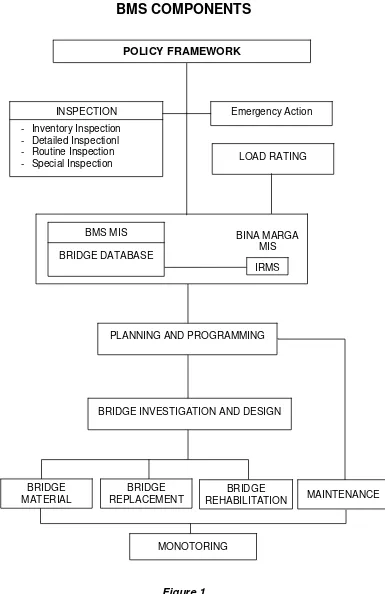
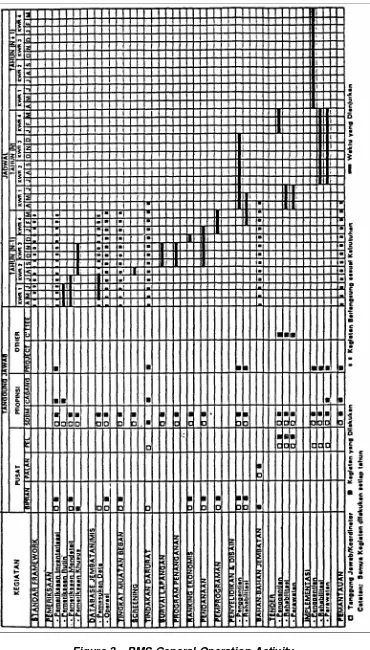
The description of the General Procedures in the Manual follows the two charts in Figures 1 and 2 which show the BMS components (Figure 1) and the BMS activities (Figure 2) in the form of flowcharts.
1.4 SCOPE
OF MANUAL
The Manual consist of four Parts.
Part 1 is the Introduction to the Manual.
Part 2 gives an overview of the BMS.
Part 3 is the main text of the Manual, setting out the General Procedures for the implementation of all BMS activities.
Part 4 contains Appendices which give relevant information that is not part of the Procedures. The Appendices contain:
Appendix 1 List of BMS Manuals
Appendix 2 An outline of the organisation of DGH and DPU in Provinces as it relates to bridgeworks
Appendix 3 Duty Statements for BMS personnel in Provinces.
1.5
WHO SHOULD USE THE MANUAL
The Manual should be used by all personnel involved in BMS activities so that they can obtain a clear understanding of the operation of the BMS and how the activity on which they are engaged fits into the overall System.
The Manual should be read by all officials within DGH and Bina Marga in Provinces who are involved with Roads and Bridge planning, implementation and maintenance.
Please note that all references to BMS in this Manual are for the Interurban BMS (IBMS).
2. OVERVIEW OF BMS
2.1 OBJECTIVE OF BMS
The overall objective of the BMS is to provide DGH and Bina Marga in Provinces with a tool to:
x support National Development and Land Communications through a safe and functional network of bridges, and to
x optimize the use of funds available for bridge works. The BMS provides the facility for:
x inventory recording of all bridges:
- The BMS includes a Management Information System (IBMS-MIS), and a database of all bridges on National and Provincial roads in Indonesia which provide easy access to information on any or all bridges.
x condition, traffic and load capacity rating:
- all bridges are inspected and assessed for Condition, Traffic Capacity and Load Carrying Capacity.
x identification of bridges for treatment:
- bridges which are in poor condition, too narrow or not strong enough to carry normal traffic are screened out and alternative treatment strategies are prepared for repair, strengthening, widening, duplication or replacement. The most economic treatment can be determined.
x priority, ranking of bridge works:
- bridges proposed for treatment are ranked in order of economic priority to ensure that bridges are treated in a sensible order.
x optimum allocation of funds
- by determining the optimum (most economic) treatment strategy for a bridge, and ranking bridges in priority order, it is ensured that funds are spent in the best way.
x standard procedures for implementation of all bridge works.
2.2 BMS
ACTIVITIES
A chart of the main BMS Components is shown in Figure 1.
BMS COMPONENTS
Emergency Action
LOAD RATING INSPECTION
- Inventory Inspection - Detailed Inspectionl - Routine Inspection - Special Inspection
BINA MARGA MIS BMS MIS
BRIDGE DATABASE
IRMS
PLANNING AND PROGRAMMING
BRIDGE MATERIAL
BRIDGE INVESTIGATION AND DESIGN
BRIDGE REPLACEMENT
BRIDGE
REHABILITATION MAINTENANCE
MONOTORING
POLICY FRAMEWORK
2.2.1 Policy Framework
The Policy Framework is established by DGH at the start of the planning period, and includes policies on bridge condition standards, road-width standards, strategic links, link priorities, load capacities and so on.
2.2.2 Inspections
There are four types of bridge inspections in the BMS for the collection of bridge data.
Inventory Inspections
These register the bridges in the database and record administrative, geometric, material, and general condition data.
Detailed Inspections
These are carried out at intervals of five years maximum to assess the detailed condition of bridges and their elements. There is a hierarchy of levels for elements in the bridge, to facilitate inspection, and reporting is carried out at the highest level possible. The condition of the bridges and elements is recorded on a scale of zero to five, with a rating of zero for bridges or elements in 'as-new' condition and a rating of five for those that are no longer serviceable. The Condition Mark is derived by a series of objective questions developed originally for the Danish Bridge Maintenance Management System and which was modified for Indonesian conditions. This procedure helps to remove subjectiveness from the derivation of the Condition Mark.
A Detailed Inspection is also carried out at the conclusion of all major bridge work, to gather updated data.
During a Detailed Inspection, the Bridge Inspector checks the Inventory Data and he can make recommendations for treatments and for Special Inspections.
Routine Inspections
These are performed annually to check that Routine Maintenance is being carried out effectively and to discover any unreported circumstances which may require Emergency Action.
Special Inspections
Special Inspections may be required as a result of the findings of a Detailed Inspection. A Special Inspection may also be needed as part of data verification prior to programming major works determined from the Screening process in the IBMS-MIS.
A Special Inspection is a detailed investigation into defects and material properties of specific elements, such as core testing-of concrete. A Special Inspection can also be carried out to supplement the Detailed Inspection in cases where the Bridge Inspector did not have the necessary equipment to complete the inspection (eg. underwater inspection), and for periodic monitoring of specific elements of a bridge.
2.2.3
Emergency Action
Emergency Action is taken when the condition of the bridge is unsafe for vehicle or pedestrian traffic, and when a bridge is in immediate danger of collapse. This action must be given priority if it is determined that the bridge is at risk and must be kept functioning. Action taken can include minor or major repairs, rehabilitation or replacement.
2.2.4
Load Rating
Load Rating is a measure of the load carrying capacity of the bridge measured against a Standard Truck for the route on which the bridge is located. (Currently, the Load Rating Module in the IBMS-MIS is unavailable. However, procedures are described in the Bridge Design Code).
2.2.5
Management Information System
The IBMS-MIS forms part of DGH's overall Management Information System (BM MIS). The IBMS-MIS contains the Bridge Database and a suite of computer programs which allow:
x entry and retrieval of data
x preparation of standard reports on bridges
x querying the database for any combination of information
x Screening, Ranking and preparation of Treatment Programs
x preparation of Annual and Five Year Plans
x determination of the most economical treatment for each bridge.
The IBMS-MIS is integrated with the Road Database in the Interurban Road Management System (IRMS).
2.2.6
Bridge Database
All available bridge data is stored in a Bridge Database held in each Province and in DGH in Jakarta. The Bridge Database consists of:
- manual bridge files, containing data which cannot be entered onto the computer, such as the original inspection forms, photographs, drawings etc,.
2.2.7
Planning and Programming
Planning and Programming involves the preparation of Programs of Work for Replacement, new Bridges, Rehabilitation and Maintenance. The BMS enables preparation of Programs to be carried out in a systematic way by utilizing the IBMS-MIS as a tool for screening, economic evaluation, ranking and budgeting.
2.2.8
Bridge Investigation and Design
After bridge programs are finalized, site investigation, site location and preliminary design are carried out before finalizing the design for the bridge works.
Bridge Investigation includes:
x reconnaissance surveys
x topographic surveys
x soil investigations
x hydrologic surveys.
Following these investigations, detailed design and preparation of tender documents is carried out.
The BMS includes rules and procedures for Bridge Design, and Standard Specifications for Bridge Construction and Rehabilitation.
2.2.9 Bridge
Materials
The BMS includes procedures for the management of the major bridge materials storage yards and for the allocation of bridge spans and standard bridge components which are supplied under various Contracts.
2.2.10
Construction
2.2.11
Maintenance and Rehabilitation
Maintenance and Rehabilitation of existing bridges is needed to keep them functioning properly and to prevent bridge collapse. The BMS includes procedures for Maintenance and Rehabilitation of bridges.
2.2.12
Monitoring
3. GENERAL PROCEDURES OF THE BMS
This Section describes the General Procedures for operation of the BMS, including an overview of the System so that the reader will understand the relationships between activities, timing, and responsibilities.
A General Flowchart is shown in Figure 2. The Flowchart is based on activities rather than components. All bridges are considered as part of this flow and will undergo one type of bridge work each year.
The description of the procedures follows the flowchart, so that the reader can easily see where the activity is located in the BMS cycle.
BMS ACTIVITY DESCRIPTION BUDGET
DATA COLLECTION - INSPECTIONS
Preparation of Inspection Programs
At the end of each year the inspection program for the coming year needs to be determined using the BMS MIS, and budget secured.
Routine BMS
Supervisor
- BMS Computer
- IBMS-MIS Manual
- IBMS Planning & Programming Manual ' .
Inventory Inspection First inspection of a bridge at start of the BMS.
PBO - APBN. Provincial Bridge
Inventory Inspection - after major work (included in Detailed Inspection)
After a new bridge is constructed, or major rehabilitation carried out.
Bridge
Detailed Inspections. Detailed evaluation of condition of bridge and all elements. Includes an inventory update
PBO - APBN. Senior Inspector.
BMS Inspection Manual
Routine Inspection. Annual inspection to report on quality of maintenance and any emergency or urgent repairs needed.
Entry of Inspection Data to
Computer. Check and enter inspection data to BMS computer in province.
PBO. Operator or PB Inspector.
BMS Computer
BMS Holding File
Reporting Routine Inspection.
Reports are despatched from the Cabang to the DBM. Routine maintenance by contract: reports sent to Kepala Dinas Bina Merge for action through project
Routine maintenance by force account: reports actioned by supervisor in cabang and copied to BMS Supervisor
Filing of Inspection Data. Hard copies of data, photos etc.
filed into BMS Bridge Data Files. PBO. Filing Clerk or PEI Inspector. BMS Data File
Despatch Data to Jakarta. Monthly despatch of BMS data to Jakarta for entry to BMS Central Bridge Database - sent by diskette or via modem.
Receival of BMS data from Provinces and entry into BMS Central Database.
Routine. Operator for Bipran, BMS Coordinator
BMS ACTIVITY DESCRIPTION BUDGET
PLANNING & PROGRAMMING
Operation of BMS Computer and IBMS-MIS
The BMS Computer contains the Bridge database and all programs necessary for operation of the BMS Planning and Programming
component. This is the centre-point of the BMS and needs to be operated daily for planning and control of all bridge activities.
Routine budget and PBO
BMS Supervisor - BMS Computer
BMS Computer operation. Operation of BMS Computer. Routine. BMS Supervisor and other staff in DBM - P&P section.
Chief of P&P section.
Review of planning policies and framework.
Policies relating to National and Provincial development, land transport policies, bridge management policies and priorities and setting of standards.
Routine. National Policy -Bipran Planning
Road link priorities. Set priorities for road links and link weight.
Link weights will be set at start of planning period and after agreement between Bipran and Sub DBM. A document setting out the link weights for the planning period will be issued through Director Bipran after
consultation with provinces.
Routine. National Roads -Bipran in liaison
Screening. Run screening program for all bridges in the province.
Routine. BMS Supervisor Planning Engineer.
IBMS-MIS
Run P&P module on BMS computer:
- annual program - 5 year
program
Prepare indicative programs for long term planning
Propose program for and execute Special Inspections
BMS ACTIVITY DESCRIPTION BUDGET
Special Inspection. From Detailed Inspection and screening carry out further specialist inspections on particular problem.
Construction
Data entry to BMS computer. Enter Special Inspection data into computer in province.
As above. Operator for
BMS Supervisor. IBMS-MIS
Report special inspection. The reports on the Special Inspection to be sent to the Head Sub DBM when carried out by Cabang. Copies sent to Pelaksana and Bipran for review.
As above. BMS Supervisor. IBMS-MIS Reports
Bridge Site Investigations. Carry out bridge site investigation including recommend bridge site, type and spans of bridge, preliminary substructure types, waterway widths and deck elevation (for new bridges). This include :
Data collected and layouts etc. are sent to the relevant Pelaksana for review in consultation with Bipran
PBO. Bridge
Investigation Engineer.
Investigation Reports
Additional data collection for design.
Data collection for design including: • loading
• quarry location • rainfall data.
PBO. Design Engineer. Chief of PBO.
Prepare Treatment Strategies Alternative treatments are prepared
for economic evaluation PBO BMS BridgeSupervisor Rehabilitation
Evaluate Treatments Analyze treatments using BMS MIS to determine optimum treatment for each bridge
Routine BMS Supervisor IBMS-MIS
Ranking Perform economic ranking on proposed bridges
Routine BMS Supervisor IBMS-MIS
Update BMS MIS for on- going projects and committed bridges
Update database with all on-going projects and budget needed for these in the next year plus all bridge projects being committed due to social or political reasons.
Routine BMS Supervisor IBMS-MIS
Budgeting Enter available budgets and determine programs for the following year
Routine BMS Supervisor IBMS-MIS
Finalise Annual Program (Province)
Prepare final program for Replacement and Rehabilitation
Review Annual Program Review by Pelaksana & Bipran Routine Pelaksana and Bipran
Finalise Annual Program Routine Bipran Pelaksana
BMS ACTIVITY DESCRIPTION BUDGET
FROM CARRIED OUTBY: MATERIAL & REFERENCE EQUIPMENT
Prepare Satuan III Documents
Commit DIP
IMPLEMENTATION
Monitoring of bridge process Reporting of bridges under
construction or rehabilitation through MIS.
Reporting updated at end of each month.
Routine BMS Supervisor with Project Manager
IBMS-MIS
3.1 POLICY
FRAMEWORK
The Policy Framework establishes the Standards under which the BMS operates. It specifies acceptable criteria for relevant parameters in the BMS as follows:
x discount rate for economic analysis
x load capacities on each route
x link. priorities
x acceptable bridge condition level
x bridge and road width standards
x responsibilities for design etc,.
At 1992 the Standards are as follows: x discount rate 15%
x load capacity - 10 tonne axle on Strategic Routes - 8 tonne axle on Non-Strategic Routes x link priorities - 1 National Arterial
- 2 National Collector and Provincial Arterial - 3 Provincial Collector
x bridge and road width standards
AADT Minimum Bridge/road width (metres)
< 3000 4.5
3000 - 8000 6.0
8000 - 20000 7.0
>20000 14.0
x responsibilities for Design (refer Section 3.13.1).
3.2 BRIDGE
INSPECTIONS
There are four types of Bridge Inspections carried out for data collection - Inventory, Detailed, Routine and Special. A brief description of each was given in Section 2.2.2.
3.2.1 General
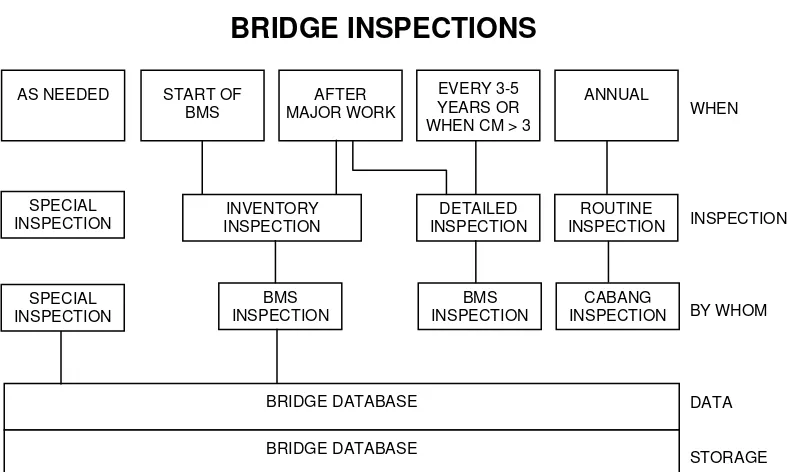
A Flowchart for Inspections is shown in Figure 4.
BRIDGE INSPECTIONS
AS NEEDED START OFBMS
Inventory Inspections were carried out at the start of the BMS to record bridges in the BMS with the following data:
x Administrative data
x Geometric data
x Material data
x General Condition Data for major components.
Inventory Inspections are also carried out as part of a Detailed Inspection after major work is performed on a bridge, to update the, general data.
After all bridges have been registered, Inventory Inspections are only required after major bridge work, ie replacement, widening, strengthening or duplication. This Inspection should form part of the final inspection of the bridge work and be covered by the budget for the Supervision of the construction of the bridge.
Routine Inspections are carried out annually on every bridge to check that Routine Maintenance is being carried out and to report any Emergency Action needed, particularly with respect to the waterway.
Detailed Inspections are carried out on all bridges at least once every five years. Detailed Inspections are normally not carriedout on small culverts, wet crossings and bridges less than six metres in length. The Detailed Inspection data is used to Screen and Rank bridges for priority for treatment. (At the start of the BMS, Detailed Inspections were conducted on bridges with Condition Mark of 2 or higher, so that bridges which were in need of immediate treatment were inspected). Detailed Inspections (including an Inventory Data update), are also carried out after major work, so that the Database is updated with the correct data.
3.2.2 Personnel
Inventory Inspections are now carried out by Provincial Bridge Inspectors when doing a Detailed Inspection at the completion of major work on bridges.
Detailed Inspections are carried out by Provincial Bridge Inspectors from the Dinas PU Bina Marga or Sub Dinas Bina Marga, under the direction of the BMS Supervisor.
3.2.3
Planning and Budgeting for Bridge Inspections
Bridge Inspections must be planned and budget must be allocated. The budget for Inspections is to be allocated from APBN and IPJP through the P3TNas for inspections of bridges on National Roads, and from P'TProp for bridges on Provincial Roads.
3.2.4
Detailed and Routine Inspections
In September each year the BMS Supervisor should prepare a list of bridges which require a Detailed or Routine Inspection in the following year. These lists are prepared on the IBMS-MIS through the 'Inspection Program' module.
The BMS Supervisor must estimate the cost of the inspections taking into account: x Transport costs
- Vehicle operation and maintenance - Ferry costs
- Air fares x Inspection Costs
- Accommodation - Allowances. x Hardware Costs
- Equipment cost - Printing of forms
- File and film processing
- Replacement/repair of standard equipment x Data validation and entry.
In planning for Inspections, the BMS Supervisor should allow 3 - 4 bridges per day to be inspected for Detailed Inspections, and 10-20 bridges per day for Routine Inspections.
In general, about 20-25% of the bridges in each Province should undergo a Detailed Inspection each year, except wet crossings, culverts and bridges undergoing work or which are programmed for work in the following year. All other bridges (except those undergoing' work or programmed for work in the following year), should have a Routine Inspection each year.
Note: At present BIPRAN coordinates the preparation and execution of the Detailed Inspections until the activity becomes fully institutionalised within DPUP.
3.2.5
Execution of Inspections
3.2.6
Reporting, Data Entry and Data Audit
All Bridge Inspection Reports must be submitted to the BMS Supervisor, who will arrange for entry of the data into the IBMS-MIS.
In each Province, there is a holding file for Bridge Inspection Data - the Bridge Inspection Holding File. The Inspection Reports are kept in this file until they are checked and entered to the IBMS-MIS.
The data should be audited prior to entry into IBMS-MIS, because all subsequent activities are dependent on its accuracy.
The BMS Supervisor must ensure that the Inspection Data is entered into the computer within 14 days after the Inspection is carried out.
After the data is entered to the IBMS-MIS, the BMS Supervisor must file the Inspection Reports, together with photographs and negatives, in the Bridge Data File for the particular bridge.
Routine "Inspection Reports from Cabang Bina Marga should be forwarded each month to the BMS Supervisor.
A copy of the Inspection Report, together with a copy of the film negatives and one set of photographs should be sent to the BMS Coordinator in BIPRAN.
3.3 SPECIAL INSPECTIONS
3.3.1 General
Special Inspections can be recommended by the Inspector during a Detailed Inspection when: x the Inspector cannot complete the inspection because of difficulty of
access (such as under-decks or underwater)
x specialist equipment is required to investigate suspected defects, such as for core testing of concrete
x monitoring of specific elements is require to detect movements which cannot be identified during a single inspection.
There are three types of Special Inspections:
x Supplementary Inspection
x Material Inspection
An inspection and evaluation of defects and material properties of specific elements which cannot be visually inspected or which require specialist investigation. Example are concrete testing and assessment of scour problems and treatments.
x Monitoring Inspection
Monitoring of the condition, (usually the geometry) of specific elements of a bridge. Special equipment for testing or measurement of level is normally required.
3.3.2 Personnel
Special Inspections are carried out by Engineers with expertise in the particular type of Special Inspection required.
For example, investigation of scour at a bridge should be carried out by experts from PUSLITBANG AIR. Material Investigation should be carried out by Engineers from PUSLITBANG JALAN. * In some cases, Provinces have the necessary equipment and personnel in Provincial laboratories in the KANWIL.
The advice of personnnel from the Sub-Directorate of Bridge Design in BIPRAN should be sought in the first instance.
3.4
LOAD RATING OF BRIDGES
Determination of the load carrying capacity of a bridge should be carried out on bridges if rehabilitation is being considered and there is doubt about the load carrying capacity of the bridge. It is not necessary to load-rate bridges which are to be replaced or bridges which are in good condition (unless there is doubt about the load capacity).
Load Rating is carried out in accordance with procedures in the Bridge Design Code.
Where there is doubt about the load capacity of a bridge, the Chief of the Bridge Design Sub-Directorate in BIPRAN should be advised, and he will take the necessary action.
3.5 EMERGENCY ACTION
Bridges requiring Emergency Action must be given high priority. The BMS Supervisor must immediately report to the Chief of Planning Section all bridges requiring Emergency Action and they should discuss the Report with the Inspector and determine the action to be taken. Depending on the circumstances, an immediate site visit should be made to ascertain the nature of problem and the rectification needed.
A decision must be made as to whether the bridge requires immediate repair or whether the work can be deferred until the next Rehabilitation Project.
The IBMS-MIS includes the Emergency Action Report No. IBMS-AR 1 which lists all bridges requiring Emergency Action at any time. This Report should be checked and the Bridge Data updated after action has been taken.
If emergency funding is required, the Province should apply for allocation of 'Bencana Alam'
from DGH.
3.6
IBMS-MIS AND BRIDGE DATABASE
3.6.1 General
The IBMS Management Information System (IBMS MIS) includes: x the Bridge Database
x the computer programs for Data Entry, data manipulation and analysis, Standard Reporting, Monitoring and querying of the Database.
The IBMS-MIS is a tool which Bridge planners can use to perform routine tasks with greater efficiency. The IBMS-MIS is a subsystem of the Bina Marga Management Information System (BM MIS).
The Bridge Database must be maintained and updated through Inspection Reports and Monitoring of Bridge Replacement and Rehabilitation Projects.
In Provinces, the daily operation of the BMS computer is the responsibility of the BMS Supervisor under the direction of the Chief of the Planning Section.
The IBMS-MIS and the Bridge Database provide a great variety of useful information. Most information can be retrieved in Standard Reports, but the facility also exists for querying the Database in a general way. Procedures for querying the Database are given in the
IBMS-MIS Manual.
The daily operation of the BMS includes the following: x reviewing bridge data
x preparation of inspection programs
x evaluation of treatment strategies for bridges
x reporting on bridges needing Emergency Action
x preparation of Indicative Programs of Work
x monitoring construction progress.
In DGH, the operation of the BMS is the responsibility of the BMS Coordinator in the SubDirectorate of Bridge Design.
The daily operation of the BMS in DGH includes similar activities to the Provinces. However, operations are more directed' towards data auditing, long-range planning, preparation of (DGH's) Annual Programs and overall management of the System. Guidance and direction on the operation of the BMS is available through the Chief of the Sub
Directorate of Bridge Design and the BMS Coordinator.
3.6.2 Interface
with IRMS
The BMS uses data directly from the IRMS. Data is exchanged in BIPRAN through a Local Area Network which connects the two Systems.
The IBMS-MIS uses Road Programming Data from the IRMS to establish priorities for Bridge Programs of Work.
The following data from the IRMS is used by the BMS: x vehicle operating cost (by vehicle type)
x traffic data by link and suffixed link
x data reference points
x projected traffic growth rates
x road conditions
x road width
x road works programs
3.6.3
Backing-up of Data
Bridge Data should be backed-up every week by the BMS Supervisor. At the end of each month, a copy of the data must be sent to the BMS Coordinator in BIPRAN for updating of the Central Database.
The data disk should be addressed to:
Koordinator BMS
Sub Direktorat Jembatan Direktorat Bina Program Jalan Departemen Pekerjaan Umum Jl Pattimura 20
Kebayoran Baru - Jakarta Selatan
3.7
SCREENING AND TECHNICAL RANKING
Screening is the filtering-out of bridges that require treatment based on current policy. Screening can be carried out at any time, and must be carried out in August each year, in preparation of the Annual Program for the following year.
The purpose of Screening is to identify bridges with: x poor condition
x inadequate traffic capacity
x insufficient load capacity.
The Screening model in the IBMS-MIS uses the data in the Bridge Database to determine indicative treatments for each bridge. These treatments must be confirmed by the BMS Supervisor or Planning Engineer by a field inspection, before the bridge is committed for major works.
The Screened bridges are given a Rating which is a function of the Condition Mark, the importance of the element, the importance of the road, the Traffic Mark and the Load Mark. Bridges at the top of the Ranking List are those that are most in need of treatment and therefore those which should receive priority in Works Programs, if economically viable.
3.8
ECONOMIC EVALUATION AND RANKING
3.9
INDICATIVE ANNUAL AND FIVE YEAR PLANS
After Screening and Economic Evaluation in the Planning Module, the IBMS MIS can produce Draft Annual and Five Year Programs. These Programs are 'indicative' only, until the data on which the treatment is based and the recommended treatments are confirmed (see Section 3.10). Furthermore, the costs generated in these programs are assumed costs which must confirmed by the Bridge Planners especially for rehabilitation. It is a requirement of the BMS that treatments must be verified in the field and should undergo a Treatment Strategy evaluation in the IBMS-MIS Programming Module.
3.10
DATA VERIFICATION, FIELD SURVEYS AND TREATMENT
STRATEGIES
The outputs from the Screening process are recommended treatments, such as Replacement, Rehabilitation or Widening, and an indicative cost for the treatment.
The recommended treatment must be confirmed. This will involve:
x verifying the data by checking the Inspection Reports and photographs
x carrying out field surveys if necessary to confirm the treatment or alternative treatments, especially for major work
x ordering Special Inspections if necessary (particularly for extensive concrete repair or scour protection work).
Reference should be made to all available Reports such as Detailed Inspections, Special Inspections, Manual Bridge Data File, and Photographs, road data etc,.
Treatment Strategies are prepared using the Treatment Strategies option in the IBMS-MIS Programming Module. This basically involves considering 2 or 3 alternative treatments, determining the NPV of each, and adopting the one with the lowest NPV (over a 10 year period). Costs include owner costs and road user costs.
Treatment Strategies must be prepared for all elements with Condition Mark 2 or more, so that they are repaired or replaced to restore the condition of the bridge and all its components to at least Condition Mark 1. A Strategy can include several treatments. A bridge must have a remaining life of at least 10 years after treatment. If this is not the case, then other treatments within the 10-Year planning period must be specified and included in the analysis of the Treatment Strategies.
3.11
PREPARATION OF DESIGN PROGRAMS
The IBMS-MIS is used for preparing the program for bridge design. Wherever possible, bridges should be designed one year before construction is scheduled. This is particularly important for long span and multispan bridges, where alternative bridge locations and more extensive site investigations need to be performed.
The IBMS-MIS includes an option for establishing the Design Program, based on the following:
Year Activity
1 Planning and Programming - prepare Replacement program for Year 2 and proposed Replacement program for Years 3 and 4. Prepare Design Program for year 2.
2 Design Bridges.to be constructed in Year 3 and first 20% ranked for Year 4, and any Bridges for which Design was not completed for Year 2.
3 Bridge Replacement implemented
The activities of course follow a regular cycle, and are carried out each year.
It is important that the lead time for design is taken into account when preparing the Annual Programs of Work.
3.12
PREPARATION AND REVIEW OF BUDGET PROGRAMS
Following Economic Evaluation and Ranking, the Bridge Projects are documented by the Planning Sections in the Sub Dinas Bina Marga and Dinas PU Bina Marga. DUP documents setting out the proposed lists of projects for funding in the following financial year, together with Draft Five Year bridge programs, are prepared before mid-September each year in accordance with the Ministry of Public Works planning time-table.
Proposals for bridges on National Roads are reviewed by DITPEL and BIPRAN, and Provincial proposals are reviewed by BAPPEDA, the Governor, and the Ministry of Home Affairs.
Responsibilities are summarized as follows:
(i) Programs of Works are prepared by the Planning Section in Sub Dinas Bina Marga or by the Sub Dinas Bina Program in Dinas PU Bina Marga;
(ii) Programming is coordinated and assisted by the Sub Directorate of Bridge Design in BIPRAN;
(iv) DITPEL review projects proposed for APBN funding and send to BIPRAN;
(v) Projects nominated for Provincial APBD funding are sent to the Governor's office for review by the Governor, BAPPEDA and the Ministry of Home Affairs.
National Budgeting
Bridge works proposals in Draft Annual and Five Year Budget Programs are reviewed by DITPEL and BIPRAN. Revised Annual Programs are incorporated in the SATUAN III document which lists all Annual budget proposals for Projects to be administered by the Directorate General of Highways.
Programs for later years in Five Year Programs are adjusted by the Planning Sections in the Sub Dinas Bina Marga and Dinas PU Bina Marga after Annual Programs are finalized.
SATUAN III proposals are negotiated by BIPRAN on behalf of DGH with BAPPENAS and the Directorate General of Budgeting in the Ministry of Finance. These negotiations are usually completed before the end of December. A revised SATUAN III document is submitted to the Ministry of Public Works at this time.
The Projects defined in SATUAN III are individually documented in DIP documents. The Draft DIP documents are prepared by PERINTAL and DITPEL. Final DIP documents are jointly issued by BAPPENAS and the Ministry of Finance.
Provincial Budgeting
Provincial budgeting operates at two levels. Some Provincial projects are funded from APBN and Foreign Loans. These Projects must be reviewed and processed in the same way as National projects. Projects which are funded purely from Provincial resources are reviewed by the Governor and the Ministry of Home Affairs.
Responsibilities are summarized as follows:
(i) BIPRAN consults with BAPPENAS, the Directorate General of Budgeting and the Ministry of Home Affairs to establish APBD and IPJP budgets for Provincial projects which cannot be financed by APBN;
(ii) DITPEL and PERINTAL prepare Draft DIP documents for IPJP-funded Projects;
(iii) The Chief of Sub-Dinas Bina Marga or Dinas PU Bina Marga prepares Draft DIP documents for APBD funded projects;
Funding must be allocated for each of the following under separate projects:
1. Replacement, New and Duplication of Bridges (under the Bridge Replacement Project)
2. Rehabilitation, widening, strengthening and major repair of Bridges (under the Bridge Rehabilitation Project)
3. Routine and Periodic Maintenance of Bridges (under the Road/Bridge Maintenance Project)
4. The program for design of bridges will come under P3TNas for bridges on National Roads, and P3TProp for bridges on Provincial Roads.
3.13
INVESTIGATION AND DESIGN
3.13.1
General
After bridges have been included in the final Annual Program, Bridge Investigations and Design are carried out under the supervision of the organization responsible for the design.
Bridge Investigation and Design Responsibility
Road Status Type and Span Responsibility for Investigation
and Design
3.13.2
Investigation
Bridge Investigations are carried out in accordance with the Bridge Investigation Manual. Investigation is carried out in-house or by Consultants. It consists of the following surveys:
x Reconnaissance Survey
Areconnaissance survey is carried out to gain a general appreciation of the proposed bridge site and to collect data:
x to assess the suitability of the site and environs for the proposed bridgework
x to enable an adequate and economic design to be prepared
x to plan the best method of construction
x where alternatives exist, to advise on the relative suitability of each site, or different parts of the same site.
The data required to be collected is as follows:
x full details of the existing bridge (if any) including overall dimensions and superstructure, substructure and foundation type, and construction materials
x type of foundation material and an assessment of soil slope stability
x waterway characteristics including geometry, bed material, bank material and streamflow velocities
x hydrological data.
In carrying out the Bridge Reconnaissance Surveys particular attention should be given to bridge site location with respect to:
x potential scour
x road alignment
x location and cost of substructures.
x Topographic Survey
x Soils Investigation
Soils investigation involves initial geological studies, subsurface investigation and sampling, and field and laboratory soils testing.
Subsurface investigation and sampling is usually carried out by means of seismic survey, electrical resistivity survey, pits or hand auger bores, and boring by machine auger, washboring, push-tube, or rotary core drilling.
Field testing carried out by means of penetration tests, vane tests, measurement of groundwater table, field load tests, field unconfined compression tests, and insitu soil density tests.
Laboratory testing carried out includes shear box test, triaxial test, unconfined compression tests, one-dimensional consolidation tests, laboratory shear vane test, compaction tests and soil classification tests.
x Hydrological Investigation
Hydrological investigation is required to be carried out before the hydraulic investigation
of the bridge waterway can commence. The investigation procedure involves collection of hydrological data, delineation of catchment areas and estimation of the design flood.
x Hydraulic Investigation
Hydraulic investigation requires estimation of peak water level, discharge and flow velocity for the design flood at the bridge site.
x Waterway Scour Investigation
Waterway scour investigation requires prediction of scour at the bridge site and design of scour protection works if necessary.
x Investigations report
The results of these surveys are collated in a Report which is then used by the designers to complete the Bridge Design.
3.13.3
Bridge Design for New or Replacement Bridges
In preparing bridge designs, particular attention must be given paid to: x bridge location
x layout and choice of substructures
x bearing centres of Standard Superstructures.
Bridge Designs are presented on Drawings. The Drawings consist of: x General Layout
x Abutment Details
x Pier Details
x Wing-wall Details
x Steelwork Details
x Concrete Deck Details
x Movement Joint Details
x Abutment Bearing and Seismic Restraint Details
x Handrail and Guardrail Details
x Reinforcement Bar Shape Diagram:.
The Design Engineers should pay close attention to correct dimensioning of Drawings and must ensure that all information is shown so that the Contractor is able to bid and then construct the bridge with as few Variations as possible.
Particular care must be taken to show the correct layout of the foundations and substructure for Standard steel bridges taking into account the bearing centres and
inclination of the superstructure.
3.13.4
Bridge Design for Rehabilitation of Bridge
3.14
BRIDGE TENDER PROCESS
Bridge Tender Documents required are:
1. Introductory Documentation
2. General Conditions of Contract
3. Specifications
4. Bid Schedule (including Schedule of Dayworks)
5. Drawings
6. Addenda.
The General Specifications for Bridges are based on the Standard Specifications for Bridge Construction prepared by DGH.
Pre-qualification of Tenderers, issuing of Bid Documents, tendering, tender analysis and award of contract are carried out in accordance with DGH Standard Procedures.
3.15
BRIDGE CONSTRUCTION
The Supervision of Bridge Construction Projects is carried out using the procedures in
Construction Supervision Manual.
The reporting forms contained in this Manual should be used to control the quality of work and for recording the progress of work.
Bridge construction is carried out to the requirements of the relevant Specifications. The methods used to carry out those works should generally follow the procedures laid down in the
Construction Supervision Manual and the Construction Techniques Manual, which describes various methods for Bridge construction including concrete works, foundations and steel bridge erection.
Bridge construction supervision is carried out by supervision staff from the Project Office or by Consultants under the direction of the Project Manager for the project.
After the completion of each Project, a Detailed Inspection of the bridge(s) must be carried out to update the Bridge Database in the IBMS-MIS.
3.16
BRIDGE MATERIALS MANAGEMENT
DGH controls a large amount of construction materials and equipment which is supplied from various sources and stored in various depots throughout Indonesia. The management of the receival, storage and dispatch of this material is described in the Store Management Guidelines.
A computerized Stores Inventory Control System (SICS) has been established at the main store at Citeureup for handling the large volume of material held in that store, particularly bridge components. The operation of this system is covered in the Stores Inventory Control System Manual.
The ordering of material and the contract processes are not part of the BMS.
The Directorate of Road Equipment (PALAN) is responsible for stores and material handling. The allocation of bridge material to construction sites, using the BMS Span Allocation System, is carried out through the Chief of Superstructure Design in the Bridge Design Sub Directorate in BIPRAN.
3.17 MONITORING
Works in progress are entered to the Monitoring System in the IBMS-MIS, with regular updates.on disbursement of funds.
The BMS will ultimately use the monitoring system being implemented by DGH through PERINTEL. Data will be entered into the BM-MIS and then transferred to the Central Database in Jakarta where it is linked via Local Area Network to the IBMS-MIS.
The Provincial IBMS-MIS will be updated with the Monitoring data through disk transfer (procedures currently under development).
Monitoring will involve the collection of data which is essential for both DGH's overall Project Monitoring System and for BMS operation. Bridges entered into the Monitoring system are excluded from Screening and Planning activities and the IBMS-MIS will highlight the need for a Detailed Inspection and data update after completion of the work.
The data required for monitoring bridge work is as follows: x Province data
x Contract data x Name of Contractor x Date Contract let x Duration of Contract x Contract Value
x Addendums to Contract x Type of Project:
Rehabilitation
Replacement
Maintenance
x Bridge Number and name for each Bridge in the Contract
Location
Bridge width Bridge Length Type of work:
x New Bridge
x Replacement x Duplication
x Widening
APPENDIX 1
BMS MANUALS
A list of BMS manuals is presented below.
Activity Title of Manual
All General Procedures Manual
Inspections Bridge Inspection Manual
Emergency Action Maintenance and Rehabilitation Manual
IBMS MIS IBMS Management Information System
(IBMS-MIS) Manual
Planning and Programming IBMS Planning and Programming Manual Bridge Investigation Manual
Bridge Design Manual Investigation and Design
Bridge Design Code
Standard Specifications for Bridge Construction
Standard Specifications for Bridge Rehabilitation
Tender Documents
Guidelines for Preparation of Specifications
Tender Process Standard DGH Procedures
Bridge Span Allocation System Store Management Guidelines Bridge Materials Management
Store Inventory Control System User Manual
Construction Supervision Manual Construction
Construction Techniques Manual Maintenance and Rehabilitation Maintenance and Rehabilitation Manual Monitoring General Procedures/IBMS-MIS Manual
APPENDIX 2
BRIDGE ORGANIZATION WITHIN THE MINISTRY OF
PUBLIC WORKS AND
HOME AFFAIRS
1. INTRODUCTION
This section outlines the overall Bina Marga organization and responsibility at the National, Provincial and District levels for administration of Indonesia's road and bridge networks. It explains the hierarchical and responsibility relationships for both technical and administrative matters.
2. INSTITUTIONAL
FRAMEWORK
Ministry of Public Works
The Ministry of Public Works (MPW) of the Government of Indonesia is the central government agency for all public works. There are three directorates within the Ministry:
x Highways (Bina Marga)
x Water (Pengairan)
x Human Settlements (Cipta Karya).
Directorate General of Highways
The Directorate General of Highways (Bina Marga - DGH) is the central government highway authority responsible for coordinating all public highway matters. Bina Marga is directly responsible for the construction, maintenance and administrations of all national and provincial highways, roads and bridges. The MPW organization chart is shown in Annex 3.
Bina Marga is responsible for the technical quality of all roads and bridges in Indonesia, irrespective of the source of funding and the level of government. The Director General of Highways (Chief Officer of Bina Marga) reports directly to the Minister of Public Works.
Ministry of Home Affairs
In the provinces the Public Works offices come under the Provincial Governor who in turn is responsible to the Minister of Home Affairs (Departemen Dalam Negeri).
Road and Bridge Classification
In general, arterial roads are those between provincial capitals (first order cities) or between provincial capitals and major cities (second order cities). These are classified as national roads and are generally the responsibility of the central Bina Marga organization, which often delegates responsibility for the execution of works to the provinces.
Collector roads are roads between major provincial cities (second order cities) which are classified as provincial roads and are generally the responsibility of the provincial government. Administration of the provincial roads is under the jurisdiction of the Provincial Public Works office (DPUP).
Local roads are those between small communities (villages) which are classified as district roads and are generally the responsibility of the District (Kabupaten) Government. Administration of district roads comes under the Kabupaten Public Works office (DPUK).
BAPPENAS
The overall coordination of transport planning falls under the jurisdiction of the National Development Planning Board (BAPPENAS) in the Ministry of National Development. BAPPENAS establishes intersectoral priorities and determines the overall allocation of funds for roads in the five year development plans (Repelitas).
BAPPEDA
The principal planning agencies associated with roads at the provincial and district levels are the BAPPEDA I and BAPPEDA II respectively.
Ministry of Communications
Regulation of the transport operations, including road transport, is a function of the Ministry of Communications (M0C).
Funding for Bridge Work
Funding of road and bridge works comes from revenues and budgets of the national, provincial and local governments. The National Government is responsible for allocating foreign loans and bilateral aid.
3.
DIRECTORATE GENERAL OF HIGHWAYS (BINA MARGA)
Overview
Central Bina Marga has the primary responsibility for the road and bridge subsector at the central level, including planning public bridge development, design and execution of most major bridge works (except toll roads) and coordination of rehabilitation, maintenance and minor construction programs undertaken by the DPUP with funds from the central government.
Bina Marga also operates a national highway equipment pool. Bina Marga functions under a Director General, through seven Directorates in charge of:
Administration (Secretary General) x Planning (BIPRAN)
x Implementation (Pelaksana) (West, Central and East regions)
x Road Equipment (PALAN)
x Sub-urban Roads (BINKOT).
In addition Bina Marga has established provincial representative offices in regional centres called Regional Betterment Offices. These are planned to be phased out by the end of Repelita V in favour of Provincial Betterment Offices located in each province.
The organizational structure of DGH is shown in Annex 2.
Directorate of Planning
The Directorate of Planning (BIPRAN) is responsible for the planning and design of projects outside urban areas. BIPRAN, through the Sub Directorate of Bridge Design, is the coordinator of the BMS for Indonesia.
Directorates of Implementation
The three -Implementation Directorates (PELAKSANAS) are responsible for monitoring of work in progress, assisting with planning and programming, tender document preparation and evaluation of tenders. Each Pelaksana has a sub directorate of technical design called BINTEK and a section responsible for each province under its jurisdiction.
Directorate of Urban Roads
Directorate of Road Equipment
The Directorate of Road Equipment (PALAN) has responsibility for procurement and maintenance of all equipment, supply of spare parts to workshops, management of DGH'S Regional Base Workshops, and procurement of bridge and construction materials.
Regional Betterment Offices (RBO)
DGH has established nine Regional Betterment Offices (RBO) in the following major Regional Centres:
x Medan (North Sumatra),
x Padang (West Sumatra),
x Palembang (South Sumatra),
x Banjarmasin (South Kalimantan) and
x Ujung Pandang (South Sulawesi),
x Semarang (Central Java),
x Surabaya (East Java)
x Bandung (West Java)
x Jakarta.
RBO assist with the Design and supervision of major Road and Bridge betterment and rehabilitation Projects.
The main functions of the RBO include:
x data preparation for Feasibility studies
x Engineering Design and Supervision
x provision of advisory services to Sub Dinas Bina Marga and Dinas PU Bina Marga.
4.
PROVINCIAL ORGANIZATION
General
There are 27 provinces in Indonesia, each having a DPUP (Dinas Pekerjaan Umum) responsible for Roads, Water resources and Human Settlements. The DPUP is attached to the provincial administration, which is headed by the Governor of the Province, who reports to the Ministry of Home Affairs in the Central Government.
The various Provincial public works functions are handled by separate offices within the DPUP. Dinas PU Bina Marga is the office responsible for roads and bridges in large Provinces, and Sub Dinas Bina Marga is the responsible office in smaller Provinces.
DPUP also has functional responsibilities to the Central Government agencies of DPU, including DGH. The DPU provides the DPUP with technical direction and some administrative support, and DPUP acts as the implementing agencies for many DPU functions.
With respect to bridges, the main functions of DPUP include responsibility for works financed from the provincial budgets, DGH-financed projects (other than those undertaken by DGH itself), maintenance of all National and Provincial bridges other than those on Toll Roads, and assistance to DPUK (Kabupatens).
The BMS is operated in the Sub Dinas Bina Program in the Dinas PU Bina Marga, or in the Planning Section in Sub Dinas Bina Marga.
The DPUP implement Government-financed road/bridge improvement projects as well as large-scale road/bridge rehabilitation and maintenance programs. These works are mostly carried out by contract.
The Provincial government organizations are in the process of changing from Dinas Public Works to Dinas PU Bina Marga, Dinas PU Cipta Karya etc. The organization charts for the two types of Provincial organisation are attached.
The Ministry of Public Works has a representative in the Province called Kepala Kantor Wilayah (Kakanwil) and he reports directly to the Minister for Public Works.
Dinas PU Bina Marga and Sub Dinas Bina Marga (SDBM)
This Section briefly describes the functions of the Sub Dinas Bina Marga and Dinas PU Bina Marga.
The Bina Marga office in each province is headed by the Kepala Sub Dinas Bina Marga who reports to the Kepala Dinas P.U, or by the Kepala Dinas PU Bina Marga who report directly to the Governor.
DPUP have Provincial workshops which also are used as store yards for construction materials and equipment.
The Provincial Bina Marga organizations plan and prepare Annual Works Programs and budgets and can disburse funds for both Provincial budgets and National budgets up to a limit of Rp. 200 million. Most of the professional staff in the Provincial Bina Margas offices are selected and paid through DGH.
Provincial Bina Marga offices supervise new construction and major maintenance projects. Routine and Periodic Maintenance is normally the responsibility of Branch offices (Cabang Dinas) which are generally located in each Kabupaten office. At present there are about 220 Cabang Dinas and 266 Kabupaten offices. The Provincial Bina Marga office is responsible for ensuring technical compliance of maintenance works but it is not responsible for the budgetary matters of the Cabang Dinas Bina Marga.
Implementation work is carried out through Project Offices. The relevant areas for bridge work are:
x P3TNas and P3TProp (Proyek Perencanaan dan Pengawasan Teknik)
x Bridge Replacement Project
x Bridge Rehabilitation Project
x Road/Bridge Routine Maintenance Project
x PBPJK - Project for Assistance to Kabupatens
Cabang Dinas
The Cabang Dinas is responsible for all Routine and Maintenance functions including those of Cipta Karya and Pengairan. The Cabang Dinas offices are located in most of the Kabupatens, and are responsible for the district activities of the Provincial governments but not for activities under the kabupaten level of government.
The Bina Marga section (Seksi Bina Marga) within the Cabang Dinas is responsible for Road and Bridge maintenance within its district. The Kepala Seksi Bina Marga reports directly to the Kepala Cabang Dinas who in turn reports to the Kepala Dinas P.U.
Except for major maintenance projects funded by DGH with foreign assistance, the budget for maintenance is from the Provincial budget (APBD.I).
(Cabang Dinas were abolished in 1992, but will still operate during a phasing-out period).
Kabupaten Provincial Public Works Departments (DPUK)
The DPUK has a Bina Marga Section which is responsible for design, tendering, construction and maintenance of district roads and bridges. For large or complex works on district roads the DPUKs obtain assistance from the DPUPs through the PBPJK.
P3TNas, P3TProp, and PBPJK
The P3TNas and P3TProp carry out the following functions:
x collect planning data for province on social, economic, transportation, areal and sectoral development for National, Provincial, Kabupaten and Kotamadya Roads
x assist with planning functions in Provincial Bina Marga offices
x prepare designs including feasibility studies if necessary for bridge Replacement and Rehabilitation
x prepare tender documents
x arrange supervision of the Projects by Consultants. PBPJK –
Proyek Bantuan Peningkatan Jalan Kabupaten
x provides assistance to the Kabupaten/Kotamadya offices in the Province in areas of general planning and programming, design, supervision and implementation
x overseeing development in the Kabupaten/kotamadya
x organizing administration of implementation of Kabupaten/Kotamadya road and bridge work
PENGATURAN WEWENANG PEMBINAAN JALAN
PERUMUSAN SASARAN PERWUJUDAN SASARAN
STATUS
AP BM BM BM BM/DPUP BM/DPUP SM/DPUP
KP1 BM BM BM BM/DPUP BM/DPUP BM/DPUP
JALAN NASIONAL
STRATEGIS NASIONAL BM BM BM BM/DPUP BM/DPUP BM/PUP
KP2 BM BM BM DPUP DPUP DPUP
KP3 BM BM BM DPUP DPUP DPUP
JALAN PROPINSI
STRATEGIS PROPINSI BM BM BM DPUP DPUP DPUP
SP BM BM BM DPUP DPUP DPUP
JALAN
PROPINSI DKI JAYA SS DKI DKI DKI DPUP DPUP DPUP
KP4 BM BM BM DPUK DPUK DPUK
LP BM BM BM DPUK DPUK DPUK
SSKBM PEMDA II KAB PEMDA II KAB PEMDA II KAB DPUK DPUK DPUK
JALAN KABUPATEN
STRATEGIS KABUPATEN PEMDA II KAS PEMDA II KAS PEMDA II KAS DPUK DPUK DPUK
JALAN KODYA SSKM PEMDA II KODYA PEMDA II KODYA PEMDA II KODYA DPU KODYA DPU KODYA DPU KODYA
JALAN DESA SSD PEMDA II KAS PEMDA II KAS PEMDA II KAS PEMDA II KAS PEMDA II KAS PEM. DS
JALAN TOL AP/AS BM BM BM DPUK OPUK DPUK
JALAN KHUSUS JALAN KNUSUS Yes Yes Yes Yes Yes Yes
CATATAN:
AP = ARTERI PRIMER SP = SISTEM JARINGAN JALAN PRIMER
KPI = KOLEKTOR PRIMER MENGHUBUNGKAN ANTAR IBUKOTA PROPINSI SSKM = SISTEM JARINGAN JALAN SEKUNDER DALAM KODYA BERDEKATAN
KP 2 = KOLEKTOR PRIMER MENGHUBUNGKAN ANTAR PROPINSI DENGAN SSKBM = SISTEM JARINGAN JALAN SEKUNDER DALAM KOTA BUKAN KOTAMADYA KABUPATEN/KODYA
KP3 = KOLEKTOR PRIMER MENGHUBUNGKAN ANTARA IBUKOTA KABUPATEN/KODYA SSD = SISTEM JARINGAN JALAN DALAM DESA
KP 4 = KOLEKTOR PRIMER LAINNYA ((..)) = DILIMPAHKAN DALAM RANGKA TUGAS PEMBANTU
LP = LOKAL PRIMER (..) = DISERAHKAN (SEBAGAI ALTERNATIF)
DESENTRALISASI TUGAS PERENCANAAN DAN SUPERVISI
- Teknologi Tinggi & spesial problem
- Periodic Maintenance * Nas + Prop
Bipran Bipran + RBO DBM
JEMBATAN
- Jemb. Teknologi Tinggi Bipran Bipran Ditpel/Binkot Keterangan:
1. Tugas-tugas perencanaan teknis/review design dan supervisi yang dilaksanakan oleh DPUK/DPUKm dibina oleh DPUProp/DMBProp melalui PBPJK.
APPENDIX 3
DUTY STATEMENT
x
BMS Supervisor
DUTY STATEMENT FOR BMS SUPERVISOR
Position : BMS Supervisor
Status : Permanent Staff
Responsible to : Chief of Planning Section, Sub Dinas Bina Marga, or Chief of Sub Dinas Bina Program in Dinas PU Bina Marga
Location : Planning Section of Sub Dinas Bina Marga, Sub Dinas Bina Program in Dinas Bina Marga
Qualifications : 1. Minimum Ir. in Civil Engineering (or at least BE with 4 years experience in Bridge Engineering)
2. Has attended BMS training courses in Bridge Inspections, and Planning and Programming.
Responsibilities
To ensure that the BMS is implemented and operated effectively in each Province. To provide assistance and advice to Provincial BM staff to achieve the above. Duties
To assist Provincial BM with
1. Bridge Inspections
x planning and implementation of Routine and Detailed Bridge Inspections
x verify data for accuracy and completeness.
2. Data Entry
x entry of data to BMS Computer and manual data to Bridge Data Files
x transfer of data diskettes to BIPRAN
3. Operation of BMS Computer
x operation and maintenance of BMS Computer and IBMS Management Information System including generation of IBMS Reports.
4. Planning and Programming
5. Monitoring
x progressively update bridge database in accordance with progress of bridge works being carried out in the Province.
6. Training
x Assist with conducting training course in MBS components and on-job training.
7. Liaison with Sub Directorate of Bridge Desain BIPRAN on BMS matters.
DUTY STATEMENT OF BRIDGE INSPECTORS
Position : Bridge Inspector
Status : Permanent Staff - 2 or more in each Province
Responsible to : Chief of Planning Section through BMS Supervisor
Location : Planning Section of Sub Dinas Bina Marga, or Sub Dinas Bina Program in Dinas PU Bina Marga
Qualifications : 1. BE in Civil Engineering or at least 5 year experience in bridge engineering
2. Has been certified as Bridge Inspector by DGH (ie. has attended training course and formal class and field examination).
Responsibilities
To plan and execute Bridge Inspections (Inventory and Detailed) according to BMS Procedures.
To ensure that data from these is entered to the Bridge Database on the BMS Computer and filed in the BMS Data Files.
Duties
x to prepare Inspection Program
x to carry out Inventory Inspections as required
x to carry out Detailed Inspections as required
x to verify Routine Inspections carried out by Cabang Dinas Inspectors
x to enter or supervise entry of Inspection data into BMS computer and to files
x to liaise with Cabang Staff to obtain their assistance during Inspections
x to train Cabang Staff who are qualified and capable of being Bridge Inspectors
Facilities