PROSES ASIMILASI NITROGEN
Oleh
Novri Youla Kandowangko
Novri Youla Kandowangko
Universitas Negeri Gorontalo 1
Capaian Pembelajaran
• Mahasiswa akan dapat menganalisis siklus nitrogen
• Mahasiswa dapat membedakan beberapa cara fiksasi Nitrogen
Novri Youla Kandowangko
Universitas Negeri Gorontalo 2
Hara Nitrogen
• Nitrogen merupakan mineral yang essensial bagi tumbuhan.
• Peran N dalam nutrisi tumbuhan sbg
Penyimpanan energi dan transfer ikatan energi.
• Fungsi : bahan penyusun asam amino, amida, basa bernitrogen seperP purin, dan protein serta nukleoprotein. serta esensial untuk pembelahan sel,
pembesaran sel dan karenanya penPng bagi pertumbuhan.
Novri Youla Kandowangko
Universitas Negeri Gorontalo 3
Hara Nitrogen
• Nitrogen ( N) diserap tumbuhan dalam bentuk ion NH 4 + (amonium) atau NO 3 - (Nitrat)
• Konsentrasi N pada jaringan kering
tumbuhan sebesar 15.000 mg/kg atau 1.5 %
• Tanda Kahat / Defisiensi / kekurangan : klorosis pada daun tua, kandungan
protein turun, pertumbuhan terhambat.
Novri Youla Kandowangko
Universitas Negeri Gorontalo 4
Siklus Nitrogen
Novri Youla Kandowangko
Universitas Negeri Gorontalo 5
oxygen into highly reactive hydroxyl free radicals, free hydrogen atoms, and free oxygen atoms that attack molecular nitrogen (N2) to form nitric acid (HNO3). This nitric acid subsequently falls to Earth with rain.
• Photochemical reactions. Approximately 2% of the nitrogen fixed derives from photochemical reactions between gaseous nitric oxide (NO) and ozone (O3) that produce nitric acid (HNO3).
• Biological nitrogen fixation. The remaining 90% results from biological nitrogen fixation, in which bacteria or blue-green algae (cyanobacteria) fix N2into ammo- nium (NH4+).
From an agricultural standpoint, biological nitrogen fixa- tion is critical because industrial production of nitrogen fer- tilizers seldom meets agricultural demand (FAOSTAT 2001).
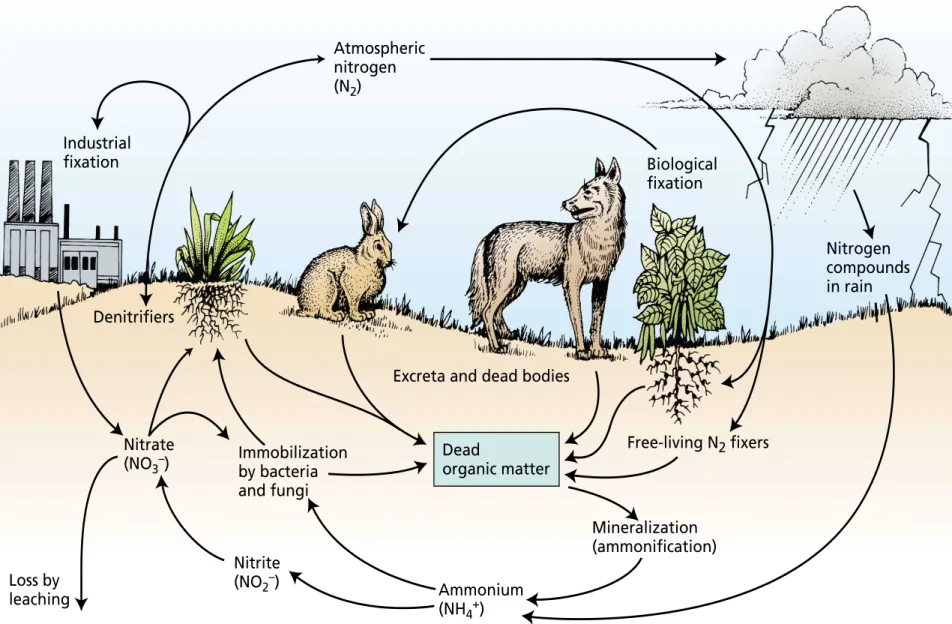
Once fixed in ammonium or nitrate, nitrogen enters a biogeochemical cycle and passes through several organic or inorganic forms before it eventually returns to molecu- lar nitrogen (Figure 12.1; see also Table 12.1). The ammo- nium (NH4+) and nitrate (NO3–) ions that are generated through fixation or released through decomposition of soil organic matter become the object of intense competition
among plants and microorganisms. To remain competitive, plants have developed mechanisms for scavenging these ions from the soil solution as quickly as possible (see Chap- ter 5). Under the elevated soil concentrations that occur after fertilization, the absorption of ammonium and nitrate by the roots may exceed the capacity of a plant to assimi- late these ions, leading to their accumulation within the plant’s tissues.
Stored Ammonium or Nitrate Can Be Toxic
Plants can store high levels of nitrate, or they can translo- cate it from tissue to tissue without deleterious effect. How- ever, if livestock and humans consume plant material that is high in nitrate, they may suffer methemoglobinemia, a disease in which the liver reduces nitrate to nitrite, which combines with hemoglobin and renders the hemoglobin unable to bind oxygen. Humans and other animals may also convert nitrate into nitrosamines, which are potent car- cinogens. Some countries limit the nitrate content in plant materials sold for human consumption.
In contrast to nitrate, high levels of ammonium are toxic to both plants and animals. Ammonium dissipates trans- membrane proton gradients (Figure 12.2) that are required for both photosynthetic and respiratory electron transport (see Chapters 7 and 11) and for sequestering metabolites in
Atmospheric nitrogen (N2)
Mineralization (ammonification) Ammonium
(NH4+) Nitrite
(NO2–) Nitrate
(NO3–)
Loss by leaching
Denitrifiers
Immobilization by bacteria and fungi Industrial
fixation Biological
fixation
Nitrogen compounds in rain
Excreta and dead bodies
Deadorganic matter
Free-living N2 fixers
FIGURE 12.1 Nitrogen cycles through the atmosphere as it changes from a gaseous form to reduced ions before being incorporated into organic compounds in living organisms. Some of the steps involved in the nitrogen cycle are shown.
Assimilation of Mineral Nutrients 261
Sumber Nitrogen di Alam
• Nitrogen menyusun 79 % dari atmosfer, dalam bentuk dinitrogen (N 2 )
• Nitrogen di dalam tanah terikat sbg sedimen organik, yang Pdak tersedia bagi
pertumbuhan tanaman.
Novri Youla Kandowangko
Universitas Negeri Gorontalo 6
Amonifikasi
• Pengubahan nitrogen organik menjadi NH 4 +
(amonium) oleh bakteri dan fungi tanah.
Novri Youla Kandowangko
Universitas Negeri Gorontalo 7
Nitrifikasi
• Proses pengubahan nitrogen secara biologis di dalam tanah dari bentuk tereduksi menjadi
bentuk yang lebih teroksidasi.
• Oksidasi biologis garam amonium dalam tanah menjadi nitrit dan selanjutnya oksidasi nitrit
menjadi nitrat.
• NH 4 + + 1,5 O 2 NO 2 - + 2 H + + H 2 O + 66 Kcal
Novri Youla Kandowangko
Universitas Negeri Gorontalo 8
Nitrifikasi
• NH 4 + + 1,5 O 2 NO 2 - + 2 H + + H 2 O + 66 Kcal
Diperantarai oleh Nitrosomonas
• NaNO 2 + 0,5 O 2 NaNO 3 + 18 Kcal Diperantarai oleh Nitrobacter
Novri Youla Kandowangko
Universitas Negeri Gorontalo 9
Beberapa Contoh Organisme yang membantu fiksasi Ntrogen
gen-fixing organisms listed in Table 12.2 either functions under natural anaerobic conditions or can create an inter- nal anaerobic environment in the presence of oxygen.
In cyanobacteria, anaerobic conditions are created in spe- cialized cells called heterocysts (see Figure 12.9). Heterocysts are thick-walled cells that differentiate when filamentous cyanobacteria are deprived of NH
4+. These cells lack photo- system II, the oxygen-producing photosystem of chloro- plasts (see Chapter 7), so they do not generate oxygen (Bur- ris 1976). Heterocysts appear to represent an adaptation for
nitrogen fixation, in that they are widespread among aero- bic cyanobacteria that fix nitrogen.
Cyanobacteria that lack heterocysts can fix nitrogen only under anaerobic conditions such as those that occur in flooded fields. In Asian countries, nitrogen-fixing cyano- bacteria of both the heterocyst and nonheterocyst types are a major means for maintaining an adequate nitrogen sup- ply in the soil of rice fields. These microorganisms fix nitro- gen when the fields are flooded and die as the fields dry, releasing the fixed nitrogen to the soil. Another important TABLE 12.2
Examples of organisms that can carry out nitrogen fixation
Symbiotic nitrogen fixation
Host plant N-fixing symbionts
Leguminous: legumes, Parasponia Azorhizobium, Bradyrhizobium, Photorhizobium, ` Rhizobium, Sinorhizobium
Actinorhizal: alder (tree), Ceanothus (shrub), Frankia Casuarina (tree), Datisca (shrub)
Gunnera Nostoc
Azolla (water fern) Anabaena
Sugarcane Acetobacter
Free-living nitrogen fixation
Type N-fixing genera
Cyanobacteria (blue-green algae) Anabaena, Calothrix, Nostoc Other bacteria
Aerobic Azospirillum, Azotobacter, Beijerinckia, Derxia
Facultative Bacillus, Klebsiella
Anaerobic
Nonphotosynthetic Clostridium, Methanococcus (archaebacterium)
Photosynthetic Chromatium, Rhodospirillum
TABLE 12.3
Associations between host plants and rhizobia
Plant host Rhizobial symbiont
Parasponia (a nonlegume, formerly called Trema) Bradyrhizobium spp.
Soybean (Glycine max) Bradyrhizobium japonicum (slow-growing type);
Sinorhizobium fredii (fast-growing type)
Alfalfa (Medicago sativa) Sinorhizobium meliloti
Sesbania (aquatic) Azorhizobium (forms both root and stem nodules;
the stems have adventitious roots)
Bean (Phaseolus) Rhizobium leguminosarum bv. phaseoli;
Rhizobium tropicii; Rhizobium etli
Clover (Trifolium) Rhizobium leguminosarum bv. trifolii
Pea (Pisum sativum) Rhizobium leguminosarum bv. viciae
Aeschenomene (aquatic) Photorhizobium (photosynthetically active rhizobia that form stem nodules, probably associated with adventitious roots)
Assimilation of Mineral Nutrients 267
Novri Youla Kandowangko
Universitas Negeri Gorontalo 10
Asosiasi antara Tumbuhan inang dan bakteri
Novri Youla Kandowangko
Universitas Negeri Gorontalo 11
gen-fixing organisms listed in Table 12.2 either functions under natural anaerobic conditions or can create an inter- nal anaerobic environment in the presence of oxygen.
In cyanobacteria, anaerobic conditions are created in spe- cialized cells called heterocysts (see Figure 12.9). Heterocysts are thick-walled cells that differentiate when filamentous cyanobacteria are deprived of NH 4 + . These cells lack photo- system II, the oxygen-producing photosystem of chloro- plasts (see Chapter 7), so they do not generate oxygen (Bur- ris 1976). Heterocysts appear to represent an adaptation for
nitrogen fixation, in that they are widespread among aero- bic cyanobacteria that fix nitrogen.
Cyanobacteria that lack heterocysts can fix nitrogen only under anaerobic conditions such as those that occur in flooded fields. In Asian countries, nitrogen-fixing cyano- bacteria of both the heterocyst and nonheterocyst types are a major means for maintaining an adequate nitrogen sup- ply in the soil of rice fields. These microorganisms fix nitro- gen when the fields are flooded and die as the fields dry, releasing the fixed nitrogen to the soil. Another important TABLE 12.2
Examples of organisms that can carry out nitrogen fixation
Symbiotic nitrogen fixation
Host plant N-fixing symbionts
Leguminous: legumes, Parasponia Azorhizobium, Bradyrhizobium, Photorhizobium,`
Rhizobium, Sinorhizobium Actinorhizal: alder (tree),Ceanothus (shrub), Frankia
Casuarina (tree), Datisca (shrub)
Gunnera Nostoc
Azolla (water fern) Anabaena
Sugarcane Acetobacter
Free-living nitrogen fixation
Type N-fixing genera
Cyanobacteria (blue-green algae) Anabaena, Calothrix,Nostoc Other bacteria
Aerobic Azospirillum, Azotobacter,Beijerinckia, Derxia
Facultative Bacillus, Klebsiella
Anaerobic
Nonphotosynthetic Clostridium, Methanococcus (archaebacterium)
Photosynthetic Chromatium,Rhodospirillum
TABLE 12.3
Associations between host plants and rhizobia
Plant host Rhizobial symbiont
Parasponia (a nonlegume, formerly called Trema) Bradyrhizobium spp.
Soybean (Glycine max) Bradyrhizobium japonicum (slow-growing type);
Sinorhizobium fredii (fast-growing type)
Alfalfa (Medicago sativa) Sinorhizobium meliloti
Sesbania (aquatic) Azorhizobium (forms both root and stem nodules;
the stems have adventitious roots)
Bean (Phaseolus) Rhizobium leguminosarum bv. phaseoli;
Rhizobium tropicii; Rhizobium etli
Clover (Trifolium) Rhizobium leguminosarum bv. trifolii
Pea (Pisum sativum) Rhizobium leguminosarum bv. viciae
Aeschenomene (aquatic) Photorhizobium (photosynthetically active rhizobia that form stem nodules, probably associated with adventitious roots)
Assimilation of Mineral Nutrients 267
• Menurut Del Gallo dan Fendrik (1994), proses asosiasi Azospirillum pada tanaman diduga
terjadi sebagai berikut :
(1) Adanya sifat kemotaksis dari bakteri.
Kemampuan sensiPvitas bakteri itu
menyebabkan Azospirillum mampu mendeteksi dan tanggap terhadap eksudat akar yang yang sesuai dengan kebutuhannya. Dengan sifat kemotaksis tersebut bakteri mendekaP
permukaan akar ;
(2) bakteri kemudian melekat pada permukaan akar. Flagella dan polisakarida bakteri akan saling berikatan (fase pelekatan 1) ;
Novri Youla Kandowangko
Universitas Negeri Gorontalo 12
• Menurut Del Gallo dan Fendrik (1994), proses asosiasi Azospirillum pada tanaman diduga terjadi sebagai
berikut : (lanjutan)
(3) terjadi pertukaran sinyal antara tanaman dengan bakteri ;
(4) bakteri memproduksi serat-serat selulosa yang
menyebabkan bakteri terikat kuat pada permukaan akar (fase pelekatan 2);
(5) asosiasi sudah terjadi secara sempurna. Azospirillum memproduksi senyawa yang mendukung pertumbuhan tanaman dan mensPmulasi produksi hormon tumbuh endogen di perakaran. Azospirillum berada di rizoplan
(permukaan akar) dan di dalam jaringan akar tanaman.
Novri Youla Kandowangko
Universitas Negeri Gorontalo 13
• KeefekPfan asosiasi Azospirillum – tanaman tergantung pada ketersediaan nutrisi sumber karbon, nitrogen, dan energi dalam rizosfer tanaman.
• MarPnez-Drets dkk. (1989) mengungkapkan bahwa akPvitas reduksi asePlen oleh
Azospirillum lipoferum paling baik jika
digunakan glukosa sebagai sumber karbonnya, diikuP oleh malat, fruktosa, suksinat, piruvat, arabinosa, α-ketoglutarat, laktat, galaktosa, mannose, dan mannitol.
Novri Youla Kandowangko
Universitas Negeri Gorontalo 14
• Berdasarkan pengamatan yang intensif, ada beberapa faktor yang mempengaruhi fiksasi nitrogen pada asosiasi tanaman Gramineae
dengan Azospirillum yang melipuP temperatur maksimum-minimum tanah dan udara, serta kandungan nitrogen dan kelembaban tanah (Boddey dan Döbereiner, 1994).
Novri Youla Kandowangko
Universitas Negeri Gorontalo 15
• Penambatan (fiksasi) N 2 bebas oleh
Azospirillium dimungkinkan oleh adanya
enzim nitrogenase. Pada A. brasilense dan A.
lipoferum enzim itu terdiri atas komponen nitrogenase (protein MoFe), denitrogen reduktase (protein Fe) yang “inakPf”, dan
akPvator enzimnya (Song Seung dkk., 1985).
Novri Youla Kandowangko
Universitas Negeri Gorontalo 16
Penambatan (fiksasi) N2 bebas oleh Azospirillium dimungkinkan oleh adanya enzim nitrogenase. Pada A. brasilense dan A. lipoferum enzim itu terdiri atas komponen nitrogenase (protein MoFe), denitrogen reduktase (protein Fe) yang “inaktif”, dan aktivator enzimnya (Song Seung dkk., 1985).
Faktor-faktor yang mempengaruhi pertumbuhan bakteri nitrifikasi dalam tanah :
• Ketersediaan amonia dan nitrit
• Aerasi
• Kelembaban
• Temperatur
• pH tanah
• Bahan organik
Novri Youla Kandowangko
Universitas Negeri Gorontalo 17
Biological Fixa+on
(where MOST nitrogen fixing is completed) There are two types of “Nitrogen Fixing Bacteria”
Free Living Bacteria
(“fixes” 30% of N 2 ) Symbiotic Relationship Bacteria
(“fixes” 70% of N 2 )
Free Living Bacteria
Highly specialized bacteria live in the soil and have the ability to combine atmospheric nitrogen with hydrogen to make
ammonia (NH 3 ).
Free-living bacteria live in soil and combine
atmospheric nitrogen with hydrogen
Nitrogen changes into ammonia
N N
H N H
3(NH
3)
Bacteria
Symbio+c Rela+onship Bacteria
Bacteria live in the roots of legume family plants
and provide the plants with ammonia (NH 3 ) in exchange for the plant’s
carbon and a protected home.
Legume plants
Roots with nodules where bacteria live Nitrogen changes into ammonia.
NH
3N
N
Nitrogen FixaPon
• Legumes commonly form N-fixaPon symbioses
• N fixaPon is not free
– may cost the plant up to 30% of the C it captures from the atmosphere in photosynthesis
• Rate of N fixaPon is inversely proporPonal to
available N in the soil.
Novri Youla Kandowangko
Universitas Negeri Gorontalo 22
(A)
(C)
(E)
(B)
(D)
(F) Rhizobia
Root hair
Infection thread
Golgi body Golgi vesicle
Curling growth
Infection thread membrane fuses with cell membrane
Vesicle containing rhizobia
Note that the reduction of N2 to 2 NH3, a six-electron transfer, is coupled to the reduction of two protons to evolve H2. The nitrogenase enzyme complex catalyzes this reaction.
The nitrogenase enzyme complex can be separated into two components—the Fe protein and the MoFe protein—
neither of which has catalytic activity by itself (Figure 12.12):
• The Fe protein is the smaller of the two components and has two identical subunits of 30 to 72 kDa each, depending on the organism. Each subunit contains an iron–sulfur cluster (4 Fe and 4 S2– ) that participates in the redox reactions involved in the conversion of N2 to NH3. The Fe protein is irreversibly inactivated by O2with typical half-decay times of 30 to 45 seconds (Dixon and Wheeler 1986).
• The MoFe protein has four subunits, with a total mol- ecular mass of 180 to 235 kDa, depending on the species. Each subunit has two Mo–Fe–S clusters. The MoFe protein is also inactivated by oxygen, with a half-decay time in air of 10 minutes.
In the overall nitrogen reduction reaction (see Figure 12.12), ferredoxin serves as an electron donor to the Fe pro- tein, which in turn hydrolyzes ATP and reduces the MoFe protein. The MoFe protein then can reduce numerous sub- strates (Table 12.4), although under natural conditions it reacts only with N2and H+. One of the reactions catalyzed by nitrogenase, the reduction of acetylene to ethylene, is used in estimating nitrogenase activity (see Web Topic 12.2).
The energetics of nitrogen fixation is complex. The pro- duction of NH3from N2and H2is an exergonic reaction Assimilation of Mineral Nutrients 271