Full Terms & Conditions of access and use can be found at
http://www.tandfonline.com/action/journalInformation?journalCode=cbie20
Download by: [Universitas Maritim Raja Ali Haji] Date: 18 January 2016, At: 18:56
Bulletin of Indonesian Economic Studies
ISSN: 0007-4918 (Print) 1472-7234 (Online) Journal homepage: http://www.tandfonline.com/loi/cbie20
A dream denied? Mining legislation and the
Constitution in Indonesia
Kosim Gandataruna & Kirsty Haymon
To cite this article: Kosim Gandataruna & Kirsty Haymon (2011) A dream denied? Mining legislation and the Constitution in Indonesia, Bulletin of Indonesian Economic Studies, 47:2, 221-231, DOI: 10.1080/00074918.2011.585951
To link to this article: http://dx.doi.org/10.1080/00074918.2011.585951
Published online: 20 Jul 2011.
Submit your article to this journal
Article views: 369
View related articles
ISSN 0007-4918 print/ISSN 1472-7234 online/11/020221-11 © 2011 Indonesia Project ANU DOI: 10.1080/00074918.2011.585951
A DREAM DENIED?
MINING LEGISLATION AND
THE CONSTITUTION IN INDONESIA
Kosim Gandataruna* Kirsty Haymon*
Former Director General of Monash Asia Institute, General Mining (1989–93) Monash University
Indonesia is blessed with a wealth of natural resources. After wresting power from the Dutch, the leaders of the new republic adopted a constitution that required this national wealth to ‘be controlled and utilised by the State for maximum prosperity of the people’.The dream of turning the country’s abundant natural resources into a catalyst for socio-economic development was not pursued actively until 1967, when Soeharto’s incoming New Order government introduced policies that supported a signiicant expansion of the mining industry. The combined effect of the Asian inancial crisis and domestic political unrest in 1997–98 interrupted this process. It was anticipated that the introduction of a new mining law in 2009 would re-invigorate the sector. Based on an analysis of ive signiicant elements of the new legislation, this article inds it is unlikely to result in a mining industry that provides maximum beneit to the Indonesian people.
INTRODUCTION
As a consequence of the revolutionary struggle that followed Indonesia’s proc-lamation of independence in 1945, the mining sector was sidelined by political instability and social unrest. In 1959, in an act of rejection of the country’s colonial past, the Soekarno government nationalised all Dutch mining companies. This resulted in the country’s vast mineral resources remaining largely untouched for most of the following decade (Simatupang, Sigit and Wahju 1996). In 1967 Soeharto’s New Order government introduced Law 1/1967 on Foreign Invest-ment and Law 11/1967 on the Basic Provisions of Mining. The political rationale behind these laws was to lay the foundation for a recovery from the chaos of the mid-1960s and to achieve accelerated economic development on which the legiti-macy of the new government could be built.
After three decades, total annual government revenue from mining (excluding oil and gas) had reached $648 million (PricewaterhouseCoopers 2002). Much of the industry’s growth could be attributed to the highly favourable conditions pro-vided by Law 11/1967, which ensured that investment was not subject to changes
* The authors gratefully acknowledge funding in the form of an Endeavour Award from the Australian government to support this research.
in government laws or policies (Wahju 2002). It provided for guaranteed secu-rity of tenure (so that companies undertaking exploration could be sure that they would be able to proceed to production) and competitive and stable royalty rates, especially in comparison to neighbouring countries. Neither of these elements has been retained in the new mining law introduced in 2009 (see below).
The much lauded Contract of Work (CoW) scheme was formulated under Law 11/1967.1 It allowed foreign investors to operate mines under the status of
con-tractor to the Indonesian government. Over time, the details of the scheme were revised to ensure that it remained responsive to the international investment cli-mate and prevailing market conditions. Each revision was referred to as a ‘gen-eration’, with eight such generations introduced since 1967 – although the last remained unsigned by any investor until 2008. This type of contractual system allowed the government to modify the terms and conditions that would apply to each generation of contracts to ensure greater certainty for investors during the lifespans of their extractive projects (Barberis 2001).
During the same period, many other developing countries were dismantling their neo-colonial systems of offering mining concessions over large areas for long periods of time. By the 1990s, more than 100 countries had revised their foreign investment regimes for the mining sector. While there was a realistic apprecia-tion that condiapprecia-tions should remain suficiently conducive to investment by multi-national companies, the terms by which business was conducted shifted to ensure that greater beneits lowed to the general public (Brown 1984).
Meanwhile, Indonesia’s contractual system continued to offer foreign inves-tors highly favourable conditions in relation to iscal obligations, employment of Indonesian nationals, production royalty rates and import duties. Many of these features have since been revoked by the new mining law, Law 4/2009 on Min-eral and Coal Mining. Investors no longer enjoy guaranteed security of tenure or predictably low royalty rates. The contractual distinctions between foreign and domestic companies have been eliminated. Whereas CoWs could only be held by foreign companies, Law 4/2009 offers ‘business mining licences’ that do not discriminate between foreign and domestic companies. The period within which some divestment of foreign ownership must take place has been shortened, although the total level of divestment has been reduced.2
1 A CoW is a contract between the government and a foreign mining company that sets out the company’s rights and obligations – including all tax, royalty and other iscal charges. Under a CoW, the company retains management control and responsibility for all its activi-ties (PricewaterhouseCoopers 2010). This arrangement differs from the production-sharing contracts used in Indonesia’s oil and gas industry, in which net income is split between Per-tamina (the state-owned energy and petrochemical company) and the foreign contractor. 2 While Law 11/1967 did not specify divestment obligations, foreign-owned companies operating under irst through fourth generation CoWs were required to reduce the level of foreign ownership by at least 51% within 10 years of commencement of commercial opera-tions. By contrast, article 112 of Law 4/2009 requires foreign-owned mining companies to start divesting to local shareholders ive years after commencement of production, by a minimum of 20%. Shareholders may be drawn from the central government, the provincial and district governments of the jurisdiction where the mine is located, state-owned compa-nies, regional government-owned companies and privately owned Indonesian compacompa-nies, with the divestment to take place through a tender process.
During the course of a mining venture two licences are now required: one for the exploration and feasibility study phase and the other for the production– operation phase. Consequently, companies that successfully undertake exploration (that is, discover economically viable mineral deposits) are no longer guaranteed the right to proceed to extraction without applying for further government permissions. Combined with an effective decrease in the land area available for exploration under the new law,3 this has weakened the incentive for companies to undertake
exploration, on which future expansion of the industry depends.
The process of moving from an exploration licence to a production–operation licence is now managed through a tender process. While this is widely regarded as a shift in the right direction – as it does not allow for collusion and it more accu-rately relects market prices (Leigh 2011) – nepotism and corruption still plague the tender process in Indonesia. Other features of Law 4/2009 that diverge sig-niicantly from Law 11/1967 include its domestic processing and reining obliga -tions, its requirement for mining companies to undertake domestic arbitration of disputes, and to use local or national mining support companies,4 and its greater
emphasis on contributing to community development. For companies still oper-ating under CoWs, the law stipulates transitional requirements.
Under the conditions created by Law 11/1967, Indonesia had become the world’s second-largest tin producer, third-largest copper producer, ifth-largest nickel producer and seventh-largest gold producer by the turn of the century (PricewaterhouseCoopers 2000). It had managed to maintain its position as a pre-eminent producer of minerals despite the repercussions of the Bre-X scam (Feridhanusetyawan 1997),5 the 1997–98 Asian inancial crisis and the domestic
political transition following President Soeharto’s resignation.
3 Under article 75 of Government Regulation 23/2010 on the Implementation of Mineral and Coal Mining Business Activities, the maximum land area available for metallic mineral exploration activity is 100,000 hectares, and for coal exploration activity 50,000 hectares. After three years the land area must be reduced to 50,000 and 25,000 hectares respectively. While Law 11/1967 stipulated a total exploration area of only 10,000 hectares, companies could – and often did – appeal to the Minister of Mines and Energy for access to additional land, resulting in vastly increased holdings. The option of appealing to the minister is not available under the current law.
4 According to Ministerial Regulation 28/2009 on the Conduct of Mineral and Coal Min-ing Services Business, a ‘local’ minMin-ing services company is a domestically owned irm that is established and provides services in a district/city or province, while a ‘national’ com-pany is one that operates throughout the archipelago. In the event that no local or national company is available, the licence holder may use the services of a company with a foreign shareholding, as long as it is incorporated as an Indonesian legal entity.
5 The Bre-X scam has been described as the biggest mining hoax in history. Bre-X, a sub-sidiary of Canadian company Bresea Resources, claimed to have found a large gold deposit in Busang, Kalimantan, estimated to be in excess of 70 million ounces. The ind was valued by independent consulting company Kilborn Engineering at over $70 billion. Subsequent tests showed, however, that crushed core samples had been ‘salted’ with alluvial gold. When the fraud was discovered, Bre-X’s stock price – which had risen from 50 cents in 1994 to $286 in 1996 – plummeted to just nine cents in May 1997. Bre-X iled for bankruptcy in 2002 (Behar 1997).
While the fall of Soeharto generated public euphoria in anticipation of a more transparent and democratic system of government, it also created signiicant problems for the mining industry. This was primarily a result of the decentrali-sation of power through two key laws: Law 22/1999 on Regional Government and Law 25/1999 on the Fiscal Balance between the Centre and the Regions. The former in particular devolved considerable authority for the management of min-ing concessions to regional governments. In combination with Law 34/2000 on Regional Taxes and Levies, the new arrangements gave regional governments slightly greater revenue-raising capacity by allowing them to impose some new taxes, subject to central government approval. This included the right to tax heavy equipment commonly used in coal mining, which had previously been exempt.
Unfortunately, the lack of institutional capacity at the lower levels of govern-ment led to legal uncertainty, poor administrative practices, a lack of coordina-tion across government departments and a dramatic increase in illegal mining activity (Djalal 2001; Saad 2001; Regional Autonomy Watch 2004). In some cases, local government oficials issued export licences to local entrepreneurs who lacked capability and experience, often without keeping any oficial record of the transaction. For example, in 2001 the state-owned mining company PT Tambang Timah, the world’s largest tin producer, reported a 92% drop in proit, seemingly as a direct consequence of the proliferation of illegal mines extracting ore from its CoW area. This would only have been possible with the support of local oficials, presumably for inancial reward (Aspinall 2001).
The fact that realised foreign investment in the mining industry remained above $4.5 billion in 1999/2000 owed more to the country’s mineral potential and high global demand, and to the lower value of the rupiah as a result of the Asian inancial crisis, than to any concerted attempt by the new government to respond to the needs of investors (BPM–PBUMN 2000). A more accurate relection of the condition of the mining industry is perhaps the decline in greenield explora -tion expenditure: while most other mineral-rich countries were experiencing an unprecedented surge in investment in greenield exploration, in Indonesia it fell from an average of $30 million per annum in 1996–2000 to just $14 million in 2001–06 (PricewaterhouseCoopers 2008).
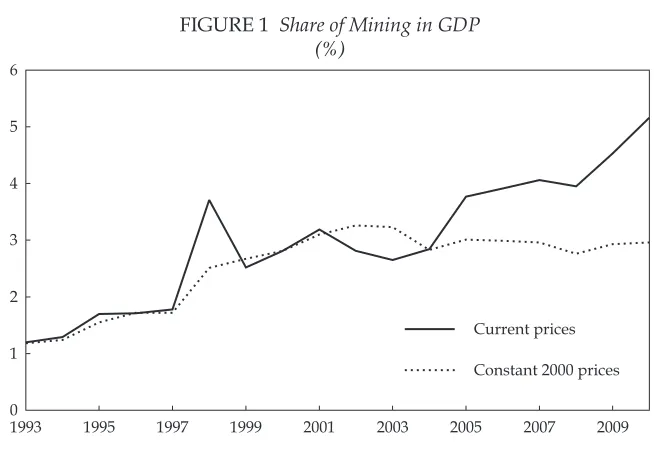
Figure 1 shows the share of mining in GDP, expressed in both current and con-stant (2000) prices. It can be seen that this increased until 2001, the irst year of decentralisation. In the period since then, the industry’s share of GDP, in current prices, has continued to increase – exceeding 5% by 2010, compared with a little over 1% in 1993 – although this has mainly been the consequence of rising world prices for mineral exports rather than increases in output. This is relected in the divergence of the GDP shares in current and constant prices, especially since 2004. When price increases are removed from the mining sector output and GDP series, the share of mining is revealed to have been stagnant at around 3% since the turn of the century. Evidently Indonesia has not been able to beneit as readily from its mineral resources in recent years as it had prior to decentralisation.
The government responded to the falling levels of investor conidence by pro -posing a new mining law. The industry enthusiastically welcomed this move and actively supported the government’s efforts to reform the mining regime. How-ever, despite voluminous input from industry stakeholders and nearly six years of drafting (and an additional three and a half years of deliberation in parlia-ment), Law 4/2009 does not satisfactorily address the many concerns of investors.
The associated implementing regulations that have been released subsequently have similarly failed to clarify a number of important issues. The new legislation attempts to overcome lack of certainty by introducing signiicantly more detail than was contained in Law 11/1967. However, the end result is legislation that contains so many rules that it is insuficiently lexible to adjust either to changing realities in the ield or to future shifts in the investment climate and commodity markets. Moreover, it contains a number of stipulations that are unrealistic and dificult to implement. The outcome may be a mining industry that fails to live up to the dream of achieving the greatest public beneit from exploitation of the country’s mineral resources.
This paper argues that ive signiicant elements of the new mining law dis-regard a number of key principles made explicit in the Constitution. These are its delegation of mining authority to regional governments; its articles pertaining to land ownership, people’s mining and the obligation to increase domestic value added; and the length of the production–operation period.
DELEGATION OF AUTHORITY TO REGIONAL GOVERNMENTS
According to chapter 4 of Law 4/2009, ‘authority for the management of miner-als and coal’ is largely delegated to the provincial and local (district/municipal) levels of government. However, the deiciency of experience within regional governments to manage the increasingly onerous process of coordinating licences has already translated in the ield to unrestrained and unscrupulous mining practices.6 It is likely that these problems will be exacerbated if the
6 See, for example, Djalal (2001); Saad (2001); Regional Autonomy Watch (2004); and Indo-nesia Corruption Watch (2005).
FIGURE 1 Share of Mining in GDP (%)
1993 1995 1997 1999 2001 2003 2005 2007 2009
0 1 2 3 4 5 6
Current prices
Constant 2000 prices
Source: CEIC Asia Database.
number of unqualiied investors currently seeking mining licences continues to increase.7
The ability of regional governments to determine their own policies and tap new sources of revenue is a relatively recent development brought on by the shift to regional autonomy. Considering that some 8,000 mining licences were issued over the 12 months to December 2010, it is conceivable that regional governments will continue to pursue a strategy of rampant exploitation of mineral resources, justiied in terms of generating more regional income or speeding up the pace of development. It is clear that they have yet to ind an appropriate balance between the immediate cash-low beneits generated by large-scale issuance of mining licences and the longer-term returns in the form of taxes and royalties.
Combined with the limited capacity of regional governments to enforce min-ing regulations, the entry of unqualiied investors lackmin-ing technological, technical and inancial competence appears likely to result in a rapid depletion of Indo -nesia’s mineral resources, extensive damage to the environment and minimum revenue generation for the state. Even more importantly, it is likely to deprive the Indonesian public of its constitutional right to enjoy the maximum possible beneit from exploitation of the country’s mineral wealth. There is therefore a clear need for continued central government oversight and further implementing regulations to compensate for the lack of institutional capacity within regional governments. The Directorate General of Mineral Resources and Coal recently announced that responsibility for enforcement and supervision of all regulations and management of state revenue associated with Law 4/2009 would fall to the provincial rather than central level of government (Prasodjo 2011). As in the case of the management of forest resources, however, revoking the licensing authority of regional governments would seem to be the only way to ‘lessen ambiguities and enhance eficiencies’ (Fox, Adhuri and Resosudarmo 2005: 105).
LAND OWNERSHIP
Article 135 of Law 4/2009 stipulates that ‘Mining Exploration Licence holders or Special Mining Exploration Licence holders may carry out their activities upon approval of land title holders’. Article 136 goes on to say that ‘Mining Licence hold-ers or Special Mining Licence holdhold-ers, before carrying out production– operation activities, must resolve land titles with title holders under provisions of [the cur-rent] laws and regulations’. Neither of these articles, nor any other in Law 4/2009, details the grounds upon which title holders can refuse to allow mining on their land. The elucidation of article 135 provides no further explanation, stating only that ‘the agreement of land title holders is intended to resolve [issues relating to] land disrupted by exploration activities, such as drilling, trenches and sampling’. Under Indonesia’s ‘positive’ legal system, an act has to be explicitly forbidden by law to be considered illegal. Consequently, Law 4/2009 implies that land title holders have no right to refuse access to mining licence holders. In the end, the
7 According to article 13 of Government Regulation 23/2010, mining licence holders are qualiied if they have a minimum of three years experience in the mining or coal industries, employ one mining and/or geological expert with a minimum of three years experience, and have annual working plans and budgets for four years of exploration activity.
lack of explicit clariication about the conditions under which title holders may or may not refuse access to their land can be expected not only to heighten the debate about traditional land ownership but also to increase the number of cases requiring arbitration (Ballard and Banks 2003; Thorburn 2004).
By comparison, under Law 11/1967 land title holders could not refuse entry to mining companies if a ‘fair’ amount of compensation had been amicably agreed. In the early 1990s, this was interpreted as meaning that companies were permit-ted to carry out any form of mining activity on the land, regardless of objections from land title holders, provided the offer of reparation was deemed suficient by government oficials.8 Such a provision was considered indispensable at a time
when the country’s economic development relied heavily on the exploitation of commodities, and was accordingly given precedence over traditional land rights. However, the paradox remains that although, in principle, exploitation of natu-ral resources beneits the people, in practice it may also deprive traditional land-holders of their livelihoods in the absence of adequate compensation.
Traditional land rights should not be overlooked in the pursuit of develop-ment. Rather, to ensure deined roles and responsibilities in the arbitration pro -cess, the rights of each party should be sanctioned by the prevailing law. In this regard, Law 4/2009 does not contain suficient guidance on how to balance the rights of land title holders (including those that claim traditional land rights) with those of mining licence holders. The only way to resolve this tension – so common in extraction sites around the world – is to set out explicitly in the law the roles and responsibilities of land title holders and mining licence holders. Without this, Law 4/2009 cannot accomplish one of the most basic national goals: equitable distribution of socio-economic development through the exploitation of natural resources. There is a clear need for the central government to clarify the law fur-ther to ensure that this goal can be achieved.
PEOPLE’S MINING
Relecting the spirit of economic democracy, article 38 of Law 4/2009 stipulates that mining licences may be granted to ‘entities, cooperatives or sole proprietor-ships’. In allowing sole proprietorships, the government is employing the politics of equal opportunity. However, this policy should not be applied without due regard for the nature of mining. In particular, it needs to be understood that min-ing is a highly capital-intensive undertakmin-ing, subject to signiicant economies of scale. Such ventures are often risky, slow to yield results, and accompanied by sig-niicant social and environmental responsibilities. Only irms with considerable technical, economic and inancial capability would be able to devise and carry out the long-term planning needed to mine a mineral deposit, or cluster of mineral deposits, eficiently.
For these reasons, it would seem sensible to limit the mining ventures of coop-eratives and sole proprietorships to small, local deposits. Article 67 of Law 4/2009 goes some way towards this, by allowing local residents, either as individuals or as groups, to obtain small-scale mining licences over small areas of land, with
8 This was the policy when Kosim Gandataruna, a co-author of this paper, was Director General of General Mining (1989–93).
limits on the amount of capital investment.9 However, the law should also
pre-clude the possibility of large numbers of small-scale miners being allowed to exploit larger-scale deposits, as this would result in a failure to take advantage of scale economies. The most eficient way to mine a large deposit is for a single management to draw up a long-term plan that covers the entire reserve, and that adheres to principles of sustainable development. Small-scale miners are unlikely to have the resources to formulate and commit to such a plan.
This is not in any way intended to disregard the importance of Indonesia’s small-scale mining entrepreneurs, or question their competence. Rather, the mes-sage is that in order to accelerate socio-economic development, particularly in remote and impoverished regions, the government needs to encourage participa-tion by the most adept players. This means relying on those investors that use state-of-the-art technology and that have access to the considerable amounts of capital that large-scale exploration activity requires.
DOMESTIC VALUE-ADDING OBLIGATION
Articles 95, 102, 103 and 170 of Law 4/2009 impose obligations on the holders of mining licences to process domestically the minerals they extract. These pro-visions are intended to promote forward and backward linkages with domestic suppliers of goods and services, thereby increasing the value of output of the min-ing industry. They are neither realistic nor feasible when applied indiscriminately, however. For example, some minerals need to be reined to very high degrees of purity. This is a technically complex process that is subject to signiicant econo -mies of scale, such that very few plants worldwide are capable of operating efi -ciently in this area.
Interestingly, the Indonesian policy runs counter to the worldwide trend towards fragmentation of the production process – that is, the location of differ-ent stages of production in differdiffer-ent countries in an attempt to minimise the cost of each stage (Athukorala 2006). This ‘trade in tasks’ has boomed in the wake of lower transport and trade costs, shifting processing plants away from the sources of raw materials (Coxhead 2010).
Market mechanisms that respond to technical, technological, inancial and environmental factors more reliably discover where feasible, long-term business opportunities exist. If processing and reining could be conducted more eficiently (that is, more cheaply) within Indonesia than overseas, companies could be expected to choose this option voluntarily (Baird and Wihardja 2010). To achieve the maximum commercial value of minerals, therefore, such decisions should be left to the market.
Indonesia’s value-adding policy fails to distinguish between value added in a sector and value added in the economy as a whole, even though it is the lat-ter that matlat-ters for the prosperity of the Indonesian people. The net result of forcing a domestic processing requirement on the mining industry is a reduction
in the value of minerals to the economy, because the unnecessarily high cost of
9 The size of the holdings is limited to a maximum of 1 hectare for individuals, 5 hectares for groups and 10 hectares for cooperatives. Such licences are granted for an initial period of ive years with the possibility of extension.
processing – when conducted (less eficiently) within Indonesia – must be sub -tracted from the value of processed ore to arrive at the net value of those miner-als. In short, this obligation reduces the beneits of mining to the general public. At the same time it reduces mining industry proits, and therefore the funds that can be re-invested in exploring for new resources and increasing the eficiency of exploitation of known mineral assets.
DURATION OF PRODUCTION–OPERATION LICENCES
Article 47 of Law 4/2009 stipulates that production–operation licences are lim-ited to an initial 20-year period, with the option of two 10-year extensions.10 This
timeframe is 10 years shorter than was available under Law 11/1967, introducing the possibility that the full value of a mineral deposit may not be recovered. A longer production–operation period would motivate licence holders to set aside resources to search for additional mineral reserves within their licence areas. It would allow them to fully recover such deposits before reclaiming the land for other uses.
The shorter timeframe available to mining companies to maximise their returns from investment in exploration and development may prompt them to resort to the practice of ‘high grading’, where the focus is on recovering only the highest-grade ore (Lemieux 2000). In most cases it is economic for mining companies to extract lower-grade ore in conjunction with higher-grade ore, given suficient time to do so. Therefore, any move towards high grading would reduce the bene-its from the mines in question for the Indonesian people. Precisely for this reason, this practice is prohibited in many countries through legislation that demands maximum economic recovery (Hamilton 2005).
A longer production–operation period would also enable mining companies to make longer-term commitments to local communities. One of the greatest beneits that can be derived from a mining operation is for the people living in adjacent areas to beneit directly as a result of the company’s corporate social responsibility projects, and through the development of forward and backward linkages with local businesses. Over an extended period, this type of community engagement can be a catalyst for socio-economic transformation in remote and less developed areas. In its current form, Law 4/2009does not suficiently facilitate such long-term social transformation.
CONCLUSION
Nature has endowed Indonesia with abundant mineral wealth. For many years, investors have applied state-of-the-art technology, mobilised inancial resources
10 The conditions for Special Mining Licences are slightly different (article 83). They per-mit licence holders to conduct mining in sections of a state reserve in which commercial operations are allowed. The government has determined that it is in the national interest to permit mining of certain commodities (copper, lead, gold, iron, nickel, bauxite and coal) in some forested areas in order to hasten national economic growth and meet the coun-try’s energy needs, while giving due consideration to the carrying capacity of the local environment.
and taken considerable risks to transform the country’s geological potential into tangible economic beneits – for the companies themselves, and for the country through the sector’s contribution to government revenue and higher-productivity employment. It is the duty of any government to create an investment climate that is suficiently attractive to ensure that the mineral sector helps to push forward the process of socio-economic development.11 But Law 4/2009 does not advance
this cause. On the contrary, the law has the potential to undermine a pivotal prin-ciple of the Constitution: that the exploitation of Indonesia’s natural resources is to ‘be controlled and utilised by the State for maximum prosperity of the people’.
REFERENCES
Aspinall, C. (2001) ‘Small-scale mining in Indonesia’, Mining, Minerals and Sustainable Development 79 (September), International Institute for Environment and Development and World Business Council for Sustainable Development, London.
Athukorala, P. (2006) ‘Product fragmentation and trade patterns in East Asia’, Asian Eco-nomic Papers 4 (3): 1–27.
Baird, M. and Wihardja, M.M. (2010) ‘Survey of recent developments’, Bulletin of Indonesian Economic Studies 46 (2): 143–70.
Ballard, C. and Banks, G. (2003) ‘Resource wars: the anthropology of mining’, Annual Review of Anthropology 32: 287–313.
Barberis, D. (2001) ‘Negotiating mining agreements: when is it worth it?’, Minerals & Energy: Raw Materials Report 16 (4): 13–21.
Behar, R. (1997) ‘Jungle fever’, Fortune, 9 June: 116–28.
BPM–PBUMN (Badan Penanaman Modal dan Pembinaan Badan Usaha Milik Negara, Board of Investment and State-owned Enterprise Development) (2000) Laporan Bulanan Investasi [Monthly Investment Report], June, Jakarta.
Brown, R. (1984) ‘The relationship between the state and the multinational corporation in the exploitation of resources’, International and Comparative Law Quarterly 33: 219–20. Coxhead, I. (2010) Trade, resources and development: the implications of Asian
integra-tion, Paper presented to the Economy and Environment Program for Southeast Asia (EEPSEA) Impact Conference, Hanoi, 26–27 February.
Djalal, D. (2001) ‘Jakarta to pass the buck: investors fear if power corrupts, regional power will corrupt absolutely’, Asian Business 37: 66–7.
Feridhanusetyawan, T. (1997) ‘Survey of recent developments’, Bulletin of Indonesian Eco-nomic Studies 33 (2): 3–39.
Fox, J., Adhuri, D. and Resosudarmo, I. (2005) ‘Uninished ediice or Pandora’s box? Decentralisation and resource management in Indonesia’, in The Politics and Economics of Indonesia’s Natural Resources, ed. B. Resosudarmo, Institute of Southeast Asian Stud-ies, Singapore: 92–108.
Hamilton, M. (2005) Mining Environmental Policy: Comparing Indonesia and the USA, Ash-gate, Aldershot.
Indonesia Corruption Watch (2005) Otonomi Daerah Lahan Subur Korupsi: Laporan Akhir Tahun 2004 [Regional Autonomy, the Fertile Land of Corruption: 2004 Final Report], Indonesia Corruption Watch, Jakarta.
Leigh, A. (2011) ‘Break the resource curse’, Australian Financial Review, 17 May.
11 That governments have a responsibility to manage natural resources for the greatest so-cial and economic beneit of their citizens is one of the precepts of the recently formulated Natural Resource Charter (<www.naturalresourcecharter.org>).
Lemieux, M. (2000) ‘Surface mine reserve deinition and the high-grading fallacy’, Mining Engineering 52 (2): 48–50.
Prasodjo, E. (2011) Indonesia’s mineral and coal policy, Paper presented to the Revitaliza-tion and IntegraRevitaliza-tion in Accelerating Sustainable Economic Development Conference, Jakarta, 14 April.
PricewaterhouseCoopers (2000) Indonesian Mining Industry Survey 2000, Pricewaterhouse-Coopers, Jakarta.
PricewaterhouseCoopers (2002) Indonesian Mining Industry Survey 2002, Pricewaterhouse-Coopers, Jakarta.
PricewaterhouseCoopers (2008) mineIndonesia 2008: 10th Annual Review of Trends in the Indo-nesian Mining Industry, PricewaterhouseCoopers, Jakarta.
PricewaterhouseCoopers (2010) Oil and Gas in Indonesia: Investment and Taxation Guide, PricewaterhouseCoopers, Jakarta.
Regional Autonomy Watch (2004) Regional Investment Attractiveness: A Survey of Business Perceptions, Asia Foundation, Jakarta.
Saad, I. (2001) ‘Indonesia’s decentralization policy: the budget allocation and its implica-tions for the business environment’, SMERU Working Paper, SMERU Research Insti-tute, London, September.
Simatupang, M., Sigit, S. and Wahju, B. (1996) Mining Indonesia: Fifty Years Development 1945–1995, Indonesian Mining Association, Jakarta.
Thorburn, C. (2004) ‘The plot thickens: land administration and policy in post–New Order Indonesia’, Asia Paciic Viewpoint 45: 33–49.
Wahju, B. (2002) Indonesian mining industry in the period of transition, between 1997– 2001, Paper presented to the International Convention, Trade Show Investors Exchange, Toronto, 10–13 March.