299
RETHINKING THE ROLE OF ZAKAT IN POVERTY ERADICATION
KU ‘AZAM TUAN LONIK AND NOR SYAFINAS MUDA
School of Distance Education, Universiti Sains Malaysia, 11800, Penang, Malaysia. Corresponding author: [email protected]
ABSTRACT
Malaysia has done very well in eradicating the problem of poverty in the country. The poverty rate has fallen from 49.3 percent in 1970 to 3.9 percent in 2009. Nonetheless, one main facet of such phenomenon remains, i.e. the majority of the poor are from the Malay-Muslim community. In Malaysia, the management of zakat is under the state jurisdiction. As such the collection and disbursement of the zakat funds also falls under the purview of the Majlis Agama Islam Negeri. Each of the Majlis Agama Islam Negeri has its own zakat collection body. Two issues emerged. First, while zakat should be able to free the recipient from poverty, yet, the proportion of money allocated for these groups of asnaf is very minimal such that it fails to uplift the economic well-being of the recipients. Second, current practices adopted by most
zakat agency are to give cash money to the recipients which failed to motivate them to embark on productive activities to uplift their economic well-beings. This paper evaluate the attempt made to provide start-up capital for the poor to engage in business activities using the zakat
fund in the hope that the success of the initiatives will see a reduction in the incidence of poverty among the muslim communities and to ensure that the money disbursed to the poor and the needy are used not for consumptive purpose but for productive activities.
Keywords: zakah, poverty, poor and needy.
Introduction
Being one of the pillars of Islam shows how important Zakat is in the life of a Muslim. The zakat that was prescribed upon Muslim has two main features. First, the zakat was imposed on income and specifically identified properties. Secondly, the Quran also specifically prescribed the eight groups of people entitled to receive the zakat payout (asnaf).
Zakat are paid by the haves among the society to the haves-not. Together with sadaqah,
it serves as an embodiment of the functionality of the social welfare functions of an Islamic society. While in certain society, Malaysia for example, the payment and disbursement of zakat
is carried out by a legal body, the same cannot be said of other parts of the world. The functioning of these bodies acts only to facilitate the collection and disbursement of the zakat. Nonetheless, the nas (al-Quran and al-Hadith) recognised the existence of these bodies. According to the nas, one of the categories of people entitles to receive the zakat money is the amil – someone responsible for collecting the zakat fund.
300 to motivate them to embark on productive activities to uplift their economic well-beings. Realising this, in recent years, some of these bodies have devised a new mechanism in disbursing the zakat fund especially for the poor and the needy (al-fakir wa al-masakin). This new mechanism exists in the form of start-up capital to help the zakat recipients setting up a business endeavour. The initiative has enables the recipients to stand by their own feet thus reducing their dependence on the zakat fund.
This paper evaluates the attempt undertaken by the Jabatan Zakat Negeri Kedah
(Kedah State Zakat Department) in managing the start-up fund known as the Bantuan Jayadiri
to provide start-up capital for the poor to engage in business activities using the zakat fund in the hope that the success of the initiatives will see a reduction in the incidence of poverty among the muslim communities and to ensure that the money disbursed to the poor and the needy are used not for consumptive purpose but for productive activities.
The Economic of Zakat
Various verse in the Qur’an emphasised the need for Muslim to pay zakat. For example, in Surah Al-Baqarah, verse 83, Allah says
And remember we took a Covenant from the Children of Israel (to This effect): worship none but Allah treat with kindness your parents and kindred, and orphans and those in need; speak fair to the people; be steadfast in prayer; and practise regular charity then did ye turn back, except a few among you, and ye backslide (even now).
Except for zakat al fitr, many Muslim economists have argued that from the economic points of view, zakat acts as a form of an automatic stabiliser and a counter-cyclical policy instrument (see for example, Sadeq, 1990). As with other income based tax system, and conforming to the mechanism of an automatic stabiliser and a counter-cyclical policy instrument, the revenue collected from zakat fluctuates from time to time. This fluctuation is based on the fiscal cycles of a country. This also highlights the beauty of zakat being imposed as a percentage of income or wealth, or in the case of livestock, it was imposed based on the number of livestock in possession.
The collection and disbursement of Zakat transfer wealth from the haves to the haves-not (Siddiqi, 1980). The haves may haves-not necessarily be the surplus sector in literal meaning, for the payment of zakat is based on the minimum amount owned by a Muslim (the nisab) and the minimum time period in which a Muslim owned the income or wealth (the haul).
Apart from being a counter-cyclical policy instrument, zakat also acts as a build-in safety net akin to a social welfare programs in a society. It provides financial protection to the haves-not. Zakat should increase the level of disposable income of the zakat recipients (Kahf, 1980) as well as providing a humane standard of living for them (Chapra, 1980).
301 of the community.
What Allah has bestowed on His Messenger (and taken away) from the people of the townships,- belongs to Allah,- to His Messenger and to kindred and orphans, the needy and the wayfarer; In order that it may not (merely) make a circuit between the wealthy among you. So take what the Messenger assigns to you, and deny yourselves that which He withholds from you and fear Allah, for Allah is strict in punishment.
Taking the two objectives of zakat as highlighted by Faridi (1980) above into account, one can adduced that this two groups of people should take precedent above the other. In fact, as argued by Chapra (1992), needs fulfilment of the poor is the most important aspect of zakat
payment, to enable them to stand on their own feet.
Apart from that, although, the list of zakat beneficiaries does not necessarily means the
priority assigned to certain group or groups, however, the Qur’an constantly emphasised the
destitute and the poor (fakir wa al masakin). In the following ayah in Surah al_Baqarah, verse 110, the commands to Muslim to be good to the poor are placed and emphasised together with being good to the parents, kindred and the orphans.
And be steadfast In prayer and regular In charity: and whatever good ye send forth for your souls before you, ye shall find it with Allah for Allah sees well all that ye do.
Apart from the poor and needy, the Quran has list down six other categories of people entitled for the zakat fund. This is specified in Surah at-Taubah, verse 60:
Alms are for the poor and the needy, and those employed to administer the (funds); for those whose hearts have been (recently) reconciled (to Truth); for those In bondage and In debt; In the cause of Allah, and for the wayfarer: (thus is it) ordained by Allah, and Allah is full of knowledge and wisdom.
They are: al-Fuqara’ (destitute), al-Masakin (the poor), amil (the collector), muallaf
302 the way of Allah) and ibnu sabil (wayfarer who runs out of resources).
Methodology
Poverty remains one of the problems in Malaysia. The Economic Planning Unit estimated that despite the reduction in the incidence of poverty throughout Malaysia, the incidence of poverty in a few states remain high. One of the states is Kedah which recorded a 5.3% poverty rate. Although there is no data to identify the specific percentage of Muslim in the category of poor, but being a predominantly Malay society, it can be deduced that the majority of those are the Malay-Muslim community.
This study attempts to evaluate the success of the program Bantuan Jayadiri introduced by the Jabatan Zakat Negeri Kedah (Kedah State Zakat Department) which provide start-up fund for the poor to venture into a business activity. The program was introduced in 2008. Within the period January 2009 until April 2011 a total of 215 recipients received the financial assistance under this program. However, only 180 recipients were involved in this study. This constitutes 83.72% of the total recipients. For some reasons, the remaining 35 recipients cannot be reached.
This study adopted a face-to-face interview with 180 recipients of the Bantuan Jayadiri.
They are the recipients of the Bantuan Jayadiri for the year 2009 and 2010. The lists of recipients were provided by the Jabatan Zakat Negeri Kedah.
Results and Discussion
A. Background Information
Of the total 180 recipients of the Bantuan Jayadiri in 2010 and 2011, 82 (45.6%) are male and 98 (54.4%) are female – Table 1.
Table 1: Sex of resipient
Sex Frequency Percentage
Male Female
82 98
45.6 54.4
Total 180 100
As shown in Table 2, 5% (9 recipients) aged between 20-30 years old; 23.3% (42 recipients) aged between 31-40 years old; 42.2% (76 recipients) aged between 41-50 years old; 22.8% (41 recipients) aged between 51-60 years old; and 6.7% (12 recipients) aged over 60 years old.
Table 2: Age of recipient
Majority of the recipients are married (79.4% or 143 recipients). 16.1% (29 recipients)
Age Frequency Percentage
20 – 30 years 31 – 40 years 41 – 50 years 51 – 60 years > 60 years
9 42 76 41 12
5.0 23.3 42.2 22.8 6.7
303 are widow, 6 recipients are single and 2 are widower.
Table 3: Marital Status
Marital status Frequency Percentage
Single Married Widow Widower
6 143
29 2
3.3 79.4 16.1 1.1
Total 180 100
B. The Financial Assistance
79 recipients received financial assistance in the form of cash money as a start-up capital to start a business venture while 101 received the assistance in the form of tools.
Table 4: Types of Assistance
Frequency Percentage
Cash money Tools
79 101
43.9 56.1
Total 180 100
The amount of assistance varies in the rage of RM500 – RM5,000. 12 recipients (6.7%) received between RM500-RM1,000; 91 recipients (50.6%) received between RM1,001-RM2,000; 67 recipients (37.2%) received between RM2,001-RM3,000, 7 recipients (3.9%) received between RM3,001-RM4,000 and finally only 3 recipients (1.7%) received between RM4000-RM5000. The later are fishermen and the assistance was in the form of a boat engine.
Table 5: Amount of Assitance
Amount (RM) Frequency Percentage
500 – 1000 1001 – 2000 2001 – 3000 3001 – 4000 4001 – 5000
12 91 67 7 3
6.7 50.6 37.2 3.9 1.7
Total 180 100
304 (11.1%)
Table 6: Types of Business Ventures
Frequency Percentage
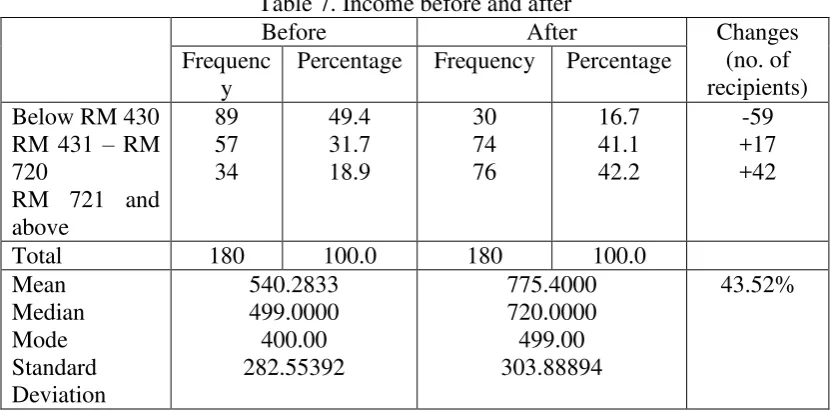
Before receiving the financial assistance from Bantuan Jayadiri, 49.4% (89 recepients) have an income of RM430 or below per month which fall under the category of absolute poverty. In addition, 31.7% (57 recipients) has an income between RM421-RM720. The remaining 18.9% (34 recipients) has an income of RM721 an above even before receiving the
Bantuan Jayadiri. The poverty line income used to measure the incidence of poverty in Malaysia is RM720 per month.
Table 7. Income before and after
Before After Changes
(no. of recipients) Frequenc
y
Percentage Frequency Percentage
Below RM 430
However, after receiving the Bantuan Jayadiri, only 30 recipients (16.7%) falls under the absolute poverty category while 74 recipients (41.1%) have an income of between RM421-RM720. The number of recipients above the poverty line income has almost doubled from 34 to 76. In other words, 42.2% of the recipients has managed to escape the poverty trap as a result of the Bantuan Jayadiri compared to 18.9% before the Bantuan Jayadiri.
305
Bantuan Jayadiri to RM775.40 after the receiving the bantuan Jayadiri– an increase of 43.5%.
D. Relationship between Changes in Income and Types of Business Ventures
Table 8 shows the relationship between the changes in income and the types of business ventures undertaken by the recipients of Bantuan Jayadiri. In total, 122 recipients (67.8%) of
Bantuan Jayadiri experienced an increased in income while 58 recipients (32.2%) does not experienced an increase in income. On occupational basis, all recipients venturing in construction had experienced an increased in income, 83.3% of those in agro-business, 82.2% of those venturing in sewing/tailoring, 66.7% percent of those in retail, 59.1% in selling food stuff. Sadly, all recipients venturing into producing traditional medicines does not experienced changes in income.
Table 8. Relationship between Changes in Income and Types of Business Ventures
Types of business ventures Total
(%)
While the nas specifically identified the people entitled for the zakat disbursement, it says nothing about the method of disbursement. Initiatives undertaken by a few zakat collection agencies in Malaysia in providing a start-up fund to help the poor and needy to venture into business activities should be welcomed. As shown in this study, the Bantuan Jayadiri as a form of business start-up capital to help the poor set up business ventures has succeeded in a) increase the income of the poor, and, b) alleviate the poor out of the poverty trap. This should become a model in poverty eradication programs throughout the Muslim world.
References
Ahmad, K., 1980. Studies in Islamic Economics. Leicester, UK: Islamic Foundation.
Chapra, M.U., 1992. Islam and the Economic Challenge. Leicester, UK: Islamic Foundation. Hasanuz Zaman, S.M., 1991. Economics Function of An Islamic States. Leicester, UK: Islamic
Foundation.
Muhammad Syukri Salleh, 2006. Lokalisasi Pengagihan Zakat: satu Cadangan Teoritis. dalam Hailani & Abdul Ghafar (penyt). Zakat: Pensyariatan, Perekonomian & Perundangan. Bangi: Penerbit Universiti Kebangsaan Malaysia.
Patmawati Hj Ibrahim, 2007. Peranan Agihan Zakat Dalam Meningkatkan Tahap Ekonomi
Ummah, Konvensyen Zakat dan Cukai Peringkat Kebangsaan PWTC, Kuala Lumpur,
22/5/07 – 24/5/07.
Patmawati Ibrahim, 2005. Potential Role Of Zakat Distribution In Reducing Income Inequality Among The Muslim Society in Abdullah Alwi Hj Hassan et al. Teori dan Aplikasi Kontemporari Sistem Ekonomi Islam di Malaysia. Utusan Publications dan Distributors Sdn Bhd, Kuala Lumpur.
Sadeq, A.M., 1990. Economic Development in Islam. Kuala Lumpur: Pelanduk Publication.
306 Pembayaran Zakat Melalui Institusi Formal. Jurnal Ekonomi Malaysia 39: 53-69. Siddiqi, M.N., 1980. Issues in Islamic Banking. Leicester UK: Islamic Foundation.