STAGE OF
Acacia mangium
and
Michelia montana
Chairil Anwar Siregar
Two primary processes are relevant to carbon sequestration including carbon dioxide uptake through photosynthesis and longevity of assimilated carbon. As carbon dioxide gas in the atmosphere is absorbed by plants and converted into carbohydrates in the photosynthesis process (in the presence of chlorophyll and solar radiation), forest vegetations are becoming especially important in the global carbon cycle due to the fact that they are affecting the ecosystems with the greatest biomass and hold the largest carbon pool. Holdgate (1995) reviewed that in a given live vegetation, forest contained 400-550 billions tons of carbon, holding approximately ten times as much carbon as any other major vegetations.
1
ABSTRACT
Charcoal, or black coloured carbon-predominated stuff, is produced during incomplete combustion of woody plant biomass. Charcoal application to the soil can improve chemical and nutritional nature thereby inducing better plant growth and development. However, the utilization of charcoal in forestry sector, especially industrial plantation, has not been introduced due to the absence of available information. Indicator species used in this study are and . is one of the most important species grown in industrial plantations in Indonesia. Meanwhile is critical endemic species in Gunung Halimun National Park. Glasshouse research was designed to examine the effectiveness of charcoal incorporation into marginal soils on the growth of 6-month-old and 6-month-old . Charcoal treatments were 0, 10, 15 and 20% (v/v) for , while 0, 5, 10, 15 and 20 % (v/v) for . Representative samples of Orthic Acrisol (i.e. Very fine, mixed, semiactive, isohyperthermic, and Typic Paleudult) were collected from B horizon. A completely randomized design with four replications (for ) and five replications (for ) was employed to examine the effect of charcoal application on the plant growth and some important chemical properties of the corresponding soil. Charcoal additions to the soil significantly increased height, diameter, and leaf and stem biomass weight of
and significantly increased height, diameter, and total biomass weight of
seedlings in comparison to those of a control. Increasing the amount of charcoal higher than 10% level, however, have little effect on growth. On the other hand, increasing the amount of charcoal higher than 10% is still effective on growth. This study indicated that charcoal application at the rates of 10 % for and 15 % for would be adequate to improve the availability of soil nutrients, and hence significantly induce a better plant growth response.
Keywords: Charcoal application, soil nutrients,
Acacia mangium Michelia montana A. mangium
M. montana
Acacia mangium Michelia montana
A. mangium M. montana
A. mangium M. montana
A. mangium, M. montana
A. mangium
M. montana
A. mangium M. montana
Acacia mangium, Michelia montana
I. INTRODUCTION
1
Effectiveness of organic or biomass production from natural forests and plantation forests are well understood as a potential carbon sink. However, the fixation and storage of carbon for longer period of time still endure some constraints such as forest fire accident and high wood consumption in village and industry sector. As a result, managing forest plantation to enhance both wood production and carbon stock requires a formulation of applicable method wherein the activity of organic carbon mass-produced is suppressed and whenever possible used as such to improve site quality of plantation forests. By the same token, organic carbon storage and soil carbon sequestration processes employed to furnish better growing condition are simultaneously established.
Land preparation prior to forest planting and forest harvest activities always generate forest waste composed of leaves and twigs. It also includes inferior and nonharvestable trees. Some amount of this forest waste traditionally is an important energy source alternative namely as fuel wood or woody waste converted charcoal. Most carbon will be released to the atmosphere when organic materials are burned as a fuel wood; in contrast, most carbon will be stored in a form of charcoal if the same organic materials undergo controlled partial combustion (pyrolysis).
In Japan, charcoal is sometimes utilized as a soil conditioner to accelerate growth of plants (Ogawa, 1994; Kishimoto, 1984). Researchers have reported the increase in plant growth, higher nutrient retention, and nutrient availability after charcoal additions to soil, and this related to higher exchange capacity, surface area, and direct nutrient additions (Glaser
., 2002). In addition, charcoal was reported to be responsible for high organic matter contents in the soil and the fertility of anthropogenic soils found in central Amazonia. In contrast, charcoal application at high rate may produce detrimental effects on crop growth (Kishimoto and Sugiura, 1985; Siregar, 2002).
Owing to the fact that the formation of charcoal during incomplete burning (slash and burn) would lead to the long term sequestering of carbon in soils and sediments and therefore provide a sink for atmospheric carbon (Fearnside, 1991), this preliminary research hence, is designed at examining soil amendment through charcoal application with the potential to enhance better plant growth and soil carbon sequestration. This research, then, would evaluate the plant growth response to promote the most judicious use of charcoal in the
plantation of and
Representative samples of Orthic Acrisol (Very fine, mixed, semiactive, isohyperthermic, and Typic Paleudult) and Dystric Nitosol (Fine, mixed, active, isohyperthermic Typic Hapludult) were collected from B horizons (50-75 cm deep) located at Maribaya and Cianten in the KPH (Forestry District) Bogor, Perum Perhutani Unit III, West Java. These soils were used to grow and respectively.
Soil samples were ground and thoroughly mixed before potting (polybag). From the soil samples, 4000 g (air dry) were weighed into individual pots. A completely randomized design with four replications was employed to examine the seedling growth as affected by
et. al
A. mangium M. montana.
A. mangium M. Montana II. MATERIAL AND METHODS
charcoal application. Levels of crushed charcoal applications were 0 %, 10 %, 15 %, and 20 % (v/v) in the case of seedlings One experimental unit was five potted seedlings. Meanwhile in the case of seedlings levels of crushed charcoal applications were 0 %, 5 %, 10 %, 15 %, and 20 % Five replications was employed to examine the effect of charcoal application on the growth and some important chemical properties of the soil. The charcoal was ground to pass a 5 mm sieve and thoroughly mixed with the soils before potting. The levels of charcoal applications were prepared by mixing together charcoals in particular amount and soils that further provided each of the charcoal concentration. No inorganic fertilizer was used in this experiment. Soil moisture was brought to field capacity at the beginning of the study and every three days thereafter for 6 months.
At the beginning and the end of the study period, soil samples from each pot were collected, air dried, passed through 2 mm sieve, and stored for chemical analyses.
seedlings were replanted in June 10, 2003 and were harvested December 4, 2003. Plant height and diameter at ground level were recorded from five seedlings in each experimental unit every two- months. seedlings were replanted in April 22, 2004 and were harvested November 2, 2004. Initial plant height data were also collected at the first week after replanting. At harvesting time, total plant biomass was separated from soils and after wards top root ratio and total biomass weight were recorded.
In this study, evaluation of treatment differences were conducted by analysis of variance using Statistical Analysis System (SAS Institute, 1998). Unless otherwise indicated, significance is indicated at P 0.05. Further mean separation test, if necessary, was conducted by employing LSD test procedure.
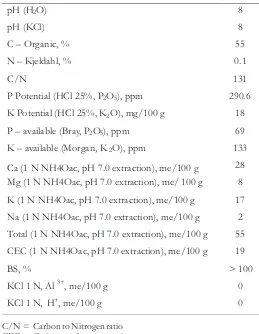
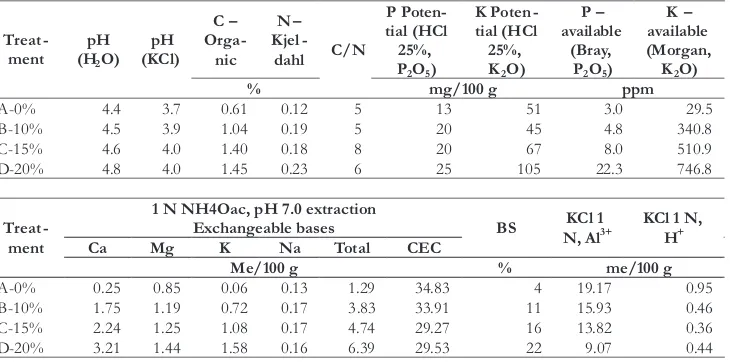
Some important chemical properties of charcoal are presented in Table 1, meanwhile some important soils chemical properties at replanting time (1 week after charcoal was added to the soils) are given in Table 2.
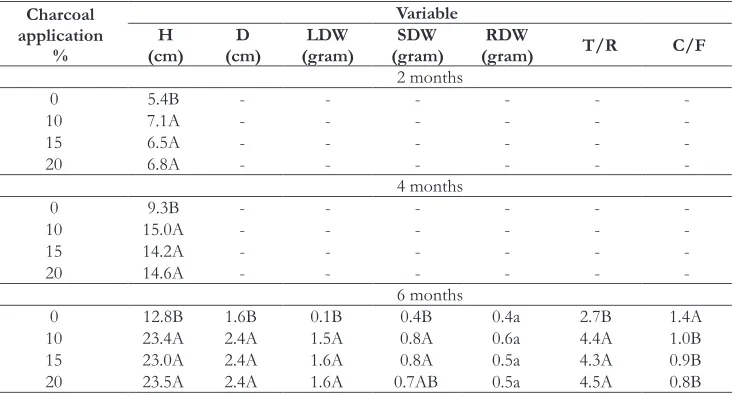
Charcoal application significantly influenced plant height at the ages of 2, 4 and 6 months, plant diameter, leaf dry weight, stem dry weight, top root ratio, and C/F [(root+stem)/leaf] at the age of 6 months (Table 3). Charcoal application had no effect on root dry weight. It is essential to note that optimum plant height was produced at 10 % charcoal application at all ages (Table 4). It is also interesting to note that in most cases,
A. mangium .
M. montana ,
. M. montana
A. mangium
M. montana
B. Plant Height, Diameter and Biomass Measurement
C. Statistical Analysis
III. RESULTS AND DISCUSSION
A.
1. Plant Growth with Charcoal Application <
charcoal application at 10 % level gave better results in terms of leaf and stem dry weight, top root ratio and C/F [(root+stem)/leaf] as compared to control and the other levels of charcoal application.
Root dry weight was essentially constant across charcoal application. One explanation for this may be due to good soil-rhizosphere circumstance already presented even without charcoal addition to the soils. In other words, sufficient soil nutrient level to support root growth was there. As stem and leaf dry weight increased significantly at 10 % charcoal application and meanwhile the root dry weight remained constant, consequently this resulted in the improvement of top to root ratio parameter.
Soil nutrient status is one important growth factor that affects assimilation ability, which is a critical determinant for growth of plant and survival of seedlings. In addition to assimilation, respiration is a critical determinant of net carbon gain (net primary production) in seedlings at the whole plant level.
Table 1. Some important chemical properties of charcoal
pH (H2O) 8
pH (KCl) 8
C – Organic, % 55
N – Kjeldahl, % 0.1
C/N 131
P Potential (HCl 25%, P2O5), ppm 290.6
K Potential (HCl 25%, K2O), mg/100 g 18
P – available (Bray, P2O5), ppm 69
K – available (Morgan, K2O), ppm 133
Ca (1 N NH4Oac, pH 7.0 extraction), me/100 g 28 Mg (1 N NH4Oac, pH 7.0 extraction), me/ 100 g 8 K (1 N NH4Oac, pH 7.0 extraction), me/100 g 17 Na (1 N NH4Oac, pH 7.0 extraction), me/100 g 2 Total (1 N NH4Oac, pH 7.0 extraction), me/100 g 55 CEC (1 N NH4Oac, pH 7.0 extraction), me/100 g 19
BS, % > 100
KCl 1 N, Al3+, me/100 g 0
KCl 1 N, H+, me/100 g 0
Table 2. Some important soil chemical properties at replanting time ofA. mangium
1 N NH4Oac, pH 7.0 extraction Exchangeable bases
B-10% 1.75 1.19 0.72 0.17 3.83 33.91 11 15.93 0.46
C-15% 2.24 1.25 1.08 0.17 4.74 29.27 16 13.82 0.36
D-20% 3.21 1.44 1.58 0.16 6.39 29.53 22 9.07 0.44
A,B,C, and D refer to charcoal application level, i.e. Consecutively 0%, 10%, 15%, and 20%
Table 3. Summary of analysis of variance for plant growth variable as affected by charcoal application at the ages of 2, 4 and 6 months
Variable
Notes : - = no observation
* = significant at the 5% level ** = significant at 1% level ns = not significant C/F = (root+stem)/leaf
Table 4. Effect of charcoal application on the plant growth variable at the ages of 2, 4 and 6 months
Variable Charcoal
application %
H (cm)
D (cm)
LDW (gram)
SDW (gram)
RDW
(gram) T/R C/F
2 months
0 5.4B - - -
-10 7.1A - - -
-15 6.5A - - -
-20 6.8A - - -
-4 months
0 9.3B - - -
-10 15.0A - - -
-15 14.2A - - -
-20 14.6A - - -
-6 months
0 12.8B 1.6B 0.1B 0.4B 0.4a 2.7B 1.4A
10 23.4A 2.4A 1.5A 0.8A 0.6a 4.4A 1.0B
15 23.0A 2.4A 1.6A 0.8A 0.5a 4.3A 0.9B
20 23.5A 2.4A 1.6A 0.7AB 0.5a 4.5A 0.8B
Note: Values followed by different letters within a column are significantly different
- = no observation; H = height; D = diameter; LDW = leaf dry weight; SDW = stem dry weight; RDW = root dry weight; T/R = top to root ratio; C/F = (root+stem) /leaf ratio
Several components in plant part / tissues (leaf, stem, and root) accumulate, store and retranslocate different amounts of nutrients and hence influence the dynamic relation between nutrients, tissue production, and rates of photosynthesis. Since the respiration rate of leaf is generally higher than that of supporting tissues such as stem and roots, Ishida . (2000) pointed that dry matter partitioned among plant parts is important for the daily carbon gain of whole plants. This growth parameter is a prerequisite to reach a better understanding of plant growth and development progress over time.
Observations of data in Table 4 suggest that top root ratio (T/R) as high as 4.4 and C/F as high as 1.0 coincides with the significant increase of other growth parameters (plant height and diameter, stem dry weight and leaf dry weight) as affected by 10 % charcoal application. Moreover, based on the physical appearance of the plant, it is apparent that T/R that ranges from 4.3 to 4.5 is classified as satisfaction when compared to that of 2.7, which received no charcoal application. Likewise, C/F value of 1.0 is attributed to better plant growth as compared to higher C/F value of 1.4 attributed to poor plant growth.
Results obtained from this experiment mostly are consistent with observations reported by some researchers. Chidumayo (1994) reported generally better seed germination (30 % increase), shoot heights (24 %), and biomass production (13 %) of woody plant growing on Alfisols and Ultisols under kiln charcoal. Working with sugi trees (
) on clay loam soils, five years after charcoal application at the rate of 0.5 Mg ha , Kishimoto and Sugiura (1985) found out that the heights of sugi trees increased by a factor of 1.26 – 1.35 and the biomass production increased by a factor of 2.31 – 2.36. Ishii and Kadoya
et al
A. mangium
Cryptomeria
Soil Properties
1 N NH4Oac, pH 7.0 extraction Exchangeable bases
(1994) also reported that the fresh weights of the root, shoot and the whole mandarin tree one year after replanting, increased in response to charcoal application at the rate of 2 % (w/w). Unlike those reported, root dry weight observed in this experiment was not significantly affected by the charcoal application. Speculation for the lack of root growth response to this charcoal addition was due to the sufficient soil fertility level (at this growth stage) as indicated by relatively high soil CEC value (approx. 30 me / 100 gr) but with very low percentage of BS (approx. 4– 6 %).
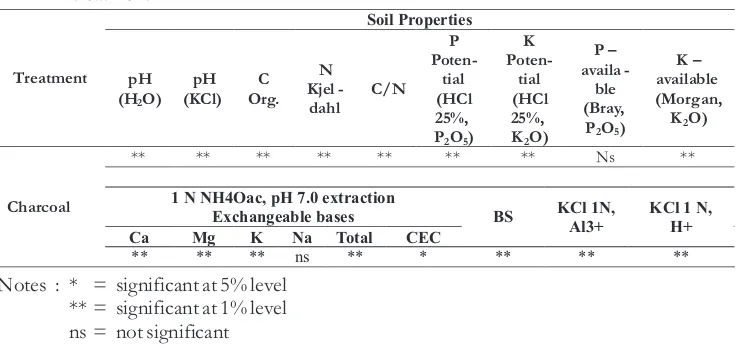
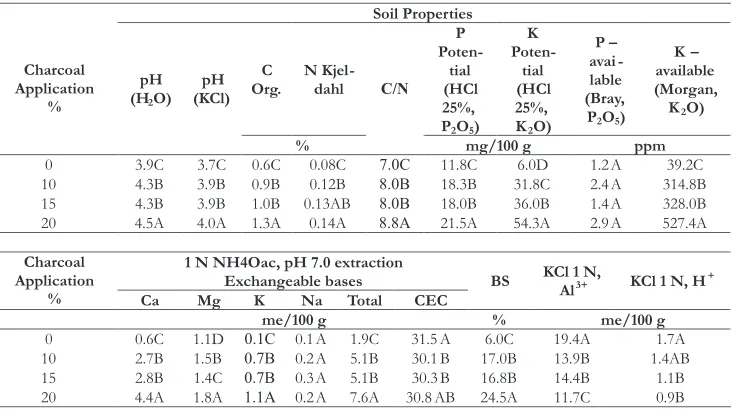
Charcoal application significantly influenced soil pH, C organic, N, P, K, C/N, exchangeable bases, CEC, BS, Al, and H (Table 5). Generally, soil variables at harvesting time increased with the increase of charcoal application, except Bray's extractable P, and Na, which are fluctuating, CEC, Al and H ~ 10 pH, which are decreasing (Table 6).
Table 5. Summary of analysis of variance for soil properties as affected by charcoal treatment
2. Soil pH, Nutrient Availability, and Retention
Notes : * = significant at 5% level ** = significant at 1% level ns = not significant
Soil pH changes as affected by charcoal application were observed. The soil reaction increased gradually with the increase in charcoal application. Charcoal addition to the soils functioned like liming effect phenomenon as basic cations originated from charcoal ashes can neutralize the soil acidity. Note that soil pH is higher by 0.4 0.6 unit due to charcoal addition as compared to that of control. Application of charcoal that can increase the soil pH, and decrease Al saturation and H is well documented, and is often used to improve the fertility of highly weathered tropical soils (Sanchez , 1983).
The present of basic cations originated from charcoal ashes on the ligand exchange gave rise to the reduction in acidic cations and the increased in basic cations, and in turn, resulted in an increase in soil pH (Foth, 1990). This experiment indicated that exchangeable bases (Ca, Mg, K, and Na) mostly increased with the increase in charcoal application. Consequently, the base saturation also increased and was becoming three to four fold higher after charcoal application.
–
et. al
Charcoal addition to soil at the rate up to 20 % also increased organic C and total N. The trend of organic C and total N increased as the rate of charcoal application increased was also reported by Glaser (2002). Equally, potential P considerably increased as charcoal was added to the soils at the rate of 10 %. These data are apparent since charcoal contains some amounts of elemental C, N, P, and others (Table 1). Eventhough available soil P did not significantly increase as the rate of charcoal application increased, the elevated trend was observed, and was consistent with the trend noticed at replanting time. Note that the available P occurred at charcoal application at the rate of 15 % was lower than that of 10 %, and this unexpected result appears to be due to random variation rather than charcoal addition.
Table 6. Effect of charcoal application on soil properties at harvesting time Soil Properties
10 4.3B 3.9B 0.9B 0.12B 8.0B 18.3B 31.8C 2.4 A 314.8B
15 4.3B 3.9B 1.0B 0.13AB 8.0B 18.0B 36.0B 1.4 A 328.0B
20 4.5A 4.0A 1.3A 0.14A 8.8A 21.5A 54.3A 2.9 A 527.4A
1 N NH4Oac, pH 7.0 extraction Exchangeable bases
Note: Values followed by different letters within a column are significantly different
Soil CEC level significantly decreased as the rate of charcoal application increased. However, most researchers have observed that soil CEC tends to increase following charcoal addition to the soils (Glaser ., 2002). They assumed that slow oxidation on the edges of the aromatic backbone of charcoal forming carboxylic groups is responsible for both the potential of forming organo-mineral complexes and the sustainably increased CEC. It is also documented that hardwood charcoal increased the CEC compared to that of the original soils, meanwhile conifer charcoal decreased the CEC. The latter case should be wisely observed bearing in mind that the charcoal CEC (19 me/100 gr) used in this experiment is much lower than that of the soils (30 me/100 gr).
B.
1. Plant Growth with Charcoal Application
Michelia montana
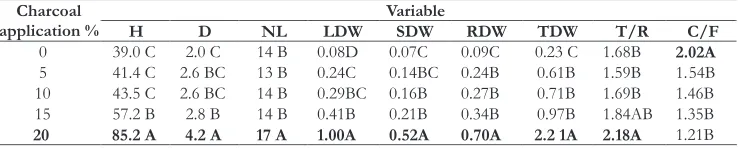
Charcoal application significantly affected plant height, diameter, number of leaves, leaf dry weight, root dry weight, stem dry weight, and total dry weight at the age of 6 months (Table 7). Note that the magnitude of all parameters observed increased as the level of charcoal applications increased except C/F, and this growth response appears to be almost in linear fashion in most cases. At this growing stage, the maximum plant height, diameter, number of leaves, and total dry weight were obtained at 20 % charcoal application (Table 8). The trend of C/F is inversely correlated with the trend of T/R. The C/F as high as 1.21 (the lowest) seems to be the most vigor plant performance and this coincides with the highest magnitude of T/R. In contrast to the case of , it is remarkable to observe that the plant growth responses possibly keep increasing, as dosage of charcoal application is greater than 20 %. This result suggests that and gave different growth response from one another as some particular amount of charcoal is added to the soils. Table 7. Summary of analysis of variance for growth variable as affected by
charcoal application at the age of 6 months
A. mangium
A. mangium M. montana
M. montana
Variable
Treatment
H D NL LDW SDW RDW TDW T/R C/F
Charcoal ** ** ** ** ** ** ** ** **
Notes : ** = significant at 1% level
H = height; D = diameter; NL= Number of leaves; LDW = leaf dry weight; SDW = stem dry weight; RDW = root dry weight; TDW= total dry weight; T/R = top to root ratio; C/F = (root+stem)/leaf
Table 8. Effect of charcoal application on growth variable at the age of 6 months
M. montana
Variable Charcoal
application % H D NL LDW SDW RDW TDW T/R C/F
0 39.0 C 2.0 C 14 B 0.08D 0.07C 0.09C 0.23 C 1.68B 2.02A
5 41.4 C 2.6 BC 13 B 0.24C 0.14BC 0.24B 0.61B 1.59B 1.54B 10 43.5 C 2.6 BC 14 B 0.29BC 0.16B 0.27B 0.71B 1.69B 1.46B 15 57.2 B 2.8 B 14 B 0.41B 0.21B 0.34B 0.97B 1.84AB 1.35B
20 85.2 A 4.2 A 17 A 1.00A 0.52A 0.70A 2.2 1A 2.18A 1.21B
Note : Values followed by different letters within a column are significantly different
2. Soil pH, Nutrient Availability and Retention
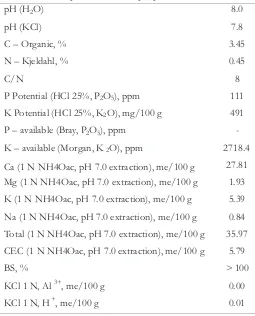
Some important chemical properties of charcoal are presented in Table 9, meanwhile some important soils chemical properties at replanting time (1 week after charcoal was added to the soils) are given in Table 10.
Charcoal application apparently influenced soil pH, C organic, N, P, K, exchangeable bases, BS, Al, and H, but did not affect CEC and C/N, which were relatively constant (Table 10). In general, most of soil variables at replanting time increased with the increase of charcoal application except for Al and H, which were decreased. The decrease in Al and H is obvious since the soil pH increases due to alkaline nature of charcoal material.
Table 9. Some important chemical properties of charcoal
pH (H2O) 8.0
pH (KCl) 7.8
C – Organic, % 3.45
N – Kjeldahl, % 0.45
C/N 8
P Potential (HCl 25%, P2O5), ppm 111
K Potential (HCl 25%, K2O), mg/100 g 491
P – available (Bray, P2O5), ppm
-K – available (Morgan, -K2O), ppm 2718.4 Ca (1 N NH4Oac, pH 7.0 extraction), me/100 g 27.81 Mg (1 N NH4Oac, pH 7.0 extraction), me/100 g 1.93 K (1 N NH4Oac, pH 7.0 extraction), me/100 g 5.39 Na (1 N NH4Oac, pH 7.0 extraction), me/100 g 0.84 Total (1 N NH4Oac, pH 7.0 extraction), me/100 g 35.97 CEC (1 N NH4Oac, pH 7.0 extraction), me/100 g 5.79
BS, % > 100
KCl 1 N, Al3+, me/100 g 0.00
KCl 1 N, H+, me/100 g 0.01
C –
1 N NH4Oac, pH 7.0 extraction Exchangeable bases
C-10% 6.98 0.69 0.70 0.13 8.50 20.99 40 3.58 0.22
D-15% 10.94 0.80 1.07 0.26 13.07 20.89 63 0.59 0.20
E-20% 12.85 0.93 1.42 0.30 15.50 19.74 79 0.00 0.13
Table 10. Some important soil chemical properties at replanting time of M. montana
IV. CONCLUSIONS
REFERENCES
Charcoal additions to soil significantly increased height, diameter, and leaf and stem biomass of and significantly increased height, diameter, number of leaf, root dry weight, stem dry weight, and total biomass of seedlings in comparison to those of a control. Increasing the amount of charcoal higher than 10% level, however, have little effect on growth. Nevertheless, increasing the amount of charcoal higher than 10% or up to 20 % is still effective on growth. This study indicated that charcoal application at the rate of 10 % for and 20 % for would be adequate to improve the availability of soil nutrients, and hence significantly induce a better plant growth response.
Charcoal treatment significantly increased soil pH, soil organic C, total N, HCl 25 %-extractable P, HCl 25 % and Bray-%-extractable K, exchangeable bases (Ca, Mg, Na, and K), percentage of base saturation, and significantly decreased CEC, and significantly decreased KCl 1 N-extractable Al and H cations.
Chidumayo, E. N. 1994. Effects of wood carbonization on soil and initial development of seedlings in miombo woodland, Zambia. Forest Ecology and Management 70: 353 - 357. Fearnside, P.M. 1991. Green house gas contributions from deforestation in Brazilian Amazonia. J.S. Levine (Ed.) Global biomass burning. Atmospheric, climatic, and biospheric implications. The MIT Press, Cambridge, Massachusetts, London, England. 92-105.
A. mangium
M. montana
A. mangium
M. montana
A. mangium M. montana
In
Foth, H. D. 1990. Fundamentals of Soil Sciences. John Wiley & Sons, New York. 435 pp. Glaser, B., J. Lehmann, and W. Zech. 2002. Ameliorating physical and chemical properties
of highly weathered soils in the tropics with charcoal - a Review. Biology and Fertility of Soils 35: 219 - 230.
Holdgate, M. 1995. Greenhouse gas balance in forestry. Forestry 68: 297-302.
Ishida, A., T. Toma, S. Mori and Marjenah. 2000. Effects of foliar nitrogen and water deficit on the carbon economy of Sym. seedlings. BIOTROPICA 32: 351 -358.
Ishii, T. and K. Kadoya. 1994. Effects of charcoal as a soil conditioner on citrus growth and vesicular-arbuscular mycorrhizal development. Journal of Japan Society for Horticulture Science 63 (3): 529 - 535.
Kishimoto, Y. 1984. Over-look on the other aspect of charcoal industry, Yamasaki Agriculture Research Series No. 3. (in Japanese).
Kishimoto, S. and G. Sugiura 1985. Charcoal as a soil conditioner. Int Archieve Future 5: 12-23.
Ogawa, M. 1994. Symbiosis of people and nature in the tropics. Farming Japan 28: 10 - 34. Farming Japan CO., LTD. Tokyo, Japan.
Sanchez, P. A., J. H. Villachia, and D. E. Bandy. 1983. Soil fertility dynamics after clearing tropical rainforest in Peru. Science Society America J 47: 1171 - 1178.
SAS Institute. 1998. SAS User' Guide: Statistics Version, Release 6.12. SAS Ins. Cary, NC. Siregar, C. A. 2002. Application of mycorrhizal fungi, organic fertilizer and charcoal
to improve the growth of indicator plant in tailing soils contaminated with Pb and Fe in gold mining of PT. Aneka Tambang, Pongkor. Proceedings: Rehabilitation and Forest Conservation. Forest Research and Development Agency. Bogor. (In Indonesian).
,