ABSTRACT
SADA, EDWARD LEWA USU (2014). Learning Writing Text Types With MOODLE Experience : Graduate Program English in Language Studies, Sanata Dharma University
Computer Assisted Language Learning is without a doubt one of the most powerful replies to the growing needs of education. The interactive and motivating appeal of electronic books, multimedia software and internet provisions has given a new perspective in language learning as well as discovering new strategies for both teacher and student alike. Having a good writing proficiency in English is the demand of today's society and to some extent considered as the benchmark of which a person's intellect is judged.
Learning academic writing as a second language is a great challenge for students especially those in the EFL context. The disparity of culture, the aspect of motivation, and the writing conventions, plays significant in the outcome of learning. Students have to depend on various learning resources such as internet websites for resources to ensure success in every levels. Given the rationale I conducted a qualitative research in an attempt to find answer for question what is the students lived experience in learning writing with MOODLE look like? The research took place in the faculty of letters, Sanata Dharma University, academic year of 2011-2012, with three students as the participants. The research instruments were semi-structured in-depth interview, re-interview, classroom observations, and document collection.
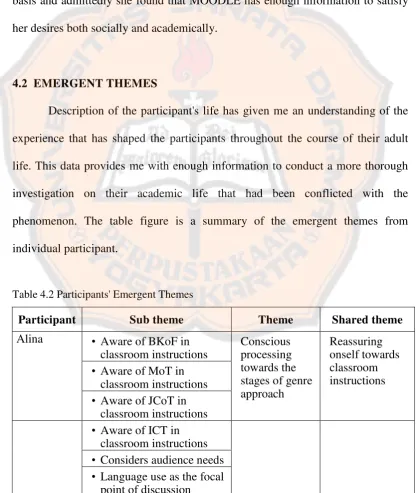
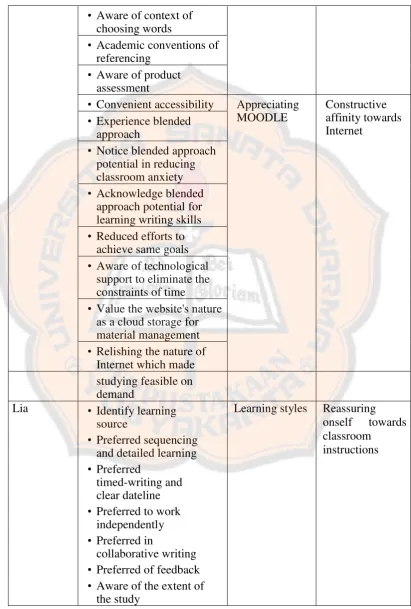
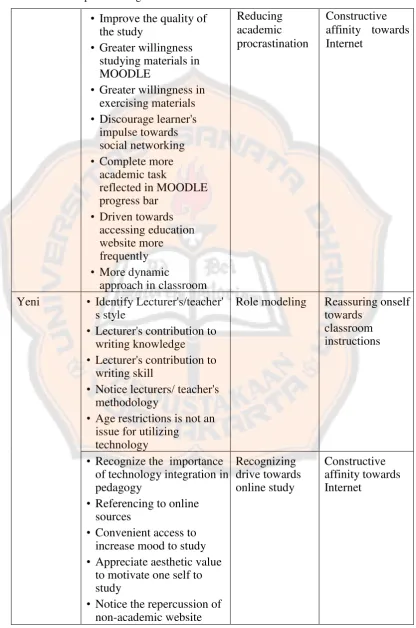
This research sought the meaning of students experience when learning writing using MOODLE as the learning model. The result of my research was in the form of narratives describing students experience and the interpretation of such experience. Six individual themes emerged from the data collected, they were Consciousness towards the stages of genre approach, appreciative towards MOODLE, accommodating learning styles, reducing academic procrastination, role modelling, and driven towards studying online, where these themes lead to two shared lived experience namely reassuring one self towards classroom instructions and constructive affinity towards internet.
ABSTRAK
SADA, EDWARD LEWA USU (2014). Belajar Menulis Tipe-Tipe Teks Dengan Pengalaman MOODLE: Kajian Bahasa Inggris, Program Pasca Sarjana, Universitas Sanata Dharma
Computer Assisted Language Learning dapat dipastikan sebagai salah satu jawaban untuk kebutuhan belajar. Penampilan yang menarik dari buku-buku elektronik, software multimedia dan kehadiran internet telah memberikan perspektif baru dalam pembelajaran Bahasa dan juga sebagai momentum untuk menemukan strategi baru untuk kebutuhan guru dan murid. Kebutuhan untuk mampu menulis dengan baik dalam Bahasa Inggris merupakan kebutuhan untuk masyarakat modern bahkan dalam kondisi tertentu dianggap sebagai standar dimana intelektualitas seseorang diuji kebenarannya.
Belajar menulis secara akademis dalam Bahasa Inggris sangat sukar untuk siswa, terlebih lagi siswa yang belajar Bahasa Inggris dalam konteks EFL. Perbedaan budaya yang besar, aspek motivasi, dan juga aturan yang berlaku memiliki peran yang besar dalam keberhasilan siswa dalam belajar. Kebanyakan siswa harus bergantung pada banyak sumber seperti internet untuk meraih keberhasilan. Melihat keadaan tersebut, saya melakukan penelitian qualitative dalam rangka mengetahui jawaban daripada pertanyaan "Seperti apa pengalaman hidup para siswa yang signifikan ketika belajar menulis tipe-tipe teks menggunakan MOODLE?" Penelitian ini dilakukan di Fakultas Sastra, Universitas Sanata Dharma, tahun akademik 2010-2011, dengan tiga peserta. Instrumen dalam melakukan penelitian ini adalah interview yang semi terstruktur, interview semi terstruktur yang diulang, observasi di kelas, dan dokumen para peserta penelitian.
Penelitian ini ditujukan untuk menemukan makna dan pemahaman siswa ketika mengalami pembelajaran menulis menggunakan MOODLE sebagai model pembelajaran. Hasil daripada penelitian ini dalam bentuk narasi menjelaskan pengalaman siswa beserta interpretasi saya sebagai peneliti. Enam tema muncul sebagai hasil penelitian yaitu kesadaran siswa akan urutan belajar dalam metode genre, apresiasi siswa terhadap MOODLE, pemenuhan model belajar siswa, mengurangi stagnasi belajar, figure belajar, dan kebutuhan untuk belajar di media elektronik dari masing-masing peserta, tema-tema tersebut menjadi kunci untuk terungkapnya tema besar yang dirasakan para peserta yaitu penegasan terhadap materi perkuliahan dan afinitas positive terhadap Internet.
LEARNING WRITING TEXT TYPES WITH
MOODLE EXPERIENCE
A THESIS
Presented as Partial Fulfilment of the Requirements for the Degree of Magister Humaniora (M.Hum)
in Graduate Program of Sanata Dharma University
by:
EDWARD LEWA USU SADA 106332031
THE GRADUATE PROGRAM IN ENGLISH LANGUAGE STUDIES SANATA DHARMA UNIVERSITY
A THESIS
LEARNING WRITING TEXT TYPES WITH
MOODLE EXPERIENCE
by
Edward Lewa Usu Sada Student Number : 106332031
Approved by
F.X. Mukarto, Ph.D. __________________
A THESIS
LEARNING WRITING TEXT TYPES WITH
MOODLE EXPERIENCE
Presented by
Edward Lewa Usu Sada
Student Number : 106332031
Defended before the Thesis Committee and Declared
Acceptable
THESIS COMMITTEE
Chairperson :
_____________________
Secretary
:
_____________________
Members
:
1.
_____________________
2.
_____________________
Yogyakarta, ... 2014
The Graduate Program Director
Sanata Dharma University
STATEMENT OF ORIGINALITY
This is to certify that all ideas, phrases, sentences, unless otherwise stated, are the ideas, phrases, and sentences of the thesis writer. The writer understands the full consequences including degree cancellation if he took somebody else's ideas, phrases, or sentences without proper references.
Yogyakarta, February, 2014
LEMBAR PERNYATAAN PERSETUJUAN
PUBLIKASI KARYA ILMIAH UNTUK KEPENTINGAN AKADEMIS
Yang bertanda tangan di bawah ini, saya mahasiswa Universitas Sanata Dharma:
Nama : Edward Lewa Usu Sada
Nomor Mahasiswa : 106332031
Demi pengembangan ilmu pengetahuan, saya memberikan kepada Perpustakaan Universitas Sanata Dharma karya ilmiah saya yang berjudul:
LEARNING WRITING TEXT TYPES WITH MOODLE EXPERIENCE beserta perangkat yang diperlukan (bila ada). Dengan demikian saya memberikan kepada Perpustakaan Universitas Sanata Dharma hak untuk menyimpan, mengalihkan dalam bentuk media lain, mengelolanya dalam bentuk pangkalan data, mendistribusikan secara terbatas, dan mempublikasikannya di Internet atau media lain untuk kepentingan akademis tanpa perlu meminta ijin dan saya maupun memberikan royalti kepada saya selama tetap mencantumkan nama saya sebagai penulis.
Demikian pernyataan ini yang saya buat dengan sebenarnya. Dibuat di Yogyakarta
Pada tanggal: 7 Maret 2014
Yang menyatakan
ACKNOWLEDGEMENTS
This thesis would not be completed without a number of exceptional figures in my life. I would like to begin with by saying thank you to the almighty God, Jesus Christ for His presence in my life particularly when writing this thesis. His presence is felt throughout the entire process of thesis writing and especially when I hit a stumbling block or divided path.
My deepest gratitude goes to my thesis advisor, F.X Mukarto, Ph.D, who has given me an immense support and guidance throughout my college year and in particular during thesis writing. I have learnt great many lesson under his wing and developed significant life qualities as well. Overall he was an inspiration for me as a student and I would wholeheartedly cherish the knowledge that he has passed down to me. I would also like to thank Dr. B.B. Dwijatmoko, M.A., for giving me endless support in my study in ELS. He has given me the ability and confidence to lift my knowledge to another level. His guidance in ICT and his feedback during thesis review was definitely revered. My next appreciation goes to Dr. J. Bismoko who was very inspirational to me; he has assured me to be more critical in teaching.
mother Christina "Ko Tien" Titien and my older sister Maria Adeleheid Lelyana, they have been outstanding since the very beginning.
TABLE OF CONTENTS KARYA ILMIAH UNTUK KEPENTINGAN AKADEMIS v
CHAPTER 4 DESCRIPTION AND INTERPRETATION
4.1 Participant's Life Stories ... 67
4.1.1 Alina's Story ... 68
4.1.2 Lia's Story ... 72
4.1.3 Yeni's Story ... 76
4.2 Emergent Themes ... 81
4.2.1 Description of the Emergent Themes ... 84
4.2.2 Conscious Processing Towards the Stages of Genre Approach ... 84
4.2.3 Appreciating MOODLE ... 88
4.2.4 Accommodating Learning Styles ... 91
4.2.5 Reducing Academic Procrastination ... 94
4.2.6 Role Modelling ... 98
4.2.7 Recognizing drive towards online study ... 100
4.3 Shared Lived Experience ... 104
CHAPTER 5 CONCLUSION AND SUGGESTIONS 5.1 Conclusion ... 108
5.2 Suggestion ... 111
REFERENCES ... 112
LIST OF TABLES
Table 2.1 Paltridge's Examples of Genres and "Text Types"
LIST OF FIGURES
Figure 2.1 The Cycles and Stages of learning (Feez & Helen
LIST OF CODES AND ABBREVIATIONS
List of Codes
BEL : Belief
APP-MO : Appreciative towards MOODLE DRIV-ON : Driven towards studying online
RM : Role Modelling
RED-AP : Reducing Academic Procrastination
LS : Learner's Style
List of Abbreviations
CALL : Computer Assisted Language Learning
MOODLE : Modular Object-Oriented Dynamic Learning Environment ICT : Information Communication and Technology
ELS : English Language Studies
SDU : Sanata Dharma University
SEAMOLEC : South East Asia Minister of Education Organization Regional Open Learning Center
BkoF : Building Knowledge of the Field
MoT : Modelling of Text
JCoT : Joint Construction of the Text
ICT : Independent Construction of the Text Instruction for Decoding
(AL-BEL-A20)
AL : Anecdotes, Leaner
BEL : Belief
ABSTRACT
SADA, EDWARD LEWA USU (2014). Learning Writing Text Types With MOODLE Experience : Graduate Program English in Language Studies, Sanata Dharma University
Computer Assisted Language Learning is without a doubt one of the most powerful replies to the growing needs of education. The interactive and motivating appeal of electronic books, multimedia software and internet provisions has given a new perspective in language learning as well as discovering new strategies for both teacher and student alike. Having a good writing proficiency in English is the demand of today's society and to some extent considered as the benchmark of which a person's intellect is judged.
Learning academic writing as a second language is a great challenge for students especially those in the EFL context. The disparity of culture, the aspect of motivation, and the writing conventions, plays significant in the outcome of learning. Students have to depend on various learning resources such as internet websites for resources to ensure success in every levels. Given the rationale I conducted a qualitative research in an attempt to find answer for question what is the students lived experience in learning writing with MOODLE look like? The research took place in the faculty of letters, Sanata Dharma University, academic year of 2011-2012, with three students as the participants. The research instruments were semi-structured in-depth interview, re-interview, classroom observations, and document collection.
This research sought the meaning of students experience when learning writing using MOODLE as the learning model. The result of my research was in the form of narratives describing students experience and the interpretation of such experience. Six individual themes emerged from the data collected, they were Consciousness towards the stages of genre approach, appreciative towards MOODLE, accommodating learning styles, reducing academic procrastination, role modelling, and driven towards studying online, where these themes lead to two shared lived experience namely reassuring one self towards classroom instructions and constructive affinity towards internet.
ABSTRAK
SADA, EDWARD LEWA USU (2014). Belajar Menulis Tipe-Tipe Teks Dengan Pengalaman MOODLE: Kajian Bahasa Inggris, Program Pasca Sarjana, Universitas Sanata Dharma
Computer Assisted Language Learning dapat dipastikan sebagai salah satu jawaban untuk kebutuhan belajar. Penampilan yang menarik dari buku-buku elektronik, software multimedia dan kehadiran internet telah memberikan perspektif baru dalam pembelajaran Bahasa dan juga sebagai momentum untuk menemukan strategi baru untuk kebutuhan guru dan murid. Kebutuhan untuk mampu menulis dengan baik dalam Bahasa Inggris merupakan kebutuhan untuk masyarakat modern bahkan dalam kondisi tertentu dianggap sebagai standar dimana intelektualitas seseorang diuji kebenarannya.
Belajar menulis secara akademis dalam Bahasa Inggris sangat sukar untuk siswa, terlebih lagi siswa yang belajar Bahasa Inggris dalam konteks EFL. Perbedaan budaya yang besar, aspek motivasi, dan juga aturan yang berlaku memiliki peran yang besar dalam keberhasilan siswa dalam belajar. Kebanyakan siswa harus bergantung pada banyak sumber seperti internet untuk meraih keberhasilan. Melihat keadaan tersebut, saya melakukan penelitian qualitative dalam rangka mengetahui jawaban daripada pertanyaan "Seperti apa pengalaman hidup para siswa yang signifikan ketika belajar menulis tipe-tipe teks menggunakan MOODLE?" Penelitian ini dilakukan di Fakultas Sastra, Universitas Sanata Dharma, tahun akademik 2010-2011, dengan tiga peserta. Instrumen dalam melakukan penelitian ini adalah interview yang semi terstruktur, interview semi terstruktur yang diulang, observasi di kelas, dan dokumen para peserta penelitian.
Penelitian ini ditujukan untuk menemukan makna dan pemahaman siswa ketika mengalami pembelajaran menulis menggunakan MOODLE sebagai model pembelajaran. Hasil daripada penelitian ini dalam bentuk narasi menjelaskan pengalaman siswa beserta interpretasi saya sebagai peneliti. Enam tema muncul sebagai hasil penelitian yaitu kesadaran siswa akan urutan belajar dalam metode genre, apresiasi siswa terhadap MOODLE, pemenuhan model belajar siswa, mengurangi stagnasi belajar, figure belajar, dan kebutuhan untuk belajar di media elektronik dari masing-masing peserta, tema-tema tersebut menjadi kunci untuk terungkapnya tema besar yang dirasakan para peserta yaitu penegasan terhadap materi perkuliahan dan afinitas positive terhadap Internet.
CHAPTER 1
INTRODUCTION
This thesis aimed to investigate the students' perception of learning writing text types by integrating MOODLE as an learning model in the Department of English Letters, Sanata Dharma University in particular third semester students in the academic year of 2010-2011. Furthermore, this thesis tried to explore the lived experience of the students implicated with such learning model.
This chapter is organized into several sections, namely: research background, problem identification, problem limitation, problem formulation, research goals, and research benefits.
1.1 BACKGROUND
synchronous and asynchronous learning task both in oral and written modes pedagogically feasible (Brandle 2005, p.16). Employing technology however is not for the sole purpose of using the technology itself, it should not be the goal of any educational system that strives to provide substantial learning outcomes. Employing technology should be used as a platform for achieving objectives standards (Reigluth, 1999). Using technology should empower learning of other field of interest and even raise the bar for the objectives or goals of any educational institutions and should be conducted efficiently and with systematic pattern.
internet or mobile phones.
Furthermore the changing perspective on language teaching and learning from structural perspective that is learning about the language, more often the rules that governs the a language to a socio-cognitive perspective where language is treated as a means to negotiate meaning has also transformed the role of computer in language education Kern and Warschauer (2000). ITC integrated in pedagogy or CALL termed by Kessler (2005) is the use of technology for pedagogical purpose within language instructions. ITC itself is very versatile, rather than for common pre-conception that is merely for accessing a vast range of information or resources, or perhaps reviewing literatures, it offers ways to supports current teaching paradigms such as assisting in collaborative learning which is the core of socio-cognitive teaching practices.
Web-based technologies have been advocated as particularly promising examples of computer-based learning with the potential to enable language students to interact across geographic, linguistic, and cultural lines (Ware & Kramsch, 2005, p. 190).
In the context of technology or multimedia software to facilitate learning writing text types, ICT can assist in all level of phase in writing such as the process of planning, transcribing, and revising. For learners who are struggling with these aspects can use technology to liberate their thought from mechanis and liberate the expression of ideas. This research employ MOODLE (Modular Object Oriented Design and Learning Environment) since the feature of MOODLE course consists of a set of tools that allow for the integration of a wide range of assignments, activities, and multimedia resources, electric delivery of teaching materials, synchronous and asynchronous teacher-student and student-student communication, and testing and assessment of students' work. MOODLE enable English writing teachers to organize their teaching materials, improve their means of communication, and retrieve their records of interaction with students when necessary Su (2008).
Writing is arguably the most difficult subject for every student in every level of education lest tertiary education students. From the earliest stage of paragraph writing up to the creative writings and journals has its own challenges and many have failed to meet the challenges. Many teachers in their teaching practices have always try to seek out methods and strategies in their teaching that would allow their students to have better understanding of knowledge in writing and to have greater control writing skills.
coherent flow of ideas in nature, structured in such a way that would become viable is a compelling task that would require meticulous effort for students. Many students nonetheless the students in EFL context that does not have a good competence and lacking in basic knowledge in L2 and also academic conventions is condemn for failure. As suggested by Van Lier 1966 To acquire such a complex skills one begins with a conscious, deliberate actions, and ends up with
automitazion, effortless action. Meaning to say that in writing students must be aware that such skill requires a combination of mental processes, physical endurance, and socio-cultural context to achieve a good piece of writing. In writing, students are not only realizing information message or idea in a sentence in correct grammatical but also they must be packed in text formulation that conventionally have been agreed by the academic society. Hence, audience will more easily understand the content in the texts
Hence, there's a greater need for self autonomy in writing a piece of text in a later stages especially in creative writing for a more advanced students.
In higher education writing is treated as a compulsory subject, the emphasis has been on students' final products. Teaching writing whether in formal writing classes or as an activity within discipline-based courses entailed presenting students with models of good piece of writing, and asking them to imitate these exemplars. However, little analysis occurred of the various rhetorical aspects of the texts or the social contexts in which the texts functioned. The focus instead rely heavily on specific features of the written texts, for instance, the mechanics, the vocabulary, sentence structuring. In addition, little attention was typically paid to the process of writing, including the conscious and unconscious decisions that writers make in order to communicate for different purposes and to different audiences. In an era in which students may have been more homogenous and shared previous educational experiences and social backgrounds, the assumption was again often made that students could pick up how to do academic writing through this process of imitation.
highlighted how apparently universal text types such as the essay vary in purpose or function and in different disciplines.
The aim of this thesis is to respond to the changing literary demands to keep pace with increasing technological change as teachers continue to build their understanding of language and the way it is learnt, they develop and refine the way they teach language in particular writing. In addition, this paper is dedicated to describe and interpret students lived experience involved in the teaching and learning activities using MOODLE.
1.2 PROBLEM IDENTIFICATION
This research concerns the implementation of MOODLE and the experience that the student had when learning writing text types. Writing is one of the mandatory subjects offered in the Faculty of Letters, Sanata Dharma, students in semester three is subject to learn basic academic English before they can continue to writing four which is essay writing and then continue to creative writing. The approach suggested by the faculty is writing text types or genre based approach for writing in semester three with three major genre to discuss. There were two major concerns in the practicality of learning writing text types and implementation of MOODLE. The first concern would be the implementation of genre based approach itself, and the second was the implication of MOODLE as a learning model.
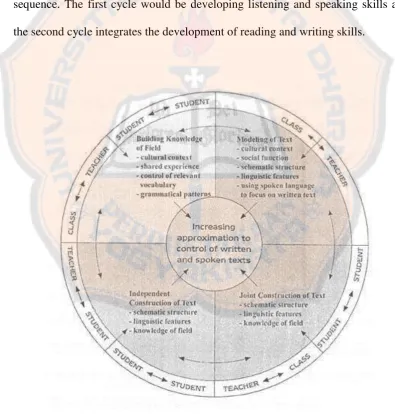
sentence structure of a text but it is more on having the knowledge or consciousness in understanding the relationship of the elements of a language or lexico-grammar, coined by Halliday of a text, It is aimed to provide students independent control of a particular type of text and also important to prepare students for a more complicated academic writing. Genre based approach is an approach which consist of cycle and stages and students are encourage to undergo the whole cycle and stages. The cycles are divided into two even part, that is the oral cycle and the written cycle, where each cycles has four stages that students and teachers must undergo. They are Building Knowledge Of The Field (BKOF), Modelling of Text (MoT), Joint Construction Of Text (JCoT) and lastly Independent Construction Of Text (ICoT). This rather recent approach would post different perception in students mind. The experience of such approach is then manifested in the form of attitude and behaviour.
and learning activities. The first ever in English Letters Department, Sanata Dharma University. The use of ICT in classroom is even encourage from the government from the earliest stage of formal school, and only in recent year it has become fully functional. Hence, the students of writing three, odd semester year 2011-2012 experience phenomenon in twofolds, the nature of genre based approach and implications of MOODLE and its exciting properties to students behavior.
The first step that the researcher did was to design a learning management system namely MOODLE as a learning model and the teaching and learning process take advantage of the teaching and learning cycles and stages proposed by Hammond (1992). The researcher sought the effect of implementing of the students with MOODLE as a learning model in learning writing text types. Such phenomenon is entirely new in the faculty of letters in Sanata Dharma therefore the researcher is keen to see the changing perception and attitude of the students when implicated with the changing of approach in learning how to write text types. The experience of the students may be unique since they may have various lived experience and meaningful experience could emerge and may lead students to have different responses to this approach.
anticipation, relations with others, cultural patterns, feelings, belief or sights, smells, sounds etc.. Using a qualitative paradigm, the researcher sought to describe the meaningful experience and delivered in the form of narration.
1.3 PROBLEM LIMITATION
There were some limitations in this research due to the restrictions of time and the capacity of the researcher. This thesis integrate technology in classroom teaching traditionally this will be motivation for CALL research. Traditionally a key question that has driven CALL research is if computers improve language learning (Kern, 2006). The ground of such question is to determine as to whether computers improve language learning, or questions concerning the effectiveness of technologies are in promoting learning (Felix, 2005; Liu, Moore, Graham & Lee, 2003). This research utilizes technology in classroom teaching however this research emphasizes to seek the meaningful experience from the students rather than to seek the performance of the students.
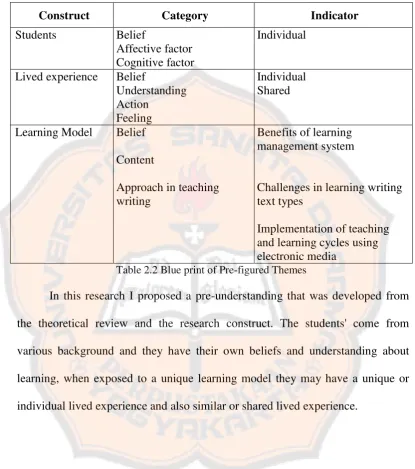
use of MOODLE as the instruments and inherently would lead to different understanding, beliefs, feeling, and actions.
The research will only focus on the lived experience of the participants which is a student in writing 3 classes in the academic year of 2011-2012, and the number of the participants is limited to three students. It is hoped that the limited number of participants that has similar background and competences will provide maximum feedback and consequently provide a thick description of their experiences.
1.4 RESEARCH QUESTIONS
This research employs qualitative inquiry and as such, the researcher will investigate and describe the participants lived experience, where individual and shared experience of the participants becomes the focal point of the discussion. In order to seek the participants' lived experience in learning writing text types using MOODLE as instrument a research questions was formulated as follows What is the students' lived experience in learning writing text types with MOODLE look
like?
1.5 RESEARCH GOALS
to provide descriptions such as (1) to reveal how the teaching and learning process in writing text types (2) to discover the implementation of an open source learning management system in college of an EFL context (3) to discover the changes of paradigms that could lead to the changing feeling and behavior or attitudes in classroom.
1.6 RESEARCH BENEFITS
This research intends to describe and interpret students' lived experience in learning writing text types based on genre based approach and incorporate unique learning management system with overall internet technology. This study provides thorough scientific information using lived experience in relation to the use MOODLE as a learning management system with various features in the education field as a method to improve the understanding of learning writing. Hopefully, this research will be able to serve as a foundation that will generate other ideas of research in this field, and thus will enrich the development of MOODLE as a software and teaching practices in general
discussion that is the lived experience of the participants. This knowledge will be the foundation or a stepping stone in further related research inquiries so that one day the researcher can self actualize better based on the ideals of oneself and in the academic society.
For the participants of this research, it is with my great belief that they will get a better understanding on the materials that they learn during their study. By having been interviewed numerous times and at long hours in English and they get to practice their English more frequently in a more serious mode. Furthermore, the questions given to them was a semi-structured and revolved around text types, consequently it has given them the opportunity to elaborate their ideas more freely and also to be exposed even more about text types gives them the edge in their study.
CHAPTER 2 LITERATURE REVIEW
This chapter discusses the theories which support this study. It consists of two sections: theoretical review and theoretical framework. The first section discusses language learning, writing, teaching of writing, definition of genre, genre-based approach, CALL, MOODLE, phenomenology and relevant study. Meanwhile, the second section elaborates the framework synthesized from the discussed theories.
2.1 THEORETICAL REVIEW
In this section, the researcher discusses some theories related to develop good instructional models using MOODLE for writing text types in Department of English Letters, Sanata Dharma University. This part provides the information relevant to the research, which will be used as a foundation for the researcher to design the materials. The first is about writing, the second is the genre based approach, and the third is MOODLE.
2.1.1 Language learning
socio-cultural context and register rather on grammatical norms. I would like to describe some theoretical perspective that made such notion to came about. Vygotsky suggest that higher mental function originates in social life, which an individual development originates from social, cultural, and historical form of life.
Any function in the child's development process appears twice, or on two planes. First it appears on the social planes, and then on the psychological planes. First it appears between people as an inter-psychological category, and then within the child as intra-inter-psychological category. This is equally true with regard to voluntary attention, logical memory, the formation of concepts, and the development of volition. We may consider this position of law in the full sense of the word, but it goes without saying that internalization transforms the process itself and the changes its structures and functions. Social relations or relations among people genetically underlie all higher functions and their interrelationships (1978, 163).
In other words, it suggest that learning of information first takes place on an inter psychological plane between a person and other persons, then on an intra psychological plane. This mediation-internalization process suggest that learning first takes place on the inter-psychological plane between a person and other persons, then it is recognized, and borrowed by individuals on the intra-psychological plane. These steps are what Vygotsky called Internalization, such process is not merely an imitation of the information obtained from the external world but undergone a transformation resulting in cognitive development.
knowledge trough interaction eventually recognize the language and through their development know how to use the language appropriate to the context and even able to make changes to accommodate the purpose of communication. For instance when a teacher engage a student to write a particular text, the manner which is used to engage the students is then appropriated by the students and hence creating and understanding within the students mental process, and later the students able to create a same text using similar instruction to that of the teacher to her self. To further elaborate his ideas on how social mediation came about to cognitive development or internalization, Vygotsky developed a concept called the Zone of Proximal Development (ZPD) (Vygotsky, 1978, 1986).
It is the distance between the actual developmental level as determined by independent problem solving and the level of potential development as determined through problem solving under adult guidance or in collaboration with more capable peers (Vygotsky, 1978, p.86).
... the zone of proximal development defines those functions that have not yet matured but are in the process of maturation, functions that will mature tomorrow but are currently in an embryonic state. These functions could be termed the "buds" or "flowers" of development rather than the "fruits" of development. The actual developmental level characterises mental development retrospectively, while the zone of proximal development characterises mental development prospectively (Vygotsky, 1978, p.86, originally Vygotsky, 1935, p. 42)
her peers. In relation to the ZPD, the capacity to learn is related to both the context and capacity of the person
Rather, the potential for learning is an ever-shifting range of possibilities that are dependent on what the cultural novice already knows, the nature of the problem to be solved or the task to be learned, the activity structures in which learning takes place, and the quality of this person's interaction with others (Lee & Smagorinsky, 2000, p. 2).
In regards of appropriation, one must voluntarily to participate to appropriated the knowledge, participatory appropriation, Rogoff (1995)
The basic idea of appropriation is that, through participation, people change and in the process become prepared to engage in subsequent similar activities. By engaging in an activity, participating in its meaning, people necessarily make ongoing contributions (whether in concrete actions or in stretching to understand the actions and ideas of others). Hence, participation is itself the process of appropriation (p. 150).
consciousness I perceive consciousness as a process of being unaware and begin notice object of desire and then direct his or her attention towards the object of desire. In other words it is a progressive process of acquiring knowledge of the object of desire and showing appreciation (Schmidt 1990) Furthermore, Schmidt proposed a concrete concept of consciousness, and they are intention, attention, awareness, and control. Intention is defined as a purposeful act or conscious apprehension from the learner or the teacher to pay attention at the stimulus. Attention can be defined as focusing on object which includes identifying and noticing attention. Awareness is defined as having vivid knowledge of the object or stimulus. Control is defined as the capacity of someone to automate his or her activity as if it were a part of the habit. Van Lier advocates such notions of consciousness, he suggest that in the context of perceiving object of desire a person will notice and actively respond to the object of desire and then he will select and direct his attention since conscious attending may assist in a more efficient selecting or directing of attention (Van Lier, 1996: 49). In addition, awareness means that it is a process of identifying personal sensation In terms of language learning, students will be more ready if he or she consciously attending the class, that is noticing and paying attention to his or her existence of attending the class in the first place which consequently yield better classroom behavior.
2.1.2 Writing
the elite and the well educated. It is right to say that written is more strict interms of the use of the conventions compared to that of speaking or spoken text. Writing, as compared to speaking can be seen as a more standardized system which must be acquired through special instructions (Weigle 2002, pg 4 citing Grabowzki) Mastery of this standard system is an important prerequisite of cultural and educational participation and the maintenance of one's rights and duties.
The fact that writing is a more standardized that speaking allows for higher degree of sanctions when people deviate from that standard. Meanwhile, (Shilva, 1990) and (Hyland, 2003) states that writing as seen as a product constructed from the writer' command of grammatical and lexical knowledge and writing development is considered to be the result of imitating and manipulating models provided by the teacher. In addition, (Brown 2004, p221) described two categories of writing skills. They are micro and macro skills. The followings are the list of micro and macro skills for writing. A Macro Skills Produce grapheme and orthographic patterns of English, it aims at producing writing at an efficient rate of speed to suit the purpose, also produce an acceptable core of words and use appropriate word order patterns. Special attentions are paid to the use of acceptable grammatical systems, writers also must be able to express a particular meaning in different grammatical forms and lastly use cohesive devices in written discourse.
to form and purpose; Convey links and connection between events, and communicate such relation as main idea, supporting idea, new information, given information, generalization, and exemplification; Distinguish between literal and implied meanings when writing; Correctly convey culturally specific references in the context of the written text; Develop and use of writing strategies, such accurately assessing the audience's interpretation, using pre-writing devices, writing the fluency in the first drafts, using paraphrases and synonyms, soliciting peer and instructor feedback, and using feedback for revising and editing. Micro skills of writing are appropriately applied to imitative and intensive types of writing task, while macro skills writing are essential for the successful mastery of responsive and extensive writing.
social activity. As student move up level they need to be able to handle different kinds of writing.
2.1.3 Writing in English Letters
The status quo of Indonesian curriculum for tertiary education reflected in the Indonesian Regulation concerning Education Number 12 article 64, 2012: The Autonomy of Higher Learning, states that Tertiary educations or Universities have the autonomy to plan, organize and conduct teaching learning activities in the classroom by each university thus the objectives set by the government for Universities in Indonesia may be achieved through different means or unique. Such policy is also imposed in Sanata Dharma University, and English Letters department where I had conducted my research on, was also in the effect of such policy. In English letters writing is divided into two distinct premises.
readers. However, the ability of choosing correct vocabulary and understand the use of transitional sentences is also taken into accounts.
In the third semester students are expected to have a good command of writing by looking at their ability to construct a well organized paragraphs and become more aware of the aspects that embedded within a good paragraphs such as the paragraphs coherentness, and the use of cohesive devices through the use of different text types. In writing 3 there are three major text types or genres that are being explored they are descriptive, narrative, and expository as well as the subsidiary text types that follows. The syllabus that is used for teaching and learning writing text types was a task based syllabus (Brown: 1995:7). A task based syllabus is a syllabus with the coverage of the core materials or learning materials concerning different task that must be achieved by the students such as writing description, reporting experiences, or instructions; and these task will very beneficial later in a more complex of language use.
Creative writing began at semester 4, where students are expected to write essays. This subjects will be require the basic knowledge of the previous three semesters, this creative writing continues to writing 6 with which the preparation of the thesis writing is the main focus.
2.1.4 Teaching Writing
practices is an evolving body of knowledge. The teaching of writing is without a doubt influenced by new methods developed from ever changing research. Current teaching practices as stated in is developed since the literacy demands of society, schools and employers have been evolving, to keep pace with increasing technological change. Literate people now need to be able to engage with a diverse range of print, electronic and visual texts. The teaching of writing must continue to respond to these changing literacy demands.
As teachers continue to build their understanding of language and the way it is learnt, they develop and refine the way they teach language. At the same time, they incorporate useful elements of earlier approaches into their current teaching practice. The teaching of writing practices has been evolving through time. Traditionally concept of teaching writing is as the process of scaffolding fixed structure in the students mind, the elaboration of the concept is that the fixed structure which is represented in students mind can be used to built blocks of knowledge and skills.
whether the students final work achieve predetermined accuracy or well connected to each other.
Furthermore, the student's part taking in the process of writing is also to be valued as much as the accuracy of the final piece of writing. This method was known as the process writing approach it aimed to build on the knowledge, skills about writing that students brought with them to school. It encouraged teachers to set up classrooms rich in the structure of the written language. The emphasis was students chose what they want to write about regardless of formal letter formation provided by their teachers, hence students get the to improve their existing knowledge that they acquire outside of the classroom context.
This method proven effective for encouraging students to write since students get to write based on familiar topic that they encounter on daily basis. In other words process writing methodology was learner centered, since the focal point of the approach was the students socio-cognitive development. The role of the teacher, however, was not to take responsibility of the students final product but merely a facilitator and motivator for the students. Teachers may facilitate students by providing conferencing, in which students were assisted to draft their work, edit, proofread, and may even publish their work. The process writing approach emphasize on the process undergo by the students during the construction of a text, the approach composed of many elements delivered in series of steps or sequential manner.
progress to the top. Hence, students will be expected to construct and reconstruct their text should they fail to meet the goal set by the teachers. This process was considered to be much more effective in arousing students attention to each stage of writing such as drafting, editing, and proofreading process from which a written text emerges.
The process writing approach was right in line to the current view of language learning where it is considered as natural learning, the notion is based on the condition under which children learn oral language at home. Students are encouraged to write for real purposes and demonstration by the teacher was valued as an effective teaching strategy. However, teachers found that the writing of many students was lack in creativity, as students fail to write text that would be familiar to their existence knowledge in particular language that is used in everyday spoken interactions. Also, the texts typically produced were not the kinds of texts which would support learning in the subject areas as students progressed through school. It became apparent that many students needed more to expand the repertoire of language choices available to them as they drafted texts.
The advantages of genre approaches are seen in the recognition of the value of learning about typical text structures and related grammatical features. The important feature of our current approach to writing, however, is that it is based on a view of language which recognizes that texts are socially constructed. Students need to be able to compose texts with critical understanding of social contexts and how meaning is constructed. This emphasis on critical understanding
as well as social purpose is what distinguishes the current approach from others.
2.1.5 Genre
Writing is arguably the most difficult subject for language learners due to the fact that learners' rarely communicate their ideas in written modes. Jumbled ideas, incoherent writings, wrong choice of words and grammar is a reflection of the problems that teachers encountered in evaluation writing. In recent years, educators have been seeking a methodology to improve the teaching and learning processes to communicate message better in teaching writing. In order to do this a new approach was be introduced, an approach that caused a major shift in educational system, an approach that embraces the notion of imposing genre in pedagogy has gain interest among teachers in various educational system particularly with the use of genre in academic writing.
prominent researcher that are able to give basic description of 'genre' is Douglas Biber. Biber (1988: 70) suggest genre as
the term 'genre' to refer to categorizations assigned on the basis of external criteria. I use the term 'text type', on the other hand, to refer to groupings of texts that are similar with respect to their linguistic form, irrespective of genre categories.
This may be sufficient for many academics however Biber's idea was not universally accepted and still disputed. The terms 'genre' and 'text type' seem to be fused together without being clear cut definition, with the term 'genre' being used to include both the concept of genre and text types. It is obvious that not all texts are of the same type. Another theory was proposed by Faigley and Meyer (1983), the identification of text types is deeply rooted in our culture but the labels of these categories vary according to the linguist's orientation and preferences.
1976: 108). Beaugrande and Dressler (1981) proposes seven text types descriptive, narrative, argumentative, scientific, didactic, literary and poetic, while Adam (1992) considers five major text types, they are récit, description, argumentation, explication and dialogue. Biber (1988) on the other hands makes a distinction between genre which later becomes register (Biber 1995: 9) and text types. Biber (1988) draws a distinction between genre and text type which has important implications for the language learning classroom.
Biber suggest genre is influenced by cultural and external criteria, whereas text types can be derived from the texts themselves, irrespective of their genre. Meaning to say, external criteria follow distinctions and classifications already available in the culture, Biber establishes a typology of texts based on internal linguistic criteria only, which are interpreted with reference to external functions. This notion is supported by Wikberg (1992: 247) suggests that theoretically "one could define a text type as a group of texts which share a cluster of linguistic features which occur as with a significantly different frequency compared with some other group of texts and Swales' (1990: 58) definition of genre as 'a class of communicative events, the members of which share some set of communicative purposes which are recognized by the expert members of the parent discourse community shows that he, too, views the notion of genre from a similar perspective to that expressed by Biber.
information, and online informational elaboration. Biber identify genre as grouping of texts on the basis of external criteria, the term genre describes types of social activities such as prayers, sermons, songs, and poems, which regularly occur in society' (Dudley-Evans 1989: 77), and 'are considered by the speech community as being of the same type' (Richards et al. 1992: 156).
On the other hand text types represent groupings of texts which are similar in linguistic form, regardless of genre or speech community. Text types represent groupings of texts which are similar in terms of co-occurrence of linguistic patterns. Biber found that the same genre can differ greatly in its linguistic characteristics. He also observed that different genres can be quite similar linguistically. The terms 'genre' and 'text type' thus represent different, yet complementary, perspectives on texts. This article argues that the distinction between genre and text type is an important and useful one for language learning classrooms
provide genre/stylistic writing as the title but text types as the weekly topic for throughout the course of the semester and to avoid further confusion it requires some explanation from the lecturer to enlightened the students by using the concept of genre developed by Paltridge (1996).
As forementioned the definition of genre and text types is not clear cut, most scholars agreed that is similar but has some degree of differences Biber (1988) and Wikberg (1992), while other agreed that it is somewhat interwoven but different in practicality Karlgren (2000), and others make distinction based on the contextuality of the use of the term Kilgarriff and Grefenstette (2003). To answer the confusion of the student and to bring forward the definition of genre in this study I took the concept of genre from Paltridge. Paltridge work was based on Biber but different in term of external and internal criteria.
occurrence features, which are, instead, the internal linguistic criteria forming the basis of text type categories.
Genre categories are determined on the basis of external criteria relating to the speaker's purpose and topic; they are assigned on the basis of use rather than on the basis of form. Biber (1988 p.170)
In theory, two texts may belong to the same text type in Biber's sense even though they may come from two different genres because they have some similarities in linguistic form biographies and novels are similar in terms of some typically past-tense, third-person narrative linguistic features. This highly restricted use of text type is an attempt to account for variation within and across genres and hence, in a way, to go "above and beyond" genre in linguistic investigations. Biber's (1989, p. 6) use of the term, for example, is prompted by his belief that "genre distinctions do not adequately represent the underlying text types of English, linguistically distinct texts within a genre represent different text types; linguistically similar texts from different genres represent a single text type."
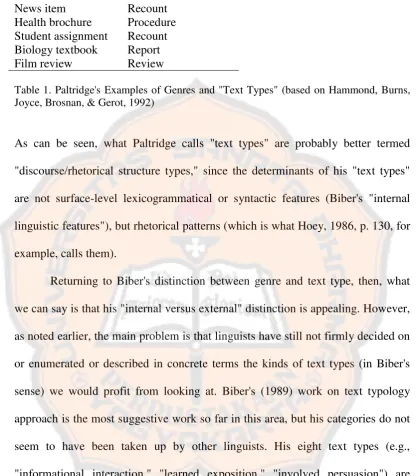
The more sensible sense of genre that I would try to explore in terms of genre and text types distinction, would be Paltridge (1996). Paltridge derive his ideas from Biber's concept of genre and text type, however it is quiet explicit that Paltridge understanding of internal versus external criteria is farfetched to of Biber's. Paltridge proposes the following distinction:
Genre Text Type
Recipe Procedure
Personal letter Anecdote Advertisement Description Police report Description Student essay Exposition Formal letter Exposition
News item Recount Health brochure Procedure Student assignment Recount Biology textbook Report
Film review Review
Table 1. Paltridge's Examples of Genres and "Text Types" (based on Hammond, Burns, Joyce, Brosnan, & Gerot, 1992)
As can be seen, what Paltridge calls "text types" are probably better termed "discourse/rhetorical structure types," since the determinants of his "text types" are not surface-level lexicogrammatical or syntactic features (Biber's "internal linguistic features"), but rhetorical patterns (which is what Hoey, 1986, p. 130, for example, calls them).
In summary, with text type still being an elusive concept which cannot yet be established explicitly in terms of linguistic features, perhaps the looser use of the term by people such as Faigley and Meyer (1983) may be just as useful: they use text type in the sense of the traditional four-part rhetorical categories of narrative, description, exposition and argumentation. Steen (1999, p. 113) similarly calls these four classes "types of discourse." 4 Stubbs (1996, p. 11), on the other hand, uses text type and genre interchangeably, in common, perhaps, with most other linguists. At present, such usages of text type (which do not observe the distinctions Biber and EAGLES try to make) are perhaps as consistent and sensible as any, as long as people make it clear how they are using the terms.
2.1.6 The Genre-Based Approach
In other words, that ideational is grammar for representing the world, while interpersonal suggest grammar for enacting social relationship such as asking, request, asserting control, or ordering. Whereas interpersonal suggest about interaction between human beings, society and culture. Textual is grammar for binding linguistic elements together into broadertext Christie (1999). Martin (1984) supports Christie's views and define genre as a staged, goal oriented, purposeful activities in which speakers engage as members of the culture.
In addition Feez and Joys (1998, 24-27) paradigm also support Christie's, they suggest that language learning is a social activity, and is the outcome of collaboration between the teacher and the student and between the student and the other students in the group. Halliday (1992:19) describes language learning as
Learning to mean and to expand one's meaning potential Halliday's language learning model with three outcomes. Hence, this model of language learning shows that social interaction has significant role that enable language students to develop a resource for making meaning, a tool for interpreting and organizing reality, knowledge about language.
learning in particular learning writing is a series of scaffolded development steps which addresses different aspects of language
For many learners, these materials will provide models which can be used to developed familiarity with the structure of such texts, and provide scaffold to assist with the learners' subsequent attempts to write similar text. Materials should be integrated and not require students to write genres which have not already been encountered. Elis (1989) as quoted in Richards (2002)
The methodology applied within the genre approach is based on the work of the Russian psychologist Vygotsky (1934/1978) and the American educational psychologist Bruner (1986). In genre-based approach the scaffholding is provided by the role of the teacher in providing explicit knowledge and in the stage of joint construction of the text. Thus, a genre-based approach to literacy means engaging students in the role of apprentice and also means re-establishing the teachers' role as an expert on language system and function.
Genre based approach is a teaching methodology that has been developed and sustained in Australia pedagogy. The genre based approach is an approach which values the notion of explicit knowledge, meaning to say that in learning learners must be provided with explicit knowledge about the language. It also emphasizes on teacher-learner interaction as well as the dynamics occurring in the classroom.
and teachers must undergo. They are building knowledge of the field, modelling of text, joint construction of text and lastly independent construction of text.
The concept of genre based approach for teachers is that teachers must complete a full circle of the cycle when delivering materials in the classroom. Based on Feez & Helen Joyce, 2002) in order to make full potential of the genre based approach in the classroom teachers must go thorough all the cycles in sequence. The first cycle would be developing listening and speaking skills and the second cycle integrates the development of reading and writing skills.
To implement genre-based approach in the classroom, one widely accepted instructional approach in Australian schools is the curriculum cycle, also referred to as 'the teaching and learning cycle'. One of the is proposed by Hammond et al. (1992.17 cited in Agustien 2006a dan 2006b) which is called Cycles and Stages of Learning. The four stages consist of building students' knowledge of the field, modeling the text, joint construction of text and independent construction of text.
The first stage, building knowledge of the field, aims at providing students with background knowledge of the topic. In this stage, the focus is on the content of information and the language of the genre of the text that is going to be used. Throughout this stage, the teacher and students will cooperatively build up a shared knowledge of the field. This initial exploration helps students to be prepared for approaching the next stage of the learning such as modeling of the text.
When students are already familiar with the model of a particular genre, teacher and students can work together to construct a particular text type. This is the third stage, known as the joint construction stage. The aim of this stage is to show students how a text is produced. In this stage, the focus is on illustrating the process of creating/writing a text considering both the content and the language. Finally, in the last stage, the Independent Construction stage, students are ready to work independently to produce their own texts within the chosen genre. The practicality of the genre based approach in the classroom is easy but not simple.
2.1.7 MOODLE
Moodle is a free, open-source cross-platform, virtual learning management system. The word MOODLE is an acronym for Modular Object-Oriented Dynamic Learning Environment. MOODLE was created by Martin Dougiamas, a former WebCT administrator at Curtin University of Technology, Perth, Australia, who has graduate degrees in Computer Science and Education. Since MOODLE was first released in 2002 it has grown to be the world's most popular Open Source eLearning environment with over 43 million users in more than 200 countries. One of the reasons that MOODLE is widely recognized is because it has been developed as an open source software project, which means that MOODLE is available free of charge under the terms of the GNU General Public License (GPL) and has no licensing cost attached (Brand!, 2005). MOODLE can be installed without making any alteration to the operating system of the users. MOODLE can run in any major operating systems such as Window, Mac OS X, Linux, etc.
at the courseware. MOODLE is specifically designed to help teachers to create dynamic online materials with the view of creating virtual communities with their peers. MOODLE is very versatile that teachers can customize it to meet the core learning requirements of an institution without the constrainments of license fees. MOODLE has also been supported by official MOODLE Partner such as NetSpot to provide technological support and increased capacity with services backed by a Service Level Agreement.
information ecosystem of a large organisation, MOODLE's strength in administration lies in its flexibility.
One of the goals of any eLearning environment is to be able to deliver information to students in a quick and easy way but still maintaining the authenticity of the information. Regardless of the shape or format of the information, the content should be simple to load and seamless to view, as well as being robust enough to work with internet connections. MOODLE provides a range of intuitive tools that make content easy to create and simple to present in a variety of ways. MOODLE enables teacher to upload documents, create web pages, import SCORM packages, embed video, flash animation, insert online pictures and video. MOODLE resources can easily be altered or perhaps supplemented with a wide range of content imported from Web 2.0 repositories such as YouTube and Flickr.
the statement of social constructionist view, from MOODLE documentation archive shows how MOODLE supports social constructionist view such as potential teachers as well as learners work in a true collaborative environment, it enable us to learn from observing the activity of our peers, by understanding the contexts of others, we can teach in a more transformational way.
MOODLE is an open Learning Management Systems that provide support teachers who uphold the view of socio-cultural approach in language learning made feasible in their. However, MOODLE is not the only learning management system available for educational practices. Blackboard would be a good example of commercially built LMS which has more sophisticated features and interface than of MOODLE. From the technical point of view given the fact that MOODLE as an open source learning management systems enable teachers who has special needs in his or her teaching to contribute to the development of MOODLE, hence, the next version of MOODLE will accommodate his or her needs, furthermore if he or she possesses knowledge of "scripting". In the view of pre-service teacher, the concept of open source or free of charge really help with the load of teaching expenses, this leads to an increase of self motivation by the pre-service teacher. Moreover the flexibility of MOODLE in the sense of creative tasks and cognitive benefits with new ICT and teaching skills is another asset that MOODLE has compared to Blackboard, Williams (2010).
2.1.8 Phenomenology
experienced, before the phenomenon has been overlaid with explanations as to muses or origins. To study the experience of phenomena as they appear in consciousness and in so doing apprehend their authentic reality, phenomenologists turn their attention to the life-world of the individual, the world of everyday lived experience (Munhall, 1994).
Husserl in Eagleton, (1983:55) described phenomenology as the science of pure phenomena. The aim is to return to the concrete or "Back to the things themselves" (Eagleton, 1983:56; Kruger, 1988: 28; Moustakas, 1994: 26). The operative word in phenomenological research is 'describe'. The aim of the researcher is to describe as accurately as possible the phenomenon, refraining from any pre-given framework, but remaining true to the facts. According to Welman and Kruger (1999, p. 189) "the phenomenologists are concerned with understanding social and psychological phenomena from the perspectives of people involved.
prominent phenomenologist, Van Manen (1990), suggest that phenomenology as a poetizing activity in that "it tries an incantative, evocative speaking, a primal idling, wherein we aim to involve the voice in an original singing of the world" (Van Manen 1990:13). Phenomenology is both the "description of the lived-through quality of lived experience and the description of meaning of the expressions of lived experience" (Van Manen 1990: 25). The description of meaning is a mediated expression and is more interpretive. It is through the use of some type of text or symbolic expression that interpretations are made of life experience. Hence researchers applying phenomenology in their work is concerned with the lived experiences of the people (Greene, 1997; Holloway, 1997; Kruger, 1988; Kvale, 1996; Maypole & Davies, 2001; Robinson & Reed, 1998) involved, or who were involved, with the issue that is being researched. Van Manen (1997: 41) profoundly captures what is stated in this paragraph:
[Phenomena] have something to say to us - this is common knowledge among poets and painters. Therefore, poets and painters are born phenomenologists. Or rather, we are all born phenomenologists; the poets and painters among us, however, understand very well their task of sharing, by means of word and image, their insights with others -an artfulness that is also laboriously practised by the professional phenomenologist.
lived experience and recollects lived experience? Is validated by lived experience and it validates lived experience" (Van Manen 1990:27)
Paradigm of principle in interpretative research Bismoko, 2007:27 A. The truth of the world reality and its meaning which is never objective .the researcher understands the meaning of world reality by reflecting and interpreting the interpretation of the group of participants. The major concern of phenomenological analysis is to understand "how the everyday, inter-subjective world is constituted" (Schwandt, 2000) from the participants' perspective. The basic philosophical assumption underlying this inquiry has most often been illustrated by Husserl's (1962) statements - "we can only know what we experience." Thus, any inquiry cannot engage in 'sciences of facts' because there are not absolutely facts; we only can establish 'knowledge of essences'. The essence is the central underlying meaning of the experience shared within the different lived experiences.
phenomenon being encountered by the participant directly impacted human lives (Bismoko, 2007:22).
Prominent theorist such as Ajjawi and Higgs (2007) suggest that hermeneutics is experiential meaning whereas semantics is empirical. The world of lived experience is both the source and the object of phenomenological research. To make a study of the lived experience of teaching ones needs to orient oneself in a strong way to the questions of the meaning of teaching. Nothing is given or granted meaning to say that experience can be found in the experience of learning or pedagogy, thus we need to search everywhere that might yield something of its fundamental nature using personal experience as a starting point. To conduct a personal description of lived experience, we must describe our experiences as much as possible in experiential terms, focusing in a particular situation or event.