Halaman: 980-986 DOI: 10.13057/psnmbi/m010504
Species diversity of
Selaginella
in the Dieng Plateau, Central Java
Keanekaragaman jenis Selaginella di Dataran Tinggi Dieng, Jawa Tengah
AHMAD DWI SETYAWAN1,2,♥, SUGIYARTO1, A. WIDIASTUTI3
1Jurusan Biologi, Fakultas Matematika dan Ilmu Pengetahuan Alam, Universitas Sebelas Maret Surakarta. Jl. Ir. Sutami36A Surakarta 57126, Jawa
Tengah. Tel./Fax. +62-271-663375, ♥email: [email protected]
2 Program Biologi Konservasi, Departemen Biologi, Fakultas Matematika dan Ilmu Pengetahuan Alam, Universitas Indonesia, Depok 16424, Jawa Barat 3Development Agency for Seed Quality Testing of Food and Horticulture Crops, Depok, Indonesia
Manuskrip diterima: 28 April 2014. Revisi disetujui: 15 Juni 2015.
Abstrak. Setyawan AD,Sugiyarto, Widiastuti A. 2015.Keanekaragaman jenis Selaginella di Dataran Tinggi Dieng, Jawa Tengah. Pros Sem Nas Masy Biodiv Indon 1: 980-986. Selaginella merupakan jenis tumbuhan herba yang memerlukan air untuk fertilisasi, sehingga menyukai habitat yang lembab dan sejuk. Dataran Tinggi Dieng merupakan salah satu kawasan dengan curah hujan paling tinggi di Pulau Jawa. Didukung kondisi habitatnya yang berbukit-bukit kawasan ini sangat sesuai bagi pertumbuhan Selaginella. Penelitian ini dilakukan di kawasan Dataran Tinggi Dieng dari ketinggian 300 m. dpl., hingga 2500 m. dpl. Penelitian lapangan dilakukan mulai pertengahan tahun 2007 sampai dengan akhir tahun 2013. Di samping penelitian lapangan dilakukan pula pengamatan lembar herbarium koleksi dari Herbarium Bogoriense, Pusat Penelitian Biologi, LIPI, Cibinong Bogor. Dalam penelitian ini ditemukan delapan spesies, yaitu: S. aristata, S. ciliaris, S. intermedia, S. involvens, S. opaca, S. ornata, S. plana, and S. remotifolia. Ditemukan pula varian dari S. ciliaris yang membentuk kumpulan yang kompak, dengan ukuran batang dan daun yang lebih ramping dan ujung daun lebih meruncing, varian ini kemungkinan merupakan jenis baru, karena belum pernah dilaporkan adanya jenis Selaginella dengan ciri-ciri demikian, jenis yang ciri-ciri morfologinya paling mendekati dengannya adalah S. ciliaris.
Kata kunci: Dieng, Jawa Tengah, jenis baru, Selaginella
Abstract. Setyawan AD,Sugiyarto, Widiastuti A. 2015.Species diversity of Selaginella in the Dieng Plateau, Central Java. Pros Sem Nas Masy Biodiv Indon 1: 980-986.Selaginella is a herbaceous plant species that requires a lot of water for growth and fertilization. Therefore, moist and cool habitats are preferred for the cultivation of Selaginella. Dieng Plateau is one of the regions having the highest rainfall in Java. This region is very suitable for the growth of Selaginella due to its moistness. This research was conducted in Dieng Plateau from an altitude of 300 m. up to 2500 m. asl. The field study was conducted from mid of 2007 until the end of 2013. In addition to field study, an observation view of herbarium sheets which are the collection of the Herbarium Bogoriense, Research Center for Biology, Indonesian Institute of Sciences (LIPI), Cibinong Bogor. Eight species of Selaginella were found, namely: S. aristata, S. ciliaris, S. intermedia, S. involvens, S. opaca, S. ornata, S. plana, and S. remotifolia. Variant of S. ciliarnis that form a compact set was found, the size of the stems and leaves was slimmer and more tapered at the leaf tip. This variant is probably a new species because the species with these characteristics has not been reported. The morphological characteristics of this species are mostly close to S. ciliaris.
Keywords: Dieng, Central Java, new species, Selaginella
INTRODUCTION
Dieng is a plateau in Central Java Province, Indonesia which the main area has an altitude of 1000 m to 2500s m (the peak of Mt. Prahu). This is a unity in biophysical, social, economic and cultural characteristics (Setyawan 2012). This area includes some districts, namely Pekalongan (18,000 ha), Temanggung (5000 ha), Batang (5000 ha), Kendal (1500 ha), Banjarnegara (11,800 ha) and Wonosobo (11,600 ha) (BPDASSOP 2007). The name of
Dieng Plateau (from Di-Hyang, a high place in Sanskrit)
refers to the village located near the complex of Dieng temples, with the same name, Dieng Village. In 1831, this village divided into two new villages bordered by Kali Tulis River, namely Dieng Wetan of Wonosobo and Dieng Kulon of Banjarnegara (Setyawan 2012). However, the
ecosystem of Dieng Plateau covers a much larger area than the two villages. Dieng has long been a region of human activity. Based on stratigraphic analysis of pollen in Dieng lakes, the land clearing have started in the 4th century AD, two centuries before it began construction of the Hindu temples complex, and continued until the 13th century, then abandoned due to the eruption of Dieng caldera, such as in 1375, and inhabited again at the beginning of the 20th century (Pudjoarinto 1999; Pudjoarinto and Cushing 2001). Dieng Plateau has a very important role in maintaining hydrological cycle and biodiversity. This area is the center of rivers springs in the middle of Central Java, including Serayu, the longest river of the south coast of Java. In some areas, there are still primary forests with high biodiversity. This area is a refuge for rare endemic animals of Java, such
(Hystrix javanica), Javan leopard (Panthera pardus), Javan
hawk-eagle (Nisaetus bartelsi), etc. (Nijman and van Balen
1998; Pemkab Wonosobo 2006). It is also the only place
where Pimpinella pruatjan, an aphrodisiac plant endemic
to Java and Vasconcellea pubescens, an alien fruit
introduced from the Andean Highlands, can be cultivated economically.
The economical and political turmoil in 1997 has left severe natural destruction in the Dieng Plateau. The forest looting and land conversion into agriculture have caused exposing a large number of forest permanently. The reforestation has a tough challenge from farmers (Setyawan 2012). In Dieng area of Wonosobo alone, there was 7758 ha of degraded land with erosion rates of 10.7 mm/year, or 161 tons/ha/year. This is compounded by the landslides and floods that occur regularly. Management of this area needs to involve economic, social, cultural, and physical developments; as well as coordination among stakeholders (Aisyah 2013; Pemkab Wonosobo 2013; Hidayati 2014).
Selaginella is a group of herbs found in moist and wet
areas and it uses water for fertilization and healthy growth.
Selaginella is an ancient plant that can survive and adapt to
the local environments. In the tropics, its distribution is influenced by altitude, because the higher region the higher the moisture and rainfall. The wet hilly area is very suitable for its growth, but it can also adapt to the drier environments. It could be affected by global climate change since the growth and breeding are dependent on water availability.
The aim of this study is to identify the diversity of
Selaginella in the Dieng Plateau, Central Java, Indonesia.
MATERIALS AND METHODS
Study areas
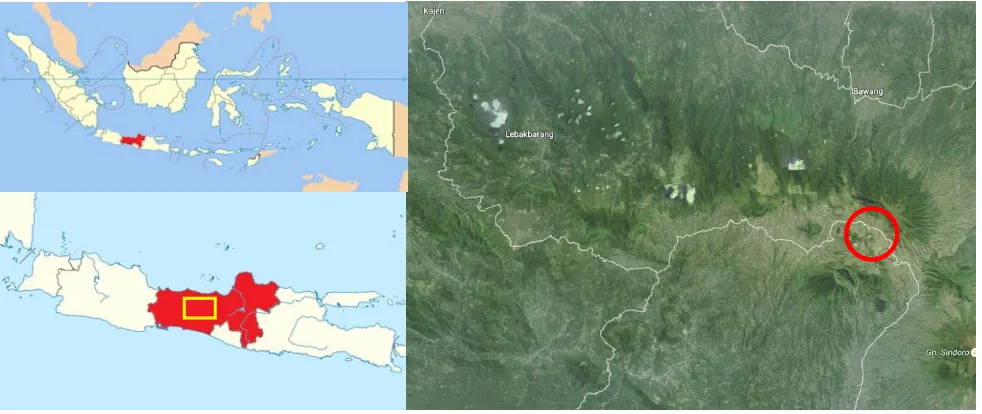
This research is primarily conducted in the Dieng Plateau of Wonosobo and Banjarnegara districts of Central Java, Indonesia, as well as other influenced ecosystem of
the districts of Pekalongan, Batang, Temanggung, and
Kendal (Figure 1). Several surveys of Selaginella had been
carried out, with an altitude between 300 m and 2500 m. Geographically, the study area is located between -7.0625° and -7.3092° (S) and between 109.5802° and 110.0162° (E), the total area of more than 52,900 ha.
This area is a group of old inactive volcanoes consisting of flat craters and valleys in between or surrounded by hills. The height of the mountain peaks increased gradually from west to east. At West, the height are mostly less than 2000 m, e.g. Mt. Lumping (1327 m), Mt. Beser (1579 m) and Mt. Langit (1623 m); at the central part there lies Mt. Kendalisada (1899 m), Mt. Kemulan (1931), Mt. Geni (1937), Mt. Kendeng (2015), and Mt. Rogojembangan (2177 m); while at east there lies Mt. Ngesong (2210 m), Mt. Bisma (2362 m), as well as Mt. Prahu (2565 m), the highest mountain in the Dieng Plateau (US Army Corps of Engineers 1954). The main area of Dieng Plateau lies at an altitude of 2000s m, with a daily temperature average of 14˚C; and frost (5˚C) may occur at night in the dry season (July-August); the average rainfall is 4000-7000 mm per year; only in June-September rainfall decreases, but still there are 40 days of rain (Steenis 1972).
In the Dieng Plateau, forests are remained in the steep and inaccessible hillsides, whereas in flat places it has been converted into cultivated land of potatoes and vegetables. Vegetation type of Mts. Dieng is a wet tropical rainforest. This forest has a height range from 300 m in the west to near the summit of Mount Prahu (2565 m) in the east. Below 1000 m, there is a mixture of lowland and montane forests. At an altitude of 1000-2400 m, there is a wet mountain rain forest. At the peak of Mt. Prahu, an upper montane zone, there is a meadow with a few trees. In some places, it is still found clusters of undisturbed primary forest. In the 1990s, reaching 25,500 ha of forest cover, but it is now much reduced. The only Telaga Warna has been declared as conservation areas i.e. natural reserve (Setyawan 2012).
Procedures
The field survey was conducted several times in July and October 2007, October 2008, February 2010, July 2011, April 2012 and August 2013. The presence of all selaginellas was recorded, then collected as herbarium specimens and living plants for the experimental garden in Wonosobo, Central Java (768 m.). Data passport collected along with the specimens were used as a standard for herbarium specimens. Each specimen was unique, distinguished by location and time of collection. Both herbarium specimens and living plants were observed. Specimens of field collection were deposited at the Herbarium Soloense (SO), Sebelas Maret University, Surakarta, Indonesia and some selected specimens will be sent to the Herbarium Bogoriense (BO), Research Center for Biology, Indonesian Institute of Sciences (LIPI), Cibinong-Bogor, Indonesia. From field work, a total of nine species was obtained from 109 herbarium specimens collected from 56 sites. Observations were also conducted to the collection of Herbarium Bogoriense, which had 600s herbarium sheets of Javan selaginellas, but only eight specimens collected from Dieng Plateau.
The specimens were identified by referring to several early kinds of literature on Selaginella of Nusantara (Malay Archipelago), i.e. Alston (1934, 1935a,b, 1937, 1940); as well as several latest references such as Wong (1982, 2010), Tsai and Shieh (1994), Li and Tan (2005), Chang et al. (2012), Setyawan et al. (2012, 2013), and Zhang et al. (2013). In addition to direct observations, the kinds of literature were used to guide the preparation of description. Meanwhile, the global distribution of selaginellas was mainly based on Hassler and Swale (2002) and Chang et al. (2012). The locality was based on the administrative division of sub-district level.
RESULTS AND DISCUSSION
Selaginella aristataSpring, Bull. Acad. Brux. 10: 232, no. 152 (1843) (Figure 2.A)
Annual herb, small, fleshy. Stems are suberect, prostrate or ascending, glabrous, dendritic, especially at the mature ones, pink to brown, 5-20 cm long, 5-6 mm wide (incl. leaves). Rhizophores present at basal stem, originated from the ventral side of branching stem, ca. 1 mm in diam.
Leaves are dimorphic(trophophylls), arranged in 4 lanes (2
lateral, 2 median), sparsely arranged at main stem but closely arranged at the branches, single vein, fan-shaped,
whitish green; lateral (ventral) leaves are lanceolate,
oblong or ovate at main stem, lanceolate to falcate at branches, 2-3 mm long, 1-2 mm wide, acute or obtuse apex, asymmetrical, subcordate or rounded base, serrulate
to subentire margin; median (dorsal) leaves are smaller
than the lateral ones, lanceolate to ovate, more or less symmetri-cally, 1.5-2 mm long, 0.5-1 mm wide, caudate to long tail-like apex, apices upward or bended back, obtuse base, serrulate margin, single vein reaching the apex;
axillary leaves are lanceolate, ovate or subcordate, 1.5-2.5
mm long, 0.5-1.5 mm wide, apex obtuse, rounded base, serrulate margin, single vein nearly reaching the apex.
Strobilus are solitary, terminal, loosely, bisymmetrical,
upper-plane sporophylls longer than lower-plane, up to 1 cm long.
Habitat and ecology: On the steep cliffs of primary forests, moist, wet, near river; on the banks of a small river shaded by bamboo; vegetable fields; cliff at roadside, near housing; on the fern spikes agricultural land, shaded by paranet; cliff near a small spring. It was abundant in the rainy season; at an altitude of 419-1209 m.
Locality: Banjarnegara (Pagentan), Pekalongan (Talun), Wonosobo (Garung, Mojotengah).
Distribution: Indonesia (Java, Buru, Halmahera, Seram, Ternate, Sulawesi), China, India, Japan, Myanmar, Philippines, Sri Langka, Taiwan, Thailand, Vietnam.
Selaginella ciliaris (Retz.) Spring, Bull. Acad. Brux. 10: 23 (1843) (Figure 2.B, 2.J-K)
Annual herb, small. Stems are decumbent, shortly
creeping, prostrate or ascending, glabrous, angular or sulcate, branched throughout without a significant main stem, 2-10 cm long, 4-5 mm wide (incl. leaves).
Rhizophores present at intervals but mostly near the base,
originated from the ventral side in axils of branches, ca. 0.3
mm in diam. Leaves are dimorphic, arranged in 4 lanes (2
lateral, 2 median), single vein, sometimes fan-shaped;
lateral leaves are ovate to lanceolate, more or less
symmetrical, 1.5-2 mm long, 0.5-1 mm wide, acuminate or acute apex, rounded or subcordate base, serrulate or ciliate margin, single vein reaching the apex, keeled, pointing
outwards; median leaves are ovate to falcate, contiguous,
nearly asymmetrical, 2-2.5 mm long, 0.5-1.5 mm wide, acute apex, aristate or cuspidate, subcordate or rounded base, serrulate margin but laciniate at basal part, pointing upwards, minutely toothed, ciliate, slightly carinate, midrib prominent, single vein reaching or nearly reaching the apex; axillary leaves are lanceolate to ovate, equally sided (bisymmetrically) or slightly asymmetrical, 1.5-2.5 mm long, 1-1.5 mm wide, single vein reaching or nearly reaching the apex, acute apex, rounded to subcordate base, exauriculate, ciliate, ciliate margin or laciniate at basal part and finely toothed or serrulate at apical part. Strobilus are solitary (or twin), terminal, compact, dorsiventrally complanate or flattened, up to ca. 0.5-2 cm long; sporophylls strongly dimorphic, spore greenish-yellowish orange.
Habitat and ecology: On the cliff of small rivers and rice fields embankment; on cliff of the village road, near factories and tea gardens; in vegetable field on the roadside and in the steep fields; fern spikes agricultural land, shaded by paranet; cemented wall near the river; cliffs near the small springs; steep cliffs in primary forest, moist, wet, near the small river; at altitudes of 549-1209 m.
Locality: Banjarnegara (Pagentan, Pejawaran), Pekalongan (Paninggaran, Talun), Wonosobo (Garung, Kejajar, Mojotengah).
Figure 2. A.S. aristata, B. S. ciliaris, C. S. intermedia, D. S. involvens, E. S. opaca, F. S. ornata, G. S. plana, H. S. remotifolia, I. Unknown species (solitary), J-K. Unknown species in a clump
In the study, a variant of ciliary is found growing tightly with more slender body sizes (Figure 2.I-K). This variant differs from the three variants mentioned by Andrews (1990), so it is thought to be a new species. Intensive field surveys and more detailed morphological and genetic studies need to be conducted.
Selaginella intermedia(Blume) Spring, Bull. Acad. Brux. 10: 144 (1843) (Figure 2.C)
Perennial herb. Stems are suberect to ascending,
cylindrical, glabrous, membranous, multiple branched toward apex, up to ca 70 cm long, 3-5 mm wide (incl.
leaves). Rhizophores present at basal stem, thick,
A B C
D E F
G H I
cylindrical, originated from the ventral side of branching
stem, ca. 1-1.5 mm in diam. Leaves are dimorphic,
arranged in 4 lanes (2 lateral, 2 median), sparsely arranged at main stem but closely arranged at the branches, single vein, pale green leaves; lateral leaves are oblong or ovate at main stem, lanceolate at branches, 4 mm long, 1.5-2.5 mm wide, acute or acuminate apex, asymmetrical, rounded
base, dentate margin; median leaves are smaller than the
lateral ones, obovate, oblique at base, more or less symmetrically, 3.5 mm long, 1.5 mm wide, aristate apex, rounded or cordate base, dentate margin; axillary leaves are lanceolate or ovate, 2-2.5 mm long, 1.5-2 mm wide, acute or obtuse apex, rounded base, dentate–denticulate margin, single vein nearly reaching the apex. Strobilus are solitary, terminal, loosely, quadrangular, up to 5 cm long; sporophylls monomorphic.
Locality: Pekalongan (Doro, Paninggaran), Wonosobo (Mojotengah).
Habitat and ecology: On the cliff of a roadside, in a pine forest; on the small river banks shaded by lush bamboo; at an altitude of 738-1131 m.
Distribution: Indonesia (Java, Sumatra, Sulawesi). India, Malaysia, Myanmar, Sri Lanka, Thailand, Vietnam.
Selaginella involvens(Sw.) Spring, Bull. Acad. Brux. 10: 136, no. 6 (1843) (Figure 2.D)
Perennial herb, terrestrial, epilithic or xerophytic. Stem
are robust, hard, but easily broken, two types, i.e.: erect main stem and creeping subterranean rhizome. Main stems are erect or ascending, branched from half upward, dendritic, fan-shaped, pinnately branched, stramineous, unbranched main stem 20-60 cm long, 3-4 cm wide (incl. leaves),1-1.5 mm in diam. with several dormant buds or leaves; in lower part, terete, not sulcate, glabrous; leafy main stem incl. leaves 4-6 mm wide at middle, ultimate
branches 2-3 mm wide incl. leaves. Rhizophores are
restricted to creeping rhizomes, at intervals. Leaves are on the rhizome, scalelike, monomorphic, ovate, ciliate, sessile, acute apex, apprised or recurved, colorless to pale yellow or brown; Leaves on the half basal main stem are monomorphic, ovate, clasping, nearly asymmetrical, appressed, 1.5-2 mm long, 1-1.5 mm wide, acute to attenuate apex, truncate base, auriculate or not, serrate to serrulate margin but lacerate with spinose at the auricule, arose and long ciliate towards apex. Leaves on the branches are dimorphic, arranged in 4 lanes (2 lateral, 2 median), single vein, reaching the apex, fan-shaped frond, yellowish green, rolling up when dry; lateral leaves are lanceolate to ovate, contiguous or overlapping, slightly ascending, asymmetrical, 1-2.5 mm long, 0.25-1.5 mm wide, slightly carinate, ciliate near base, attenuate or acuminate apex, cuneate or oblique base with auriculate, single vein always curved and pointing to abaxial side, having 2 significant grooves beside the vein, adaxial blade raised and forming two-main-vein, denticulate or laciniate margin but spinose
at the auricule; median leaves are ovate on the main stem
but elliptical or laceolate to ovate on the top branch, asymmetrical, 1.5-2.5 mm long, 1-2.5 mm wide, acute apex, rounded to subcordate base, twisting to form miniature auricle at the base, single vein, obscure, 1-2 longitudinal groove(s) at the adaxial surface beside the vein
of median leaves on the top branch, having 2-3 grooves at the abaxial surface on the top branch, 2 beside the vein and 1, less significant or absent, inside the midrib, margin entirely to serrate, laciniate at most basal part of margin, concentrated spinose at the miniature-auricle base,
minutely ciliate, pointing upwards; axillary leaves are
ovate to cordate on first forked site but lanceolate to ovate at following forked site, nearly symmetrical, 1-2.5 mm long, 0.5-1.5 mm wide, acute or attenuate apex, subcordate or cordate base, exauriculate, serrate margin but laciniate at
basal part, minutely ciliate or denticulate. Strobilus are
solitary, terminal, tetragonal, compact, up to 2 cm long; sporophylls monomorphic.
Habitat and ecology: On the steep cliffs of riverbank; on the steep cliff of a big rock; stone wall on the roadside, in primary forest; on small springs sacred by Buddhists, on the steep walls of river bank; at an altitude of 700-1296 m.
Locality: Banjarnegara (Kalibening), Pekalongan (Kajen, Lebakbarang, Petungkriyono), Temanggung (Ngadirejo)
Distribution: Indonesia (Java, Flores, Kalimantan, Sulawesi), Bhutan, Cambodia, China, India, Japan, Korea, Laos, Myanmar, Nepal, Palau Isl., Sri Lanka, Philippines, Taiwan, Thailand, Vietnam.
Selaginella opacaWarb., Monsunia 1: 108, 122, no. 112 (1900) (Figure 2.E)
Perennial fleshy herb. Stems are creeping, ascending,
hanging, glabrous, usually fertile branches alternate on long fleshy main stem, 40-75 cm long, 3-8 cm wide (incl. leaves). Rhizophores are at intervals stem, mostly near the base, originated from the dorsal side of stem, ca. 1-1.5 mm
in diam. Leaves are conspiciously dimorphic, but
monomorphic on the main stem, oblong, asymmetrical, spaced farther apart than their width, midrib present. Leaves on the branches are dimorphic, arranged in 4 lanes (2 lateral, 2 median), loosely arranged at long creeping
stem but closely arranged at branches; lateral leaves are
ovate to oblong, asymmetrical, 2-5 mm long, 2-3 mm wide, acute apex, rounded base, serrulate to entire or minutely ciliate at the base margin, pointing outwards, imbricating at the ends of branches, single vein, obscure, not reaching the
apex; median leaves are ovate to oblong, asymmetrical,
1.5-3 mm long, 1-2 mm wide, caudate apex, obliquely cordate or cordate base, pointing upwards, imbricating at the ends of branches, serrulate or serrate margin, but entire
at basal part, single vein not reaching the apex; axillary
leaves are ovate, entire, rounded or obtuse, symmetrical,
2.5-3.5 mm long, 1.5-2.5 mm wide, acute apex, rounded base, entire or serrulate at apical part margin. Strobilus are solitary (rarely twin), terminal or lateral, tetragonal, up to more than 3.5 cm long; sporophylls monomorphic.
Locality: Banjarnegara (Batur, Wanayasa), Pekalongan (Petungkriyono), Wonosobo (Garung, Kejajar, Mojotengah).
housing; inside the Albisia lophanta forest, near a crater; in the dike or cliffs and among the rocks of vegetable, potato and herbs fields; among the vegetable crops, on the banks of irrigation canals; in bushes at the edge of lake; around the spring; at altitude of 993-2124 m.
Distribution: Indonesia (Java, Lombok, Ceram, Sumatra, New Guinea), Philippines.
Selaginella ornata(Hook & Grev.) Spring, Bull. Acad. Brux. 10: 232 (1843) (Figure 2.F)
Perennial herb. Stems are creeping to ascending or
suberect, oval, flattened, or subquadrangular, sulcate or not, glabrous, branched from near base upward, green, stramineous or brownish, fragile, very easily broken, ca. 30-40 cm long, 1-3 cm wide (incl. leaves), 1-1.5 mm in
diam. Rhizophores are at intervals throughout length of
creeping stem and branches, rarely on upper part, originated from ventral side in axils of branches, ca. 0.5-1
mm in diam, brownish or green. Leaves are dimorphic,
arranged in 4 lanes (2 lateral, 2 median), densely arranged throughout the stem and imbricating at top of branches,
green to brownish green; lateral leaves are oblong to
oblong-falcate, denticulate to dentate, exauriculate, asymmetrical, on main stem larger than on branches, distant or contiguous, spreading, 2-3 mm long, 1-2 mm wide, obtuse apex, acuminate or acute, and prickly tip, base rounded to truncate, basiscopic base decurrent, entire margin; acroscopic rounded base, overlapping stem and branches, margin denticulate in basal half, single vein not
reaching the apex; median leaves are contiguous or
imbricate, ovate, denticulate to dentate, carinate, with arista often more than half the lamina length, asymmetrical, 1.5-3.5 mm long, 0.5-1.5 mm wide, acute or aristate apex, prickly tip, obtuse or rounded base, attenuate, single vein not reaching the apex, minutely denticulate to entire margin; axillary leaves are ovate, lanceolate or subcordate, exauriculate, imbricating, asymmetrical, 1-1.5 mm long, 0.5-1 mm wide, acute apex, rounded base, entire margin.
Strobilus is solitary or twins, terminal, compact,
dorsiventrally complanate, bisymmetrical, upper-plane sporophylls longer than lower-plane sporophylls, up to more than 1 cm long; sporophylls strongly dimorphic, spores pale yellow to reddish brown.
Locality: Banjarnegara (Kalibening, Pagentan), Pekalongan (Kajen, Paninggaran, Petungkriyono, Talun), Wonosobo (Garung, Mojotengah, Watumalang).
Habitat and ecology: On the roadside cliff of a pine forest; in a small river and a cliff wall of street gutter; step cliff near the cloves garden; on the steep cliffs roadside of a small river; on the steep cliffs of roadside that moist, shady and watery; in the primary forest near river; on the rock wall at roadside near primary forest; on the river banks shaded by bamboo; on the roadside cliff and the river bank, slightly open, shaded by trees and bamboo; on a very dusty roadside; on the cliffs of vegetable fields, very abundant; on a cliff at roadside, near housing; around small water channels under steep cliffs; at altitude of 419-1457 m.
Distribution: Indonesia (Java, Kalimantan, Bali, Flores, Lombok, Sumatra), Cambodia, India, Malaysia, Philippines, Thailand, Vietnam.
Selaginella plana(Desv. ex Poir.) Hieron., Nat. Pflanzenfam. 1 (4): 703 (1901) (Figure 2.G)
Perennial stout herb. Stems are suberect to ascending
with stoloniferous rhizome, branches on the upper half, glabrous, up to 80 cm long, 3-10 cm wide (incl. leaves); subterranean stems (rhizome) shallowly radiating.
Rhizophores present sometimes at the branching stem,
originated from the dorsal side of stem at the branch site,
ca. 1-1.5 mm in diam. Leaves are at the lower part and
main stem are monomorphic, well spaced, appressed, 1.5-3 mm long, 1-2 mm wide, upper part slightly spreading, ovate, asymmetrical, acuminate or acute apex, but rounded tip, translucent, entire margin. Leaves on the branches are dimorphic, arranged in 4 lanes (2 lateral, 2 median), loosely arranged at lower stem but closely arranged at branches,
fan-shaped; lateral leaves are oblong to ovate,
asymmetrical, 2-4.5 mm long, 2-3 mm wide, acuminate-acute to rounded apex, but rounded tip, sessile, single vein, obscure, not reaching the apex, truncate and rounded base, upper base with a spur-like lobe which overlaps the stem,
transparent, entire margin; median leaves are ovate to
oblong, asymmetrical, 1.5-3 mm long, 1-2 mm wide, acuminate-acute to obtuse-rounded apex, but rounded tip, sessile, single vein, obscure not reaching the apex, truncate
and rounded base, transparent, entire margin; axillary
leaves are ovate or obovate-oblong, asymmetrical, 2.5-3.5
mm long, 1.5-2.5 mm wide, acute to slightly acuminate apex, minutely ciliate, rounded base, entire margin.
Strobilus is solitary, terminal, tetragonal, up to more than 3
cm long; sporophylls monomorphic.
Locality: Banjarnegara (Kalibening, Pagentan), Pekalongan (Kajen, Paninggaran, Petungkriyono, Talun), Wonosobo (Watumalang)
Habitat and ecology: On the river bank and bunds of the rice fields; roadside cliff of the pine forest; small river bank and ditch on the roadside; moist cliff on the roadside; steep cliffs, moist, shady and moist near the river; stone wall on the roadside in primary forests; in agroforestry gardens; at altitudes of 419-1020 m
Distribution: Indonesia (Java, Bali, Flores, Sumbawa, Solor, Timor, Sulawesi, Sumatra, Ambon, Banda, Buru, Ceram, Kei Isl., Ternate), Malaysia. Introduced to Asia: India, Philippines, Taiwan. Introduced to America: Barbados, Brazil, British Guyana, Colombia, Costa Rica, Dominica, Ecuador, Honduras, Jamaica, Martinique, Panama, Puerto Rico, USA (Florida), St. Kitts, St. Thomas, Trinidad. Introduced to Africa: Tanzania.
Selaginella remotifoliaSpring, Miq. Pl. Jungh. 3: 276, no. 5 (1854) (Figure 2.H)
Perennial wiry herb. Stems are creeping, glabrous,
branched from near base upward, several fertile branches alternate on long main stem, oval or terete, sulcate, stramineous, up to 75 cm long, 0.5-1.5 cm wide (incl.
leaves). Rhizophores are at the branching stem, throughout
length of creeping stem and branches, originated from the dorsal side in axil of stem branches, ca. 0.5 mm in diam.
Leaves on the main stem are monomorphic, decussate,
are dimorphic, arranged in 4 lanes (2 lateral, 2 median), loosely arranged at the long creeping main stem but closely arranged at branches, those on main stems slightly larger
than those on branches; lateral leaves are contiguous,
lanceolate to ovate, distant or approximate, spreading, asymmetrical, 1.5-3 mm long, 1-2 mm wide, acute to acuminate apex, single vein, obscure not reaching the apex, rounded base, serrulate margin, entire or minutely ciliate, denticulate, pointing outwards, fertile branches erect;
median leaves are lanceolate to ovate, asymmetrical, 1.5-3
mm long, 0.5-1.5 mm wide, not carinate, attenuate acuminate, or caudate apex, obliquely cordate or cuneate base, uniauriculate, approximate or imbricate at ends of branches, serrulate or serrate margin, but subentire or minutely denticulate at abaxial medium and basal part, single vein; axillary leaves are ovate, broadly ovate, entire, rounded or obtuse, symmetrical, 1.5-2.5 mm long, 1-1.5 mm wide, acute apex, exauriculate base, entire margin, slightly denticulate or loosely serrulate at apical part.
Strobilus are solitary, terminal or lateral, compact,
tetragonal, up to more than 0.5-2 cm long; sporophylls monomorphic.
Locality: Banjarnegara (Batur, Pagentan, Pejawaran, Wanayasa), Pekalongan (Petungkriyono), Wonosobo (Garung, Kejajar, Mojotengah, Watumalang)
Habitat and ecology: On the step cliff at roadside; on the cliffs and steep embankment of vegetable garden; in agroforestry near the ditch; on the wall of a roadside small ditch flowing watery; on the very dusty roadside; in a small river bank; on the river banks shaded by bamboo; steep cliffs in vegetable fields, very abundant; cliff at the roadside, near housing; on the roadside near the former mushroom processing factory; around the lake, growing
wild among the potatoes; in the Albisia lophanta forest
near a crater; on the dirt road for inspection geothermal steam pipe; around small water channels under steep cliffs; on the steep cliffs near a waterfall; at the edge of fields and among the vegetable crops, on the banks of irrigation canals; in the garden cultivation of fern spikes, shaded by paranet; on the roadside stone wall near a tomb; on the river-bank of Serayu tributaries; on the roadside tea gardens; at an altitude of 738-2161 m.
Distribution: Indonesia (Java, Sumatra, New Guinea), China, Japan, Korea, Malaysia, Myanmar, New Guinea, Philippines, Taiwan.
ACKNOWLEDGEMENTS
We thank the chief and staff of Herbarium Bogoriense (BO), Research Center for Biology, Indonesian Institute of Sciences (LIPI), Cibinong-Bogor, Indonesia for facilitating the herbarium materials and early literature of Nusantara selaginellas.
REFERENCES
Aisyah S. 2013. Peningkatan peran pemerintah dan masyarakat sebagai upaya menjaga ekosistem dan konservasi lingkungan di Dieng
Plateau. Jurnal Organisasi dan Manajemen 9 (2): 135-144 [Indonesian]
Alston AHG. 1934. The genus Selaginella in the Malay Peninsula. Gard Bull Strait Settl 8: 41-62.
Alston AHG. 1935a. The Selaginella of the Malay Islands: I. Java and the Lesser Sunda Islands. Bull Jard Bot Buitenzorg 3 (13): 432-442. Alston AHG. 1935b. The Philippines species of Selaginella. Philippines J
Sci 58: 359-383.
Alston AHG. 1937. The Selaginella of the Malay Islands: II. Sumatra. Bull Jard Bot Buitenzorg 3 (14): 175-186.
Alston AHG. 1940. The Selaginella of the Malay Islands: III. Celebes and the Maluku. Bull Jard Bot Buitenzorg 3 (16): 343-350.
Andrews SB. 1990. Ferns of Queensland. Queensland Department of Primary Industry, Brisbane.
BPDASSOP. 2007. Grand Design Rencana Tindak Penataan dan Pemulihan Kawasan Dieng (RTPPKD). Balai Pengelolaan DAS Serayu-Opak-Progo, Pusat Studi Agroekologi UGM, Dinas Kehutanan Prov. Jawa Tengah. BPDAS Serayu-Opak-Progo. Yogyakarta. [Indonesian]
Chang HM, Chiou WL, Wang JC. 2012. Flora of Taiwan, Selaginellaceae. Endemic Species Research Institute, Nantou, Taiwan.
Hassler M, Swale B. 2002. Checklist of world ferns. http://homepages.caverock.net.nz;
Hidayati EW. 2014. Kinerja Tim Kerja Pemulihan Dieng dalam Pelaksanaan Program Pemulihan Dieng Di Kawasan Dataran Tinggi Dieng [Skripsi]. Universitas Negeri Yogyakarta, Yogyakarta. [Indonesian]
Li ZJ, Tan BC. 2005. A review of the species diversity of Selaginella in Fujian Province of China. Acta Phytotaxonomica Sinica 43 (1): 50-59 Nijman V, van Balen S. 1998. A faunal survey of the Dieng Mountains,
Central Java, Indonesia: distribution and conservation of endemic primate taxa. Oryx 32 (2): 145-156.
Pemkab Wonosobo. 2006. Pengelolaan sumberdaya hutan lestari secara partisipatif dan terintegrasi di Kabupaten Wonosobo. Pemerintah Kabupaten Wonosobo, Wonosobo. [Indonesian]
Pemkab Wonosobo. 2013. Penyusunan Analisis Sosial Budaya dan Mitigasi Bencana: Untuk Mendukung Rehabilitasi dan Konservasi Lahan di Kawasan DiengWonosobo. Pemerintah Kabupaten Wonosobo dan PT Wanamukti Mandiri, Yogyakarta. [Indonesian] Pudjoarinto A, Cushing EJ. 2001. Pollen-stratigraphic evidence of human
activity at Dieng, Central Java. Palaeogeog Palaeoclimatol Palaeoecol 171 (3-4): 329-340
Pudjoarinto A. 1999. Interpretasi palinologi pengaruh aktivitas manusia terhadap flora dan vegetasi di Pergunungan Dieng. Biologi2 (7), 329-342. [Indonesian]
ReppproT. 1990. Peta ReppproT Jawa dan Bali. Bakosurtanal, Bogor. [Indonesian]
Setyawan AD, Sugiyarto, Susilowati A, Widodo. 2015. Diversity and distribution of Selaginella in the Province of Yogyakarta Special Region. Pros Sem Nas Masy Biodiv Indon 1: 986-991.
Setyawan AD, Sugiyarto, Widiastuti A. 2012. Species diversity of
Selaginella in Mount Merapi National Park, the central part of Java. Proc Soc Indon Biodiv Intl Conf 1: 102-106
Setyawan AD, Sutarno, Sugiyarto. 2013. Species diversity of Selaginella
in Mount Lawu, Java, Indonesia. Biodiversitas 14 (1): 1-9.
Setyawan AD. 2012. Konflik kepentingan berkaitan permasalahan ekologi, ekonomi dan sosio-budaya di Tanah Tinggi Dieng, Indonesia. GEOGRAFIA Mal J Soc Space 8 (4): 88-104. [Malaysian] Tsai JL, Shieh WC. 1994. Selaginellaceae. In: Huang TC (ed) Flora of
Taiwan. Vol. 1. 2nd ed. Department of Botany, National Taiwan
University, Taipei
US Army Corps of Engineers. 1954. Indonesia Topographic Maps 1:250,000, Series T503, SB 49-14, Jogjakarta, Indonesia. U.S. Army Map Service, Washington DC.
Wong KM. 1982. Critical observations on Peninsular Malaysian
Selaginella. Gard Bull Sing 35 (2): 107-135
Wong KM. 2010. Selaginellaceae. In Parris BS, Kiew R, Chung RKC, Saw LG, Soepadmo E (eds) Flora of Peninsular4 Malaysia Series 1. Ferns and Lycophytes. Malayan Forest Records No. 48. FRIM Kepong, Selangor.