0
MATHEMATICAL ABSTRACTION OF
PRE-SERVICE MATHEMATICS TEACHERS
IN LEARNING NON-CONVENTIONAL MATHEMATICS CONCEPTS
A Dissertation Submitted in Partial Fulfillment
of the Requirements for
Doctor of Mathematics Education
Farida Nurhasanah
NIM: 1201426
STUDY PROGRAM OF MATHEMATICS EDUCATION
SCHOOL OF POSTGRADUATE STUDIES
2
ACKNOWLEDGMENTS
I would like to thank Allah SWT for giving me the best parents in the world who have an everlasting love for their daughter. Without their affection I could not reach this stage, completing my dissertation. I have never imagined that I could finish my thesis by having three periods of pregnancies and taking care of two babies and two children, but Allah SWT gives the strength through my parents’ assistance. I will walk in a humble manner upon receiving my degree, knowing that it was Allah SWT who enabled me to reach this milestone in my life.
I owe my deepest gratitude to my supervisor, Professor Yaya S. Kusumah, MSc., Ph.D., the best supervisor a doctorate mathematics student can have. You have taught me by your own expert model how to create not only good but the best writing article through the comments and revision in the draft. Through a long discussion in your comfortable room, you show me how to be a patient, humble, and humorous scientist but still have a good critical thinking. You have a special skill of reviewing articles and selecting the words to express ideas in wonderful sentences. Most importantly, you bring me to experience the academic atmosphere in international forum that inspired me a lot. I am glad that I have had the opportunity to be one of those privileged to work with you.
I extend my sincere appreciation to Prof. Didi Suryadi, M.Ed., who has helped me in answering difficult questions that I ask to myself. My sincere appreciation also goes to Prof. Turmudi, M.Sc., M.Ed., Ph.D., Dr. Sufyani Prabawanto, M.Ed., Dr. Elah Nurlaelah, M.Si., and Eyus Sudihartinih, M.Pd., for all their valuable help, support, and unwavering assistance throughout the completion of this study.
I would like also to thank my extended family, my little sister, the big family of Mbah Hadiwijaya, Mbah H. Mawardi, and the big family of Mbah H. Madmasum, the big family of Marimun and Rasinah for their encouragement and prayer. Most of all, I would like to thank my loving husband, you have given me so much and loved me so well. I would not have accomplished this without you beside me.
Finally, I cannot thank Prof. Jozua Sabandar enough for encouraging me to pursue something that I never imagine before in academic level. He always helps me when I asked for it. I am impressed by the everlasting, enthusiastic attitude that he has for guiding and motivating students. I would not have reached this point in my career without the influence of Prof. Jozua Sabandar, M.A., Ph.D. He not only served as my advisor during my Master and Doctorate studies at Universitas Pendidikan Indonesia, but he has become a lifelong best friend.
The last but not least, I want to extend my high gratitude to my colleagues in Mathematics Education Department, Sebelas Maret University, for their sincere giving me the opportunity to take my doctorate degree. Also to my fellow friends, Nurfadillah Siregar for every single support that you gave, for Ibu Maria, Puji Lestari, Pak Joko, Pak Cecep, Ibu Laila, Pak Mujib, and all friends that cannot be mentioned one by one in this page, thanks for the friendship. Thanks also to all the committee of SEMDIKMAT 2016, thank you for trusting me! Thanks to Mr. Juanda for the opportunity that you gave to me during my refreshing time in finishing my dissertation.
Bandung, January 2018
3
DEDICATION
I dedicate my dissertation to my beloved parents, Hartini and Kasan for their unlimited loves.
This dissertation is a proof of a woman’s love for her husband, Agus Fitriandi, and the children Mote, Moza, Mota, and baby Moze.
I dedicated this dissertation to every special person in my life who has been creating mosaics of my wings so that I can fly high out of the sky.
I dedicate this dissertation to myself who deserved to be happy for the choices of life that have been taken.
4
Nurhasanah, F. (2018). Mathematical Abstraction of Pre-Service Mathematics Teachers in Learning Non-Conventional Mathematics Concepts.
ABSTRACT
One of the important processes in learning and teaching mathematics is mathematical abstraction. Having rich experiences with this will be beneficial for pre-service mathematics teachers in understanding students’ learning processes as well as for designing mathematics instruction. Mathematical abstraction is a cognitive process that takes place in learners’ mind. So, to be able to analyze the process, a learning context needs to be designed specifically for triggering this process. A theoretical framework that also provides methodological tools for investigating this process is Abstraction in Context (AiC). Using AiC framework, this study aims to investigate three particular issues: (1) the abstraction processes of pre-service mathematics teachers when they learn non-conventional mathematics concepts; (2) mathematical abstraction levels raised by pre-service mathematics teachers in learning non-conventional mathematics concepts; and (3) relationship between the abstraction process of pre-service mathematics teachers in learning non-conventional mathematics concepts and their performance in learning conventional mathematics concepts. This is a qualitative study that rely on the aims of the study. This study employed a grounded study using AiC framework and RBC model for answering the first and the second issue. In addition, a case study designed using descriptive statistics is used for answering the last issue. A context comprised a lesson plan, learning activities, a set of module, and classroom setting, while learning environment were designed as part of AiC framework. The topic of Parallel Coordinates was selected especially for the design. The study was conducted in six months, involving 45 participants in Analytic Geometry course. All participants have to construct six knowledge elements in Parallel Coordinates topic after learning concept of Cartesian coordinate, then taking a prior knowledge test on Cartesian coordinate concept. The data were collected through video recording, students’ worksheet, test, and field notes. Related to the first issue, the abstraction process of pre-service mathematics teachers in learning low-level knowledge elements mostly takes place in group context. Whereas the abstraction process of them in learning high-level knowledge elements takes place in classroom context. In both contexts researcher find that reducing abstraction can help participants in constructing new mathematical knowledge. Regarding the second issue, Pre-service mathematics teachers as the participants in this study are can be categorized into three level of abstraction, less than half of participants are in level 1 (perceptual abstraction) and in level 2 (internalization). The rest of participants are in level 4 (second level of interiorization). There are no participants belong to level 3 (interiorization) while the others are still in pre-level of perceptual abstraction and in transition to level 1 and level 3. With regard to the final issue, there is a positive linear association between participants’ scores in Parallel Coordinates test and participants’ scores in Analytic Geometry test.
Keywords: Mathematical Abstraction, Parallel Coordinates, Non-Conventional Mathematics Concept, Abstraction Level.
5
Nurhasanah, F. (2017). Mathematical Abstraction of Pre-Service Mathematics Teachers in Learning Non-Conventional Mathematics Concept.
ABSTRAK
Abstraksi merupakan salah satu proses yang penting dalam pembelajaran matematika. Guru yang kaya pengalaman dengan proses abstraksi akan lebih mudah memahami proses belajar siswa sehingga dapat merancang proses pembelajaran yang sesuai dengan karakteristik siswanya. Abstraksi merupakan proses kognitif yang berlangsung di benak seorang individu yang mempelajari konsep baru, sehingga proses tersebut hanya dapat dianalisis ketika pembelajaran dirancang khusus untuk memicu munculnya proses tersebut. Terkait dengan hal tersebut penelitian tentang abstraksi membutuhkan kerangka teoretis dan metodologi khusus. Salah satu kerangka teoretis yang dapat digunakan untuk mengkaji proses abstraksi adalah Abstraction in Context (AiC). Kerangka teoretis ini dilengkapi model RBC (Recognizing, Building-with, Construction) untuk menganalisis data kualitatif yang diperoleh ketika proses abstraksi berlangsung. Dengan menggunakan kerangka AiC, penelitian ini bertujuan untuk mengkaji tiga isu: (1) proses abstraksi calon guru matematika ketika mereka mempelajari konsep matematika non-konvensional; (2) level abstraksi matematis calon guru matematika dalam belajar konsep matematika non-konvensional; dan (3) hubungan antara proses abstraksi calon guru matematika dalam belajar konsep matematika non-konvensional dan hasil belajar mahasiswa calon guru matematika dalam belajar konsep matematika konvensional. Penelitian ini merupakan penelitian kualitatif yang menggunakan desain grounded study dengan menggunakan kerangka AiC dan model RBC untuk menjawab pertanyaan pertama dan kedua. Sedangkan desain studi kasus menggunakan statistik deskriptif digunakan untuk menjawab pertanyaan terakhir. Berdasarkan kerangka AiC, rencana pembelajaran, lembar aktivitas mahasiswa, modul, setting kelas, dan lingkungan belajar dirancang dengan memlilih topik Koordinat Parallel sebagai konsep yang harus dikonstruksi. Penelitian dilakukan selama enam bulan, melibatkan 45 peserta pada kelas Geometri Analitik. Semua peserta harus membangun enam elemen pengetahuan dalam topik Koordinat Paralel. Data dikumpulkan melalui rekaman video, lembar kerja siswa, tes, wawancara, dan catatan lapangan. Proses abstraksi calon guru matematika sebagian besar berlangsung pada konteks kelompok saat membangun elemen pengetahuan yang memiliki tingkat abstraksi yang rendah dan terjadi pada konteks kelas ketika elemen pengetahuan memiliki tingkat abstraksi yang tinggi. Dalam penelitian ini, isu reduksi abstraksi ditemukan berperan penting dalam proses mengkonstruksi konsep matematika yang baru. Mengenai isu kedua, calon guru matematika sebagai dalam penelitian ini dapat dikategorikan menjadi tiga level. Sebagian besar peserta berada di level 1 (perceptual abstraction) dan level 2 (internalization). Sisanya berada di level 4 (second level of interiorization). Tidak ditemukan peserta yang berada di level 3. Masih ditemukan beberapa peserta yang berada pada level pre- perceptual abstraction dan masih dalam transisi ke level 1 dan level 3. Berkaitan dengan isu terakhir, diperoleh korelasi yang positif antara skor pada tes abstraksi matematis dan skor pada tes Geometri Analtik.
6 A.Rational and Background
The quality of mathematics education is influenced by many factors such as curriculum, facilities, learning environment, and teachers. All these factors are considered as integral parts of learning process in a classroom. In classroom teaching process, teacher becomes the key person who is responsible for students’ learning process (Turnuklu & Yesildere, 2007; Sabandar & Nurhasanah, 2014). It can be stated that in order to have a good quality of mathematics education we need qualified mathematics teachers. To obtain qualified mathematics teachers, professional development programs need to be addressed not only for in-service teachers but also for pre-service teachers.
Mathematical thinking experiences are very important for pre-service mathematics teachers, as these experiences will contribute to the way they teach mathematics. They can use their experiences in mathematical thinking to predict in which part students will face problem and how they can cope with that problem. Mathematical thinking consists of various strands such as reasoning, proofing, representation, communication, problem-solving, abstraction, and reflection. All those strands are essential for pre-service mathematics teachers. Some studies related to mathematical thinking in pre-service mathematics teachers are focused on the issues concerning mathematical problem-solving, representation, communication, creative and critical thinking. However, there are still limited studies on abstraction of pre-service mathematics teachers whereas this thinking process belongs to advanced mathematical thinking (Tall, 2002), as well as fundamental process in mathematics and mathematics learning (Ferari, 2003).
Based on studies by experts such as Schwartz, Dreyfus, & Herskowitz (2009); Kidron, 2008; Ozmantar and Monaghan, (2006); Mitchelmore and White (2004); Hazzan (2003), mathematical abstraction could be classified into empirical abstraction and theoretical abstraction referred to types of mathematics concepts in mathematics learning. Empirical mathematical abstraction processes take place when someone learns fundamental mathematics concepts that mostly part of elementary concepts such as numbers and their operation (Mitchelmore and White, 2004). In more advanced mathematics learning, many mathematics concepts have no counterparts in daily life experiences, for example the square root of negative numbers. Those mathematics concepts are easily founded in more advanced mathematics courses such as Real Analysis or Abstract Algebra. The process of abstraction in learning these types of mathematics concepts involves a process of similarity recognition followed by formalization; it is widely known as theoretical abstraction (Mitchelmore and White, 2004; Nurhasanah, 2010).
Abstraction is a process of mental constructions related to the emergence of new concepts. In order to investigate the emergence of new mathematics concepts for future teachers, a consideration must be made in term of what kind of concept that is suitable to this context. Considering that mathematics schools concepts are part of empirical mathematics concepts, all pre-service mathematics teachers learned all those concepts during their elementary and high school time. Those concepts become no longer “new” for them when they enter university.
7
do not accommodate opportunity to explore mathematical abstraction processes during the classroom teaching.
Ball (1999) provided some evidences from his study that some of pre-service mathematics teachers still have problems in dealing with the basic knowledge of mathematics. Michoux (2013) even stated that many pre-service teachers have no differences with elementary school pupils in terms of their ability in geometry; moreover, they were having similar difficulties and misconception as compared to their pupils. This condition will cause pre-service teachers encounter problem when they become a teacher and meet smart students who ask questions such as “Why 25 + 5 is equal to 30 not equal to 255?” or “Why we have to put zero point at the intersection of x-axis and y-axis?”. Without a profound mathematical background, this type of questions will end up with answer “we just take it for granted”.
In order to build a profound mathematical background for pre-service mathematics teachers, a list of mathematics topics is compulsory for them. Even though probably they will have certain preferences but they have to master all compulsory topics. Unfortunately, intensive study about why some mathematics topics are more important than the others for pre-service mathematics teachers are still limited and debatable (Zaskis, 1999).
There are at least three types of mathematics concepts that are important for pre-service mathematics teachers: (1) elementary mathematics; (2) intermediate mathematics; and (3) advanced mathematics (Suryadi, 2016). Elementary mathematics means all mathematics concepts that are learned by students from elementary until high school level. Intermediate mathematics concepts means part of mathematics concept for undergraduate level such as Calculus, Algebra, Linear Algebra, Discrete Mathematics, while advanced mathematics concepts means mathematics concepts that are part of mathematics topics for graduate students or the newest theory from mathematics researches in various journals or monographs. All those types of mathematics concepts can provide complete experiences for pre-service mathematics teachers in mathematical thinking.
Zaskis (1999) has an idea about mathematics concepts that are not part of one of those types stated in the previous paragraph. She proposed a concept of non-conventional mathematics object for pre-service mathematics teachers for achieving deeper understanding of mathematical concepts or constructing richer schemes. Examples of those concepts are fractional number in non-base-10 numeracy, focus-directric coordinate system, Parallel Coordinates, and Boolean operation.
To provide pre-service mathematics teachers with the experience of constructing mathematical concepts, an alternative that can be done is by providing them with learning experiences of mathematics concepts that they have never learned before in order to stimulate the processes of concept construction. Experiences in the processes of constructing new mathematical concepts can sharpen their thinking processes. In addition it also provides them with skills to adapt to new situation.
In order to decide what new mathematics concepts are suitable for abstraction context, some aspects need to be considered. The concepts must not be too rigor for them; it is not part of elementary mathematics concepts but it still can encourage them to use their mathematical thinking; and help them doing abstraction processes. One of the concepts that could be selected is Parallel Coordinates systems as part of non-conventional concepts.
Based on mathematics school curriculum around the world, Cartesian coordinate is one of the compulsory concepts for high school students; almost all high school students are familiar to Cartesian coordinate system. Probably, freshmen in mathematics education department in university also have in mind that Cartesian coordinate system is the only coordinate system that they know before they learning Polar coordinate in Calculus.
8
Invented by Rene Descartes (1596 – 1650), the Cartesian coordinate system led to the development of Analytic Geometry which is very useful for surveyors and navigators.
In Analytic Geometry, geometrical ideas are presented using a coordinate system in the Euclidean plane. Cartesian coordinate uses two axes, namely X –axis and Y-axis, these are two perpendicular number lines of ℝ where each point on the plane has two coordinates. Here ℝ2
is the set of ordered pairs of real numbers. Cartesian coordinate system is a basic tool of Analytic Geometry presented in Euclidean plane. Descartes developed it, starting from two-dimensional space in Euclidean plane with ℝ2 by describing geometry concepts in term of numbers. Then it was extended into Analytic Geometry in three-dimensional Euclidean space identified as ℝ3. Finally it is generalized into Analytic Geometry in n dimensional space (ℝ ), where the dimension n can be any natural number. Unfortunately when ≥4 for ℝ , Euclidean geometry cannot be used anymore to interpret any object in these dimensions in Analytic Geometry.
The concepts and tools developed in Analytic Geometry, particularly on ℝ2 are very important to be used in generalization and abstraction for multidimensional geometry in ℝ3, ℝ , and Linear Algebra. It is also as a fundamental concept for the notion of dimension in mathematics.
Representing objects in more than 3 dimensions in Cartesian coordinate is complicated. Mostly objects on those dimensions are learned without their representation. This condition leads to difficulties in learning higher dimensions. Study did by Skordoulis, Vitsas, Dafermos and Koleza (2008) found that the limitation on Cartesian coordinate system became epistemological and didactical obstacles for pre-service teachers in Greece in learning the concept of dimensions. The coordinate system becomes an epistemological obstacle when students tend to use the approach with coordinates even though they are working outside of the coordinate system. Cartesian coordinate as didactical obstacles in Greece was identified when many students did not notice the case of interdependence of variables in the case of learning curves equation.
This situation was mainly caused by teaching practice of the Greek mathematics teachers who did not sufficiently analyze the interdependence between variables during teaching. In addition, Greek teachers also did not give emphasis on the parametric equation of the circle and the elips, where the dependence of x and y only one variable.
9
Study about pre-service mathematics teachers was focused on their achievement or their performance in learning specific concepts in mathematics or focus on what kind of methods or strategies that can be used to enhance their mathematical thinking skills. Unfortunately, studies that have been conducted about their thinking process in learning mathematics are still limited. So that this study will enrich the field of research in mathematics education in term of pre-service mathematics teachers thinking processes. This study will focus on the process of mathematical abstraction that take place when pre-service mathematics teachers learn concept of Parallel Coordinates with the title is “Mathematical Abstraction of Pre-Service Mathematics Teachers in Learning Non-Conventional Mathematics Concepts”.
B.Research Questions
The problem that stands out most, from the background presented above, on one side is the lack of information about how pre-service mathematics teachers abstraction process in learning new mathematics concepts. On the other side, new mathematical concepts learned by pre-service mathematics teachers mostly belong to advance mathematics concepts. In order to fill this gap, this study will document more carefully the process of mathematical abstraction for pre-service mathematics teachers in learning new concepts: non-conventional concept.
Below are some general questions guiding this study:
1. How do pre-service mathematics teachers’ abstraction processes take place when they learn non-conventional mathematics concepts?
2. What kind of mathematical abstraction levels that could be raised by pre-service mathematics teachers in learning non-conventional mathematics concepts?
3. To what extent the abstraction process of pre-service teachers in learning non-conventional mathematics concepts could indicate their performance in learning conventional mathematics concepts?
C.Aims of the Study
The aims of this study, as conducted in this research are to explore the mathematical abstraction processes of pre-service mathematics teachers in learning non-conventional mathematics concepts in analytic geometry using RBC + C model initiated by Schwarz, et al. (2009), to investigate their levels of abstraction based on the theory of level abstraction proposed by Hazzan (1999), Battista (2007), Nurhasanah, Sabandar, & Kusumah (2013), and Hong & Kim (2015). Finally, the last but not least aim of the study is to investigate the relationship between the abstraction processes of pre-service mathematics teachers in learning non-conventional concept and their understanding in learning concept of school mathematics which has similar structure.
D.Terminology
10
The term of non-conventional mathematics concepts in this study is adopted from Zazkis (1999). Non-conventional mathematics concept defined as mathematical concepts that are not part of school mathematics and also not part of advanced mathematical concepts. This concept has a similar structure to that of empirical mathematics concepts but not part of mathematics concepts that are learned by students from elementary to high school level. On the opposite, the term of ‘advanced mathematics concept’ refers to object of mathematics which are not part of empirical mathematics concepts or not part of school mathematics, for example Abstract Algebra, Real Analysis and Geometry from an advance point.
Abstraction in Context (AiC) is a theoretical framework for studying students’ processes of constructing abstract mathematical knowledge. This process occurs in a context that includes specific mathematical curricular and social components as well as a particular learning environment. This framework is completed by a model for describing and analyzing the emergence of mathematical constructs that are new to students. This model called as RBC+C- model which is consisting of three observable epistemic actions: Recognizing, Building-with, Construction, and Consolidation. This model serves as the main methodological tool for AiC (Dreyfus, et al., 2015).
E. Benefits of the Study
Firstly, through this study pre-service mathematics teachers will get benefit in terms of mathematical abstraction knowledge, they will have experiences in doing mathematical abstraction, and they will learn new concept of mathematics that they probably never learn before. They could use all those experiences and knowledge in order to develop their content knowledge and pedagogical content knowledge.
Secondly, this study can help lecturers in mathematics education department to develop their teaching material related to mathematical concepts that must be conveyed to their students. In addition, information about the process of mathematical abstraction of pre-service mathematics teachers will be useful for lecturers to determine an appropriate teaching strategy in order to have more effective instructional processes. Knowing more about students’ thinking processes can improve their teaching aimed at supporting students’ own knowledge construction.
Thirdly, through this study, researchers will have new topics to be explored further. Research on mathematical abstraction is relatively new. This study will use two famous theoretical frameworks in topic of mathematical abstraction that have never been used in any study before. This study contributes both for developing mathematical abstraction theory and developing methodology for conducting research in mathematical abstraction topic.
F. Research Method
This study is a qualitative study which comprised of two phase using grounded theory design and case study design. This study adopted Abstraction in Context (AiC) theoretical framework (Dreyfus et al, 2015) for investigating mathematical abstraction process of pre-service mathematics teachers in learning non-conventional mathematics concept. This framework completed by RBC (Recognizing, Building-with, Construction) model and theory of reducing abstraction for analyzing the abstraction process. Indicators for level of abstraction in this study adopted from Dreyfus et al (2001), Gray & Tall (2007), Battista (2007), Nurhasanah, Sabandar, & Kusumah (2013) and Hong and Kim (2015). Related to the third question, a case study design using statistic descriptive is used to analyze relationship between data from participants’ score test on Analytic Geometry and participants’ score test on Parallel Coordinate.
11
mathematics teachers. They already finish all school mathematics concepts; (2) the concept must not be too advanced for them; (3) the concept must bring benefit for their mathematical horizon knowledge; (4) the concept must be flexible to be embedded in curriculum.
This study was conducted for six months, in a government university in Bandung, involving 45 participants. The pre-service mathematics teachers were grouped consisted of 4 until 5 participants in each group. The researcher intentionally used the result of prior knowledge test on topic of Cartesian coordinate to be the basis for grouping process. Based on the result of prior knowledge test, the participants were grouped into three categories, high, medium, and low in term their performance on the prior knowledge test. Using this result, the participants were grouped into 11 groups consisted of 7 homogenous groups and 4 heterogeneous groups.
The entire participants have never been in touch with concept of Parallel Coordinates. They have never learned other types of coordinates such as Polar coordinate. Cartesian coordinate system both in 2D and 3D are the only coordinate systems that they have been familiar with. Their understanding of prior knowledge concepts such as Cartesian coordinate and Lines was varied.
There were two lecturers who conducted the lecture, a senior lecturer, and a junior one. However, the junior lecturer is the one who was responsible for the teaching while the role of senior lecturer is supervising the learning process of the students. Considering the content curriculum of Analytic Geometry and times constraint, the lecturers and researcher have agreement that topic of Parallel Coordinates would be delivered in additional lecture combined with tutorial class for Analytic Geometry. This tutorial was held once a week. Topic of Parallel coordinates was delivered after the topic of conics in dimension 3. This topic was delivered in three consecutive weeks, completed by a prior knowledge test before the topic was delivered and abstraction test on the topic of Parallel Coordinates after the topic was delivered. Five types of data were collected in this study: video recording of the classroom activity; field notes; video recording of semi-structured interviews; documents of students’ worksheet; and scores of the test.
The pre-service mathematics teachers here were expected to construct the four key concepts that underlie the learning design in this study in four stages: using worksheet 1, 2, 3, and 4, consecutively. Those worksheets were divided into Stage A, Stage B, Stage C, and Stage D. The relationship of the stages and the key concepts that were constructed in each stage are given below:
Table 1. Key Concepts in Each Stage
No Stages Worksheets Key Concepts
1 A 1 Construction of Parallel Coordinates in 2D (EA1)
A representation of a point A(x.y) in Parallel Coordinates (EA2)
2 B 2 Representation of a line ℓ ≡ = −2 + 3 in 2D Parallel Coordinates(EB)
3 C 3 Generalization of the representation of a line y = mx + b, ≠1 in 2D Parallel Coordinates (EC1)
Representation of a line y = mx + b, = 1 (EC2)
4 D 4 Representation of intersection of two lines (ED1) Representation of two parallel lines (ED2)
12
Knowledge elements were determined based on key concepts. It is a didactical decision made by the researcher for designing the Parallel Coordinates unit.
In line with the aims of this study and the use of AiC framework, data analysis in this study are done in micro-level. In the microanalysis process the researcher did frame-by-frame coding stage to select appropriate data, continued b data categorization as the result of frame-by-frame coding stage to do focused coding. In this stage, RBC + C model is used to be the tools for analyzing the data using RBC + C table. Finally, the researcher created more general categories; found similarities and dissimilarities as well as patterns among categories; and analyzed the data quantitatively if needed in analytic coding stage. After selecting the frames, the researcher formulated four episodes in order to present the answer to the first question in this study. In every episode, RBC + C method was used to analyze the abstraction process that took place in group context and compared it with the classroom discussion. The researcher provided at most two result analysis from two different groups in every episode.
In order to answer the second research question, the researcher did analysis using data from test result in the topic of Parallel Coordinates and constant comparative technique, which was followed by data microanalysis of interview transcriptions.
One ofthe criteria for trustworthiness adopted in this study is credibility. In this study, specific procedures that are AiC designed and RBC + C model has been selected from Dreyfus, Heskowitz, & Swartz (2015) used throughout the data collection, analysis, and interpretation in this study. The interview questions also designed based on Zaskis and Hazzan (1999). General qualitative approach and constant comparative analysis were used to ensure credibility as well.
Another strategy used to ensure credibility is triangulation; the researcher used video recorded transcripts, interview transcripts, participants’ documents such as their worksheet, test as well as observer field notes to triangulate and verify the findings of this study.
Peer debriefing strategy (Creswell, 2009) is another strategy used in this study to ensure credibility. The researcher met with her advisers to consult about emerging design and themes. The researcher also discussed one case thoroughly with peer researchers, who also helped verify the inter-rater reliability of the initial code list.
In order to ensure the consistency of researcher’s approach in this study, the researcher documented all processes in detail, and then shared with advisers to help evaluate the processes to confirm the consistency. The researcher also checked the result from three professional video transcribers to make sure that they do not contain obvious mistake during the transcriptions. Another procedure that used by the researcher is constantly comparing data with the codes and their definitions during the process of coding.
G.Results and Discussions
Referred to the research question, there are three main results in this study. The first is the result of mathematical abstraction of pre-service mathematics teachers, the second is the levels of mathematical abstraction of pre-service mathematics teachers, and the third is the relationship between scores on Cartesian coordinate test and mathematical abstraction test on the topic of Parallel Coordinates.
G.1 Mathematical Abstraction of Pre-Service Mathematics Teachers in Learning 2D Parallel Coordinates
There are seven knowledge elements in the topic of Parallel Coordinates need to be constructed by all Participants, EA1, EA2, EB, EC1, EC2, ED1, and ED2. The abstraction process of
pre-service mathematics teachers in learning concept of Parallel Coordinates is taken place in group and whole class contexts. The construction of EA1, EA2, EB are described in group
13
groups in constructing, Group 2, Group 5, and Group 9. Two groups are heterogeneous group, Group 2 and Group 5, and another one is homogeneous group.
The construction of EC1, EC2, ED1, and ED2 are presented in whole class context due to
the processes are facilitated on the module as instructional scaffolding, assistance that essentially related to the preparation and organization of the activity. In addition, spontaneously pedagogical scaffolding also found mostly during the building-with actions both in group and whole class contexts. The more complex compound of the knowledge elements, the more scaffolding needed to help participants construct the knowledge elements so that the longer time needed to accomplish the epistemic actions.
The result will be described from episode I until episode IV. In every episode, there is an illustration of a case to provide clear insight for the reader. Due to the space limitation in this summary book, not all cases are presented here.
G.1.1 Episode I: Constructing EA1 and EA2
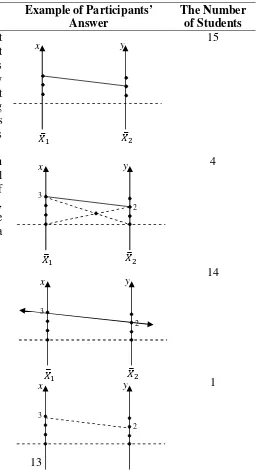
According to the analysis of students’ answer sheets and video recording, the hypothesis that participants proposed can be classified into several types, as can be seen in Table 2. :
Table 2. The Participants’ Hypothesis in Constructing EA2
No Participants’ Hypothesis Example of Participants’ Answer
14
No Participants’ Hypothesis Example of Participants’ Answer
The Number of Students
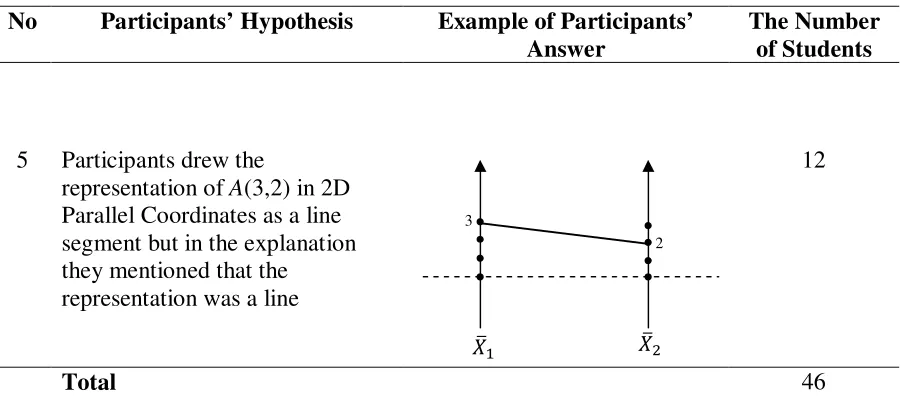
5 Participants drew the
representation of A(3,2) in 2D Parallel Coordinates as a line segment but in the explanation they mentioned that the
representation was a line
12
Total 46
*The number of participants are 45, but there is a participant proposed two hypotheses. G.1.2 The Result of Microanalysis from Group 2
The data that used in microanalysis of Group 2 were taken from the Video Transcript 1 In Task 1, the participants were asked to predict representation of an ordered pair of Real number (3,2) in Parallel Coordinates. In this case, all the participants already have a construct in Cartesian coordinate that the representation of an ordered pair of Real number is a point. Group 2 consists of 4 participants, two participants are from high category, and two others are from mediocre category based on the result of prior knowledge test.
Table 3. Table of RBC Analysis-1 of Group 2
Lines Subject Transcription Epistemic
Actions R B C 3 S[3] I think x one [she meant that -axes] is related to x and x two
[she meant that -axes] is related to y
D1
4 S[23] That is equivalent D1
5 S[3] Yup that’s right EA1
6 L Write your name in individual worksheet [...] then predict if we have a point, three points two in Cartesian coordinate,
6 L what is the representation of its point in Parallel Coordinates?
As I explained before that there are correspondence between the xy-Axes in Cartesian coordinate and x-one, x-two Axes in Parallel Coordinates
7 S[8] This coordinate is ...
8 S[3] Hmm...[looking at the problem]
9 S[23] I think it should be straight, like this [put her hands parallel in front of her face]
D2 D2 10 S[8] One, two, negative one, ... [looking at his worksheet]
11 S[23] But it is like this
12 S[3] Maybe it’s a line [Just guessing] D2
13 S[23] Do you think it’s a skew line?... D2
14 S[8] Look at this, it is also a point [cut off the discussion between S3 and S23 and showed his result]
3
15 16 S23 Yes, I think the point also like that [starring the answer
of S3]... But I guess that is a plane
D4
17 S3 How come it can be a plane? D4
Silent
As can be seen in Table 3, there were two participants in Group 2 who recognized the concept of “relation” between the axes as the components of Cartesian coordinate and Parallel Coordinates in order to construct EA1. It can be seen when they consolidated EA1 in order to construct EA2 and EB. The abstraction processes in constructing EA1 that took place in Group 2 started by recognizing the components of the 2D Cartesian coordinate then building -with by took possibility of a correspondence between x-axis and ̅ - axis, y-axis and ̅ (xy -axes in Cartesian coordinate and ̅ ̅ -axes).
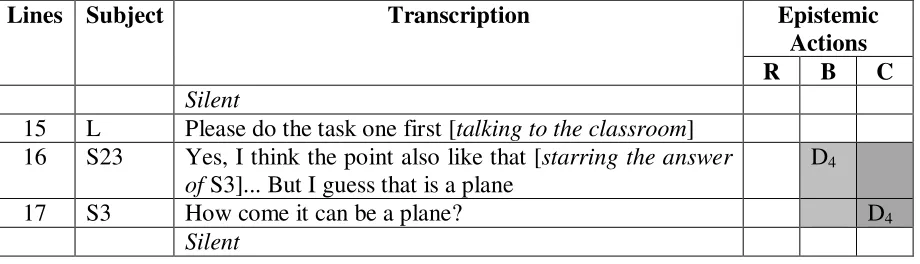
Referred to Table 3. lines 7 to 17, it can be inferred that S3 and S23 had recognized and built-with notions that the representation of an ordered pair of integer number (3,2) was not a point like in Cartesian coordinate, but it could be a line or plane in 2D Parallel Coordinates. Unfortunately, they are still struggling in finding the argumentation for justifying their thinking.
Table 4. Table of RBC Analysis-2 of Group 2
Lines Subject Transcription Epistemic Actions
R B C
23 S[8] Look at this axis, if this axis is mapped parallel, this axis will be drawn here, isn’t it? Oh that is the application of transformation [he meant that drawn the x-axis
D1 D5
24 S[3] Yup transformation? [as if shouting] D5 D5 25 SS He..he..he... [all the group members laugh]
26 S[3] So how?
27 S[8] Just drawn the x-axis here D6 D6
28 S[35] Hm,... I see
29 L Do not have to answer directly correct, please make a prediction first [The lecturer remained the Students]
30 S[23] Oh,... I see if it is rotated from this angle... [talking to herself]
D5 31 [all the group members working on their worksheet
did sketch using ruler]
32 L Could you explain how you can come to this answer? [Asking to S[8]]
33 S[8] There is a transformation from a ... Cartesian coordinate to Parallel Coordinates, in Cartesian coordinate the axes are perpendicular while in Parallel Coordinates, the axes are parallel, my presumption is that there is a movement of the point [tried to explain his idea]
D5 D6
16
Lines Subject Transcription Epistemic Actions
R B C
35 L That’s ok, so what is a representation of the point A in 2D Parallel Coordinates?
36 S[8] A line EA2
37 L A line or a line segment? EA2
38 S[3] Segment EA2
39 S[8] A line segment EA2
*Notes:
D1: Concepts of mapping, correspondence, and relation. D2: Concept of straight line in Cartesian coordinate.
D3: Concept of line segment, and intersection of lines in Cartesian coordinate. D4: Concept of plane in Cartesian coordinate.
D5: Concept of transformation, rotation, dilatation, translation, reflection. D6: Concept of xy-axes in Cartesian coordinate.
According to Table 3 there was a participant, S[8] who applied concept of rotation and translation of the x-axis of Cartesian coordinate in order to construct the ̅ -axis of 2D Parallel Coordinates (lines 30-34). His opinion triggered his friend S[3] to think that there was “a movement” as a part of building-with action in constructing EA2.
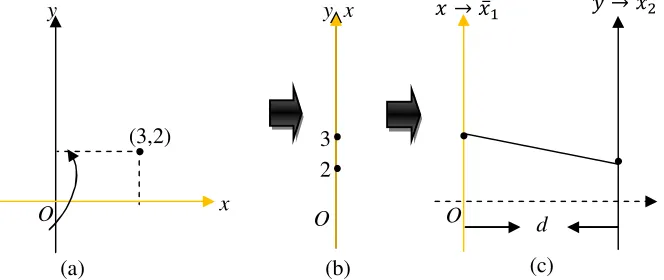
The process of recognizing and building-with action of the S[8] as illustrated in Figure 1 can be explained as follows: the first, in Figure 1(a) he did a rotation of x-axis 900 so the x -axis coincides with the y-axis as can be seen in Figure 1(b). In the second step he tried to translate the x-axis by a distance d then he came to Figure 1(c).
Figure 1. Ilustration of The Thinking Process of S[8]
Figure 2. Interpretation of The Process of Knowledge Construction in Constructing EA2 x
y
O
→ ̅
O
→ ̅
x y
O d
(a) (b) (c)
x y
O
→ ̅
O
→ ̅
x y
O d
(a) (b) (c)
(3,2)
17
This illustration explains how the role of D5 and D6 as his prior knowledge was used in the process of building-with. Unfortunately, he did not relate the concept of transformation motion to the concept of mapping and still could not differentiate which one is independent variable and dependent variable between x and ̅ ; y and ̅ .
Referred to the concept of D6, the x-axis represents the independent variable while the y-axis represents the independent variable, which is dependent on the value of x in a linear function. Figure 2 represents how the thinking process resulted when the concept of mapping applied correctly in detail to achieve the construction of EA2.
G.1.2. Episode II: Constructing EB
Similar to the Episode I, in Episode II the analysis results will be described through a backward flow, from the results of the classroom discussion into specific group discussion. In Episode II participants were asked to work on worksheet 2 in a group, not individually.
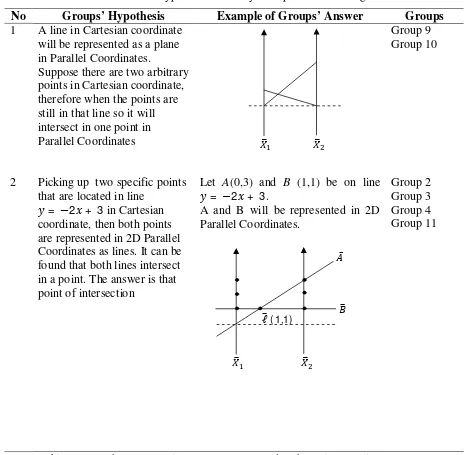
In general, there are only three types of answer related to worksheet 2 when the participants were asked to represent ℓ ≡ = −2 + 3 in 2D Parallel Coordinates.
Table 5. The Hypothesis of Every Group in Constructing EB
No Groups’ Hypothesis Example of Groups’ Answer Groups 1 A line in Cartesian coordinate
will be represented as a plane in Parallel Coordinates.
Suppose there are two arbitrary points in Cartesian coordinate, therefore when the points are still in that line so it will intersect in one point in Parallel Coordinates
Group 9 Group 10
2 Picking up two specific points that are located in line
= −2 + 3 in Cartesian coordinate, then both points are represented in 2D Parallel Coordinates as lines. It can be found that both lines intersect in a point. The answer is that point of intersection
Let A(0,3) and B (1,1) be on line = −2 + 3.
A and B will be represented in 2D Parallel Coordinates.
Group 2 Group 3 Group 4 Group 11
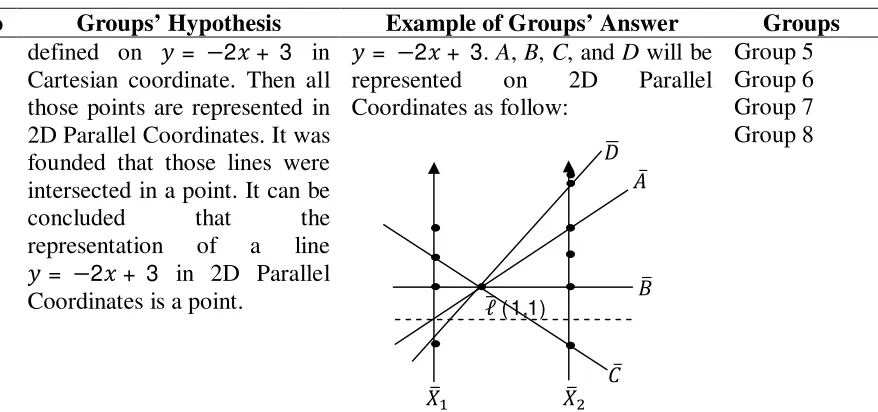
3 Taking more than two points Let A, B, C and D be points on line Group 1
̅
18
No Groups’ Hypothesis Example of Groups’ Answer Groups defined on = −2 + 3 in
The following sections will explain how the microanalysis in group context took place when they construct the EB.
G.1.3. The Result of Microanalysis from Group 2
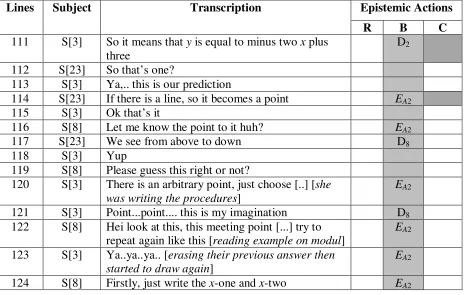
The result of microanalysis of Group 2, can give information on when and how S[3] come to the notion of transformation from 2D Cartesian coordinate to 3D Cartesian coordinate in the process of constructing EB.
Table 6. Table of RBC Analysis-1 of Group 2
Lines Subject Transcription Epistemic Actions
19
Lines Subject Transcription Epistemic Actions
R B C
111 S[3] So it means that y is equal to minus two x plus three
D2 112 S[23] So that’s one?
113 S[3] Ya,.. this is our prediction
114 S[23] If there is a line, so it becomes a point EA2 115 S[3] Ok that’s it
116 S[8] Let me know the point to it huh? EA2
117 S[23] We see from above to down D8
118 S[3] Yup
119 S[8] Please guess this right or not?
120 S[3] There is an arbitrary point, just choose [..] [she was writing the procedures]
EA2
121 S[3] Point...point.... this is my imagination D8 122 S[8] Hei look at this, this meeting point [...] try to
repeat again like this [reading example on modul]
EA2
123 S[3] Ya..ya..ya.. [erasing their previous answer then started to draw again]
EA2
124 S[8] Firstly, just write the x-one and x-two EA2
From Table 6, it can be identified that S[3] was very dominant in the process of building-with in group 2, and relied on her prior knowledge about D6, D8, as well as consolidating EA1 and EA2. Based on Hershkowitz, Tabach and Dreyfus (2017), it can be said that S[3] is the knowledge agent while the other participants who passive called as follower. Based on their worksheet, they used the same procedure with another group as resumed in Table 4.7 number 2, but in terms of the explanation of their process in building-with action is very different. This case leads the researcher to review the study did by Skordulis, et al (2008). They stated that Cartesian coordinate system becomes an obstacle for college students to learn concept of dimensions epistemologically and didactically.
As can be seen in this case that S[3] assumed that she was working on 3D, she ignored the variables involved in the context. However, from the perspective of analytic geometry, concept of dimension is expressed by the number of independent variables used to describe an object. She did not realize that there were only two variables involved in that situation.
From the point of view regarding how the group reached a shared knowledge, the interactions that took place in group two was dominated by three participants, one participant, S[35], was passive during the building-with action, while S[8] and S[23] were strongly influenced by the ideas expressed by S[3]. It can also be seen that only S[8] could influence S[3]’s thinking.
G.1.4. Episode III: Constructing EC
In this episode, participants were asked to generalize the representation of linear function = + c with m ≠ 1 (EC1) and the representation of linear function = + c with m = 1 (EC2) in 2D Parallel Coordinates.
G.1.5. Constructing EC1
20
every linear function graphs with m ≠ 1 is a point on 2D Parallel Coordinates. Based on the analysis of group worksheet, there are four types of answers from 11 groups.
In this episode, the construction process of EC1 was helped by lecturer through the scaffolding in the learning process and through the module. This can be traced from the transcription of classroom discussion that is translated from video transcript-2 from lines 52 – 59 and lines 68 – 88 below:
Lines Speakers Conversations
52 L “Ok let we discuss together, who want to propose your answer first?”
53 S[3] “We already got ma’am, but only the coordinate of x”
54 L “ ok do you got?”
55 S[3] “ ehm,... minus d divided by p-minus-one − ”
56 L “Ok, d divided by p-minus-one” [writing the answer on whiteboard]
57 L “Is there anything else?” 58 S[3] “enough Ma’am”
After the lecturer asked the class, then she asked the representative of group 7 to write their answer on whiteboard, the lecturer help explaining the answer as can be seen in this transcription:
Lines Speakers Conversations
68 L “Ok,now please pay attention to the answer from group 7”
69 SS “yes ma’am”
70 L “so the answer from group 7 is that the point ℓ -bar is h divided by one-minus-p comma q divided
by one-minus-p , , this answer is similar
with the answer in the module, do you agree?...” 71 SS “d divided by one-minus-m comma b divided by
one-minus-m , ”
72 L “..comma,. now how we can get this?” now please pay attention to this, we took two points A and
B, is that true?... then here is the intersection of the point A and point B, if the value of q
divided by p is less than q < , this is the
first case and the second case is when the value
of q divided by p is greater than q > for
example if p is a fraction, this value will be greater than q, so the intersection will be ...?”
73 SS “on above”
21
Lines Speakers Conversations
Because we already made an agreement that this is the reference line (x-one), so the zero point is over here isn’t? Then what is from here to here?” 75 SS “h...”
76 L “ So it true? How about to the above?” 77 SS “q...”
78 L “so what is coordinate of this point? Then can you find the equation of the line? ”
79 SS “Yes it can”
80 L “so what is the equation?”
81 SS “y is equal to qx divided by h”
82 L “This y is equal to qx divided by h. Is that true? Then the next is determining the equation of line B which passes through minus-q point zero and h point zero, minus-q-divided-by-p point zero, what is the equation?”... ok h point zero because the distance from here to here is...” 83 SS “h...”
84 L “is this a point? Ok,.. h point zero, so we can get the equation using formula y minus y–one is equal to mx minus x-one ( − = ( − ). Then we can get the value of m using formula y-two minus
y-one divided by x-two minus x-one , finally
we can get the equation of both lines. Are these lines intersecting?”
85 SS “yes...”
86 L “Then we find the intersection point using both equations, we get x is equal to h divided by
one-minus-p = and y is equal to q divided by
one-minus-p = . So if I have an arbitrary
line, for example y is, equal to two-x plus five ( = 2 + 5), then what is the ℓ-bar if d is equal to h?”
87 SS “h divided by two,... five, one-minus-two”
88 L “So,.. it equals to minus h,.... that is it! and this is a point. So for any line, we can always find the point using this formula, it is very simple formula isn’t?”
Based on the classroom observation during Geometry Analytic lecture, participants often found difficulties in doing generalization, so the researcher provided two types of scaffolding for helping them generalize the concept of representation of line ℓ ≡ = +
, ≠ 1 in 2D Parallel Coordinates. The first scaffolding was module. Module in this study was considered as scaffolding which was concerned with the preparation of the teaching-learning activities that called as sort of assistance “structuring situations” when referring to the choice of puzzles and selection of appropriate tools and materials (Rogoff, 1990). As can be identified in from the above transcription in line 70 how the lecturer used the module to confirm participants’ answer.
22
The type of “pedagogical means” in scaffolding needs spontaneous responses from the lecturer to the learner’s performance during the teaching-learning activity; in this case, it can be identified when lecturer discussed the participants’ answer from group 7. In addition, Wood et al (1976) stated that there are six functions of the tutor/teacher/lecturer in scaffolding, each of which can be considered as a different form of pedagogical assistance: enlisting the learner's adherence to the requirements of the task, reducing the degrees of freedom, maintaining the learner's direction in pursuit of a particular objective, marking critical features of a task, controlling the learner's frustration and demonstrating solutions to a task.
The other different forms of assistance within the realm of scaffolding that identified appearing from Appendix B-5 in this study are: hinting (Bliss, Askew, and Macrae, 1996); explaining (Anghileri, 2002); inviting learners to participate (Hogan and Pressley, 1997); questioning (Graesser et al., 1995); describing the problem (McArthur, Stasz, and Zmuidzinas, 1990); clarification of direction, purpose and expectation (McKenzie, 1999).
Due to the role of scaffolding in the construction process of EC1 that indicated has a
significant effect for almost all groups, this section will only present one of the examples of microanalysis result from group 9 which is identified clearly how the abstraction process took place when they used the example on the module to generalize the EC.
G.1.6. Constructing EC2
The construction process of EC2 is guided by a task in the Lesson Activity 3 that the participants were asked to predict the duality of a line ℓ ≡ = + 1 with d = 3. After predicting a case of a duality of a line with m = 1, then the participants to explore the generalization of duality of lines with m = 1. Based on the analysis of groups’ worksheet, there are three types of answers from 11 groups.
The lecturer explained the concept of “ideal point” as a part of introduction, before the participants worked on LessonActivity 3. The reason behind this action was as anticipation for resolving the cognitive conflict that would be faced by the participants when they finally succeeded in finding the representation of a line with m = 1.
It can be stated that the process of constructing EC2 was not independently done by the participants in group context. It was led by the lecturer in classroom context then followed by the participants in group context when they were asked to do Lesson Activity 3. How the lecturer guided the construction process of EC2 can be traced in transcription below:
Lines Speakers Conversations
17 L “Last week, we tried to find the representation of a line y=mx+b with m≠1. Then what happens if
m=1? Who wants to try to answer it?”
18 L “Is there anyone here who wants to predict the answer what happens if m = 1?”
19 SS “Parallel...”
20 L “How the point will be?” 21 SS “The point is,....”
22 L “The point is undefined. Why?” 23 SS “Because....”
24 L “Ok Nur, you can try it”
25 S[25] “Because the line x = y (the example on the module) is a line in Cartesian coordinate, but when it is represented on Parallel Coordinates this line become parallel lines”
23 line in Cartesian coordinate will be presented as a point in Parallel Coordinates. But then we found that there is a line with m = 1 that has different representation in Parallel Coordinates” 33 L “So how?”
34 L “the fact is that we still can make a generalization of duality concept using the term of “ideal point” quadratic equation, then you found imaginary roots which contain √-1”
with m =1, then the duality is an ideal point” 46 L “Using the concept of an ideal point, so the
24
were not have enough prior knowledge to solve the conflict, based on this background the lecturer provided cue to introduce the concept of ideal point. Due to the abstraction process did not take place in group context, but it guided directly by the lecturer in classroom, so researcher decided not to analyze the abstraction process of EC2.
Even though that the lecturer already explained and guided the participants to construct EC2 by introducing the term of “ideal point” as the duality of straight line with slope 1, but there was a group which having answer that the representation of a line ℓ ≡ = + 1 was two parallel lines. It means that not all the participants have constructed the EC2 completely. This phenomenon can be traced also in the process of constructing ED3, when the participants
solve problem number 3 in LessonActivity 4. G.1.7. Episode IV: Constructing ED
Knowledge element of ED consists of two sub-knowledge elements. First, ED1 that refers
to the representation of an intersection point between two lines in Parallel Coordinates, and second ED2 that refers to the representation on two parallel lines in Parallel Coordinates. There were two tasks on Lesson Activity 4 that need to be executed by all groups to construct ED1 and ED2.
G.1.8. Constructing ED1
The participants were guided by task number 1 in Lesson Activity 4, where they need to predict the representation of an intersection point between ℓ ≡ 4 − −4 and ℊ ≡ + − 1 in Parallel Coordinates with d = 3. There are four types of answers from all groups in constructing ED1.
Based on the analysis result of groups answers, there were two types of construction process in order to construct the representation of intersection point in 2D Parallel Coordinates. Firstly, the participants worked in Cartesian coordinate to find the intersection point, then that point was represented in 2D Parallel Coordinates. Secondly, the participants worked directly in 2D Parallel Coordinates by representing the ℓ and ℊthen find the line that passes through both “points”.
An interesting finding is that there is a cognitive conflict appeared during the classroom discussion. There were participants who claimed that the representation of an intersection point is a segment while the others claimed that it is a line. This condition happened because they were not used to be aware to the differences between a line segment and a line. It can be traced from previous cases when they were asked to proved that the representation of an ordered pair (x,y) with x, y∈ ℝ in 2D Parallel Coordinates is “a line” not “a line segment”.
The role of the lecturer during the classroom construction process of ED1is dominated
by doing clarification as part of scaffolding. The whole classroom construction process of ED1
can be traced from transcription below:
Lines Speakers Conversations
15 L “Let’s discuss worksheet 4 number 1. Ok what is the answer here?” [there was a participant who writes the answer in the white board]
16 S “line”
17 L “Which one? This one?... ok ” “Does anyone of you have different answer?”
18 SS “Yes,... we”
19 L “Which group that have different answer?”
20 L “Okay I give opportunity for the group which haven’t present their answer”
21 S “the most important thing is the answer should be different, regardless it is right or wrong”
25
Lines Speakers Conversations
then we find the intersection point. We got zero point one, then we represented the point in Parallel Coordinates”
23 SS “yeah,... e are the same”
24 L “Are you having the same answer?” 25 SS “Yes Ma’am”
26 L “Is there anyone who still have different answer?”
27 S “I think that group who has different answer” {the one who presents their answer in white board]
28 L “Pay attention please, it is very interesting. Group 3 said that the representation is a segment. My question is: do you think l-bar and g-bar are defined on the extended of this line [line passes through (0,1)]?
29 SS “yes..” [some participants asked, some other not] 30 L “It defined here?”
31 SS “yes,..” [more participants convincing answer yes]
32 L “Are you sure?” [challenged the participants] 33 SS “Sure” [most students very confident answer] 34 S “Not”[one of the participants was still not sure] 35 L “are you sure?” “what makes you sure?”
36 S “Because there are the same line with the line passes through (0,1)”
37 L “Both are passes through (0,1). Then which one the answer? this is over here, the l-bar ok? And this one is g-bar?”
38 SS “Yes Ma’am”
39 L “Then where is the intersection point? Because the intersection of two lines in Cartesian coordinate is “a point” so the representation of that point is a line that passes through l-bar and g-bar . we have to remember that the duality of a point is a line”[lecturer gave explanations]
From the transcription above, it can be seen that the lecturer tried to find as many as possible different answers from all groups. This is important in term of abstraction process. It can be used to trace how the construction ED1 of taken place, and what are the knowledge
elements that involve in the process.
In line 35 – 36 it can be detected when a participant with a high confident gave her argument to convince the whole class and herself that when the segment passes through ℓ and ℊ is extended, it will pass through (0,1) in 2D Parallel Coordinates.
G.1.9. Constructing ED2
The participants were guided by task number 2 in Lesson Activity 4, where they need to predict the representation of line which is parallel to ℓ ≡ 4 − −4 and passes through (0, -1) in 2D Parallel Coordinates with d = 3. From 11 groups there are 5 different answers for the second case.
Looking into the resume types of answers in second case, the construction process of ED2 was varied. The variation obtained in this process was influenced by the consolidating
26
formula of point ↔ line duality , as knowledge that they were constructed before ED2. On the other hand, Group 6 was identified failed in representing an ordered pair in 2D
Parallel Coordinates correctly. It was the indication that the construction of ED2 is not finish
yet for this Group or this Group need additional time to do building-with action. While the other groups were used the knowledge elements that were already established constructed in their mind such as the properties of two parallel lines in Cartesian coordinate.
There were two groups that using geometric approach in constructing ED2. Group 7 and
Group 9 did experiment by sketching a line passes through ℓ and parallel to the axes ̅ and ̅ . They were surprised when they found that this line intersect (0,-1) at . Unfortunately, they were not connect this finding with the formula , that ℓ and are actually having similar axis and different ordinate.
The lecturer used the moment when they explained the answer in classroom discussion to remain the participants the relationship between the geometric approach that they used with the formula , as can be traced in trancription below (Lines 42 – 82):
Lines Speakers Conversations
42 L “ Now we come to number 2. Let’s pay attention to the answer of Group 1 here (on whiteboard). Group 1, firstly tried to find the equation of a line which is parallel to ℓ and passes through (0, -1). Is this the equation?”
So, if I have a line = + 1 with ≠1 we can
used the formula of , so that we got the
point 4, it’s here.
43 SS “Yeees”
44 L “Is there any group who have different answer?” 45 SS “Yes...” (there were many students who have
different answer with Group 2) 46 S “my answer is different Ma’am” 47 L “How about Group 2?”
48 S “we are different Ma’am” [ Then a participant come to the whiteboard to share her answer]
49 S “From this equation we can get points (0,1) and (-4,0) then we found ℓ as the point. Because the line that we search is a parallel line so we used properties m1 = m2. So, we used this equation” 50 S “Which one?”
51 S “This one. − = ( − ) then we will get the points (0,-1) and (4,0”
52 SS “Yes,... same”
53 L “Ok many of you have the same answer ya. Now my question is,... or is there anyone of you want to ask?”
54 S[22] “yes Ma’am, I want to ask?” 55 L “Ok, what is your question Nur?”
56 S[22] “The answer of our group is different with both answers. From the ℓ we sketch a line passes
through that point 4, , is that line is parallel to the axes?”