SENSING THE URBAN INTERIOR
VALERIE MACESchool of Design, London College of Communication, University of the Arts London [email protected]
ABSTRACT
Following the principle of “spatial inversion” (Attiwill, 2011), whereby spaces between buildings habitually referred to as exteriors become interiors, this paper presents the background research, methodology and key findings from a case study framed as a perceptual documentation of an urban interior, the More London Estate, a riverside business development in London, England. The location sits at the boundaries between inside and outside, private and public, enclosed and open space. This distinctive position and promise of interiority makes it an ideal site of enquiry. The objective of the research is to uncover connections between the way we feel and our sense of belonging by investigating the correlation between the site’s embodied atmosphere and its perceptual affect on the body. The methodology is inspired by Peter Zumthor’s (2006) writings on atmospheres, James J. Gibson’s (1966, 1986) studies of ecology and perceptual systems, and Joy Monice Malnar and Frank Vodvarka’s (2004) work on sensory design. Key findings reveal a duality in existing perceptual narratives, and the recognition of the way the urban interior resonates with our senses provides a framework for reflection and an incentive towards sensory transformations.
Keywords: perceptions, atmosphere, senses, interior, environment
INTRODUCTION
London Bridge, located at the heart of the city’s ancient interior, on the south bank of the River Thames, is a bustling, vibrant urban environment with a rich interplay of sensory diversity. It is stimulating but also frantic, even chaotic at times, when the momentum of people negotiating each other on the narrow pavements reaches its peak. It is noisy and everything but the buildings is in constant motion. Space is limited so the old and the new coexist in confined conditions. At 310 metres high the London Bridge Tower, also known as the Shard (http://www.londonbridgequarter.com/the-shard/overview), dominates the crowded London Bridge train station and dwarfs its surroundings, including the historical landmark of Southwark Cathedral and the animated Borough Market. Peaceful and secluded public spaces are a rarity, personal space at a premium.
close by. The site however includes generous public spaces, which, framed by the height of the buildings, offer an opportunity for a welcome respite from the intensity of the surrounding activity. Like interiors, their precise volumes provide a sense of enclosure. On that account and through spatial inversion, the spaces between buildings become the urban interior and the focus of this study. “Techniques of inflecting the urban fabric where exteriors become interiors through spatial inversion are readily grasped as an urban interior” (Attiwill, 2011, p. 15).
Figure 1. The dense and vibrant Borough High Street in London Bridge. Source: Valerie Mace
CONTEXT OF THE STUDY
flourish in their own terms” (Caan, 2011, p. 78). Transposed into the context of this urban interior, the word “experience” relates to sensory perceptions and atmosphere, while the phrase “flourish in their own terms” indicates a correspondence with our sense of belonging. So an empirical documentation of the site’s embodied atmosphere and sensory experiences is required to reveal and recognise their influence on people’s perceptions, and the emotional affect that fosters the sense of belonging we need to feel to fully engage with our surroundings.
A Sense of Belonging
What constitutes a sense of belonging? The Collins Oxford Dictionary defines the English verb “to belong” as “to be bound (to) by ties of affection, allegiance” and “sense” as “a mental perception or awareness.” So here, sensing is not simply positioned as an external body sensation, for example when we sense the warmth of the sun on our skin, but as an internal manifestation that occurs as a result of perception andconsciousness. This implies that a sense of belonging exists in the interiority of our mental space and so the way we feel about a space determines our relationship with it; whether for example, we feel welcome or experience attachment. We also need to consider our ability to stretch intimate personal space into our immediate surroundings and conversely “how the world of objects - including other bodies - enters the body of the subject and remakes its interior entities” (Cohen, 2009, p. 6). Moreover, personal space is intrinsically portable so our sense of belonging is also activated as we determine our location within the physical world.
The notion of personal space is one that locates an individual in the physical world. Its significance lies mainly in how it marks out a personal territory, enabling the individual to develop a sense of identity and engage in the rituals of communication and recognition (Madanipour, 2003, p. 34),
and so it seems that a sense of belonging is inherently connected to a sense of place.
The Sensing Body
Cartesian rationalism, Merleau-Ponty presents human subjectivity, in even its most abstract and ethereal forms, as rooted in the body” (Cohen, 2009, p. 16). Meleau-Ponty also advocates the construction of knowledge that serves to decode the qualitative nature of the “perceived object” (Merleau-Ponty, 1945, 2012 ed., p. 53), in this case the urban interior, and thus understand its perceptual affect on our sense of self. So the interest of this study lies in developing techniques that contribute to such knowledge through the phenomenological documentation of the More London Estate. The incentive is to establish how this unique urban interior resonates with our senses, and determine our position within it. As Iain Borden, Professor of Architecture and Urban Culture at the Bartlett School of Architecture, University College London, underlined at the 2011 Royal Academy Forum “Spaces of Memory”, “we make space and space makes us” (Bartlett UCL, 2011, 1:15).
The Environment
Consequently, in order to uncover the perceptual value of the More London urban interior, we need to explore embodied sensory stimuli and their agency on our perceived experiences as we move through the environment.
Figure 2. The More London Estate site drawing showing the mass of the buildings and furniture in grey and the void of the interior in white.
Source: Valerie Mace
CASE STUDY
used in this study were inspired from preceding work in this area, and revised and adapted to meet the specifics of this project.
The Perceived Atmosphere
The study begins by establishing the key principles guiding the exploration and investigation of the More London Estate interior. In his book “Atmospheres” Peter Zumthor (2006) offers an account of what concerns him the most when he tries “to generate a certain atmosphere” (Zumthor, 2006, p. 21) in his buildings.
We perceive atmosphere through our emotional sensibility - a form of perception that works incredibly quickly, and which we humans evidently need to help us survive. We are capable of immediate appreciation, of a spontaneous emotional response, of rejecting things in a flash. (Zumthor, 2006, p. 13)
So atmosphere is determined by a fluid and fleeting choreography of perceptual and emotional relationships, and the study is based on Zumthor’s (2006) proposal for nine guiding principles that underpin this choreography: the architectural presence of the environment, materials and their relationships, the soundscape, actual and perceived temperature, objects in space, the way architecture involves movement and temporality, the duality of interior-exterior thresholds and transitions, the scale and distances perceived from the body as well as details designed for the body, and finally, the way the light falls with its corresponding shadows.
Interior Architecture and Spatial Order
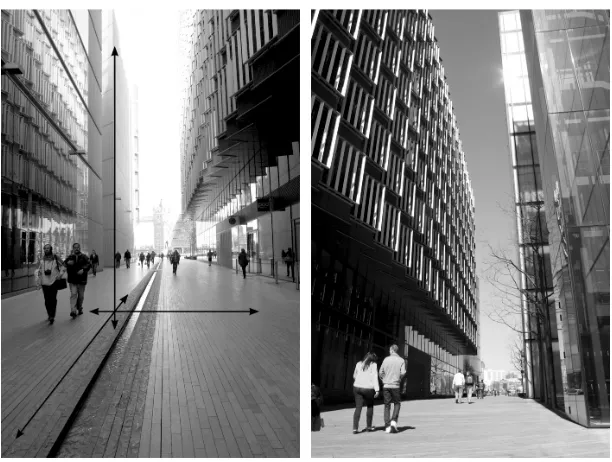
The More London Estate however isn’t styled on Renaissance architecture. It is uncompromisingly contemporary, with a profusion of glass complemented by efficient hard surfaces, sharp edges and cool tones. Yet, despite the extensive use of glass, a transparent material, the opacity created by reflections along with the mass of the adjacent metal cladding give substances a perceived solidity that reinforces the “persistence of the geometrical layout” (Gibson, 1986, p. 13). So even though the architectural display is visually striking and the interior includes recessed areas, designed to psychologically reduce the cavernous sensation created by the intense verticality of the enclosing walls, the architectural presence of the environment, the imposing scale, the rigidity of the objects, inexorably exert their dominant force over the human body.
Figure 3. The dominant force of the interior. Source: Valerie Mace
Furthermore, the documentation reveals another notable feature. This is an environment that lacks temporality. The desire for perfection is controlled to such an extent that substances and surfaces are unyielding to human occupation. “The structures acting as enclosing agents are employed to establish the volumetrics…, resulting in a strongly articulated statement, defying alteration or addition” (Fench, 1978, p. 76). Materials don’t retain visible signs of weathering and traces of the day’s activities are erased overnight.
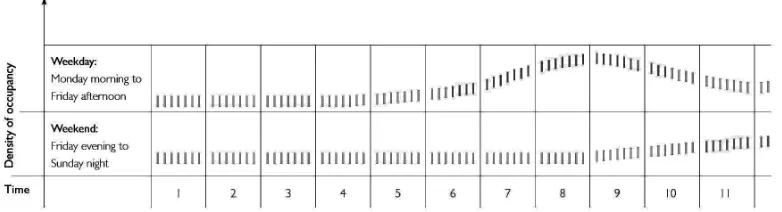
predetermined and absolute, with long uninterrupted distances and interior proportions that dominate the scale of the body. The spatial order, with furniture divided into small territories, is governed by controlled codes of behaviour reinforced by powerful directional forces that encourage people to keep moving or only remain within the site for a limited amount of time. As a result, occupancy is mostly transient and fleeting, movement is contrived with little opportunity for meandering and discovery. Peaks in density and velocity are identified when mapped into a motion sequencer, a diagram used to visualise empirical data recordings of the density of occupancy against time. It highlights patterns of highs and lows linked to office hours, which further emphasise the singularity of the environment.
Figure 4. Partial view of the Motion Sequencer, showing the density of occupancy across weekdays and weekends from 1am to 11am. The complete diagram shows the density of
occupancy across a typical 24 hour period. Source: Valerie Mace
Sensory Mapping
back into the real world as transformed mental images. To evaluate this process they propose an interpretation of architecture as a story, with a beginning, middle and end. The sensory experience chart designed by Marina Panos in 2001 (Malnar and Vodvarka, 2004, p. 281) and Gibson’s classification of perceptual systems (Gibson, 1966, pp. 49-58) provide the framework for the recording of perceptual and sensory experiences that unfold while moving through the urban interior.
Figure 5. Plan layout of the More London Estate urban rooms with the footprint of the buildings in light grey and the urban interior in dark grey.
Source: Valerie Mace
Language is used to document sensory information across each urban room while sound and film recordings complement the resulting perceptual narrative. The sensory journey forces the investigator into a position of acute awareness and its purpose is to record impressions as they occur: across time, human interaction, the visual, auditory, smell-taste, basic-orienting and haptic systems, kinesthesia, temperature and finally, a description of the overall level of stimuli. The information is thenmapped across a drawing that illustrates the topography of the sensory systems within the entire site and a sensory flow diagram where each room is represented by a curve aligned to reveal the levels of intensity of their respective sensory characteristics: visual, sound, touch, temperature, odour, kinesthesia, orienting.
site, it also highlights essential similarities and differences within it, as well as perceptions of interiority. Rooms 2, 3 and 4 are identified as the core of the interior, differentiated from rooms 1 and 5 by their distinct sensory characteristics, such as the singularity of their soundscape, which contrasts sharply with the surrounding area. “Acoustic ecology researcher R. Murray Schafer coined the term soundscape in the 1970s to describe the total sounding environment, which consists of keynote sounds, sound signals and soundmarks” (Knueppel, 2012, p.118).
Figure 6. Mapping drawing that illustrates the topography of the sensory systems in the urban interior
Source: Valerie Mace
engines coming out of the station nearby. The mass of the buildings however protects the core of the interior and provides a more secluded experience.The third component of the soundscape, the soundmarks, represent the features of an area that determine the location. In London Bridge it would be the sound of the bells of Southwark Cathedral, but the sheltered and acoustically undisturbed environment of the More London Estate remains free of soundmarks.
Figure 7. Sensory flow, mapping sensory characteristics across each urban room. An adaptation of the sensory slider created by Malnar and Vodvarka (2004, p. 248).
Source: Valerie Mace
Furthermore, despite the programmatic of the interior architecture and spatial order, the sensory mapping of the site reveals a unique blend of visual poetics that permeate the urban interior. In rooms 2 and 3 especially the extensive use of glass serves as protagonist and canvas for a dynamic spectacle of reflections: the fragmented visions of surrounding landmarks - Tower Bridge, the Tower of London, City Hall - vistas reflected into the interior as framed images; the rhythmic ballet of distorted forms and patterns that flood the interior remodeled by changes in surfaces as people move through it; and the contemplative slow moving clouds reflected across the windows of the upper levels of the buildings.
The Perceptual Voice of the Interior
Figure 8. Translation of the More London Estate urban interior atmospheric conditions into a syntax that expresses the qualitative nature of the embodied atmosphere.
Source: Valerie Mace
The study shows that the urban interior is designed for efficiency, resulting in a comfortless atmosphere where the human body is dominated and where positive sensory stimulation is primarily visual. These conditions are not known to be conducive to the kind of sensory perceptions and atmosphere that give rise to a sense of place and sense of belonging. In order to feel a connection with the urban interior people need to be able “to mark out a personal territory, enabling the individual to develop a sense of identity and engage in the rituals of communication and recognition” (Madanipour, 2003, p. 34). So it becomes clear that the design of the site and its corresponding atmosphere create a situation where the narrative is being forced upon people, who then become constrained to predetermined types of behaviour. The urban interior gives us no choice but to enter its symbolic order as it penetrates our intimate personal space.
CONCLUSION
The complexity and multiplicity of sensory experiences and perceptual affect, make them a challenging but also exciting subject to explore. In the urban interior, perceptions are shaped by the gradual articulation of meanings as we move through the environment to feel through all our senses and experiences, and construct our perceptual knowledge. Perceptions are not only spatial but also temporal and define the way we feel about our surroundings, whether a space becomes a place, whether we feel a sense of belonging. So this study proposes techniques that facilitate the perceptual documentation of the environment but doesn’t advocate a single fixed model. The techniques remain fluid and flexible but they are needed. “Unless properly guided by diagnostic techniques the outcome will tend to lack both objectivity and depth of thought” (Potter, 1969, 2002 ed., p. 47).
The study follows Peter Zumthor’s (2006) guiding principles on atmospheres and James J. Gibson’s (1966) classification of perceptual systems. It begins with a documentation of the site's interior architecture and spatial order. The empirical documentation of participation and occupancy identifies people’s experiences and responses to the site through their actions. The investigator is then ready to embark on a sensory journey, where the urban interior, structured as a series of individual rooms, is documented as an experience through sensory narratives. The findings are then mapped across drawings that highlight the fundamentals of its perceptual topography and discreet components. Additionally, the information gathered is synthesised across a sensory flow diagram, a visual reference that maps the intensity of sensory perceptions across each urban room. This knowledge is then translated into language, using words to assign qualitative symbols to the relationship between the body and the environment. This language recognises the intangible and provides the clarity required for reflection to reveal the need for making sensory adjustments, while also celebrating existing poetics. The diagnosis and corresponding translation provide the means to introduce desired atmospheric qualities to stimulate individual and shared perceptual narratives, thus fostering the sense of belonging we need to fully engage with our surroundings.
REFERENCES
Attiwill, S. (2011). Urban and Interior: techniques for an urban interiorist. In R. U. Hinkel, (Ed.), Urban Interior - informal explorations, interventions and occupations (pp. 12-24). School of Architecture and Desing, RMIT University, Melbourne, Australia. Baunach: Spurbuchverlag.
Bartlett UCL. (2012, October 26). Iain Borden at the Royal Academy in London 2011 [Video file]. Retrieved from
https://www.youtube.com/watch?v=b8w9jCHUnDE
Retrieved from http://www.bbc.co.uk/programmes/p003k9h0
Caan, S. (2011). Rethinking Design and Interiors. Human beings in the Built Environment. London: Laurence King Publishing.
Cohen, W. A. (2009). Embodied. Victorian Literature and the Senses. Minneapolis: University of Minnesota Press.
Fench, J. S. (1978). Urban Space. A brief history of the city square. Dubuque: Kendall Hunt Publishing Company.
Fosters + Partners. (n.d.) Facts + Figures. Retrieved from
http://www.fosterandpartners.com/projects/more-london-masterplan/
Gibson, J. J. (1966). The Senses Considered as Perceptual Systems. Cornell University Westport. Boston: Houghton Mifflin Company.
Gibson, J. J. (1986). The Ecological Approach to Visual Perception. Hove: Psychology Press.
Giedion, S. (1941, 2008 ed.) space, time & architecture. the growth of a new tradition. Cambridge, MA: Harvard University Press.
Ingold, T. (2000). The perception of the environment. Essays on livelihood, dwelling and skill. New York: Routledge.
Knueppel, G. (2012). Spatial Fragments,Visual Distortions and Processes of Sense Making. IDEA Journal 2012, Writing/Drawing: Negotiating the Perils and Pleasures of Interiority, 112-121.
Lefebvre, H. (1974, 1991 ed.). The Production of Space. Oxford: Blackwell Publishing. London Bridge Quarter. (n.d.). A Symbol for London. Retrieved from
http://www.londonbridgequarter.com/the-shard/overview
Madanipour, A. (2003). Public and Private Spaces in the City. New York: Routledge. Malnar, J. M. & Vodvarka, F. (2004). Sensory Design. Minneapolis: University of
Minnesota Press.
Merleau-Ponty, M. (1945, 2012 ed.). Phenomenology of Perceptions. New York: Routledge.
Potter, N. (1969, 2002 ed.). What is a designer : things.places.messages. London: Hyphen Press.
Royal Academy of Arts. (2014, March 29). Sensing Architecture. A symposium held in conjunction with Sensing Spaces: Architecture Reimagined. Symposium conducted at the Royal Academy of Arts, London, UK. Retrieved from
http://static.royalacademy.org.uk/files/sensing-architecture-programme-with-abstracts-1783.pdf