Siri Latihan Pembangunan Staf
MENNDEPANI TEKANAN KERJA &
AGRESIF MARAH
DEFINISI TEKANAN DAN PUNCA TEKANAN
DEFINISI TEKANAN
Sebarang jenis desakan yang memberi kesan kepada kehidupan seharian seseorang
Kesan daripada desakan ini mungkin baik ataupun tidak baik bergantung kepada faktor-faktor tindak balas kepada faktor-faktor-faktor-faktor tekanan
Tiga elemen menyebabkan tekanan dalam kehidupan individu:
1. Faktor tekanan
2. Pembentukan tingkahlaku dan emosi orang yang mengalami
3. Reaksi individu dan makna hubungannya dengan faktor tekanan
TEKANAN DAN PUNCA TEKANAN DI TEMPAT KERJA
1. Faktor Luaran Diri
Faktor organisasi ataupun majikan
1.1 Tahap birokrasi
1.2. Perubahan dalam organisasi
- perubahan struktur kerja
- perlu menyesuaikan diri dengan perubahan ini
- ramai anggap, perubahan beri tekanan – keluar dari zon selesa
1.3. Teknologi tinggi
- perubahan cepat - gagal ikut perubahan
1.4. Industri perkhidmatan
- tanggungjawab kepada stake holder dan pelanggan - sasaran ditentukan
2. Faktor pekerjaan
Pekerjaan profesional yang mementingkan hubungan dan perkhidmatan sesama manusia seperti kedoktoran, pekerja social, pendidikan dan pekerjaan-pekerjaan
perkhidmatan yang melibatkan pelanggan.
Desakan memberi perkhidmatan sesuai dengan fungsi sesuatu pekerjaan. Kegagalan sistem sokongan seperti kerosakan sistem komputer beri tekanan. Antara faktor lain:
2.1. Jumlah kerja
- melebihi limitasi, beri tekanan
2.2 Pembuatan keputusan
- bimbang salah keputusan
- keputusan perlu dibuat dalam tempoh tertentu
2.3 Tarikh akhir
- keperluan menyiapkan kerja berdasarkan tarikh akhir
2.4 Kerjaya yang mempunyai matlamat kurang jelas
- hilang arah
- tiada masa depan
2.5 Salah pemadanan kerjaya
- tidak jelas minat
- kurang padanan dengan ciri diri
- diarah melaksana tugas bukan hakiki / bidang
3. Hubungan Interpersonal
Kebanyakan kerja melibatkan hubungan denga orang lain. Kemahiran menjalin hubungan interpersonal tidak boleh diabaikan dan selalu perlu dipertingkatkan. Masalah kepada individu dari tret personaliti introvert berbanding individu ekstrovert
3.1 Hubungan dengan superior
- tertakluk autoriti dan kuasa - tidak saling hormat menghormati
- kurang faham tanggungjawab antara satu sama lain - Teguran dan kritikan oleh suporior disalah erti
3.2 Hubungan dengan subordinate
- samar dari segi bidang kuasa dan cara mengamalkannya - kegagalan delegasi yang seimbang
- gagal percaya dengan kebolehan subordinate – gagal delelegasi - kerja sendiri, tidak dalam pasukan
3.3 Hubungan dengan rakan sekerja
- gagal tahu peranan sendiri - kurang saling mempercayai - persaingan
- penilaian prestasi
- curiga hubungan pekerja lain dengan ketua - curiga terhadap pilih kasih
3.4 Hubungan dengan keluarga dan rakan
- kurang asertif
- salah jangkaan peranan - salah jangkaan sumbangan
- perselisihan pendapat dan pandangan
4. Faktor Luar Kerja
4.1 Konflik antara tempat kerja dan rumah
4.2 Aktiviti peribadi individu – sihat dan tidak sihat 4.3 Aktiviti masyarakat – politik, sukan, perniagaan
Faktor Dalaman Diri
1. Kekecewaan 1.1 Kelewatan
- lambat capai matlamat kerjaya
- gagal penuhi harapan sendiri – lambat dapat anak
1.2. Kekurangan sumber
- ilmu pengetahuan - kemahiran
1.3 Kegagalan
1.4 Kehilangan
- hilang sesuatu dalam kehidupan – kematian atau putus hubungan - hilang peluang dalam kerjaya
1.5 Kesunyian
- masalah perhubungan
- kemahiran pergaulan terbatas
2. Jangkaan Terhadap Diri 2.1 Matlamat tidak realistik
- diluar kemampuan - cita-cita terlalu tinggi - tiada cita-cita / matlamat
2.2 Tidak kenal diri
- kemampuan
- tahap pengetahuan - perkara perlu diperbaiki
3. Pendekatan negatif dalam kehidupan 3.1 Tiada kemahiran hidup sihat
3.2 Tidak jaga kesihatan 3.3 pengurusan kewangan
RUJUKAN
Mohd Azhar Abd. Hamid (2004), EQ : Panduan Meningkatkan Kecerdasan Emosi, Kuala
Lumpur: PTS Profesional.
Coping Work Stress – Coping With Work Overload
1. Activity Logs - Identifying time-wasting activities
Activity logs are useful tools for doing this. They help you understand how you use your time, so that you can identify and eliminate time-wasting and unproductive habits. This gives you more time to do your work, increases your efficiency, and makes it more likely that you will be able to leave work on time and have good quality time to yourself to relax.
The first time you use an activity log, you may be shocked to see the amount of time that you waste! Memory is a very poor guide when it comes to this: It is too easy to forget time spent reading junk mail, browsing interesting but unhelpful web pages, talking to colleagues, making coffee, waiting for meetings, traveling, etc.
By keeping an Activity Log for a couple of weeks, you can identify the
unproductive time in your daily routine. By cutting this out, or by changing your habits, you can substantially increase your productivity. For example, if you are ruthless in your pruning of irrelevant emails and focused in your daily newsgathering, you can make substantial time available. If you take a train rather than drive, you can open up good quality, undisturbed working time in your schedule.
2. Job Analysis - Understand the reality of your job
To do a good job, you need to fully understand what is expected of you. While this may seem obvious, in the hurly-burly of a new, fast-moving, high-pressure role, it is
oftentimes something that is overlooked.
possible. This helps you get the greatest return from the work you do, and keep your workload under control.
Job Analysis is a useful technique for getting a firm grip on what really is
important in your job so that you are able to perform well. It helps you to cut through clutter and distraction to get to the heart of what you need to do. And it shows you the tasks you should try to drop.
To conduct a job analysis, go through the following steps:
1.Review formal job documentation:
o Look at your job description. Identify the key objectives and priorities within it. o Look at the forms for the periodic performance reviews. These often show
precisely the behaviors that will be rewarded and, by implication, show those that are not respected.
o Find out what training is available for the role. Ensure that you attend
appropriate training so that you know as much as possible about what you need to know.
o Look at incentive schemes to understand the behaviors that these reward.
2. Understand the organization’s strategy and culture:
Your job exists for a reason – this will ultimately be determined by the strategy of the organizational unit you work for. This strategy is often expressed in a mission statement. In some way, what you do should help the organization achieve its mission (if it does not, you have to ask yourself how secure the job is!) Make sure you understand and perform well the tasks that contribute to the strategy.
new to an organization, talk through with established, respected members of staff to understand these values.
Make sure that you understand this culture. And make sure that your actions
reinforce the company’s culture, or at least do not go against it. Looked at through
the lens of culture, will the company value what you do?
Check that your priorities are consistent with this mission statement and the company culture.
3. Find out who the top achievers are. Make sure you understand why they are successful:
Inside or outside the organization, there may be people in a similar role to you who are seen as highly successful. Find out how they work, and what they do to
generate this success. Look at what they do, and learn from them. Understand what skills make them successful, and learn those skills.
4. Check that you have the people and resources to do the job:
The next step is to check that you have the staff support, resources and training needed to do an excellent job. If you do not, start work on obtaining them.
5. Confirm priorities with your boss:
By this stage, you should have a thorough understanding of what your job entails, and what your key objectives are. You should also have a good idea of the
This is the time to talk the job through with your boss, and confirm that you share an understanding of what constitutes good performance in the role.
It is also worth talking through serious inconsistencies, and agreeing how these can be managed or corrected.
Summary:
Job analysis is a five-step technique for:
Understanding and agreeing what you need to do to perform well in your job;
Ensuring that you and your boss agree on the areas you should concentrate on when time gets tight; and the areas that can be de-emphasized during this time; and
Making sure that you have the resources, training and staff needed to do a good job.
By using the Job Analysis technique, you should gain a good understanding of how you can do your job well. You should have a clearer view of the things that you must do, and the things that you can drop. And if, after reviewing your workload you are still overloaded, it gives you much of the information you need to negotiate for more help.
3. To Do Lists - Focus your efforts on the most important tasks
“slip through the cracks.” This obviously helps in reducing the stress of having failed to
do something important.
To Do Lists are essential when you need to carry out a number of different tasks or different sorts of task, or where you have made a number of commitments. If you find that you are often caught out because you have forgotten to do something, then you need to keep a To Do List.
While To Do Lists are very simple, they are also powerful, both as a method of organizing yourself, and as a way of reducing stress. Often, problems may seem overwhelming, or you may have a seemingly huge number of demands on your time. This may leave you feeling out of control, and overburdened with work. Keeping a To Do List guides you in your approach to work, puts the work into context, and gives you a starting point for negotiating deadlines.
Just as importantly, by prioritizing your To Do List, you can ensure that you focus on the highest value tasks, helping to ensure that you deliver the greatest possible value.
Using the Tool:
Creating Your To Do List:
A 'To Do List' is a simple list of the tasks that you need to carry out, consolidating all the jobs that you have to do into one place.
To create a To Do List, write down the tasks that face you, and if they are large, break them down into their component elements. If these still seem large, break them down again. Do this until you have listed everything that you have to do, with all tasks shown as manageable pieces of work.
Make sure that you put all of the tasks you have to do down on your list, so that you do not have the stress of trying to remember tasks that are "buzzing around" in your memory.
Then Prioritize It...
Once you have created your list, run through the tasks and allocate priorities from A (very important) to F (unimportant). Where you have several tasks of the same priority,
number them in order of priority (for example, “B2” may be the second most important
B priority task).
Base your assessment of priorities on two criteria: the urgency of the task and the importance of the task. Some little tasks can be urgent and must be done. For example, paying an electricity bill is a small task, but if you have reached the payment date, it is a task that needs to be completed; otherwise, your power may be cut off! Other tasks will be important and have a high value. Use your own judgment to prioritize your list.
Remember, you should consider the results of your Job Analysis when prioritizing your To Do List. Ensure that you are doing all the important tasks that you should be doing.
If too many tasks have a high priority, run through the list again and demote the less important ones. Once you have done this, rewrite the list in priority order.
Tip 1:
To Do Lists are very personal, and different approaches to them are valid for different people at different times, and in different jobs. Paper lists, for example, are very portable and easy to change; however, they are laborious to write out and order. You may find that you prefer to keep your list on your PC, perhaps as a document,
spreadsheet, or on To Do List software. If this suits the way you work, this will make it easier to keep the list and sort it into order.
What To Do If You're Overloaded...
If you have too many tasks to do in too short a time, then work through the list and see if there are any tasks that can be delegated to someone who is not as overloaded as you may be, and who can help you.
Alternatively, negotiate with affected people to see it they are prepared to give more time. You should find that being able to show your To Do List helps in these
negotiations. Tip 2:
"Negotiate" is an overloaded word, conjuring up images of sophisticated ploys and subtle gamesmanship. While this can be true in very important negotiations with a
great deal at stake, what “negotiate” normally means is "find a mutually acceptable
solution". This is easy and is something we do all the time!
Tip 3:
If you know that you are unlikely to be able to deliver something to someone by a deadline, let them know why you cannot do it as early as possible, and give them a date by which you expect to deliver. It is usually much better to do this up front than to let someone down when they are relying on you.
As you consider your use of time and your ability to deliver tasks, remember to leave contingency time for unexpected activities and for appropriate teamwork.
Your To Do List should now be a sensible, small-scale plan that you can use to manage your workload.
Using Your To Do Lists
In an operational role, or if tasks are large or dependent on too many other people, it
may be better to keep one list and “chip away” at it. This may mean be that you carry
low priority tasks from one To Do List to the next. You may not be able to complete some very low priority tasks for several months. Only worry about this if you need to. If you are running up against a deadline for them, raise their priority.
If you have not used To Do Lists before, try them: they are one of the keys to being truly productive and efficient.
Summary:
To Do Lists are fundamentally important to efficient work. By using To Do Lists, you ensure that:
You remember to complete all necessary tasks;
You tackle the most important jobs first, and do not waste time on less important tasks; and
You do not get stressed by taking on too many unimportant jobs.
To draw up a To Do List, list all the tasks you must carry out. Mark the importance of the task next to it, with a priority from A (very important) to F (unimportant). Use your judgment to assess these priorities. They should be based on a combination of task importance, urgency, and contribution to your job objectives.
Then redraft the list into priority order and work your way through the tasks on your list in order. By doing this, you will do the most important jobs first, and will make the best use of your time.
4. Anticipating Stress - Managing stress by preparing for it
This tool brings together a number of simple techniques that help you to anticipate the stresses that come with important performances, and take early action to manage them. These are rehearsal, reducing uncertainty, and reducing the importance of the event.
Using the Tool:
Reducing Uncertainty:
In preparing for an event, uncertainty about key factors can cause high levels of stress. Uncertainty can also lead you to make mistakes in your preparation that then
undermine your performance.
You need to know different things for different types of performance. For example, a presentation to the board of your organization will need different information from an athletic or artistic performance. From your circumstances, you should be able to identify the sort of uncertainties that you might face.
Examples of these uncertainties may include:
The size of your audience and the situation or environment you will be performing in
What the audience wants to get out of your performance
Where your performance occurs within the program and what will have happened before it
The mood that the audience will be in. Are they likely to be skeptical or hostile, or are they (as in many cases) likely to be well disposed to you?
Will the audience want to question you? Do you need to prepare for questioning?
What technology will support your performance (equipment, lights, sound, data projectors, etc)? What preparations have been made in case the technology fails?
Without clarification of these uncertainties, there is a high risk that you will be wrong-footed if your assumptions are incorrect or if something goes wrong.
Asking the questions that reduce this sort of uncertainty is all part of preparing
professionally for the event. If you ask in a positive way, then people are usually quite happy to help.
Rehearsal:
The next technique, Rehearsal, is well known and regularly used in many, many situations. However, it is included here for completeness.
Rehearsing for a stressful event such as an interview or a speech helps you to polish your performance and build confidence. Each time you rehearse your performance, you make the flow of words or actions smoother and more polished. Also, practice allows you to spot potential problems with the performance and have the ability and time beforehand, to change and eliminate these problems. As you rehearse your
performance, you can identify any areas that may cause you difficulty, and can change things appropriately.
Ultimately, the more you repeat what you are going to say and the actions you will take, the more these become automatic. The more they become automatic, the more you are able to repeat them and perform well when under pressure.
Reducing the Importance of an Event:
When an event is important to you, this can make it very stressful. This is particularly true when you are operating at a high level, or when many people are watching. It can also be true when there is the prospect of a large financial reward, promotion, or personal advancement if you perform well.
The presence of family, friends or important people can add to this pressure.
If stress is a problem under these circumstances, then think carefully about the event, and take every opportunity to reduce its importance in your eyes:
If the event seems big, put it in its place along the path to your goals. Compare it in your mind with bigger events you might know of, or might have attended.
If there is a financial reward, remind yourself that there may be other
opportunities for reward later, and this may not be the only chance you have. Focus on the quality of your performance. Focusing on the rewards will only damage your concentration and raise stress.
If members of your family are watching, remind yourself that they love you anyway. If friends are real friends, they will continue to like you whatever happens.
Switch your focus from your own feelings, and think about what your audience wants to get out of the event. Concentrating your attention on delivering this will distract you from worrying about yourself.
Summary:
By anticipating stressful situations, you can prepare for them. By making sure of your facts, and getting a complete understanding of the situation, you can ensure that you are properly prepared, and that you are not wrong-footed by predictable situations and events.
By rehearsing properly and fully, you can polish your performance and identify and eliminate problems with it. By rehearsing your performance often enough, you can make it almost automatic. This helps you to enter the state of flow we talked about earlier, turning a stressful event into an enjoyable and pleasurable experience.
Finally, by reducing the importance of the event, you place it in its proper context. This helps you to reduce stress and gain a fair sense of perspective.
References
Activity Logs. Retrieved April 21, 2008, from
http://www.mindtools.com/stress/WorkOverload/ActivityLogs.htm
Job Analysis. Retrieved April 21, 2008, from
http://www.mindtools.com/stress/WorkOverload/JobAnalysis.htm
To Do Lists. Retrieved April 21, 2008, from
Coping Work Stress – Valuing Your Time & Time Management
Valuing Your Time - Find out what your time is worth
A first step in good time management is to understand the value of your time.
If you are employed by someone else, you need to understand how much your
employer is paying for your time, and how much profit he or she expects to make from you.
If you are working for yourself, you should have an idea of how much income you want to bring in after tax.
By working these figures back to an hourly rate, this gives you an idea of the value of your time.
By knowing the value of your time, you should be able to tell what tasks are worthwhile to perform, and which tasks give a poor return.
This helps you cut away the low value jobs, or argue for help with them.
Time Management
Good time management is essential if you are to handle a heavy workload without excessive stress.
By using time management skills effectively, you can reduce work stress by being more in control of your time, and by being more productive.
The central shift of attitude within time management is to concentrate on results, not on activity.
Skills that help:
Assess the value of your time, understand how effectively you are using it, and improve your time use habits;
Focus on your priorities so that you focus on the most important jobs to do, delegate tasks where possible, and drop low value jobs;
Manage and avoid distractions; and
Create more time.
Time Management helps you to reduce long-term stress by giving you direction when you have too much work to do. It puts you in control of where you are going, and helps you to increase your productivity. By being efficient in your use of time, you should enjoy your current role more, and should find that you are able to find the time to relax outside work and enjoy life.
References
Valuing Your Time. Retrieved April 21, 2008, from
http://www.mindtools.com/stress/WorkOverload/ValuingTime.htm
Time Management. Retrieved April 21, 2008, from
Coping Work Stress – Cognitive Strategy
1. Thought Awareness, Rational Thinking & Positive Thinking (1)
Introduction:
In preparing for a performance, you may have a whole range of fears, anxieties and negative thoughts associated with the upcoming event. While this is completely normal and is something that everyone experiences, it is important that you deal with these; otherwise, they can undermine your self-confidence.
Negative thinking and negative emotion is something we look at in much more detail in our section on Reducing Stress With Rational Thinking. What we look at here are
techniques explicitly focused on managing performance stress.
Firstly we look at “Thought Awareness,” a technique you can use to understand your
fears and negative thoughts. We then look at rational thinking and positive thinking as ways of countering the negative thoughts you have identified.
Using the Tool:
Thought Awareness
You are thinking negatively when you fear the future, put yourself down, criticize yourself for errors, doubt your abilities or expect failure. Negative thinking can damage confidence, harm performance and paralyse mental skills.
which means they can be completely incorrect and wrong. This does not stop them doing damage.
Thought awareness is the process by which you observe your thoughts and become aware of what is going through your head.
To use the technique, observe your “stream of consciousness” as you think about the
upcoming event. Do not suppress any thoughts. Instead, just let them run their course while you make note of them.
As you notice negative thoughts, write them down and then let them go.
Examples of common negative thoughts might be:
Fear about the quality of your performance or of problems that may interfere with it;
Worry about how the audience or the press may react to you;
Worries about how you appear to others, for example, important people;
A preoccupation with the symptoms of stress;
Dwelling on the negative consequences of a poor performance;
Self-criticism over less than perfect rehearsal and practice, or
Feelings of inadequacy.
Thought awareness is the first step in the process of eliminating negative thoughts: You cannot counter thoughts that you do not know you think.
Rational Thinking
The next step in dealing with negative thinking is to challenge the negative thoughts that you wrote down using the Thought Awareness technique.
Look at every thought you wrote down and rationally challenge it. Ask yourself whether the thought is reasonable. Does it stand up to fair scrutiny? What evidence is there for and against the thought? Would your friends or mentors agree with the thought or disagree with it?
Looking at some of the examples above, the following challenges could be made to some of these common negative thoughts:
Quality of performance: Have you trained yourself as well as you reasonably should have? Have you gathered the information you need and prepared
properly for the event? Have you conducted a reasonable number of rehearsals? If so, you've done as much as you can to give a good performance.
Problems of distraction and issues outside your control: Have you conducted appropriate contingency planning and created a Performance Plan? Have you thought about how you will manage all likely contingencies and prepared a solution? If so, you will be well prepared to handle potential problems.
Worry about other people’s reaction:
If you perform the best you can, then you should be completely satisfied. If you give a good performance, fair people are likely to respond well. If people are not fair, then this is something outside your control, and the best thing to do is to ignore and rise above any unfair comments.
Problems during practice:
Tip:
If you find it difficult to look at your negative thoughts objectively, imagine that you are your best friend or a respected coach or mentor. Look at the list of negative thoughts and imagine the negative thoughts were written by someone you were giving objective advice to, and think how you would challenge these thoughts.
These are some examples of how you can challenge negative thinking. You should be able to quickly see whether the thoughts are wrong, or whether they have some substance to them. Where there is substance to the negative thoughts, take
appropriate action. In these cases, negative thinking has been an early warning system for you, showing where you need to direct your attention.
Positive Thinking
Where you have used Rational Thinking to identify incorrect negative thinking, it is useful to prepare rational, positive thoughts and affirmations to counter these negative thoughts.
Positive affirmations help you to build self-confidence and change negative behavior patterns into positive ones. By basing your affirmations on the clear, rational
assessments of fact that you made using Rational Thinking, you can use them to undo the damage that negative thinking may have done to your self-confidence.
Continuing the example above, positive affirmations could be:
Quality of performance: “I have trained hard for this event. I have prepared well and have rehearsed thoroughly. I am well prepared to give an excellent
Problems of distraction and issues outside your control: “I have thought through everything that might reasonably happen and have planned how I can
handle all likely contingencies. I am well placed to react flexibly to events.”
Worry about other people’s reaction: “Fair people will react well to a good
performance. I will rise above any unfair criticism in a mature and professional
way.”
Problems during practice: “I have experimented with and learned from my practice. This has put me in a position where I can deliver a great
performance.”
Tip 1:
Supporting this, you can also use confidence boosting affirmation scripts, like "Thinking Positive" from Meditainment.
Tip 2:
Traditionally, people have advocated positive thinking almost recklessly, as if it is a solution to everything. Positive thinking should be used with common sense: No amount of positive thinking can make everyone who applies it an Olympic champion marathon runner (though an Olympic marathon runner is unlikely to have reached this level without being pretty good at positive thinking!)
First, decide rationally what goals you can realistically attain with hard work, and then use positive thinking to reinforce these.
Summary:
This set of tools helps you to manage and counter the negative thinking that can undermine a good performance.
Thought Awareness helps you to understand the fear and negative thinking that may damage your self-confidence in the time leading up to an event.
Rational Thinking is a technique that helps you to challenge your negative thoughts and either learn from them, or refute them as incorrect.
Positive Thinking is a technique you use to create positive affirmations that you can use to counter negative thoughts, neutralizing them and building your self-confidence.
Note: Here we are focusing on countering performance-related negative thinking. We will expand on dealing with more serious cases of negative thinking in the next section.
2. Cognitive Restructuring - From Unhappiness to a Positive Outlook...
Introduction:
Cognitive Restructuring is a useful tool for understanding and turning around negative thinking. It helps us put unhappy, negative thoughts "under the microscope",
challenging them and in many cases rescripting the negative thinking that lies behind them. In doing this, it can help us approach situations in a positive frame of mind.
This is obviously important because not only are negative moods unpleasant for us, they also reduce the quality of our performance and undermine our working and social relationships with other people.
The key idea behind this tool, as with the other tools in this section, is that our moods are driven by what we tell ourselves, and this is usually based on our interpretations of our environment. Cognitive Restructuring helps us evaluate how rational and valid these interpretations are. Where we find that these assumptions and interpretations are
incorrect, then this naturally changes the way we think about situations and changes our moods.
Cognitive Restructuring is similar to the “Thought Awareness, Rational Thinking and Positive Thinking” tool. The Thought Awareness tool is a quick technique that is useful for dealing with spontaneous or simple negative thinking. Cognitive Restructuring can help where issues are more significant.
Note:
The ‘Cognitive Restructuring’ tool is based on the approach to Cognitive Therapy
described elegantly and simply by Drs. Dennis Greenberger and Christine Padesky in their book “Mind Over Mood”. Mind Over Mood is well worth reading for a deeper understanding of this material.
Cognitive Therapy is now one of the main techniques used to manage anxiety and depression, among others. As with other tools in this section, it focuses on helping its users understand the negative thought processes that can cause problems, and on restructuring these so that they are fair and balanced.
Cognitive Restructuring is a stripped down version of this approach focused on
managing “normal” negative thinking. If stress or anything else is causing you
significant or persistent unhappiness, you should take the advice of suitably qualified health professionals.
Using the Tool:
We may also use it after using a stress diary, when we see that we are frequently experiencing bad moods of a particular type or in particular circumstances.
To use the tool, either print off this template, or download the template at: http://www.mindtools.com/courses/SMMC/CognitiveRestructuringWorksheet.xls
To use the worksheet, go through the following steps:
1. Write down the situation that triggered the negative thoughts:
Make a brief note of the situation in the first column of the worksheet.
2. Identify the moods that you felt in the situation:
In the second column, enter the moods that you feel in the situation. Moods here are the deep feelings that we have about the situation. They are not thoughts about it.
“Mind over Mood” offers an easy trick to help tell moods from thoughts: It is usually
possible to express moods in one word, while thoughts are more complex. Keep in mind, you may well feel several different moods at the same time. These reflect
different aspects of the situation. For example, “he is trashing my suggestion in
front of my co-workers,” would be a thought, while the associated moods might be
“humiliated”, “frustrated”, “angry” and “insecure”.
3. Write down the Automatic Thoughts that you experienced when you felt the mood:
felt the mood. Identify the most distressing of these.
In the example above, thoughts might be:
o Maybe my analysis skills aren’t good enough…
o Have I failed to consider these things?
o He hasn’t liked me since…
o How rude and arrogant of him! o Everyone will think badly of me
o But my argument is good and sound…
o This is undermining my future with this company
In this case, the person in this example might consider that the most distressing
thoughts (the “Hot Thoughts”) are “maybe my analysis skills aren’t good enough,” and everyone will think badly of me”.
4. Identify the evidence that supports these Hot Thoughts:
In the fourth column of the worksheet, write down the objective evidence that you can find that supports the Hot Thoughts. Developing this example, the evidence written down might have been:
o The meeting moved on and decisions were taken with no account being taken
of my suggestion
o He did identify a flaw in one of the arguments in my paper on the subject
5. Identify the evidence that does not support the Hot Thoughts:
Evidence contradicting the Hot Thought in the example might be:
o The flaw was minor and did not alter the conclusions
o The analysis was objectively sound, and the suggestion was realistic and well
founded
o When I trained in the analysis method, I usually came close to the top of my
class
o My clients respect my analysis and my opinion
6. Now, identify fair, balanced thoughts about the situation:
By this stage, you will have looked at both sides of the situation as far as you can. This should have clarified the situation. You may now have all the information you need to take a fair, balanced view of the situation.
Alternatively, you may find that there are still substantial points of uncertainty. If this is the case, then you may need to clarify this uncertainty, perhaps by
discussing the situation with other people who have a view or by testing the question in some other way. Obviously, the amount of effort you put in does depend on the importance of the situation.
Do what is needed to come to a balanced view and write the balanced thoughts down in the sixth column of the worksheet.
The balanced thoughts in this example might now be:
o I am good at this sort of analysis. Other people respect my abilities. o My analysis was reasonable, but not perfect
o People were surprised and a little shocked by the way he handled my
suggestion (this comment would have followed a conversation with other people at the meeting).
7. Finally, observe your mood now and think about what you are going to do:
You should now have a clearer view of the situation.
Look at your mood now. You will probably find that it has changed and (hopefully!) improved. Write this in the final column.
The next step is to think about what you could do about the situation. You may conclude that no action is appropriate. By looking at the situation in a balanced way, it may cease to be important.
Alternatively, you may choose to do something about the situation. If you do, you may find that some of the techniques explained elsewhere on this site are useful. The Assertiveness tool is most likely to be particularly useful in dealing with problems with other people!
Make a note of these actions in the final column, but also put them on your To Do List so that you act on them.
Finally, think through positive affirmations that you can use to counter any future negative thoughts of this type, and see if you can spot any opportunities coming out of the situation.
Concluding the example above:
o Mood: Compared with the moods felt at the start of the example, the mood
Instead of feeling humiliation, frustration, anger and insecurity, this person is most likely to feel only anger.
o Actions: A first action will be to use relaxation techniques to calm the anger.
Having done this, this person may take away two actions: First, to check his or her work more thoroughly and second, to arrange a meeting to discuss the situation in an assertive manner.
o Positive Thoughts: This person could also create, and use, the following
positive thought in a similar situation: “My opinions are sound and are
respected by fair-minded colleagues and clients. I will rise above rudeness.”
Summary:
Cognitive Restructuring is a useful technique for understanding what lies behind negative moods.
To use Cognitive Restructuring, work your way through this process:
Write down the situation that triggered the negative thoughts
Identify the moods that you felt in the situation
Write down the Automatic Thoughts that you experienced when you felt the mood.
Identify the evidence that supports these Hot Thoughts.
Identify the evidence that does not support the Hot Thoughts.
Now, identify fair, balanced thoughts about the situation.
References
Thought Awareness, Rational Thinking & Positive Thinking (1). Retrieved April 21, 2008, from
http://www.mindtools.com/stress/PerformanceStress/ThoughtAwareness.htm
Cognitive Restructuring. Retrieved April 21, 2008, from
Coping Work Stress – Emotive Strategy
Emotional Analysis - Understanding and Decoding the Information in Your Emotions
Introduction:
We are educated to believe that emotion is bad. Emotion, we are told, clouds the intellect and interferes with the objective analysis of facts. We understand that
excessive emotions like intense anger have tremendous power to damage the complex social relationships on which we rely. So they do. However, this is only part of the story.
In this article, we make a working assumption that negative emotions are similar to the fight-or-flight reflex, in that they are an evolutionary "short cut" that prepares us to react to a situation much more quickly than we could if we had to carefully think each situation through.
Emotion as an "Early Warning Signal"
We assume that emotions give us the benefit of a speedy, and more-often-than-not effective response to simple situations, at the cost of a sophisticated response to more complex ones. As such, negative emotions are a useful early warning signal that something may be wrong.
If instant action is required, then we may choose to act. If it is not, these negative emotions can alert us to something we need to pay attention to. We can then use more sophisticated techniques to understand the situation in appropriate detail.
“‘Emotional Analysis” is an approach we use to start to understand and decode these
negative emotions. It helps us get to the root of why we are experiencing a particular emotion, and understand the imperfect information that it may be communicating to us.
We can then either rescript the negative emotions that are based on incorrect
assumptions or, if assumptions turn out to be correct, can learn from the early warning signals we have received.
Note:
Emotional Analysis draws on the fascinating “‘Cognitive – Motivational - Relational
Theory” advanced by Prof. Richard S. Lazarus and others. This recognizes the deep,
impulsive nature of emotions and proposes a useful model as to how they work.
The Rationality of Emotion
Emotional Analysis assumes that we experience different negative emotions for different, very rational reasons. It assumes that each emotion has its own underlying set of assumptions, and that we experience a particular emotion because we are making a particular set of assumptions about a situation we are experiencing.
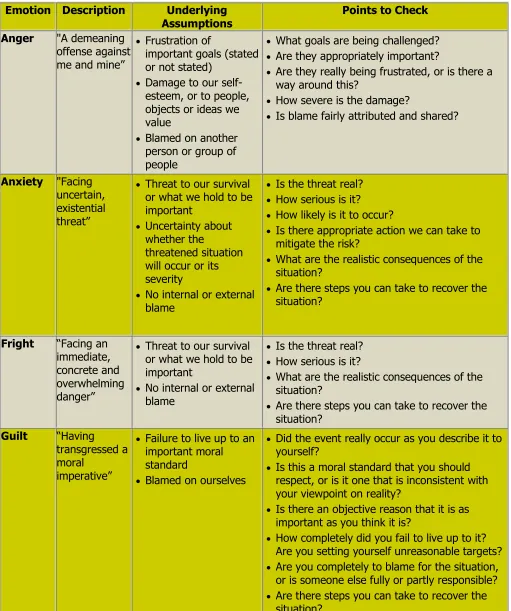
In fact, according to the theory, there are six main automatic assumptions that can lie beneath negative emotions. These are shown in figure 1 below. The emotions we
experience in difficult situations depend on which of these assumptions or factors apply. The assumptions behind some common emotions are shown in figure 2 below.
That someone or something is preventing us from achieving a goal that is important to us;
That we feel that this is damaging our self-esteem, or that it is hurting people, objects or ideas that we think are important; and
That the person we are getting angry with is responsible for this situation.
Using the Tool:
Emotional Analysis is a useful staring point for understanding our own strong emotions, as well as those of others. It helps us to see whether the emotions we're experiencing are alerting us to important information, or whether they are incorrectly founded or an over-reaction to the circumstances.
To use the tool, follow these steps:
Relax! Once you recognized the emotion, you need to let it pass so you can think clearly and objectively. If you are able to, use the relaxation techniques
Identify the assumptions you are making: Start by using the list of assumptions shown in figure 1. Using this as a checklist, work through it and identify the assumptions that you are making. Once you have done this, identify any other assumptions (not on the list) that are influencing the emotion.
With each challenge, identify whether the assumptions you have made are correct or incorrect. If it helps with this, imagine as you make each challenge that you are your own best friend – do not be harsh with yourself. Be fair.
Take action appropriately: Where your assumptions are incorrect, the negative emotions should change or disappear as soon as you acknowledge this.
Where assumptions either have some element of truth to them or are fully correct, then you need to recognize this. Think through what you need to do to manage these situations. This may include drawing on skills explained
elsewhere on this site.
Where you are sure of the foundation of the negative emotion, then you have the option to use it for good effect. For example, in the right circumstances, feeling angry can provide tremendous power and motivation. Expressing it has a shock effect that can help you achieve what you need to achieve, as long as you accept the fact that this may damage relationships.
Figure 1 – The Automatic Assumptions That Lie Behind Emotion:
This list below shows some of the key automatic assumptions that we make when we experience negative emotion. Different assumptions are associated with the experience of different emotions. Only some of these will apply at any one time (see figure 2 for examples of this):
That the situation is relevant to our goals: Goals can be formal goals or objectives that we set ourselves, or can be informal, unstated desires like wanting to drink when thirsty or eat when hungry. If the situation is not
That the situation threatens our goals: We usually experience positive emotions in situations that support our achievement of goals and negative emotion when these are being frustrated.
That we expect the situation to turn out badly.
That we feel that something important to us is being threatened: We experience different emotions depending on which of the following personal factors we think are threatened (see figure 2):
o Our self-esteem, or the value that other people see in us
o Our ideal of how we want to see ourselves
o Our moral values
o Thoughts, ideas, philosophies and understandings of reality that we think
are important
o People that we love or objects that we value
o Goals and ambitions that are important to us
o That we are responsible, or that someone else is to blame
o That we have some power to affect the situation, or that we are
powerless
Summary:
While acting immediately on strong emotion can often leave us looking foolish, emotion should not be discounted. While strong emotion can cause us to make mistakes, it can also act as an early warning system, alerting us to threats in our environment long before we could rationally understand what's going on.
To use Emotional Analysis, follow these steps:
Relax so that you can challenge the assumptions you are making objectively
Identify these assumptions
Challenge them rationally and identify valid and invalid assumptions
Take action appropriately
Figure 2 - The Assumptions Underlying Some Negative Emotions
Descriptions of are emotions drawn from "Why We Should Think of Stress as a Subset of Emotion", Richard S Lazarus, in the Handbook of Stress (Ed Leo Golderberger and Shlomo Breznitz), 1993, The Free Press, New York
Emotion Description Underlying Assumptions
What goals are being challenged?
Are they appropriately important?
Are they really being frustrated, or is there a way around this?
How severe is the damage?
Is blame fairly attributed and shared?
Anxiety "Facing uncertain, existential threat”
Threat to our survival or what we hold to be
No internal or external blame
Is the threat real?
How serious is it?
How likely is it to occur?
Is there appropriate action we can take to mitigate the risk?
What are the realistic consequences of the situation?
Are there steps you can take to recover the situation?
Threat to our survival or what we hold to be important
No internal or external blame
Is the threat real?
How serious is it?
What are the realistic consequences of the situation?
Are there steps you can take to recover the situation?
Did the event really occur as you describe it to yourself?
Is this a moral standard that you should respect, or is it one that is inconsistent with your viewpoint on reality?
Is there an objective reason that it is as important as you think it is?
How completely did you fail to live up to it? Are you setting yourself unreasonable targets?
Are you completely to blame for the situation, or is someone else fully or partly responsible?
Emotion Description Underlying Assumptions
Points to Check Shame “Failing to live
up to an ego ideal”
Failure to live up to an ideal of oneself
Blamed on ourselves
Did the event really occur as you describe it to yourself?
Is this an ideal that is reasonable and achievable?
Is there an objective reason that it is as important as you think it is?
How completely did you fail to live up to the ideal? Are you setting yourself unreasonable targets?
Are you completely to blame for the situation, or is someone else partly or fully responsible?
Are there steps you can take to recover the situation?
No intense internal or external blame
No ability to recover the situation
How the damage real?
How serious is it?
Is there really no ability to recover the situation, or is there something that can be done about it?
* It is difficult to know how this could be tested objectively; however, it seems reasonable to think that our distant ancestors were more likely to survive if they reacted quickly but approximately, rather than slowly but rationally! [Back up]
References
Emotional Analysis. Retrieved April 21, 2008, from
Coping Work Stress – Behavioral Strategy
Relaxation Techniques
We all know how unpleasant excessive stress can be. We also know the feeling of sickness in our stomach before an important performance, and the intense 'fight-or-flight' reaction we get when we face frustration after frustration.
This section gives you simple techniques for relaxing and dealing with the unpleasant symptoms of stress. These are useful and important, just as long as you deal with the fundamental causes of stress as well.
1. Imagery - Mental Stress Management Relaxation Techniques from Mind Tools
Introduction:
Imagery is a potent method of stress reduction, especially when combined with physical relaxation methods such as deep breathing.
You will be aware of how particular environments can be very relaxing, while others can be intensely stressful. The idea behind the use of imagery in stress reduction is that you use your imagination to recreate and enjoy a situation that is very relaxing. The more intensely you imagine the situation, the more relaxing the experience will be.
Using the Tool:
Imagery in Relaxation
One common use of relaxation imagery is to imagine a scene, place or event that you remember as safe, peaceful, restful, beautiful and happy. You can bring all your senses into the image with, for example, sounds of running water and birds, the smell of cut grass, the taste of cool white wine, the warmth of the sun, and so on. Use the imagined place as a retreat from stress and pressure.
Scenes can involve complex images such as lying on a beach in a deserted cove. You
may “see” cliffs, sea and sand aroundyou, “hear” the waves crashing against rocks,
“smell” the salt in the air, and “feel” the warmth of the sun and a gentle breeze on your
body. Other images might include looking at a mountain view, swimming in a tropical pool, or whatever you want.
Other uses of imagery in relaxation involve creating mental pictures of stress flowing out of your body, or of stress, distractions and everyday concerns being folded away and locked into a padlocked chest.
Imagery in Preparation and Rehearsal
You can also use imagery in rehearsal before a big event, allowing you to prepare for the event in your mind.
Imagery also allows you to pre-experience achievement of your goals, helping to give you self-confidence. This is another technique used by successful athletes.
Summary:
With imagery, you substitute actual experience with scenes from your imagination. Your body reacts to these imagined scenes almost as if they were real.
To relax with imagery, imagine a warm, comfortable, safe and pleasant place, and enjoy it in your imagination.
Imagery can be shown to work by using biofeedback devices that measure body stress. By imagining pleasant and unpleasant scenes, you can actually see or hear the
changing levels of stress in your body change
2. Meditation - Relaxing with sustained concentration Relaxation Techniques
Introduction:
As with our next tool (self-hypnosis), meditation has a popular image that can lead to it being dismissed as a less-than-serious stress management tool. This is a shame. Good research has been conducted into meditation that shows it is a useful and practical technique for managing stress.
As with the next two tools, meditation is a good way of relaxing during, and at the end of, a stressful day. It is something you can learn to do yourself, or may be something you prefer to learn in classes.
Some of the key research on meditation was carrier out by Dr. Herbert Benson of
Harvard University. His book on this, “The Relaxation Response”, was published in
1968. In a series of experiments into various popular meditation techniques, Dr. Benson established that these techniques had a very real effect on reducing stress and
controlling the fight-or-flight response. Direct effects included slowed heartbeat and breathing, reduced oxygen consumption and increased skin resistance.
Using the Tool:
The idea behind meditation is to consciously relax your body and focus your thoughts on one thing for a sustained period. This occupies your mind, diverting it from the problems that are causing you stress. It gives your body time to relax and recuperate, and to clear away stress hormones that may have built up.
There is nothing mystical about meditation. On the contrary, it is something that you can do quite easily by following these steps:
Sit quietly and comfortably.
Close your eyes.
Start by relaxing the muscles of your feet and work up your body relaxing muscles (a technique like Progressive Muscular Relaxation can be useful for this).
Focus your attention on your breathing.
Breathe in deeply and then let your breath out. Count your breaths, and say the number of the breath as you let it out (this gives you something to do with your mind, helping you to avoid distraction).
Focusing on breathing and counting breaths is just one way you can occupy your mind during meditation. Other approaches are:
Focusing on an object:
Here, you completely focus attention on examination of an object. Look at it in immense detail for the entire meditation. Examine the shape, color differences, texture, temperature and movement of the object. Objects often used are flowers, candle flames or flowing designs, but you can use other objects equally effectively (for example alarm clocks, desk lamps or even coffee mugs!)
Focus on a sound:
Some people like to focus on sounds they make. The classic example is the
Sanskrit word “Om”, meaning “perfection”. Whether or not this is practical
depends on your lifestyle.
Using Imagery:
This can be a very refreshing and pleasant way of meditating. Here, you create a mental image of a pleasant and relaxing place in your mind. For more
information, see our article on imagery.
However you do it, it is important to keep your attention focused. If external thoughts or distractions wander into your mind, let them drift out.
Summary:
Meditation is a useful and practical relaxation technique. To use it, sit in a comfortable place, close your eyes, relax your body, and focus your concentration on something for a period of time.
3. Self-Hypnosis Relaxation Techniques
Introduction:
Hypnosis, like meditation, has a dubious image. Many people over many years have made their living by overlaying this practical and useful technique with unwarranted mystical and magical rituals. In fact, it is a useful tool for achieving deep relaxation.
Self-hypnosis is when you hypnotize yourself. This is often more practical as a stress management tool than normal hypnosis, as you do not need to have a hypnotist present.
Drawing on the same "relaxation response" that drives meditation, self-hypnosis helps you to relax your body, lets stress hormones subside, and distracts your mind from unpleasant thoughts. The relaxation achieved with self-hypnosis can be intense. Unlike meditation, we often use affirmations as part of self-hypnosis to manage stress and build self-confidence. Affirmations are the positive statements (based on rational thinking) that we make to ourselves to counter stress and unpleasant thoughts - see our article on Rational and Positive Thinking for more information on this.
Along with meditation and imagery, self-hypnosis can usefully be used as a part of a daily stress management routine.
Using the Tool:
First, decide if you want to use affirmations as part of your self-hypnosis session (you will still be able to relax deeply if you do not use them). If you do, then prepare the affirmations you want to use before you start the session, as you will not want to think about them once you have reached a state of deep relaxation!
Next, find somewhere comfortable and quiet, and sit down.
Now, relax your body. A good way of doing this is to close your eyes and imagine waves of relaxation running down your body from your scalp downwards, washing out stress. Let the waves run in time with your breathing, first washing down over your head, then your neck, then your torso, then arms, and finally your legs. Feel the muscles in your body relaxing as the waves of relaxation wash over them.
The next step is to use suggestion to deepen the state of relaxation. This can be as
simple as saying something like: “I am feeling relaxed and comfortable to yourself. With every breath I am becoming more relaxed and more comfortable…" Alternatively, use
the traditional approach of suggesting sleepiness: "I am tired and sleepy. I can feel the
heaviness in my arms and legs. I am more and more tired…"
Once you feel completely relaxed, use the affirmations you have prepared. Mix these in with the relaxation suggestions.
Typical self-hypnosis sessions can last between 15 and 25 minutes; however, they can last for as long as you like.
Summary:
Self-hypnosis is a practical and effective technique for relaxing deeply. It can be used with or without affirmations, depending on what you want to achieve.
4. Using Music or Relaxation Tapes - Easy mental relaxation
The three tools we have looked at so far in this section are active techniques. You need to concentrate to use them - unfortunately you may, quite legitimately, be too tired at the end of a busy day to want to concentrate on anything.
An alternative approach is to listen to calming music, or to pre-prepared relaxation or hypnosis tapes. It takes no effort on your behalf to listen to these, and this may be very welcome at the end of a long, hard day's work!
Quite obviously, you can buy relaxing music in very many places.
5. Physical Techniques: Deep Breathing, Progressive Muscular Relaxation & The Relaxation ResponseRelaxation Techniques
Introduction:
This tool introduces three useful physical relaxation techniques that can help you reduce muscle tension and manage the effects of the fight-or-flight response on your body. This is particularly important if you need to think clearly and perform precisely when you are under pressure.
The techniques we will look at are Deep Breathing, Progressive Muscular Relaxation and
“The Relaxation Response”.
Using These Techniques:
Deep Breathing:
conjunction with other relaxation techniques such as Progressive Muscular Relaxation, relaxation imagery and meditation to reduce stress.
To use the technique, take a number of deep breaths and relax your body further with each breath. That's all there is to it!
Progressive Muscular Relaxation (PMR):
Progressive Muscular Relaxation is useful for relaxing your body when your muscles are tense.
The idea behind PMR is that you tense up a group of muscles so that they are as tightly contracted as possible. Hold them in a state of extreme tension for a few seconds. Then, relax the muscles to their previous state. Finally, consciously relax the muscles even further so that you are as relaxed as possible.
By tensing your muscles first, you will probably find that you are able to relax your muscles more than would be the case if you tried to relax your muscles directly.
Experiment with PMR by forming a fist, and clenching your hand as tight as you can for a few seconds. Then relax your hand to its previous tension, and then consciously relax it again so that it is as loose as possible. You should feel deep relaxation in your hand muscles.
For maximum relaxation you can use PMR in conjunction with breathing techniques and imagery.
The “Relaxation Response”:
We mentioned “The Relaxation Response” in our article on Meditation. In a series of
fight-or-flight response. Direct effects included deep relaxation, slowed heartbeat and breathing, reduced oxygen consumption and increased skin resistance.
This is something that you can do for yourself by following these steps:
Sit quietly and comfortably.
Close your eyes.
Start by relaxing the muscles of your feet and work up your body relaxing muscles.
Focus your attention on your breathing.
Breathe in deeply and then let your breath out. Count your breaths, and say the number of the breath as you let it out (this gives you something to do with your mind, helping you to avoid distraction).
Do this for ten or twenty minutes.
An even more potent alternative approach is to follow these steps, but to use relaxation imagery instead of counting breaths in step 5.
Again, you can prove to yourself that this works using biofeedback equipment.
Summary:
“Deep Breathing,” “Progressive Muscular Relaxation,” and the steps leading to the
“Relaxation Response” are three good techniques that can help you to relax your body
and manage the symptoms of the fight-or-flight response.
6. Yoga - An important physical relaxation technique Relaxation Techniques by Kellie Fowler
Many people turn to yoga for simple reasons, perhaps they just enjoy it, perhaps they find it relieves stress, maybe yoga helps them to better cope with life’s ups and downs, or perhaps it's because a physician has prescribed it. Regardless of the reason for participating in yoga, the result is almost always a more fulfilled life.
If you have tried yoga, you already know that it can help you achieve your goals with a clearer head, a more in-tune body and a renewed spirit.
In this article, we will take a look at the many benefits of yoga but we must caution that no physical fitness program should be taken on without the knowledge and consent of your personal physician.
Before we discuss the benefits of yoga, we should also point out that the body is actually an energy system with close interplay between breathing, heart beat and brain function. Yoga provides a useful maintenance service for this system.
Working from the premise that “Life is breath, breath is life,” yoga places great
emphasis on making the breathing deep, rhythmic and effective. The principle here is that essential thoughts and messages are delivered more effectively when the body is relaxed and the brain is well-oxygenated, helping the body and mind to work more successfully while feeling less tired and less stressed.
Yoga breathing (as we see in a later article in this newsletter) lowers blood pressure and brings intense relaxation. Of course, shallow breathing does not always cause unclear thinking or low spirits, but it has been medically linked with attacks of depression, mood swings and other various disorders.
flexible. And, it can be amazing to see how much more flexible the body is and how
much more positive one’s outlook becomes with just a few month’s of yoga practice.
If you are unable to locate a reputable yoga studio in your area, you may benefit from purchasing a DVD or video that allows you to practice yoga in your home. Keep in muscles, and helping participants relax deeply with proven stress relieving yoga techniques. Their programs (many of which are at an introductory level) include yoga poses and stretches that will help revitalize your mind and body and refresh your spirit.
7. Relaxation & The Relaxation Response
Relaxation Techniques by Kellie Fowler
Multitasking has become a part of our everyday lives. At any given time, most of us are actively working on, or overseeing, a handful of projects and problems all at once, making it nearly impossible to slow down and relax.
Years ago, when I first embarked on a journalism career and subsequently found myself in a bustling newsroom working amongst some of the most experienced writers for a very large, reputable newspaper, I was overwhelmed. As the youngest and one of only two females, I found that the only way I could earn the respect of those around me was to show up first, leave last and give 110% all day long, even when my work days lasted 16 hours! Talk about being on the fast track – the fast track to burnout, that is!
Needless to say, it took just a few short months to realize that the pace I had set for myself was unrealistic. Sure, I was playing in the big leagues and making a great name for myself, but if I wound up too tired to perform, which was inevitable, I would surely make costly mistakes and quickly place myself out of work.
Considering this one weekend, I turned to the local library (I am embarrassed to say that this was before the days of the World Wide Web) to find sources on relaxation. I knew I had to work in some relaxation if I wanted to continue meeting tight deadlines each day with copy that was strong and print-worthy. So, I spent hours at the library that day and left with seven books. To this day, I continue to rely on the information I found in one book, and would like to share this with you.
It was a book called “The Relaxation Response,” by Dr. Herbert Benson, that changed
my life and taught me the importance of relaxing each day, and even showed me exactly how to do it.
Based on studies at Boston’s Beth Israel Hospital and Harvard Medical School, Dr.
Benson’s quick and easy relaxation techniques have immense physical benefits, from
lowering blood pressure to a reduction in heart disease. The book explains how anyone can benefit from learning and perfecting relaxation techniques. In doing so, Dr. Benson created a book that is relied on by healthcare professionals and authorities to treat the negative effects of stress.
By learning to invoke the relaxation response once or twice a day for just ten minutes at a sitting, one can effectively lower blood pressure and gain tranquility in their emotional life, making them more successful both in the workplace and at home.
Try the following 6-step relaxation response the next time you feel anxiety or stress:
1. Sit quietly in a comfortable position. 2. Close your eyes.