Nick Furneaux
Cryptocurrencies
John Wiley & Sons, Inc. 10475 Crosspoint Boulevard Indianapolis, IN 46256 www.wiley.com
Copyright © 2018 by John Wiley & Sons, Inc., Indianapolis, Indiana Published simultaneously in Canada
ISBN: 978-1-119-48058-7 ISBN: 978-1-119-48057-0 (ebk) ISBN: 978-1-119-48056-3 (ebk)
Manufactured in the United States of America 10 9 8 7 6 5 4 3 2 1
No part of this publication may be reproduced, stored in a retrieval system or transmitted in any form or by any means, electronic, mechanical, photocopying, recording, scanning or otherwise, except as permitted under Sections 107 or 108 of the 1976 United States Copyright Act, without either the prior written permis-sion of the Publisher, or authorization through payment of the appropriate per-copy fee to the Copyright Clearance Center, 222 Rosewood Drive, Danvers, MA 01923, (978) 750-8400, fax (978) 646-8600. Requests to the Publisher for permission should be addressed to the Permissions Department, John Wiley & Sons, Inc., 111 River Street, Hoboken, NJ 07030, (201) 748-6011, fax (201) 748-6008, or online at http://www.wiley .com/go/permissions.
Limit of Liability/Disclaimer of Warranty: The publisher and the author make no representations or war-ranties with respect to the accuracy or completeness of the contents of this work and specifically disclaim all warranties, including without limitation warranties of fitness for a particular purpose. No warranty may be created or extended by sales or promotional materials. The advice and strategies contained herein may not be suitable for every situation. This work is sold with the understanding that the publisher is not engaged in rendering legal, accounting, or other professional services. If professional assistance is required, the services of a competent professional person should be sought. Neither the publisher nor the author shall be liable for damages arising herefrom. The fact that an organization or Web site is referred to in this work as a citation and/or a potential source of further information does not mean that the author or the publisher endorses the information the organization or website may provide or recommendations it may make. Further, readers should be aware that Internet websites listed in this work may have changed or disappeared between when this work was written and when it is read.
For general information on our other products and services please contact our Customer Care Department within the United States at (877) 762-2974, outside the United States at (317) 572-3993 or fax (317) 572-4002. Wiley publishes in a variety of print and electronic formats and by print-on-demand. Some material included with standard print versions of this book may not be included in e-books or in print-on-demand. If this book refers to media such as a CD or DVD that is not included in the version you purchased, you may download this material at http://booksupport.wiley.com. For more information about Wiley products, visit www.wiley.com.
Library of Congress Control Number: 2018939042
I love you
vii Nick has been playing and working with computers since his parents gave him a Sinclair ZX81 when he was 12. By the age of 14, Nick had designed a computer program to convince his teacher that he had gained access to his bank account. In the past 20 years, he has provided cyber security, forensics consultancy, and training to companies and law-enforcement institutions in the UK and across Europe, the United States, and Asia, and has lectured on the subject to numerous groups and organisations.
Nick has been specifically involved in the development of data extraction and digital forensic analysis techniques that work on live, running computers, and has had the opportunity to work with some of the top security researchers in the world.
He is currently working with government and corporate teams throughout Europe in various forms of data acquisition, teaching computer memory analysis and carrying out cryptocurrency investigations.
Nick is the Managing Director of CSITech Ltd and Director of the online forensics training company CSILearn Ltd.
xi Project Editor
Kathryn Duggan Technical Editor David S Hoelzer Production Editor
Athiyappan Lalith Kumar Copy Editor
Kim Cofer
Production Manager Katie Wisor
Manager of Content Enablement and Operations
Pete Gaughan Marketing Manager Christie Hilbrich
Executive Editor Jim Minatel
Project Coordinator, Cover Brent Savage
Proofreader Nancy Bell Indexer
Johnna VanHoose Dinse Cover Designer
Wiley
Cover Image
xiii Firstly, thank you to my Mum for not just teaching me to read as a child, but to learn to love reading and writing. One of the reasons I started writing this book in late 2017 was to take my mind off her finally going to sleep in the July after showing pancreatic cancer who was boss for four years. She would have been really happy that I eventually wrote a book, even if she didn’t understand a word of it! (Although she would have tried and told me it was the best book ever!)
Secondly, my “brother from another mother,” Chris Hadnagy, who suggested I write this book and has stood tirelessly at my shoulder through the extraor-dinary challenges of the past few years.
Next, thank you to the team at Wiley. Jim Minatel, I appreciate you giving me a chance—we need to go watch some racing sometime! And to Kathi Duggan, for your astonishing levels of patience dealing with my writing style and for your personal words of kindness over the past months.
xv Foreword xxi Introduction xxiii
Part I Understanding the Technology 1
Chapter 1 What Is a Cryptocurrency? 3
Chapter 2 The Hard Bit 15
Chapter 3 Understanding the Blockchain 39
Chapter 4 Transactions 67
Chapter 5 Mining 87
Chapter 6 Wallets 95
Chapter 7 Contracts and Tokens 109
Part II Carrying Out Investigations 117
Chapter 8 Detecting the Use of Cryptocurrencies 119 Chapter 9 Analysis of Recovered Addresses and Wallets 147
Chapter 10 Following the Money 175
Chapter 11 Visualization Systems 199
Chapter 12 Finding Your Suspect 217
Chapter 13 Sniffing Cryptocurrency Traffic 245
Chapter 14 Seizing Coins 255
Chapter 15 Putting It All Together 267
xvii Foreword xxi Introduction xxiii
Part I Understanding the Technology 1
Chapter 1 What Is a Cryptocurrency? 3
A New Concept? 3
Leading Currencies in the Field 8
Is Blockchain Technology Just for Cryptocurrencies? 9
Setting Yourself Up as a Bitcoin User 10
Summary 14
Chapter 2 The Hard Bit 15
Hashing 16
Public/Private Key Encryption 21
RSA Cryptography 23
Elliptic Curve Cryptography 28
Building a Simple Cryptocurrency in the Lab 32 Summary 36
Chapter 3 Understanding the Blockchain 39
The Structure of a Block 40
The Block Header 42
Deconstructing Raw Blocks from Hex 47
Applying This to the Downloaded Hex 51
Number of Transactions 55
Block Height 57
Forks 58
The Ethereum Block 61
Chapter 4 Transactions 67
The Concept behind a Transaction 67
The Mechanics of a Transaction 69
Understanding the Mempool 76
Understanding the ScriptSig and ScriptPubKey 77
Interpreting Raw Transactions 79
Cold Wallets or Cold Storage 98
Why Is Recognizing Wallets Important? 99
Software Wallets 100
Hardware Wallets 100
Paper Wallets 100
The Wallet Import Format (WIF) 101
How Wallets Store Keys 102
Setting Up a Covert Wallet 105
Summary 107
Chapter 7 Contracts and Tokens 109
Contracts 109 Bitcoin 110 Ethereum 110
Tokens and Initial Coin Offerings 112
Summary 116
Part II Carrying Out Investigations 117
Chapter 8 Detecting the Use of Cryptocurrencies 119
The Premises Search 120
A New Category of Search Targets 121
Questioning 124
Searching Online 125
Commercial Tools 130
Extracting the Wallet File 131
Automating the Search for Bitcoin Addresses 135
Finding Data in a Memory Dump 136
Working on a Live Computer 137
Acquiring the Wallet File 138
Exporting Data from the Bitcoin Daemon 140 Extracting Wallet Data from Live Linux and OSX Systems 144 Summary 145 Chapter 9 Analysis of Recovered Addresses and Wallets 147 Finding Information on a Recovered Address 147
Extracting Raw Data from Ethereum 154
Searching for Information on a Specific Address 155
Analyzing a Recovered Wallet 161
Setting Up Your Investigation Environment 161
Importing a Private Key 166
Dealing with an Encrypted Wallet 167
Inferring Other Data 172
Summary 173
Chapter 10 Following the Money 175
Initial Hints and Tips 175
Transactions on Blockchain.info 176
Identifying Change Addresses 177
Another Simple Method to Identify Clusters 181 Moving from Transaction to Transaction 182
Putting the Techniques Together 184
Other Explorer Sites 186
Following Ethereum Transactions 189
Monitoring Addresses 193
Blockonomics.co 193 Bitnotify.com 194
Writing Your Own Monitoring Script 194
Monitoring Ethereum Addresses 196
Summary 197
Chapter 11 Visualization Systems 199
Online Blockchain Viewers 199
Blockchain.info 200 Etherscan.io 201
Commercial Visualization Systems 214
Summary 215
Chapter 12 Finding Your Suspect 217
Tracing an IP Address 217
Bitnodes 219
Is the Suspect Using Tor? 228 Is the Suspect Using a Proxy or a VPN? 229
Tracking to a Service Provider 231
Considering Open-Source Methods 235
Accessing and Searching the Dark Web 237
Detecting and Reading Micromessages 241
Summary 244
Chapter 13 Sniffing Cryptocurrency Traffic 245
What Is Intercept? 246
Watching a Bitcoin Node 247
Sniffing Data on the Wire 248
Summary 254
Chapter 14 Seizing Coins 255
Asset Seizure 256
Cashing Out 256
Setting Up a Storage Wallet 259
Importing a Suspect’s Private Key 261
Storage and Security 263
Seizure from an Online Wallet 265
Practice, Practice, Practice 265
Summary 266
Chapter 15 Putting It All Together 267
Examples of Cryptocurrency Crimes 268
Buying Illegal Goods 268
Selling Illegal Goods 268
Stealing Cryptocurrency 269
Money Laundering 269
Kidnap and Extortion 270
What Have You Learned? 270
Where Do You Go from Here? 273
xxi Any novel technology brings with it a wave of early adopters. While some of these are keen to explore the potential societal and economic benefits that may be had by leveraging the technology, others seek to apply the technology as a means to enable nefarious activities. Bitcoin and other cryptocurrencies are no exception. Indeed, it may be very reasonably argued that the first “killer-app” for Bitcoin—responsible for a large influx of users and a significant boosting of economic traction—was the Silk Road dark market, founded in February 2011. Other use cases thriving today include ransomware, unregulated gambling, Ponzi schemes masquerading as high-yield cryptocurrency investment schemes, in-person cryptocurrency muggings, and cryptojacking—that is, the practice of covertly hijacking computers to mine cryptocurrency.
that should be respected in any forensic investigation. Indeed, I have personally observed on more than one occasion how a failure to apply proper methods can mean critical evidence is missed or lost, while a lack of a sufficiently deep level of understanding can mean incorrect conclusions are drawn from the evidence. In either case, the consequences for the integrity of the investigatory process are often terminal. I hope that you will enjoy reading this book, that you will find it as insightful as I did, and that you will find the opportunity to apply its wisdom to some real-world cases.
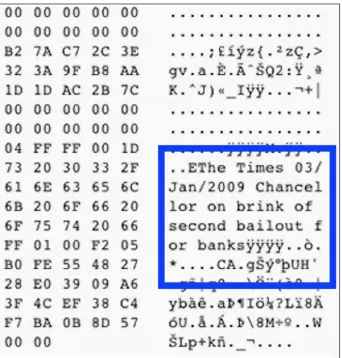
xxiii “The Times 03/Jan/2009 Chancellor on brink of second bailout for banks”
Those 69 characters should be much more famous than they are. In the very first Bitcoin block, the enigmatic Satoshi Nakamoto, the inventor of Bitcoin, encoded that message in hexadecimal (see Figure Intro-1).
Figure Intro-1: Message in the Genesis block.
that in Satoshi’s view, the banks were failing, and his or her system could free people from the control of central banks and exchanges. On a cryptography mailing list, Satoshi wrote the following:
“You will not find a solution to political problems in cryptography.
Yes, but we can win a major battle in the arms race and gain a new territory of freedom for several years.
Governments are good at cutting off the heads of a centrally controlled networks like Napster, but pure P2P networks like Gnutella and Tor seem to be holding their own.”
Satoshi, https://www.mail-archive.com/[email protected]/ msg09971.html
Although Satoshi wrote little about the Bitcoin system, the few comments on forums show that there was at least a small part of his or her motivation that wanted to enable people to step outside the traditional banking and currency systems.
Since those early days, Bitcoin has grown massively both in value and reach. Although at the time of writing, one could not assert that Bitcoin was a main-stream currency, it is certainly in the mainmain-stream consciousness, regularly making headlines on conventional news channels and spawning thousands of column inches of editorial.
Aside from Bitcoin, hundreds of cryptocurrencies are now based on the blockchain concept. Some are very similar; others are trying to do things in very different ways. For example, although Ethereum is a cryptocurrency in its own right, it is based around a complex, programmable contract system. A transaction can include many contractual obligations and could be used for everything from buying a house to getting married. In fact, several couples have already embedded their marriage on the Bitcoin and Ethereum blockchains, including parts of their vows and links to an image of their marriage certificate. Blockchain technology is here to stay, and an investigation involving it is going to land on your desk soon, if it hasn’t already.
Cryptocurrencies: Coming to a Lab near You
a computer investigation would focus almost solely on Internet activity in a web browser, perhaps some newsgroups or ICQ and, of course, good old e-mail. Fast-forward to 2018, and the equipment that lands on the check-in desk at the lab has changed beyond recognition. Most smartphones, such as the humble iPhone, have significantly more power and storage than the computers of the early 2000s, and instead of simply looking at visited websites, we now have encrypted chat, messaging programs that come in hundreds of flavors, and social media environments that are investigation centers in their own right, such as Facebook, Snapchat, and many others.
Throughout this time, criminals have continued to carry out nefarious deeds and have found ways to pay for illegal goods and acquire ill-gotten payments from the defrauded and unsuspecting. The problem for the 2005 criminal was the lack of options for sending or receiving monies in an anonymous, untrace-able way. For example, criminals could easily carry out a “ransomware” attack where malware encrypts the victim’s computer until money is paid and then they are “hopefully” provided with a decryption key. But to have the money sent to the criminal presented significant difficulties. You could publish a bank account number, but that’s very hard to set up without ID, and when the money is transferred, the police can easily trace it and move in for the arrest. Because of these problems, criminals and criminal gangs took to setting up post-office (PO) boxes where money could be sent, but again, it was not difficult for the authorities to keep watch until someone turned up to collect the cash. Some went the route of using what amounted to cash mules, who would retain some percentage of the risk involved, adding a layer of misdirection to the payments and cutting into profits. The Internet, though, offered possibilities in the form of Western Union and PayPal, but those are also connected to real-world bank accounts, making it straightforward for the police to trace. I’m somewhat sim-plifying the methods used, but you get the idea: there was no easy way to pay or get paid without leaving a trail that is easily followed.
N O T E I often see this attitude amongst investigators when it comes to anything that obfuscates computer communication or hides data. When investigating a com-puter with a VPN client on it, if storage encryption is turned on, a Tor client is installed, or even if a browser cache has been recently purged, the assumption is that the owner “must have something to hide.” I regularly argue that many reasons exist why some-one would have all or any of these software tools on their computer—they may have something to hide, but it’s not actually illegal or they just value their right to privacy. Sadly, I’m usually wrong, and the computer owner generally does have something bad to hide—but it’s nice to think the best of people, isn’t it?
In recent years, Bitcoin has moved out of the figurative shadows of the dark web and into the light of mainstream commerce. It seems most owners of bitcoins are just holding them for investment as the bitcoin-to-dollar price fluctuates wildly, but generally in an upward direction. If you go to http://bit.ly/2td8ref, you can see the bitcoin-to-dollar exchange rate from its inception in 2009 to now.
Although Bitcoin, Ethereum, and others could stand alone as a trading cur-rency if enough traders accepted them, the reality is that even today, in 2018, what you can buy with a cryptocurrency is limited. Users wanted to be able to buy cryptocurrency with dollars and euros for use online and then sell coin that they had received for currency that they could use in Walmart, for example. To fill this void, currency exchanges began to pop up that would take your real-world money in exchange for commensurate Bitcoin. The process is the same as converting between any currencies. Head to an online site that offers conversion, pay your money by credit card or wire transfer, for example, and you will be credited with the Bitcoin or whatever currency you have asked for. As I discuss in this book, most sites have their own “wallet” system that stores your Bitcoin for you so you can then pay for goods using your coin directly from the website. This means that the company can both take your money and have access to your bitcoins.
N O T E The volatility of Bitcoin compared to its dollar value in 2017 and 2018, aligned with the growing fees involved to make a Bitcoin purchase, have led some economists to question Bitcoin’s use as a currency, rather terming Bitcoin a crypto-asset. Time will tell if Bitcoin or another cryptocurrency manages to become widely available on the high street.
servers, waits until the wallet contains lots of money and bitcoins, and then quietly closes the door and tiptoes away. This happened early in the life of Bitcoin with the fraudulent Bitcoin Savings and Trust in 2012, and Global Bond Ltd in 2013.
Alternatively, the person who sets up this type of online payment might be completely legitimate but get hacked and lose all their coins. Examples include Mt Gox in 2011, MyBitcoin in 2011, Bitfinex in 2016, Bitstamp in 2015, and NiceHash in 2017. This problem is not exclusively a Bitcoin problem as $500 million worth of a cryptocurrency called NEM coins were lost in a hack of Coincheck in 2018.
Or the person can lose access to his or her master wallet file and lose all the customers’ coins. An example of this is Bitomat in 2011.
Suffice to say that there are large, legitimate exchanges out there. The key is to buy your bitcoin and then transfer it to your own wallet away from the exchange. Then remember to back up your wallet—twice. And add a password—a strong one! Alternatively, save the private key to paper-based cold storage, a method we will discuss later in the book.
No matter what happens to Bitcoin, cryptocurrencies are here to stay, and they will continue to be a strong contender for criminals to receive payments, pay for goods, and launder money. A cryptocurrency investigator does not need to be an expert in Bitcoin specifically, but needs to understand the concepts behind blockchain currencies in order to apply that knowledge to whatever becomes the next payment system of choice.
Who Should Read This Book
If you are like me and spend your life digging through other people’s data, whether that is as a digital forensics investigator, a forensic accountant, or even an Open Source Intelligence gatherer, then you need to know about this subject. If not today, then you will tomorrow. Because this book covers a broad range of techniques, you may find that parts of it are very pertinent to your work and other parts are not so relevant. For example, I will teach you how to extract cryptocurrency-related data from hard drives and devices, as well as how to conduct a premises search for this type of information. Although you may never carry out a premises search in your work, being able to communicate your needs to a front-line officer or investigator may prevent vital information being missed.
“The NCA [UK National Crime Agency] has assessed the risk of digital cur-rency use for money laundering to be relatively low; although NCA deems it likely that digital currencies are being used to launder low amounts at high volume, there is little evidence of them being used to launder large amounts of money.”
—UK HM Treasury, https://www.gov.uk/government/uploads/system/uploads/ attachment_data/file/655198/National_risk_assessment_of_money_laundering_ and_terrorist_financing_2017_pdf_web.pdf
It is my experience that the reason that law enforcement and governments believe that terrorists are not using cryptocurrencies widely comes down to lack of technical expertise. But, as with all technologies, the skill levels needed to securely operate in a cryptocurrency space are decreasing quickly, and this will not be a barrier for long. Law enforcement bosses draw the same conclu-sions with money laundering—that the technical know-how needed is holding back many crime groups.
It is worth noting in the report regarding both terrorism and money launder-ing vulnerabilities they state the followlaunder-ing:
“The rapidly developing nature of products and services in this sector puts an imperative on the ability for government, supervisors, firms and law enforcement to respond rapidly to both the opportunities and risks which they pose.”
—UK HM Treasury, https://www.gov.uk/government/uploads/system/uploads/ attachment_data/file/655198/National_risk_assessment_of_money_laundering_ and_terrorist_financing_2017_pdf_web.pdf
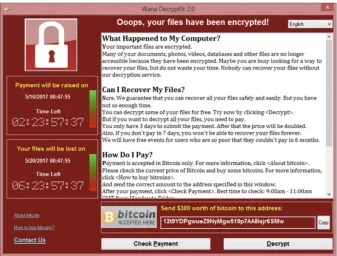
You may be reading this and believe that your job role will never pit your skills against a Russian crime group or extremist Islamists, but the use of cryp-tocurrencies is trickling down into much lower-level and lower-value crime. One example is that of crypto-mining code that is being installed by hackers into websites. When a user browses to an infected site, processor cycles on the visitor’s computer are used to mine cryptocurrency coins. Another example is the fraud that has become known as “ransomware,” which I mentioned earlier in this introduction. Ransomware became media-worthy in May 2017 with the WannaCry outbreak. It simply encrypts a computer’s files and then displays a message asking for payment.
were emptied from the wallets. Again, you may be thinking that this type of international and possibly politically motivated crime is outside your paygrade. But it was noteworthy with both WannaCry ransomware and the Petya/NotPetya virus that came later (see Figure Intro-3) that individuals and small companies were often the victims of these crimes that on a singular level only cost $300 or more dollars. Sadly, in the case of Petya/NotPetya, those who paid never saw a decryption key, and if the victim had no backups, then the potential loss was considerably greater.
Figure Intro-2: Screenshot of a computer locked with the WannaCry ransomware.
Figure Intro-3: Computer locked with the Petya/NotPetya virus.
The options for criminals to make use of cryptocurrencies are almost end-less, ranging from fraud, money laundering, purchasing illegal material, or purchasing legal material with illegally obtained currency through to crime and terrorism financing.
You may already discern the need to learn about cryptocurrencies, but your company or police department may have put their hands in their pockets and purchased software from the likes of Elliptic (https://www.elliptic.co) or Chainalysis (https://www.chainalysis.com). If you can afford one of these tools, buy one—they are both excellent. However, I make that statement in exactly the same way as I would if we were talking about computer forensic investigations and referencing Encase from Guidance Software, FTK from AccessData, or the superb X-Ways. These tools are extremely useful, they take the heavy lifting out of an investigation, and you should use them where you can. But digital investigators should be able to explain to a manager, senior officer, tribunal, or court how they reached a conclusion and be able to interpret the raw data behind some intelligence or evidence.
To illustrate, I can click a button in the FTK forensics software, and the tool will carve deleted files from a hard drive. However, when challenged, I should be able to return to the drive and have the skills to locate the disk offset and carve that file by hand, without relying on the competency of the FTK program-mer to have done his or her job right.
What You Will Learn—and Not Learn
It sounds terribly negative to tell you what you are not going to learn in this book, but it’s important that you understand where this book will take you and what other reading may be useful for you:
■ I am not going to tell you how to become rich trading cryptocurrencies.
■ The book will not help you build your own cryptocurrency.
■ The book is not a detailed technical deconstruction of the technologies behind cryptocurrencies, although I do cover them in sufficient detail for you to be able to understand the concepts and explain them to others.
What you are going to learn is much more important. Here’s a brief walk through the chapters:
Chapter 1: What Is a Cryptocurrency? defines what a cryptocurrency actually is and describes where the value of the currency comes from and how it is traded. We will look at some of the leading currencies in the field today and talk about transactions, contracts, and the many possibilities that exist for the technology.
Chapter 2: The Hard Bit covers some rather unpleasant mathematics that form the basis for hashing and the cryptography protocols that are used in various cryptocurrencies.
Chapter 3: Understanding the Blockchain is a critical chapter where a blockchain and its functions are clearly defined. We will look at how to get at the raw blockchain data via API calls and how to deconstruct a block header from the raw hex.
Chapter 4: Transactions drills down to individual transactions, again extracting raw transaction data rather than the data we get from web interfaces online. We will examine how “change” works as well as fees and the Mempool.
Chapter 5: Mining covers the concept and technology behind mining and how blocks are added to the blockchain and new “coins” created. Chapter 6: Wallets examines the many different types of wallets. This is an important chapter because investigators need to know what they are looking for in a premises search or a search on a computer or other device. This chapter also covers how a criminal might set up a covert wallet. Chapter 7: Contracts and Tokens looks more deeply into how cryptocur-rency contracts work and examines the difference between bitcoin and Ethereum scripts.
I will teach you, in detail, how to find wallets and payment addresses on a disk image or a live machine by extracting and analyzing computer memory (RAM).
Chapter 9: Analysis of Recovered Addresses and Wallets will take us into the analysis of recovered payment addresses and wallets, intelligence gathering, and using APIs to get to the raw blockchain data. We also look at utilizing recovered private keys to find public keys and discovering what has been used as well as how to crack encrypted wallets.
Chapter 10: Following the Money will help you to understand how to follow the flow of money, avoiding “address blindness” and following blocks through hard forks. This chapter also covers automatically moni-toring addresses and using the Bitcoin Core command line to interrogate the blockchain offline.
Chapter 11: Visualization Systems explores tools you can use to visualize connections between transactions. Visualization can both help and hinder because it tends to create a lot of data, so we look at ways to manage the tools.
Chapter 12: Finding Your Suspect focuses on attempting to de-anonymize a user on the blockchain. You will learn clustering methods so you can identify groups of addresses owned by a single user. In this chapter, we’ll look at logged IPs, how we can crawl for IP addresses of Bitcoin users, and even figure out if they are using Tor. We also consider how to use open-source methods to connect a payment address to a real-world person. A short section looks at the use of the blockchain to send micromessages. Chapter 13: Sniffing Cryptocurrency Traffic covers extracting data from wiretaps and watching activity of nodes on the Bitcoin network.
Chapter 14: Seizing Coins explores methods for asset seizures once you have identified coins in use by a suspect.
Chapter 15: Putting It All Together helps you to use all the skills you have learned and apply them in a methodical way to investigate a crime involving cryptocurrencies.
About the Book’s Web Resources
I
Understanding the Technology
3 Over the past few years, the term cryptocurrency has become a well-used term in financial circles, new business plans, and news headlines. Often the term is associated with criminal activity on the so-called “dark web,” but more recently with the increasing value of currencies like Bitcoin, the word, concept, and products are entering mainstream consciousness.
But what really is a cryptocurrency and how does it work? In this chapter, we will examine the concept, the history, and the uses for cryptocurrencies and look at how to set up a Bitcoin trading node.
Why does an investigator need to know this? Understanding the concept of these online currencies can help you form a good foundation to build a more comprehensive technical understanding. It can also help you to see the criminal uses of these currencies.
A New Concept?
In the far western Pacific region of Micronesia is a tiny cluster of islands named Yap. Conspicuous against the deep blue of the ocean, this tiny group of “high islands” comprises rolling hills covered with dense, lush forest. The islands share a coral reef that provides sustenance for the islanders from the fish that seek protection from ocean predators.
1
As far back as the thirteenth century, the sultan of Egypt referenced islands at the far east of the Persian Empire, where the only currency was millstones. This was later confirmed by the Spanish when they “discovered” the island group in 1528. If you visit today, you can still see the stone coins that made up the primary currency of the islanders for many centuries; in fact, they are still used today in trades involving land or marriages.
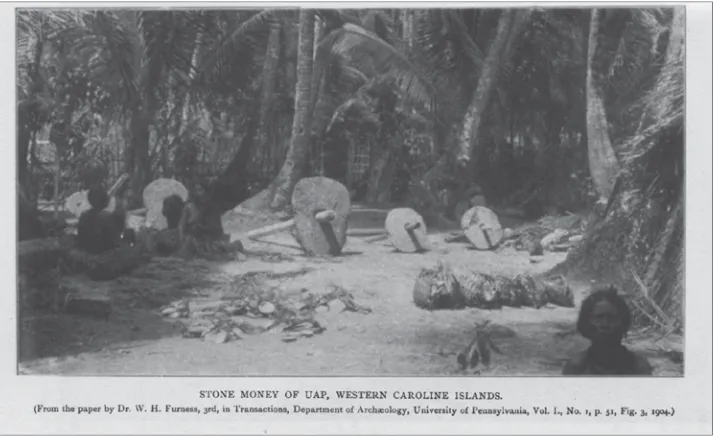
The stones are a variety of sizes—some as small as 3.5 centimeters—but the ones that draw the most attention are up to 4 meters in diameter (see Figure 1-1). The Internet boasts many pictures of tourists standing next to these vast doughnut-shaped disks of calcite named Rai coins.
Figure 1-1: Stone money of Yap.
The stones do not originate on Yap but are mined and shipped from other islands such as Palau, which is 450 kilometers away. For centuries, these coins were loaded onto sail-driven rafts, and brought across the open ocean to the island, unloaded, and moved to a location somewhere on the island where they would generally stay put forever.
You may be wondering: How do the islanders use such huge coins in actual transactions? How do they value them? How do they know who owns each coin?
you know who owns a coin with no central bank controlling the movement of funds? Examining the Yapese currency helps us to understand the blockchain currency concept.
So why does a large stone disk have value? Let’s say that Bob from Yap wants a 3-meter coin. First, the coin must be mined. Consider the difficulty involved. Workers have to be employed and sent in boats to an island 450 kilometers away. Calcite must then be mined, and the resulting stone carved into the distinctive doughnut shape. This final “coin” must then be loaded onto a boat and sailed back across the stretch of Pacific Ocean with its obvious dangers. The work and considerable expense involved to mine the coin are what gives it its perceived and agreed value to the islanders. Indeed, the bigger the coin, the higher the difficulty—so the value is commensurately greater.
One of the first questions I am asked about cryptocurrencies is where does the money come from? The answer, of course, is that the money comes from nowhere, but that is not really a fair answer. If you know anything about any cryptocurrency, you will know that new coins are “mined.” This concept will be discussed later, but in simple terms, computers work to solve really, really hard mathematical problems, and when they find a solution, they are rewarded with “new” coins. But just like mining a Yapese Rai coin, work is involved that carries a very real cost. Although Bitcoin miners, for example, are not chartering a ship and crossing oceans, they must spend real money on expensive, special-ized custom ASICs (application specific integrated circuits) capable of carrying out trillions of calculations a second. They must then spend money on provid-ing considerable amounts of electricity for runnprovid-ing the computers and keepprovid-ing them cool. Just like their stone counterparts, it’s difficult and expensive to mine cryptocurrency coins, which gives them a perceived and generally agreed value due to their scarcity and the fact that eventually Bitcoin will “mine out,” where all coins will be mined and no more can be produced.
It is notable that in 1874, a captain named David O’Keefe imported a large number of coins from Palau to trade with the Yapese. Interestingly, this “had its disadvantages, not least the introduction of inflation, caused by the sudden increase in the stock of money” (see https://www.smithsonianmag.com/ history/ david-okeefe-the-king-of-hard-currency-37051930/). In the same way, if the “difficulty of work” to mine cryptocurrency coins became easier, it would directly affect their accepted value.
would add it to their individual mental note that included the other large coins on the island. If Bob wanted to buy some land from Alice, they would agree on the transfer of coin for land, and they would then tell all the villagers that the coin “on the path by the beach” now belonged to Alice. With no centralized person keeping a record or ledger, the possibilities of fraud are massively reduced. If a pretender named Nick told others that he owned the coin “on the path by the beach,” the majority of villagers could reject the claim due to their collective knowledge of ownership.
Amazingly, blockchain-based cryptocurrencies work in almost exactly the same way. When you wish to pay for goods or services, a record of the transac-tion is sent to every (full-node) user of the currency (covered in more detail in “Setting Yourself Up as a Bitcoin User” at the end of the chapter). This means that there isn’t just one record of the transaction, but thousands all around the world. You are, in effect, saying, “Hi everyone, the coin you can find at this address now belongs to Alice.” Should anyone else try to claim ownership of a coin, the large number of ledgers around the world can disagree, preventing any fraud.
It was reported that a coin being transported to Yap was lost overboard in a storm, but as all the villagers knew of the mishap, the owner was still credited with the coin, and although no one had ever seen it, it was still traded as “the coin in the bay.” This demonstrates that a coin does not need a physical mani-festation to be accepted as real, tradable tender. A cryptocurrency coin such as a bitcoin or Ethereum ether coin never has a physical representation, but because all the users of the currency trust its existence and accept the work that went into mining it, its value is accepted as real and hence it can be traded.
Now back to the original question: What is a cryptocurrency? There is consid-erable debate over the definition of a currency when related to so-called crypto-currencies. The cryptology community is uncomfortable with the widening and often inaccurate use of the term “crypto” in news headlines and press releases and even financiers are suggesting that the term “currency” in cryptocurrency should be replaced with the word “asset.” However, a currency is generally understood to be a tradable system of money. But in reality, anything can be a currency if it is accepted as representing an agreed value; effectively, we are using a barter system where we perceive value in the currency that we trade for goods and services. Although we tend to think of a currency as the monetary notes in our purse or wallet, we use many tradable “tokens” in our everyday life. Perhaps you recently paid for a flight with air miles or used a coupon to get a free item when you bought another. Although these “tokens” do not have a traditional monetary value in the same way as a dollar bill or euro note, they are still tradable at an agreed rate or even flexible rate.
an agreement that 10 marks equal a certain treat, trip, or other benefit. In this situation, the marks on the board become a currency of sorts. They have a value that can be traded, even if it’s in a very limited way.
As we have seen, a stone slab at the bottom of the ocean can be a tradable currency, so using the same reasoning, a block of text in a database that states that it carries a particular value—for example, one bitcoin—can also be traded. But that doesn’t answer the “crypto” part of a cryptocurrency.
On Yap, the system of trust works because collectively the villagers are believed to be reliable witnesses. If many villagers clubbed together and formed a major-ity, they could then prove that a coin belonged to someone other than its rightful owner, but that would put their own coins at risk should they fall out of the new dishonest collective. This creates a paradigm of dependability where the major-ity can always be trusted. The same concept works in cryptocurrency. Users of a cryptocurrency such as Ethereum, Bitcoin, or others are encouraged to run a “full node”—that is, a complete record of every single transaction that has ever happened on the currency. This prevents individuals from dishonestly claim-ing ownership of currency, as the rest of the world’s full nodes will disagree. The “crypto” part forms the underlying basis for authenticating the ownership of coins. In fact, cryptographic systems are used in every part of the process.
The definition of cryptography in its simplest form is from the Greek meaning “secret writing.” Today, we define it as generating codes that allow informa-tion to be kept secret. With a cryptocurrency, we are not keeping informainforma-tion about a transaction secret—quite the opposite, every transaction can be read by everyone. We are using the techniques applied in messaging cryptography to enable people to prove that they are the rightful owner of monies, or more accurately, that they are the rightful owner of a transaction where they were the approved receiver of the money. Bitcoin, for example, uses a mixture of SHA256 hashing, Elliptic Curve cryptography, and others to not just secure a transaction but keep securing it repeatedly, forever. You will learn more about those systems in Chapter 2, “The Hard Bit.”
The idea of being able to pay for goods and services over the Internet is not new. David Chaum developed Digicase in the late 1980s, which was arguably the first concept of Internet money. But it wasn’t until 1998 that an attempt at public online payments based on the concept on an online wallet appeared and became successful with PayPal, which was led by the now hugely successful businessman Elon Musk. As I mentioned in this book’s Introduction, PayPal still relies on the legacy banking world to handle the storing of money, and PayPal accounts are still primarily linked to real-world bank accounts today.
were way ahead of their time, using SSL (encryption) to move the payment data and an API for other developers to leverage the E-Gold system. Sadly, its demise came in 2013, after attention by the U.S. authorities regarding the use of the system for illegal payments. Ultimately, the owners were not implicated in any wrongdoing.
Leading Currencies in the Field
It was tempting to write an investigations book about Bitcoin since, at the time of writing, it is the brand synonymous with the word cryptocurrency in the public mind. However, as I spent more time with Monero, Litecoin, Ethereum, and others, I realized that although they were all subtly or sometimes significantly different and set out to provide certain abilities to their users, for an investiga-tor, they all worked in the same fundamental way. When you consider that technology is a hard taskmaster and that online services hit the proverbial fan almost as fast as they spend their venture capital money (MySpace anyone?), will Bitcoin still be valuable and newsworthy in two years, or even a year? Could Ethereum be the next Facebook of the currency world and become the default choice for transactions and contracts of all types? Only the future will answer that question, but the methods of investigating crime involving a cryptocur-rency will remain basically the same. So, although Part II of this book deals with investigations that are focused on tools for Bitcoin with its spin-offs and alt-coins, and Ethereum, this is only because tools are available for them. Should Monero take the limelight in a few years’ time, undoubtedly an investigator will be able to find similar tools to help them investigate effectively.
In late 2017, investopedia.com, the world’s largest financial educational web-site, named Litecoin, Ethereum, Zcash, Dash, Ripple, and Monero as the best investable cryptocurrencies aside from Bitcoin, but that should not necessarily drive research by an investigator. Some of the new breeds of currency lend themselves to criminal uses. For example, Zcash offers “shielded” transac-tions where the sender’s and receiver’s details are hidden, and Dash provides increased anonymity over Bitcoin. It is more likely that these features, rather than Bitcoins’ burgeoning value, would attract someone with the need to hide his or her transactions for nefarious purposes.
Due to these issues, I will decline from the obvious inclusion of a list of available cryptocurrencies, since by the time you read this, there may be a new pretender in town being used by our suspects. Instead, this book will try to both be specific as to investigation methods you can use now and look at the generic principles behind this type of analysis.
The website Coinmarketcap.com maintains a constantly updating list of the primary cryptocurrencies, almost 900 were listed at the time of writing.
If you are interested in launching your own cryptocurrency and becoming wildly wealthy, you will find an excellent tutorial at www.ethereum.org/token. (And once you are a billionaire, please remember who gave you the tip and at least invite me onto your boat!)
Is Blockchain Technology Just for Cryptocurrencies?
Although we look in detail at what a blockchain is in Chapter 3, suffice it to say that it is simply a list of transactions, distributed to many nodes on a network, grouped into clusters called blocks, and—using a physical analogy—stacked on top of one another like a Lego™ brick tower.
The concept of a virtually anonymous, distributed ledger, contract-led blockchain-based system certainly has some significant possibilities, but believ-ing what you read in the press and in a company’s marketbeliev-ing materials would be a major mistake. In 2018, you need to include two terms in your prospectus to float your company on the stock market or add to your brochure to sell your latest product: artificial intelligence (AI) and blockchain! In fact, throwing a bit of “cloud” in there couldn’t hurt either. I saw the marketing headline “The First A.I. Big Data Marketing Cloud for Blockchain” on a software website recently. It seems that any system that adds up 2 + 2 or includes an “if . . . then” decision tree is now considered AI that may take over the planet at any moment. It’s not and it won’t, even if it’s got a lot of “big data in the cloud”!
It is the same issue with the blockchain: Business analysts have watched the extraordinary rise in the value of Bitcoin, read an article on the technology it is based on, and then added the word to any system that needs to sound a bit more hip and cool (although I am well aware that the words “hip” and “cool” themselves are no longer considered “hip” or even “cool”).
Several years ago, I bought an old book at auction—or at least I thought I had bought it since I was the final bidder. However, the auction house told me later that it did not have a record of my final bid, and since the previous bid hadn’t reached the reserve, the book would be put up for sale again. Because the auction software was hosted in a single location and the auction house controlled it, I had no recourse or way of proving otherwise. However, I had taken a screenshot of my browser with my high bid and my successful purchase message. The auction house then told me that it had “lost the book.” After a few choice words and threats of legal action from me, it “found” the book and honored the bid. It was clear that the auction house wanted more from the auction and simply wanted a chance to sell again with a better audience. How would a blockchain-based system have improved this situation?
A blockchain auction system could work as follows: Every bidder is a node on the blockchain. A product to be auctioned is set up as a token with a contract of sale connected to it, based, for example, on the Ethereum network. Each bid made is a transaction between the auction and the highest bidder with the “token” moving seamlessly from high bidder to high bidder. Whoever is the final bid-der when the real or virtual gavel comes down is left as the owner of the token. Everyone on the blockchain can see the final transaction, and the contract is set. I own the item because I own the token, and it’s proven by every node on the network. The sales contract can also form part of the blockchain contract, minimizing paperwork. (If anyone sets this system up and makes a million, please once again remember me when you are out on your yacht.)
How does this affect the investigator? Blockchain transactions on Bitcoin are one aspect of the technology and require a skill set that you will learn about in this book. However, in the future expect to find blockchain-based systems with transaction-centered contracts in a wide variety of business sectors. An analyst will need to have the skills to learn how a blockchain functions, and be able to decode contracts, and follow the flow of contract transactions. I will cover contracts in a little more detail later in the book, but if you choose to carry out further research on the smart contract-based platforms such as Ethereum, it would not be a waste of time.
Setting Yourself Up as a Bitcoin User
list of transactions. What can you figure out just from looking at this list? (We will cover everything in due course.)
Primarily, it would be a good time to set yourself up as a “full node” Bitcoin user. This will be necessary if you are to follow and practice some of the more advanced investigation techniques later in the book.
Here’s the setup procedure:
1. Browse to bitcoin.org/en/download and download Bitcoin Core. 2. Install Bitcoin Core to the default locations.
As soon as you run Bitcoin Core for the first time, it will start to download the entire blockchain. This is fine, but at the time of writing, it takes up about 170 GB on the disk, so you will need to make sure that you have enough space for the initial download as well as the space for it to grow as it synchronizes with the Bitcoin network. It’s also a good idea to experiment with the Bitcoin Testnet network where you can’t lose any money. You will need another 80 GB or so for that.
If you wish to have the blockchain files on a different drive, it’s easy to do. Just follow these steps:
1. Right-click your desktop and create a new shortcut. The path is usually:
C:\Program Files\Bitcoin\bitcoin-qt.exe
2. Add the following to the end of the command:
-datadir=d:\Bitcoinfiles
where the path is the new folder where you would like the blockchain created (see Figure 1-2).
Figure 1-2: Dialog box to create a shortcut to run Bitcoin Core.
Initially it will be beneficial to use Bitcoin Testnet. This is a fully working Bitcoin environment, but the coins are free, and you can send them around and analyze the results exactly as if you were on the actual live Bitcoin environment. Follow these steps to access and use Testnet:
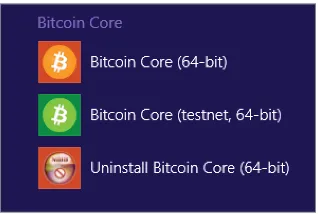
1. Locate the Start Menu Bitcoin Core group and the green shortcut to start the testnet version (see Figure 1-3).
Again, you can edit this shortcut with –datadir if you wish to change where the blockchain will be stored.
Figure 1-3: The three options in the Bitcoin Core program group.
T I P If your path has a space, remember to enclose it in double quote marks. For example: –datadir="d:\bitcoin files"
2. Start Bitcoin Testnet and allow the blockchain to download. You can run the main core and the Testnet at the same time. 3. Send your wallet some coins.
You do not need to wait for the blockchain to finish before doing this, although you will need to wait to see the coins in your wallet and send them on again.
4. While you are waiting, select File ➪ Receiving Addresses on the Bitcoin Testnet wallet.
You will see a long sequence of letters and numbers. This is a bitcoin address. (It’s actually a value represented in Base58, but more about that later.) 5. Right-click and copy the address onto your clipboard.
6. Browse to http://bit.ly/2fcuEEl and paste in your address.
8. Copy the new address onto the clipboard and click the Send button on the menu bar (see Figure 1-4).
Figure 1-4: The Send screen in Bitcoin Core.
9. Paste the new address into the Pay To box, choose how much Bitcoin to send, and click the Send button (see Figure 1-5).
You have just sent yourself some Bitcoin. Congratulations.
Figure 1-5: The Send screen with send address filled in.
10. In the Transactions dialog box, you will be able to see the transaction you just did. Double-click the transaction line, and a box will open that includes a long string titled Transaction ID. Copy this long value onto the clipboard.
11. Browse to http://bit.ly/2jKBPso_ and paste the value into the Address search box at the top of the screen.
Figure 1-6: Blockchain viewer showing a transaction.
I will explain every aspect of what you can see on this screen in a future chapter, but for the time being, you now know how to send bitcoin and find your transaction on the blockchain.
Summary
15 I think it’s only fair to apologize for this chapter. You probably didn’t become an investigator because mathematics was your strong point or you wanted to spend your workdays enjoying the beauty of hashing algorithms and Elliptic Curve Cryptography schemes. On the other hand, you may be a complete geek like me and enjoy learning about something that is outside your comfort zone. If you have been involved in digital forensics or any information security role for any length of time, many of the concepts described in this chapter will already be familiar to you.
You may be thinking, “Is this crypto stuff really needed?” To be honest, it is. The very fundamentals of a cryptocurrency are based around the relation-ship between a private key and public keys derived from it, and if you do not understand this central relationship, you will be at a disadvantage from the start. In fact, every element—from the keys just mentioned to the hashing of block headers to the Merkle Tree—requires a reasonable understanding of the subject. I recommend sticking with it.
Why does an investigator need to know this? I have always believed that investigators or analysts need to be able to provide a reasonable explanation not only of the intelligence or evidence they see, but the lower-level interpreta-tion of that evidence.
Here’s an example that will resonate with digital forensics people and may help you to understand my thinking. As I alluded to in the Introduction, a forensics person may run a carving tool over a hard drive, memory dump, or other storage
2
device and extract a JPEG file that is the smoking gun: the proverbial nail in the coffin for the suspect. However, can we trust the tool? How did the file get there in the first place? A good analyst will know, or be able to discover, the header of a JPEG file, return to the offset address on the storage device, and extract the file manually. With key evidence, one tool should never be trusted or the evidence taken at face value. In my RAM Analysis class, I teach students the possibility that an image file could be discovered in computer memory by a carving tool, but that several explanations exist for the image being there without the knowledge of the user. This would completely change the interpretation of that evidence in the case. I demonstrate that in those circumstances, the carving tool could not be trusted. If this image was an illegal image of a child, for example, the provenance of that image—how it got there—is critical to the suspect’s guilt or innocence. As you examine blockchain evidence, you may be tempted to rely purely on a tool to interpret the data, but a good investigator should be able to explain how a tool came to its conclusion and provide an appropriate technical explanation to a senior officer, manager, or even a court of law.
However, if you do a Google search for “bitcoin crypto” or “understanding public/private key infrastructure” the results are often inaccessible to anyone without a mathematics degree, with lots of equations and words like “inference” and, probably least helpfully, a good smattering of the word “obviously” when describing something that, to my eye, it is not obvious at all! This chapter covers the subject to the extent necessary to hopefully enable you to understand the concepts without the need for the detailed math.
Hashing
I was introduced to computer or digital forensics a little less than 18 years ago by an extraordinary physics professor named Haniph Latchman. I stood in his lab at the University of Florida while he described the process of imaging (copy-ing) a hard drive and the new range of tools that were available to search and analyze the data within. It was also the first time I had heard the term hashing. A computer hard drive could be “hashed” to generate a string of characters, and to check if anything had changed in any subsequent copy of the data. The drive could be “hashed” again and if the value didn’t match, something had changed and hence the evidence was not reliable. Although I had been program-ming computers since I was 13 and at the time was the boss of a company that specialized in building company intranets, I had never stumbled across this concept of a hash based on a one-way algorithm.
How a hash works is very simple to explain; however, the math is significantly more complex.
length of 32 hexadecimal characters. What makes this process really clever, though, is that the process cannot be reversed. If I take my first name, Nick, and run it through MD5, I get the following value:
fd144f65f19df1c7adaa116c44ce2617
However, if I take that value and try to reverse the process mathematically, I can never find the original value. I will talk about using brute-force methods to crack hashes later in the chapter, but the fact remains that I can give you a hash value, but you cannot work out the original input value using any mathematical function. My colleague Dave Hoelzer uses the illustration of turning a pig into a sausage using a sausage machine. You can never turn the sausage back into a pig by sending it back through the machine. Gross I know, but a good analogy.
In computer forensics, this is useful in a number of ways. First, you can prove that a file or a drive has not changed by hashing it and then checking a previous hash to ensure they are the same.
N O T E Yes, I know that MD5 was broken by Chinese researchers, but creating colli-sions by making two files that have the same hash or deliberately creating a file with a particular hash means having full control over the input files. In digital forensics, you do not just hash the drive and drive image; you hash each individual file too, even using multiple hashing algorithms so that if one is undermined the other should be fine.
Second, you can use a hash to detect if you have a particular file on your computer or in a set of evidence. This is very useful in detecting the presence of illegal material such as child pornography. The UK police had a program a few years ago to hash child abuse images from Hi-Tech Crime Units and com-bine them in a master list. The benefit of a one-way hash is that the police can send that list to any investigator to check if illegal images form part of a case, with no risk that anyone can re-create the original images from the hash values.
As mentioned previously, MD5 was successfully attacked by Chinese research-ers and othresearch-ers, so we generally use other types such as SHA, RIPEMD, and others. In this book, SHA256 is referenced quite a bit. A number of different versions of SHA exist, including SHA1 (which is not really an improvement over MD5), 224, and 256. What do the numbers mean?
First, here’s a quick tutorial about how anything digital works, which will help you understand some aspects of hashing:
■ A bit is a 1 or a 0 signifying on or off, respectively.
■ 4 bits is a nibble. (I’m not kidding—it really is. It will come up in a quiz one day, and you will thank me!)
N O T E Actually, a kilo is a factor of 1000, but that doesn’t divide by factor 2 (2, 4, 8, 16, 32, and so on), so it’s 1024.
■ 1024 kilobytes is a megabyte.
N O T E Mega means a factor of 1,000,000, but again it doesn’t fit the 8 bits to a byte model. But does it mean 1024 × 1024 bytes or 220 (which is 1,048,576 bytes), or does it mean exactly 1 million (1000 × 1000) bytes? Helpfully again, they are used inter-changeably; the larger calculation is sometimes used by hard drive manufacturers to make their drives seem bigger.
Thankfully, cryptocurrencies use tiny sizes of data, so all you need to concern yourself with are bits, bytes, and the odd kilobyte.
Now back to SHA256. The 256 signifies the number of bits: literally 256 1’s and 0’s. If I run my name and address through a binary SHA256 generator, I get the following value:
00110111 01100110 00110000 01100010 00110110 00110010 00111001 01100011 01100010 01100010 00111001 01100100 00110111 00111001 00110100 01100010 00110011 01100100 01100001 01100110 00110001 00111001 01100110 01100011 01100100 00110110 00111000 00110110 01100001 00110011 00110000 01100001
That is rather tricky to read, so to make it easier, we convert it into hexadeci-mal. Hexadecimal is Base16 and uses the characters 0–9 and then A–F.
256 bits divided by 8 gives us 32 bytes. Each computer character uses 4 bits (1 nibble), which gives us a hexadecimal value with 64 characters in it that looks like this:
7f0b629cbb9d794b3daf19fcd686a30a039b47395545394dadc0574744996a87
That’s a bit easier to read, but it does take a bit of work. Fortunately, calculator programs can do this work for you. For example, try this out:
1. Open a web browser and go to http://bit.ly/1oRH4Ct. This is a SHA256 calculator.
2. Type your name in the text box and click the Calculate 256 Hash button.
This will generate the SHA256 hash of your name.
Cryptocurrencies such as Bitcoin use SHA256 throughout their implementa-tion, so knowing what a SHA256 hash looks like, its length, and the fact that it’s hexadecimal can be helpful later on in your learning.
When you type in your password, it is hashed and compared with the hash in the database. The idea is that as and when the database is hacked (and experience shows that many databases are stolen eventually), the nefarious hacker only gets away with mathematically irreversible hashes. Also, the system administrator never actually sees the original password, so he or she can’t go rogue and use it to log in to your super-secret account (except the administrator knows the hash so can usually log in anyway).
So, if you were to steal a database, and all the passwords were hashes, is there a way to reverse the irreversible? Not mathematically, but it turns out we can attack these hashes another way, and it’s rather simple.
Imagine if in an even more insecure world than the one we live in, a website recommended that your password was simply your first name. You enter your name, and the website hashes it with something lovely and strong like SHA256 and stores that in its database. Then you, in the role of the hacker, closeted away in your dark bedroom in London or office block in Beijing, steal the database. How can you break the hashes?
If you went to the SHA256 calculator website and typed in the name Annie, calculated the hash, and then checked to see if the hash exists in the database, you would probably have no success. Then if you just start trying names in alphabetical order (for example, Arnie, then Alfie, and so on), it’s going to take a really, really long time. That assumes you are doing this manually, which of course you most likely would not. Instead of typing and hashing each name individually, you could just find a dictionary online that contains every name in the world, write a program to hash each name, and then check the database for each hash (see Figure 2-1).
Nock
Figure 2-1: Hash a value from a list and compare with the leaked database.
English dictionary file of common words and passwords, a friend of mine cracked almost 60 percent of the passwords in just a few days on his work computer using exactly the process I just described. What about the rest of the hashes? For that, you can use a technique called brute-forcing. This means you ask the computer not to use a dictionary but instead hash and then try the letter a, then
b, then aa, then ab, and so on. Even using very fast computers with modern GPUs (Graphical Processing Units) that handle password-cracking well, the time it can take is significant.
N O T E In 2017, Google released a method for cracking SHA1 more quickly, but the issues around brute-forcing hashes apply to other hashing algorithms.
The problem with brute-forcing is the key space involved. The key space is the total number of possible values. Let’s assume that an English keyboard has 26 lowercase letters, 26 uppercase letters, 10 numerals, and 32 special charac-ters such as <, >, ?, :, @, and so on. So, a one-character password has 94 possible permutations. What about a two-character password? That’s a calculation of 94 × 94 = 8836 permutations. And on and on it goes:
■ Three letters = 94 × 94 × 94 = 830,584 permutations
■ Four letters = 94 × 94 × 94 × 94 = 78,074,896 permutations
■ Five letters = 94 × 94 × 94 × 94 × 94 = 7,339,040,224 permutations
And so on.
The numbers get big quickly, don’t they? To find the password “Nick1” this method would have to try more than seven billion possibilities. Imagine if we multiply this by 94 three more times in order to obtain an 8-character password. The numbers quickly increase so that even very fast computers would take weeks, months, or even years to find just one password that matches the hash in the database.
N O T E Most LinkedIn hashes have been discovered with these techniques, and they’re available publicly if you know where to look.
In fact, if you kept doing the calculation of 94 × 94 for 10 letters, you would get a number somewhere around 50,000,000,000,000,000,000!
Now imagine if you were going to write down the details of a computer-based transaction between two parties. This would likely include a sender ID, a receiver ID, a unique ID for the transaction itself, a value, and a date and time. Let’s visualize it like this:
Hashing these values (which you can try yourself using the calculator men-tioned previously) would result in the following:
1df77ead6565bfaa82339ae75ba6bcd858a8c1fa870bb0f633984479a2ff6ef4
Now that you have a hash, think about how you would reverse this. That data contains 103 characters, which would never exist in that form in a dictionary. So, the only way to reverse it would be to brute-force this 103-character string. Some quick math on a scientific calculator provides possibilities of 17 with over 200 zeros after it. That’s more than twice the number of atoms in the universe, so good luck cracking that. This demonstrates that as long as the input to a hash is long enough, reversing it with current technology is impossible.
We will look at hashing within a cryptocurrency in detail later, but this is one of the reasons that hashing in this environment can be trusted. (This is somewhat simplistic, but this is only Chapter 2, and there’s a lot more to come!)
If you can understand the concept of a one-way algorithm used in hashing, you can apply this to the fascinating math involved in public and private key encryption.
Public/Private Key Encryption
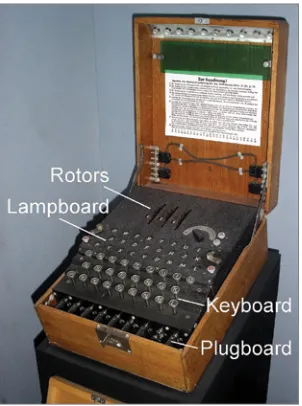
If I encrypt a message to you using some code, I may be able to send it to you with confidence—perhaps I can email it, send it by courier, or call you and read it over the phone. The problem is that the message is useless without the key to unlock it. The key could be a password, but how do I transmit that to you securely? I can’t encrypt it or it too will need a password, and so on. Even if there is no password but a method of obfuscation, such as moving all letters in an alphabet three places to the right as in the example of a Roman Caesar cypher, I still need to communicate those details to you. Even with the incredible Enigma machines used by the German military during the World War II, the receiver of the encrypted message still needed a key: the start positions of the rotors and plugboard positions (see Figure 2.2). These positions had to be encoded into code books, which became a weak link.
N O T E If you’d like to read more about the history of Enigma machines, I recom-mend Enigma, the Battle for the Code by Hugh Sebag-Montfiore (Weidenfield & Nicolson, 2000).
Figure 2.2: Military World War 2 Enigma machine