36
A Critical Evaluation of The Compatibility Between Traditional And
Contemporary Applications of
Murabahah
Transactions
Olorogun Lukman Ayinde
IIUM Institute of Islamic Banking and Finance (IIiBF)
International Islamic University Malaysia (IIUM)
E-mail: [email protected]
Abstract - The present study explores the extent of conceptual resemblance between traditional and contemporary murabahah contracts. In order to assess the discrepancies, qualitative and quantitative content analyses are applied as research methodology. In particular, discrepancies of the conceptual basis of the two contracts are evaluated by content analysis through graphical presentation. The results of this study affirm that the critique raised against contemporary contracts is indeed justified. The comparative analysis of the conceptual differences between traditional and contemporary murabahah contracts leads to the conclusion that the contemporary murabahah contract is in inverse relation to the traditional murabahah contract.
Keywords : Promise; Traditional murabahah; Contemporary murabahah; Compatibility; Islamic finance
Paper Type : Research Paper
Introduction
Wa’dmurabahahis defined as “a unilateral promise from the purchase ordering party to the institution that upon the institution making available a commodity he/she will fulfill the agreed conditions” (Fiqh Academy Resolution 5, Vol. 2). Muwa’dah is the bilateral promise of the institution and the customer. Islamic finance introduced both contracts in order to allow for modern trade financing in accordance with Islamic injunctions. A financial institution runned by Muslims and providing services to its Muslim customers which limits itself to conventional finance fails to fulfill its role as an Islamic institution if it does not offer legally permissible forms of transactions. Given the predominance of the Western financial system in the global economy, Muslims are committed to create new financial institutions in accordance with Islamic law. In addition to the creation of Islamic financial institutions (IFIs) in order to ensure permissible financial transactions, the present inequalities of distribution of wealth grounded in the capitalist system are to be minimized if not entirely eradicated.
The conventional banking system generates profit from both rich and poor populations. However, the distribution of wealth is favouring the rich who have collateral securities to guarantee repayment in case projects financed by the loan do not yield profits or are not executed. Loans are based on high interest rates which perpetuate or even increase debt and can end in bankruptcy. Since interest (riba) is prohibited in Islam, IFIs established new loaning systems which were interest-free. The fair redistribution of wealth and introduction of interest-free transactions is exercised by financing projects by way of
murabahah transactions which account for 70% of current IFI financing projects. Hegazy (2007), Masood (2010), Wiryono et al. (2011) reported the domination of Murabahah in Islamic banks‟ financing in
Indonesia. Murabahah transactions give customers the opportunity to acquire capital, such as industrial machinery, buildings, etc. on loan and pay back the cost in installments plus mark-up. The contract is made on the basis of a promise.
37
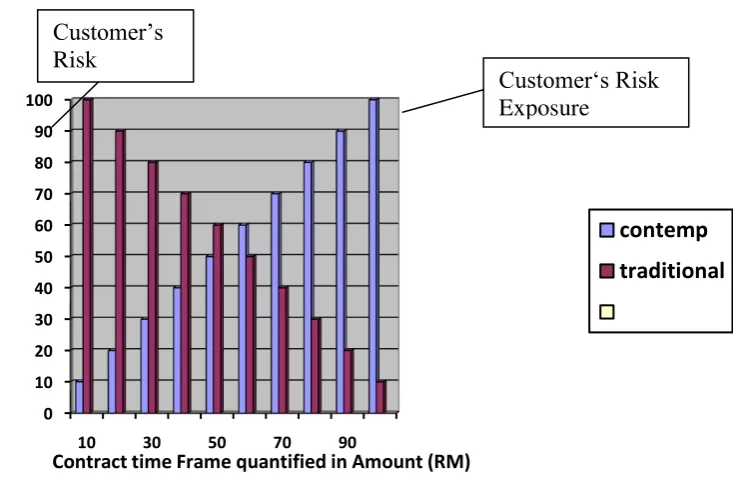
methods of analysis. The qualitative approach is based on the existing literature on the same topic area. The quantitative part of the analysis is based on content analysis, specifically the conceptual analysis of the principles underlying the traditional and the contemporary murabahah contracts. The design of a histogram graph is based on the assumed data, the actual measure being the percentage of risk exposure the customer bears in both contracts, while the curve justifies the type of the existing relationship between traditional and contemporary murabahah contracts.
Wa’d (Promise) In The Original Sources Of Islamic Law
Historically, trading is the most predominant feature of Arab nomadic culture and economy. Makkah was the commercial capital of pagan Arabia, a center for pilgrimage and annual trade fairs where all major commercial transactions took place. Traditionally, the fulfillment of trading responsibilities and promises was regarded a moral obligation and reflected in the honour and reputation of the tribesmen. Islamic tradition contains accounts of Prophet Muhammad (peace be upon him) – before his call to prophethood – making a trade agreement in the form of mudarabah with the wealthy widow Khadijah who would later become his wife. After the establishment of Islam as religion and law, some of the traditional characteristics of transactions practiced at the time were retained since they did not contradict with the Islamic principles.
Promise (Wa’d) In Qur’an And Sunnah
Exchanges of goods and services are recognized and permitted in the original sources of Islamic law. No individual or community can live completely autonomous, and humans rely on one another to cover their material needs. The geographical limitation of resources necessitates the exchange of goods, and mutual dependence upon the reliability of trade agreements foster and encourage trade which benefits both sides.
Allah the Lawgiver knows human weakness and greed, and the constant temptation of breaking a made agreement for short-term gain. He admonishes mankind to fulfill such promises: “Oh you who believe! Fulfill your trade promises …” (Al-Ma‟idah: 1). In another verse Allah says “… do not eat one another‟s
wealth unlawfully except on trade which is out of wishful of the person …” (Al-Nisa‟: 29).
Muslims are under absolute obligation to fulfill their promises, either as the promisor or the promisee, in actions and words. The Prophet (peace be upon him) said that “Muslims are on their precondition or proviso (on transactions)” (Hadith Narrated by al-Bukhari, Vol. 8/2112). However, in many transactions, one party usually has an advantage over the other party, especially in agency or representative transactions. In modern terms this is known as “information asymmetry”. For this reason there are restrictions imposed by the Prophet in the case of murabahah. The Prophet (peace be upon him) said “He who purchases something in absence among you reserves the right to accept or reject it when it is finally presented to him” (al-Darqatni, Vol. 3/8). This last tradition complies with this purchase ordering party‟s promise to buy the article in absence when advance payment is made and the customer only sees his purchase after delivery. Al-Islambuli (2003) reported al-Jassas to have said “Promise is permissible in transactions”.
The traditional practice of the early murabahah Amir bil-shira’“murabahahto the purchase orderer” is
based on trust. If a consumer lives in a remote area where a product is not available, he requests a trusted and experienced merchant to purchase it on his behalf. Also, the potential buyer relies on the merchant‟s relay of information regarding the original price of the requested article, the transportation costs for delivery, and the margin of profit charged. The classical murabahah is classified as one of the forms of sales of trust. On his side, the potential buyer gives a revocable promise to buy the ordered product upon delivery, and no deposit is required. The merchant is responsible for purchasing, transporting and delivering the product, including the risks associated (ownership risk). The ordering party‟s promise is not binding, i.e. he or she reserves the right to decline to proceed with the transaction (cancellation risk). Such a form of revocable promise is accepted as legally permissible according to most recognized schools of
fiqh. Upon delivery, the ordering party inspects the article and either accepts or rejects it (Al-Masri, 970H; Al-Qurtubi 2000; Hegazy, 2007).
Classical Juristic views on Promise on Ordering Contract (Murabahah)
In order to properly understand the legal details surrounding the traditional practice of promise in
38
The Malikite School stipulates that hoarding an article in order to sell it at a later date is not permissible in
murabaha -- save if the distance between two markets that is the distance between where it is produced and the consumers‟ market results in the delay of the sale (al-Zarqani 1936; al-Qarafi, 1994). Also, mark-up or additional profit without reasonable specification in marabahah is not permissible (Al-Qurtubi, 2000). Ibn „Abidin (2000) concluded that hoarding of a commodity with the ultimate aim of selling (murabahah) it without informing the buyer and making the deferred payment time equal to the initial procurement is preferable. Abu Thawri ascertained the permissibility of murabahah based on total truth. However, where there was fault with the article of sale, Malikite jurists conceded to the buyer the right to accept or decline the purchase (al-Tabari, 310 A.H.; al-Qurtubi, 2003 A.H.). Thus, the Malikite School was not opposed to murabahah contracts, contrary to the findings of Hegazy (2007). Similarly, the Hanafite, Hanbalite, and Shafi‟ite schools ruled in favour of the permissibility of murabahah and the profits gained thereof, on the condition that the selling party sincerely disclosed all facts surrounding the purchase beforehand (al-Tabari, 310 A.H.). Their ruling was founded on a tradition related back to Ibn Mas‟ud who had reportedly expressed his dislike of taking profit on expenses. In agreement with the latter, Ibn Musayb was reported to consent to buying an article “at ten” and selling it “at twelve” (Al -Qurtubi, 671 A.H.).
Contemporary Jurists on Promise on Ordering Contract (Murabahah)
Given the legal permissibility of murabahah in classical Islamic jurisprudence, contemporary Muslim scholars involved in developing Shari’ah compliant banking products have introduced a modern form of
murabahah transaction which has been approved by all Islamic financial institutions and has served as a mechanism for financing projects accounting for 70% of IFIs dealings (Hegazy, (2007; Masood 2010; Wiryono et al., 2011). The Bank Negara Malaysia‟s (Malaysia‟s Central Bank) Shari’ah Advisory Council resolved on its 13th meeting held on 10th April 2000 / 5th Muharram 1421 that promise (wa’d)in sale and buy-back agreements is permissible – provided that it is not stipulated as a condition for the sale and purchase of assets. In that case, a unilateral promise should be concluded which is binding to the promising party (BNM, 2007). Likewise, the AAOIFI Shari’ah Standard of 2003-2004 No. 8 2/3, 2/3/1-2/3/5 acknowledged the difference between revocable and irrevocable promises. In a revocable promise, the promising party is under no legal obligation to fulfill the promise, but his or her moral obligation to do so requires the payment of compensation. On the other hand, in an irrevocable promise the promising party is legally bound to fulfill the promise (AAOIFI, 2003-4). In short, modern jurists have agreed on the permissibility of the modern application of murabahah, yet have retained a feature close to the traditional
murabahahwhich is the buyer‟s option to revoke the promise.
Contemporary Practices of Promise (W’ad) Fulfillment of Murabahah
Despite the shared basic principles of the classical and contemporary promise of murabahah, there are differences between both practices. In the traditional practice, the ordering party asked the merchant to purchase on his behalf and promised to buy the article upon arrival (Al-Masri, 970H; Al-Qurtubi, 2000; Wiryono et al., 2011). In the present practice the buyer has full knowledge of the different components of the mark-up price, that is, the original price, shipping cost, mark-up margin, and the like. Moreover, the ordering party is considered the ultimate buyer, not the financial institution which spends the time and effort locating the desired goods and negotiating the price with the original seller (Hegazy, 2007; Masood 2010; Wiryono et al., 2011). However, it is also common practice for an IFI to appoint the murabahah
customer as the agent to negotiate and purchase from the supplier (Hegazy, 2007).
39
Critical Comparison Of The Contemporary And Traditional Promise (Wa’d) On Murabahah
A critical evaluation of the similarities and differences of the classical and contemporary usage of promise (wa‟d) on murabahah which includes both qualitative features is shown below:
Table 1. List of Salient Features of the Both Traditional and Contemporary Murabahah
Traditional Murabahah Contemporary Murabahah
1.
The customer orders a product unavailable in his or her locality.2.
The product is not in his or her capacity.3.
The customer does not know the original9.
The merchant bears all the risks of purchase and transport.6.
The customer locates, negotiates, and orders the product.Figure 1. Graphical Conceptual Features of the Traditional and Contemporary
Murabahah at 100%
The histogram depicts the inverse relationship between the merchant and customer‟s position in traditional and contemporary murabahah contracts. The traditional murabahah contract curve displays the
40
characteristics of a demand curve while the contemporary murabahah contract curve displays the characteristics of a supply curve.
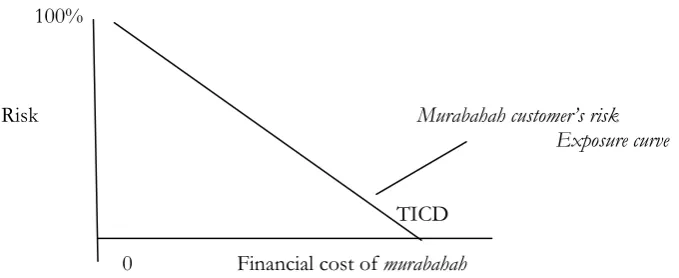
In the traditional murabahah contract the risk of the customer is minimal to the waiting period at 100%. The waiting period covers the cost incurred until delivery of the ordered article by the merchant which only cost RM10. Ibn „Abidin (2000) affirmed that – according to custom – time can be translated into monetary value. Therefore, the potential loss incurred by the customer is minimal because the merchant bears all financial burdens and risks from the beginning to the end of the transaction. The merchant‟s minimum risk exposure amounts to RM100 with a minimum time investment of 10%. This means that even though the merchant can acquire the article of sale in minimum time his potential financial loss (exposure) stands at RM100 because the customer may ultimately reject the contract. The demand curve represents the obligations imposed on the merchant in the authentic murabahah contract. In Figure 2, the Traditional Murabahah Contract Demand (TMCD) curve supports the conventional principle of demand that says “The higher the demand, the higher the price, and the higher the price, the lower the quantity demanded”. The TMCD is low, and the price changes in proportion to it.
Figure 2. Traditional Murabahah Contract Demand Curve (TMDC)
100%
Risk Murabahah customer’s risk
Exposure curve
TICD
0 Financial cost of murabahah
In contrast to the traditional contract, in the contemporary murabahah contract the risk undertaken by an IFI is minimal to the waiting period (minutes or seconds) at 10%. If an IFI is to incur any loss, it would be at a minimum level since it is the customer who bears all costs and risks from the beginning to the end of the transaction. The customer‟s financial risk exposure minimum is RM100 while the minimum time invested is 100%. If the customer can acquire the article of sale at a minimum time, it still amounts to 100% which is ten times more than what the customer bears in the traditional system. However, his exposure or financial risk stands at RM100 as the ultimate purchaser of the article. The supply curve movement is the imposed or supply-oriented transfer of responsibilities on the customer. In Figure 3, the Contemporary Murabahah Contract Supply (CMCS) curve does not support the conventional law of supply which states “The higher the supply, the lower the price” as it is expected to be but the reverse is the case here. If the CMCS curve shows the price is higher in proportion to the supply.
Figure 3. Contemporary Murabahah Contract Supply Curve (CMCS)
100% CICS
Risk
Murabahah customer’s risk
exposure
0 Financial cost of murabahah
41
Figure 3 is graphical representation of inverse conceptual relationship between contemporary and traditional murabahah contracts. The proponents of the contemporary murabahah contract argue that the protection of the investors and the IFIs is of paramount importance, while the traditional murabahah
contract is customer oriented because it protects the interests of the customers. Contemporary murabahah contracts make up 70% of the IFIs‟ financing modes which is percentage that certainly speaks for its success. On the other hand, the popularity of the contemporary model of murabahah contracts does not constitute the focal point of this research. The question is whether contemporary murabahah contracts qualify to be offered to customers under the term murabahah contracts or not. As the researcher have demonstrated above, contemporary murabahah contracts are not based on the same principles and do not offer terms similar to the traditional murabahah contracts.
The present promise (wa’d) on murabahah does not qualify as a sale of trust because the potential buyer no longer relies on the professional judgment or expertise of the seller. Also, there is no need to rely on the trustworthiness of the seller since the buyer has full knowledge of the different components of the mark-up price, that is, the original price, shipping cost, mark-up margin, and the like.
Moreover, unlike traditional murabahah where the potential buyer acts as the promising party, it is the ultimate buyer, not the IFI, who spends the time and effort identifying and locating the desired goods and negotiating the price with the original seller. It is common practice for an IFI to appoint the
murabahah customer as the agent to negotiate and purchase the goods from the supplier on behalf of the IFI. IFIs have eliminated exposure to ownership and cancellation risks to which a seller in traditional
murabahah was exposed. They are able to circumvent or shift such risks to the murabahah buyer. Hegazy (2007) states:
“IFIs are able to minimize the ownership risk by restricting the time period between the two sales [the sale from original supplier or merchant to the IFI and the sale from the IFI to the customer] to minutes, if not seconds." As an additional form of security, some IFIs require their customers to provide a third-party guaranty for the customer's performance of its obligations under the murabahah arrangement. Furthermore, IFIs tend to build into the mark-up margin the cost of insuring the goods during transportation and during the time period between the two sales, even though in practice this period typically is limited to a few minutes or even seconds”.
Ownership lasting only a few seconds legalized the contemporary promise of buy-back sale agreement. In the traditional practice of promise, the merchant and the customer know nothing concerning the good or commodity in question, and no third party acts as the agent of the merchant in the purchase of the commodity. The traditional practice of murabahah promise as developed and approved by Muslim jurists of the past has not been replaced by an equal form of contemporary practice. The contemporary model violates these basic principles and features of the traditional model. Thus, modern
Shari’ah advisors appointed by the IFIs have – undoubtedly with full knowledge and deliberation – sanctioned a model of murabahah promise and declared it permissible according to Islamic law which actually bears no resemblance to the original murabahah promise. The fact that both models bear the same name thus leads the unassuming average Muslim customer to the wrong assumption that contemporary
murabahah promise constitutes a modern equivalent to the traditional model. Critics like Hegazy (2007) further add that the IFIs‟ decision to make the promise irrevocable has been vehemently objected by a number of outspoken Muslim jurists in the form of official legal rulings (fatwas) who did not hesitate to accuse the proponents of the contemporary murabahah promise of performing a controversial juristic stratagem known in Islamic jurisprudence as amalgamation (talfiq).
42
benefit of financial institutions and their investors, perfectly agrees with the Prudent Investor Act of 1830 stated by Judge Samuel Putnum1. This Act was passed to guarantee the assurance of investors‟ returns
and constitutes part of secular capitalist legislation serving the interests of Western capitalist finance – the very same system modern Islamic finance was supposed to oppose and provide with an alternative. The Investor Act of 1830 did not regard customer protection as paramount but modern Islamic finance has been expected and supposed to ensure exactly that.
Conclusion
This study revealed that the present practice murabahah promise offered by IFIs as a permissible mode of financing is indeed not Shari’ah compliant. The comparative analysis of all elements of the contemporary usage of murabahah promise and the traditional reveals striking and disquieting differences. Classical Muslim jurists allowed murabahah promise on the condition that it constituted a revocable promise while modern IFIs have altered it into an irrevocable promise which modern Muslim scholars have declared as equally permissible. Secondly, our graphical illustration has demonstrated the 100% inverse relationship between traditional and contemporary murabahah contracts, the traditional murabahah being a demand-oriented contract while the contemporary murabahah being a supply-oriented contract. Similarly, today‟s customer risk exposure lies at 100%, while in the original murabahah contract it only amounted to 10% representing the waiting period. Since modern murabahah contracts were officially pronounced as permissible and in perfect accordance with Islamic law, the uninformed Muslim public has been grievously misled into entrusting their capital into the hands of these scholars. Many critics have continued to express the need to alter the present condition of Islamic finance and demanded the issuance of new and binding legal rulings on IFIs dealings because the presently practiced Islamic financing models bear more or less the same conventional traits as its secular capitalist counterparts. The challenge of modern Islamic finance is to achieve a viable synthesis of the traditional Islamic
murabahah contract and modern elements – without altering the basic structure and principles it was based on and was declared permissible and in accordance with Islamic law. However, in order to successfully implement this approach, IFIs and their regulators will have to show more creativity and authenticity in developing future financing models to address the particular types of risks associated with their operation. They must learn to truly and sincerely serve the interests of the communities they operate in, not merely their own
Notes:
1. The learned Judge Samuel Putnum defined in 1830 how a professional money manager should conduct
himself and stated as follows: “Those with responsibility to invest money for others should do so with prudence, discretion, intelligence, and regard for the safety of capital as well as income”. Retrieved 21st
June 2011; www.investorwords.com
References
Accounting and Auditing Organization for Islamic Financial Institutions (AAOIFI). (2003), Shari’ah
Standards (2003-2004), Kuala Lumpur: Islamic Banking and Finance Institute Malaysia Sdn. Bhd. Ahmad, Muhammad Khalil al-Islambuli. (2003), “Hukmu al-Wa‟d fi al-Fiqh Islami wa Tatbiqatihi
al-Mu‟asara”, Journal of King Abdul Aziz University: Islamic Economics, Vol. 16, Iss. 2, pp. 43-57.
Al-Bukhari, Muhammad bin Isma‟il bin „Ibrahim. (1987), Al-Jami’ al-Sahih. Based on Ibn Hajar al-„Asqalani (ed.), Cairo: Dar al-Sha‟b.
Al-Darqatni al-Baghdadi Ali bin Umar Abu al-Hasan. (1966), Sunan al-Darqatni. In al-Sayyid Abdullah Hashim Yameni al-Madni (ed.), Beirut: Dar al-Ma‟rifah.
Al-Tabari, Abu Ja‟far, Muhammad bin Jarir bin Yazid bin Kathir bin Galib al-Amali. (310H), Ikhtilaf al-Fuqahah, Dar al-Kutub al-„Ilmiyyah, www.raqamiya.org
Al-Masri, Zayn al-Din bin Ibrahim bin Najim. (970), Al-Bahr al-Ra’q Sharh Kanzu al-Daqa’q,
http://www.al-islam.com.
Al-Qurtubi, Shamsu Din Abu Abdullah Muhammad bin Ahmad bin Abi Bakr bin Farh Ansari al-Kazraji. (2003), Al-Jami’ li Ihkam al-Qur’an. In Hisham Samir al-Bukhari (ed.), Riyadh: Dar „Alim al-Kitab.
43
Al-Qurtubu, Abu Umar Yusuf bin Abdullah bin Abdul al-Barr al-Namri. (2000), Al-Istidhkar al-Jami’ li
Madhahib Fuqaha’ al-Amsar. In Salim Muhammad „Ata & Muhammad Ali Ma‟wwad (eds.), Beirut: Dar al-Kutub al-„Ilmiyah.
Al-Zarqani Sayyed MuÍammad. (1936), Sharih al-Zarqani Ala Muwata’ al-Imam Malik, Al-Maktabah al-Tijariyya al-Kubra.
Bank Negara Malaysia. (2007), Resolutions of Shariah Advisory Council of Bank Negara Malaysia.
Fiqh Academy of Makkah. (1985-1988), Resolutions of the Second Conference in Jiddah: The Fiqh Academy of Makkah.
Hegazy, W. S. (2007), “Contemporary Islamic Finance: from Socioeconomic Idealism to Pure Legalism”, Chicago Journal of International Law, Vol. 7, Iss. 2, Retrieved 8th Nov., 2010. www.questia.com
Ibn Abidin. (2000), Hashiyah Rad al-Mukhtar’Ala al-Durr al- Mukhtar Sharh Tanwir al-Absar Fiqh Hanafi,
Beirut: Dar al-Fikr li-Taba‟ah wa al-Nashr.
Laldin, M. A. (2009), “The concept of promise and bilateral promise in financial contracts: A Fiqhi perspective, ISRA Research Paper, No. 4, Retrieved on 10th Nov., 2010. www.isra.my
Masood, O. (2010), “The Rise of Islamic Finance: Two-Step Murabaha”, Malaysian Accounting Review, Vol. 9 No. 1, pp. 67-84.