Relationship of Geriatric Nutritional Risk
Index (GNRI) with length of hospitalization
and mortality rate in elderly patients
Retno Ambarukminingsih1*, I Dewa Putu Pramantara2, Neneng Ratnasari2
1Departement of Internal Medicine, Wates District Hospital, 2Departement of Internal
Medicine, Faculty of Medicine, Universitas Gadjah Mada/Dr. Sardjito Hospital Yogyakarta
ABSTRACT
The proportion of elderly population is growing faster than any other age group. Malnutrition is a widespread problem in elderly and has been recognized as the most common cause of mortality and morbidity. Mini Nutritional Assessment (MNA) is recommended to detect malnutrition risk among geriatrics. However, it is just appropriate for geriatric who stay at home. For hospitalization patients, Nutritional Risk Index (NRI) that using albumin and weight is recommended. However, the weight data is often not possible obtained in geriatrics. Therefore, Geriatric Nutritional Risk Index (GNRI) using ideal body weight is recommended. The aim of this study was to evaluate relationship of GNRI with length of hospitalization and mortality rate in geriatric patients. This was an observational study with a prospective cohort design conducted in Dr. Sardjito General Hospital, Yogyakarta from January to February 2012. Patients who met the inclusion and exclusion criteria were recruited. Laboratoty and clinical examinations as well as GNRI scoring were then performed. Patients were grouped into two groups i.e. patients with GNRI score < 82 and e” 82. The patients were then monitored during hospitalization until they were discharged due to die or recovered. The length of stay and patients died were then recorded. The results showed that the length of stay of patients with GNRI score < 82 (14.32 ± 8.20 days) was significantly longer than those with GNRI score82 (9.31 ± 6.15 days) (p = 0.006). Moreover, the mortality rate of patients with GNRI score < 82 (42.1%) was significantly higher than those with GNRI score82 (2.8%) (p = 0.000). Kaplan-Meier survival analysis showed survival rate of patients with GNRI score <82 rapidly decreased when compared with those with GNRI score 82. In conclusion, there is negative correlation between GNRI with length of hospitalization and mortality rate in elderly.
ABSTRAK
Proporsi populasi usia lanjut tumbuh lebih cepat dari kelompok usia lain. Malnutrisi menjadi masalah luas pada usia lanjut dan diketahui sebagai penyebab umum kesakitan dan kematian.
GNRI < 82 (14,32 ± 8,20 hari) lebih lama dibandingkan dengan pasien dengan angka GNRI e” 82 (9,31 ± 6,15 hari) (p = 0,006). Selain itu, tingkat kematian pasien dengan angka GNRI < 82 (42,1%) lebih tinggi secara nyata dibandingkan pasien dengan angka GNRI 82 (2,8%) (p = 0.000). Hasil analisis survival dengan Kaplan-Meier menunjukkan survival rate pasien dengan GNRI < 82 menurun cepat dibandingkan pasien dengan angka GNRI 82. Dapat disimpulkan, ada hubungan terbalikkan antara GNRI dengan lama tinggal di rumah sakit dan angkat kematian pada usia lanjut.
Keywords : Geriatric Nutritional Risk Index length of hospitalization mortality – elderly -malnutrition
INTRODUCTION
The proportion of elderly population is growing faster than any other age group. It is estimated that the elderly population, person 65 years or older, will grow four time faster than the average of world population growth in 2050. This demographic transition occurs due to the decrease mortality and women fertility rates.1,2
Malnutrition is a widespread problem in the elderly and has been recognized as the most common cause of secondary immunological dysfunction.3Malnutrition has the potential to
cause serious problems and is often under-diagnosed among the elderly. The importance of early detection and aggressive intervention is essential to overcome this problem. Correct diagnosis depends on the status of nutrition and the screening tools available. After malnutrition was diagnosed, we can determine intervention to the underlying problem.4
Some guidelines recommend the use of the Mini Nutritional Assessment (MNA) to detect risk of malnutrition among elderly subjects aged >70 years. The MNA assessment is based on a questionnaire and does not use a biological indicator.5 Because of the questionnaire’s
natural bias, MNA is more suitable for elderly who live at homes or nursing homes than during hospitalization. For adult patients who were hospitalized, it is recommended to use a combination of Body Mass Index (BMI, in kg/
m2) and weight loss or Nutritional Risk Index (NRI). Nutritional Risk Index combines two indicators of nutrition (albumin and weight loss), unfortunately it is often not possible to obtain the data of body weight in elderly patients. Therefore, the formula of Geriatric Nutritional Risk Index (GNRI) using ideal body weight (BW) should be prepared. Ideal BW is calculated according to the Lorentz formula that takes the patient’s height and gender into account. Height is difficult to measure in patients who are hospitalized because they are often unable to stand. Therefore, it is estimated using the equation based on the high Chumlea knee (Knee height).6,7
There is a difference between the risk index related to nutritional status and indices of nutrition and malnutrition. Geriatric Nutritional Risk Index is not an index of malnutrition, but it is risk index that related to nutritional status. Therefore, GNRI score corelates to complicat-ions due to nutritional status.6 The GNRI has been introduced since 2005 as early screening in patients with malnutrition high risk.8
MATERIALS AND METHODS
Subjects
This was an observational study with a prospective cohort design to evaluate the mortality rate and length of stay of elderly patients who admitted to the Internal Medicine Ward, Dr. Sardjito General Hospital, Yogyakarta and met the inclusion and exclusion criteria. The study was conducted from January to February 2012. The inclusion criteria were elderly patients (e” 60 years) admitted to the Internal Medicine Ward who were willing to participate in the study, whereas the exclusion criteria were the patients with severe liver disease, severe renal disease, coma patients, patients coming for chemotherapy, and patients who went home at their own or family request. The protocol of this study has approved by Medical and Health Research Ethics Committee, Faculty of Medicine, Universitas Gadjah Mada, Yogyakarta.
Procedure of study
Geriatric patients who admitted to the Internal Medicine Ward were selected. An explanation concerning background, objectives, benefit of the study was given. The patients who fulfilled the inclusion and exclusion citeria were given an informed consent to be signed. Laboratoty and clinical examinations consisting serum albumin and hemoglobin (Hb) level, body weight (BW) and body height (BH), Body Mass Index (BMI), knee height, upper arm circumference, depression status, and GNRI scoring were then performed. The patients were then monitored during hospitalization until they were discharged from the hospital due to died or recovered. The lenght of stay and patients died were recorded.
The measurement of serum albumin (g/dL) and Hb (g/dL) levels were performed in
Hospital. Body weight (kg) and BH (cm) were measured a portable stadiometer. For non ambulatory patients, estimation of their BW was performed by measurement of their upper arm circumference. For patients who could not be measured their BH, estimation of their BH was performed according to the Chumlea equation based on their knee height. The BMI of patients was measured by the formula of BW divided by BH and calculated as kg/m2 according to
WHO.9For non ambulatory patients, BMI was
calculated according to the Powell-Truck formula. Depression status of the patients was performed by an independent physician according to the Diagnostic and Statistical Manual IV - Text Revision (DSM IV-TR). Comorbidity Index was calculated based on patient’s diagnosis. For each desease, a number of points were allocated according to Charlson Comorbidity Index and the sum of these points gived an overall score. The Comorbidity Index indicating risk relative to mortality was then categorized into two groups i.e. patients with Charlson score of3 and > 3.
GNRI was determined by the following formula: GNRI = (1.489 x albumin g/L) + (41.7 x weight/ideal BW).6Severe renal impairment
was defined if creatinine clearance <15 mL/h according to the Cockcroft and Gault. Severe hepatic impairment was defined if clinical symptoms of liver impairment such as jaundice, hepatomegaly or ascites were observed. Patient was considered to have ascites if Child-Pugh scale was grade C or total score of 10-15.10
Statistical analysis
RESULTS
Sixty elderly patients who met the inclusion and exclusion criteria involved in this study. All the patients underwent anthropometric and laboratory examination as well as GNRI measurement. The patients were then monitored their health status during hospitalized until they died or came back home from the hospital. During the monitoring, five patients could not follow the obseravtion and dropped out of the study, therefore only subjects completed this study.
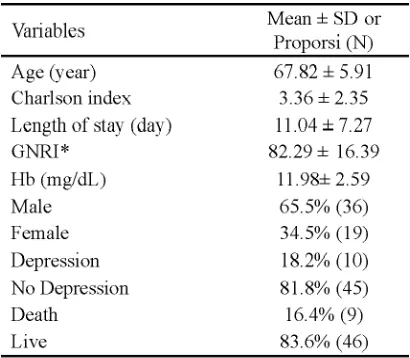
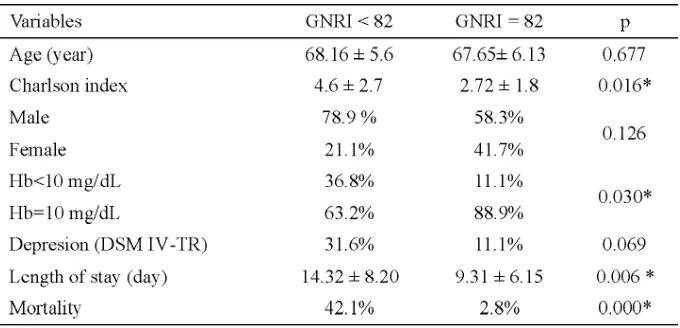
The characteristics of patients are presented in TABLE 1. Thirty (65%) male and 19 (34.5%) female subjects were recruited in this study with the mean age of 67.82 ± 5.91 years, Charlson Cormobidity Index of 3.36 ± 2.35 and length of stay of 11.04 ± 7.27 days. The mean GNRI and Hb level of subjects were 82, 29 ± 16.39 and 11.98 ± 2.59 mg /dL, respectively. Among 55 patients who completed this study, 10 (18.2%) had depression and 45 (81.8%) patients had no depression. In addition, nine (16.4%) patients died and 46 (83.6%) patients came back home. The characteristics of patients based on the GNRI score is presented in TABLE 2. It was showed that the mean age subjects with GNRI score <82 (68.16 ± 5.6 years) was not significantly different with those with GNRI score 82 (67.65 ± 6.13 years) (p = 0.677). No significant difference was also observed in gender of subjects (p = 0.126) and in subjects with depression (p = 0.069) between the two
TABLE 1. Characteristics of subjects
*GNRI: Geriatric Nutritional Risk Index
TABLE 2. Subjects’ characteristics based on GNRI value
Length of stay of subjects in the hospital based on the characteristics of subjects is presented in TABLE 3. Length of stay of subjects was influenced by depression and GNRI value, however it was not influenced by gender and Hb value. Subjects who experienced depression (14.40 ± 4.20 days) had longer length of stay
than those who not experienced depression (10.29 ± 8.20 days) (p = 0.003). In addition, subjects of group with GNRI <82 (14.32 ± 8.20 days) had longer length of stay than those in group with GNRI82 (9.31 ± 6.15 days) (p = 0.006).
TABLE 3. Length of stay of geriatic patients in the hospital
The correlation between characteristics of subjects and length of stay in hospital is presented in TABLE 4. No significant correlation was observed between length of stay in hospital with age, Charlson index, gender,
TABLE 4. Correlation between the length of stay in hospital and characteristics of geriatric patients
FIGURE 1. Relationship between length of stay and GNRI
The characteristics of geriatric patients accordint to mortality are presented in TABLE 5. The age, gender and depression status were not significantly associated with mortality in
geriatric patients (p > 0.05). However, the mortality in the geriatic patients significantly associated with their Charlson index, Hb and GNRI values (p < 0.05).
TABLE 5. Factors related to mortality rate of subjects
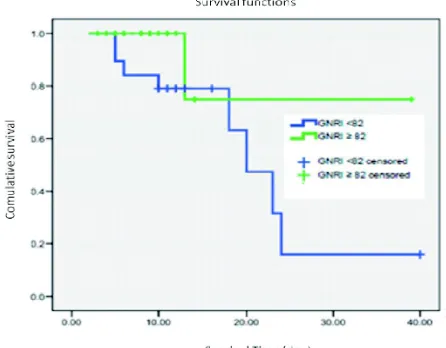
Survival rate for patients based on GNRI group can be seen on the Kaplan-Meier curves as presented in FIGURE 2. Patients with GNRI
FIGURE 2. Kaplan-Meier survival analysis of patients with GNRI < 82 and > 82.
DISCUSSION
This study showed that the length of stay of subjects was influenced by depression and GNRI value, however it was not influenced by gender and Hb value. Subjects who experienced depression (14.40 ± 4.20 days) had longer length of stay than those who not experienced depression (10.29 ± 8.20 days) (p = 0.003). In addition, subjects of group with GNRI <82 (14.32 ± 8.20 days) had longer length of stay than those in group with GNRI > 82 (9.31 ± 6.15 days) (p = 0.006).
Previous study conducted in Sanglah Hospital, Bali found a negative correlation between GNRI scores and the length of hospitalization.11Moreover, a study in geriatric
patients hospitalized in France also showed the relationship between the length of hospitalizat-ion and GNRI.12However, these results is not
supported with other study that reported no significant correlation between the length of hospitalization and GNRI.13
Consistent with this study, a study conducted in Queen Elisabet Geriatric Center, Victoria reported no significant difference in the length of hospitalization was observed between male
and female geriatric patients.14In contrast with
this study, a significant association between Hb level and the length stay in patients undergoing operations was observed.15,16 This difference
may be caused the difference of patients observed.
This study also showed that the mortality rate was influenced by Charlson index, Hb and GNRI values, however it was not influenced by age, gender and depression status. The mortality rate of patients with GNRI score < 82 (42.1%) was significantly higher than those with GNRI score > 82 (2.8%) (p = 0.001). In addition, the mortality rate of patients with Hb value < 10 mg/dL (36.4%) was significantly higher than those with Hb value > 10 mg/dL (11.4%) (p = 0.045). The mortality rate of patients with Charlson index < 3 (36.4%) was also higher than those with Charlson index < 3 (3.0%) (p = 0.002).
Consistent with this study, a prospective observational study involving 358 elderly newly admitted to a long-term care setting in Italy reported nutritional risk by GNRI, but not nutritional status by MNA, was associated with higher mortality risk.17 Other studies also
showed the relationship between GNRI and mortality in hospitalized elderly patients.6,12
As found in this study, the presence of comorbidities has been known to worsen the prognosis of patients. Charlson index has been evaluated in numerous studies as a predictor of mortality in the future.18,19
In contrast with this study, a study conducted on heart bypass surgery patients showed that patients with Hb < 10 mg/dL showed postoperative mortality rate in the hospital 10 times higher than those with Hb > 10 mg/dL. In addition, low Hb level, severity as well as comorbidity is a major determinant of patients survival.20Another study conducted in anemia
rate than those without anemia with a 4-fold relative risk.21
Number of male patients who died were higher than female patients in this study, although it was not significantly different. Some studies gave different results regarding the relationship of gender with mortality rate. A study conducted in Japan showed that male patients had a greater risk for death than women.22Another study in
elderly patients who suffered from a hip fracture showed that female gender was an independent and significant risk factor for mortality. However, other studies found no differences between the sexes.23
Geriatric patient with depression had higher mortality rate than those without depression in this study, although it was not significant different. Studies in patients with cardiac symptoms showed that mortality at 2-year folow-up was higher in patients with depression.24The difference is probably due to
the research subjects or the difference of duration of folow up.
CONCLUSION
In conclusion, there is negative correlation between GNRI with length of hospitalization and mortality rate in elderly who admitted to the Internal Medicine Ward in the hospital. Further study with a larger subjects and a wider range of cases should be encouraged. In addition, elderly patients with GNRI score < 82 should get improved nutrition therapy to reduce the length of stay and mortality rate.
ACKNOWLEDGEMENTS
We would like to thank Head of Department of Internal Medicine, Faculty of Medicine/Dr. Sardjito General Hospital, Universitas Gadjah Mada, Yogyakarta for his permission to conduct this study. We would also like to thank all elderly patients and their families who have participated and supported in this study.
REFERENCES
1. United Nations, Department of Economic and Social Affairs (DESA), Population Division. World Population Ageing: 1950-2050. New York: United Nations, 2009.
2. United Nations, Department of Economic and Social Affairs (DESA), Population Division. World Population Ageing 2013. New York: United Nations, 2013.
3. Law DK, Dudrik SJ, Abdou NI.
Immuno-competence of patients with protein calorie malnutrition. The effect of nutritional repletion. Ann Intern Med 1973; 79(4):545-50.
4. Hajjar RR, Kamel HK, Denson K. Malnutrition in aging. Int J Geriat Gerontol 2004; 1(1): 1-5. 5. Guigoz Y. The Mini Nutritional Assessment
(MNA®
) review of the literature – What does it tell us? J Nutr Health Aging 2006; 10(6):466-87. 6. Bouillanne O, Morineau G, Dupont C, Coulombel I, Vincent JP, Nicolis I,et al. Geriatric Nutritional Risk Index: A new index for evaluating at-risk elderly medical patients. Am J Clin Nutr. 2005; 82(4):777-83.
7. Cereda E and Pedroli C. The use of the Geriatric Nutritional Risk Index (GNRI) as a simplied nutritional screening tool. Am J Clin Nutr 2008; 87(6):1966-7.
8. Cereda E, Pusani C, Limonta D, Vanotti A. The association of Geriatric Nutritional Risk Index and total lymphocyte count with short-term nutrition-telated complications in institutionalised elderly. J Am Coll Nutr 2008; 27(3): 406-13.
9. Expert Consultation WHO. Appropriate body-mass index for Asian populations and its implications for policy and intervention strategies. Lancet 2004; 363(9403):157-63. 10. Pugh RN, Murray-Lyon IM, Dawson JL, Pietroni
MC, Williams R. Transection of the oesophagus for bleeding oesophageal varices. Br J Surg 1973; 60(8):646-9.
11. Andriyasa K, Kuswardhani T, Aryana IS, Astika N, Putrawan IB. Korelasi antaraGeriatric Nutritional Indexdengan lama rawat pasien geriatri di Rumah Sakit Sanglah, Denpasar. J Peny Dalam 2011; 12:115-20.
13. Gómez JJL, Casariego AV, Laranjo CB, Vicente EF, García RM, Rodríguez IC,et al. Screening of the nutritional risk in elderly hospitalized patients with different tools. Spain: León. Sección de Endocrinología y Nutrición, Complejo Asistencial Universitario de León. 2011.
14. Hubbart WA. Rehabilitation outcomes for elderly lower limb amputees. Austr J Physiother 1989; 35(4): 219-24.
15. Wang X, Rintala DH, Garber SL, Henson HK. Association of hemoglobin level, age and comorbidities with rehabilitation outcomes after total knee replacement. Am J Phys Med Rehabil 2005; 84(6):451-6.
16. Burr RG, Peace CL, Nuseibeh I. Haemoglobin and albumin as predictor of length of stay of splinal injured patients in a rehabilitation centre. Paraplegia 1993; 31(7): 473-8.
17. Cereda E, Pedrolli C, Zagami A, Vanotti A, Piffer S, Opizzi A, et al. Nutritional screening and mortality in newly institutionalised elderly: A comparison between the Geriatric Nutritional Risk Index and the Mini Nutritional Assessment. Clin Nutr. 2011; 30(6):793-8.
18. Murray SB, Bates DW, Ngo L, Ufberg JW, Shapiro NI. Charlson index is associated with one-year mortality in emergency department patients with suspected infection. Acad Emerg Med 2006; 13(5):530-6.
19. Charlson ME, Pompei P, Ales KL, MacKenzie CR. A new method of classifying prognostic comorbidity in longitudinal studies: development and validation. J Chronic Dis 1987; 40(5):373-83.
20. Zindrou D, Taylor KM, Bagger JP. Preoperative haemoglobin concentration and mortality rate after coronary artery bypass surgery. Lancet 2002; 359(9319):1747-8.
21. Reinecke H, Trey T, Wellmann J, Heidrich J, Fobker M, Wichter T,et al. Haemoglobin-related mortality in patients undergoing percutaneous coronary interventions. Eur Heart J 2003; 24(23):2142-50.
22. Haraguchi Y, Osaki Y, Mazume M, Kishimoto T, Yakura N, Okamoto M. Risk factors for death among the functionally independent elderly living in Japan: a 3-year prospective cohort study. Yonago Acta Med 2006; 49:93-101
23. Ozturk A, Ozkan Y, Akgöz S, Yalçýn N, Özdemir RM, Aykut S. The risk factors for mortality in elderly patients with hip fractures: postoperative one-year results. Singapore Med J 2010; 51(2):137-43.
24. Rutledge T, Reis SE, Olson M, Owens J, Kelsey SF, Pepine CJ,et al. Depression is associated with
cardiac symptoms, mortality risk, and