453
DEVELOPING INSTRUCTIONAL MATERIALS COMPLEMENT OF SET
BASED ON INDONESIAN VERSION OF REALISTIC MATHEMATICS
EDUCATION IN 7
thGRADE OF JUNIOR HIGH SCHOOL
Thyas Agie1, Ratu Ilma Indra Putri2
Sriwijaya University1 , 2
[email protected], [email protected]2
Abstract
This study aims to development assessment instrument in Indonesian version of Realistic Mathematics Education (PMRI) with the material is a complement of a set and
difference of two sets in student’s book form where the student’s book is valid, practice,
and must have potential effect. The methodology used in this study is development research where there are analysis, design, evaluation, and revise. This form of research consists of self evaluation and prototyping. The college data were using observe, test, and documentation. The subject of this study is 31 students in 7th grade of SMPN 1
Palembang. Expert review and documentary analysis were used in collecting data. For
evaluating process, observation sheet, learning log, the use of student’s strategy and
solution from the result of their achievement. The collected data were analyzed using qualitative descriptive. The findings show that assessment instruments in PMRI in the topic special a complement of a set and difference of two set. Could be categorized as valid, practical, and effective. The validity is measured by using the aspects of contents,
construction, and language based on assessment’s principles of PMRI. Based on the
expert comments, the assessment instruments developed can be practically in the teaching learning process. The result of this study is the student is very happy and enthusiastic in their study. And then the students show positive attitude in mathematics study. It can saw from their commenter and the result of observe. The effect potential shows that 12 students have very good category and 14 students have good category, so
it can call student’s understanding of concept is good.
Keywords: Development research, Set, PMRI
INTRODUCTION
Mathematics is one of subject which is passed to student since elementary until high school. In KTSP compiled in such a manner later the student can own ability think logical, analysis, systematic, critical, and creative so that later all educative competitor able to compete and adapt. According to Nila (2008) saying that one of mathematics material which is a lot of used in life is set. And then set also represent basic concept from mathematics. Fact that happened in set material study is the presentation is too abstraction especially at difference of two sets and complement. Same thing meet in SMPN 1 Palembang, the school use student's book with publisher of erlangga and directorate Jakarta.Book used still too the abstraction even erlangga book not early use existing real context in life. Others in used student book, the book have direct give congeniality from the items students do not given a break to release their opinion. Somakim (2009) also suggest that can develop book of mathematics base on realistic mathematics education.
454
To handle problem, researcher try to develop a student's book with PMRI approach. With PMRI approach student book later do not become abstraction because by using this PMRI student given their opinion to find the mathematics conception with teacher guided by constructivist. To come to the invention the concept and formula of mathematics do by activity of investigation so that the educative competitor will learn informally to tip of formal form (Hadi, 2005).
Somakim (2009) saying that activity of conventional study result the happening of memorization process conception or procedure, understanding of mathematics concept become to lower effect of the conventional study is that student in learning the mathematics more aimed by a process memorize from comprehending concept. According to the mentioned of researcher will develop teaching items yielding student book product base on PMRI. according to the background, so we can find the question research is how developing instructional materials of set based on Indonesian version of realistic mathematics education in 7th grade of junior high
school and how the potential effect to understanding of concept in SMPN 1 Palembang?
DEVELOPING MATERIAL
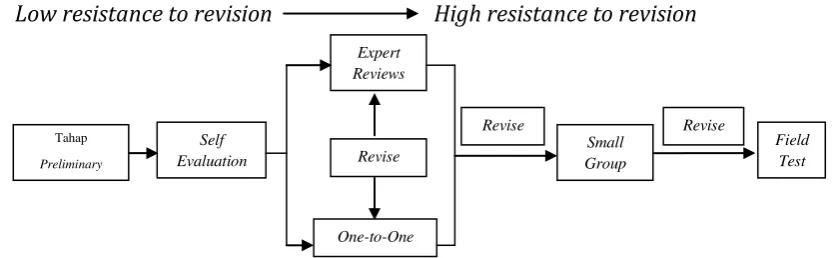
According to Gravemaijer in Misdalina (2009:64) development is process or way of deed to develop a substance to be tested step by step and regular so that can yield better result again. Tessmer (1993) in Zulkardi (2006:56) by explicit define formative evaluation as consideration (hitting strength and feebleness of substance teach in growth phase) review of substance teaches to increase effectiveness and fascination. There are 4 step in formative Evaluation, that is: 1.) Expert Review: Expert evaluate substance teach with or without evaluator. 2.) One To one: one student at one time evaluates substance teach by evaluator and give [his/its] comment. 3.) Small Group: evaluator try substance teaches with a group of student and note appearance and comment. 4.) Field test: evaluator perceive substance of teaching which test in situation that of real with a group of educative competitor.
INDONESIAN VERSION OF REALISTIC MATHEMATICS EDUCATION
One of approach study which is start from real context problem where student by their self to find the understanding of concept is Realistic Mathematics Education (RME) which now we have Indonesian version of realistic mathematics education (PMRI). Hadi (2005) say that since year 1971, institute Freudenthal develop a theoretical approach to study of mathematics recognized by RME (Realistic Mathematics Education), RME combine view about what is mathematics, how the student learn mathematics, and how mathematics have learned. Introducing RME is Hans Freudenthal from Holland who say mathematics is human activity which is student activity, finding and develop; building by their self the knowledge that is needed so that the study become to bent the mind to by student. In PMRI the students give chance to find their mathematics conception with teacher guided by constructivist.
455
teacher telling') and in the end use that mathematics to finish problem of either through individual and also group.
Zulkardi And Ilma (2010: 11) say that PMRI as according to Principle RME 1.) Guided Reinvention and Didactical Phenomenology, 2.) Progressive Mathematization 3.) Self Developed Models. According to (de lange, 1987, 1996, Treffers 1991; Gravemaijer 1994) in Zulkardi (2010:5) There are 5 characteristic PMRI that is: 1.) Using Problem contextual, 2.) Using Bridge or Model by Instrument Vertical, 3.) Using student contribution, 4.) Interactivities and 5.) Intertwined.
RESEARCH METHOD
This research is development research (Akker, 1999) which the material development using 2 step, that is preliminary and formative study.
Low resistance to revision High resistance to revision
Diagram 1. Flow charts of Formative Evaluation (Tessmer 1993 in Zulkardi 2006)
This research is executed at even semester 2012/2013 in SMPN1 Palembang class VII.1 with 31 students.
No Collecting Data Analyze Data
1. Documen Data from One to One, and Small Group
2. Walkthrough From expert Review
3. Observation Analyze student activity when field test
4. Student’s book result Analyze result from
student's book
5. Exercise Analyze exercise when field test
6. Test Analyze test when field test
7. Documentaries Analyzed as additional data to support observation.
Table 1. Technique Collecting Data and Analyse Data
RESULT AND DISSCUSION Development student’s book
This research there are 2 big step that is Preliminary and the Formative Study, like that: Preliminary, this step is analyzing student, analyze curriculum, and analyze material. Formative study, this step is self evaluation and prototyping.
Expert Reviews
Revise
One-to-One
Revise
Small Group
Revise
Field Test Self
Evaluation
Tahap
456 First Prototype
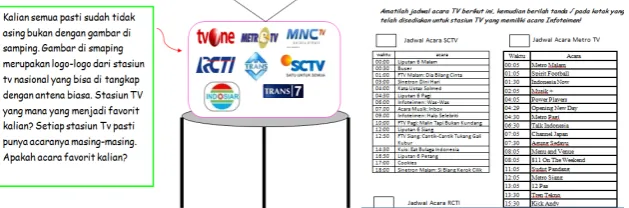
From result of self evaluation obtained by draft of book of student using approach of PMRI which aim to measure ability of student as first prototype. First prototype focused content, construct, and Language. Example of student's book at first prototype is
Figure 1. Student’s Book at First Prototype
Expert Review
This step in first prototype is student's book validated by mathematics teacher and expert. This step aim to get valid material instruction. And then the first prototype validated content, construct, and Language. Process validating expert ( expert review) using Walk through method, where prototype given to the expert and then one by one validated by expert.
No. Validator Suggestion / comment
1.
Nasrullah, M.Pd
Change sentence of second question in first student's book
in fourth problem in first student's book don't start with word of set.
in the first exercise there are wrong words and try to make problem which is the solution use diagram Venn.
in the second student's book problem no 3, what is the difference blue box and the question in yellow box?
2.
Farida
Nursyahidah, M.Pd
Change the sentence of the problem which is related to conclusion from complement.
At problem 5 and 7 there are typing mistake.
At the second student's book question 4 decomposing become 3 questions.
Check Ianguage in problem.nguage in problem.
3.
Christy Matitaputhy, M.Pd
the Context in the first student’s book there must be in RPP as motivation to start learning set or be a introductory.
Limit the schedule in list of station TV schedule.
At first problem in first student's book give the list of station TV name so, they can answer the first and second problem .
457
At ninth problem in first student's book asking their conclude. From their thinking, the student instructed to comprehend order and simbol in set.
Change problem evaluate to become exercise
The second problem in excsrcise is better be ordered to draw Venn.
Change the sentence the second problem from second student's book.
Table 2. Result of Validating Expert
One to One
The first prototype had test to 2 students seventh grade class. The students becoming object are Rischka Salsabila Maulini from SMPN 1 Palembang, and M. Fayad from SMP Al - Furqon Palembang. one to one use to see difficulty that happened during process of study when the students use student's book.
Revise
According to the suggestion from expert review and one to one, so the student's book at this first prototype revised to obtain get the material is better and to be the second prototype.
Second Prototype
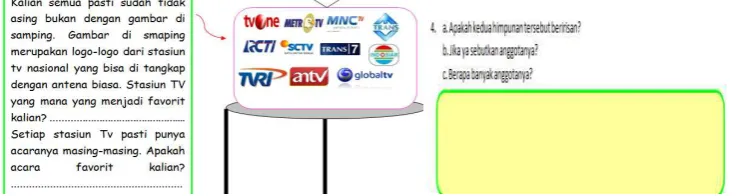
The result from One to one and expert review made basis for revise first prototype become prototype second. From The picture second prototype have giving space for the student answer and some sentence which wrong repaired by according to suggestion from validate.Following is the second prototype:
Figure 2. Appearance second picture
Small Group
Small group is doing in SMPN 1 Palembang using 6 students from class 7.2 and 7.3 owning heterogeneous ability. In this step they work together to finishing the student’s book. See there is no difficulty when they do student's book. And then the researcher revises according to result from small group.
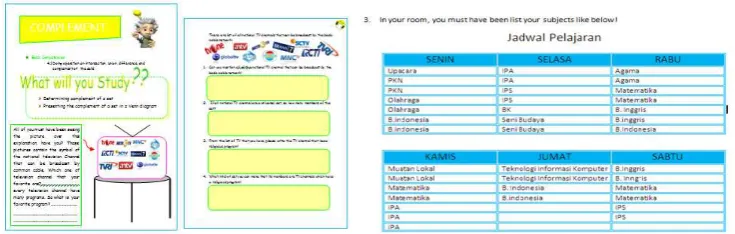
Third Prototype
458
Figure 3. Design Third Prototype
Field Test
After third prototype was born which practical and valid. Field test is use to see potential effect to understanding concept. Field test executed on 13 - 14 February 20013 in class VII. 1 SMPN 1 Palembang amounting to 31 students who divided to become 13 heterogeneous group which have member 2 until 3 people. Learning executed during 2 times meeting.
Analyzed observation
Result of research from observation sheet to know process of study use PMRI approach. In the following the tables of score process study of student use PMRI approach.
No Indicator Mean of Score Obtained At Meeting To Maen
I II
1 Use Real Context 91,39 86,02 88,70
2 Vertical Instrument Use ( Schema, Model, Scheme)
86,02 88,17 87,09
3 Use the Result Student
Work and Construction. 82,79 89,24 86,02
4 Interactivities 87,09 79,03 83,06
5 Intertwine 41,93 40,32 41,12
Table 3. Student Study Process Seen From Each Indicator
From the table we can see that intertwined has the low score. That happened because the student’s book developed without intertwined for other subject.
The Result of Third Prototype Test to See Understanding of Concept
Score Frequency Category
80 – 100 17 Very good
66 – 79 14 good
459
From the table we can see that there are 17 students who get very good category for their understanding of concept and there are 14 students who get good category for their understanding of concept. The 14 students get goo category because in their test, they are get the low score. Many of them forget to write what known from the question.
SOLUTION
Principal and Characteristic PMRI by Prototype
Principal PMRI: Guided Reinvention
Through station TV student subject and context given a chace to do mathematization. Here the student build her knowledge about difference two set and complement. the student guided to go to understanding about difference two set.
Progressive Mathematization
This process the student which given by a real context problem related to station TV which later reach formal storey level about difference two set and complement. Self – Developed models
In this step the student develop model by their self from context which have been given. Students develop their knowledge either through individual and group.
Characteristic PMRI: Use Of Context
In this research the context is station TV and lesson which they learn at school. The Real problem within call with student life so that assist student to comprehend difference of two sets and complement concept.
Using Model or Bridge with Vertical Instrument
Student instructed in developing model, scheme, diagram, and the symbolizing. In this case student instructing to comprehend symbol - symbol which exist in complement and difference two sets. Student also instructing to understanding diagram Venn.
Use Student’s Contribution
Student work in group and individual. They conclude meaning of complement and difference two set with their Language. And answer the question by the understanding of their concept. After they discuses with their group so some group present their answer.
Interactivity
This student's book designing in order to can be discuses in the group. Seen at the learning in class, student work together and discussion of class where student unite mind in order to get the correct understanding. So that from discussion of group and discussion of class seen by existence interactivities.
Intertwined
460 CONCLUSION
According to the result and the solution, so we can conclusion that:
Developed material of set in junior high school use PMRI approach is valid according content, construct, and language. And practice to use the students.
From the field test the material of set have the effect potential :
Student is active follow study by using PMRI approach, it can see from the result of observation.
Result of final value of student to understanding of concept is equal to 17 student getting very good category for their understanding of concept, 14 students getting good category for their understanding of concept. The 14 students who get score with good category because they get low score from exercise and test, and many of them get low score because they didn’t write what is the know from the question, they
didn’t use previous concept to answer the question. So understanding of concept the
students by using PMRI approach is very good. So it can call that the student’s understanding of concept is good.
SUGGESTION
According to the conclusion and result of above research, hence the researcher can suggest for Teacher, must try student to always propose reason in each every study in order to more earn creative. For student, in learning to use student's book base on PMRI is expected can more active in study others shall be more can accustom to give a conclusion to a concept. For other researcher, expected to earn design student’s book with the intertwined of other material items learned with other dissimilar Lesson.
REFERENCES
Akker, J. v. d. (1999). Principle and Methods of Development Research dalam J. v. d Akker (Ed). Design Approaches and tools in Education Training. London : Klower Academic Publishers.
Kusumawati, Nila. (2008). Pendekatan Matematika Realistik Indonesia Pada Materi Himpunan. Makalah disampaikan dalam Seminar Nasional Penelitian Pendidikan
dan Penerapan MIPA Yogyakarta, 30 Mei 2008 di Yogyakarta.
Misdalina, Zulkardi, Purwoko . (2009). Pengembangan materi Integral Untuk Sekolah Menengah Atas (SMA) Menggunakan Pendekatan Pendidikam Matematika
Realistik (PMRI) di Palembang dalam Jurnal Pendidikan Matematika No 1 Vol 3.
Palembang: PPs Pendidikan Matematika Universitas Sriwijaya.
Somakim. (2009). Peran Konteks dalam meningkatkan kemampuan Berpikir Kritis Matematika Siswa (Tinjauan Pengembangan Konteks Kesebangunan Berbasis
Matematik Realistik). Dalam Seminar Nasional Pembelajaran Matematika
Sekolah, pada tanggal 6 Desember 2009 di Yogyakarta.
Zulkardi. (2006). Developing A learning Environment On Realistic Mathematics Education For Indonesian Students Teacher. Disertasi.
Zulkardi dan Ilma. (2010). Pengembangan Blog Support untuk membantu siswa dan Guru Matematika Indonesia Belajar Pendidikan Matematika Realistik Indonesia
(PMRI). Palembang:Unsri
This paper can be cited as Zulkardi(2013). Proceeding The First South East Asia Design/Development Research (SEA-DR) International