!!"#$%&&'()*!$+!!,)-&#).-($)./!0$)+&#&)%&!1)!2&3&.#%45!,67/&6&)-.-($)!8)'!9':%.-($)!! 1+!;.-4&6.-(%3!8)'!<%(&)%&3!=>?@5!A$*B.C.#-.!<-.-&!D)(E(-B5!?FG=>!;.B!=>?@!
!
!
ME-69Development of Interactive Learning Media Based Lectora Inspire in Discrete Method Course
Alfensi Faruk
Sriwijaya University email: [email protected]
Abstract
This study aims to (1) produce a valid and practical interactive learning media based Lectora Inspire in a discrete method course, (2) see the effects of the developed learning media to the studentsÕ learning outcome in a discrete method class. Research and development, which consists of five stages: pre-development, pre-development, evaluation, field test, and revision, was implemented in this study. The developed interactive learning media was tested against 23 students of discrete method class in the Department of Mathematics, Faculty of Mathematics and Natural Science, Sriwijaya University. The results of the analysis are: (1) based on the evaluation of the experts and the perceptions of the students, the interactive learning media which has been developed was valid, practical, and highly recommended to be used as a source of studentÕs self-learning in discrete method courses, (2) the interactive learning media which has been developed was effective to increase studentsÕ learning outcome.
Keywords: Interactive learning media, lectora inspire, discrete method
1. Introduction 1.1. Background
Discrete method is one of the compulsory course in Department of Mathematics, Faculty of Mathematics and Natural Science, Sriwijaya University. Based on the data at the end of the even semester of academic year 2012/2013, the studentsÕ average score on that course is still low. It happened due to the lack of the studentsÕ motivation and understanding of the course materials. In addition, the teaching and learning process in this course still used conventional learning media such as books, modules, and static power point file (ppt without animations). Therefore, an interactive learning media that can create a two-way interaction between the students with the media and the learning resources is needed in the studentsÕ learning process.
The ability of Macromedia Flash, which can make various interesting animations, has made the software became popular in the development of interactive learning media. Some examples are the works by Garcia et al. (2005), Luthfi & NafiÕ (2011), and Safitri et al. (2013). Interactive learning media are not only developed by using Macromedia Flash but also by using any other computer software, some example works are by Korakakis et al. (2009) who develop an interactive computer application to support the learning process for students in the 8th grade, and Khalid et al. (2010) committed a study to know the effect of work group method and interactive learning media in algebra learning of engineering students, another work was also done by Lee et al. (2012) that made interactive multimedia modules in electrochemistry learning and it was aimed to see the effect of the developed modules toward the studentsÕ understanding and learning motivation.
!
ME-70Inspire. This software is an authoring tool which can be easily used by any common teachers and lecturers to make contents of interactive learning media. Another aim of this study is to see the effects of the developed learning media to the studentsÕ learning outcome in a discrete method class. To reach the latter aim, we have tested the developed interactive learning media against the students of discrete method class in the Department of Mathematics, Faculty of Mathematics and Natural Science, Sriwijaya University.
1.2. Formulations of The Problem
Based on the background, the formulations of the problem of this research project are: 1.How to produce a valid and practical interactive learning media based Lectora Inspire in a
discrete method course?
2.How the developed interactive learning media affect the studentsÕ learning outcome in a discrete method class?
1.3. Aims and Benefits of The Study
The aims of the study are:
1. To produce a valid and practical interactive learning media based Lectora inspire in a discrete method course.
2. To see the effects of the developed learning media to the studentsÕ learning outcome in a discrete method class.
The benefits of this study are:
1. To give a learning resource which based on information technology for both the lecturers and students in a discrete method course.
2. It is expected to be more and more lectures are using interactive learning media in a math class, especially in the subjects of discrete methods.
2. Research Method
2.1. Design
Research and development cycle design was used in this study, and it has been modified and fitted to the research aims. The research design contains of five stages, i.e. pre-development, pre-development, evaluation, field test, and revision.
2.2. Subjects
The subjects of this research are 23 students (10 male and 13 female) of Department of Mathematics, Faculty of Mathematics and Natural Science, Sriwijaya University. All the students have taken the discrete method course class A in the semester of academic year 2012/2013.
2.3. Procedure
!!"#$%&&'()*!$+!!,)-&#).-($)./!0$)+&#&)%&!1)!2&3&.#%45!,67/&6&)-.-($)!8)'!9':%.-($)!! 1+!;.-4&6.-(%3!8)'!<%(&)%&3!=>?@5!A$*B.C.#-.!<-.-&!D)(E(-B5!?FG=>!;.B!=>?@!
!
!
ME-71development process in the second stage has been completed. Two experts in multimedia and content, who have been already selected, gave their opinions, criticisms, and suggestions about the developed interactive learning media.
After the interactive learning media had been fixed based on the expertsÕ advices, then it was ready to be tested. The field test stage consists of three sub-stages, that is pre test, implementation, and post test. Each sub-stages took place about fifty minutes and the students should fill out the questionnaires at the end of the test. This test conducted in the Laboratory of Computation, Department of Mathematics, Faculty of Mathematics and Natural Science, Sriwijaya University. In the revision stage, some advices from the students were selected as the basis for the improvement of the developed interactive learning media.
2.4. Instruments
2.4.1. Achievement test
There are two kinds of tests that were conducted in this study, namely a pre test and a post test. The questions on the tests cover the basic knowledges that should be already studied by the students who already took a discrete method course.
2.4.2. Questionnaire
There are three kinds of statements of the studentsÕ perception questionnaire, namely perceptions about the multimedia and accessibility, perceptions about the content of materials, and perceptions about the example questions and quiz.
3. Results and Discussion
3.1. Results
3.1.1.The Interactive Learning Media
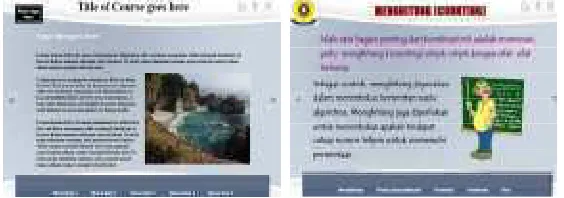
One of the benefits using Lectora Inspire is there are so many templates for interactive learning media which can be choosen. The face-to-face display for the developed interactive learning media is given in the figure 1. The left side of the figure 1 shows default template and the right side shows the adjusted template.
Figure 1. Adjustment of a default template with the learning contents
Musics and sound effects are also added to the developed interactive learning media. The videos which added to the media are made in format of flash video. To play a video in Lectora Inspire, we have to download flash player program which can be downloaded freely from the website http://get.adobe.com/flashplayer/.
There are eight types of question that can be added in Lectora Inspire, those are !
order the interactive learning image are also added to each students to answer each ques without having to read all the m an example question of the qui be used in a discrete method c
3.1.3. Field Test
ach question, and then a time limit of 3 minutes is also given for the question. The students can access this test simula
the material by directly clicking the quiz menu button quiz.
Figure 2. A multiple choice type question
rts who reviewed the developed interactive learning ontent expert. Both of them have given some suggest t the developed interactive learning media were prac hod course.
s conducted to know the effects of interactive le es. There are three steps in this field test, that is cond and conducting a post test. All the activities of field t
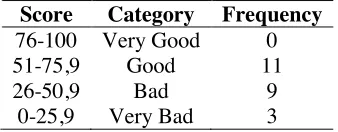
administered to determine the studentsÕ baseline k re four questions that were given to the students in t topics in combinatorics. Based on the test that has be score!obtained at the pre test is 58,7. It can be seen ed as low because it below 60 scales of 100. The st own in table 1 below. rned the contents of the developed interactive learn exploring the media has been ended, the students students should answer five essay type questions a
The average score that was obtained by the students
!!"#$%&&'()*!$+!!,)-&#).-($)./!0$)+&#&)%&!1)!2&3&.#%45!,67/&6&)-.-($)!8)'!9':%.-($)!! 1+!;.-4&6.-(%3!8)'!<%(&)%&3!=>?@5!A$*B.C.#-.!<-.-&!D)(E(-B5!?FG=>!;.B!=>?@!
!
!
ME-73
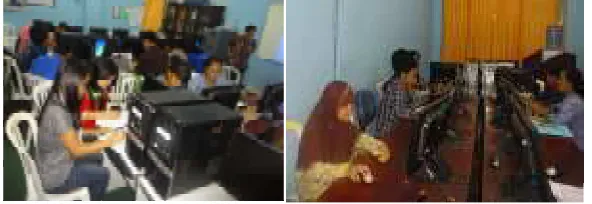
is 72,61. The activities of the students and their results in the post test are shown in figure 3 and table 2 respectively .
Figure 3. The students explored the interactive learning media
Table 2. The StudentsÕ Results in Post Test
Score Category Frequency
76-100 Very Good 11
51-75,9 Good 8
26-50,9 Bad 4
0-25,9 Very Bad 0
3.1.4. The StudentsÕ Perceptions
When all the steps in the field test phase have been completed, the students had to fill out the given questionnaires. Generally, the statements in the questionnaires are divided into three aspects, namely perceptions about the multimedia and accessibility, perceptions about the contents or materials, and perceptions about the questions of the quiz. In this questionnaire, all the students can also give their opinions and suggestions about the interactive learning media by writing it in a special column on the last page of the questionnaire.
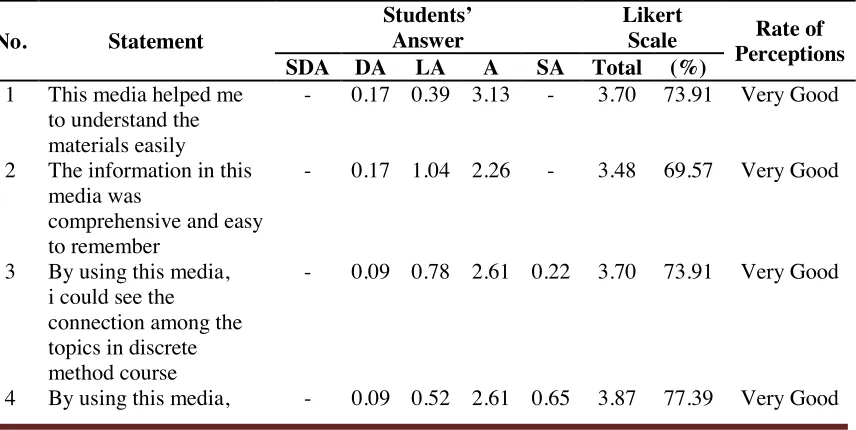
The first aspect is the studentsÕ perceptions about the multimedia and accessibility of the developed interactive learning media. This studentsÕ perceptions are summarized and shown in table 3. On that table, the perception rates about the multimedia, that are stated in the statement 1 to 4, are excellent. Statement number 5 is the studentsÕ perception about the accessibility of the interactive learning media. Very good rate is given by the students. One of the reasons is because the menu-driven system in the media makes them should not start the learning from the beginning, otherwise they can directly go to the desired materials by pressing the appropriate menu button.
!
!
Explanation : SA=Strongly Agree; A=Agree; LA=Less Agree; DA=Disagree; SDA=Strongly Disagree
Likert Scale : 0%-20% = Very Bad; 20.01%-40% = Bad; 40.01%-60%= Good; 60.01%-80%= Very Good; 80.01%-100%= Excellent
The studentsÕ perception rate about the given materials in the developed interactive learning media are very good in the average as shown in table 4. After the students have learned the interactive learning media, their interest to the combinatorial topic became higher than before as shown by the rate of perceptions in statement number 5.
Table 4. StudentsÕ Perceptions about The Content of Materials
No. Statement
2 The information in this
!!"#$%&&'()*!$+!!,)-&#).-($)./!0$)+&#&)%&!1)!2&3&.#%45!,67/&6&)-.-($)!8)'!9':%.-($)!!
Explanation : SA=Strongly Agree; A=Agree; LA=Less Agree; DA=Disagree; SDA=Strongly Disagree
Likert Scale : 0%-20% = Very Bad; 20.01%-40% = Bad; 40.01%-60%= Good; 60.01%-80%= Very Good; 80.01%-100%= Excellent
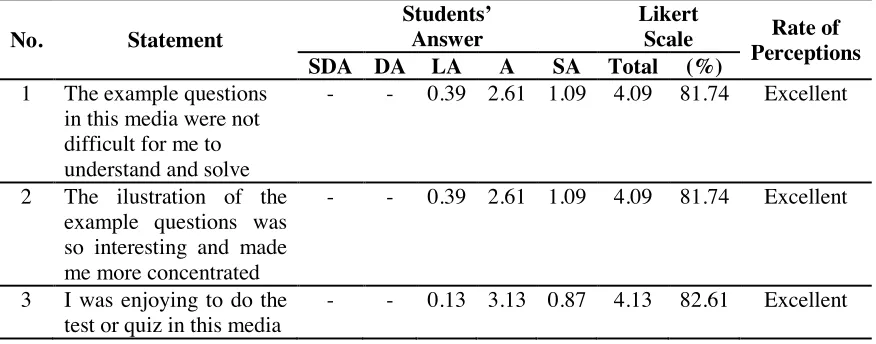
The perception rates of the students toward the given example questions and quiz in this interactive learning media are excellent as shown in table 5 below.
Table 5. StudentsÕ Perceptions about The Example Questions and Quiz
No. Statement
Explanation : SA=Strongly Agree; A=Agree; LA=Less Agree; DA=Disagree; SDA=Strongly Disagree
Likert Scale : 0%-20% = Very Bad; 20.01%-40% = Bad; 40.01%-60%= Good; 60.01%-80%= Very Good; 80.01%-100%= Excellent
3.2. Discussion
In this study, flypaperª became the main alternative software of Macromedia Flash in making animations for the developed interactive learning media. Among the three common types of animations for use in teaching: swf, exe, and avi, the swf type has the smallest size
than the other (Garcia et al., 2007). The animations, that were designed using flypaperª, were
made in swf type, so that the animations may also be added to a web page such as math learning blog support (Arifin et al., 2010).
!
ME-76method, especially in combinatorial topic. This treatment successfully increased the studentsÕ learning outcome. It showed by their average post test score that can be categorized as good,
that is 72,61 scales of 100. This result was along with other works (Garcia et al., 2007; Arifin et
al., 2010; Sazaliet al., 2010; Safitri et al., 2013) that made interactive learning media as one of potential novel learning techniques in general math learning.
Based on the studentsÕ perceptions, multimedia which added into the developed interactive learning media has increased the studentsÕ learning motivation. The same result was also committed by Khalid et al (2010) who showed that an interactive multimedia has an impact on studentsÕ learning. It is because of a majority of the students, who are still young, think that learning with music is very enjoyable. The students also think that the varying animations, pictures, and text colours are so interesting. In their opinion, studying with the interactive learning media is very much like playing a game on their personal computer.
The results also showed that the given materials in the media were presented completely and related each other among the sub topic. The given examples are any phenomena that are frequently found in studentsÕ daily life, consequently they could understand the relevance between the subject which was being studied and real problems. Furthermore, the example questions are given using animations, pictures, and sounds. As a result, the students were enjoying the explanations which have been presented in this interactive learning media. The explanations of the answer of the questions are presented with help of illustrating objects and animations. One of the advantages of Lectora Inspire is its capability of making a test simulation with various question types and many attractive illustrations.
4. Conclusion and Suggestion
4.1. Conclusion
Based on the results, the interactive learning media has been reviewed by the experts and some suggestions from them have been conducted to get a better interactive learning media. The students also gave their perceptions and they thought that the developed interactive learning media should be used regularly in discrete method class, although there are some aspects that have to be improved. Therefore, it can be concluded that the developed interactive learning media is practical and valid to be used in a discrete method course.
The interactive learning media have significant effects to increase the students learning outcome. It showed by the results of the field test that has been committed against 23 students of discrete method class in the Department of Mathematics, Faculty of Mathematics and Natural Science, Sriwijaya University. Based on the tests, the studentsÕ average score increased to 72,61 in post test from 58,7 in pre test.
4.2. Suggestion
!!"#$%&&'()*!$+!!,)-&#).-($)./!0$)+&#&)%&!1)!2&3&.#%45!,67/&6&)-.-($)!8)'!9':%.-($)!! 1+!;.-4&6.-(%3!8)'!<%(&)%&3!=>?@5!A$*B.C.#-.!<-.-&!D)(E(-B5!?FG=>!;.B!=>?@!
!
!
ME-77
5. Bibliography
Arifin S., Zulkardi, &Darmawijoyo. 2010. Pengembangan Blog Support Pembelajaran
Matematika Sekolah Menengah Atas. Jurnal Pendidikan Matematika 4 (2): 70-85
Garcia R. R., Quiros S. J., Santos G. R., Gonzalez, M. S., &Fernanz, M. S..2005. Interactive multimedia animation with Macromedia Flash in Descriptive Geometry Teaching.
Computers & Education 49: 615Ð639
Khalid, M. S., Alias, M., Razally, W., Yamin, S., &Herawan, T.. 2010. The Influence of Teamwork Using a Multimedia Interactive Courseware in Learning Pre-Algebra.
Procedia Social and Behavioral Sciences 8: 654Ð662
Korakakis, G., Pavlatou, E. A., Palyvos, J. A., &Spyrellis, N.. 2009. 3D visualization types in multimedia applications for science learning: A case study for 8th grade students in
Greece. Computers & Education 52(3): 390Ð401.
Lee, T. T.,&Osman, K.. 2012. Interactive multimedia module in the learning of
electrochemistry: effects on studentÕs understanding and motivation. Procedia - Social
and Behavioral Sciences 46: 1323 Ð 1327
Lutfi, K., &NafiÕ, M.. 2011. Interactive Multimedia Based Learning Media For Javanese
Letters Using Macromedia Flash 8. http://eprints.uny.ac.id/id/eprint/5965
Safitri, M., Hartono, Y., &Somakim. 2013. Development Of learning media Based Macromedia
Flash About Triangle For Student Grade 7 Junior High School.Proceeding The First
South East Asia Design/Development Research (SEA-DR) International Conference.
Palembang: 22-23 April 2013. Palembang: 241-250.
Yuhana, Y.,&Hendrayana, A.. 2008. Pengembangan Model Bahan Ajar Matematika Interaktif
Berbasiskan Teknologi Komputer. Konferensi dan Temu Nasional Teknologi Informasi