139
Faculty of Engineering, Universitas Negeri YogyakartaEvaluating vocational education teachers’ performance is an important link of teaching management and an important guarantee of improving teaching quality. In conducting teaching, research and community service, vocational education teachers should weight more on quality than quantity. In this context, individual habit reacts to the demanded jobs which are influenced by his/her knowledge, attitude, and skill. Teacher’s performance evaluation is nothing but a Multi Criteria Decision Making Problem (MCDM). There are several quality attributes that influence the efficiency of a potential vocational education teacher while guiding his/her students towards a positive and value added academic outcome. However, the importance of quality attributes may differ from individuals’ perspective. In other words, different attributes may have different weightage according to their priority of significance while evaluating quality/performance level of a vocational education teacher.
This paper makes the vocational education teachers’ performance appraisal quantitative and determines the evaluation index based on academic performance. Criteria for performance are: teaching load, publication, research, conferencing, consultancy, services, teaching attitude, teaching content, teaching method, and teaching effect. The Analytic Hierarchy Process (AHP) and PROMETHEE (Preference Ranking Organisation METHod for Enrichment Evaluations) II analysis were used in performance appraisal.
Application feasibility of this method approach and guidelines in solving such a multi)attribute decision making problem has been described illustratively in this paper. It is also observed that this MCDM approach is a viable tool in solving the teacher selection decision problems. It allows the decision maker to rank the candidate alternatives more efficiently and easily.
! " : performance, teaching, Analytic Hierarchy Process, PROMETHEE II.
#$
With the development of higher vocational education and large)scale expansion of enrollment of vocational education institutions and universities, the difficulty in obtaining work and the quality of higher education has aroused extensive attention. The difficult employment of vocational education institution graduates not only has relation with government employment measures, job creating, development of the rhythm of vocational education institution and professional settings, but also, more importantly, has relation with the reform of teaching model and the quality of training. However, the core of solving the problem is how to improve the overall quality of vocational education teachers to improve their core competitiveness. Teacher assessment is an important task. How to establish and improve the performance appraisal system is very important to the development of vocational education institutions, universities and training. However, there are many problems in current performance appraisal of teachers in vocational education institutions and universities,
140
targets and productivity [2]. Various factors can beregarded in applying performance appraisal. Some researchers state that performance appraisal can be viewed from various aspects relating to the aims of research or what is going to be analyzed. Some evaluate working activity aspect, while others evaluate behavior or personality aspect.
%$ & ' "
The concept of performance was defined differently by a few people. Performance measures must be based on a set of objectives that are linked to the mission of the department and its visions for the future [3]. Pritchard et al. [4] defined performance measures as “the numerical or quantitative indicators that show how well each objective is being met”. Alternatively, Neely et al., [5] defined a performance measure as “a parameter used to quantify the efficiency and / or effectiveness of past action”. In the educational sector, each school of faculty need to establish its core competencies based on its mission and vision, besides thinking of its current resources and state of competitiveness [6].
Decision making for academic staff promotion often involves criteria such as tasks, activities, teaching, supervision, publication, research, consulting, conferencing, administration and community service. Oshabegmi [1] indicated that the main tasks of academic staff can be divided into three categories namely teaching, research and management. Academic staff promotion appraisal is evaluated based on three components such as teaching, research and services. Academic staff appraisal can also be evaluated through items such as research article produced, teaching method, presentation style and involvement in university and community activities [7]. A technique usually used in multi criteria decision making is Analytical Hierarchy Process (AHP) which was introduced by
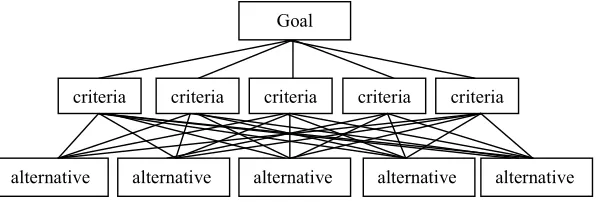
Thomas L. Saaty in 1980. The advantage of using this technique is in conducting the subjective evaluation situation on the important components or variables in the decision making process. AHP was developed based on three principles which are the principle of constructing hierarchy, the principle of developing priority and the principle of logical consistency [8]. Saaty in his book of The Analytical Hierarchy Process developed the hierarchy for the selection of academic staff position and promotion. This hierarchy was developed to make the basic appraisal on the selection based on two main criteria which are teaching and research. However, the criteria became more complicated for a higher level education. At the same time, the application of AHP technique for the purpose of reward and excellent awards at the higher education institution was also formulated at United Arab Emirates University [7]. The model is described in figure 1 and also can be used to evaluate and assess the qualified candidates. The model built is based on three components which are teaching, research and publication, and services. Every component has sub criteria which are related. The analysis indicated that the most important component is research and publication. Preference function based outranking method is a special type of MCDM tool that can provide a ranking ordering of the decision options. The PROMETHEE (preference ranking organization method for enrichment evaluation) method was developed by Brans and Vincke in 1985 [9]. The PROMETHEE I method can provide the partial ordering of the decision alternatives, whereas, PROMETHEE II method can derive the full ranking of the alternatives.
Figure 1. AHP Model of Alternative Performance
($
This study uses qualitative and quantitative methods to achieve the objectives. Qualitative research in principle focuses on gaining meaning
and insight into the area of interest [10]. It is not used to draw any definitive conclusion. It is associated with “face)to)face” contact with people, together with verbal data and observations [10]. Quantitative method uses techniques that gather measurable data.
criteria
alternative criteria
criteria criteria
criteria
alternative alternative alternative
alternative
141
The research objectives are as follows: (1) Toidentify the preferred indicators to measure performance based on teacher perspectives. and (2) To develop a valid and reliable performance measurement system using AHP and PROMETHEE II to measure teacher performance with regard to teaching, research and servicing that link to strategies.
3.1. PROMETHEE II
In this paper, the PROMETHEE II method is employed to obtain the full ranking of the alternative teachers for a given vocational education institution. The procedural steps as involved in PROMETHEE II method are enlisted as below [9]:
Step 1: Normalize the decision matrix using the alternative with respect to other alternatives. This step involves the calculation of differences in criteria values between different alternatives pair) wise.
Step 3: Calculate the preference function, Pj(i,ii). There are mainly six types of generalized preference functions as proposed by [11]. But these preference functions require the definition of some preferential parameters, such as the preference and indifference thresholds. However, in real time applications, it may be difficult for the decision maker to specify which specific form of preference function is suitable for each criterion and also to determine the parameters involved. To avoid this problem, the following simplified preference function is adopted here:
Step 4: Calculate the aggregated preference function taking into account the criteria weights. Aggregated preference function outranking flows as follows:
Leaving (or positive) flow for ith alternative,
where n is the number of alternatives.
Here, each alternative faces (n – 1) number of other alternatives. The leaving flow expresses how much an alternative dominates the other alternatives, while the entering flow denotes how much an alternative is dominated by the other alternatives. Based on these outranking flows, the PROMETHEE I method can provide a partial preorder of the alternatives, whereas, the PROMETHEE II method can give the complete preorder by using a net flow, though it loses much information of preference relations.
Step 6: Calculate the net outranking flow for each
Step 7: Determine the ranking of all the considered alternatives depending on the values of
ϕ
(i).The higher value ofϕ
(i), the better is the alternative. Thus, the best alternative is the one having the highestϕ
(i) value. The PROMETHEE method is an interactive multi)criteria decision)making approach designed to handle quantitative as well as qualitative criteria with discrete alternatives. All qualitative criteria are expressed subjectively in linguistic terms. The objective values for these criteria are assigned from an 5)point scale, as given in Table 1.Table 1. Fuzzy Scale of Weight Criteria
Weak: W 0.1 alternatives is performed to compute a preference function for each criterion. Based on this preference function, a preference index for alternative i over
'
142
alternatives. It is quite different from AHP in thatthere is no need to perform a pair)wise comparison again when comparative alternatives are added or deleted.
3.2. Analytical Hierarchy Process
Analytic Hierarchy Process (AHP) was originally designed to solve complicated multi) criteria decision problem [12], beside that AHP is appropriate whenever a target is obviously declared and a set of relevant criteria and alternatives are offered [13]. AHP has been proposed for study program selection problem to support Higher Education manager through the decision making activity, which aims to select the right Study program to be promoted as International class [14]. The AHP technique assists decision makers to identify and determine the priority of criteria for promoting academic staff [15].
The result is calculated by multiplying the weight of each criterion with the weight of each teacher. The teacher which has got the highest score is suggested as the best teacher and management may consider that one as the best decision choice for promoting academic career. In AHP the problems are usually presented in a hierarchical structure and the decision maker is guided throughout a subsequent series of pairwise comparisons to express the relative strength of the elements in the hierarchy. In general the hierarchy structure encompasses of three levels, where the top level represents the goal, and the lowest level has the teacher under consideration. The intermediate level contains the criteria under which each teacher is evaluated. The final score obtain for each teacher across each criterion is calculated by multiplying the weight of each criterion with the weight of each teacher. Teacher which has got the highest score is suggested as the best teacher and decision maker may consider that one as the best decision choice for promotion.
Generally, AHP has the following steps:
1. Employ a pair)wise comparison approach. Fundamental scale for pair)wise comparisons developed to solve this problem [12]. The pair) wise comparison matrix A, in which the
Reciprocals are automatically assigned to each pair)wise comparison, where is the matrix size.
3. Hierarchical synthesis is now utilized to weight the eigenvectors according to weights of criteria. The sum is for all weighted eigenvectors corresponding to those in the next lower hierarchy level.
4. Having made all pair)wise comparisons, consistency is identified by using th eigenvalue
max
λ , to calculate the consistency index. The largest eigenvalue,λmax, will be
λ is the principal or largest eigenvalue of positive real values in a judgment matrix;
W is the weight of th factor W is the weight of th factor.
5. Consistency test. Each pair)wise comparison contains numerous decision elements for the consistency index (CI), which measures the entire consistency judgment for each comparison matrix and the hierarchy structure. CI and consistency ration (CR) is utilized to consistent matrix, judgments should be reviewed and improved.
)$ ' *
143
The same example is considered here todemonstrate the applicability and effectiveness of PROMETHEE II method as a MCDM tool. This example takes into account ten selection criteria and three alternative teachers. The objective and subjective information regarding different selection criteria are given in Table 2. All these criteria are expressed subjectively in linguistic terms and numeric value. The objective values for these criteria are assigned from an 5)point scale, as given
in Table 2. The fuzzy judgments weak (W), fairly weak (FW), average (A) and fairly high (FH), and high (H) shown in Table 1 with respect to different criteria. The ten selection criteria as considered here to affect the decision are teaching load (A), publication (B), research (C), conferencing (D), consultancy (E), services (F), teaching attitude (G), teaching content (H), teaching method (I), and teaching effect (J). and the remaining are the beneficial attributes.
Table 2. Result for teacher performance
A B C D E F G H I J
Teacher A 14 6 25000 10 3 18 FW A H FW Teacher B 16 4 50000 6 5 12 A H W FH Teacher C 20 2 14000 4 6 24 FH FH A H
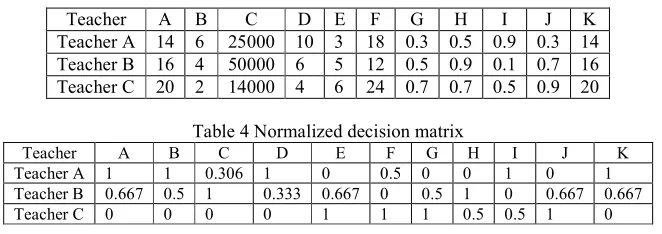
At first, the information for teacher alternatives with respect to different criteria, as shown in Table 2, are converted to crisp scores using the 5)point scale, as given in Table 3. The transformed objective data, as given in Table 3, are then normalized using Eqn. (1) or (2) and are given in Table 4. Determined the criteria weights for the
considered criteria as wA = 0.1267, wB= 0.1267, wC = 0.0883, wD = 0.0517, wE = 0.0929, wF = 0.0706, wG = 0.0834, wH = 0.0834, wI=0.1382, and wJ = 0.1382 using AHP method and the same criteria weights are used here for PROMETHEE II method)based analysis.
Table 3. Objective data for teacher performance selection problem
Teacher A B C D E F G H I J K
Teacher A 14 6 25000 10 3 18 0.3 0.5 0.9 0.3 14 Teacher B 16 4 50000 6 5 12 0.5 0.9 0.1 0.7 16 Teacher C 20 2 14000 4 6 24 0.7 0.7 0.5 0.9 20
Table 4 Normalized decision matrix
Teacher A B C D E F G H I J K
Teacher A 1 1 0.306 1 0 0.5 0 0 1 0 1
Teacher B 0.667 0.5 1 0.333 0.667 0 0.5 1 0 0.667 0.667
Teacher C 0 0 0 0 1 1 1 0.5 0.5 1 0
Now, the preference functions are calculated for all the pairs of alternatives, using Eqns. (3) and (4), and are given in Table 5. Table 6 exhibits the aggregated preference function values for all the paired alternatives, as calculated using
Eqn. (5). The leaving and the entering flows for different teacher alternatives are now computed using Eqns. (6) and (7) respectively, and are shown in Table 7.
Table 5 Preference functions for all the pairs of alternatives
A B C D E F G H I J
(A,B) 0.333 0.5 0 4 0 0.5 0 0 1 0 (A,C) 1 1 0.306 6 0 0 0 0 0.5 0 (B,A) 0 0 0.694 0 2 0 0.5 1 0 0.667 (B,C) 0.667 0.5 1 2 0 0 0 0.5 0 0
Table 6 Aggregated preference function
teacher A teacher B teacher C teacher A 0.485883 0.659681
teacher B 0.464353 0.381217
teacher C 0.3915 0.258433
Table 7 Leaving and entering flows for different teachers
144
Table 8 Net outranking flow values for differentteacher (alternatives)
Teacher
Performance Net outranking flow Rank
teacher A 0.144856 1
teacher B 0.050626 2
teacher C )0.19548 3
The net outranking flow values for different alternative teachers and their relative rankings are given in Table 8. Now, the alternative teachers are arranged in descending order according to their net outranking flow values. The best teacher performance of vocational education institution is teacher A. This proves the applicability and potentiality of the PROMETHEE II method for solving complex decision)making problems in the academic domain.
+$ ,
School and university are organizations which based on science which is not overtly competitive. The competitive advantage should lie on academic staffs as the main resource. With behavior appraisal, academic staffs will make the school and university to become more globally competitive as a science)based organization and as the main
producer of human capital. The statement correlates with the main function of a vocational education institution as the main producer of human resources which is based on science and competency, and which shows its competitive advantage. Teacher appraisal performance decision has long)term implications. It is therefore important to select the best teacher for a given educational institution. The problem of teacher appraisal performance is a strategic issue and has significant impact on the performance of the vocational education institutions. The present study explores the use of PROMETHEE II method in solving a teacher selection problem and the results obtained can be valuable to the decision maker in framing the teacher selection strategies. It is also observed that this MCDM approach is a viable tool in solving the teacher selection decision problems. It allows the decision maker to rank the candidate alternatives more efficiently and easily. The cited real time vocational education institution example demonstrates the computational process of the PROMETHEE II method and the same method can also be applied to other strategic decision)making problems.
- .,
[1]. Oshagbemi, T.,
International Journal of Sustainability in Higher Education, 2000. #(2): p. 124)136.
[2]. Nasution, H. and N.A. Marzuki,
! "
International Journal for Educational Studies, 2011. ((2).
[3]. Al)Turki, U. and S. Duffuaa, !
" International Journal of Educational Management, 2003. #/(7): p. 330)338. [4]. Pritchard, R.D., et al., #
$ %
" National Productivity Review, 1990. #0(1): p. 57)67.
[5]. Neely, A., M. Gregory, and K. Platts,
! %
" International Journal of Operations & Production Management, 1995. #+(4): p. 80)116.
[6]. Chen, S.H., C.C. Yang, and J.Y. Shiau, $
" The TQM Magazine, 2006. #1(2): p. 190)205.
[7]. Badri, M.A. and M.H. Abdulla, &
% ! "
International Journal of Educational Management, 2004. #1(4): p. 224)242. [8]. Islam, R. and S.M. Rasad, '
! ' $ !%
( " Asia Pacific Management Review, 2006. ##(3): p. 163.
[9]. Brans, J.P., P. Vincke, and B. Mareschal, %
! )*' '' " European
Journal of Operational Research, 1986. %)(2): p. 228)238.
[10]. Rubin, H.J. and I. Rubin, +
% .
2005: Sage Publications, Inc.
[11]. Brans, J.P., B. Mareschal, and P. Vincke,
! )*' ''%
" Operational Research, 1984. 1): p. 477)490.
[12]. Saaty, T.L., %
145
[13]. Bayazita, O. and B. Karpakb, !. 2005, ISAHP.
[14]. Jati, H., ,' #(#)- (.!!) (/( '*
0) * - 1#-1 -, ,' ' *#-#-1
#- ' - #)- 2 2 (( ! )1 *%
1 -, ! !! ) " JOURNAL
OF EDUCATION, 2011. (.
[15]. Salmuni, W., W. Mustaffa, and K. Hariri.
! 3
$ . 2007.
[16]. Yan, L. and Z. Fan. ( !
* .