Cultural Content Analysis When English Rings a Bell for Junior
High School in Indonesia
THESIS
Submitted in Partial Fulfillment Of the Requirements for the Degree Of
Sarjana Pendidikan
Vivian Carolinna Prananto 112016065
ENGLISH LANGUAGE EDUCATION PROGRAM
FACULTY OF LANGUAGE AND ARTS
SATYA WACANA CHRISTIAN UNIVERSITY
i
Cultural Content Analysis When English Rings a Bell for Junior
High School in Indonesia
THESIS
Submitted in Partial Fulfillment Of the Requirements for the Degree Of
Sarjana Pendidikan
Vivian Carolinna Prananto 112016065
ENGLISH LANGUAGE EDUCATION PROGRAM
FACULTY OF LANGUAGE AND ARTS
SATYA WACANA CHRISTIAN UNIVERSITY
ii
Cultural Content Analysis in When English Rings a Bell for Junior
High School in Indonesia
THESIS
Submitted in Partial Fulfillment Of the Requirements for the Degree Of
Sarjana Pendidikan
Vivian Carolinna Prananto 112016065
Approved by:
Thesis Supervisor Thesis Examiner
iii
COPYRIGHT STATEMENT
This thesis contains no such material as has been submitted for examination in any course or accepted for the fulfillment of any degree or diploma in any university. To the best of my knowledge and my belief, this contains no material previously published or written by any other person except where due reference is made in the text.
Copyright@ 2020. Vivian Carolinna Prananto and Dr. Debora Tri Ragawanti, S.S., M.A-ELT. All rights reserved.
No part of this thesis may be reproduced by any means without the permission of at least one of the copyright owners or the English Language Education Program, Faculty of Language and Arts, Universitas Kristen Satya Wacana, Salatiga.
iv
PERNYATAAN TIDAK PLAGIAT
Saya yang bertanda tangan dibawah ini:Nama : Vivian Carolinna Prananto
NIM : 112016065 Email : [email protected]
Fakultas : Bahasa dan Seni Program Studi : Pendidikan Bahasa Inggris Judul tugas akhir :
Pembimbing : Dr. Debora Tri Ragawanti, S.S., M.A-ELT. Penguji : Prof. Dr. Gusti Astika, M.A.
Dengan ini menyatakan bahwa:
1. Hasil karya yang saya serahkan ini adalah asli dan belum pernah diajukan untuk mendapatkan gelar kesarjanaan baik di Universitas Kristen Satya Wacana maupun di institusi pendidikan lainnya.
2. Hasil karya saya ini bukan saduran/terjemahan melainkan merupakan gagasan, rumusan, dan hasil pelaksanaan penelitian/implementasi saya sendiri, tanpa bantuan pihak lain, kecuali arahan pembimbing akademik dan narasumber penelitian.
3. Hasil karya saya ini merupakan hasil revisi terakhir setelah diujikan yang telah diketahui dan disetujui oleh pembimbing.
4. Dalam karya saya ini tidak terdapat karya atau pendapat yang telah ditulis atau dipublikasikan orang lain, kecuali yang digunakan sebagai acuan dalam naskah dengan menyebutkan nama pengarang dan dicantumkan dalam daftar pustaka.
Pernyataan ini saya buat dengan sesungguhnya. Apabila di kemudian hari terbukti ada penyimpangan dan ketidakbenaran dalam pernyataan ini maka saya bersedia menerima sanksi akademik berupa pencabutan gelar yang telah diperoleh karena karya saya ini, serta sanksi lain yang sesuai dengan ketentuan yang berlaku di Universitas Kristen Satya Wacana.
Salatiga, _____________________
meterai
Rp.6.000,-____________________________
Tanda tangan & nama terang mahasiswa PERPUSTAKAAN UNIVERSITAS
UNIVERSITAS KRISTEN SATYA WACANA Jl. Diponegoro 52-60 Salatiga 50711 Jawa Tengah, Indonesia Telp. 0298 – 321212, Fax. 0298 321433 Email: [email protected] ; http://library.uksw.edu
v
PERNYATAAN PERSETUJUAN AKSES
Saya yang bertanda tangan di bawah ini:
Nama : Vivian Carolinna Prananto
NIM : 112016065 Email : [email protected]
Fakultas : Bahasa dan Seni Program Studi : Pendidikan Bahasa Inggris Judul tugas akhir : CULTURAL CONTENT ANALYSIS IN TEXTBOOK SERIES,
WHEN ENGLISH RINGS A BELL FOR JUNIOR HIGH SCHOOL IN INDONESIA
Dengan ini saya menyerahkan hak non-eksklusif* kepada Perpustakaan Universitas – Universitas Kristen Satya Wacana untuk menyimpan, mengatur akses serta melakukan pengelolaan terhadap karya saya ini dengan mengacu pada ketentuan akses tugas akhir elektronik sebagai berikut (beri tanda pada kotak yang sesuai):
a. Saya mengijinkan karya tersebut diunggah ke dalam aplikasi Repositori PerpustakaanUniversitas, dan/atau portal GARUDA
b. Saya tidak mengijinkan karya tersebut diunggah ke dalam aplikasi Repositori Perpustakaan Universitas, dan/atau portal GARUDA**
* Hak yang tidak terbatashanya bagi satu pihak saja. Pengajar, peneliti, dan mahasiswa yang menyerahkan hak non-ekslusif kepada Repositori Perpustakaan Universitas saat mengumpulkan hasil karya mereka masih memiliki hak copyright atas karya tersebut.
** Hanya akan menampilkan halaman judul dan abstrak. Pilihan ini harus dilampiri dengan penjelasan/ alasan tertulisdari pembimbing TA dan diketahui oleh pimpinan fakultas (dekan/kaprodi).
Demikian pernyataan ini saya buat dengan sebenarnya.
Salatiga, ____________________
___________________________
Viviam Caeolinna Prananto
Mengetahui,
_____________________________ ___________________________
Dr. Debora Tri Ragawanti, S.S., M.A-ELT. Prof. Dr. Gusti Astika, M.A.
F-LIB-08
PERPUSTAKAAN UNIVERSITAS
UNIVERSITAS KRISTEN SATYA WACANA Jl. Diponegoro 52-60 Salatiga 50711 Jawa Tengah, Indonesia Telp. 0298 – 321212, Fax. 0298 321433 Email: [email protected] ; http://library.uksw.edu
vi
Perpustakaan Universitas
PUBLICATION AGREEMENT DECLARATION
As a member of the (UKSW) Universitas Kristen Satya Wacana academic community, I verify that:
Name : Vivian Carolinna Prananto
Student ID Number : 112016065
Study Program : English Language Education
Faculty : Language and Arts
Kind of Work : Undergraduate Thesis
In developing my knowledge, I agree to provide UKSW with a non-exclusive royalty free right for my intellectual property and the contents therein entitled:
CULTURAL CONTENT ANALYSIS IN TEXTBOOK SERIES, WHEN ENGLISH
RINGS A BELL FOR JUNIOR HIGH SCHOOL IN INDONESIA along with any pertinent equipment.
With this non-exclusive royalty free right, UKSW maintains the right to copy, reproduce, print, publish, post, display, incorporate, store in or scan into a retrieval system or database, transmit, broadcast, barter or sell my intellectual property, in whole or in part without my express written permission, as long as my name still included as the writer.
This declaration is made according to the best of my knowledge. Made in: Salatiga Date :
Verified by signee,
Vivian Carolinna Prananto
UNIVERSITASKRISTENSATYAWACANA Jl. Diponegoro 52 – 60 Salatiga 50711 Jawa Tengah, Indonesia Telp. 0298 – 321212, Fax. 0298 321433 Email: [email protected] ; http://library.uksw.edu
vii
TABLE OF CONTENT
COVER PAGE………i
APROVAL PAGE………..ii
COPYRIGHT STATEMENT ... iii
PERNYATAAN TIDAK PLAGIAT ... iv
PERNYATAAN PERSETUJUAN AKSES………...v
PUBLICATION AGREEMENT DECLARATION………...vi
TABLE OF CONTENT………vii LIST OF TABLES………..………...ix LIST OF FIGURE ... x ABSTRACT……….………1 INTRODUCTION………...………1 LITERATURE REVIEW ... 4 A. Textbook ... 4 Definition of Textbooks ... 5 B. Culture in a Textbook ... 5 Definition of Culture ... 5 Dimension of Culture ... 6 Cultural Categories ... 7
C. Previous Relevant Studies ... 7
THE STUDY ... 8
Method of Research ... 8
Sample of the Study... 9
The Research Instrument ... 9
The procedure of Data Analysis ... 10
FINDINGS AND DISCUSSION ... 11
Findings ... 11
A.The representation of Dimension of Culture in the Textbook ... 11
B.The representation of Cultural Categories in the Textbook ... 24
Discussion ... 29
viii
ACKNOWLEDGEMENTS ... 33
References ... 34
Appendix A ... 38
ix
LIST OF TABLES
Table 1. Category of Dimension of Culture ... 6
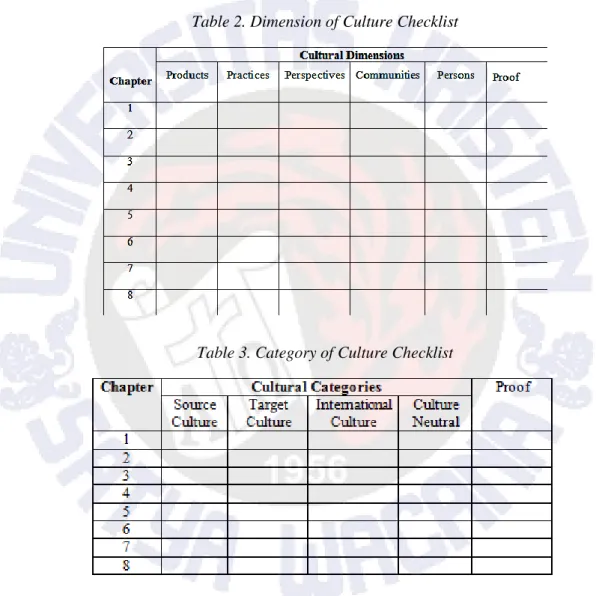
Table 2. Dimension of Culture Checklist ... 10
Table 3. Category of Culture Checklist ... 10
Table 4. Analysis of Source Culture ... 25
Table 5. Analysis of Target Culture………27
Table 6. Analysis of International Culture ... 28
x
LIST OF FIGURE
Figure 1. Dimension of Culture ... 12
Figure 2. Percentages of Products... 12
Figure 3. Representation of Artifact 1……… …13
Figure 4. Representation of Artifact 2……… ……13
Figure 5. Representation of Artifact 3……….13
Figure 6. Representation of Artifact 4……….14
Figure 7. Representation of Artifact 5……….14
Figure 8. Representation of Artifact 6……….15
Figure 9. Representation of Artifact 7……….15
Figure 10. Representation of Artifact 8..……….15
Figure 11. Representation of Artifact 9..……….15
Figure 12. Representation of Places 1 ……….16
Figure 13. Representation of Places 2 ……….16
Figure 14. Representation of Places 3 ……….17
Figure 15. Representation of Places 4 ……….17
Figure 16. Representation of Places 5 ……….18
Figure 17. Representation of Places 6 ……….18
Figure 18. Representation of Art Form 1.………..……….19
Figure 19. Illustration of Sultanah Seri……….……….20
Figure 20. Representation of Art Form 2……….……..……….20
Figure 21. Representation of Operation 1………...21
Figure 22. Representation of Operation 2……….…..21
Figure 23. Representation of Operation 3……….…..21
Figure 24. Representation of Communities 1……...………..22
Figure 25. Representation of Communities 2………...………..22
Figure 26.Representation of Perspectives………...23
Figure 27. Representation of Cultural Categories……….25
2
Cultural Content Analysis When English Rings a Bell for Junior
High School in Indonesia
Vivian Carolinna Prananto Universitas Kristen Satya Wacana
ABSTRACT
The researcher analyzed the textbook using Moran‟s Cultural Dimensions (2001) and Cortazzi‟s and Jin‟s Cultural Categories (1999) using a documentary study framework. There was two research question addressed. First, to what extent does When English Rings a
Bell for grade 7 represent the dimension of culture? Second, to what
extent does When English Rings a Bell for grade 7 represent cultural categories? This research used a documentary study. The data for this study were collected from reading passages and illustrations in the textbook, and the instrument for collecting the data was a checklist. The result of this study shows that the textbook mostly presents products as the dimension of culture. Furthermore, it mostly presents source culture as the category of culture.
Keywords: Dimension of Culture; Cultural Categories; EFL
textbooks; Source Culture; Target Culture; Culture Neutral; International Culture
INTRODUCTION
A textbook plays a pivotal role in English Foreign Language (EFL) teaching and learning activities. From a textbook, teachers can know what to teach at what level, what to be expected by the prevailing national curriculum, and various textbook activities for their teaching. Similarly, from a textbook, learners can learn English through various language aspects and tasks or topics; know what to learn,
3
and know what to expect from the prevailing national curriculum. Such roles of a textbook for teaching and English are in line with Cunningsworth (1995) and Schmidt (1997) as cited in Sarem (2013) that a textbook act as a source of ideas and activities, and it plays an important role in leaping intentions and plans to classroom activities. It is also in line with Cortazzi and Jin (1999) confirm that a textbook can be a teacher, a map, a resource, a trainer, an authority, a de-skiller and an ideology.
In response to the textbook roles in Indonesia as a resource and an ideology, the minister of education and culture published an English textbook based on the newest curriculum (the 2013 curriculum) entitled When English Rings a Bell. Even though Indonesia uses English as a foreign language, English language teaching cannot be separated from the national education values. As stated in the 2013 national curriculum of Indonesia, one of the goals of national education is to deepen student‟s knowledge about the national cultural values and ideology of the nation,
and it should be integrated with all school subjects, including English (as stipulated in the Regulation of the Ministry of Education and Culture the year of 2018, No.35, article 5, and paragraph 3). Considering that textbooks play many important roles in teaching and learning, analyzing the textbooks is necessary to understand how When
English Rings a Bell accommodates cultural values‟ national policy.
Relatively few researchers have discussed cultural contents in the textbook using various theories like Byram‟s (2008) intercultural dimension in language teaching, Cortazzi and Jin‟s (1999) cultural categories, and Moran‟s (2001)
dimension of culture. Those theories are useful to distinguish cultural content in the textbook, but the content was only viewed from one theoretical view. This study
4
used Cortazzi and Jin‟s (1999) and Aliakbari‟s (2004) cultural categories and Moran‟s (2001) dimension of culture in order to see the cultural content from two
points of theoretical view. Those theories are chosen because they are connected, and this study wants to know what dimensions and how many proportions of each dimension appear in each cultural category. Therefore, the findings could be more obvious.
This study aimed to see the cultural content in the textbook When English
Rings a Bell for 7th grade. There were two main questions addresses to reach the
objectives:
1. To what extent does the textbook represent the dimension of culture?
2. To what extent does the textbook represent culture categories?
This study uses a qualitative research design, and the finding of this research indicated how much When English Rings a Bell implicates the cultural dimension and categories in the material. This study is significant for teacher and student researchers to analyze cultural contents in an EFL textbook. Besides, it can develop students‟ awareness of their own culture while learning English. Furthermore, it is
advantageous for textbook writers to develop a textbook based on source culture.
LITERATURE REVIEW
This section presents the literature review of about textbooks and culture in a textbook.
A. Textbook
5
Definition of Textbooks
Many experts have their own definition of textbooks. It is not easy to define a textbook in a single definition. According to Graves (2000), a textbook is used as a standard source of information for the formal study of a subject and an instrument for teaching and learning. Tomlinson (2011) defined a textbook as one material used to help teachers teach learners. Furthermore, Hutchinson and Torres (1994) said that a textbook guides a teacher in teaching and learners to review knowledge. It is also considered a record for measuring what has been taught by teachers. A textbook is a book that provides comprehensive information about the subject for people who are studying that field and for a teacher as a guide. In summary, a textbook is used as a tool to guide the teaching and learning process, provide and review material, sources of information, and knowledge about a subject.
B. Culture in a Textbook
This section discusses the definition of dimension of culture and cultural categories.
Definition of Culture
Culture is the main thing that gives influence to every nation in the world. Culture embraces all aspects of life, language, attitudes, and beliefs. Therefore, it is hard to describe culture because culture is a complex thing reflected in life features. However, Hofstede (1991) argued that culture refers to "the total way of life of people composed of their learned and shared behavior patterns, value, norms, and material objects." Then, culture influences the way how the community lives, behaves, thinks, and speaks. Moreover, Yen (2000) stated that cultures are learned by powerful human creations that afford a common identity and support
meaning-6
making in any given society. Furthermore, according to Moran (2001), culture is the interplay of products, practices, perspectives, communities, and persons. In conclusion, this study focused on the term "culture", which refers to the systems of knowledge shared by a group of people, including a group's values, beliefs, attitudes, object / artifact, shared behaviors, and perspectives.
Dimension of Culture
This study analyzed five dimensions of cultural content in the textbook using theory by Moran (2001). Below is a summary of the five dimensions of culture by Moran (2001).
Table 1. Category of Dimension of Culture
Dimensions Examples
Products 1.Artifacts: food, documents, language,
money, tools.
2.Places: buiding,cities, houses. 3.Institutions: family, law, economy, religion, education, politics.
4.Art Form: music, clothes, dancing, painting, movies, architecture.
Practices 1.Operation: manipulation of cultural
products (action and interaction, verbal and non-verbal).
2.Acts: ritualized communication practices (represents, maintains, adapts, and beliefs of a society in time).
3.Scenarios: extended communicative practices (promote, educate).
4.Lives: stories of member of the culture (respect).
Perspectives Represent the perceptions, beliefs, values, and attitudes to guide people‟s behavior in the practice of culture. It can be explicit but often they are implicit, outside conscious awarness.
Communities 1.Specific social context: national cultures, language, gender, religion, socioeconomic class, or generation.
2.Circumstances: religious ceremony 3.Groups: different social group in which members carry out cultural practices.
7
Persons Represent individual members who embody
the culture and its communities in unique ways. Personal identity and life history play important roles in the developing of cultural person.
The table explains that the five dimensions are products, practices, perspectives, communities, and persons. The theory seems to be very comprehensive for analyzing ELT material or textbook because they include almost all elements of culture commonly adhered by a cultural community.
Cultural Categories
Cortazzi and Jin (1991) categorized cultural information that can be used in EFL textbooks and material into three types. Those categories are the source, target, and international culture. The first type is focused on the teacher‟s and learner‟s
culture, which is Indonesian culture. The second type is target culture, and the focus point is on the target culture of countries such as the United Kingdom and the United States. The last type is international culture, which includes a vast range of cultures from countries with English to countries where English is used as an international language. Aliakbari (2004) added another type of category of culture: culture neutral or culture universe that means common to all human cultures worldwide. This cultural category is useful for analyzing the cultural content of the textbook to see how the representation of the category of culture corresponds to national education policy in Indonesia.
C. Previous Relevant Studies
This section discusses previous studies of the dimension of culture and cultural categories in "When English Rings a Bell" for 7th Grade (of JHS)
8
Some research about the cultural categories have been conducted, especially in the textbook When English Rings a Bell. However, studies that mentioned below only used one theoretical view. Muzainudin (2017) who used Cortazzi and Jin‟s category of culture theory in analyzed the textbook for 7th grade claimed that, source culture category in the textbook When English Rings a Bell was more dominant rather than the target and international culture; also, the international culture was not depicted in the textbook. On the contrary, Zulkarnaen, Ikhsanudin, and Sada's (2017) study who used theory from Byram‟s (2008) establish that moral value has the highest percentages (21%) followed by religious/belief (17%), school education (17%), families (17%), social interaction (14%), daily routines (10%), and social security (3%). Kriswidyantara (2019) analyzed When English Rings a Bell for 8th grade students used Adaskou, Britten, and Fahsi (1990) framework of cultural sense and found that the textbook mostly presented pragmatic sense compared to aesthetic, semantic, and sociological sense. The studies above are some examples of previous studies in the textbook This study decided to enhance cultural dimension by Moran (2001), to find out what aspects or dimensions of culture in each cultural categories.
THE STUDY
This section consists of the methodology, the sample of the study, the instrument of the study, and the data analysis procedure.
Method of Research
This research used a documentary study which is based on a document analysis. According to Tavakoli (2012, 180) a document analysis can be done with written or text-based artifacts (textbooks, novels, journals, meeting minutes, policy
9
statements, newspapers, etc.) or non-written records (photographs, audiotapes, videotapes, websites, musical performances, etc.). This study used a textbook as text-based artifact. More to that, a textbook in document analysis belongs to secondary data (Tavakoli, ibid). The researcher could create a specific participant set in collecting data in her research (Lodico, 2006). The data gathering instrument is called a checklist, and this instrument is used to obtain and classify the data.
Sample of the Study
The sample of this study was When English Rings a Bell for the 7th grade of Junior High School. This book was claimed to be based national 2013 curriculum. It was designed by the Ministry of Education and Culture and published by Erlangga.
When English Rings a Bell for 7th grade has 8 chapters. The first chapter has 12
passages and 8 illustrations. The second chapter has 5 passages and 2 illustrations. The third chapter has 5 passages and 1 picture. The fourth chapter has 6 illustrations and 0 passages. The fifth chapter has 9 passages and 0 illustrations. The sixth chapter has 5 passages and 0 illustrations. The seventh chapter has 12 passages and 3 illustrations, and the eighth chapter has 0 passages and 0 illustrations. Passages and illustrations in each chapter representing dimensions of culture and categories of culture.
The Research Instrument
This study used a checklist to collect data on dimensions of culture and cultural categories in When English Rings a Bell.According to Andrews in The Sage Encyclopedia of Qualitative Research Method (2008), if a checklist is used during data collection, it will affect a study‟s direction, findings, and conclusion. Table 2
10
provides 5 columns for dimension of culture: products, practices, perspectives, communities and person. Table 3 provides 4 columns for categories of culture: source culture, target culture, international culture, and culture neutral. One more column added in each table for the evidence.
Table 2. Dimension of Culture Checklist
Table 3. Category of Culture Checklist
The procedure of Data Analysis
The data was collected through the following procedures by the researcher. First, the illustration and reading passages in When English Rings a Bell are comprehended and read. Second, reading passages and illustration are categorized into cultural dimension theory: products, practices, perspectives, communities, and
11
persons. Third, the percentages of the dimension of culture occurrence in the textbook are calculated. Fourth, reading passages and illustrations are classified into three categories of culture: local culture, target culture, international culture, and culture neutral. Fifth, the percentages of the categories of culture occurrences in the textbook are calculated. Then the percentage analyzed to determine cultural representation in the textbooks. . Sixths, the findings to previous studies are related to the theory of culture in EFL materials, and the national policy about the integration of culture in school subject. (i.e., English).
FINDINGS AND DISCUSSION
Findings
This section presents the findings that found in When English Rings a Bell and presented into two categories: dimension of culture and cultural categories.
A. The representation of Dimension of Culture in the Textbook
This research aims to analyze the textbook‟s cultural content through Moran‟s dimensions of culture (2001). Moran defined culture as the interplay of
products, practices, perspectives, communities, and persons or the dimension of culture. The representation of the dimension of culture in the textbook can be seen in figure 1. The percentages come out from the data obtained from the checklist and are calculated by the researcher to make the data easier to read by the reader. In this data analysis, the percentage of each dimension criteria fulfillment was calculated by dividing the total of criteria points. It was then multiplied by 100%.
12
Figure 1. Dimension of Culture
The most dominant dimension of culture represented in the textbook was products (75%), followed by practices (13%), communities (8%) and perspectives (4%). Unfortunately, the dimension of persons could not be found in the textbook.
The representation of product as the dimension of culture in the Textbook
Product as the dimension of culture is represented with artifacts, places, institutions, and art forms. In this textbook, there were three representations of products. Among others were places, art forms, and artifacts. Figure 2 below indicates the percentages of products in the textbook.
Figure 2. Percentages of Products Products Perspectives Communities Practices Persons 0 20 40 60 80 75% 4% 8% 13% 0% Places Art Forms Artifacts Institutions 0 20 40 60 50% 38% 0% 12%
13
Figure 2 presents the percentages each dimension of products in “When English Rings a Bell”. It indicates that artifacts appeared most frequently, followed
by places and art forms.
The first proportion of culture representation is Artifacts
The representation of artifact in the textbook consists of tools and food. Moran (2011) stated that one of the dimensions of the product is the artifact. Examples of artifacts are food, documents, language, money, tools in When English Rings a Bell, artifact is also represented. In this section, the researcher divides the artifact into 2 groups. The first group is for the artifact used in Indonesia, the second group for the artifact that is usually used worldwide. Figure 3 until 7 illustrate the first group of artifacts.
Figure 3 is a scoop. A scoop is a tool that uses for ladling water. The scoop is used to scoop water out of a large container and pour it over the body. This kind of
Figure 3. Representation of Artifact 1 Figure 4. Representation of Artifact 2
14
method is used in Indonesia and Malaysia as a traditional bathing/mandi (Lumanau, 2004). Figure 4, is a bolster. In Southeast and South Asia, especially in Vietnam, Filipina, Indonesia, Bangladesh, Kamboja, Malaysia, Myanmar, and Thailand, a bolster is designed to hug while asleep. According to Komala (2014), in Indonesia, bolster was born from Indische culture (mix of Indonesian, European, Chinese, and Arabic culture) of the 18th – 19th century; it was a legacy from the colonialism era. Figure 5 represent a shower, it is a tool that is placed inside or outside the bathroom. The simplest showers have a swiveling nozzle aiming down on the user. Jones (2004) states that showering is commonly used in Western culture due to its efficiency compared with a bathtub. Nowadays, shower also has been widely used in Indonesia.
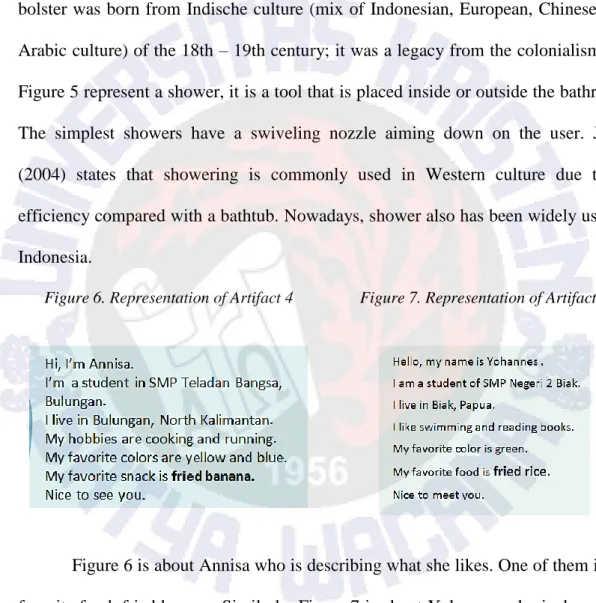
Figure 6. Representation of Artifact 4 Figure 7. Representation of Artifact 5
Figure 6 is about Annisa who is describing what she likes. One of them is her favorite food, fried banana. Similarly, Figure 7 is about Yohannes who is describing what he likes and one of them is his favorite food, fried rice. The focus of discussion here is the favorite food. Fried banana is a snack made of banana covered with batter and deep-fried in hot cooking oil. Backshall (2003) said that fried bananas are usually sold on traveling carts or by street vendors as gorengan. It is often found in
15
Crossette (1986), fried rice, known as nasi goreng is categorized as Indonesian national food.
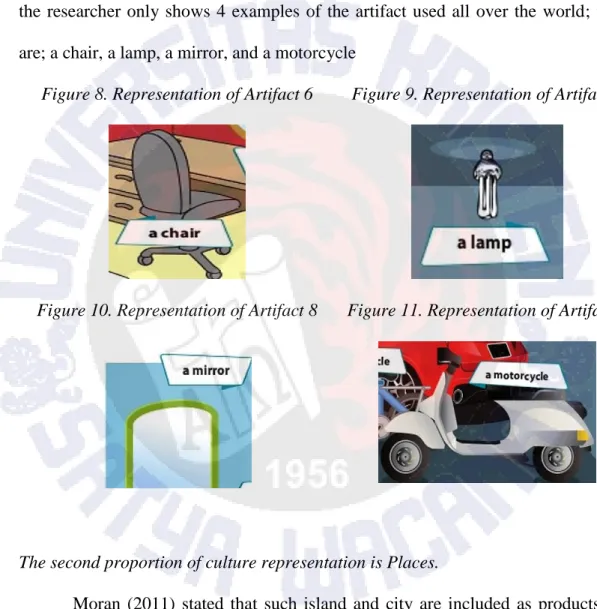
The second group indicates Figure 8 until 11 shows the category of artifacts in the textbook that are commonly used worldwide. Due to this report's efficiency, the researcher only shows 4 examples of the artifact used all over the world; those are; a chair, a lamp, a mirror, and a motorcycle
Figure 8. Representation of Artifact 6 Figure 9. Representation of Artifact 7
Figure 10. Representation of Artifact 8 Figure 11. Representation of Artifact 9
The second proportion of culture representation is Places.
Moran (2011) stated that such island and city are included as products that represent places. Figure 12 until 18 display the name of the mountain, islands and seas in Indonesia. Figure 12-17 were taken from chapter 2. They were used for talking about one‟s identity (e.g name and where someone comes from). Figure
12-17 consisted of name of people and where they are from (place). In this case, the analysis was focused on the place.
16
Figure 12 presents Max Bae from East Nusa Tenggara, and he lives in Kupang. Nusa tenggara and Kupang here refers to „place‟. According to Encyclopedia Britannica (2002), Kupang is the capital of East Nusa Tenggara, and the majority of the population is Papuan, with the admixture of Malayan and Polynesian people.
Figure 13. Representation of Places 2
Figure 13 point out that Hasnida is from West Sumatra, and she lives in Padang. According to Encyclopedia Britannica (2016), Padang is the capital and the largest area in West Sumatra with 695 square miles.
17
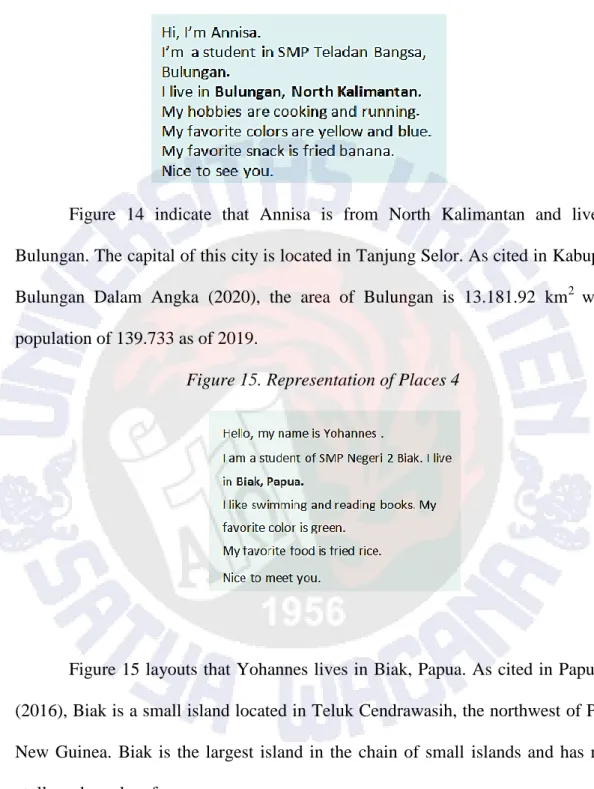
Figure 14. Representation of Places 3
Figure 14 indicate that Annisa is from North Kalimantan and lives in Bulungan. The capital of this city is located in Tanjung Selor. As cited in Kabupaten Bulungan Dalam Angka (2020), the area of Bulungan is 13.181.92 km2 with a population of 139.733 as of 2019.
Figure 15 layouts that Yohannes lives in Biak, Papua. As cited in Papua Go (2016), Biak is a small island located in Teluk Cendrawasih, the northwest of Papua New Guinea. Biak is the largest island in the chain of small islands and has many atolls and coral reefs.
18
Figure 16. Representation of Places 5
Figure 16 displays the conversation between 2 people; one of them will go to Bali for vacation. As cited in Encyclopedia Britannica (2020) Bali is situated 1.6km east of Java Island. It is a small island surrounded by the sea, that is why Bali has most beautiful beach and become one of tourist destination in Indonesia because of the natural beauty and cultural viscosity.
Figure 17 were taken from chapter 7. There were used for describing things to make them stand out and to make the students be proud of Indonesia. “things” in this chapter refer to islands, seas, and mountains in Indonesia. Therefore, the analysis was focused on the “things” or place.
19
The passage clearly describes places (e.g. islands, seas, mountains) in Indonesia with the purpose of making the students be proud of Indonesia (as seen in the title of the passage, “I am proud of Indonesia”).
The Third Proportion of Culture is Art Forms.
The representation of art form in the textbook involved clothing. Moran (2011) stated that one of the dimensions of a product is an art form; it includes music, clothes, dancing, painting, movie, architecture. As shown in figure 18, the art form is the hijab.
Figure 18 shows two girls greeting each other. It can be seen that students wear hijab. As cited in El Guindi's book entitled Veil: Modesty, Privacy, and Resistance (1999), the veil has been around since 2500 BCE as a sign of respectability and high status for elite women in ancient Mesopotamia, Byzantine, Greek, and Persian empires. Ridwan (2012) states that many years ago, the hijab was known in Melayu culture. Indonesian know it as baju kurung, that means using a veil in the head. It can be seen in Figure 19, and there is an illustration of Sultanah Seri
20
Ratu Nahrasyiah Rawangsa Khadiyu, who lead Kerajaan Samudra Pasai (1400-1427).
Meanwhile, in Java, this outfit is usually worn by Muslim women from the santri family. In the independence era, Indonesian First Lady, Mrs. Fatmawati, always wore a veil at state events.
The second art form is batik. Figure 20 displays the conversation between 2 students. They are discussing their science teacher and one of them describes what their teacher is wearing (Batik). The focus of discussion here is the „batik‟.
Figure 20. Representation of Art Forms 2
According to Santosa (2003), batik is an Indonesian technique that originated from Java, Indonesia. Usually, batik is used in a formal event like a wedding and cultural ceremony. In this era, batik also can be used for casual or daily outfits. From Figure 18 and 20, proves the representation of art forms in When English Rings a
Bell for 7th grade students, in an example, clothes.
Figure 19. Illustration of Sultanah Seri Ratu Nahrasyiah Rawangsa Khadiyu
21
The representation of practices as the dimension of culture in When English Rings a Bell
Operation is the only representation of practices that appears in the textbook.. According to Moran (2011), one component of the practices is operation. Operation concerns with manipulation of cultural products (action and interaction, verbal and
non-verbal
).
Figures 21, 22 and 23 portray the operation.Figures 21, 22 and 23 portray the action of kissing the elder‟s hand to greet, say goodbye, and show respect to that person. Usually, this action is done when children leave their house, and they come back as an act to ask for a blessing. This cultural habit is classified as an operation because it is an action; as stated in the
Figure 21. Representation of Operation 1 Figure 22. Representation of Operation 2
22
Cambridge Dictionary, the action is the process of doing something. Second, it is an interaction. Cambridge Dictionary (1999) also claimed that “interaction is an occasion when two or more people communicate with or react to each other.” In this case, the action is hand shaking and kissing someone‟s hand and interaction is saying goodbye and greetings.
The representation of communities as the dimension of culture in “When English Rings a Bell”
The only representation of communities in the textbook is groups. Moran (2001) claimed that there are three sections of communities that are specific social context, circumstances, and groups. Kowalski gives examples of what is included in groups into three categories: unalterable, alterable, and self-selected.
Figure 24. Representation of Groups 1 Figure 25. Representation of Groups 2
Figures 24 and 25 are about a conversation between a Boy Scout leader and the members. The conversation is about greetings. Besides, the figures spotlight Boy Scout activities as the background of the illustration. This discussion is focused on Boy Scout group represented in the illustration. Scout movement is included as a community, especially a group, because, according to Collins Dictionary (2004), the definition of scout movements is "the group of people who set up the Scout
23
Association and those who currently are involved with it." Also, Kowalski states that self-selected is a profession, association, and organization membership (club, team, political party). Scout movement is considered as a community because it is an association that consists of a group of people.
The representation of perspectives as the dimension of culture in “When English Rings a Bell”
The example of perspective in the textbook is the presentation of national days.
Figure 26. Representation of National days
As shown in figure 26, there are some national days in Indonesia. The researcher put „national day‟ as a dimension of perspectives because it is matched
with the definition of perspectives (perceptions, beliefs, values, and attitudes). Merriam Webster (2019) defined those terms as follows. “National Day is a day to have significance for and celebrated throughout a nation. Perception is the awareness of something through the sense. Belief is accepted, considered to be true, or held as an opinion: something believed. Values are the regard that something is held to deserve the importance, worth or usefulness of something, and attitude is a way of feeling or acting toward a person, thing, or situation.” It can be concluded that
24
National days are considered as a perspective since they are considered or believed to be valuable days to remember or celebrate.
As a closure from this section it can be concluded that in this textbook the dimension that appears the most is „product‟ in a form of tools, places, food and clothes (see figure 1). Followed by „practices‟ in the form of salim, „communities‟ in the form of illustrations of Boy Scout, and „perspectives‟ in the form of national day.
B. The representation of Cultural Categories in the Textbook
The evaluation of cultural categories is based on the idea of Cortazzi and Jin, Categories of Culture (1999). Cortazzi and Jin (1999) differentiated three categories of culture that can be used in language textbooks and material. Those categories are Source Culture, Target Culture, and International Culture. Aliakbari (2004) also added a new culture category, which is Culture Neutral or Culture Universe. The data of cultural categories were obtained from the data of dimensions of culture. The data of dimensions of culture revealed lists of elements of culture (product, perspective, community, and practice). These findings were then categorized into three categories of culture (source, target, international culture and culture neutral). The percentage of dimensions of culture was calculated by dividing the total of each category of culture. It was then multiplied by 100%. The cultural categories that appeared in the textbook can be seen in figure 27.
25
Figure 27. Cultural Categories
From figure 27, it can be concluded that English textbook When English
Rings a Bell mostly adapts Source Culture (65%), which is Indonesian culture. The
next culture is Culture Neutral (30%) and followed by International Culture (5%). Surprisingly, Target Culture is not depicted in the textbook. How the cultural categories are represented in the textbook is discussed in the following part.
Source Culture Representation in the Textbook
As stated by Cortazzi and Jin (1999), source culture refers to a teacher and learner‟s own culture. In this research, the source culture is Indonesian culture. From
the section of dimension of culture, each dimension already divided into several groups which can be used directly to identify cultural categories. The representation of Source Culture (Indonesian Culture) can be seen from the table analysis of source culture below.
Table 4. Analysis of Source Culture
Dimension of Culture Form Origin Category of
Culture Product Places Country: Indonesia. Indonesia Source
Source Culture Target Culture International Culture Culture Universe 0 20 40 60 80 65% 0% 5% 30%
26
Island: Kalimantan (Borneo), Sumatera (Sumatran), Jawa (Java), Sulawesi, Bali, Nusa Tenggara, Papua.
City: Padang, Kupang, Bulungan, Biak. Seas: Java sea, Bali sea, the Arafuru sea, Banda sea, the Timor sea.
Mountains: Sinabung, Marapi, Merapi, Lokon
Culture
Art Form Clothes: Batik Indonesia Source
Culture Artifact Tools: 1. Scoop 2. Bolster 3. Shower Foods: 1. Fried Rice 2. Fried Banana 1.Indonesia , Malaysia 2. Mix of Indonesian, European, Chinese, and Arabic culture 3. Western Country 1.Indonesia 2.Indonesia Source Culture
Practice Operation Salim Indonesia Source
Culture Perspectives National Days: Kartini‟s Day Indonesia Source Culture Communities Self-Selected: Scout Movement United
Kingdom
Source Culture
27
Table 4 represents source culture that appeared in When English Rings a Bell, it explains that this textbook mostly presented “product” of Indonesian culture like names of cities, islands, mountains, and seas in Indonesia, traditional clothes, tools commonly used in Indonesia, Indonesian food and common practice that Indonesian do. Even though the origin of showers is from western countries, showers have been widely used in Indonesia in this era. Similarly, scouting has come to Indonesia since 1912. With the 2013 curriculums, scouting is compulsory for all Indonesian students to join the movement as an official extracurricular (Kompas, 2012). In another word, “shower” and “scouting” are not authentic from Indonesia but have been adopted by
Indonesian people. What is more, it presents the national day, which valuable for Indonesian people. It can be seen from figure 28 below the dimension that occurs the most in source culture is „products‟ with the category of „places‟ and „artifact‟ it followed by „communities, „practice‟, and „perspectives‟ in the same number of
percentages.
Figure 28. Representation of Dimension of Culture in Source Culture
0 20 40 60 80 100 Product Practice Perspectives Communities Person 85% 5% 5% 5% 0%
28
International Culture Representation in the Textbook
Cortazzi and Jin in Mckay (1999) said that international culture is a variety of English and non-English speaking countries around the world. The representation of International Culture in the textbook can be seen from the table analysis of International Culture below.
Table 5. Analysis of International Culture
Dimension of Culture Form Origin Category of Culture Product; Artifact Veil (Hijab) Ancient Mesopotamia International Culture
Table 5 indicates that hijab (veil) as dimension of culture belongs to an international culture since it was initially originated from ancient Mesopotamia. Although the hijab belongs to International culture, the use of hijab in Indonesia has been rooted for more than 500 years, and it seems to become a part of Indonesian culture.
Culture Neutral or Culture Universal Representation in the Textbook
According to Durkheim, Murdock, Strauss, and Brown (1991), culture universal is an element, pattern, property, or institution common to all human cultures worldwide. The representation of culture universal in the textbook can be seen in Table 6 below.
Table 6. Analysis of Culture Neutral
Dimension of Culture Form Category of Culture
Product; Artifact Lamp, motorcycle, mirror, chair, clock, globe, table, floor, telephone, sink, stove, fork,
29
plate, blanket, bed, pillow, car, bicycle.
Practices; Acts Greetings (good morning & good night)
Culture Neutral
Table 6 portrays various kinds of artifact (tools and properties) and practices that are common to all human cultures worldwide (culture neutral/culture universal).
Discussion
This section discusses the interconnection between the research findings and some previous studies, and theory of culture in ELT materials, and the Indonesian government policy.
The first point of discussion is the interconnection between the research findings with previous findings. This research revealed that the textbook mostly presents Indonesian / source culture. In response to the findings, Pratiwi (2017), analyzing cultural representation in When English Rings a Bell for 8th grade (of JHS), found that source culture appeared in almost all dimensions of culture except beliefs and values. Pratiwi (2017) claimed that the representation of target and international culture is deficient and international culture is only depicted through art and traditional ceremony. Another similar result was also found by Kriswidyantara (2019), who analyzed cultural Content in When English Rings a Bell for 8th grade students. The result indicated that the textbook mostly represents source culture rather than target culture and international culture.
The second point of discussion is the interconnection between the findings of this study and the culture theory in ELT materials. Cortazzi and Jin in Heinkel (1999)
30
categorized a textbook into three: the one based on source culture, target culture, and international culture. In line with this category, the finding of this study suggested that When English rings a Bell for grade 7 clearly belongs to a textbook based on source culture since the presentation of findings reveal that When English Rings a
Bell for 7th grade (of JHS) is dominated by source culture (65%).
The third point of discussion is the interconnection between the research finding and the Indonesian government policy. Cortazzi and Jin in Hinkel (1999: 205) argued that one of the reasons why a source culture features so strongly emerge in a textbook is "to help students become aware of their own cultural identity." This reason goes along with the Indonesian government policy as stipulated in the Regulation of the Ministry of Education and Culture in 2016, No.20. It stated that students should have technical and specific knowledge at a simple level for science, technology, art, and culture associated with society and the natural environment around, nation, and country. Consequently, the national curriculum needs to address or even deepen students' knowledge about Indonesian cultural values and ideology. As a textbook based on source cultures, When English Rings a Bell does carry the "message" stated in the regulation. For example, by strongly emphasizing the cultural practice of “salim” and displays briefly about many places (Kalimantan,Bali,
Kupang, Nusa Tenggara) in Indonesia, traditional clothes like Batik, and Indonesian food. The cultural presentation, I think, can make the students aware of the various categories of culture in Indonesia and proud of their cultural identity.
31
CONCLUSION
This section presents the conclusion and suggestion based on the results. This study has two research questions. First, to what extent does the textbook represent Moran‟s dimension of culture? Second, to what extent does the textbook represent Cortazzi and Jin‟s cultural categories? The conclusion is obtained from the study's
findings.
Based on the findings of this study (as seen in figure 1), the researcher found and calculated that, first, the percentages of the dimension of culture by using Moran's (2001) is the 'products' dimension had the highest percentages among the other cultural dimension followed by 'practices‟, „communities‟, and 'perspectives.' It turns out that the dimension of 'persons' cannot be found in the textbook. Second, the percentages of cultural categories using Cortazzi and Jin's (1999) and Aliakbari (2004) are the source culture have the highest percentages over the other categories, followed by culture neutral, a small part of the target culture and international culture (as seen in figure …). The findings on dimension of culture and cultural categories
revealed that the textbook frequently presents products and practices. Furthermore, the findings on category of culture found out that the textbook is mostly adopting source culture (Indonesian culture). From the factual analysis on the dimension of culture and category of culture in the textbook, it is obvious that this textbook appropriately reflects the national policy on integrating culture in all subjects (in this case English subject).
As the pedagogical implication from this study, teachers can integrate more dimensions of culture (Indonesian traditional customs, various places in Indonesia,
32
folklores, and some common behavioral practices of Indonesian people) in English teaching materials. As for the study's limitation, data analysis research needs more time and effort since there are limited sources that explained the categorization of dimensions of culture and cultural categories completely.
33
ACKNOWLEDGEMENTS
First of all, I would like to thank Almighty God for help and guidance throughout my life to work on life's right path. Next, I would like to thank my parents, who have support me mentally and financially from the beginning until finishing this thesis. Congratulations to my parents because they succeed in making their daughter graduated and get the title of Sarjana Pendidikan. I give all of my achievements to my beloved parents.
The biggest gratitude goes to my thesis supervisor, Dr. Debora Tri Ragawanti, S.S., M.A-ELT., for the time, help, and suggestion to develop my thesis. For my second reader, Prof. Dr. Gusti Astika, M.A., to proofread my paper and for the suggestion.
Special thanks go to my college friends, Yuliana, Abel, Shanita, Kaisha, and Vania, for the times of struggling, studying, laughter, and cried together in my whole college life. My best friend, Karina, Novia, and Denny, who support me in all of the things and make my hard times seems easier than before. My personal supporter, Sultan Bimasakti, who always be there when I was grumbling about many things. Thank you for always listening and giving me support. Lastly, thanks to all my Sixteeners family at the Faculty of Language and Arts for the bittersweet experiences and memories.
34 References
Aliakbari, M. (2004). The Place of Culture in the Iranian ELT Textbooks in High School Level. The 9th Pan-Pacific Association of Applied Linguistics Conference. Seoul: Namseoul University. Retrieved from
http://www.paaljapan.org/resources/proceedings/PAAL9/pdf/Aliakbari.pd
f
Badan Pusat Statistik Bulungan. (2019). Kabupaten Bulungan dalam angka.
Retrieved August 16, 2019 from
https://bulungankab.bps.go.id/publication/2019/01/16/75023615437a756c
36552dfe/kabupaten-bulungan-dalam-angka-2019.html
Cunningsworth, A. (1995). Choosing your Coursebook. Macmillan Heineman. Dickins, R.P., & Germaine, K. (1992). Evaluation, 6(2), 1-175. Oxford: Oxford
University Press.
Ellis, R. (1996). Does it work? Evaluating tasks in language teaching.The
Language Teacher, 1 (1), 1-24. Retrieved from
http://www.jalt-publications.org
Faris, I.N.I. (2014). Cultural content analysis of an English textbook for senior high school grade three in Cianjur, West Java. Journal of English and
Education, 2(2), 14-25. Retrieved from
https://ejournal.upi.edu/index.php/L-E/article/view/4599
Fitriyah, L. (2015). An analysis of culture on the reading material textbook in the second grade junior high school. ELT Perspective, 3(2), 340 –
351.Retrieved from
https://www.researchgate.net/publication/331706449_An_Analysis_of_Cul ture_on_the_Reading_Material_Textbook_in_the_Second_Grade_Junior_
High_School
Graves, K. (2000). Designing Language Course, A Guide for Teachers. Boston.
Guindi, E.F. (1999). Veil: Modesty, Privacy, and Resistance. Berg Publishers. Gunantar, D. A. (2017). Textbooks analysis: analyzing English as a foreign
35
Language Circle: Journal of Language and Literature, 10(2), 173-180.
Retrieved from http://journal.unnes.ac.id
Hinkel, Eli. (1999). Culture in second language teaching and learning. Cambridge: Cambridge University Press.
Hofstede, G (2011). Dimensionalizing cultures: The Hofstede model in context.
Online Readings in Psychology & Culture, 2(1), 1-25
Hutchinson and Torres. (1994). The textbook as agent of change. ELT Journal.
Retrieved from
https://academic.oup.com/eltj/articleabstract/48/4/315/2724140
Juan, W. (2010). A content analysis of the cultural content in the EFL textbooks.
Canadian Social Science, 6(5), 137-144. Retrieved from
http://www.cscanada.net/index.php/css/article/view/j.css.19236697201006
05.016
Karamouzian, F.M. (2010). A post-use evaluation of current reading comprehension textbook used in TEFL programs. The Iranian EFL 6(4). Kramsch, C. (1998). Language and culture. Oxford: Oxford University Press.
Lodico, G.M., Dean, T.S., Katherine, H.V. (2006). Methods in Educational
Research From Theory to Practice San Fransisco. Jossey Bass.
Mckay, S.L. (2002). Teaching English as an international language: Rethinking
goals and approaches. Oxford: Oxford University Press.
Moran, P. (2001).Defining culture in teaching culture: Perspectives in practice. Boston, MA: Heinle & Heinle.
Muzainuddin, M. (2017). Cultural content analysis of revised English textbook
for junior high school. Retrieved 2017, from Brawijaya University Web
Site:
http://repository.ub.ac.id/id/eprint/2453
Nurjanah, I., & Umaemah, A. (2019). An analysis of cultural content in the textbook “pathway to English” for second grade in senior high school.
36
ELT-Echo, 4(1), 83-92. Retrieved from
http://syekhnurjati.ac.id/jurnal/index.php/eltecho/article/download/4536/p
df_25
Peraturan Menteri Pendidikan dan Kebudayan (Permendikbud) No. 20. (2016). Indonesia: Minister of Education and Culture.
Pratiwi, T.L. (2017). Cultural representation in English course books for junior
high school. Retrieved August 15, 2017, from Sanata Dharma University
Web Site: http://repository.usd.ac.id/id/eprint/12080
Rahmawati, L. (2019). The cultural content analysis on the English textbook
entitled “When English Rings a Bell” for 7th
grade of junior high school based on the cultural dimensions and categories. Retrieved September 4,
2019, from Jember States University Web Site:
http://repository.unej.ac.id/handle/123456789/100207
Rajabi, S., & Ketabi, S. (2012). Aspects of cultural elements in prominent English textbooks for EFL setting. Theory and Practice in Language Studies, 2(4),
705-712. Retrieved from
https://www.researchgate.net/publication/267378647_Aspects_of_Cultural
_Elements_in_Prominent_English_Textbooks_for_EFL_Setting
Ramadhani, K., Fitriani, S.S., & Burhansyah. (2017). Teachers‟ perceptions on the content of when English rings a bell textbook.Research in English and Education, 2(4), 63-72. Retrieved from
http://jim.unsyiah.ac.id/READ/article/view/7178
Santosa, I. (2015). Cultural representation in English course books for junior high
school. Eduscience, 1 (1), 25 – 32. Retrieved from
https://ejurnal.esaunggul.ac.id/index.php/EDU/article/view/1181
Tavakoli, H. (2012). A Dictionary of Research Methodology and Statistic in Applied
Linguistics. Iran: Rahnama Press.
Tomlinson, B. (Eds.). (2011). Materials Development in Language Teaching (2nd
37
Yen, Y. (2000). Identity Issues in EFL and ESL Textbook: A Sociocultural
Perspective. The Ohio State University, USA. Retrieved September 11, 2018
from http://etd.ohiolink.edu/view.cgi?acc_num=osu124284567 Zulkarnaen.,Ikhsanudin.,& Sada, C. (2017). Cultural content and context in
thetextbook “When English Rings a Bell” used by grade seventh students of SMP Mandiri Pontianak. Jurnal Pendidikan dan Pembelajaran
Khatulistiwa, 6(4), 1-9. Retrieved from
38 Appendix A
Chapter Page Dimension of Culture
Products Practices Perspectives Communities Persons Proof
1 5 ν
5 ν
7 ν
8 ν
39 12 ν 2 25 Ν 25 ν 30 ν 31 ν 3 52 ν
40 4 77 ν 77 ν 80 ν 80 ν 80 ν 83 ν 83 ν 6 - - - - - - -
41 Appendix B 7 153 ν 158 ν 168 ν 169 ν
Chapter Page Cultural Categories
Source Culture Target Culture International Culture Culture Neutral Proof 1 5 ν
42 5 ν 7 ν 8 ν 11 ν 12 ν 2 25 ν
43 25 ν 30 ν 31 ν 3 52 ν 4 77 ν 77 ν
44 80 ν 80 ν 80 ν 83 ν 83 ν 6 - - - - - - 7 153 ν 158 ν
45
168 ν