ABSTRACT
Wijayanti, Yunita Rizky. 2015. Undergraduate Students’ Vocabulary Learning Strategies Adopted in Online Crossword Puzzles. Yogyakarta: The Graduate Program in English Education Studies, Sanata Dharma University.
Learning vocabulary using web-based learning may engage undergraduate students to become active to apply their own vocabulary learning strategies which are more appropriate and convenient for them in order to achieve the objectives of the learning process. The students’ vocabulary learning strategies may affect their achievement, so they are required to explore more vocabulary learning strategies to find out the most effective vocabulary learning strategies to optimize their learning process. Thus, this study aimed to describe the vocabulary learning strategy through online crossword puzzles implemented by the students. It is elaborated into two research questions intended (a) to investigate the most dominant vocabulary learning strategies used in the puzzles, and (b) to describe factors or features most significantly encourage the students to learn vocabulary using the puzzles.
This study applied a mixed-method design inasmuch as the analysis involved both qualitative and quantitative data. It used a survey to obtain data dealing with what vocabulary learning strategies using the puzzles the learners conducted and how they did those strategies. It implemented triangulation to strengthen the findings of this study by conducting interviews developed from the result of the questionnaire to clarify and to dig out more detailed data gained from the questionnaire. The study was carried out in English Letters Department of Sanata Dharma University. The samples of this research were 61 first semester students who took vocabulary course in academic year 2014/2015.
Furthermore, from this study, it is found that there are eleven most important factors or features which encourage students to learn vocabulary through the puzzles. Those factors or features are opportunities to use dictionaries, immediate checking, attractive learning method, guessing words, peer collaboration, typing words, repetition, learning from the errors, practice, flexible time, and display scores. Those factors or features are listed from the most to the least favourite factors or features chosen by the students to support at the most to learn vocabulary using the puzzles.
ABSTRAK
Wijayanti, Yunita Rizky. 2015. Undergraduate Student’s Vocabulary Learning Strategies Adopted in Online Crossword Puzzles. Yogyakarta: The Graduate Program in English Education Studies, Sanata Dharma University.
Belajar kosakata dengan metode berbasis website dapat mendukung siswa menjadi lebih aktif dalam menentukan sendiri penerapan strategi belajar yang paling tepat dan untuk mencapai tujuan pembelajaran secara optimal. Penerapan strategi belajar kosakata siswa dapat mempengaruhi keberhasilan belajar mereka sehingga siswa perlu lebih mengeksplorasi berbagai macam strategi belajar kosakata agar dapat menemukan strategi belajar kosakata yang paling tepat untuk mengoptimalkan proses belajar kosakata. Oleh karena itu, penelitian in bermaksud menggambarkan strategi belajar kosakata melalui teka-teki silang online yang diterapkan oleh para siswa yang dirumuskan dalam dua pertanyaan dalam penelitian ini yang bertujuan untuk (a) meneliti strategi belajar kosakata yang paling dominan digunakan untuk belajar kosakata menggunakan teka-teki silang online, dan (b) untuk menggambarkan faktor atau sarana yang paling penting dalam mendorong siswa untuk belajar kosakata melalui teka-teki silang.
Studi ini menerapkan metode penelitian campuran karena menganalisa data kuantitatif dan kualitatif. Studi ini menggunakan survey untuk memperoleh data jenis strategi belajar kosakata yang diterapkan para siswa menggunakan teka-teki silang online serta bagaimana mereka menerapkan strategi tersebut. Triangulasi dilakukan untuk memperkuat temuan studi ini dengan melakukan wawancara yang pertanyaannya dibuat berdasarkan pengembangan dari hasil kuesioner. Penelitian ini dilakukan di Universitas Sanata Dharma Jurusan Sastra Inggris. Sampel penelitian ini melibatkan 61 mahasiswa semester pertama yang mengambil kuliah kosakata pada tahun ajaran 2014/2015.
Hasil penelitian menunjukkan bahwa tiga belas macam strategi belajar kosakata yang dibagi menjadi dua kategori: strategi direct dan strategi indirect. Secara keseluruhan, ditemukan bahwa penerapan strategi direct lebih dominan daripada penerapan strategi indirect. Strategi direct meliputi strategi guessing intelligently, memory dan cognitive. Strategi guessing intelligently merupakan strategi paling dominan dari semua strategi direct. Strategi berikutnya yaitu strategi memory seperti strategi creating mental linkages, employing action, dan
reviewing well. Strategi berikutnya diikuti oleh strategi cognitive yang penerapannya hampir sedominan strategi memory. Strategi cognitive terdiri dari strategi analyzing and reasoning, practicing, dan creating structure for input and output.Sedangkan strategi indirect meliputi strategi affective, metacognitive, dan
social. Hasil dari penelitian menunjukkan bahwa strategi affective merupakan strategi paling dominan dari semua strategi indirect. Strategi affective tersebut yaitu lowering anxiety dan selfyencouraging. Akan tetapi, strategi metacognitive
hampir sedominan strategi affective. Strategi metacognitive meliputi evaluating learning, centering learning, dan juga arranging and planning learning. Strategi yang terakhir yaitu strategi social yang dapat dilakukan dengan cara cooperating with others.
dengan menggunakan teka-teki silang online. Faktor atau sarana tersebut yaitu kesempatan untuk menggunakan kamus, segera mengoreksi, metode pembelajaran yang menarik, menebak kata, bekerja sama dengan teman, mengetik kata, pengulangan, belajar dari kesalahan, latihan, waktu yang fleksibel, dan tampilan nilai. Penyebutan kesebelas factor atau sarana tersebut diurutkan dari yang paling favorit dipercaya oleh mahasiswa dalam mendukung mahasiswa untuk belajar kosakata melalui teka-teki silang online.
i
UNDERGRADUA
TE STUDENTS‟
VOCABULARY LEARNING STRATEGIES
ADOPTED IN ONLINE CROSSWORD PUZZLES
A THESIS
Presented as a Partial Fulfillment of the Requirements To Obtain the Magister Humaniora (M Hum) Degree
In English Language Studies
by
Yunita Rizky Wijayanti Student Number: 136332001
THE GRADUATE PROGRAM IN ENGLISH LANGUAGE STUDIES SANATA DHARMA UNIVERSITY
iv
DEDICATION PAGE
BE THE BEST OF WHATEVER YOU ARE by Douglas Malloch
If you can‘t be a pine on the top of the hill Be a scrub in the valley – but be
The best little scrub by the side of the rill Be a bush if you can‘t be a tree
If you can‘t be a bush be a bit of the grass And some highway some happier make If you can‘t be a muskie, then just be a bass – But the liveliest bass in the lake!
We can‘t all be captains, we‘ve got to be crew There‘s something for all of us here
There‘s big work to do and there‘s lesser to do And the task we must do is the near
If you can‘t be a highway then just be a trail If you can‘t be the sun be a star
It isn‘t by size that you win or you fail – Be the best of whatever you are!
I dedicated my thesis to
vii
ACKNOWLEDGEMENTS
First and foremost, I would like to dedicate my greatest gratitude to ALLAH S.W.T for showering me the invaluable mercy and love in my life. Hence, I could have an opportunity to accomplish my study.
I would like to express my deepest appreciation to my thesis advisor, Dr. B. B. Dwijatmoko, M. A., for his support, guidance, patience, and kindness to complete my research. Furthermore, my great appreciation also goes to Dr. J. Bismoko, F. X. Mukarto, M.S., Ph. D., Dr. Fr. B. Alip, M.Pd., Paulus Sarwoto, S.S., M.A., Dr. Alb. Budi Susanto, S.J. for the knowledge, insights, and encouragements during my study to make me become a better person. I would like to thank Dr. Retno Muljani, M. Pd for her great suggestions to improve my research. I would like to extend my thanks to all staff of the Graduate Program, Mbak Lely for her help in administrative matters and also Pak Mul for his help
and friendliness.
I would like to dedicate my precious gratitude to my mother, Ibu Sri Hastuti for her prayers, endless love, support, patience, and all best values of life for being a better person, and also to my father, Bapak Soebagyo, who has been in heaven, yet he always keeps alive in my heart. I would also like to give my sincere gratitude to my lovely sisters, Mbak Ika, Mbak Lia, and Dik Zeni, and to my beloved brother Dik Taufik for their prayers, love, and encouragement. I am also grateful to have my dearest newborn niece, Dik Aisya who has shared happiness to my big family and makes our lives more colourful.
viii
cheerful time during learning in KBI. I particularly thank to Dian and Levyn for being my partners in accomplishing my study.
I would like to thank all of my colleagues and academic staff of Cilacs UII for their support to finish my study. My special thank goes to Mas Norman for his prayers, support, sincerity, and kindness. I am deeply indebted to Mas Dhadha for his helps whenever I got problems with my computer and also Mbak Ita for her ideas and suggestions for my study.
Finally, my gratitude also goes to those whom I cannot mention by names. May ALLAH S.W.T. bless all of us with health and the happiest life. Aamiin.
ix
e. Intentional and Incidental Vocabulary Learning ... 24
f. Principles of Vocabulary Learning ... 25
x
B. REVIEW OF RELATED STUDIES ... 52
C. THOERETICAL FRAMEWORK ... 56
F. Research Population and Sample ... 73
G.Data Gathering Techniques and Instruments ... 74
H.Data Analysis ... 78
I. Trustworthiness of the Study ... 82
CHAPTER IV RESEARCH RESULTS AND DISCUSSION ... 84
A.RESEARCH RESULTS ... 84
1. The Results from the Close-Ended Items of the Questionnaire ... 84
2. The Results from the Open-Ended Items of the Questionnaire ... 88
3. The Results from the Interviews ... 93
B.DISCUSSION ... 96
1. Vocabulary Learning Strategies (VLS) Used in Online Crossword Puzzles 96 2. The Factors or Features Most Significantly Encourage the Students to Learn Vocabulary through the Puzzles ... 131
CHAPTER V CONCLUSIONS AND SUGGESTIONS ... 145
A.Conclusions ... 145
B.Suggestions ... 148
BIBLIOGRAPHY ... 150
xi
Appendix 2: Questionnaire Result ... 160
Appendix 3: Score Interpretation ... 164
Appendix 4: Data from Open-Ended Questionnaire ... 168
Appendix 5: The Interview Guideline ... 177
xii
LIST OF TABLES
Table Page
2.1 VKS Elicitation Scale-Self Report Categories ... 14
2.2 Knowing a Word ... 16
2.3 Definitions of Learning Strategies ... 27
2.4 Features of Language Learning Strategies ... 28
2.5 Language Learning Strategies ... 29
2.6 A Taxonomy of Vocabulary Learning Strategies ... 33
2.7 Gu and Johnson‘s Categories of Vocabulary Learning Strategies ... 35
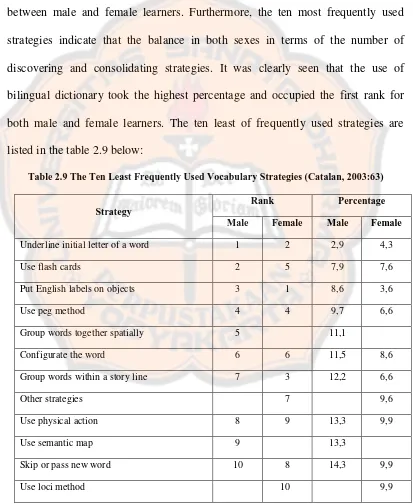
2.8 The Ten Most Frequently Used Vocabulary Learning Strategies ... 36
2.9 The Ten Least Frequently Used Vocabulary Learning Strategies ... 37
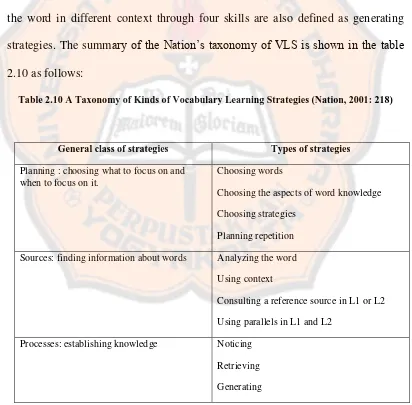
2.10 A Taxonomy of Kinds Vocabulary Learning Strategies ... 39
2.11 The Syllabus of Vocabulary Web-Based Class ... 41
2.12 A Brief Overview of Online Crossword Puzzles ... 47
2.13 Vocabulary Learning Strategies adapted from Oxford (1990:17) ... 54
2.14 Oxford‘s VLS Compared with Other Proponents‘ Concept ... 57
3.1 The Steps to Conduct Survey Research ... 64
3.2 Research Timeline ... 67
3.3 The Summary of Data Gathering Techniques and Instruments ... 71
3.4 The Blueprint of the Data Gathering ... 73
3.4 The Meanings of Coding of the Data of the Open-Ended Questions and the Interview ... 76
4.1 Degrees of Frequency of the Questionnaire ... 80
4.2 Score Criteria ... 81
4.3 The Interpretation of the Close-Ended Questionnaire Results ... 82
4.4 The Results from the Open-Ended Question Showing the Students‘ Vocabulary Learning Strategies (VLS) Using the Puzzles ... 83
4.5 The Results from the Open-Ended Question Showing the Factors Most Significantly Encouraging Students to Learn Vocabulary Using the Puzzles .. 86
xiii
LIST OF FIGURES
Figure
Page
2.1 The Classification of Language Learning Strategies ... 29
2.2 Vocabulary Menu in ELTGallery ... 43
2.3 Vocabulary Facilities in ELTGallery ... 44
2.4 The Home Page of ELTGallery ... 48
2.5 An Online Crossword Puzzle in ELTGallery ... 48
2.6 A Model of WWW-Based Learning ... 59
4.1 Crossword‘s Check Puzzles ………. ... 128
xiv
LIST OF APPENDICES
Appendix Page
Appendix 1. The Questionnaire for the Data Gathering …….………..150
Appendix 2. The Questionnaire Result ……….……….153
Appendix 3. The Score Interpretation ……….………..156
Appendix 4. The Data from Open-Ended Questions ………..………..159
Appendix 5. The Interview Guideline ……….…………..166
xv
LIST OF ABBREVIATIONS
A03 : Anisa‘s transcript interview 3
App : Appendix
B02 : Bima‘s transcript interview 2
CALL : Computer Assisted Language Learning D01 : Dina‘s transcript interview 1
LLS : Language Learning Strategies
Q1.2 : Open-Ended Question 1, student‘s comment 2 Q2.3 : Open-Ended Question 2, student‘s comment 3 VLS : Vocabulary Learning Strategies
xvi ABSTRACT
Wijayanti, Yunita Rizky. 2015. Undergraduate Students‟ Vocabulary Learning Strategies Adopted in Online Crossword Puzzles. Yogyakarta: The Graduate Program in English Education Studies, Sanata Dharma University.
Learning vocabulary using web-based learning may engage undergraduate students to become active to apply their own vocabulary learning strategies which are more appropriate and convenient for them in order to achieve the objectives of the learning process. The students‘ vocabulary learning strategies may affect their achievement, so they are required to explore more vocabulary learning strategies to find out the most effective vocabulary learning strategies to optimize their learning process. Thus, this study aimed to describe the vocabulary learning strategy through online crossword puzzles implemented by the students. It is elaborated into two research questions intended (a) to investigate the most dominant vocabulary learning strategies used in the puzzles, and (b) to describe factors or features most significantly encourage the students to learn vocabulary using the puzzles.
This study applied a mixed-method design inasmuch as the analysis involved both qualitative and quantitative data. It used a survey to obtain data dealing with what vocabulary learning strategies using the puzzles the learners conducted and how they did those strategies. It implemented triangulation to strengthen the findings of this study by conducting interviews developed from the result of the questionnaire to clarify and to dig out more detailed data gained from the questionnaire. The study was carried out in English Letters Department of Sanata Dharma University. The samples of this research were 61 first semester students who took vocabulary course in academic year 2014/2015.
xvii
Furthermore, from this study, it is found that there are eleven most important factors or features which encourage students to learn vocabulary through the puzzles. Those factors or features are opportunities to use dictionaries, immediate checking, attractive learning method, guessing words, peer collaboration, typing words, repetition, learning from the errors, practice, flexible time, and display scores. Those factors or features are listed from the most to the least favourite factors or features chosen by the students to support at the most to learn vocabulary using the puzzles.
xviii ABSTRAK
Wijayanti, Yunita Rizky. 2015. Undergraduate Student‟s Vocabulary Learning Strategies Adopted in Online Crossword Puzzles. Yogyakarta: The Graduate Program in English Education Studies, Sanata Dharma University.
Belajar kosakata dengan metode berbasis website dapat mendukung siswa menjadi lebih aktif dalam menentukan sendiri penerapan strategi belajar yang paling tepat dan untuk mencapai tujuan pembelajaran secara optimal. Penerapan strategi belajar kosakata siswa dapat mempengaruhi keberhasilan belajar mereka sehingga siswa perlu lebih mengeksplorasi berbagai macam strategi belajar kosakata agar dapat menemukan strategi belajar kosakata yang paling tepat untuk mengoptimalkan proses belajar kosakata. Oleh karena itu, penelitian in bermaksud menggambarkan strategi belajar kosakata melalui teka-teki silang online yang diterapkan oleh para siswa yang dirumuskan dalam dua pertanyaan dalam penelitian ini yang bertujuan untuk (a) meneliti strategi belajar kosakata yang paling dominan digunakan untuk belajar kosakata menggunakan teka-teki silang online, dan (b) untuk menggambarkan faktor atau sarana yang paling penting dalam mendorong siswa untuk belajar kosakata melalui teka-teki silang.
Studi ini menerapkan metode penelitian campuran karena menganalisa data kuantitatif dan kualitatif. Studi ini menggunakan survey untuk memperoleh data jenis strategi belajar kosakata yang diterapkan para siswa menggunakan teka-teki silang online serta bagaimana mereka menerapkan strategi tersebut. Triangulasi dilakukan untuk memperkuat temuan studi ini dengan melakukan wawancara yang pertanyaannya dibuat berdasarkan pengembangan dari hasil kuesioner. Penelitian ini dilakukan di Universitas Sanata Dharma Jurusan Sastra Inggris. Sampel penelitian ini melibatkan 61 mahasiswa semester pertama yang mengambil kuliah kosakata pada tahun ajaran 2014/2015.
Hasil penelitian menunjukkan bahwa tiga belas macam strategi belajar kosakata yang dibagi menjadi dua kategori: strategi direct dan strategi indirect. Secara keseluruhan, ditemukan bahwa penerapan strategi direct lebih dominan daripada penerapan strategi indirect. Strategi direct meliputi strategi guessing intelligently, memory dan cognitive. Strategi guessing intelligently merupakan strategi paling dominan dari semua strategi direct. Strategi berikutnya yaitu strategi memory seperti strategi creating mental linkages, employing action, dan reviewing well. Strategi berikutnya diikuti oleh strategi cognitive yang penerapannya hampir sedominan strategi memory. Strategi cognitive terdiri dari strategi analyzing and reasoning, practicing, dan creating structure for input and output.Sedangkan strategi indirect meliputi strategi affective, metacognitive, dan social. Hasil dari penelitian menunjukkan bahwa strategi affective merupakan strategi paling dominan dari semua strategi indirect. Strategi affective tersebut yaitu lowering anxiety dan self-encouraging. Akan tetapi, strategi metacognitive hampir sedominan strategi affective. Strategi metacognitive meliputi evaluating learning, centering learning, dan juga arranging and planning learning. Strategi yang terakhir yaitu strategi social yang dapat dilakukan dengan cara cooperating with others.
xix
dengan menggunakan teka-teki silang online. Faktor atau sarana tersebut yaitu kesempatan untuk menggunakan kamus, segera mengoreksi, metode pembelajaran yang menarik, menebak kata, bekerja sama dengan teman, mengetik kata, pengulangan, belajar dari kesalahan, latihan, waktu yang fleksibel, dan tampilan nilai. Penyebutan kesebelas factor atau sarana tersebut diurutkan dari yang paling favorit dipercaya oleh mahasiswa dalam mendukung mahasiswa untuk belajar kosakata melalui teka-teki silang online.
Dari hasil penelitian ini dapat disimpulkan bahwa ada tiga belas macam strategi belajar kosakata yang memungkinkan diterapkan untuk belajar kosakata menggunakan teka-teki silang online. Akan tetapi, setiap strategi yang diterapkan mempunyai tingkat frekuensi yang berbeda. Selain itu, mahasiswa juga mempunyai prioritas strategi belajar kosakata yang berbeda untuk diterapkan sehubungan dengan ditemukannya sebelas macam pendapat tentang faktor terpenting yang memotivasi mereka untuk belajar kosakata melalui teka-teki silang online. Perbedaan tersebut dipengaruhi oleh latar belakang mereka seperti kondisi tempat tinggal, tingkat kecerdasan, dan aktivitas keseharian mereka, dan juga dipengaruhi oleh sifat mereka yang berbeda pula seperti mudah terpengaruh oleh suasana hati, mandiri, atau tertutup. Dalam penerapannya, mahasiswa melakukan penggabungan strategi satu dengan strategi lainnya untuk mencapai tujuan pembelajaran secara optimal, dan juga mengganti strategi satu dengan strategi lainnya ketika mereka merasa strategi yang mereka terapkan belum dapat mengatasi masalah yang mereka temui selama proses belajar berlangsung.
CHAPTER I INTRODUCTION
This chapter is to ensure the validity and feasibility of the research project intending to describe undergraduate students‘ vocabulary learning strategies adopted in online crossword puzzles.
A. RESEARCH BACKGROUND
It is essential to master English inasmuch as it is used to communicate by international community. As a part of international community, it is inevitable to elaborate, negotiate, or cooperate with people from other countries who most of them speak English. It means that in this globalization era, mastering English seems highly demanded in order to be able to compete globally. As a consequence, nowadays not only government but also more private companies require human resources who master English well.
In education, the mastery of English certainly supports both learners and educators to enrich their knowledge and to improve their skills. Most of the references are written in English, so they are demanded to understand written texts. In addition, attending meetings such as international conferences, seminars, and also workshops may also accommodate them to upgrade their knowledge and skills. During the meeting, they need to interact with people who come from different countries, and it is obvious that English as an international language is used to communicate. Hence, considering the importance of mastering English, it becomes such a great challenge for educators to keep improving the quality of
English education, and one of the ways is by facilitating learners to master English in a better way.
It is believed that vocabulary is fundamental to learn a language. Thus, it is crucial for second language learners to know a great number of words to learn another language. According to Carter, ‗vocabulary teaching and learning‘ plays
role as the most important part of ‗the theory and practice of ELT‘ inasmuch as
vocabulary has been the core of ‗culture‘, and ‗learning words‘ is considered as
the most crucial thing as learners most find problems dealing with this matter in the acquisition of second language (2001: 47).
In vocabulary learning, learners are required to deal with three aspects of vocabulary knowledge namely form, meaning, and use. Brown (2000:7) defines the meaning of learning into some definitions. Learning means acquisition or obtaining. Learning means ‗retention of information or skills‘ which involves
‗storage system, memory and organization‘. Learning may imply reinforced
practices. Nation divides word knowledge into three areas namely knowledge of form, knowledge of meaning and knowledge of use. Each of these areas is then
further subdivided. Knowledge of word form might involve knowing what a word
looks like, the written form of a word; or of what it sounds like, the phonological
form. Knowledge of word meaning is likewise divided into three parts. The first
sub-division, form and meaning, is the part most of us will think of in terms of
knowing a word. It involves being able to link the form, however it occurs, to a
meaning, and often in a foreign language this involves forming a link between a
foreign language word and its translation in the native language. The other
in one language might require several translations or carry subtly different
meanings and associations in another language. Knowledge of word use is also
divided into three parts. Grammatical functions deal with knowing what part of
speech a word is and how it will link with other words as a consequence. The
collocations sub-section refers to the company words like to keep. Some words
occur very frequently alongside certain others and these words are said to
collocate with each other. The last sub-division relates with the constraints on use
such as formal and informal use of the words (2000:39-41).
Despite the importance of vocabulary to learn a language, a large number of learners face difficulties to learn vocabulary. Nation (2000:103) states that ‗a word is not fully learned through one meeting.‘ It is because learning a word
relates with learning its form, its meaning, and its use; in addition, learners may focus on different parts to develop knowing a word: focus on input, production, and fluency. The last reason is connected with the condition that learners may deal with limited amount of information at a time because of too much confusion. According to Setiawan (2010:2), a large number of students find problems to master vocabulary because they master limited number of words, and they face ‗difficulty to memorize the meaning of the words‘.
In order to achieve effectiveness in learning vocabulary, it is important to apply such appropriate techniques, and one of them is by using games. O‘Dell and Head (2003:4) advice that ‗words are most easily learnt when students manipulate
in a memorable context‘. In brief, games may provide enjoyable and memorable
experience which is helpful to retain words better; thus, game is considered as an effective way to learn vocabulary.
Crossword puzzle is one of the popular and simple games, so a large number of children as well as adults love playing this game to memorize vocabulary. It is believed that when learners enjoy what they do, they will feel more motivated to do it. Considering that crossword puzzles may support learners‘ enthusiasm, crossword puzzles were selected as supplementary materials
of the vocabulary course at English Letters of Sanata Dharma University. Since the class implemented web-based learning environment, the game was designed on the website which enables students to get more benefits of it.
Furthermore, it is believed that crossword puzzles are effective to help students to memorize vocabulary intentionally. Learning vocabulary intentionally relates with being aware or conscious in attempting of knowing words of the target words (Ellis:1997). As what is claimed by Hill and Popkin that ‗bigger
crossword puzzles are very good for reviewing words (as cited in Nation:1990:255). Thus, each online crossword puzzle is designed to accommodate 50 - 60 words per puzzle, and the students have to accomplish one online crossword puzzle every week. It aims to encourage students to review 50 - 60 words weekly. It is supported by Nation (2000:102) who explains the importance of doing repetition to acquire words and retain the words.
learning websites. Reeves (1997) claims that it is undeniable that web-based learning certainly contributes more facilities and advantages to learners such as enabling learners to have learning autonomy, having easier access to get more sources related to their study, and providing collaborative learning which may support learners to achieve their better performance in learning.
Moreover, the use technology enables to change from teaching to learning to accommodate more students to have fair chances to optimize their learning process. Esnault claims that shifting from teaching to learning is a revolution for the university similar to the one faced by industry when shifting from mass production of goods toward client relationship management (2008:ix). Similarly, Kochtanek and Hein (2000) state that web-based learning is beneficial to transfer control to students. It means that the result of the learning process depends on the learners not on teachers anymore inasmuch as the learners may control their own learning process.
Web-based learning is a part of Computer-Assisted Language Learning (CALL) since it uses computer to apply it, and both may encourage rapid development in the learning teaching process. Cameron (1988) clarifies that ‗the aim of developing CALL is not to provide language learners with novelty, (a novelty which in many cases has already disappeared), but is to improve the quality of language teaching. The aim is not to show how ingenious we are in creating software but to use the computer to help us implement educational aims‘.
In addition, the prior proponents, Harahap (2013), Orawiwatnakul (2013), and Njoroge, Ndung‘u, and Gathigia (2013) declare that crossword puzzles are
crossword puzzles in conducting their studies, so this study aims to develop the prior researches by describing the necessity of using online crossword puzzles to support the students to enhance vocabulary learning. Considering that web-based learning environment enables to empower students to manage their own their learning process to achieve the goals of the course, it is believed that online crossword puzzles may give contribution to enhance students‘ vocabulary learning. According to Reeves (1997), a model of World Wide Web (WWW) - based learning involves certain aspects namely opportunity to construct learning, task ownership, sense of audience, collaborative support, teacher support, and metacognitive support. In other words, this study is intended to look for how well the relation between online crossword puzzles and students‘ vocabulary learning
in order to provide better description related to this issue by conducting a confirmatory survey to a number of respondents who were university students in Yogyakarta.
Furthermore, this study was conducted underlying a big project. Another similar research was carried out by B.B Dwijatmoko, who designed the website called ELTGallery and the online crossword puzzles applied in this study. He intended to examine the contribution of bilingual crossword used in the vocabulary web-based course. It is found that bilingual crosswords in teaching-learning vocabulary contributes to the vocabulary mastery of the students (Fobs > Ftab, p = 0.045). It shows that although the contribution of the puzzle is low inasmuch as only 8.5% cases in the student‘s vocabulary development can be
through the puzzles gives the learners pleasure and influenced to their learning achievement. Thus, being in line with his study, this research also was concerned with the online crossword puzzles. It was intended to provide other aspects dealing with the issue. This study aimed to investigate the most dominant vocabulary strategies implemented by the students used in the puzzles and also the most significant factors or features which encouraged the students to learn vocabulary using the puzzles.
B. PROBLEM IDENTIFICATION
may truly more easily memorize those words by experiencing to retrieve the words through the game.
One of the ways to make improvement in order to support learners achieving their best performance is to do evaluation on what has been going on during the learning process. Hence, this study is intended to investigate the most common vocabulary learning strategies used in the puzzles applied by the students as well as the most significant factors or features of the puzzles motivating the students to learn vocabulary in order to provide better understanding related to the issue and to give feedback to both teachers and learners to make better progress in the future.
C. PROBLEM LIMITATION
This study is limited to provide the description of the implementation of vocabulary learning strategies using online crossword puzzles in certain population. The respondents of this study were the students of vocabulary classes in English Letters Department of Sanata Dharma University Yogyakarta particularly students of academic year 2014/2015 from class B and C as the students in those classes use web-based vocabulary learning environment, and they were required to do online crossword puzzles using website namely ELTGallery during the semester.
questions of the questionnaire and the interview conducted to three learners who experienced learning vocabulary using online crossword puzzles.
D. RESEARCH QUESTIONS
This study was intended to answer the following questions in order to describe how the students learn vocabulary adopted in online crossword puzzles:
1. Which vocabulary learning strategies used in online crossword puzzles are most dominantly applied by the students?
2. What factors or features most significantly encourage the students to learn vocabulary using the puzzles?
E. RESEARCH OBJECTIVES
It is believed that online crossword puzzles may support learners‘ autonomy to apply their vocabulary learning strategies to achieve the goals of the study inasmuch as the vocabulary learning is supported by the web-based learning which is implemented in CALL. The technology or ELTGallery website used to do the crossword puzzles may accommodate the learners‘ diversity to construct
Furthermore, the vocabulary learning is conducted using an online game which may provide much fun to the learners, so it may indirectly support the learners to explore their vocabulary learning strategies. In other words, online crossword puzzle may bring enjoyment to the learners which may motivate them to learn vocabulary more willingly. Wahyuningsih (2009) as cited in Njoroge, Ndung‘u, and Gathigia (2013) claims that crossword puzzle may help learners get
interest and reduce boredom in learning by providing an alternative of varying teaching techniques and by helping them to find a simpler way to learn English.
Thus, in order to provide detailed description of which vocabulary learning strategies used in the puzzles are most commonly applied by the students and what factors which most significantly support the students to learn vocabulary, this study used both quantitative data gained from the result of the questionnaires and the qualitative data gained from the result of the interview of the learners who experienced learning vocabulary using online crossword puzzles. Conducting the interviews to some learners is aimed to dig out more detailed information or the quantitative data obtained from the questionnaire as the researcher may dig out more detailed explanation of the gained data from the questionnaire.
F. RESEARCH BENEFITS
findings of this study may be used as encouragement to the development of web-based learning environment, particularly in vocabulary learning through online crossword puzzles. Beatty (2003) claims that web-based learning may assist students as it may perform as ‗patient tutor‘. Meanwhile, Jones (2007) clarifies
that crossword puzzles may provide some educational values such as useful skills (vocabulary, reasoning, spelling, and word attack skills) and may encourage
learners to construct different learning styles. Practically, it is expected that language teachers may take benefits of this
study to get deeper understanding of how to optimally learn vocabulary by conducting the most appropriate vocabulary learning strategies in order to achieve the objectives effectively with fun to maintain their enthusiasm for a long period of time. The results of this study may be used to reflect and evaluate the contribution of online crossword puzzles to enhance learners‘ vocabulary learning
for achieving a better performance in English in the future.
Finally, this study is beneficial to second language learners as it provides illustration of the puzzles to strengthen the path between the form and meaning of words, so the puzzles may encourage the learners‘ memory connection of the
CHAPTER II LITERATURE REVIEW
This chapter is to discover the logical truth. It has three parts namely, a theoretical review, review of related studies, and theoretical framework. The theoretical review consists of brief discussions of some theories used as the basis of the research. The review of related studies provides the main points of the prior studies relevant to this study, and the theoretical framework summarizes all the major relevant theories for conducting the research.
A. THEORETICAL REVIEW 1. Vocabulary
Vocabulary is commonly perceived as the knowledge of words. Grave (2000) describes vocabulary as the entire stock of words belonging to a branch of knowledge or known by an individual. Meanwhile, Nation (2001) defines acquiring a word means knowing its ‗form‘ (spoken, written, and word parts), its
‗meaning‘ (concepts and association), and its ‗use‘ in terms of grammatical
functions, collocations, and constraints.
In contrast, Harber (1993) argues that at the basic level, knowing a word involves its form and its meaning, while at a deeper level, it includes the abilities to know its meaning, usage, word formation, and grammar. Hence, vocabulary is not only confined to the meaning of words, but it also covers how vocabulary in a language is structured, how people use and store words, and how they learn words and the relationship between words, phrases, categories of words and phrases
(Harber: 1993). Being in line with Harber (1993), Schmitt (2000:5) claims that learning vocabulary is not only a matter of learning its meaning but also learning all properties called ―word knowledge‖ which include its register, association,
collocation, grammatical behavior, written form, spoken form, and frequency. Accordingly, a word may have different meanings in different contexts in that it deals with the register.
a. Definition of a Word
In order to learn vocabulary well, learners should know the meaning of words. The most well known definition of a word is stated by Bloomfield. Bloomfield defines a word as a minimum free form (Poole, 1999:10). It means that a word is the smallest unit of a language which has its own meaning or can stand by itself.
b. Categories of Word Knowledge
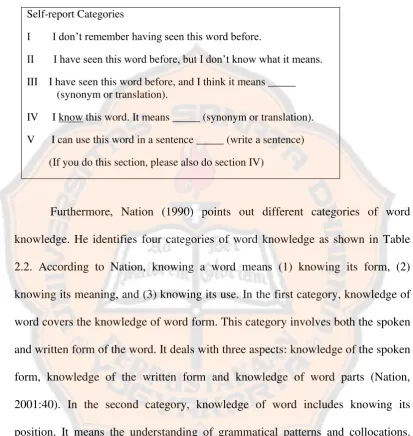
Paribakht and Wesche (1997:180) describe five stages of vocabulary knowledge as reflected in their Vocabulary Knowledge Scale (VKS). The VKS is originally used to elicit self-perceived and demonstrated knowledge of specific words in written text (Paribakht & Wesche, 1997:179). The five stages in VKS illustrate the steps of learners‘ vocabulary development. The first two stages rely
on honest reporting by learners or test-takers (Read, 2000:132). Stage I of vocabulary development indicates that the word is totally unknown meaning unable to recognize neither the word nor the meaning. At Stage II of vocabulary development, the word is identified, but the meaning is not recognized. The next two stages, Stage III and IV, indicate that the learners know both the word and its meaning. The difference between those stages is on the degree of learners‘
Table 2.1 VKS Elicitation Scale – Self Report Categories
(Paribakht & Wesche, 1997:180)
Self-report Categories
I I don‘t remember having seen this word before.
II I have seen this word before, but I don‘t know what it means.
III I have seen this word before, and I think it means _____ (synonym or translation).
IV I know this word. It means _____ (synonym or translation).
V I can use this word in a sentence _____ (write a sentence)
(If you do this section, please also do section IV)
commonly found than ‗plummet‘. Knowing its appropriateness signifies the
understanding whether the word is suitable for the context in which it occurs or not. For instance, the word ‗would like to‘ is more appropriate than the word ‗want‘ when it is used to in a formal situation (Nation, 2001:57). The last category
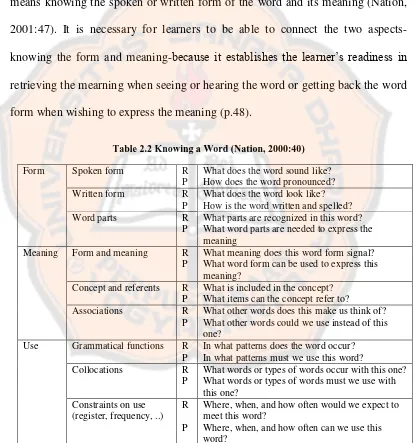
is knowing its meaning of word. Learners usually perceive that knowing a word means knowing the spoken or written form of the word and its meaning (Nation, 2001:47). It is necessary for learners to be able to connect the two aspects-knowing the form and meaning-because it establishes the learner‘s readiness in retrieving the mearning when seeing or hearing the word or getting back the word form when wishing to express the meaning (p.48).
Table 2.2 Knowing a Word (Nation, 2000:40)
Form Spoken form R P
What does the word sound like? How does the word pronounced? Written form R
P
What does the word look like? How is the word written and spelled? Word parts R
P
What parts are recognized in this word? What word parts are needed to express the meaning
Meaning Form and meaning R P
What meaning does this word form signal? What word form can be used to express this meaning?
Concept and referents R P
What is included in the concept? What items can the concept refer to? Associations R
P
What other words does this make us think of? What other words could we use instead of this one?
Use Grammatical functions R P
In what patterns does the word occur? In what patterns must we use this word? Collocations R
P
What words or types of words occur with this one? What words or types of words must we use with this one?
Constraints on use (register, frequency, ..)
R
P
Where, when, and how often would we expect to meet this word?
Where, when, and how often can we use this word?
c. Breadth and Depth of Vocabulary Knowledge
The term breadth of vocabulary knowledge usually refers to the vocabulary size of the learners. Vocabulary size refers to the number of words that the person knows (Read, 2000:31). It is expected that the greater number of words which learners remember, the better understanding which learners may perform when they read or listen. Nevertheless, learners may not only requested to acquire wide range of vocabulary but also demanded to define those words appropriately in that those words may have different meanings in different contexts. Henriksen claims that inasmuch as knowledge of words is operationalized as the ability to translate L2 vocabulary into L1, to define words correctly, or to say the words differently, vocabulary knowledge is defined as precise comprehension (1999:305).
Vocabulary size is different from vocabulary depth. Depth of vocabulary knowledge emphasizes more on the quality of the learners‘ vocabulary knowledge covering the full understanding or rich meaning representation of a word (Henriksen, 1999:305). Furthermore, Laufer and Paribakht (1998:367) clarify that a depth knowledge continuum involves knowledge of the words‘ syntagmatic and
paradigmatic relations with other words. It implies that full understanding of rich meaning of words is acquired by analyzing its relations or associations with other words and its contexts. It is crucial for advanced learners to understand the context in which the word occurs to obtain the precise meaning of the word.
d. Learning Vocabulary
high-frequency words is an arbitrary of the word use and occurrence. Learners may feel more familiar with high-frequency words in that they are more commonly used or more frequently occurred. On the other hand, learners may find more difficulties when they have to deal with many low-frequency words in the text inasmuch as they need hard effort to understand the general meaning of the text. Indeed, it is necessary to know the strategies in order to learn vocabulary dealing with both low-frequency words and high-frequency words. Hence, learners may expand their high-frequency words to learn a language well by learning more and more new words.
1) Low - Frequency Words
Nation (2006b) suggests four strategies to deal with low-frequency words. Those strategies are 1) word guessing from the context, 2) deliberate learning with word cards, 3) memorization with word parts, and 4) dictionary use.
a) Word Guessing from Context
It is believed that guessing word from context is the most effective strategy among those four strategies proposed by Nation (Nation and Meara:2002). There are some factors which influence learners to guess the unfamiliar words easily. Firstly, guessing word can be easily done when learners know most of the words in the text with approximately 95-98% of the whole words in the text. Accordingly, the unfamiliar words can be guessed by relating the words with the surrounding words have been known. Another factor which may affect the learners to guess the unfamiliar words easily is the learners‘
(Clarke and Nation:1980), and then they have the background knowledge of the text (Coady and Nation:1988).
Learners may change the words from low-frequency words to high-frequency words by focusing to the meaning of the words. It belongs to a strategy to learn high-frequency words which are commonly called as meaning-focused input. In order to optimize the learning process, learners may conduct direct learning of the same words after they have been able to guess the words from context.
b) Deliberate Learning with Word Cards
This strategy deals with small cards with the target word or phrase on one side and its first language translation on the other side. This strategy is best conducted when learners‘ few minute-free time, so they are really in a relaxed
learning should become the responsibility of each learner, but learners may need encouragement and training in applying the guidelines.
c) Memorization with Word Parts
This strategy is conducted to learn unknown words by examining the word parts. It includes knowledge of affixes and stems which already known by learners from the first language or from other second language words. Accordingly, Nation (2000:62) claims that ‗knowing a word may involve knowing that it is made up of
affixes and a stem which can occur in other words.‘ For example, the word unpleasantness derived from some parts: un, pleasant, and ness which then join together forming a word. ‗This does not mean that the word is learned in this way,
but it may be that for some words their whole unanalyzed form is learned initially, and it later seen as fitting into a regular pattern and is then stored differently.‘
Thus, it requires practice and learning to implement this strategy. Nevertheless, it is believed that word part analysis may not be the best way to guess words, yet it certainly helpful to employ checking an accuracy of a guess based on context clues (Nation and Meara: 2002: 45)
d) Dictionary Use
Furthermore, Nation (2000:228) suggests that it is needed to train learners to use dictionary to make them ready to find words they need in writing. Havey and Yuill (1997) claim that the most common uses of dictionary in a writing task are to check word spelling, check word meaning, to see if the word exists, to find the synonyms, and to check grammar. Nevertheless, the length of an entry becomes the main obstacle for learners to find the information needed of a word.
2) High - Frequency Words
Nation (2006b) claims that teaching learning vocabulary comprises four strands covering meaning – focused input, meaning – focused output, language – focused learning, and fluency development.
a) Meaning – Focused Input
Meaning-focused input covers chances for learning through listening and reading in which learners have already been able to recognize with 95-98% of the existing words in listening and reading input (Nation and Meara:2002). This strategy may be conducted effectively when it is supported by three conditions. The first condition is that second language learners may only have small proportion of unfamiliar words of the whole words occurred in the text with approximately 2% or around 1 out of 50 words. The second condition is that the learners obtain large amount of information or great number of words at least a million tokens or more a year. The last condition is that the learners intend to focus on unfamiliar words in order to increase the vocabulary mastery and improve vocabulary learning.
learners‘ interests to material given, the text should contain about 98% of running
words which learners already known. As a result, it may support them to read at least three books at the same level before moving up to the next level. Accordingly, it may bolster them to deliberately learn unknown words found in the texts. Furthermore, it gives chances for learners to talk and write about their texts. Indeed, Elley (1991) claims that extensive reading course provides benefits to increase vocabulary knowledge.
b) Meaning – Focused Output
Meaning-focused output involves opportunities for learning through speaking and writing. Nation (2006b:496) claims that negotiating of meaning becomes one of the greatest factor influencing vocabulary learning. Learners may conduct negotiation by deliberately explaining language items as a result of a breakdown in communication.
To design a good speaking task, it is important to consider the main influence on what and how much vocabulary learned using such tasks. It is because vocabulary learning may happen if the written input to the tasks contains the target vocabulary to practice, to repeat, to use that vocabulary.
c) Language – Focused Learning
This strategy can be employed by giving deliberate attention to vocabulary learning through activities such as intensive reading, using cards, pre-teaching of vocabulary before doing communicative activities (Nation:2006b:494). The most tangible activity for direct vocabulary learning is intensive reading in that it engages both of the teacher and the learners to work carefully through a short text noticing at a range of language features and content issues relevant to the text. The activities in intensive reading dealing with vocabulary can be conducted by involving pre-learning some words before reading the text, getting the meaning of some words, neglecting some, spending a lot of time for others to use the text as a chance to learn the strategies of guessing from context, word-part analysis, and dictionary use, and altering the text to get rid of some low frequency words.
Furthermore, as it is said previously that vocabulary learning may involve learners to learn how to apply vocabulary strategies of guessing words from context, learning from word cards, word analysis, and dictionary use inasmuch as these strategies demand a repeated investment of time over several months. Thus, learners reach the level where it is easier to use the strategy than not to use it.
Feedback on learners‘ spoken and written output can be as another opportunity to deliberate vocabulary learning. It is because they may realize the errors and revise them. Accordingly, it may expand their vocabulary knowledge.
d) Fluency Development
already known. In other words, it does not mean to teach them new words, but it intends to strengthen and enrich knowledge of words already possessed.
The good fluency activities have the following characteristics. First, they should not involve unknown vocabulary, grammatical features, or discourse features. Thus, it supports learners to perform at faster at a faster than typical speed. Secondly, they should focus on producing and comprehending messages. Finally, they involve a large quantity of language use. Fluency activities are required in all skills (listening, reading, writing, and speaking).
It is also necessary to be wise in adjusting the activities with learners‘
level. At a word or phrase level, learners may conduct activities focusing on numbers, time sequences, greetings, and any set without a great deal of thought. Meanwhile, the teacher for this level may play as a role model to say words. For higher level of fluency activities, it can be conducted by involving 4/3/2 activity or giving the same talk in a decreasing timeframe to a new listener, speed reading, and ten-minute writing in which learners write each day for ten minutes concentrating on quantity of writing rather than on quality.
e. Intentional and Incidental Vocabulary Learning
Intentional vocabulary learning, on the other hand, means that it deals with an attempt with an explicit focus in which the specific goal is to learn vocabulary (Schmitt: 2008). Schmitt (2008) claims that intentional vocabulary learning usually leads to greater and faster gains, with a better chance of retention and of reaching productive levels of mastery. It implies that learners need to focus their attention to effectively acquire vocabulary.
Laufer (2005) as cited in Schmitt (2008) declares certain reasons of better conducting intentional vocabulary learning. First, learners who understand the overall message tend to neglect the precise meanings of individual words. The second reason is that guessing from context is often unreliable, particularly for the beginners. Another reason is that words which are understood or guessed from context may not generate enough engagement to be learned and remembered. Finally, new words which learners have met in discourse need to be met again relatively quickly in order to avoid their being forgotten.
f. Principles of Vocabulary Learning
fluency development. Thirdly, to teach low frequency vocabulary, it should focus to some strategies like guessing from context, learning word cards, using word parts, and using the dictionary. Fourth, designing learning activities supporting ‗thoughtful processing of vocabulary through retrieval, generative use, and the use
of mnemonic devices where needed‘ is essential. Fifth, teachers take role to lead learners for being responsible of their own vocabulary learning.
Moreover, Schmitt (2008) suggests nine principles which may facilitate learners to conduct better vocabulary learning. Those principles are 1) increasing frequency of exposure, 2) escalating attention focused on the lexical item, 3) increasing noticing of the lexical item, 4) escalating intention to learn the lexical item, 5) a requirement to learn the lexical item (by teacher, test, syllabus), 6) a need to learn or use the lexical item (for tasks or for personal goals), 7) increasing manipulation of the lexical item and its properties, 8) increasing amount of time spent engaging with the lexical item, and 9) increase amount of interaction spent on the lexical item. Hence, it is expected that by applying those principles the learning vocabulary may optimally achieve the goals.
2. Learning Strategies
This section discusses about language learning strategies, vocabulary learning strategies, web-based learning in CALL, and web-based learning in the class.
a. Language Learning Strategies (LLS)
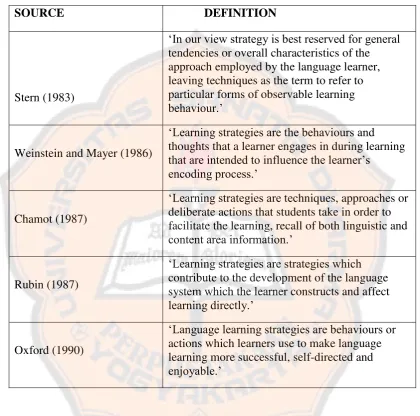
achieve the optimal performance of language learning. Ellis (2008) summarized those definitions presented in the following table.
Table 2.3 Definitions of Learning Strategies (Ellis, 2008, 704)
SOURCE DEFINITION
Stern (1983)
‗In our view strategy is best reserved for general tendencies or overall characteristics of the approach employed by the language learner, leaving techniques as the term to refer to particular forms of observable learning behaviour.‘
Weinstein and Mayer (1986)
‗Learning strategies are the behaviours and thoughts that a learner engages in during learning that are intended to influence the learner‘s
encoding process.‘
Chamot (1987)
‗Learning strategies are techniques, approaches or deliberate actions that students take in order to facilitate the learning, recall of both linguistic and content area information.‘
Rubin (1987)
‗Learning strategies are strategies which contribute to the development of the language system which the learner constructs and affect learning directly.‘
Oxford (1990)
‗Language learning strategies are behaviours or actions which learners use to make language learning more successful, self-directed and enjoyable.‘
From the table it shows that Oxford and Weinstein and Mayer have the closest term definition of learning strategy. Indeed, they define it as learners‘
behaviours during the learning process to optimize their performance.
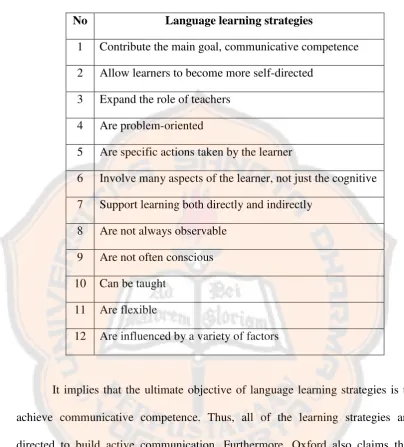
Table 2.4 Features of Language Learning Strategies (Oxford:1990:9) No Language learning strategies
1 Contribute the main goal, communicative competence 2 Allow learners to become more self-directed
3 Expand the role of teachers 4 Are problem-oriented
5 Are specific actions taken by the learner
6 Involve many aspects of the learner, not just the cognitive 7 Support learning both directly and indirectly
8 Are not always observable 9 Are not often conscious 10 Can be taught
11 Are flexible
12 Are influenced by a variety of factors
It implies that the ultimate objective of language learning strategies is to achieve communicative competence. Thus, all of the learning strategies are directed to build active communication. Furthermore, Oxford also claims that language learning strategies should support learners to perform greater self-direction inasmuch as it is impossible to expect their teacher‘s guidance anytime
and anywhere. Accordingly, they are gradually led to be more independent learners.
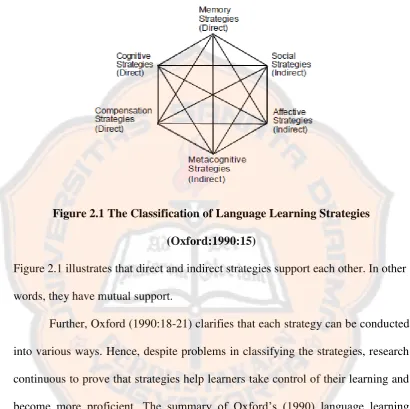
compensation, while indirect strategies consist of metacognitive, affective, and social.
Figure 2.1 The Classification of Language Learning Strategies (Oxford:1990:15)
Figure 2.1 illustrates that direct and indirect strategies support each other. In other words, they have mutual support.
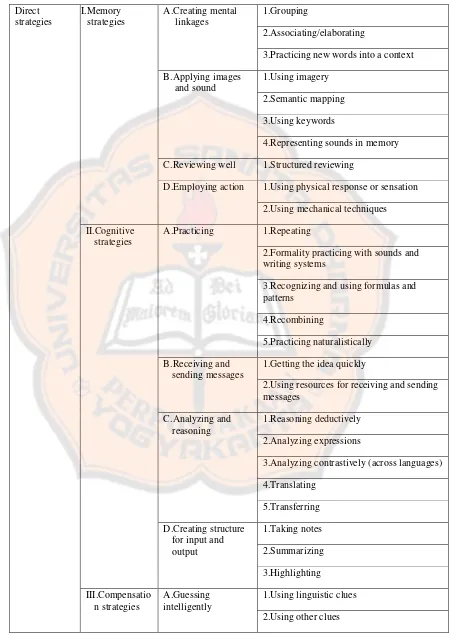
Further, Oxford (1990:18-21) clarifies that each strategy can be conducted into various ways. Hence, despite problems in classifying the strategies, research continuous to prove that strategies help learners take control of their learning and become more proficient. The summary of Oxford‘s (1990) language learning
Table 2.5 Language Learning Strategies (Oxford: 1990:18-21)
3.Practicing new words into a context
B.Applying images
D.Employing action 1.Using physical response or sensation
2.Using mechanical techniques
B.Overcoming
3.Delaying speech production to focus on listening
temperature 3.Writing a language learning diary
4.Discussing your feeling with someone else
III.Social strategies
A.Asking questions 1.Asking for clarification or verification
2.Asking for correction
B.Cooperating with others
1.Cooperating with peers
2.Cooperating with proficient users of the new language
C.Empathizing with others
1.Developing cultural understanding
2.Becoming aware of others‘ thoughts and feelings
From table 2.5 it shows that language learning strategies are possibly conducted for four skills (listening, reading, writing, and speaking).
b. Vocabulary Learning Strategies (VLS)
This sub-topic of the study is intended to provide theories of Vocabulary Learning Strategies (VLS). It comprises the definitions of VLS and four different types of VLS proposed by Schmitt, Gu and Johnson, Catalan, and also Nation.
1) Definition of Vocabulary Learning Strategies (VLS)
2) Types of Vocabulary Learning Strategy (VLS)
The experts generally provide some similar and different characteristics between one and other strategies in that they basically have the same principles, yet they view them in quite different ways.
a) Schmitt‟s Taxonomy of Vocabulary Learning Strategies
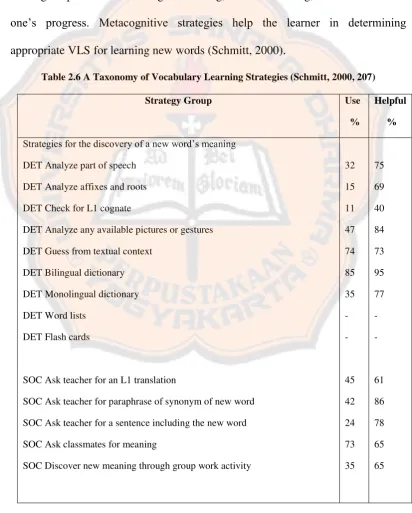
Schmitt (2000 : 207) compiled a list of VLS categorized according to the following two purposes: 1) strategies which discover a new word‘s meaning; and 2) strategies which consolidate a word once it has been encountered. Schmitt‘s taxonomy of VLS includes a variety of different strategies and all important skills in the learner‘s process.
The first strategies are determination strategies. Determination strategies are individual learning strategies, which help learners to discover the meaning of words by themselves with no assistance from peers, such as guessing the words from the context (Schmitt, 2000, 207). The next strategies are called social strategies. Social strategies engage learners in interaction with their peers, and this helps them to learn from each other, such as observing their classmates and asking their teacher for the meaning of a word (Schmitt, 2000, 207). The third strategies are memory strategies. Memory strategies are strategies, which engage learners in learning the new word through mental processing by associating their existing or background knowledge with the new word (Schmitt, 2000, 207). For example, if the learner comes across the word ―cat‖, the learner can group the word ―cat‖
and guesses the name of the sport be-cause he/she already remembers the actions associated with that sport. The fourth strategies are cognitive strategies. Cognitive strategies do not engage learners in mental processing but is more mechanical. An example is repeating the pronunciation of new words (Schmitt, 2000). The last strategies are metacognitive strategies. Metacognitive strategies are strategies relating to processes involving monitoring, decision-making, and evaluation of one‘s progress. Metacognitive strategies help the learner in determining
appropriate VLS for learning new words (Schmitt, 2000).
Table 2.6 A Taxonomy of Vocabulary Learning Strategies (Schmitt, 2000, 207)
Strategy Group Use
%
Helpful
%
Strategies for the discovery of a new word‘s meaning
DET Analyze part of speech
DET Analyze affixes and roots
DET Check for L1 cognate
DET Analyze any available pictures or gestures
DET Guess from textual context
DET Bilingual dictionary
DET Monolingual dictionary
DET Word lists
DET Flash cards
SOC Ask teacher for an L1 translation
SOC Ask teacher for paraphrase of synonym of new word
SOC Ask teacher for a sentence including the new word
SOC Ask classmates for meaning
SOC Discover new meaning through group work activity
Strategy Group Use
%
Helpful
%
Strategies for consolidating a word once it has been encountered
SOC Study and practice meaning in a group
SOC Teacher checks students‘s flash cards or word lists for accuracy
SOC Interact with native speakers
MEM Study word with a pictorial representation of its meaning
MEM Image word‘s meaning
MEM Connect word to a personale experience
MEM Associate the word with its coordinates
MEM Connect the word to its synonyms and antonyms
MEM Use semantic maps
MEM Use ‗scales‘ for gradable adjectives
MEM Peg method
MEM Loci methhod
MEM Group words together to study them
MEM Group words together spatially on a page
MEM Use new words in sentences
MEM Group words together within a storyline
MEM Study the spelling of a word
MEM Study the sound of a word
MEM Say new word aloud when studying
MEM Image word form
MEM Underline initial letter of the word
Strategy Group Use
%
Helpful
%
MEM Learn the words of an idiom together
MEM Use physical action when learning a word
MEM Use semantic feature grids
COG Verbal repetition
COG Written repetition
COG Word lists
COG Flash cards
COG Use the vocabulary section in your textbook
COG Listen to tape of word lists
COG Put English labels on physical objects
COG Keep a vocabulary notebook
MET Use English-language media (songs, movies, newcasts)
MET Testing oneself with word class
MET Use spaced word practice
MET Skip or pass new word
MET Continue to study word overtime
48
b) Gu and Johnson‟s Taxonomy of Vocabulary Learning Strategies
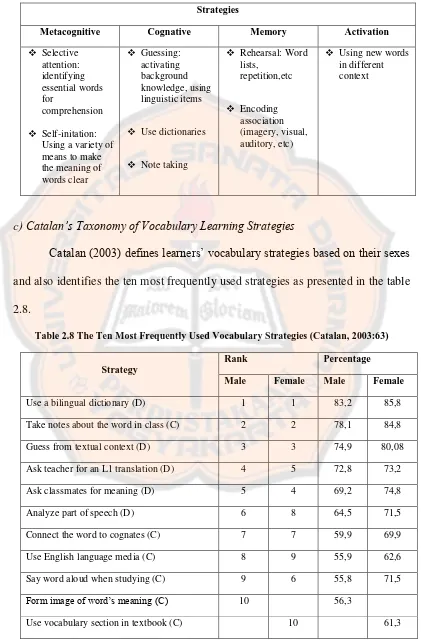
new words in different context. Those four strategies are defined further in the following paragraphs.
Metacognitive strategies consist of selective attention and self-initiation strategies. Foreign and second language learners who employ selective attention strategies know which words are important for them to learn and are essential for adequate comprehension of a passage. Learners employing self-initiation strategies use a variety of means to make the meaning of vocabulary items clear.
Cognitive strategies in Gu and Johnson‘s taxonomy entail guessing
strategies, skillful use of dictionaries and note-taking strategies. Learners using guessing strategies draw upon their background knowledge and use linguistic clues like grammatical structures of a sentence to guess the meaning of a word.
Memory strategies are classified into rehearsal and encoding categories. Word lists and repetition are instances of rehearsal strategies. Encoding strategies encompass such strategies as association, imagery, visual, auditory, semantic, and contextual encoding as well as word structure such as analyzing a word in terms of prefixes, stems, and suffixes.