Biosaintifika
Journal of Biology & Biology Educationhttp://journal.unnes.ac.id/nju/index.php/biosaintifika
Flavonoid Production in Callus Cultures from Mesocarp of
Stelechocarpus burahol
Noor Aini Habibah1, Sukarti Moeljopawiro1,2, Kumala Dewi1,2, Ari Indrianto1,2
DOI: 10.15294/biosaintifika.v8i2.6632
1Doctorate Program of Faculty of Biology, Gadjah Mada University, Indonesia 2Faculty of Biology, Gadjah Mada University, Indonesia
Abstract
Stelechocarpus burahol is one of the medicinal plants that contains flavonoids. The study was carried out to know flavonoid production of cultures in vitro S. burahol
from mesocarp explants. Mesocarp explants were cultured on MS medium contain-ing different combination and concentration of plant growth regulators i.e. piclo-ram (5, 7.5 and 10 mg/L) and 2, 4-D (10, 15 and 20 mg/L) under dark condition. Induction of callus formation started on the 20.29th to the 29.86th days. Medium
supplemented with Picloram and dark state proved to be the best condition for op-timum callus induction from mesocarp explants of S. burahol. Callus grown on me-dium with the addition of 7.5 mg/l Picloram produces the highest flavonoid. The maximum production of the secondary metabolite was obtained from 8 weeks old callus. However, by the time of callus ageing, its output has declined. It could be concluded that callus cultures from mesocarp S. burahol can be used for flavonoid production.
How to Cite
Habibah, N. A., Moeljopawiro, S. Dewi, K. & Indrianto, A. (2016). Flavonoid Pro-duction in Callus Cultures from Mesocarp of Stelechocarpus burahol. Biosaintifika: Journal of Biology & Biology Education, 8(2), 214-221.
© 2016 Semarang State University History Article
Received 20 February 2016 Approved 10 June 2016 Published 18 September 2016
Keywords: mesocarp; callus; Stel-echocarpus burahol; flavonoid
Correspondence Author:
Jl. Teknika Selatan, Sekip Utara, Yogyakarta 55281 Indonesia
E-mail: [email protected]
sociated with the metabolites synthesis) (Zhao et
al., 2011, Rosa et al., 2013). Lewis et al.,(2011)
found that the addition of exogenous auxin is re-ported to induce the gene encoding enzymes in-volved in flavonoid biosynthesis pathway. In fact, all plants have the same flavonoid biosynthesis pathway; however, the results of flavonoid types and concentrations produced are different in each species.
This phenomenon occurs since there is va-ried gene expression patterns associated with the primary enzymes and transcription factors invol-ved in the biosynthesis of flavonoids depending on the stage of organ development, response to the hormonal treatment, and response to the sti-mulation of the wound (Zhao et al., 2013). Chal-cone synthase (CHS) is a key enzyme in the bio-synthesis of all classes of flavonoids in the plant. This enzyme catalyses the condensation of 4-cou-maroyl-CoA with three molecules of malonyl-CoA to form naringenin-chalcone (Kreuzaler & Hahlbrock (1975) in Moriguchi et al., 1999).
There are some researches related to kepel
potencies that have been investigated (Tisnadjaja et al., 2006, Purwantiningsih et al., 2010, Sunar-di, 2010, Darusman et al., 2012). Research on the
in vitro culture of the family Annonaceae have
been reported in Annona muricata L., Rollinia
mu-cosa,Annona cherimola and Annona gabra (Lemos and Baker, 1998, Figueiredo et al., 1999, Figuei-redo et al., 2000, FigueiFiguei-redoet al.,2001, Padilla
and Encina,2004, Oliveira et al., 2008).
Recently, the information on callus
induc-tion and flavonoids producinduc-tion by in vitro
cultu-re of kepel that used mesocarp as explant has not
been reported. Therefore, the study was carried out to know flavonoid production of cultures in
vitro S. burahol from mesocarp explants.
METHODS
Establishment of Callus Culture
Mesocarp explants were taken from young fruit of kepel trees at University of Gadjah Mada area. The fruit was washed by running water and soaked in a solution of liquid detergent (1 ml in 50 ml aquadest) for 15 minutes, then immersed in 100% bleach solution (containing 5.25% NaClO) for 30 minutes. In the laminar air flow cabinet, fruits were sterilised using 100% bleach solution (containing 5.25% NaClO) for 10 minutes. Final-ly, mesocarp was taken from the fruit after wash-ing with sterile distilled water for three times. the mesocarp was taken from the fruit.
Murashige and Skoog (1962) (MS) me-dium was used as a meme-dium for the growth of INTRODUCTION
Stelechocarpus burahol (Blume) Hook. F. & Thomson) is one of the potential medicinal plants from Annonaceae family which has the
sy-nonym Uvaria burahol, Blume. It naturally spread
in Southeast Asia and the islands of Salomon (Si-regar, 2005). In Indonesia, it is called by its local name Kepel. Kepel has the anti-hyperuricemic flavonoid compounds which can be potentially developed as gout medication. A study on the ability of Kepel as gout treatment was performed
by Purwatiningsih et al.(2010). The study results
showed that both ethanol and hexane extracts of Kepel have the effect on lowering blood uric acid levels. The ethanol extract of Kepel was effective at 200 mg/kg b.w., whereas the hexane extract was effective at 100 mg/kg b.w One of the most active antioxidants of flavonoid compounds in Kepel is 3, 7, 3 ‘, 4’-methyl-5- tetrahydroxy-flavo-ne (Sunarni et al., 2007). Kepel has traditionally been used as a traditional perfume, particularly among the palaces in Java Island. Kepel is usu-ally consumed by the queen and princesses since Kepel acts as a natural body, breath, and urine deodorant (Darusman et al., 2012). The previo-us study on Kepel as a natural deodorant showed that Kepel can eliminate the smell of sweat,
bre-ath, and faeces by absorbing the ammonia (NH3)
and methyl mercaptan (CH3SH). Also, Kepel leads to increase the population and the activity of probiotic bacteria Bifidobacter sp. with growing population. The growing population of probiotic bacteria will combat the people of odor-produ-cing bacteria (Darusman et al., 2012). ).
Flavonoids are secondary metabolites pro-duced by various parts of the plant with low mo-lecular weights. It has varied functions of bioac-tive activities among others. For example: as an antioxidant (Sunarni et al., 2007), an anti-cancer (Lin et al., 2008), an anti-gout (Purwatiningsih et al., 2010), an antihypertensive (Cassidy et al., 2011 ) and an anti-bacterial (Khan et al., 2013).
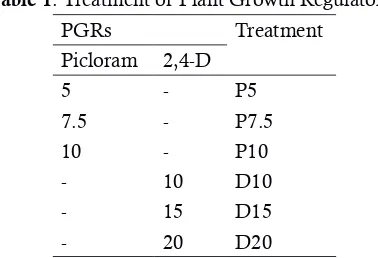
as-explants. Plant growth regulators 2.4-D at con-centrations of 10, 15 and 20 ppm and Picloram at concentrations of 5, 7.5 and 10 ppm used for callus induction. In the treatment of 2,4-D, the medium is was added 0.09 ppm BAP as well. The investigation was carried out using six combina-tion treatments (Table 1).
Table 1. Treatment of Plant Growth Regulator
PGRs Treatment
After the medium preparation, subse-quently, the sterile explants were cultured in the treatment medium. The cultures were main-tained under total darkness at 25±2 °C. The culture was maintained for three months. Every month the culture was transferred to fresh media. Calli were harvested and weighed to determine the wet weight. Then callus dried in an oven for 48 hours at 60°C to determine the dry weight and analysed the content of flavonoids. Observations were made on growth and morphology of the cal-lus. Percentage of explants that formed the callus speed callus formation, callus fresh weight, dry weight and morphology of the callus were re-corded.
Callus Growth Determination
The callus growth was observed by inocu-lating 1 g callus in the optimum medium obtained from the previous experiment. The experiment was set up in a completely randomised design with 12 treatments (number of weeks in culture) and three replicates. Evaluations were made at 1-week intervals up to the 12th week. Each treat-ment consisted of one flask, from which cell fresh and dry weights, and flavonoid content was de-termined.
Total Flavonoid Determination
Dried callus (0.2 g) was ground to a pow-der with a mortar and pestle. The powpow-der was ex-tracted with methanol containing 1% (v/v) HCl, followed by addition of 2 N HCl (equal volume) and 1 h incubation at 90ºC. Acid-hydrolyzed ex-tracts were dried and resuspended in methanol (Hao et al., 2009). The total flavonoid content
was determined using the procedure reported by Zou et. al., (2004). A 0.5-mL aliquot of appropri-ately diluted sample solution was mixed with 2 mL of distilled water and subsequently with 0.15 mL of a 5% NaNO2 solution. After 6 min, 0.15 mL of a 10% AlCl3 solution was added and al-lowed to stand for 6 min, then 2 mL of 4% NaOH solution was added to the mixture. Immediately, water was added to bring the final volume to 5 mL, then the mixture was thoroughly mixed and allowed to stand for another 15 min. Absorbance of the mixture was determined at 510 nm versus a prepared water blank. Quercetin was the stan-dard of choice for the expression of results at 510 nm.
Data analysis and Statistical Testing
Analysis of variance calculated for the callus induction, callus growth, cell growth, and flavonoid content. All the results expressed as means ± standard errors from three replications. Data were analysed using the SPSS statistical system. Where the F test showed significant dif-ferences among means, multiple range test were performed at the 0.05 level of probability.
RESULTS AND DISCUSSION
Establishment of Callus Culture
The endophytic species live in the Kepel’ mesocarp is causing a laborious and tedious ste-rilisation process. However, the steste-rilisation pro-cess on mesocarp is easier than the leaves. The sterilisation process on leaves requires gradual processes with the low success rate (Habibah et al., 2013).
of inducing callus growth. The optimum callus induction using immature seeds explant was also obtained on MS medium supplemented by Piclo-ram 7.5 mg/L (Habibah et al., unpublished data). However, when compared with the culture of mesocarp of other plants, the callus inducti-on inducti-on Kepel requires linducti-onger time. Mesocarp of
Psidium guajava produced callus within three days with a percentage of 92% on MS medium supple-mented with 2.4-D 2 mg/L. Mesocarp of imma-ture fruit is more responsive than the maimma-ture one (Chandra et al., 2004). The growth of callus on Vitis mesocarp was induced in 15 days on a me-dium supplemented with 1.0 mM kinetin and 0.5 mM a-naphthaleneacetic acid (Calderon et al., 1995). Peach mesocarp was induced within two weeks on White medium with kinetin and coco-nut water. Kepel mesocarp was failed to produce callus when it has grown in a medium with 2.4-D concentrations lower than 10 mg/L (data not shown). According to the results, it could be as-sumed that the induction of callus formation on Kepel requires higher auxin concentration than in other plants. Induction of callus formation re-quires auxin and cytokinin in balance concentra-tion that derived from endogenous or exogenous hormones.
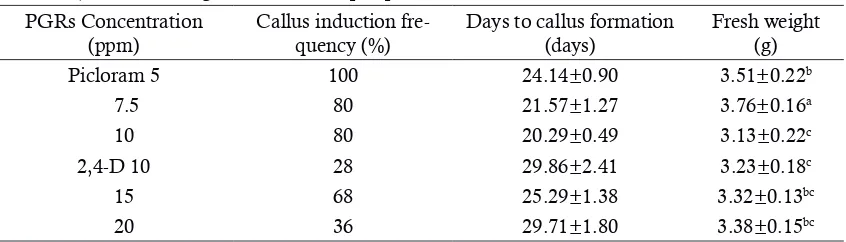
Callus growth is shown by the wet weight and dry weight of the callus generated at each tre-atment. These results indicated that the growth of callus varies in each treatment. The explants grown in the medium supplemented with Piclo-ram 7.5 mg/L produced the optimum callus growth. It showed the wet weight of 3.76 ± 0.7. Inversely, the explants were grown in the medium supplemented with Picloram 10 mg/l produced the lowest callus growth with the wet weight of 3.13 ± 0.22. Picloram reportedly also can induce the most rapid growth and produce the highest biomass in suspension cultures of Rollinia (Figu-eiredo et al., 2000). Fruit explants (epicarp and
hypoderm) of Aronia melanocarpa grown in
me-dium supplemented with Kinetin combination, IAA and 2.4-D with various concentrations pro-duced callus but the intensity, the growth index and morphology differs depending on the type
and dose of PGR. The explants of Aronia
melano-carpa were grown in medium supplemented with 2.4-D showed the highest callus intensity than medium supplemented with NAA. Mesocarp with the addition of Kin, BAP and 2.4-D does not produce callus (Calalb et al., 2014). The re-sults of this studied reinforce that types of plant growth regulators (auxin and cytokinin), and the ratio between the two are important not only for increasing the percentage of callus formation but also for callus growth (Zenk 1978).
Auxin showed different effects on cell di-vision, proliferation and subsequent regeneration of auxin in plants. Auxin acts by inducing non-dividing cells that are sensitive to auxin, which is at the G1 phase, to enter S phase and mitosis. The time duration of this process depends on the type and concentration of auxin (Barro et al., 1998). Callus produced on most of the treatment medium was friable callus (Figure 1). Callus for-med are the yellowish white colour at the begin-ning of its formation, and it turns into brownish associated with an increased content of phenolic compounds on the callus.
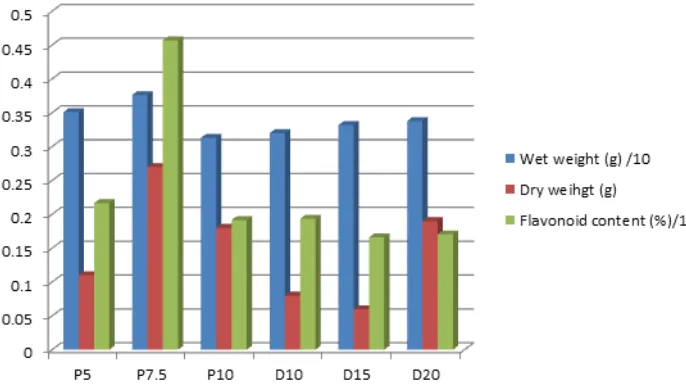
The resulting callus on all treatments pro-duced flavonoids with varying amounts (Figure 2). Flavonoids in Kepel has an antioxidant activi-ty and one of the flavonoids contained in Kepel is 3, 7, 3 ‘, 4’-methyl-5- tetrahydroxy-flavone which has the most active antioxidant activity than ot-her flavonoids (Sunarni et al., 2007). Flavonoids in S. burahol also have an anti-hyperuricemic ac-tivity. The results of in vivo tests of both ethanol and hexane extracts of Kepel has a potential in lowering blood uric acid levels. Flavonoids in S. burahol have the ability as a xanthine oxidase
in-Tabel 2. Effects of Picloram and 2,4-D in MS medium on callus induction frequency, days to callus
formation, and fresh weight from mesocarp explants in S. burahol
PGRs Concentration (ppm)
Callus induction fre-quency (%)
Days to callus formation (days)
Fresh weight (g)
Picloram 5 100 24.14±0.90 3.51±0.22b
7.5 80 21.57±1.27 3.76±0.16a
10 80 20.29±0.49 3.13±0.22c
2,4-D 10 28 29.86±2.41 3.23±0.18c
15 68 25.29±1.38 3.32±0.13bc
20 36 29.71±1.80 3.38±0.15bc
Hormones strongly influence the pro-duction of secondary metabolites in callus. The signal hormone can regulate the physiological processes in plant culture (Molchan et al., 2012). Exogenous growth regulating substances can al-ter the accumulation of secondary metabolites by regulating the expression of genes involved in the synthesis of secondary metabolites. Regula-tion of gene expression performed on the stages of transcription by regulating gene transcription factor that plays a major role in the process of plant development including synthesis of secon-dary metabolites (Zhao et al., 2011, Rosa et al., 2013). Plant-specific transcription factor NAM / Ataf / CUC (NAC) plays a critical role in a varie-ty of developmental processes including defence responses. NAC transcription factor domain was allegedly organised at the level of transcription by hibitor which inhibits the formation of uric acid
as well as gout medication using Allopurinol (Purwantiningsih et al., 2010).
A callus that produces the highest fla-vonoid was the callus that grew in the medium containing 7.5 mg / l Picloram. Conversely, the lowest level of callus growth and flavonoid com-pound were found in a medium supplemented with 15 mg/l 2.4-D. Picloram and 2.4-D signifi-cantly increased the accumulation of biomass and
production of withanolides in Withania somnifera.
High concentration of auxin often inhibits cell growth and production of withanolides in culture
Withania somnifera (Sivananhan et al., 2013). The use of 2,4-D with higher concentrations of BAP can improve the quality but not the quantity of bioactive compound in Hawthorn callus culture (Chaabani et al., 2015)
(A) (B)
Figure 1. (A) Callus from mesocarp of S. burahol on MS medium supplemented with 7.5 mg/l of Picloram after
a culture period of two months. (B) The anatomy of callus (3 months old) as the results of mesocarp inoculation on MS medium with the addition of 7.5 mg/l Picloram
Figure 2. Growth and Flavonoid content in S. burahol callus in different medium
environmental factors, such as hormone concent-rations. Induction at the transcriptional level Pm-NAC1 associated with increased levels of auxin in the culture medium (Rosa et al., 2013). Auxin is also reported to induce gene encoding enzymes involved in flavonoid biosynthesis pathway. The addition of 1 μm IAA induces the accumulation of mRNA chalcone synthase (CHS) and flavonol synthase (FLS) 3 times greater than the control (Lewis et al., 2011).
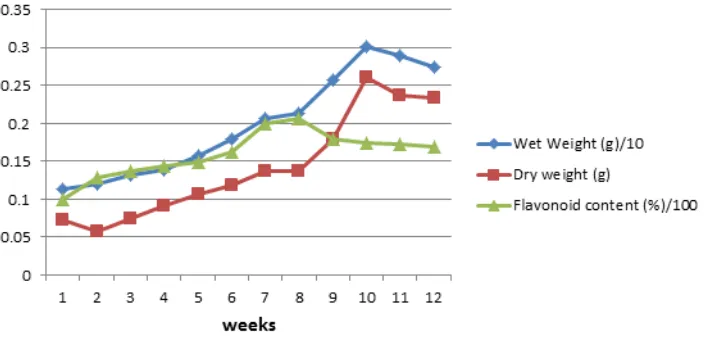
The production of flavonoids in the callus
culture of S. burahol ran from the first week and
peaked at the 8th week (Figure 3). The growth
of callus in the first week until the eighth week showed the lag phase. Subsequently, started from the 8th to the 10th week, it represents the log phase
and then entered the stationary phase. Both steps showed that the production of flavonoids is not in line with the growth of callus. At the time of early log phase of callus growth, the highest flavonoid concentration was obtained. The optimum callus
growth was reached in the 10th week. On the date
of log phase, it requires an abundant amount of primary metabolites. Therefore, the production of secondary metabolites is decreased. When a stationary phase on the callus is reached, the se-condary metabolite production will increase.
However, the supply of nutrients is limiting the process of secondary metabolites production to not to rise in its concentration. Verbascoside and linear in production were associated with growth, reaching their highest metabolite produc-tion when cell growth was in the staproduc-tionary stage. Verbascoside was the primary phenylpropanoid produced in vitro cultures (root, white and green callus, while linear in and hydroxycinnamic acid production were low. Verbascoside and linear in production were improved in cell suspension cul-ture (Estrada-Zu´n˜iga et al., 2009).
CONCLUSIONS
The optimum callus induction from meso-carp explants was obtained in the growth me-dium supplemented with 7.5 mg/L Picloram in dark conditions. Picloram induces the formation of friable callus. The callus induction was varied from 28% to 100%. Callus in all treatments ex-pressed the flavonoid compound production. The callus that produced the highest flavonoid content was the callus maintained in the medium with the addition of 7.5 mg/l Picloram. The maximum flavonoid production was obtained at eight weeks old callus.
REFERENCES
Amoo, S. O., Aremu, A. O., & Van Staden, J. (2012). In vitro plant regeneration, secondary metabolite production and antioxidant activity of micro-propagated Aloe arborescens Mill. Plant Cell, Tissue and Organ Culture (PCTOC), 111(3), 345-358.
Amoo, S. O., & Van Staden, J. (2013). Influence of plant growth regulators on shoot proliferation and secondary metabolite production in micro-propagated Huernia hystrix. Plant Cell, Tissue and Organ Culture (PCTOC), 112(2), 249-256. Aslam, J., Mujib, A., Fatima, Z., & Sharma, M. P.
(2010). Variations in vinblastine production at different stages of somatic embryogenesis, embryo, and field-grown plantlets of Catharan-thus roseus L.(G) Don, as revealed by HPLC.
In Vitro Cellular & Developmental Biology-Plant, 46(4), 348-353.
Balasubramanya, S., Rajanna, L., & Anuradha, M. (2012). Effect of plant growth regulators on morphogenesis and forskolin production in Plectranthus barbatus Andrews. In Vitro Cellular & Developmental Biology-Plant, 48(2), 208-215.
Barro, F., Cannell, M. E., Lazzeri, P. A., & Barcelo, P. (1998). The influence of auxins on transfor-mation of wheat and tritordeum and analysis of transgene integration patterns in transfor-mants. Theoretical and Applied Genetics, 97(5-6), 684-695.
Chaâbani, G., Tabart, J., Kevers, C., Dommes, J., Khan, M. I., Zaoui, S., ... & Karray-Bouraoui, N. (2015). Effects of 2, 4-dichlorophenoxyace-tic acid combined to 6-Benzylaminopurine on callus induction, total phenolic and ascorbic acid production, and antioxidant activities in leaf tissue cultures of Crataegus azarolus L. var. aronia. Acta Physiologiae Plantarum, 37(2), 1-9.
Calalb, T., Nistreanu, A., Oroian, S., & Samarghitan, M. (2014). Callus Induction And Biomass Ac-cumulation In Vitro In Explants From Choke-berry (Aronia Melanocarpa (Michx.) Elliot) Fruit.Acta Agrobotanica, 67(3), 53–64.
Calderon, A. A., Zapata, J. M., & Ros Barcelo, A. (1995). Peroxidase isoenzymes as markers of cell de-differentiation in grapevines (Vitis vinif-era). Vitis, 34(4), 207-210.
Cassidy, A., O’Reilly, É. J., Kay, C., Sampson, L., Franz, M., Forman, J. P., ... & Rimm, E. B. (2011). Habitual intake of flavonoid subclasses and incident hypertension in adults. The Ameri-can journal of clinical nutrition, 93(2), 338-347. Chandra, R., Bajpai, A., Gupta, S., & Tiwari, R. K.
(2004). Embryogenesis and plant regeneration from mesocarp of Psidium guajava L.(guava).
Indian Journal of Biotechnology, 3(2), 246-248. Darusman, H. S., Rahminiwati, M., Sadiah, S.,
Ba-tubara, I., Darusman, L. K. & Mitsunaga, T. (2012). Indonesian Kepel Fruit (Stelechocarpus burahol) as oral Deodorant. Research Journal of Medicinal Plants. 6(2), 180-188.
Estrada-Zúñiga, M. E., Cruz-Sosa, F., Rodriguez-Monroy, M., Verde-Calvo, J. R., & Vernon-Carter, E. J. (2009). Phenylpropanoid produc-tion in callus and cell suspension cultures of Buddleja cordata Kunth. Plant Cell, Tissue and Organ Culture (PCTOC), 97(1), 39-47.
Figueiredo, S. F. L., Viana, V. R. C., Simões, C., Al-barello, N., Trugo, L. C., Kaplan, M. A. C., & Krul, W. R. (1999). Lignans from leaves, seed-lings and micropropagated plants of Rollinia mucosa (Jacq.) Baill.–Annonaceae. Plant cell, tissue and organ culture, 56(2), 121-124.
Figueiredo, S. F. L., Simões, C., Albarello, N., & Vi-ana, V. R. C. (2000). Rollinia mucosa cell sus-pension cultures: establishment and growth conditions. Plant cell, tissue and organ culture, 63(2), 85-92.
Gurel, E., Yucesan, B., Aglic, E., Gurel, S., Verma, S. K., Sokmen, M., & Sokmen, A. (2011). Regen-eration and cardiotonic glycoside production in Digitalis davisiana Heywood (Alanya Fox-glove). Plant Cell, Tissue and Organ Culture (PC-TOC), 104(2), 217-225.
Habibah, N. A., Sumadi, & Ambar, S. (2013).
Opti-mization of Leaf Surface Sterilization and En-dophytic Elimination on Burahol.Biosaintifika: Journal of Biology & Biology Education, 5(2), 94-99.
Hao, G., Du, X., Zhao, F., Shi, R., & Wang, J. (2009). Role of nitric oxide in UV-B-induced activation of PAL and stimulation of flavonoid biosynthe-sis in Ginkgo biloba callus. Plant Cell, Tissue and Organ Culture (PCTOC), 97(2), 175-185.
Khan, M. F., Negi, N., Sharma, R., & Negi, D. S. (2013). Bioactive flavanoids from Glycosmis arborea. Organic and medicinal chemistry letters, 3(1), 1.
Butiuc-Keul, A. L., Vlase, L., & Crăciunaş, C. (2012). Clonal propagation and production of cichoric acid in three species of Echinaceae. In Vitro Cel-lular & Developmental Biology-Plant, 48(2), 249-258.
Lemos, E. E. P., & Baker, D. A. (1998). Shoot regenera-tion in response to carbon source on internodal explants of Annona muricata L. Plant growth regulation, 25(2), 105-112.
Lewis, D. R., Ramirez, M. V., Miller, N. D., Vallab-haneni, P., Ray, W. K., Helm, R. F., ... & Mu-day, G. K. (2011). Auxin and ethylene induce flavonol accumulation through distinct tran-scriptional networks. Plant Physiology, 156(1), 144-164.
Lin, Y., Shi, R., Wang, X., & Shen, H. M. (2008). Lu-teolin, a flavonoid with potentials for cancer prevention and therapy. Curr Cancer Drug Tar-gets, 8(7), 634–646.
Misra, B. B., & Dey, S. (2013). Developmental varia-tions in sesquiterpenoid biosynthesis in East Indian sandalwood tree (Santalum album L.). Trees, 27(4), 1071-1086.
Molchan, O., Romashko, S., & Yurin, V. (2012). L-tryptophan decarboxylase activity and trypt-amine accumulation in callus cultures of Vinca minor L. Plant Cell, Tissue and Organ Culture (PC-TOC), 108(3), 535-539.
Moriguchi, T., Kita, M., Tomono, Y., Endo-Inagaki, T., & Omura, M. (1999). One type of chalcone synthase gene expressed during embryogenesis regulates the flavonoid accumulation in citrus cell cultures. Plant and cell physiology, 40(6), 651-655.
Oliveira, L. M., Paiva, R., de Santana, J. R. F., Alves, E., Nogueira, R. C., & Pereira, F. D. (2008). Ef-fect of cytokinins on in vitro development of autotrophism and acclimatization of Annona glabra L. In Vitro Cellular & Developmental Biolo-gy-Plant, 44(2), 128-135.
Padilla, I. M. G., & Encina, C. L. (2004). Micropropa-gation of adult cherimoya (Annona cherimola Mill.) cv. Fino de Jete. In Vitro Cellular & Devel-opmental Biology-Plant, 40(2), 210-214.
Phar-maceutical Sciences, 2(2), 122-7.
Rosa, Y. B. C. J., Aizza, L. C. B., Bello, C. C. M., & Dornelas, M. C. (2013). The PmNAC1 gene is induced by auxin and expressed in differentiat-ing vascular cells in callus cultures of Passiflo-ra. Plant Cell, Tissue and Organ Culture (PCTOC), 115(2), 275-283.
Tisnadjaja, D., Saliman, E., Silvia, & Simanjuntak, P. (2006). Study of kepel (Stelechocarpus burahol
(Blume) Hook & Thomson) as an anti-oxida-tive compounds containing fruit. Biodiversitas. 7 (2), 199-209
Siregar, N. (2005). Atlas Benih Tanaman Hutan Indone-sia. Jilid V. Ed. Dede Rohadi, Darmawati F. Djam ’An, Aam Aminah, Ricky Sitorus. Bogor: Balai Penelitian Teknologi Perbenihan.
Sivanandhan, G., Dev, G. K., Jeyaraj, M., Rajesh, M., Muthuselvam, M., Selvaraj, N., ... & Ga-napathi, A. (2013). A promising approach on biomass accumulation and withanolides pro-duction in cell suspension culture of Withania somnifera (L.) Dunal. Protoplasma, 250(4), 885-898.
Sunardi, C. 2010. Structure of Steroids in Stelechocar-pus burahol Hook F. & Thomson Stem Bark.
The Journal of Indonesian Medicinal Plant. 3 (2). Sunarni, T., Pramono, S. & Asmah, R. (2007). Flavo-noid antioksidan penangkap radikal dari daun kepel (Stelechocarpus burahol (Bl.) Hook f. & Th.). Majalah Farmasi Indonesi, 18(3), 111-116. Zenk, M. H. (1978). The impact of plant cell cultures on
industry. In: Thorpe EA (ed) Frontiers of plant tissue culture. The International Association of Plant Tissue Culture, Calgary, pp. 1-14. Zhao, S. Z., Sun, H. Z., Gao, Y., Sui, N., & Wang, B.
S. (2011). Growth regulator-induced betacya-nin accumulation and dopa-4, 5-dioxygenase (DODA) gene expression in euhalophyte Suae-da salsa calli. In Vitro Cellular & Developmental Biology-Plant, 47(3), 391-398.
Zhao, L., Gao, L., Wang, H., Chen, X., Wang, Y., Yang, H., ... & Xia, T. (2013). The R2R3-MYB, bHLH, WD40, and related transcription fac-tors in flavonoid biosynthesis. Functional & In-tegrative Genomics, 13(1), 75-98.