UNITED NATIONS VOLUNTARY TRUST FUND
FOR VICTIMS OF TRAFFICKING IN PERSONS
ANNUAL PROGRESS REPORT | 2015
REPORT PREPARED BY
TABLE OF CONTENTS
INTRODUCTION _______________________________________________________________________________________________________ 1
1. TRUST FUND MANAGEMENT: PROGRESS MADE IN 2015 _______________________________________________________ 3
1.1 Overview and Context ____________________________________________________________________________________ 3
1.2 Contributions to the UNVTF ______________________________________________________________________________ 3
1.3 Board of Trustees __________________________________________________________________________________________ 4
1.4 Achievements in 2015 ____________________________________________________________________________________ 5
1.4.1 Disbursement of Grants to New Projects: _____________________________________________________ 5
1.4.2 Awareness Raising and Public Information ____________________________________________________ 6
1.4.3 Adovocacy and Fundraising _____________________________________________________________________ 7
1.4.4 Private Sector Partnerships _____________________________________________________________________ 8
1.4.4 Legal Successes __________________________________________________________________________________ 8
2. EMPOWERING VICTIMS & SURVIVORS ___________________________________________________________________________ 9
2.1 Grants Awarded through the Second Call for Proposals ______________________________________________ 10
2.2 Project Implementation Status _________________________________________________________________________ 12
2.2.1 African Centre for Advocacy and Human Development (Nigeria) __________________________ 13
3. FINANCIAL PERFORMANCE OF THE TRUST FUND ____________________________________________________________ 47
3.1 Contributions and Pledges ______________________________________________________________________________ 47
3.2 Expenditures ____________________________________________________________________________________________ 48
INTRODUCTION
The 2015 Annual Progress Report provides an overview of the management of the United Nations Voluntary Trust Fund for Victims Trafficking in Persons (hereinafter the Trust Fund or UNVTF). It also provides an overview of the activities supported through grants from the Trust Fund to NGOs, in order to assist victims of trafficking in persons. The report is prepared by the United Nations Office on Drugs and Crime (UNODC) in its capacity as the Manager of this Trust Fund. The report covers the period 1 January to 31 December 2015 and provides narrative, results-based and financial findings on the progress made by the 20 projects that were funded during this period. The information on the progress and implementation of the projects is derived from site monitoring visits to the NGOs, project progress reports, as well as financial statements submitted by the NGOs.
WHAT IS HUMAN TRAFFICKING?
In the Trafficking in Persons Protocol, supplementing the United Nations Convention Against Organized Crime, human trafficking is defined as the "recruitment, transportation, transfer, harbouring or receipt of persons, by means of the threat or use of force or other forms of coercion, of abduction, of fraud, of deception, of the abuse of power or of a position of vulnerability or of the giving or receiving of payments or benefits to achieve the consent of a person having control over another person, for the purpose of exploitation. Exploitation shall include, at a minimum, the exploitation of the prostitution of others or other forms of sexual exploitation, forced labour or services, slavery or practices similar to slavery, servitude or the removal of organs.”1
Human trafficking harms women and men, girls and boys in every part of the world, whether they are trafficked across borders or within their own country. Often, the victims of trafficking are persons searching for a brighter future, who are harmed in unimaginable ways by the many forms of exploitation, including sexual exploitation, forced labour, domestic servitude, begging, petty crime, forced criminality, removal of organs and other exploitative purposes.
1 As defined in article 3 (a) of the Trafficking in Persons Protocol, which provides the UN definition of trafficking in persons and
People are exploited in fisheries, mines, brothels, farms and homes among many other places. Some are physically imprisoned by locks, bars or guards while those with apparent freedom to leave are controlled by other means, including physical, sexual and psychological abuse. The brutality and injustice associated with trafficking in persons is immeasurable for each and every victim. At the same time, the exploitation of human beings is a lucrative multi-million dollar business for organized crime, victimizing millions of people worldwide. It affects virtually every country of the world, as countries of origin, transit or destination - or even a combination of all three.
Criminal networks engaging in trafficking in persons thrive in contexts of conflict, instability and generalized vulnerability. The conflicts in Syria and Iraq in particular have led millions of people to leave their homes and seek refuge in neighboring countries and beyond. Refugee and displaced person's often precarious legal status, a lack of legal employment opportunities and income, limited access to social services and support structures, minimal protection schemes and gender inequality make many women, men and children vulnerable to exploitation and trafficking in persons.
According to the Global Report on Trafficking in Persons, women account for 49 percent of all trafficking victims detected globally, while women and girls combined account for 70 percent. That being said, men are also targeted, in particular, vulnerable members of society from low socio-economic backgrounds and those who lack legal status abroad. Thirty-three percent of detected victims are children, with more detected cases of trafficked girls than boys: nearly two of every three trafficked children were girls.
1. TRUST FUND MANAGEMENT – PROGRESS MADE
IN 2015
1.1 OVERVIEW AND CONTEXT
General Assembly Resolution A/RES/64/293, also called the “United Nations Global Plan of Action (GPA) against Trafficking in Persons”, was adopted on 30 July 2010. As part of the GPA, the General Assembly unanimously established the United Nations Voluntary Trust Fund for Victims of Trafficking in
Persons, Especially Women and Children. As per Article 38 of the GPA, the Trust Fund’s objective is to provide humanitarian, legal and financial aid to victims of trafficking in persons through established channels of assistance.
The Trust Fund was created to mobilize funds from governments, intergovernmental bodies,
non-governmental organizations, civil society, the private sector and concerned individuals of goodwill. The Trust Fund’s goal is to provide direct and tangible assistance to victims and survivors who have undergone harm, and exploitation at the hands of human traffickers, so that they can regain their human dignity and rebuild
their lives. Since its inception, the UNVTF has strived to become a robust and
internationally recognized vehicle to afford assistance to victims of human trafficking.
The primary way in which the Trust Fund adds value is that it channels funds to grassroots and civil society organizations that provide specialized direct assistance to victims, through a range of truly inspirational activities. During the first five years of its existence, the Trust Fund has been a key global mechanism through which funds are channeled to victims and survivors of human trafficking. Until December 2015, the UNVTF has supported 30 NGO projects, in 26 countries around the world, with grants worth USD 1.26 million.
1.2 CONTRIBUTIONS TO THE UN VOLUNTARY TRUST FUND FOR VICTIMS OF HUMAN TRAFFICKING
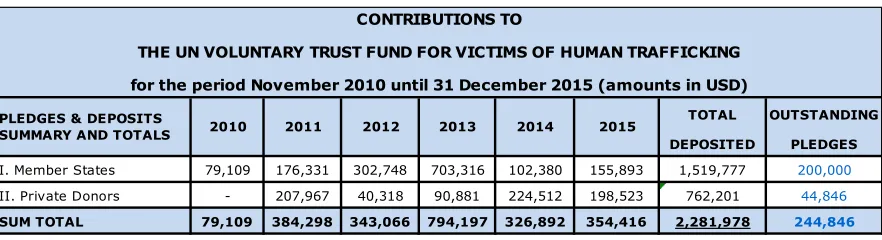
years, averaging around USD 400,000. However, in 2015, the UNVTF only received a total of USD 354,416, with USD 155,893 from Member States and USD 198,523 from the private sector. This amount remains less than the target of USD 1 million that was expected by UNODC and the First Board of Trustees at the establishment of the Trust Fund.
1.3 BOARD OF TRUSTEES
Article 38 of the UN Global Plan of Action stipulates that UNODC administer the Trust Fund, with the advice of a five-member Board of Trustees appointed by the UN Secretary-General. Board members would be selected, with due regard to equitable geographical distribution, and in consultation with Member States and the Executive Director of UNODC, for a three-year term. The United Nations Office of Drugs and Crime acts as the Secretariat to the Board of Trustees.
The members of the first Board of Trustees of the Fund (2011-2013) included the appointed Chairperson of the Board, Ms. Aleya Hammad (Egypt), Ms. Saisuree Chutikul (Thailand), Mr. Nick Kinsella (United Kingdom), Ms. Virginia Murillo Herrera (Costa Rica) and Ms. Klara Skrivankova (Czech Republic).
The current Board of Trustees was appointed by the Secretary-General in December 2013 serving a term of three years until December 2016. The current Board Members are:
• Ms. Benita Ferrero-Waldner (Austria) – appointed as the Chair of the Board,
• Ms. Saisuree Chutikul (Thailand),
• Ms. Joy Ngozi Ezeilo (Nigeria),
• Ms. Ketevan Khutsishvili (Georgia), and
• Ms. Virna Luque Ferro (Panama).
TOTAL OUTSTANDING DEPOSITED PLEDGES I. Member States 79,109 176,331 302,748 703,316 102,380 155,893 1,519,777 200,000
II. Private Donors - 207,967 40,318 90,881 224,512 198,523 762,201 44,846
SUM TOTAL 79,109 384,298 343,066 794,197 326,892 354,416 2,281,978 244,846 CONTRIBUTIONS TO
THE UN VOLUNTARY TRUST FUND FOR VICTIMS OF HUMAN TRAFFICKING
for the period November 2010 until 31 December 2015 (amounts in USD)
PLEDGES & DEPOSITS
UNVTF Board Members (clockwise from top right): Chair Ms. Benita Ferrero-Waldner, Ms. Saisuree Chutikul, Ms. Ketevan Khutsishvili and Ms. Virna Luque Ferro
(not pictured, Ms. Joy Ngozi Ezeilo)
1.4 ACHIEVEMENTS IN 2015
Achievements accomplished in 2015 include the signing of contracts and disbursement of grants to 19 new NGO projects selected under the second call for proposals. Lessons learned related to the management of the Trust Fund and the interaction with NGO partners from the first grant cycle were taken into account for the second grant cycle. Also, numerous outreach initiatives to promote the Trust Fund in Vienna, New York and at the UN Crime Congress in Qatar, as well as several events to commemorate July 30th as World Day Against Trafficking in Persons around the world
were undertaken successfully. The achievements will be described in more detail in the proceeding sections.
1.4.1 DISBURSEMENT OF GRANTS TO NEW PROJECTS
1.4.2 AWARENESS-RAISING AND PUBLIC INFORMATION
CRIME CONGRESS SPECIAL EVENT
In April, a High-Level Special Event for the Trust Fund was held in Doha, Qatar. The event was chaired by Benita Ferrero-Waldner, the Chair of the Board of Trustees of the Trust Fund. Other speakers included, UN Special Rapporteur on Trafficking in Persons, Maria Grazia Giammarinaro, Ms. Sunita Danuwar, President of the Board of Nepalese NGO Shakti Samuha and Paul Adepelumi, Executive Director of the Nigerian NGO African Centre for Advocacy and Human Development ACAHD.
In his remarks, UNODC Executive Director Yury Fedotov said that the UN Trust Fund was helping today's victims become tomorrow's survivors. "Some two thousand victims annually benefitted from direct assistance, including provision of shelter, basic health services, vocational training and schooling, as well as psychosocial, legal and economic support," he said.
Mr. Fedotov used his speech to bring home the appalling experiences of trafficking survivors, whose names had been changed to protect their anonymity. These survivors include girls such as Skye, who was trafficked to India when she was only 13 years old. Skye managed to escape back home to Nepal, and filed a case against her trafficker. After a successful conviction, Skye was able to return to school and finish her studies with the assistance of Shakti Samuha, one of the world’s first anti-trafficking NGO’s managed exclusively by survivors of this crime. Skye now works at the NGO full time as a counselor to help other girls like herself.
During the event, the President of this NGO, Ms. Danuwar, gave a moving account of the work and achievements made to assist girl’s trafficked to India for the purpose of sexual exploitation with the grant received from the Trust Fund. Through the project, Shakti Samuha has been able to assist more than 200 vulnerable women and girls through different programs, such as legal, emergency training, economic education, and providing opportunities in time of need.
WORLD DAY AGAINST TRAFFICKING IN PERSONS
The commemoration of World Day has become a key opportunity to promote the UNVTF and raise awareness on its work and the possibility for the wider public to contribute to it.
The second annual World Day against Trafficking in Persons was marked on 30 July 2015. To mark this special day, a social media campaign was launched by the Principals of eight (ILO, INTERPOL, IOM, OHCHR, UN Women, UNHCR, UNICRI and UNODC) of the world’s key organizations working to tackle this crime. Together, these eight heads of organizations urged more to be done to help the millions of women, men and children who fall victim to one of today’s most brutal crimes, and to join forces to improve trafficked persons' access to remedies that respond to their individual needs.
In 2015, two public events were organized to commemorate World Day Against Trafficking in Persons featuring the Trust Fund, one in Mexico City at the Liaison Partnership Office, and the second in Vienna at the Viennale International Film Festival, on the evening of 30 July.
1.4.3 ADVOCACY AND FUNDRAISING
The Trust Fund website is constantly updated with new information, including advocacy initiatives for the Blue Heart and the Trust Fund, press releases and social media postings.
OZARK HENRY, UNODC GOODWILL AMBASSADOR FOR BELGIUM
UNODC appointed Belgian artist Piet Goddaer (aka Ozark Henry) as its UNODC Goodwill Ambassador for Belgium on 21 October 2015. Piet Goddaer has been eager to use his concerts and social networks to raise awareness to support UNODC’s Blue Heart campaign and the Trust Fund. Ozark Henry held a concert in Antwerp, Belgium, where he raised awareness on the issue of human trafficking through a song composed especially for this purpose.
Also, Ozark Henry was invited by the Flanders House in New York to play a concert for the United Nations to raise
Ozark Henry with UNODC NYLO Representative Ms. Simone Monesebian and Ambassador of Belgium to the United Nations
Permanent Representative of Belgium to the UN Ms. Bénédicte Frankinet, the UNODC Representative in New York, Ms. Simone Monesebian and artist Mr. Piet Goddaer.
1.4.4 PRIVATE SECTOR PARTNERSHIPS
PARTNERSHIP WITH PEOPLESHARE FOUNDATION
In February, the Trust Fund benefitted from its partnership with Austrian private foundation PeopleShare, a major donor to the Trust Fund, to be selected to receive the proceeds from a private sector fundraiser held at the 2015 Real Estate Ball at the Hofburg in Vienna. Proceeds originated from the sales of nearly 3,000 tickets plus individual contributions from Raiffeisen Bank Bezirk Baden and PeopleShare Foundation to total EUR 25,000. This contribution enabled the provision of a grant to the previously selected project of the NGO Casa Alianza in Nicaragua.
Pictured from left Reinhard Einwaller (Organizer of the Real Estate Ball), Erwin Atzmueller
(Raiffeisen Bank Bezirk Baden), Herman Rauter (Founder of Herztraum Initiative and the PeopleShare Foundation), Monica Belalcazar (UNVTF Trust Fund Manager), Samira Rauter (Board Member,
1.4.5 LEGAL SUCCESSES
In addition to the life-changing interventions for thousands of victims assisted by the Trust Fund, some remarkable legal successes were also achieved through the work of NGO partners. Many of the cases resulted in historic judgments in the respective countries.
For example, in Mexico, the NGO Justicia Para Nuestras Hijas successfully concluded a trial on behalf of the families of four deceased female victims. In this historic ruling for Mexico, on 14 April 2015, five traffickers were each sentenced to 697 years in prison and fined US$ 839,274 in damages.
In Romania, the NGO ADPARE provided legal assistance to five female victims trafficked for the purpose of sexual exploitation, and one male victim trafficked to Denmark for the purpose of forced criminality. The male victims’ case is part of the “Wasp Nest investigation”, in what is being called the biggest case of human trafficking in Danish history.
In Canada, the NGO Covenant House provided legal assistance to a victim whose trafficker was deemed a dangerous offender — a rare designation reserved for Canada's most notorious criminals, such as murderers and rapists. This historic ruling in a Toronto court has opened the door to designating human traffickers as dangerous offenders.
In India, The NGO Bachpan Bachao Andolan rescued 40 children trafficked for the purpose of forced labour in two operations in Delhi, in coordination with local law enforcement authorities. Twenty-one children received INR 227,948 (USD $ 3,393) each in compensation, and two factories, which used child labour, were closed down.
These are just a few of the legal successes that have been made possible due to the support from the Trust Fund.
2. EMPOWERING VICTIMS & SURVIVORS
In 2015, grants were disbursed to 19 new projects and one project from the previous cycle2. These projects continued to provide direct assistance to victims of trafficking
and improve upon the achievements of the first grant cycle. The call for proposals launched in 2014 was open to all eligible NGOs to apply for grants of up to USD 20,000
2 The NGO Hors La Rue received its third year of funding from the first call in 2015, due to a delay in
per year, for up to 36 months, through an open and competitive process. The 2014 call resulted in 113applications being received by NGOs from all over the world. Following a stringent selection process and recommendations from the Board of Trustees, 19 projects were selected for funding. Around 50 projects remained on a reserve list to select further projects should more funding be received before December 2016.
2.1 Grants Awarded through the Second Call for Proposals in 2015
In 2015, the Trust Fund disbursed funding to 20 NGOs:
African Centre for Advocacy and Human Development - Nigeria (victims of sexual exploitation, forced labour and domestic servitude),
Agar Ethiopia Charitable Society – Ethiopia (female victims of sexual exploitation, forced labour, domestic servitude and the removal of organs),
Association for Voluntary Action/Bachpan Bachao Andolan - India (child victims of forced labour),
Blue Dragon Children's Foundation - Vietnam (child victims of forced labour and sexual exploitation),
Casa Alianza Nicaragua - Nicaragua (child victims of sexual exploitation),
Coalition for Organ-Failure Solutions - India/Egypt (victims of trafficking in persons for the purpose of organ removal),
Covenant House - Canada (youth-focused services and support to victims of sexual exploitation and human trafficking),
Different and Equal - Albania (sexual exploitation, forced labour, domestic servitude, forced begging and forced marriage),
Dhaka Ahsania Mission - Bangladesh (sexual exploitation, cross-border trafficking and labour migration),
El Refugio de la Niñez - Guatemala (sexual exploitation, forced labour and domestic servitude),
Foundation for Child Understanding - Thailand (child victims of sexual exploitation and forced labour),
Initiative pour le Développement de la Population en Milieu Rural - Burundi
(child victims of sexual exploitation and domestic servitude),
Istiqbolli Avlod Tashkent - Uzbekistan (forced labour),
Jesuit Refugee Service - Malta (sexual exploitation and forced labour),
Justicia para Nuestras Hijas - Mexico (sexual exploitation),
NGO ATINA - Serbia (sexual exploitation, forced labour and forced begging),
Raksha Nepal - Nepal (sexual exploitation and forced labour),
Samusocial - Senegal (child victims of forced begging, sexual exploitation and forced labour),
TABLE 1: 2015 FUNDED PROJECTS OF THE UNVTF
Organization Country Project Duration 2015 Funds Requested
ACAHD Nigeria 36 months 20,000 60,000
COFS India/Egypt 36 months 19,537 57,965
Covenant House Canada 36 months 18,860 60,000
Istiqbolli Avlod Uzbekistan 12 months 18,330 18,330
JRS Malta Malta 36 months 19,800 60,000
2.2.1 AFRICAN CENTRE FOR ADVOCACY AND HUMAN DEVELOPMENT
Project Title: Expanding Livelihood Opportunities for Victims of Human Trafficking in Nigeria: Training and Support for 20 Victims of Human Trafficking in Nigeria
Location of Project: Ondo State, Nigeria
Project Objective: The aims of this project is to support 20 former victims of human trafficking from Ajue, Akure, Ondo township, Akure, Irele and Ore environs of Ondo State to become economically self-sufficient and to become small business owners in a profession of their choosing. It is anticipated that by supporting the interests of these trafficking victims, and cultivating particular skill-sets with commercial viability, these individuals will be able to support themselves financially and establish professional careers for themselves.
Description of Grant Recipient
The African Centre for Advocacy and Human Development (ACAHD) is a Nigerian-based organization that has been working on issues of human trafficking in Nigeria since 2004. ACAHD has professional associations with human trafficking organizations in Nigeria and abroad, as well as governmental organizations, and has received past funding from numerous organizations to combat human trafficking. Overall, this project will equip survivors with the necessary skills to become self-sufficient, and at the same time provide vital services to the community.
Description of Project
Nigeria is a source, transit and destination country for women and children trafficked for labour and sexual exploitation. Ondo State, where the project will be based, is one of the States in Nigeria with the highest rates of human trafficking. Victims of human trafficking who come from the Ore community of Ondo State often do not receive essential support, and will therefore be targeted. ACAHD will provide
professional and vocational skills training and support these individuals in establishing a business in a profession of their choosing.
Key Achievements
• Conducted 5 community advocacy visits and 2 workshops
• 20 former victims were selected, assigned to selected mentors and were trained in computer skills, tailoring, bead making, hairdressing, photography and video, and were provided with vocational job training and stipends during training. • 20 selected project beneficiaries completed between 6 to 10 months vocational
training in computer set skills (3), tailoring(9), bead making (1), hairdressing (5), photography and video coverage(2)
• The 20 graduated project beneficiaries were provided with trade equipment on the day of graduation. The equipment included computers, printers, sewing machines, dryers, stoves, bead making equipment, cameras, and received soft grants to start their businesses.
• 20 businesses were registered with trade unions and local government authorities.
• 20 small business with shops established under this project.
Key Challenges
ACAHD reviewed over 300 prospective applications from victims and survivors interested in taking part in the project’s introductory training. However, only twenty individuals could be selected to take part. There are daily referrals of victims to our office from NGOs, traditional rulers and chairmen of local government. There are many victims still looking to benefit under this project.
2.2.2 ADPARE
Project Title: M-Power: Empowering trafficked persons for autonomy
Location of Project: Project beneficiaries are from Bucharest, and the southern and southeastern counties of Romania; the project activities will be implemented at the ADPARE counselling center in Bucharest.
Description of Grant Recipient
Since 2009, ADPARE has become more actively involved in international cooperation activities, especially with assistance providers in destination countries, mainly focused on identification and referral and preparation for repatriation to Romania for Romanian victims of trafficking in persons.
Description of Project
The project has as direct beneficiaries up to 30 Romanian adults and minors over 16, of both domestic and international trafficking in persons for sexual exploitation, (including forced marriage), forced labour and forced criminality. Wherever possible, family members of victims, found in a state of dependency, have been included as indirect beneficiaries, upon a prior needs assessment.
Key Achievements
ADPARE assisted a total of 46 victims that were trafficked or had been in vulnerable situations and included them within the 1st year of the M-Power project. Forty-two of them were women (of which 5 were minors) and four men. Six of the victims also have children (8 children in total). Twelve victims were included in the project in the
first months of implementation. Seven of the beneficiaries completed the assistance programme with outstanding results, while others are still being assisted with positive results as well. During the last 6 months of the project, an additional twenty-two people were added to the project.
Key Challenges
Recently, one of their beneficiaries was arrested for the crime of spreading HIV through prostitution. She continued this activity after her exploiters were arrested due to her vulnerability of having developed a heroin addiction (that had been induced by the traffickers themselves - this is a common way for exploiters to control their victims). The beneficiary was already being assisted by M-Power (before returning to the criminal group) through medical, psychological, legal and material assistance in order to help her regain a decent life. The fact that she is now being held under arrest is indeed a secure provision for the public safety, but on the other hand, it limits the NGO’s reintegration plan and her reinsertion into the project.
A site visit was conducted by a member of UNODC HQ staff to ADPARE on 8 December 2015. Summary of the visit:
The on-site visit provided the opportunity to meet with two project staff at the intake facility and assess implementation of the project as to whether or not it is meeting expectations. The NGO shared the achievements and challenges of the project funded by the UNVTF primarily aimed at assisting victims of sexual exploitation. Although no interaction with project beneficiaries was possible, based on the information provided, it was recommended that the project funding be continued.
2.2.3 AGAR ETHIOPIA CHARITABLE SOCIETY
Project Title: Rehabilitation and Reintegration of trafficking victims
Location of Project: Addis Ababa
Project Objective: Rehabilitate 180 trafficked women by providing accommodation, medical care, psycho-social support and psychiatry treatments, and vocational skills training.
Description of Grant Recipient
Agar Ethiopia is the only non-government organization in Ethiopia working on human trafficking to fill the gaps in all areas of trafficking in persons. Agar provides shelter, food, medical and psychological treatments, clothes and vocational skills training to 180 women that had been trafficked to countries in the Middle East and were deported back to Ethiopia.
The program is a continuation of former projects for which Agar made a significant contribution in improving the lives of trafficked women and received great appreciation from respective government and non-government institutions.
Description of Project
Key Achievements
• 72 Beneficiaries received shelter services
• Of the total 72 beneficiaries from this reporting period, 70 received group & individual counseling services
• 41 received medical & psychiatric services since arriving at Agar’s shelter with medical and psychiatric health problems
• 15 received life, vocational and basic business skills training
• 1 business was established and is operated by 5 project beneficiaries • 5 beneficiaries accessed alternative income generation activities • 5 beneficiaries were employed with the facilitation-training institute
Key Challenges
• Shortage of funds;
• Shortage of service delivery facilities such as shelter, ambulance, and treatment facilities for victims of trafficking;
• Over expectation of beneficiaries from the project; • Limited reintegration capacity due to a limited budget
2.2.4 ASSOCIATION FOR VOLUNTARY ACTION/BACHPAN BACHAO ANDOLAN
Project Title: Victim’s Assistance: Rescue, Rehabilitation and Social Reintegration of Victims of Human Trafficking
Location of Project: Delhi and Jaipur
Project Objective: The project aims to identify, release, rehabilitate and repatriate the children in forced labour and reduce trafficking through direct intervention, law enforcement, legal aid and access to justice through prosecution of employers/traffickers.
Description of Grant Recipient
Forced labour, bonded labour and trafficking are different forms of slavery, yet each form is equally heinous in practice and highly detrimental to the society. Children from vulnerable communities are trafficked into forced labour and its associated forms of exploitation.
AVA/BBA has been successful in both direct intervention against trafficking through rescue and rehabilitation of victims and indirect intervention by bringing significant changes to policies and laws related to protection of victims of exploitation, capacity building of law enforcement agencies and facilitating prosecution of the exploiter.
Since its inception, BBA has rescued more than 83,000 victims of trafficking for forced labour and exploitation. It’s Founder, Kailash Satyarthi, was awarded the Nobel Peace Prize in 2014 for the struggle against the suppression of children and young people and for the right of all children to education.3
Description of Project
The project aims to rescue 450 children out of forced labour and provide them with shelter, rehabilitation, legal aid and legally-protected access to owed wages. It is anticipated that demand for child labourers will cease after children are rescued out of forced labour and factories are shuttered. Survivor’s vulnerability to re-trafficking will decrease due to
statutory rehabilitation. Rehabilitation measures will also hit the economics of trafficking by ensuring that the offenders pay just compensation to victims. Humanitarian services will be provided in the Mukti Ashram shelter, which will assist in the reintegration of the children into mainstream society and children will be empowered to act as a change agent in their communities after repatriation.
3 https://www.nobelprize.org/nobel_prizes/peace/laureates/2014/satyarthi-facts.html
Key Achievements
• Number of victims identified- 275 • Number of victims rescued-123 • Number of FIRs registered-10 • Number of Prosecutions- 9
• Number of employers/traffickers arrested-9 • Number of factories sealed-22
• Number of children that received back wages-81
• Amount of back wages recovered –-INR 1527205 (USD 22,6184) • Number of children received a release certificate-35
• Number of children received immediate care and protection (Mukti Ashram)- 130
• Number of children repatriated -128
Key Challenges
The major bottleneck was the lack of coordination between various government agencies that are primarily responsible for protection and rehabilitation of the children.
Sometimes, children attempt to run away during rescues as well as from Mukti Ashram due to a fear of the police presence. The employers threaten the children that the police will arrest them if they do not work hard.
Damage to boundary wall of Mukti Ashram caused substantial damage to building, which brought the functioning of Ashram to a halt.
2.2.5 NGO ATINA
Project Title: Sustainable social inclusion of victims of trafficking in the Republic of Serbia
Location of Project: Republic of Serbia
Description of Grant Recipient
Since 2004, NGO Atina has been engaged in the field of combating trafficking in persons and specifically, comprehensive re-integration of victims of trafficking and other forms of exploitation. NGO Atina is part of the National Referral Mechanism in Serbia.
Description of Project
The project has been developed as a response to identified gaps in Serbia related to the need for a well-structured, systematic and long-term assistance program, based on victims’ full participation and respect of their human rights. The project foresees a sustainable solution for comprehensive protection
of victims of trafficking and their families (suffering from multiple discrimination and both transitional and global economic crisis) and will successfully address the need for decentralization of services, long-term dedication and a developed structure for the provision of various services, addressing root causes of trafficking at the same time (poverty, family violence, marginalization, lack of education, etc.).
Key Achievements
• 84 beneficiaries were included in development of individual reintegration plans which are monitored on a regular basis;
• Legal aid was provided to 42 beneficiaries;
• 22 beneficiaries in need were accommodated in the transition House, and provided with food and other supplies;
• 6 beneficiaries were referred to medical institutions for secondary medical treatment;
• 37 beneficiaries were provided with additional psychological support;
• 20 primary beneficiaries were provided with family mediation and counselling; • 44 beneficiaries completed practice and training programmes, and 16 more are
expected to complete them;
• 90 informal gathering and workshops were organized during project implementation;
Key Challenges
During the project implementation, there were no major obstacles. NGO Atina faces different kinds of obstacles in everyday work with beneficiaries, but that is an integral part of the job, and from experience NGO Atina knows how best to respond and successfully overcome any encountered. This implies the different needs of beneficiaries that require an individual response, but also holds workshops that are organized in such a way that each beneficiary can find interesting and useful.
2.2.6 BLUE DRAGON CHILDREN'S FOUNDATION
Project Title: Psycho-social interventions for victims of sex-trade trafficking
Location of Project: Hanoi and provinces throughout Vietnam
Project Objective: To provide high-quality psycho-social support to survivors of sex-trade trafficking immediately after rescue by Blue Dragon’s anti-trafficking rescue team, and to ensure their continuing support in order to assist their reintegration into the community and recovery from trauma; to continue to develop capacity in innovative psycho-social programs for survivors of sex trafficking that will provide a model for government and NGO agencies that are increasingly encountering these issues.
Description of Grant Recipient
Blue Dragon Children’s Foundation has been involved in the rescue and reintegration of victims of trafficking since 2005. They have rescued more than 330 children trafficked domestically for child labour, as well as girls and young women trafficked to China for the sex trade.
Description of Project
Women and girls who have been trafficked for sex are in need of high-level support and services to help address extreme trauma and associated mental health problems, including depression, anxiety and post-traumatic stress disorder (PTSD) commonly experienced as a result of trafficking.
families or their chosen communities. Blue Dragon emphasizes two primary activities: 1) emergency trauma care; and 2) long-term assistance for integration.
Key Achievements
• 61 survivors rescued from trafficking into brothels or forced marriages
• 124 survivors of sex trafficking assisted at the request of the police
• 22 children rescued from labour trafficking • 58 survivors stayed in emergency
accommodation
• 8 new survivors received long-term accommodation, and a total of 19 survivors received long-term accommodation
• 61 new survivors were reunited with family • 23 survivors received monthly group therapy • 30 survivors received supportive therapy on a
daily basis
• 63 survivors received health checks and medical treatment
Key Challenges
Emergency accommodation: At times emergency accommodation is at full capacity and this can present a challenge for the team. For example, in December 2015 they had 13 rescued persons staying in the emergency accommodation. This can mean more than one survivor to a room and some survivors needing to be accommodated off site. In June 2016, Blue Dragon opened a new long-term shelter for survivors wishing to study, train or work in Hanoi. This provides them with an option for accommodating survivors in cases of emergency.
Human resources: the project team consists of three full-time staff, but their caseload is for 124 survivors. This is a huge amount of work for a small team and they are looking at how to build more capacity into the team.
A site visit was conducted by a member of UNODC HQ staff to Blue Dragon on 24 April 2015. Summary of the visit:
The site visit was conducted shortly after the selection of Blue Dragon Children’s Fund to receive grant funding from the UNVTF and was intended to facilitate direct contact, provide first-hand impressions of project activities and the project’s management, as well as to draw attention to reporting and administrative requirements going forward.
The visit provided an excellent opportunity to gain first-hand insight into the counselling methods, the tailored and individualized approach of the expert staff working with victims – referred to by Blue Dragon explicitly as “survivors” rather than “victims”, highlighting the sensitivity and respect displayed by the organization’s staff for their beneficiaries’ experience –, and the long-term care provided in the form of shelter/housing, reintegration efforts, vocational training and continued financial and psychological support, accompanying rescued victims from primary to secondary and, in appropriate cases, through to tertiary education to secure their independence and minimize the risk of re-trafficking.
2.2.7 CASA ALIANZA
Project Title: Providing Comprehensive Protection Services to adolescent survivors of TIP Crimes and Those At Risk of Being
Trafficked in Nicaragua
Location of Project: Managua, Nicaragua
Project Objective: Continue to provide a program of comprehensive residential care and specialized services to adolescent victims of human trafficking and those at risk.
Description of Grant Recipient
Since 1998, Casa Alianza Nicaragua (CAN) has been committed to serving trafficked and at-risk teens. CAN’s methodology for recovery and social reintegration provides a host of assistance and support services directly tailored to the needs of adolescents that have been abandoned, abused, exploited and/or fallen victims to TIP crimes.
Description of Project
Key Achievements participating in the program with success;
• Soon, 4 adolescents will be reintegrated with their families, and 1 who is in the independent life program;
• All 20 adolescents actively participated in sports, art, recreation and cultural activities during their time at CAN;
• 13 civil procedures and 5 criminal procedures developed in favor of the adolescents cared for;
• 10 adolescents enrolled in public education programs to continue their studies; • 8 adolescents completed vocational training courses, 2 adolescents did
internships and 1 of them is currently employed
Key Challenges
Up to this point there haven’t been any obstacles in implementing the project, but the NGO experienced challenges in terms of providing comprehensive care and the prosecution of cases:
• In terms of providing comprehensive care, the major challenge experienced was the mobility of adolescents;
• Despite the progress in the emotional stability of the adolescents who remained in the program, many still refused to report the abuse suffered to authorities (police and/or public Ministry).
• Despite their being indications of commercial sexual exploitation of children and human trafficking, most legal criminal procedures will only investigate, and therefore issue sentences for statutory rape or similar crimes.
• It is easier to obtain evidence for statutory rape than crimes such as human trafficking or commercial sexual exploitation, which requires a longer period of time to investigate. Therefore, prosecution for statutory rape or similar crimes can at least guarantee a sentence.
2.2.8 COALITION FOR ORGAN-FAILURE SOLUTIONS
Project Title: Assistance for Persons Trafficked for the Removal of Organs
Location of Project: Egypt & India
Project Objective: In each of the three, 12 month period(s) of the project, COFS specific objectives are to assist at least 250 PTROs either directly with medical and/or legal aid, and/or indirectly with other relevant assistance (economic, counseling, etc.) via partner organizations; as well as to further raise awareness about TPRO abuses, particularly to anti-trafficking organizations/ activists.
Description of Grant Recipient
Egypt:
Since 2005, COFS has conducted intermittent projects to combat trafficking in persons for the removal of organs (TPRO) in greater Cairo by engaging policymakers and key stakeholders, conducting studies on the abuses and victims’ long-term consequences, raising awareness to target groups and the public and most importantly, identifying and assisting persons trafficked for the removal of organs (PTROs). Assistance has largely included medical follow-up and health education (after an organ removal) services with a partner clinic as well as counselling/ peer support, referrals to legal aid and income generation/ employment assistance.
India:
Since 2010, COFS is formally registered in India and has conducted intermittent projects in Tamil Nadu, Karnataka and West Bengal by conducting studies on the abuses, raising awareness to policy makers, target groups and the public and identifying and assisting persons trafficked for the removal of organs. Assistance has largely included medical follow-up and health education (after an organ removal) services with volunteer doctors but also counselling/ peer support. COFS is in the process of developing counselling/ peer support and referrals to legal aid and income generation/ employment assistance in India.
Description of Project
employ mobile technologies to communicate with PTROs about their needs and the services available to them.
Key Achievements
In this project year, COFS provided assistance to 221 victims of TPRO, including 282 services provided to them via the UN Voluntary Trust Fund for victims of trafficking in persons.
By the end of this project year, COFS field staff delivered victim-assistance services to an additional 86 victims of TPRO.
COFS also expanded its network with counter-trafficking and related NGOs to encourage commitments to include assistance services to victims of TPRO.
COFS explained to each of the victims
identified in Egypt and India in this project year that they are victims of a crime and that they have rights to assistance and remedies.
Approximately 85% of victims identified in this period received at least one assistance service.
At least 85% of beneficiaries report that this assistance service enhanced their lives.
Key Challenges
The elections in India restricted COF’s ability to convene with victims of TPRO. They did not anticipate this restriction and had to delay their plans for assistance provisions until after the elections in each respective field site.
Also in India, victims expressed more hesitation about meeting with lawyers for a fear of being criminalized. COFS thus adjusted plans to have their field staff conduct less formal interviews with a focus on restorative justice.
Finally with regard to India, COFS encountered victims, almost exclusively in Chennai, who demanded that the only help they were interested in was in receiving cash. COFS paused action with these victims and will consider the use of funds in the second project year to include livelihood support.
In Egypt, security threats impeded their field staff’s ability to conduct fieldwork in much of the second half of this project year. COFS were nonetheless able to arrange food provisions, although was unable to identify new victims in this second period of this project year.
2.2.9 COVENANT HOUSE
Project Title: Project Reclaim
Location of Project: Toronto
Project Objective: Supporting victims of Human Trafficking
Description of Grant Recipient
Covenant House is part of an international network of other Covenant Houses across North America and Central America that have been operating for 42 years.
Project Reclaim is a new program that is being launched to support sexually exploited girls between the ages of 16 and 24. Currently, there is limited funding towards victim support services by Federal, Provincial or Municipal government.
Description of Project
Covenant House Toronto works with young women ages 16 to 24 who are victims of sexual exploitation and trafficking, to help them heal and reclaim their lives. In coordination with Toronto Police Services, doctors from the Hospital of Sick Children and St. Michael’s Hospital, Project Reclaim will help these young women transition out of violence into a life with hope and opportunity. There are five core components and issues to be addressed: Safety, Health Care and Support One–on-one Counseling, Mentorship and Advocacy, and Next Steps.
Key Achievements
• Our Human Trafficking Advocates have supported 47 victims during this period. • All 47 clients have access to our wrap around services including vocational
services, community support services and life skills workshops. • Twelve girls have accessed our crisis emergency beds.
• Family reunification: 8 girls beginning to build a relationship with family; 7 girls communicating regularly with family; 8 girls are living with family
• Human Trafficking Advocates support victims at court appearances, legal appointments, police meetings and any other activity regarding prosecution: 12 active court cases; 2 convictions; 57 court appearances; Supported 76 legal counselling sessions
• 13 victims referred to Covenant House by Toronto Police Services
• Their onsite Healthcare team has supported 56 girls with 224 visits to their onsite healthcare clinic.
Key Challenges
Covenant House has experienced a few obstacles to date, the first being housing. When a young women is ready to leave the shelter there is a significant shortage of affordable housing options. While there are subsidies in place for victims of domestic violence, human trafficking does not qualify under this umbrella.
Covenant House is advocating having project beneficiaries receive support through various government funded programs like Ontario Works job training programs and perhaps even qualify for Ontario Disability Support Program. Inclusion in the programs will help some girls to secure an income.
Lack of identification also makes it very challenging for victims to access the services they need, to travel across the country to reunite with family or to access housing and/or specialized healthcare services.
Finally, the inclusion of two specialized crisis emergency beds within their 94 bed shelter has brought to light some program delivery challenges.
A site visit was conducted by a member of UNODC HQ staff to Covenant House on 30 November 2015. Summary of the visit:
2.2.10 DHAKA AHSANIA MISSION
Project Title: Shelter support for protection, rehabilitation and development of the victims and survivors of Human Trafficking
Location of Project: Jessore district, Bangladesh
Project Objective: To provide direct support and services through shelter homes for protection, rehabilitation, reintegration and the development of rescued and enrolled victims of human trafficking.
Description of Grant Recipient
DAM has almost two decades of experience working to combat human trafficking in prevention, protection (support to the survivor’s for rehabilitation), prosecution and repatriation. DAM established a shelter in
Jessore in 1998, and has the capacity to accommodate 60+ survivors at a time, providing a wide range of services to the enrolled survivors.
Description of Project
The project will address 1) repatriated and referred female and male survivors who were illegally trafficked; 2) strengthen prosecutions by assisting survivors file cases against their traffickers under
Bangladeshi anti-human trafficking laws to ensure commensurate punishments; 3) The project will improve awareness raising by the survivors.
Key Achievements
• Assisted 85 rescued victims (Female: 81, Male: 4) at the shelter
• DAM shelter collected basic information, made individual profiles of 85 victims during the period of July 2015- July 2016;
• DAM shelter located in Jessore extended and offered package services to each of the enrolled survivors for their immediate safe accommodation, livelihoods and fulfilled their other basic needs during their stay.
• 21 Female survivors were trained on small business entrepreneurship for income and employment generations to be self-reliant;
• 6 Female survivors were trained on tailoring, beautician and computers;
• 5 trained survivors received a financial grant to start income generation and self-employment activities;
• The shelter created job opportunities for 4 survivors at Cafe Joyoti in Dhaka and 1 survivor is working in the shelter of an NGO as Home Mother;
• DAM published a brochure/booklet in Bangla language to disseminate and scale up shelter activities & services in other government and private organizations; 12 Participatory Monitoring and 12 follow-up reports have been prepared and shared.
Dhaka Ahsania Mission (DAM) directly supported 165 victims and survivors in total during the reporting year through different projects for rehabilitation and reintegration in the family and community.
Key Challenges
• Both male & female survivors wanted direct financial benefits to enroll in the shelter and other programs, but the project team overcame this through motivation and counseling services.
• The victims/survivors felt reluctant to file court cases against traffickers. To file cases the victims want financial and legal support.
2.2.11 DIFFERENT & EQUAL
Project Title: Enhancing the reintegration efforts for victims of trafficking in Albania
Location of Project: Services provided nationwide throughout Albania
Project Objective: The overall objective of the project is to enhance the efforts for the reintegration of victims of trafficking in Albania.
Description of Grant Recipient
services. D & E is a member of several national and international coordination structures and has partnered with several international organizations, non-governmental organizations and governments.
Description of Project
Albania continues to be plagued by the problem of human trafficking and is a source country for women, children and men trafficked for the purpose of sexual exploitation and forced labour. In terms of the provision of reintegration assistance, the sustainability of reintegration support is extremely important and dependent upon adequate reintegration mechanisms for victims of trafficking. The project will support comprehensive reintegration services for victims from the early stages when victims are freed, until full reintegration into the community.
Key Achievements
• 98 beneficiaries were assisted in the reintegration program, 40 new cases entered in the program;
• 39 children of the beneficiaries were assisted with the necessary services, among them 12 were new cases; • 37 beneficiaries attended the vocational trainings;
• 26 beneficiaries attended the formal education;
• 43 beneficiaries were employed in different job placements; • 6 beneficiaries worked full–time at D&E social business;
• 3 beneficiaries were supported to manage their own businesses;
• 8 beneficiaries were involved in traineeship programs within business companies;
• 23 local actors were trained on trafficking phenomenon related issues including identification, referral and protection of the victims of trafficking.
Key Challenges
A lack of alternative options to ensure long-term accommodation options for the beneficiaries of the program. It is very challenging to include the beneficiaries of the program in social housing programs.
One of the main challenges regarding the employment of women as well as of male victims of trafficking / potential victims of trafficking is the fact that most of the
beneficiaries have a low level of education and very few work experiences. This makes the process of reintegration and stability in the work difficult for some beneficiaries.
2.2.12 EL REFUGIO DE LA NIÑEZ
Project Title: Integral Attention for Victims and Survivors of Human Trafficking
Location of Project: Guatemala
Project Objective: 150 Girls and adolescent victims of human trafficking receive integral attention services in 3 years
Description of Grant Recipient Since 2011, El Refugio de la Niñez has implemented projects related to the attention of victims and survivors of human trafficking. El Refugio maintains a shelter to provide integral attention to victims of human trafficking and has provided support to over 200 girls and adolescents. The integral attention services include the provision of housing, health, education, psychological attention, family strengthening and legal support. El Refugio works closely with the government institutions related to children protection and justice.
Description of Project
Lack of comprehensive care programs
for victims: El Refugio will provide
specialized attention services for victims and survivors of exploitation and human trafficking, providing basic services as well as ensuring their access to psychological support, education, health, recreational activities and to return to their families.
Low capacity of the Justice System: El
Refugio will ensure staff to provide
follow up to legal cases against traffickers, in order to support the application of the Guatemalan law.
Key Achievements
• 71 girls received integral attention services and their human rights related to family, health, education and justice.
• 165 family members will have received therapy and support through Parent´s School, Self-Support Groups and Family Therapy.
• 120 cases of exploitation and human trafficking have been supported though legal support.
Key Challenges
The most significant obstacle in this reporting period was that government funding to combat human trafficking from Guatemala was received late.
2.2.13 FOUNDATION FOR CHILD UNDERSTANDING
Project Title: Protection & Prosecution: Human Trafficking in Northern Thailand
Location of Project: Chiang Mai & 8 Provinces in Northern Thailand
Project Objective: Protection: Counselling and assistance for trafficking victims in shelters. Prosecution: Counselling and compensation for trafficking victims
Description of Grant Recipient
Since its establishment in 2002, TRAFCORD has been a prime mover in Northern Thailand in the protection of child and women victims of human trafficking and prosecution of perpetrators working closely with government and non-government agencies. TRAFCORD is operational in nine provinces of Northern Thailand and is based in Chiangmai Province.
Description of Project
Northern Thailand, due to its geographical location and socio-economic disparity between neighboring countries will for the foreseeable future have an endemic problem with human trafficking and labour exploitation.
TRAFCORD will work within the framework of the human trafficking act as part of a multidisciplinary team with government agencies to explore more effective approaches to implementing the law on human trafficking.
Key Achievements
• Received 79 incident reports which 37 reports related to human trafficking and 42 callers received advice and counselling;
• Conducted 57 cases to verify human trafficking and identify ways to provide assistance;
• 173 victims of human trafficking and other forms of abuse were provided rescue services, assistance and welfare protection;
• 173 victims of human trafficking and other forms of abuse were provided social counselling;
• 41 victims were provided social counselling for repatriation/reintegration; • 63 victims were provided material assistance for repatriation/reintegration;
Key Challenges
Protection: Victim Identification/Rescue
Many times of incident reports were informed in Burmese or hill tribe languages. Due to the limitation of language barrier of FOCUS staff, it needs to procure the interpreters who have been experienced on basic counseling and data information.
Protection: Social Assistance to Victims
Some of the adult victims didn’t want to receive any services from FOCUS or multi-disciplinary team due to lack of information. Therefore, FOCUS and team need to provide them the information of their rights as human trafficking victims. Importantly, FOCUS respects their decision and brings them to participate at all decision making.
Legal Assistance
Due to the court consideration, the case of voluntary child prostitution has never entitled any compensation. FOCUS needs to explain seriously and make victims understand this limitation.
2.2.14 INITIATIVE POUR LE DEVELOPPEMENT DE LA POPULATION EN MILIEU RURAL
Project Title: Reintegration and school support for 15 girls who are victims of human trafficking and who are from the most socioeconomically disadvantaged families
Location of Project: Isare Commune (rural Bujumbura)
Project Objective: During a three-month awareness campaign, 15 female victims of human trafficking and their families will be educated about human trafficking and its consequences; and 15 female victims of human trafficking will be provided with the opportunity to finish high school.
Description of Grant Recipient
Since 2011, IDPR has worked with poor communes around Bujumbura to address the following: identification and awareness for families of children and youth victims of human trafficking; has established partnerships with local government, and local grassroots associations; has located and identified child and youth victims of human trafficking in Bujumbura; and since June 2013 to
date, has promoted awareness of trafficking in persons among children and youth.
Description of Project
IDPR has identified 15 young girls who, after being victimized from trafficking and domestic servitude, expressed an earnest desire to reintegrate the school and achieve their educational goals. These 15 young girls will remain “the pioneers” to launch the fight against sexual trafficking and carry ongoing activities.
Hence, specific problems that will be addressed consist of:
Breaking the edge of ignorance of the victims of trafficking and their families about the consequences of human trafficking and international tools; Tackling the matter related to poverty: lack of school fees; Engage a local movement in the fight against trafficking and pledge towards the implementation of a local law or policy.
Key Achievements
• 24 discussion sessions were organized (2 per week for 3 months);
• 15 victims of human trafficking have benefited from the school fees for a year and have successfully completed the school year.
Key Challenges
No major obstacles were encountered during the reporting period.
2.2.15 ISTIQBOLLI AVLOD
Project Title: Legal assistance and social services for victims of labour trafficking
Location of Project: Tashkent, Uzbekistan
Project Objective: Provide direct, effective and sustainable remedies for victims of human trafficking, with an emphasis on legal aid, access to justice, psychosocial consultation, medical care, clothing; and, strengthening human and institutional capacity in cooperation of local and international organizations and professionals in order to achieve measurable results in protecting victims of human trafficking.
Description of Grant Recipient
Description of Project
IA aims to identify, select and involve victims of labour trafficking in the “Hotline” project. The Hotline will connect victims of labour trafficking to the Project. Then, a social worker will conduct an initial assessment of victim’s needs and re-direct a case to a lawyer if a victim stays abroad and needs to repatriate.
Key Achievements
• The project participants, 50 survivors, were provided with direct legal consultations by a qualified attorney at law.
• The project participants received medical consultations, examinations and remedies to improve their health condition due to their lack of access to affordable and effective health services.
• Based on needs assessment, 33 project participants received seasonal clothing. These include: warm trousers, jackets, boots, knitted jumpers, skirts, shirts, t-shirts, sport jumpsuit for men and women.
• The Project implementation Team strengthened its professional skills and experience in combating human trafficking and protecting survivors of trafficking.
• NGO enhanced its trust, responsibility and capacity among national partners to combat labour trafficking.
Key Challenges
• It took more time than initially expected to have a confirmation from the bank to receive the grant due to financial regulations in Uzbekistan.
• Less number of survivors joined the project than expected due to their constant movements and seeking of new employments opportunities outside the country.
• Due to project goals, survivors of trafficking were able to solve their legal problems, improve their health condition and have some relevant sustainable living for a limited time, however economic hardship condition had not been removed from their lives.
• Monitoring of project participants has been difficult because some of the project participants had to move out of the country and look for jobs abroad.
A site visit was conducted by a staff member of UNODC’s Regional Office for Central Asia to Istiqbolli Avlod on 12 November 2015. Summary of the visit:
The on-site visit allowed UNODC to meet with the project staff, beneficiaries and assess the project implementation. The NGO shared achievements, challenges and lessons learned under a pilot project funded by the UNVTF and aimed at assisting the victims of labour trafficking. Site visit team had also the opportunity to assess the NGO and country needs and identify the areas where UNODC could offer its AHT/SOM technical assistance. Based on the visit, it was recommended to extend the duration of the project for a consecutive year.
2.2.16 JESUIT REFUGEE SERVICE
Project Title: PROTECT – A project to enhance the protection and support provided to victims of trafficking in Malta
Location of Project: Malta
Project Objective: To ensure as many victims of trafficking as possible are able to access legal remedies and obtain the protection, care and support they require, through the provision of timely and accurate information and counselling, legal services, psychosocial support and limited material assistance throughout the duration of the project.
Description of Grant Recipient
Since 2010, JRS Malta has been implementing projects to provide legal and social support for integration in Malta.JRS Malta has implemented several projects with the intent of enhancing the care and/or services provided by the organization.
Description of Project
In recent years, the government of Malta has made improvements on combating trafficking in persons. In spite of these developments, there are still a number of significant gaps and challenges, in the structures and services in place to ensure that the rights of victims of trafficking are safeguarded. These include:
• Lack of access to information and legal counselling