16
O R I G I N A L A R T I C L E
EFFECTS OF LATIHAN PASRAH DIRI IN QUALITY OF LIFE IN CHRONIC
KIDNEY DISEASE-DIALYSIS PATIENTS WITH DEPRESSION SYMPTOMS
1 2 2
Widyaningrum , Agus Siswanto , Bambang Djarwoto
1. Internal Medicine, Medical Doctor Specialist Training Program, Faculty of Medicine, Universitas Gadjah Mada / Dr.Sardjito General Hospital, Yogyakarta
2. Department of Internal Medicine, Faculty of Medicine, Universitas Gadjah Mada / Dr. Sardjito General Hospital, Yogyakarta
ABSTRACT
Background: Patients with chronic kidney disease (CKD) suffering from various physical and emotional symptoms show depression and disturbance in quality of life. Patients with chronic kidney disease have a decreased quality of life, and mortality rate about 22% in every year. Depression in patients with CKD must be managed properly because a large effect on HRQOL (Health Related Quality of Life) and the potential side effects on the management of patients with CKD. Latihan pasrah diri (LPD) is a method combining relaxation and remembrance with a focus on breathing exercises and words contained in the dhikr (relaxation and repetitive prayer). The rise of the relaxation response is expected to improve the symptoms of stress or depressive symptoms, which is expected to improve HRQOL.
Objective: This study aims to determine the effect of LPD on quality of life in hemodialysis patients with depressive symptoms that is compared with controls.
Methods: The research constitutes the study of Randomized Control Trial. The research aims to measure the KDQOL-SF scores (Kidney Disease Quality of Life-SF) in subjects with LPD treatment during 21 days, compared with controls. The research was conducted at the Hemodialysis Unit of Dr. Sardjito Hospital, Yogyakarta, from May to June 2012. A total of 36 patients who met the inclusion criteria were randomized and divided into LPD group (n=18) and control group (n=18).
Results: Found a statistically significant decrease in BDI scores in both groups, 23.00 ± 5.34 to 15.00 ± 8.55 (p=0.001) in the LPD group and 23.00 ± 5.34 to18.33 ± 6, 66 (p=0.022) in the control group. KDQOL-SF scores after treatment when compared between the LPD and control groups experienced different changes were statistically significant in domains effects of kidney disease 59.65 ±23.52 compared to 39.41 ± 20.03 (p=0.022),
sleep 69 ± 13.17 compared to 46.53 (p=0.000), overall health 73.89 ± 16.85 compared to 57.22 ± 19.04 (p=0.009), pain 64.86 ± 20.80 compared to 42.36 ± 24.90 (p=0.005), general health 53.88 ±16.05 compared to 47.78 ± 20.74 (p=0.014), and the physical component scale35.98 ± 6, 83 compared to 29.12 ± 6.46 (p=0.004). Despite increased KDQOL-SF domain scores, but there were 2 domains that Ä KDQOL-SF score changes were statistically significantly different compared with the control group, which was the domain of sleep and overall health.
Conclusion: Latihan pasrah diri twice a day during 21 days (3 weeks) can improve quality of life of patients with symptoms depression in CKD patients undergoing hemodialysis in domains of sleep and overall health.
Key words: CKD, depression, latihan pasrah diri, KDQOL-SF.
INTRODUCTION
Patients with Chronic Kidney Disease (CKD) suffer from various physical symptoms and emotional, especially, showed depression and impaired quality of life. The symptoms include fatigue, pain, muscle cramps, insomnia, and sexual dysfunctions in more than half of the patients with chronic dialysis. The high incidence can give contributions to impaired quality of life of the
1
population. Depression in patients with CKD should be managed properly because it has an enormous impact on HRQOL and its side effects,
2
potential in the management of CKD. In general, the arrangement of depression consists of three kinds of psychosocial intervention, pharmacotherapy and combination therapy. Psychosocial therapies
Acta Interna - The Journal of Internal Medicine
20
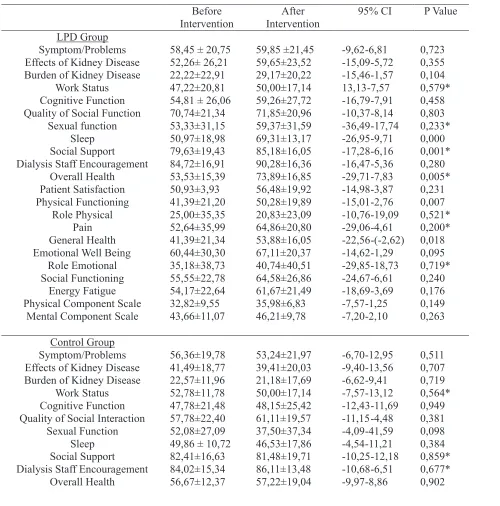
When the comparison is done in the KDQOL-SF domain scores before and after treatment, the recovery and improvement scores differ significantly from the LPD group in domain of sleep, social support, overall health, physical functioning, and general health. In the control group there was one significant different domain in general health. Although a lot of the increase KDQOL-SF domain scores in LPD group, but there are only 2
domains KDQOL Ä-SF score changes were statistically significantly different compared with the control group, which is the domain of sleep and overall health. During the study did not reveal any adverse effects of treatment. The average patient LPD group declared an improvement in the quality of sleep, the body feels fresh, loose breath and feeling calmer, corresponding to an increase.
Table 3. KDQOL-SF Score Before and After Intervention
Before Effects of Kidney Disease Burden of Kidney Disease
Work Status Cognitive Function Quality of Social Function
Sexual function Sleep Social Support Dialysis Staff Encouragement
Overall Health Emotional Well Being
Role Emotional Social Functioning
Energy Fatigue Physical Component Scale
Mental Component Scale
58,45 ± 20,75 Effects of Kidney Disease Burden of Kidney Disease
Work Status Cognitive Function Quality of Social Interaction
Sexual Function Sleep Social Support Dialysis Staff Encouragement
Overall Health Widyaningrum, et al
21 Emotional Well Being
Role Emotional Social Functioning
Energy Fatigue Physical Component Scale
Mental Component Scale
48,15±7,85
Description: Statistical analysis using paired t test, except: *Wilcoxon test.
KDQOL-SF questionnaire scores on the domain of sleep, social support, overall health, physical functioning, and general health. There were no drops out in the LPD intervention in LPD group, with 95.2-100% compliance.CAM research on regular hemodialysis patients was implemented by Ling et al. (2003) on the effects of tai chi-based
6
exercise held in China for 3 months. Yurtkuran et al. (2007) assess the program were modified
yoga-7
based exercise held in Turkey as well for 3 months. This research was done in less time is 21days and showed improved results compared to other studies that require more time. This difference is due to the LPD combining relaxation and dhikr with a focus on breathing exercises and words contained in the dhikr (relaxation and repetitive prayer), and can be done independently wherever the patient is located. Limitations of this study because it is not able to control the factors or variables that can affect the quality of life of patients, and no record of physical activity, diet, and social and religious activities of each research subject. Another limitation is the number of samples that did not meet the target, which should each group of 22 people, but in this study was obtained 18 people, there are no parameters to ensure the condition of the subject that has been done LPD if it were really resigned, the bias in the conduct of research as well as a limitation of this study. Further research is needed to further assess sustainability LPD intervention at a later time (in the second, third, and so on).
CONCLUSION
Latihan pasrah diri can improve the quality of life of patients with symptoms of depression CKD undergoing regular hemodialysis on the domain of sleep and overall health.
For some advices there are:
1. Necessary to study the effects of LPD on aspects of metabolic control inpatients with symptoms of depression CKD with respect to:
a. Aspects that cause depression in patients with CKD.
b. Blood or urine cortisol levels to determine how much current levels of depression, as well as to measure the effect of LPD. 2. Need to research in the longer term time LPD
and sustainability, so as to examine the long-term effects.
3. Need to do research with a larger sample size. 4. Need an in-depth analysis or exclusion of the
factors that can lead to bias in this study.
REFERENCES
1. Kader, K.A., Unruh, M.L., et Weisbord, S.D., 2007. Cited 28 Oktober2010.Symptom Burden, Depression, and Quality of Life in Chronic and End-Stage Kidney Disease. ISSN: 1555-9041/406–1057.
2. Tossani E, Cassano P, Fava M. Depression and renal disease. Semin Dial 2005;18 (2): 73-81.
3. Bonin L & Moreland, C.S., 2008. Overview of treatment for adolescent depression, Up To Date 16.3 version.
Acta Interna - The Journal of Internal Medicine
22
4. Steyer, T. E., 2001. Complementary and Alternative Medicine: A Primer: Family Practice Management. Americans Academy of Family Physicians; p: 37-42. Downloaded from www.aafp.org/fpm
5. Dharma, A.D., 2006. Pengaruh Latihan pasrah diri terhadap Kontrol Gula Darah pada Penderita Diabetes Melitus Tipe 2 Dengan Gejala Depresi (tesis), Universitas Gadjah Mada, Program Pasca Sarjana,Yogyakarta.
6. Ling, K., Wong, F.S.Y., Chan, W., Chan, S., Chan, E.P.Y., Cheng, Y., Yu,W., 2003. Effect of A Home Exercise Program based on Tai-Chi in Patients With End Stage Renal Disease. Permit dial Int. 23 (S2): 99-103.
7. Yurtkuran, M., Alp, A., Dilek, K., 2007. A Modified Yoga-Based Exercise Program in Hemodialysis P a t i e n t : A r a n d o m i z e d C o n t r o l l e d Study.Complementary Therapies in Medicine.15: 164-71.