Full Terms & Conditions of access and use can be found at
http://www.tandfonline.com/action/journalInformation?journalCode=vjeb20
Download by: [Universitas Maritim Raja Ali Haji] Date: 11 January 2016, At: 19:35
Journal of Education for Business
ISSN: 0883-2323 (Print) 1940-3356 (Online) Journal homepage: http://www.tandfonline.com/loi/vjeb20
Factors Affecting Perceived Learning, Satisfaction,
and Quality in the Online MBA: A Structural
Equation Modeling Approach
Rose Sebastianelli, Caroline Swift & Nabil Tamimi
To cite this article: Rose Sebastianelli, Caroline Swift & Nabil Tamimi (2015) Factors Affecting Perceived Learning, Satisfaction, and Quality in the Online MBA: A Structural Equation Modeling Approach, Journal of Education for Business, 90:6, 296-305, DOI: 10.1080/08832323.2015.1038979
To link to this article: http://dx.doi.org/10.1080/08832323.2015.1038979
Published online: 13 May 2015.
Submit your article to this journal
Article views: 107
View related articles
Factors Affecting Perceived Learning, Satisfaction,
and Quality in the Online MBA: A Structural
Equation Modeling Approach
Rose Sebastianelli
University of Scranton, Scranton, Pennsylvania, USA
Caroline Swift
The Pennsylvania State University, University Park, Pennsylvania, USA
Nabil Tamimi
University of Scranton, Scranton, Pennsylvania, USA
The authors examined how six factors related to content and interaction affect students’ perceptions of learning, satisfaction, and quality in online master of business administration (MBA) courses. They developed three scale items to measure each factor. Using survey data from MBA students at a private university, the authors estimated structural equation models to explore these relationships empirically. The findings suggest that course content is the strongest predictor of all three outcomes (perceived learning, satisfaction, and quality); it is the only significant factor affecting perceived learning. They also found that professor– student interaction had a significant positive impact on satisfaction, but not on perceptions of quality. Perceptions of quality were influenced significantly by student–student interaction and mentoring–support.
Keywords: content, interaction, online MBA, quality, satisfaction
Driven by improved technologies, changing paradigms in teaching and learning, and increased global competition among universities, the shift toward online education is well underway (Dykman & Davis, 2008). It is not surprising, therefore, that a significant amount of attention has been directed toward identifying and understanding the factors that affect learning, student satisfaction, and perceptions of quality in a web-based environment. An early report (2000) by the Institute for Higher Education Policy identified 24 benchmarks for excellence in online education in seven areas: institutional support, course development, teaching– learning, course structure, student support, faculty support,
and evaluation–assessment. The Sloan Consortium (2002) named the Five Pillars of Quality Online Education as learn-ing effectiveness, student satisfaction, faculty satisfaction, scale, and access, and a review of the literature conducted by Chaney et al. (2009) uncovered seven common themes: teaching and learning effectiveness, student support, tech-nology, faculty support, course development/instructional design, evaluation and assessment, and organizational/insti-tutional impact. These frameworks for evaluating online educational effectiveness include aspects that go well beyond the quality of online teaching and pedagogy.
In particular, business education has seen tremendous growth in the number of courses and degree programs offered entirely online. Web-based instruction has gained widespread acceptance among students (e.g., convenience, flexibility) and institutions alike (e.g., cost effectiveness, new markets), with some predicting that the internet will be the primary channel for delivering master of business administration (MBA) programs in the future. While factors
Correspondence should be addressed to Rose Sebastianelli, University of Scranton, Kania School of Management, Department of Operations & Information Management, 423 Brennan Hall, Scranton, PA 18510, USA. E-mail: [email protected]
Color versions of one or more figures in this article are available online at www.tandfonline.com/vjeb.
JOURNAL OF EDUCATION FOR BUSINESS, 90: 296–305, 2015 CopyrightÓTaylor & Francis Group, LLC
ISSN: 0883-2323 print / 1940-3356 online DOI: 10.1080/08832323.2015.1038979
related to institutional commitment, faculty support, and leadership are important determinants of quality in online programming, instructors who design and teach online busi-ness courses make a number of decisions (e.g., content, delivery, structure) that directly impact students’ experien-ces and perceptions. Understanding the impact of these choices on student outcomes, such as perceived learning or satisfaction, is important for developing effective web-based instructional strategies that can help attract and retain online students in an increasingly competitive global marketplace.
Our study deals specifically with the online MBA. The purpose is to investigate, within a structural equation model-ing (SEM) framework, how factors typically under the con-trol of faculty affect the important student outcomes of perceived learning, satisfaction, and perceptions of quality. The factors we chose to include in our study are based on a review of the literature and focus on those aspects of course design and pedagogy that can be manipulated by faculty. These factors are course content, course structure, rigor, pro-fessor–student interaction, student–student interaction, and online mentoring–support. SEM has been used previously in similar studies (e.g., Peltier, Schibrowsky, & Drago, 2007) and offers several methodological advantages, including the ability to measure each factor (i.e., construct) using multiple scale items and to estimate the impact of each construct on student perceptions. Our study, however, differs from prior work in several important ways. First, we untangle student outcomes into three distinct perceptions: learning, satisfac-tion, and quality. Our findings indicate that factors do have differential impact depending on the outcome being mea-sured. Second, the factors we consider are customizable by faculty. Consequently, our findings have implications for faculty teaching online MBA courses, providing insight into how their choices impact student perceptions and, ulti-mately, program reputation and success. Finally, it under-scores the critical role of faculty in the online educational environment, not only in terms of delivering high quality learning experiences, but also for improving a program’s ability to attract students in increasingly competitive global markets (e.g., for the online MBA). Some have suggested that full-time faculty with reputable terminal degrees, and presumably higher academic standards and more expertise, is the means by which quality conscious online MBA pro-grams can differentiate themselves to gain competitive advantage (Smith & Mitry, 2008). Our findings help bolster this position by providing empirically based recommenda-tions to online faculty for improving students’ perceprecommenda-tions of learning, quality, and satisfaction.
LITERATURE REVIEW
A number of approaches have been suggested for assuring a quality online educational experience. Grandzol and
Grandzol (2006), in a review of the literature on best practi-ces for online business education, provided guidance on course design and delivery, student services, and adminis-tration. Consistent themes include standardizing course structure, modularizing course content, giving quick and constructive feedback, providing technical support for stu-dents, and limiting class sizes. Similarly, Dykman and Davis (2008a) reiterated many of these same best practices in their review (e.g., a standardized approach to course design), but also stressed the importance of clearly defined learning objectives and planning in an online environment where courses must be prepared almost entirely in advance. In a survey of faculty and students from a variety of disci-plines (including business), Gaytan and McEwen (2007) sought to uncover instructional strategies believed to improve the quality of online learning. One major recom-mendation from their findings was that students need mean-ingful and timely feedback.
From this discourse on best practices in online educa-tion, we can infer that those under faculty control can be broadly classified as either being related to content or related to interaction. While factors other than those related to these aspects can certainly affect student outcomes, for example, Marks, Sibley, and Arbaugh (2005) showed that the advantages of flexibility and convenience influence per-ceptions of online learning, these types of factors do not dif-ferentiate particular online programs and/or courses of study. In other words, they are common to all online pro-grams irrespective of faculty decisions about teaching and pedagogy. Therefore, the remainder of our literature review focuses on content-related and interaction-related factors.
Content-Related Factors
Most theories on learning recognize the need for a specific knowledge domain within which to teach skills and con-cepts (e.g., McPeck, 1990). Faculty who teach, whether online or in traditional classrooms, make a number of deci-sions regarding content including, but not limited to, select-ing the topics to cover, the relative emphasis placed on each topic, depth versus breadth of coverage, and level of difficulty. Course content in online courses should be chal-lenging, up to date, and delivered in a way that motivates the learner (Drago, Peltier, & Sorensen, 2002; Jones & Kel-ley, 2003).
Some studies have examined the link between course content and student outcomes in the online environment. In a proposed e-learning success model based on an informa-tion systems perspective, Holsapple and Lee-Post (2006) included the dimension of information quality, which refers to course content in terms of organization, usefulness, and currency. While the research focus was on using the model to determine the success of an online operations manage-ment course, data revealed that students consistently judged understanding course materials as one of the most valuable
learning elements. In a study using data collected from online MBA students, Peltier et al. (2007) tested a complex SEM model that involved a number of interrelationships among various factors. One of their main conclusions was that “course content is the number one driver of perceived quality of the learning experience” (Peltier et al., 2007, p. 149), and, in yet another study of online MBA students, the degree of prior familiarity with and appropriateness of course content were found to be significant predictors of students’ satisfaction with online courses (Beqiri, Chase, & Bishka, 2010).
It has also been suggested that students’ perceptions of the quality of online learning are influenced by, among other aspects, degree of rigor (Adair, n.d.). Indeed one of the benchmarks for student engagement in online learning is level of academic challenge. In a study of undergraduate business students enrolled in at least one totally online course, Robinson and Hullinger (2008) found that students who reported greater levels of satisfaction with online learning also reported attain-ing more academic skill development (e.g., writattain-ing and critical thinking) as well as higher order levels of think-ing (e.g., analysis, synthesis, application).
The online environment offers both opportunities and constraints with respect to structuring course content. Indeed, much of the literature dealing with online content focuses on how it is presented, organized, and accessed. One recommendation is to use a well established, consistent structure across all online courses to achieve a standardized format (Bruckman, 2002). Consistency within courses, as well as across courses, is also recommended. Modularizing course content (into units) makes it easier for students to manage online coursework, allowing them to focus on learning new material rather than on learning new formats (Jones & Kelly, 2003). Shea, Swan, Fredericksen, and Pick-ett (2002) found that greater levels of consistency in course structure result in higher levels of student satisfaction. Moreover, in a study of online MBA students enrolled in a marketing research course, there is evidence to suggest that students preferred keeping the present look and feel of the course rather than change the way materials were accessed (Sun & Ganesh, 2014).
One limitation that must be considered in structuring an online course is that learning objectives cannot evolve, as they can in a traditional classroom setting, as the course progresses. Consequently, it is important for faculty teaching online courses to define detailed learn-ing objectives, not only for the course overall, but for each individual unit or module, so that students are clear about expectations (McLaren, 2004). Moreover, the con-tent and structure of the course should relate back to these objectives. In this way, objectives not only guide students through the e-learning process but also drive online course design.
Interaction-Related Factors
In a traditional classroom setting, students have the oppor-tunity to interact with professors and peers in ways that are more interpersonal and social than in an online environ-ment. It is a generally accepted finding in higher education research that the quality and quantity of student interaction (with both faculty and classmates) result in higher levels of engagement, a significant predictor of student academic success (Astin, 1993). As might be expected, then, the liter-ature on online education devotes considerable attention to this issue and takes multiple perspectives.
The most basic type of interaction involves faculty feed-back to students regarding academic performance and activities (e.g., assignments, quizzes, posts). In order to build trust between faculty and students in an online envi-ronment, it is recommended that feedback be prompt, meaningful (Shea et al., 2002), and consistent, especially with respect to grading (Dykman & Davis, 2008b). Further, when feedback involves concepts and ideas related to con-tent, it should be highly responsive (Coppola, Hiltz, & Rot-ter, 2002) and with regular frequency (Kuh, 2003). In the previously mentioned e-learning success model proposed by Holsapple and Lee-Post (2006), instructor feedback to students is included as the service quality dimension and it is measured by the attributes of promptness, responsive-ness, fairresponsive-ness, competency, and availability. However, it is important for faculty to recognize that students in an online learning environment may have unrealistic expectations about faculty response time. Therefore, it is advisable for online faculty to establish and communicate guidelines about reasonable turnaround times for grading assignments and posts, answering questions, and responding to emails (Perrault, Waldman, Alexander, & Zhao, 2002).
Instructor–student interaction, of course, encompasses more than providing feedback about academic progress and answering subject matter-related questions. In the online environment, professors also interact with students in forums or chat rooms where faculty participation can help guide and encourage student discussion about course and non course-related topics. Such interaction is considered critical for fostering in students a sense of connectedness and making them feel part of an online learning community (Wallace, 2004). However, there are differing opinions about the ideal way online instructors should facilitate high-quality interaction in asynchronous discussion forums. For example, it has been suggested that the approach must fit the situational context and that an instructor’s role can range from being the “sage on the stage” to the “guide on the side” (Mazzolini & Maddison, 2003). One perspective is that it is necessary for instructors to take responsibility for ensuring the success of online discussions. This can be done, for example, by directing content related discourse to higher levels by asking thought-provoking questions and keeping
298 R. SEBASTIANELLI ET AL.
an active presence in discussion forums (Nandi, Hamilton, & Harland, 2012) or by affording students the opportunity to engage in more challenging types of communication, such as debate, that require them to take and defend a position (Kanuka, Rourke, & Laflamme, 2007). Moreover, online discussions need not only deal with course content. Some advocate the benefits of non-course related discourse as a means for online instructors to offer support and advice to students, in other words, to take on a more mentoring type role. Instructor mentoring has been considered an important part of instructor–student interaction by helping to create and maintain relationships with and between students in the online environment (Peltier et al., 2007).
Online discussion forums and chat rooms also provide the means for students to interact with each other, and the nature, extent and quality of this type of student–student interaction has generated significant interest in the literature. The importance of collaborative learning (with and from peers) through asynchronous online discussion forums is well documented (e.g., Hew & Cheung, 2003; Kuh, 2003; Nandi, Hamilton, & Harland, 2012; Sher, 2009). It has been suggested that student contributions to discussion forums are even more valuable in professional programs, such as the online MBA, because students in these programs often have significant relevant professional experience upon which to draw (Peltier et al., 2007). Moreover, there is some evidence that indicates student participation in online discussions is more substantive and meaningful compared to those in tradi-tional classroom settings (Sweeney & Ingram, 2001). Conse-quently, an alternative viewpoint on how best to facilitate online discussions recommends less faculty presence and more student control over direction and content (Rourke & Anderson, 2002). Finally, student–student interaction need not be confined to discussion forums. Other means for encouraging active collaborative online learning communi-ties include assigning group work or team-based projects as well as using peer tutors (Driver, 2002).
In general, empirical research shows a positive relation-ship between instructor–student interaction or student–stu-dent interaction and desired stustudent–stu-dent outcomes in the online environment. Using data from students taking online courses within a traditional MBA program, Marks et al. (2005) tested a causal model linking online instructional factors (e.g., student–student interaction), online educa-tional advantages (e.g., convenience), and student charac-teristics (e.g., gender) to satisfaction through perceived learning. They found that instructor–student interaction was the most important factor affecting perceived learning/ satisfaction in the online environment. Similarly, Sebastia-nelli and Tamimi (2011) found that online MBA students rated professor–student interaction to be the most useful feature in learning quantitative content (statistics and man-agement science) online. Sher (2009) found that both types of interaction (instructor to student and student to student) had a significant and positive impact on student learning
and satisfaction in online courses from various professional programs (tourism, project management, and health scien-ces), and Strang (2011) found that higher levels of asyn-chronous knowledge sharing and conversation theory interactions among students (student–student interaction) improved academic performance (i.e., higher grades) in an online management information systems course.
THE PRESENT STUDY
Based on our review of the literature, we identified three content-related factors (course content, course structure, and rigor) and three interaction-related factors (professor– student interaction, student–student interaction, and men-toring–support) shown to impact student outcomes in the online educational environment. Our main objective was to use SEM to determine the differential effects of these six factors on students’ perceptions about learning, satisfaction, and quality in an online MBA program. Because we limited attention to factors that are under the direct control of fac-ulty, and included three distinct outcomes in the same study, we also sought to gain insight into how faculty choices about course design and online pedagogy affect the perceptions of online MBA students.
METHOD
Research Setting
This study was carried out in conjunction with the MBA program at a private comprehensive university in the north-east region of the United States. Both traditional and online MBA programs are offered, and the online program com-menced in the spring of 2008.
The online MBA program is offered via partnership with a provider of online education that helps academic institu-tions with program development, marketing, student recruitment, and retention. As such, all online courses in the program follow many of the best practices cited in the literature (e.g., consistent course structure, modularized content, 24/7 technical support for students). There are mul-tiple outlets available to encourage a high level of profes-sor–student and student–student interaction. These include a forum used for weekly discussion-based assignments, an ask the instructor forum for students to raise questions about problems they encounter with course material or assignments, a student lounge designed for more social, non-course related discourse, and e-mail.
Questionnaire
The questionnaire consists of two sections. The first section includes questions to gather some background data (e.g.,
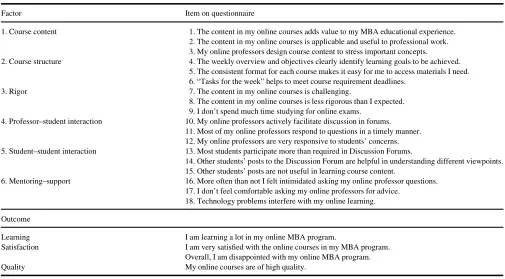
employment status, years of full-time professional experi-ence). The second section consists of a series of statements for which students are asked to indicate their level of agree-ment on a 7-point Likert-type scale ranging from 1 (strongly disagree) to 7 (strongly agree). These statements (scale items) were used to measure the six latent factors (constructs) of course content, course structure, rigor, pro-fessor–student interaction, student–student interaction, and mentoring–support as well as the three student outcomes (perceived learning, satisfaction, and perceptions of qual-ity). We pretested the questionnaire using a small sample of traditional MBA students who had taken at least one online course. Based on the pre-test results, some items were elim-inated or reworded to improve clarity. In accordance with standard practice, some items were negatively worded and the order of presentation was randomized. This was done to reduce the potential for any halo effects. Each factor was measured using three scale items. See Table 1 for exact wording of all relevant statements.
Data Collection
Data were collected from August 2009 through mid-May 2012. Students in the online MBA program and those in the traditional MBA program who had taken at least one course online were contacted via e-mail to participate in the study. The email providing a link to the online survey was sent to a total of 483 online MBA students and 100
traditional MBA students. We offered a cash prize in an incentive lottery in an attempt to increase the response rate.
Structural Equation Models
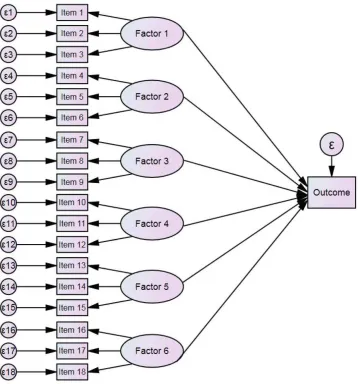
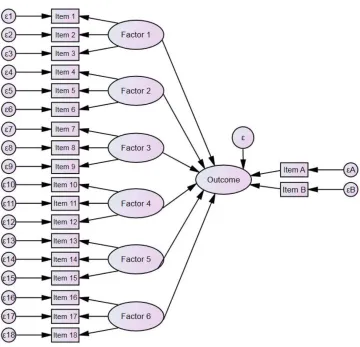
We fit three separate structural equation models. These models can be seen schematically in Figures 1 and 2, each linking the three content related constructs (Factors 1–3) and three interaction related constructs (Factors 4–6) to stu-dent outcomes. The model in Figure 1 was used to estimate perceived learning and quality. These are measured out-comes, not constructs, because each is based on the responses to only one scale item (refer to Table 1). In Fig-ure 2, a similar structural equation model is displayed, however it links the six factors (constructs) to student satis-faction, also a construct, because it is measured using two scale items (again, refer to Table 1). All three models were estimated using SSPS Amos (ver. 22.0, IMB Software).
RESULTS
A total of 169 completed questionnaires (representing an approximate response rate of 29%) were usable. Of those responding, 55% were men and 85% were employed full-time. The vast majority (84%) were enrolled in the online MBA program as opposed to taking online courses in the traditional program. The number of years of professional
TABLE 1
Questionnaire Items Measuring Factors and Outcomes
Factor Item on questionnaire
1. Course content 1. The content in my online courses adds value to my MBA educational experience. 2. The content in my online courses is applicable and useful to professional work. 3. My online professors design course content to stress important concepts. 2. Course structure 4. The weekly overview and objectives clearly identify learning goals to be achieved.
5. The consistent format for each course makes it easy for me to access materials I need. 6. “Tasks for the week” helps to meet course requirement deadlines.
3. Rigor 7. The content in my online courses is challenging.
8. The content in my online courses is less rigorous than I expected. 9. I don’t spend much time studying for online exams.
4. Professor–student interaction 10. My online professors actively facilitate discussion in forums. 11. Most of my online professors respond to questions in a timely manner. 12. My online professors are very responsive to students’ concerns. 5. Student–student interaction 13. Most students participate more than required in Discussion Forums.
14. Other students’ posts to the Discussion Forum are helpful in understanding different viewpoints. 15. Other students’ posts are not useful in learning course content.
6. Mentoring–support 16. More often than not I felt intimidated asking my online professor questions. 17. I don’t feel comfortable asking my online professors for advice.
18. Technology problems interfere with my online learning.
Outcome
Learning I am learning a lot in my online MBA program.
Satisfaction I am very satisfied with the online courses in my MBA program. Overall, I am disappointed with my online MBA program.
Quality My online courses are of high quality.
300 R. SEBASTIANELLI ET AL.
experience among respondents ranged from none to 35 years, with an average of 13 years.
In order to assess the reliability of the scales used to measure each of the six factors (constructs), Cronbach’s alpha values are computed (see Table 2). For five of the six constructs, Cronbach’s alpha values were above the gener-ally acceptable minimum of .70. The one factor falling short of this threshold, student–student interaction, has an alpha value of .691, which is nearly .70. Consequently, the scales used to measure all six constructs exhibit relatively high lev-els of reliability. Moreover, Cronbach’s alpha for the con-struct satisfaction was found to be .825, well above .70.
It is important to note that for factors involving both pos-itively and negatively worded items, responses for the nega-tively worded items were reversed before analysis. This is done so that responses across all items measuring a given factor are consistent. However, for Factor 6 (mentoring– support), all three items are negatively worded, therefore responses were not reversed.
Perceived Learning
The estimated standardized regression coefficients for the SEM linking all six factors to perceived learning are reported in Table 3. All coefficients linking scale items to their respective factors (not shown in the table) were found to be statistically significant (p < .001). Also provided in
Table 3 are some model fit statistics. The first is an overall goodness of fit measure constructed as a ratio of the chi-square statistic over degrees of freedom (CMIN/DF). Large values indicate a poor fit; values between 1 and 2 indicate an acceptable fit. The second is a comparative fit index (CFI) ranging in value from 0 (independence model) to 1 (the saturated model); values closer to 1 indicate a better the fit. The third is the root mean square error of approximation (RMSEA); values less than .05 indicate a good fit (RMSEA
<.08 indicate a mediocre fit; Byrne, 2010).
The SEM linking the six factors to perceived learning fits the data adequately with CMIN/DF D 2.063, CFI D FIGURE 1 Structural equation model predicting measured outcomes (learning and quality).
.882, and RMSEA D .080. The results indicate that only
one factor (course content) has a statistically significant (at
aD.05) effect, and based on the magnitude of its
standard-ized coefficient (.916), a very strong one, on perceived learning.
Student Satisfaction
The estimated standardized regression coefficients for the paths connecting the six factors to satisfaction are reported in Table 4. All coefficients linking scale items to their
respective six factors, as well as those linking the two items to the construct satisfaction were found to be significant (p <.001); note that these are not displayed in the table. Again, the model fit is adequate, slightly better than that for perceived learning, with CMIN/DFD2.016, CFI D.883,
and RMSEAD.078.
FIGURE 2 Structural equation model predicting student satisfaction (construct).
TABLE 2
Reliability of Scale Items Measuring Factors
Factor Cronbach’sa
1. Course content .776
2. Course structure .743
3. Rigor .733
4. Professor–student interaction .739
5. Student–student interaction .691
6. Mentoring–support .735
TABLE 3
Structural Equation Modeling Results for Perceived Learning
Path
Standardized
coefficient p
Course content!learning .916 <.001
Course structure!learning ¡.110 .327
Rigor!learning .058 .530
Professor-student interaction!learning ¡.096 .219
Student-student interaction!learning .035 .739
Mentoring–support!learning ¡.077 .284
Model fit statistics Value
Overall goodness of fit – ratiox2/df (CMIN/DF)D2.063
Comparative fit index CFID0.882 Root mean square error of approximation RMSEAD0.080
302 R. SEBASTIANELLI ET AL.
Two factors are found to have a statistically significant positive impact on student satisfaction (at aD .05); they
are course content and professor–student interaction. The estimated standardized coefficients for these two factors are .623 and .231, respectively. Additionally, course structure is marginally significant (ataD.10), with a standardized
coefficient of .185.
Quality
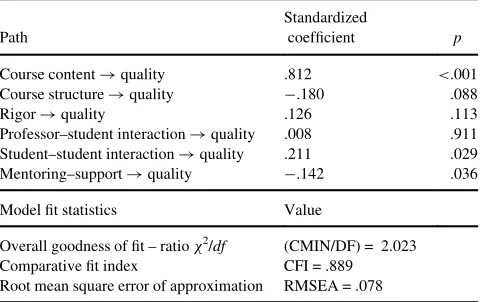
Estimation results for the SEM showing how the six factors influence the outcome measure of perceived quality are reported in Table 5. As in both previous models, all coeffi-cients linking scale items to their respective factors (not shown in the table) were found to be statistically significant (p<.001). Also like both previous models, the fit is adequate with CMIN/DFD2.023, CFID.889, and RMSEAD.078.
When it comes to students’ perceptions of quality, three of the six factors have a statistically significant effect. These are course content, student–student interaction, and mentoring–support. The standardized coefficients are posi-tive for course content and student–student interaction, .812
and .211, respectively. Because the items measuring men-toring–support are all negatively worded, its standardized coefficient (as expected) is negative (the value is ¡.142).
Of the three, the strongest predictor is course content and the weakest is mentoring–support (based on the absolute magnitude of the standardized coefficients).
DISCUSSION AND IMPLICATIONS
Depending on desired student outcomes, whether improv-ing perceived learnimprov-ing, increasimprov-ing levels of satisfaction, or enhancing perceptions of quality, our findings suggest that faculty choices about course design and pedagogy have dif-ferential impact in online MBA courses.
When it comes to perceived learning in the online MBA, course content is the most important factor. None of the other content-related or interaction-related factors were found to be significant. This suggests that it is important for faculty who teach online MBA students to provide content that adds value, is useful and applicable to the profession, and stresses important concepts. Moreover, these results are consistent with those reported in the literature that support the link between content and online learning (Holsapple & Lee-Post, 2006; Peltier et al., 2007), as well as with those that indicate interaction-related factors (e.g., professor–stu-dent interaction) do not significantly impact e-learning (Halawi & Pires, 2009).
Course content is also found to be the most important factor affecting student satisfaction. Additionally, professor– student interaction has a significant and positive influence, suggesting that faculty who teach MBA courses can enhance student satisfaction by taking an active role in facilitating discussions and by being responsive to students’ questions and concerns. Moreover, course structure is also found to be marginally significant (at aD .10). This
indi-cates that stating well-defined learning goals, providing a consistent format, and articulating clear tasks or expecta-tions are of value to students in an online environment. These findings are supported by previous research that showed a link between course content and satisfaction (Beqiri et al., 2010), between instructor–student interaction and satisfaction (through learning; Marks et al., 2005), and between course structure and satisfaction (Shea et al., 2002). Finally, we examine how content-related and interac-tion-related factors affect online MBA students’ percep-tions of quality. Three factors are found to be significant: course content, student–student interaction, and mentor-ing–support. As might be expected, the usefulness and applicability of course content influences online MBA students’ view of quality. However, perhaps more interest-ing, is the significant impact of the two other interaction-related factors on perceived quality. It appears that both the quantity and competence of other students’ contribu-tions to collaborative learning (e.g., whether discussion
TABLE 4
Structural Equation Modeling Results for Student Satisfaction
Path
Standardized
coefficient p
Course content!satisfaction .623 <.001
Course structure!satisfaction .185 .088
Rigor!satisfaction .020 .832
Professor–student interaction!satisfaction .231 .015
Student–student interaction!satisfaction .006 .968
Mentoring–support!satisfaction ¡.007 .919
Model fit statistics Value
Overall goodness of fit – ratiox2/df (CMIN/DF) = 2.016 Comparative fit index CFI = .883 Root mean square error of approximation RMSEA = .078
TABLE 5
Structural Equation Modeling Results for Perceived Quality
Path
Standardized
coefficient p
Course content!quality .812 <.001 Course structure!quality ¡.180 .088
Rigor!quality .126 .113
Professor–student interaction!quality .008 .911
Student–student interaction!quality .211 .029
Mentoring–support!quality ¡.142 .036
Model fit statistics Value
Overall goodness of fit – ratiox2/df (CMIN/DF) = 2.023 Comparative fit index CFI = .889 Root mean square error of approximation RMSEA = .078
forum posts are helpful in understanding different view-points) impact perceived quality. This seems especially relevant for online MBA courses, courses in which stu-dents presumably have pertinent professional experience to share. Consequently, the perceived quality of online MBA courses is judged, at least in part, on the basis of the caliber of fellow students in class, the extent to which they are engaged (e.g., participating more than required in discussion forums), as well as the level of their expertise (e.g., making posts that are useful in learning content). While faculty may not be able to control the background of their students (e.g., professional experience, academic capacity), faculty do have the ability to encourage frequent interaction in the online classroom. By initiating meaning-ful communication and collaboration (e.g., through discus-sion forums or team-based projects), instructors can capitalize on the diversity of the class to make the course a more compelling, high-quality experience. Furthermore, the statistically significant impact of mentoring–support suggests that faculty need to go beyond what is expected with respect to instructor–student interaction. Rather, fac-ulty would be well advised to build an environment in which students feel comfortable enough to approach them about a variety of issues (e.g., advice, guidance). While professor–student interaction affects student satisfaction, overcoming the barriers to meaningful communication in an online environment, such as technology and distance, appears necessary for improving perceptions of quality.
While many articles suggest best practices for improv-ing the quality of online education, empirical research has overwhelmingly focused on the outcomes of learning and satisfaction. Indeed, our findings with respect to perceived learning and student satisfaction are congruent with many of these studies. While it may be that learning, satisfaction, and quality are related, considering each separately has enabled us to determine empirically what has a significant impact on each. While all three depend on course content, student satisfaction, and perceptions of quality also depend on specific interaction-related factors. Professor–student interaction, while a significant predictor of student satisfac-tion, does not have a significant effect on perceived qual-ity. Instead, we find that perceived quality depends on student–student interaction and mentoring–support. Learn-ing and satisfaction are, undoubtedly, important desired student outcomes in any online program, but our findings suggest that online MBA faculty can also impact percep-tions of quality by focusing more broadly on additional interaction-related factors.
Of course, our study is not without limitations. First, it is restricted to a single MBA program, although this is not unusual for these types of studies. Moreover, a larger sam-ple size would have been preferable given the use of SEM (e.g., improving model fit), and would have allowed the estimation of more complex models (e.g., incorporating relationships among the outcomes). Second, additional
content-related and/or interaction-related factors could have been included, such as team-based learning opportuni-ties or content delivery modes. Finally, we did not account for the effects of student characteristics (e.g., GPA, number of courses completed online). While our intent was to focus on the effects of those factors under faculty control, it is possible that the impact of those factors on student out-comes may depend on student characteristics. Given the significance of the student–student interaction construct on perceived quality, this is a likely proposition and a possible area for further research.
REFERENCES
Adair, D. (n.d.).Quality in online learning: What does that mean for the online learner?Retrieved from http://www.evolllution.com/distance_on line_learning/quality-online-learning-online-learner/
Astin, A. W. (1993).What matters in college: Four critical years revisited. New York, NY: Macmillan.
Beqiri, M. S., Chase, N. M., & Bishka, A. (2010). Online course delivery: An empirical investigation of factors affecting student satisfaction. Jour-nal of Education for Business,85, 95–100.
Bruckman, A. (2002). The future of e-learning communities. Communica-tions of the ACM,45, 60–63.
Byrne, B. M. (2010).Structural equation modeling with AMOS. New York, NY: Routledge.
Chaney, B. H., Eddy, J. M., Dorman, S. M., Glessner, L. L., Green, B. L., & Lara-Alecio, R. (2009). A primer on quality indicators of distance education.Society for Public Health Education,10, 222–231.
Coppola, N. W., Hiltz, S. R., & Rotter, N. (2002). Becoming a virtual pro-fessor: Pedagogical roles and asynchronous learning networks.Journal of Management Information Systems,18, 169–190.
Drago, W., Peltier, J. W., & Sorensen, D. (2002). Course content or instructor: Which is more important in online teaching?Management Research News,25, 69–83.
Driver, M. (2002). Investigating the benefits of web-centric instruction for student learning: An exploratory study of an MBA course.Journal of Education for Business,77, 236–245.
Dykman, C. A., & Davis, C. K. (2008a). Online education forum part one—The shift toward online education.Journal of Information Systems Education,19, 11–16.
Dykman, C. A., & Davis, C. K. (2008b). Online education forum—Part three: A quality online educational experience.Journal of Information Systems Education,19, 281–290.
Gaytan, J., & McEwen, B. C. (2007). Effective online instructional and assessment strategies.The American Journal of Distance Education,2, 117–132.
Grandzol, J. R., & Grandzol, C. J. (2006). Best practices for online busi-ness education.International Review of Research in Open and Distance Learning,7, 1–18.
Halawi, L. A., & Pires, S. (2009). An evaluation of e-learning on the basis of Bloom’s taxonomy: An exploratory study.Journal of Education for Business,84, 374–380.
Hew, K. F., & Cheung, W. S. (2003). Models to evaluate online learning communities of asynchronous discussion forums.Australian Journal of Educational Technology,19, 241–259.
Holsapple, C. W., & Lee-Post, A. (2006). Defining, assessing, and promot-ing e-learnpromot-ing success: An information systems perspective.Decision Sciences Journal of Innovative Education,4, 67–85.
Institute for Higher Education Policy (2000).Quality on the line: Bench-marks for success in internet-based distance education. Retrieved from
304 R. SEBASTIANELLI ET AL.
http://www.ihep.org/research/publications/quality-line-benchmarks-suc cess-internet-based-distance-education
Jones, K. O., & Kelley, C. A. (2003). Teaching marketing via the Internet: Lessons learned and challenges met.Marketing Education Review,13, 81–89.
Kanuka, H., Rourke, L., & Laflamme, E. (2007). The influence of instruc-tional methods on the quality of online discussion.British Journal of Educational Technology,38, 260–271.
Kuh, G. (2003). What we’re learning about student engagement from NSSE.Change,35, 24–31.
Marks, R. B., Sibley, S. D., & Arbaugh, J. B. (2005). A structural equation model of predictors for effective online learning.Journal of Manage-ment Education,29, 531–563.
Mazzolini, M., & Maddison, S. (2003). Sage, guide or ghost? The effect of instructor intervention on student participation in online discussion forums.Computers & Education,40, 237–253.
McLaren, C. H. (2004). A comparison of student persistence and perfor-mance in online and classroom business statistics experiences.Decision Sciences Journal of Innovative Education,2, 1–10.
McPeck, J. (1990).Teaching critical thinking. New York, NY: Routledge. Nandi, D., Hamilton, M., & Harland, J. (2012). Evaluating the quality of
interaction in asynchronous discussion forums in fully online courses. Distance Education,33, 5–30.
Peltier, J. W., Schibrowsky, J. A., & Drago, W. (2007). The interde-pendence of the factors influencing the perceived quality of the online learning experience: A causal model. Journal of Marketing Education,29, 140–153.
Perrault, H., Waldman, L., Alexander, M., & Zhao, J. (2002). Overcoming barriers to successful delivery of distance-learning courses.Journal of Education for Business,77, 313–318.
Robinson, C. C., & Hullinger, H. (2008). New benchmarks in higher edu-cation: Student engagement in online learning.Journal of Education for Business,84, 101–109.
Rourke, L., & Anderson, T. (2002). Exploring social presence I com-puter conferencing. Journal of Interactive Learning Research, 13, 259–275.
Sebastianelli, R., & Tamimi, N. (2011). Business statistics and manage-ment science online: Teaching strategies and assessmanage-ment of student learning.Journal of Education for Business,86, 317–325.
Shea, P. J., Swan, K., Fredericksen, E. E., & Pickett, A. M. (2002). Student satisfaction and reported learning in the SUNY learning network. In J. Bourne & J. C. Moore (Eds.),Elements of quality online education: Learn-ing effectiveness, cost effectiveness, access, faculty satisfaction, student sat-isfaction(pp. 145–156). Needham, MA: Olin College-Sloan Consortium. Sher, A. (2009). Assessing the relationship of student-instructor and
stu-dent-student interaction to student learning and satisfaction in web-based online learning environment.Journal of Interactive Online Learn-ing,8, 102–120.
Sloan Consortium. (2002).The Sloan Consortium: The 5 pillars. Retrieved from http://www.onlinelearningconsortium.org/about/quality-frame work-five-pillars/
Smith, D. E., & Mitry, D. J. (2008). Investigation of higher education: The real costs and quality of online programs.Journal of Education for Busi-ness,83, 147–152.
Strang, K. D. (2011). Asynchronous knowledge sharing and conversation interaction impact on grade in an online business course.Journal of Edu-cation for Business,86, 223–233.
Sun, Q., & Ganesh, G. (2014). Developing and teaching an online MBA marketing research class: Implications for online learning effectiveness. Journal of Education for Business,89, 337–345.
Sweeney, J. C., & Ingram, D. (2001). A comparison of traditional and web-based tutorials in marketing education: An exploratory study.Journal of Marketing Education,23, 55–62.
Wallace, R. M. (2004). A framework for understanding teaching with the Internet. American Education Research Journal, 41, 447–489.