Full Terms & Conditions of access and use can be found at
http://www.tandfonline.com/action/journalInformation?journalCode=cbie20
Download by: [Universitas Maritim Raja Ali Haji] Date: 17 January 2016, At: 23:16
Bulletin of Indonesian Economic Studies
ISSN: 0007-4918 (Print) 1472-7234 (Online) Journal homepage: http://www.tandfonline.com/loi/cbie20
Jokowi's First Year: A Weak President Caught
between Reform and Oligarchic Politics
Burhanuddin Muhtadi
To cite this article: Burhanuddin Muhtadi (2015) Jokowi's First Year: A Weak President Caught between Reform and Oligarchic Politics, Bulletin of Indonesian Economic Studies, 51:3, 349-368, DOI: 10.1080/00074918.2015.1110684
To link to this article: http://dx.doi.org/10.1080/00074918.2015.1110684
Published online: 29 Nov 2015.
Submit your article to this journal
Article views: 3962
View related articles
ISSN 0007-4918 print/ISSN 1472-7234 online/15/000349-20 © 2015 Indonesia Project ANU http://dx.doi.org/10.1080/00074918.2015.1110684
* I would like to thank Edward Aspinall for his detailed comments and helpful advice on the draft. My thanks also go to Marcus Mietzner, Greg Fealy, Peter McCawley, Pierre van der Eng, Allison Ley, and the editors for their constructive feedback. Thanks also to Eve Warburton for her role as discussant at the 2015 Indonesia Update conference.
Indonesian Politics in 2015
JOKOWI’S FIRST YEAR: A WEAK PRESIDENT CAUGHT
BETWEEN REFORM AND OLIGARCHIC POLITICS
Burhanuddin Muhtadi*
The Australian National University
When President Joko Widodo (Jokowi) took ofice in October 2014, he promised to usher in a new style of politics, generating optimism among many Indonesians that his government would enthusiastically promote reform. Yet Jokowi has since placed greater value on realpolitik than on reform, as evidenced by his choice of cabinet members, his response to the controversy surrounding senior police oficer Budi Gunawan, and his handling of attempts by the police and others to weak-en Indonesia’s respected Corruption Eradication Commission (KPK). This article shows that Jokowi failed to deliver on his promises of reform largely owing to a combination of personal and external factors. He failed to show leadership on anti-corruption and human-rights issues, for example—in part because he prefers eco-nomic development over democratic reform, but also because he is not immune to the oligarchic politics that dominate Indonesia’s political life and promote the interests of Indonesia’s elite.
Keywords: oligarchic politics, party cartels, coalition, political parties, presidency, cabinet JEL classiication: D72, D73
INTRODUCTION
When Joko Widodo (Jokowi) was inaugurated as president of Indonesia on 20
October 2014, he promised to bring a new style to Indonesian politics, thereby
generating optimism among many Indonesians that his government would
enthu-siastically promote reform. Expectations for reform were high because, unlike Indonesia’s previous presidents, Jokowi came from outside the Jakarta power
structures, did not have a military background, and had no ties to established or
inluential families. He was instead seen as a product of reformasi, having risen to political prominence in a decentralised Indonesia that held direct local elections. While campaigning, Jokowi introduced a new style of participatory politics; he
climbed to the top of the pyramid by attracting a vast network of enthusiastic and politically independent volunteers, including anti-corruption and human-rights activists. His victory over Prabowo Subianto, a Soeharto-era general with a repu-tation for brutality, was deemed a victory for democracy, a decisive break from
Indonesia’s old guard. In October 2014, Jokowi appeared on the cover of Time magazine, with the headline ‘A New Hope’, which pointed to a potentially new
chapter in Indonesian democracy.
Against this popular perception of renewed faith in democracy, it took only
a few months in ofice for the Jokowi administration to produce some elements
of democratic regression, amid rising public disappointment. Jokowi placed greater value on realpolitik than on reform, as evidenced by his choice of cabinet members, his response to the controversy surrounding the nomination of senior
police oficer Budi Gunawan, and his handling of attempts by police and oth
-ers to weaken Indonesia’s respected Corruption Eradication Commission (KPK).
There was subsequently a dramatic change of tone in the public discussion of Indonesian politics. Jokowi began his term with a reputation as a highly success-ful local representative, a corruption-free, hands-on public manager, and one of a new generation of leaders who had no apparent links to the political establish-ment. Yet he soon fell into the lowlands of old politics, and is now seen by many as a business-as-usual politician who engages in promiscuous power-sharing and backroom manoeuvres. So what went wrong for Jokowi, in whom so much hope was invested?
For one, a number of personal factors prevented him from delivering on his
bold promises of irst-year reform. From the beginning, for example, he did not
show the leadership qualities necessary to tackle corruption and human-rights violations. His focus on economic development drove his agenda; he was primar-ily pragmatic and domestically focused, and concerned about concrete policies
at the expense of abstract concepts. He seemed to believe that Indonesia’s crack-down on corruption had discouraged some local and national oficials from start -ing new projects and had instilled fear in others that they would be accused of,
or even charged with, corruption. Hopes that Jokowi’s election would jump-start
democratic reform were misplaced.
Structural factors also inhibited democratic progress. Jokowi is far from immune to external pressures, particularly the presence of oligarchic forces that
dominate Indonesia’s political life and fuse the business and political interests of Indonesia’s elite. When the election ended, politics shifted from the volunteers and voting masses back to the elites. Jokowi’s distinctly non-elite background played a key role in his winning the election and being hailed as the people’s pres
-ident, yet it has kept him out of the oligarchic club that has deined Indonesian
politics for decades. His outsider status also created implausible expectations that he could overhaul the transactional nature of Indonesian politics. In reality, as a political outsider who relied primarily on a small coalition in an opposition-dominated parliament, Jokowi desperately needed political support from leading party oligarchs to govern effectively. As a result, he embraced the old-style poli-tics of horse-trading for prominent posts in the cabinet and other high-ranking positions. Then again, the structural factors of post-Soeharto politics in Indonesia would make it hard for any president to assemble a non-collusive government and push through far-reaching reforms.
OLIGARCHS, CARTELS, AND THE FAILINGS OF DEMOCRATIC REFORM Attempts to explain the problems and failings of democratic reform in the post-Soeharto era tend to rely on either the oligarchy thesis, which stresses material power, or the cartelisation thesis, which emphasises political institutions. The oli-garchy thesis asserts that, despite the consolidation of democracy since 1998, the post-authoritarian government is still controlled by the oligarchic and predatory
forces that have deined the country’s politics for decades (Hadiz and Robison
2013). The cartel thesis, on the other hand, claims that contemporary Indonesian politics is dominated by party cartels, in which a wide spectrum of political par-ties collude to enjoy the spoils of power (Slater 2004; Ambardi 2008).
In this article, I consider whether these theories help to explain the
experi-ences of Jokowi’s government to date. Jokowi’s ascendancy to the presidency
was partly a result of oligarchic support for his campaign, thereby making it hard for him to escape his obligations to oligarchs after assuming the administration.
Alternatively, Jokowi’s victory could be considered a decisive break from the old oligarchic forces, since his rise to political prominence was not the oligarchs’
choice and he is not a member of the oligarchic club (Mietzner 2015, 58). Was
Jokowi’s irst year in ofice a victory for oligarchic forces, with Jokowi simply a puppet of predatory elites? Or does he still represent a serious challenge to them? In the three months between Jokowi’s electoral victory and the formation of his cabinet, there was evidence that the cartel system that has deined Indonesian
politics since the outset of reformasi was inally dead. Jokowi came to power after an election that was deeply divisive, not only at the grass roots but also at the
elite level. A solid opposition bloc emerged, arguably the irst in the post-Soeharto
period, and Jokowi kept his pledge to build a government upon what he intrigu-ingly called koalisi ramping (a slim coalition), rather than a giant political cartel. So
does Indonesia under the Jokowi administration contradict the cartel thesis? Or
are there signs that Jokowi will ultimately fall into a collusive trap of cartelist rule? The concept of oligarchy has played a prominent role in literature on Indonesian
politics since the advent of democracy in the country in 1998. Early proponents
of the concept emphasised the primacy of material power in Indonesian politics. The oligarchy model has been advocated by, and largely associated with, three major scholars of Indonesian politics: Richard Robison, Vedi Hadiz, and Jeffrey
Winters. Their inluential works—Robison and Hadiz’s Reorganising Power: The
Politics of Oligarchy in the Age of Markets (2004) and Winters’s Oligarchy (2011)— share a framework that focuses exclusively on material wealth as the most potent
and effective determinant of political outcomes. Under their inluence, the notion
of oligarchy has increasingly come to be used by political observers and journal-ists in Indonesia and elsewhere to depict the primacy of material resources and capital accumulation in maintaining or pursuing political and economic power. The oligarchy idea has also been widely discussed in the Indonesian mass media. It received much non-scholarly attention soon after the post-2004 reforms that introduced direct elections for the presidency and regional-head positions, with many arguing that democracy was being largely driven by money politics and had opened the door for oligarchs to control electoral politics.1
1. See, for example, articles by Lubis (2015) and Airlangga (2014).
Regardless of their commonalities in characterising the nature of oligarchy in contemporary Indonesian politics, Robison, Hadiz, and Winters depart from dif-ferent theoretical starting points (Ford and Pepinsky 2013, 4). Robison and Hadiz draw primarily on neo-Marxist thought and offer a more structural
conceptu-alisation in which they deine oligarchy as ‘a system of power relations that ena
-bles the concentration of wealth and authority and its collective defense’ (Hadiz and Robison 2014, 35). Winters’s analysis centres on the role of actors, making
his framework a more Weberian concern (Ford and Pepinsky 2013, 4). Winters describes oligarchy as a ‘politics of wealth defense among materially endowed
actors’ (2011, 7). For him, oligarchs are actors who, because of the extreme con -centration of wealth in their hands, ‘are empowered by that wealth—a power
resource that stands out among the other forms’ (2013, 14).
Winters joins with Robison and Hadiz, however, in describing the opportunistic
mobility and lexibility of oligarchic power in post-Soeharto Indonesia. The three
main proponents of the thesis argue that oligarchy and democracy can go together. As Hadiz and Robison (2013, 38) put it, ‘democracy has not undermined the
oli-garchy that emerged under the New Order, although the theory does acknowl
-edge that Indonesia’s dominant elite has been forced to sustain its ascendancy in different ways’. For most oligarchy theorists, there is nothing special about the
post-authoritarian polity, since the essence of political life remains unchanged.
One of this proposition’s most controversial points is that ‘real change cannot
be achieved so long as the social order of the previous regime and its ascendant political forces remain intact and in charge of the state. . . . Incremental demands for reform by individuals or groups can only be piecemeal if they do not achieve a
broader political ascendancy and control over the state’ (Hadiz and Robison 2013, 55). Power resources that have deined political power for a long time remain
concentrated in the hands of old players, while new players are sucked into the same predatory practices. Accordingly, Winters claims that the current democratic
regimes in Indonesia are best deined as an ‘untamed ruling oligarchy’ (2011, 181).
In short, the three main proponents of this theory propose a similar conclu-sion, that ‘the power of wealthy actors and their political associates in Indonesia
is so strong that no substantial reform can occur without oligarchic approval’
(Mietzner 2015, 6). This suggests that no Indonesian can successfully escape from oligarchic rule. According to most oligarchy theorists, the rise of a politician to the apex of Indonesian political power requires the endorsement of oligarchs.
The second main framework explaining how Indonesian politics has worked since the post-Soeharto era is the so-called cartel thesis, which includes the notion that parties tend to work together in a collusive manner to capture state patron-age. Katz and Mair (2009) outline the key elements of this thesis:
The cartel party is a type that is postulated to emerge in democratic politics that are characterized by the interpenetration of party and state and by a tendency towards inter-party collusion. . . . Competition between cartel parties focuses less on differ-ences in policy and more on provision of spectacle, image, and theater (755).
Slater (2004) was the irst to apply the cartel thesis to Indonesia. Describing the
genesis of the political cartel soon after the 1999 election, he argued that instead of maintaining political competition, Indonesian parties formed an expansive car-tel that drew in potentially oppositional forces—as evidenced by the formation
of ‘rainbow’ coalitions that included all signiicant political parties under presi -dents Megawati (2001–4) and Yudhoyono (2004–14). According to the carteli-sation model, political parties ignore election results, collectively dismiss their ideological and programmatic stances, and fall in with the government for the sake of capturing state patronage. As the collusion of politicians functions as the fundamental driver of Indonesian political behaviour and parties share a
com-mon interest in enjoying the spoils of ofice, they become disengaged from soci -ety. Ultimately, the political system becomes caught up in what Slater calls the
‘accountability trap’, owing to the failure of political parties to establish checks
and balances at the governmental level. Slater and Simmons (2013) developed
the cartel model further, introducing the term ‘promiscuous powersharing’ to
describe the behaviour of party cartels.
Ambardi (2008) proposes a similar argument but distinguishes the sources and arenas of competition and cartelisation. While acknowledging that competition occurs among political parties during elections, Ambardi contends that political
competition seems to dissolve after campaigns inish, when political parties are more likely to emphasise the sharing of the state executive’s bounteous patronage
resources. According to the cartelisation camp, the system of party cartels pro-vides a stable collusive agreement among political parties and their elites to avoid societal tensions that can be seen as a threat to governability. In brief, the core fea-tures of analyses of Indonesia using the cartelisation model are as follows: party ideology is unimportant in determining coalitions, political competition occurs
only during elections, and there is no signiicant opposition in parliament.
These theories explain in different ways the problems and failings of reform in post-Soeharto Indonesia. According to the oligarchy paradigm, the interests of the wealthy in sabotaging reform is key; for cartelisation scholars, the root problem is promiscuous power-sharing. Unlike most oligarchy theorists, who focus on struc-tural conditions, proponents of the cartelisation model put greater emphasis on
political institutions. Here, I treat these theoretical approaches as conlicting ways of examining Jokowi’s irst year in ofice.
THE DEATH OF THE RULING CARTEL?
Proponents of the oligarchy and cartel interpretations of Indonesian politics
examined Jokowi’s spectacular rise to the presidency from the outset. Hadiz’s
(2014) claim that the presidential election merely continued on from previous
elections rather than marking a signiicant change is an example of how gloomy oligarchy theorists’ views can be on the future of Indonesia. Unlike many for
-eign and domestic observers and activists who saw Jokowi’s victory as a decisive
break with the old guard, Hadiz contended that Jokowi and Prabowo were not fundamentally different, characterising the former as a puppet of the oligarchs who control Indonesia. Meanwhile, Slater (2014), the main proponent of the
cartelisation theory, suggested that, despite Jokowi’s promises, parties and elites
would be unlikely to stop engaging in cartelistic politics. For Slater, ‘promiscuous
power sharing rather than ideologically deined powersharing has been the rule
since reformasi’, and the prospects of party cartels would be determined not only on election day but also during negotiations on the formation of government.
The prospect that Jokowi would diminish party cartelisation was greater, how-ever, than the likelihood that he would challenge oligarchic dominance. Unlike
Prabowo, who during his campaign formed powerful and big alliances—koalisi
tenda besar (a big-tent coalition)—and made many promises of cabinet positions, Jokowi climbed to the apex of political power while remaining somewhat less
beholden to the party cartels. There were, at a minimum, ive grounds for opti -mism that Jokowi would confound the expectations of cartelisation theory. First, rather than building an expansive coalition to campaign for him during the pres-idential elections, Jokowi instead formed a limited coalition, Koalisi Indonesia Hebat (KIH), or Great Indonesia Coalition, which consisted only of PDI–P (Indonesian Democratic Party of Struggle), NasDem (National Democrats), PKB
(National Awakening Party), and Hanura (People’s Conscience Party). This coa
-lition held only 37% of the seats in the People’s Representative Council (DPR) elected in April 2014, whereas Prabowo’s coalition held 63%.
Second, Jokowi promised no rewards in return for the support he received from parties or elites, and emphasised that he was building a coalition with no strings attached (tanpa syarat).2 Third, before his inauguration, Jokowi had put himself in
a bind by promising to reduce the number of ministries in his upcoming cabinet. He also promised that his cabinet would be dominated by non-partisan profes-sionals. These promises increased already high expectations that Jokowi would usher in a new chapter in Indonesian politics. People thought Jokowi would be different from other politicians, owing to his reputation as a highly successful
local leader, free from corruption, and his persona as a ‘man of the people’—a
real reformer with no ties to old politics. Given the challenges from the power-ful interests that shape Indonesian politics, however, managing such high public expectations was no less hard for Jokowi.
Fourth, contrary to the usual cartelistic practices in Indonesia, the 2014 presi-dential election drew a sharper line between the ruling parties and the opposition. Previously, when the elections ended, political parties in Indonesia would aban-don their hostilities, ignore the election results, and fall in line with the
govern-ment. In contrast, the atmosphere of political polarisation between Jokowi’s and Prabowo’s supporters persisted. After being sworn in, Jokowi led a limited coali -tion supported by parties with a minority of the seats in the parliament, which was controlled by an opposing coalition led by his rivals Prabowo and Aburizal Bakrie. Fifth, Jokowi stated that his new cabinet, once formed, would be known as Kabinet Kerja (Working Cabinet), symbolising his anti-cartelist approach. This
name contrasts with those of Abdurrahman Wahid’s National Unity Cabinet, Megawati’s Mutual Assistance Cabinet, and Yudhoyono’s United Indonesia
Cabinet, whose names emphasised their broad-based coalitions. Unsurprisingly, Jokowi was widely expected to open the door to a dramatically different sort of politics, in which the opposition would be invited to play a constructive function as a constitutional check on the government. Moreover, that Jokowi was able to
take advantage of his honeymoon period as the new president relected the pub
-lic’s high degree of trust in him (75%) (SMRC 2014).
Jokowi’s victory disrupted markedly the cosy environment of cartelised poli -tics, but events soon showed that cartelisation was not yet dead. Promiscuous
2. As the front-runner for the presidential election, Jokowi was approached by various par-ties about forming alliances, with the aim of providing his running mate or simply being included in his upcoming cabinet.
power-sharing was being reconstituted—not by the winning side but, unusually, by the losing side. This does not entirely support the literature on political cartels: in theory, a cartelised political system occurs when an election fails to produce a
clear opposition and when ‘every single signiicant party gains a share of execu
-tive power through appointments to the cabinet’ (Slater and Simmons 2013, 1371). Jokowi had assembled a slim coalition that, for the irst time in Indonesia, led to
the emergence of a cohesive and confrontational opposition. Hence, I use the term
‘collusive opposition’ to refer to a dominant parliamentary opposition that relies
on promiscuous power-sharing to bind its loyalties.
Disappointed by Jokowi’s refusal to promise cabinet positions to those in
opposing parties who tried to switch sides after the election, Prabowo ‘drew his strength from an alliance of parties and leaders that feared politico-economic
mar-ginalisation under the Jokowi administration’ (Mietzner 2015, 50). Supported by Yudhoyono’s Democratic Party, Prabowo’s Koalisi Merah Putih (KMP), or Red-and-White Coalition, signiicantly outnumbered the ruling coalition in the DPR. The Democratic Party was not oficially a member of KMP, but Yudhoyono was frustrated that Jokowi, who ran for president under the banner of Megawati’s
PDI–P, had cold-shouldered him when looking for a possible coalition before the presidential election. The well-known animosity between Megawati and
Yudhoyono, and Jokowi’s relative political dependence on PDI–P, gave Jokowi
little leeway to ally with the Democratic Party.
The most compelling evidence of the collusive opposition initiated by
Prabowo’s coalition in parliament was his move in September 2014 to eliminate
direct local elections.3 Prabowo clearly attempted to install a form of collusive
democracy in the regions—in which local-government leadership positions would be allocated by party coalitions in the regional legislatures—while Jokowi, with his small co alition, defended the right of people to choose their regional leaders. Rather than listening to the will of the people, 92% of whom supported
direct local elections (according to the Indonesian Survey Institute’s inding in
December 2013), KMP looked to reinstate the election of regional heads by local parliaments, considering it a far more promising way to control local politics.
Aside from KMP’s domination in the national parliament, it commanded approx -imately 60% of the seats in local parliaments nationwide (LSI 2014), making it
much easier for Prabowo’s coalition to secure victory in local government elec -tions by using indirect mechanisms rather than having to control the entire
popu-lation in a direct election. Under KMP’s plan, elections would be over before they
started, and much of local politics would take place outside the public domain, driven by intra-elite negotiations over power-sharing arrangements.
There could have been grave consequences for political stability had regional heads controlled by the opposition been able to challenge the Jokowi government
en bloc by disregarding national policies. According to one prominent igure in
3. Direct local elections have been in place since 2004, but the Yudhoyono government and parliament had been deliberating a regional election bill since 2007. The government and most parties, including Gerindra (Great Indonesia Movement Party), Golkar, and other members of KMP, had agreed that a new local election would maintain the right of people to vote for their local leaders. But they changed their mind after PDI–P and Jokowi won the 2014 legislative and presidential elections.
KMP, ‘We will let Jokowi be president, but we will control the regions. All
gover-nors, head of districts, and mayors would be ours’ (pers. comm., Jakarta, 12 Sept.
2014). The former minister Sarwono Kusumaatmadja argued that the only people
to beneit would be oligarchs and (cartel) elites, because parliaments and parties
would simply appoint their friends (Sydney Morning Herald, 26 Sept. 2014). KMP, which held a majority in the DPR, endorsed a bill abolishing direct local elections
on 26 September 2014, a few weeks before Jokowi’s inauguration. Yudhoyono’s
party, which controlled 148 of 560 seats in the old parliament, walked out of the deliberations, enabling the bill to be passed. After suffering from a barrage of complaints from the public, however, Yudhoyono issued an emergency
presiden-tial decree in early October 2014 to overturn the controversial bill and restore direct regional elections. Prabowo’s coalition vowed to vote down this decree in
parliament. But, according to Yudhoyono, after he ‘threatened to form a long-term alliance with Jokowi, they grudgingly relented and accepted the resurrection
of direct polls’ (Mietzner 2015, 49).
More evidence that Prabowo’s coalition acted collusively included its legisla -tive initia-tive to pass surreptitious amendments to Law 27/2009 on Legisla-tive Institutions (better known as the MD3 law) on 8 July 2014, just a day before the presidential election. Changing the rules allowed KMP to take control of the leg-islature by capturing the speakership of parliaments (at the national and regional
levels) and the People’s Consultative Assembly (MPR). As stipulated by the amended law, the control of a legislature’s speakership should be decided by a members’ vote based on the package system (satu paket), which requires each fac-tion to nominate four candidates from different facfac-tions, rather than by the party
with the most seats. After the new DPR was sworn in on 1 October 2014, a ple -nary meeting was held to select the House speaker. Realising that the Prabowo camp had by far the most numbers in parliament at the time, the Jokowi–Kalla
camp chose to walk out of the vote, allowing Prabowo’s coalition to make a clean
sweep of the House speakerships. The package system was also implemented in the plenary meeting to elect the MPR speaker, and ended with the victory of
Zulkili Hasan (nominated by Prabowo’s camp). The Prabowo coalition’s next salvo came on 29 October 2014, when it won every leadership position in eleven parliamentary commissions and ive other bodies without accommodating repre -sentatives from the Jokowi coalition (Today, 31 Oct. 2014). Leadership positions in
the House’s commissions are not merely administrative (Ambardi 2008); they also
provide patronage opportunities, as Slater (2004, 90) explains:
For one, the old assumption that the cabinet is generally basah, while parliament is relatively kering, appears no longer to ring true.4 To be left in the parliament does
not mean being left out of highly lucrative patronage networks. This suggests that
4. Cabinet seats are universally assumed to be more basah (wet) than parliament seats be-cause ministers have direct access to far more luxurious patronage resources. Parliament is assumed to be more kering (dry) because it deals only with budgeting, not with execut-ing lucrative budgets. This does not necessarily mean, however, that rent activities do not take place in parliament. Among party legislators and the press, labels such as komisi basah and komisi kering (wet and dry commissions, respectively) are popular in discussions of whether a commission provides access to bounteous patronage resources (Ambardi 2008).
even if the next president manages to exclude major parties from the next cabinet, the wounds may be salved by helping arrange plum positions on parliamentary commissions.
Above all, the main implication of the amended law was that PDI–P, despite being the plurality winner of the election, with 109 seats in the DPR, gained no representation in either the parliament speakerships or the commission leader-ship. Disappointed by this unfairness, KIH boycotted all parliamentary sessions
from October to November 2014 and appointed its own parliamentary leaders
in order to split the DPR. Jokowi quietly instructed his cabinet ministers to
boy-cott invitations from the side of the DPR controlled by Prabowo’s coalition; this
boycott ensured that the parliament could not pass laws, which require executive approval. After going through some reconciliatory moves and face-saving mecha-nisms, a compromise was reached in November 2014 by providing 16 new
vice-chair positions of 11 commissions and ive other bodies to accommodate Jokowi’s
coalition (Kompas, 17 Nov. 2014).
JOKOWI’S TRIPLE-MINORITY POSITION AND THE ENEMY WITHIN
Jokowi’s irst challenge after assuming the presidency was to form a cabinet that
would uphold meritocracy, something he had repeatedly promised. Previously,
Jokowi had pledged that he would not run a ‘transactional’ cabinet, vowing not
to fall into the usual practice of trading cabinet posts for support. He also tried to impress the public by inviting the KPK and the PPATK (Financial Transaction Reports and Analysis Centre) to vet the nominees. He even crowdsourced his cabinet, by conducting an online survey asking ordinary citizens to propose can-didates and by inviting his volunteers and the media to participate in selecting
ministers. Excitement and optimism after Jokowi’s election victory led to implau
-sible hopes that he would overhaul Indonesia’s schismatic realpolitik.
The political reality was, however, much trickier. Politicians often propose
grand schemes when campaigning for ofice but end up governing according
to the pressures of realpolitik.5 Moreover, Jokowi was already in a ‘triple
minor-ity’ position: he was supported by a government coalition that did not have a parliamentary majority; he was a marginal igure in his own party, with less
party authority than previous presidents such as Yudhoyono, Megawati, and Abdurrahman Wahid; and he was very much a newcomer to the national stage.6
These limitations ultimately pushed Jokowi to reward the main political parties and oligarchs who had supported him in his efforts to become president. His
run-ning mate, Jusuf Kalla, one of Indonesia’s most prominent indigenous (pribumi)
oligarchs, a long-time Golkar stalwart and major inancial contributor to the
Jokowi campaign, expressed his disagreement over the crowdsourcing approach. He reportedly said that ‘if you are given a mandate by the people, do not give it
5. As former New York governor Mario Cuomo put it, ‘We campaign in poetry, but when we’re elected we’re forced to govern in prose’ (New York Times, 16 Feb. 1985).
6. I have borrowed the term ‘triple minority’, as it relates to Jokowi, from Djayadi Hanan (Jakarta Post, 15 Feb. 2015).
back to them. Calling on the public to pick cabinet would be a terrible nuisance’ (pers. comm., 22 Oct. 2014). He also opposed Jokowi’s promise to form a slimmer, more eficient cabinet by reducing the number of ministerial posts, arguing that the format would make power-sharing dificult. This is not to mention Megawati, who had a huge inluence in selecting most of his cabinet; Surya Paloh (a wealthy businessman and head of the NasDem party), who emerged as Jokowi’s
second-most powerful patron after Megawati; and other minor stakeholders in the
win-ning coalition. After being sworn in as the president, on 20 October 2014, Jokowi postponed the planned cabinet announcement on 22 October, which had been
expected to take place at Tanjung Priok port, in North Jakarta. The delay sparked speculation about what was going on behind the scenes.
When he inally announced his cabinet, on 26 October, its composition showed
that he had had to make compromises with his backers. During the campaign,
Prabowo had repeatedly warned against electing a ‘puppet’ president, suggesting
that Jokowi was little more than a president-for-hire who would be tightly
con-trolled by his political backers, especially Megawati. The line-up of Jokowi’s cabi
-net conirmed such accusations. Although Jokowi named it the Working Cabi-net,
many political observers mocked it as a cabinet of compromises, enabling the puppet-president issue to gain prominence once more. To keep his minority coali-tion together, Jokowi had to include 15 political-party appointees in a cabinet of
34. For instance, Puan Maharani, Megawati’s daughter and PDI–P heir apparent,
was appointed coordinating minister of human development and culture. PKB secured four ministerial positions, NasDem three, and Hanura two.7 Prabowo’s
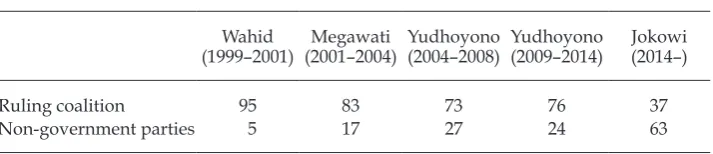
coalition, which consists of at least four political parties, and the Democratic Party, which remains neutral (and together control 63% of seats in the DPR) were not represented in the cabinet (table 1).
In addition, Jokowi appointed several ministers who were professionals,
ex-military members, or bureaucrats who were not oficially afiliated with any polit -ical party but were cronies of party grandees within KIH. Ryamizard Ryacudu, for example, whose appointment as defence minister was widely seen as setback, because it broke from the tradition of civilian rule within the Defence Ministry,
is Megawati’s conidante. Sofyan Djalil, Jusuf Kalla’s protégé, was appointed
coordinating minister for economic affairs and, later, was moved to minister in charge of the National Development Planning Agency, in the cabinet shake-up
in August. For anyone familiar with Indonesia’s traditions of realpolitik, there was little that was surprising in the cabinet’s composition. But, as Aspinall (2014)
suggested, it was ‘surprising just how far Jokowi has gone in making these
com-promises’. People understand that Jokowi is a politician, but they also expected
that he would be able to strike a balance between realpolitik and reform without upsetting the volunteer base that brought him to power.
7. In order to get political support from PPP (United Development Party), Jokowi appoint-ed Lukman H. Saifuddin minister of religious affairs, despite frictions in PPP between pro-Jokowi and pro-Prabowo factions. PPP is still embroiled in a long-running dispute over its leadership, and it cannot join the ruling coalition until a inal and binding court decision resolves the matter. Saifuddin was largely seen as a representative from the pro-Jokowi faction within the party, but the pro-Prabowo camp denied the claim that his appointment changed the party’s direction to supporting the government.
Breaking with post-Soeharto traditions, Jokowi did not look to increase the size of his coalition by offering seats in the cabinet to parties that had not supported him in the election. By not doing so, he suffered a double loss. First, he lost the
opportunity to establish a ‘minimum winning coalition’, which would contain
just enough numbers to dominate the parliament and help him realise his legis-lative agenda. Second, by granting 15 cabinet posts to political parties that had supported him, as well as accommodating a number of ex-military or technocrats promoted by party oligarchs, Jokowi paid a high price for the political support
provided by his coalition, despite that coalition’s lacking a parliamentary major
-ity. Jokowi’s 15 transactional appointments gave him the support of less than 40%
of the parliament. Yudhoyono, in contrast, appointed 18 politicians to ministerial posts and received 75% of parliamentary support in return.
Jokowi’s modest legislative support gave him little room for political manoeuvring. With only a minimal coalition in hand, Jokowi needed to ind
other ways to gain the support needed to secure parliament. After the cabinet announcement, Jokowi seemed to depend more on Kalla, Megawati, and Paloh,
as evidenced by the Budi Gunawan case and the weakening of Indonesia’s
anti-graft body, the KPK. Maintaining a core of solid coalitional partners is neither
easy nor cheap, and Jokowi became tied to a range of his allies’ vested interests
that later damaged his government.8 In order to retain the loyalty of his coalition
parties, he not only appointed their cadres in the cabinet but leading party oli-garchs were also granted greater access to burgeoning patronage opportunities. Paloh, for example, had three ministerial candidates approved before the cabinet
reshufle in August 2015 and his protégé Prasetyo appointed attorney-general.
Paloh was also behind a dubious energy deal to import fuel from Angola in the early weeks of the new administration, an example of a typically oligarchic
con-cession. Little wonder that just three months into Jokowi’s presidency, Indonesia’s leading English-language newspaper published the headline ‘Jokowi: A Hostage of His Own Alliance’, suggesting that the main dangers Jokowi faced were inter -nal to his own coalition (Jakarta Post, 30 Jan. 2015).
In brief, the cabinet line-up provided more evidence for the oligarchy thesis
than for the cartel thesis. The cabinet selections did not meet Slater and Simmons’s (2013, 1371) strict deinition of cartelisation, because a number of signiicant polit
-ical parties—indeed, a majority—were overlooked. Even the cabinet shake-up
in August, in which Jokowi replaced only key economic ministers, produced no
8. This is in line with Groseclose and Snyder’s (1996, 304) theory on buying super majorities: an oversize coalition is generally cheaper when the costs of maintaining a winning coali-tion are taken into account.
TABLE 1 Composition of Indonesian Cabinets, from Wahid to Jokowi (%)
Wahid (1999–2001)
Megawati (2001–2004)
Yudhoyono (2004–2008)
Yudhoyono (2009–2014)
Jokowi (2014–)
Ruling coalition 95 83 73 76 37
Non-government parties 5 17 27 24 63
evidence for a party cartel, because Jokowi still relied on a small coalition. In gen-eral, however, the cabinet make-up clearly served the interests of party oligarchs within the ruling coalition.
JOKOWI AMONG THE OLIGARCHS
Jokowi’s position under the thumb of his own alliance was on display in early January 2015, when he nominated Megawati’s former adjutant Budi Gunawan
as police chief. It seems that the president nominated Budi to appease Megawati, given that he had earlier refused to include him in the cabinet. The nomination of Budi, who in 2010 faced allegations of dubious transactions in his bank accounts,
soon became a scandal that quickly ended Jokowi’s political honeymoon. Just one day before Budi was to be conirmed as the new police chief, the KPK announced
that it suspected him of holding dubious bank deposits when he was the chief
of the police’s bureau of human resources. Yet Kalla and Paloh forced Jokowi to
overlook the indictment and move to inaugurate Budi as police chief after
secur-ing parliament’s approval.
Facing the prospect of rapidly losing both his popularity and his image as a
clean anti-corruption igure, Jokowi cancelled Budi’s inauguration on 18 February.
Yet this was only the beginning of the political drama. The unexpected nomina-tion had escalated tensions between the KPK and the police, who soon entered the fray by naming the KPK chairman, Abraham Samad, as a suspect in a docu-ment forgery case (Jakarta Globe, 17 Feb. 2015). Another commissioner, Bambang Widjojanto, was arrested for allegedly instructing witnesses to provide false tes-timony in a trial held at the Constitutional Court several years earlier. Since its establishment, in 2002, the KPK has made substantial progress combating
cor-ruption, long considered by Indonesians and foreign observers to be the nation’s
most serious problem. The KPK is widely seen as a great anti-corruption success
story, having imprisoned hundreds of tainted business people, senior police ofic
-ers, politicians, and government oficials.9 Jokowi’s reluctance to stop the crimi
-nalisation of the KPK was deeply disappointing to his volunteer support base. The controversy also damaged Jokowi by drawing an implicit comparison with his predecessor; many had blamed Yudhoyono for being indecisive, but at least he had been effective in defending the KPK during previous crises.10
Jokowi was politically paralysed by the entrenched oligarchs within his own
party coalition, but he was not completely tamed. Jokowi’s ambivalent relation -ship with Megawati has, by extension, engaged PDI–P, the largest shareholder in
Jokowi’s government, in a complicated relationship with the Presidential Palace
(Jakarta Post, 10 April 2015). Aside from cancelling the appointment of Megawati’s
conidante Budi Gunawan, both as a minister and as police chief, Jokowi refused to
dismiss Luhut Panjaitan as his chief of staff or Rini Soemarno as the minister of state enterprises, despite pressure from Megawati.11 Notwithstanding such sources of
9. For a detailed discussion of the KPK’s success in combating corruption, see Bolongaita’s (2010) report.
10. See, for example, the work of Fealy (2015).
11. In the cabinet shake-up in August 2015, Jokowi even appointed Luhut coordinating minister for political, legal, and security affairs.
friction, Megawati cannot deny that Jokowi alone was able to end PDI–P’s long wait
to become the ruling party. In another show of his independence, Jokowi removed
Tedjo Edhy Purdijatno, Surya Paloh’s protégé, from the cabinet in the 2015 reshuf
-le, despite Paloh’s huge inancial and political support in bringing Jokowi to ofice. The events of Jokowi’s irst year in power suggest that oligarchs are neither
politically homogeneous nor economically monolithic.12 In mid-August 2015, for
instance, Rizal Ramli, the newly appointed coordinating minister for maritime
affairs, publicly criticised the government’s plan to build power plants to add
35,000 megawatts of electricity to the national grid, claiming the undertaking was
Kalla’s idea. Rizal is closely associated with Luhut Panjaitan and has a good rela
-tionship with Megawati. Overall, however, the explanatory power of the oligarchy
paradigm is irresistible, and the level of oligarchic capture in Indonesia is extremely
robust. Most Indonesian political parties have been ‘hijacked’ by powerful oli
-garchs, including Golkar’s Aburizal Bakrie, Gerindra’s Prabowo, and NasDem’s
Paloh. It is evident that political parties have become the main tool of oligarchic
domination, opening the door for oligarchs to inluence all decisions, including
those taken by their representatives in parliament and in government institutions. In order to govern effectively, with so little political capital in hand, Jokowi needs to maintain good rapport with the ruling parties and the oligarchs who lead them. This burden does not fully explain the lack of reform impetus, however.
JOKOWI AS POLITICAL LEADER
In addition to pressures from oligarchic forces, personal factors help explain why
Jokowi has sacriiced reform for realpolitik. During his irst year as president,
he showed that that he places greater value on economic development than on democratic reform. Indeed, his understanding of democracy itself is framed in concrete, instrumental terms, at the expense of abstract or philosophical concep-tualisation. As he said during one of the televised presidential debates in 2014, when asked to explain what democracy meant to him, ‘Democracy is about lis-tening to the people and taking concrete action. That is why we have spent a
lot of time visiting villages, markets, and ishing communities’. For Jokowi, for democracy to be meaningful, people should enjoy tangible beneits through true
economic and social development.
Mietzner’s (2015) notion of technocratic populism is useful in looking at Jokowi’s emerging political persona and his tendency to prioritise economic development over democratic reform. Mietzner argues that Jokowi’s political
outlook mixes non-ideological technocratic pragmatism and social empathy with
the poor. Jokowi’s grand ambitions relate to economic development and social
welfare, while his major achievements in government include simplifying regula-tions that burden investors, continuing to push for infrastructure development, by, for example, facilitating the disbursement of village funds, particularly for irrigation, bridges, and roads (Jakarta Post, 9 Sept. 2015); and implementing social-welfare programs, such as health cards and smart cards. To fund these policies at the national level, Jokowi removed fuel subsides in November 2014.
12. Much of the work of Winters, Hadiz, and Robison tends to give the impression that oligarchy is politically homogeneous.
Jokowi seems to think of non-economic sectors as secondary, or as mere
instru-ments for improving the economy and people’s welfare. His concern for demo -cratic reform should thus be looked at from an economic perspective. When his economic goals are at odds with his anti-corruption agenda, for example, he seems to prioritise the former. In August, for instance, amid the general decrease in government spending and in an effort to increase it after the economic slow-down, Jokowi instructed that a circular be prepared for regional leaders on how to avoid becoming corruption suspects (Jakarta Post, 26 Aug. 2015). In so doing, Jokowi showed he understood that anti-corruption measures were discour-aging local leaders from initiating new projects. The dismissal of Budi Waseso
in early September 2015 as the chief of the police’s criminal investigation unit (Kabareskrim) is another example of Jokowi’s belief in eradicating corruption
without creating controversy that could hinder the economy. Jokowi forced Budi to step down because of a police investigation into a major corruption case involv-ing state-owned port operator PT Pelindo II (Jakarta Post, 3 Sept. 2015). Budi had
already become notorious for his role in criminalising the KPK during the irst
part of 2015, but Jokowi did not take action against Waseso at the time, nor did he take other steps to defend the KPK. It was not until Budi threatened one of
Indonesia’s major state-owned enterprises—and one critical to Jokowi’s vision of
enhanced infrastructure development—that the president acted.
Jokowi has paid a heavy price for rewarding party oligarchs and for
prioritis-ing the economy over democratic reform. He failed in his irst year to afirm his
image as a real reformer and to bring a new style of politics to the presidency,
and his economic agenda has yet to beneit the public.13 As a result, the level of
13. In September, Yusuf and Sumner (2015) suggested it was too early to conclude whether Jokowi’s economic reform has beneited the public.
FIGURE 1 Jokowi’s Public Approval Rating, October 2014–June 2015 (%)
75
62
47
41 SMRC
LSI–INDI
Poltracking
SMRC
X
X
X
X
Oct-2014 Dec-2014 Feb-2015 Apr-2015 Jun-2015 0
10 20 30 40 50 60 70 80
Note: SMRC = Saiful Mujani Research and Consulting. LSI–INDI = Lembaga Survei Indonesia and Indikator Politik Indonesia. The October 2014 survey shows the level of public conidence in Jokowi’s ability to govern; the others show his approval rating.
public satisfaction in his leadership fell rapidly during his irst months in ofice. A
nationwide survey conducted by Saiful Mujani Research and Consulting (SMRC)
between 25 May and 2 June 2015 revealed that Jokowi’s approval rating was at its lowest ebb since he took ofice. Only 41% of the public approved of Jokowi,
down from 62% a couple of months earlier (before the Budi Gunawan affair took
place) (igure 1). According to SMRC, the public believed that Jokowi had
under-performed in three important areas: the economy, politics, and law enforcement,
with the economy the public’s biggest concern (Jakarta Post, 10 July 2015). The survey also revealed that 32% of respondents believed that the economy had dete-riorated since Jokowi took over the presidency, while 38% felt that way about the political situation. Likewise, 38% of respondents believed that the level of law enforcement had declined during the survey period (Jakarta Post, 10 July 2015).
The survey found that Jokowi’s approval rating trailed those of former president Yudhoyono in the irst year of each of his two terms, which stood at 70% (2005) and 66% (2010). What is startling is that Jokowi’s public dissatisfaction rating exceeded his satisfaction rating (igure 2). His efforts to regain the people’s faith, such as by
showing decisiveness in pursuing capital punishment for drug smugglers in April 2015, failed to stop the decline of his approval rating. Losing popularity and sup-port from his volunteer base matter to him politically. Jokowi was presented by mass-media as both a newcomer and an outsider untouched by corruption scan-dals, providing a rationale for his earlier high levels of popularity (Hadiz 2014). He won the last election because the people trusted him and wanted him to be presi-dent. Since he is politically weak, however, and governs from a triple-minority
position, his only real bargaining chip is his popularity. When Jokowi’s public
approval rating began to decline, it left him with less bargaining power.
FIGURE 2 Jokowi’s Approval Rating Compared with Yudhoyono’s (%)
DK/NA Disapproval Approval
0 10 20 30 40 50 60 70 80 90 100
Yudhoyono, June 2005 Yudhoyono, Aug. 2010 Jokowi, May–June 2015
Source: Data from SMRC (2015)
Note: DK/NA = do not know or not available. The sample size is 1,220 respondents, selected at ran-dom from all 34 provinces. Based on the sample size, the estimated margin of error is ± 2.9% at the
95% conidence level.
Post-Soeharto presidents commonly enjoy a honeymoon period with the
pub-lic for their irst year in ofice. This was not the case for Jokowi. By mid-2015, his
honey moon was over and it was his own alliances that had cut it short. It was clear that Jokowi needed to rethink his approach to government and lay the foun-dations for the effective administration necessary to regain public faith.
ADJUSTING THE RULING FORMULA
Partly in response to his declining public approval, and partly in response to the problems that had beset his relations with parliament and his own coalition, Jokowi began to take steps to adjust his ruling formula. Some of these steps look
promising. When Jokowi found himself ighting his own coalition more than the
so-called opposition, he moved to seek support from parties on a case-by-case
basis. One sign of this adjustment was the way in which Jokowi inally dealt with
the problems between Budi Gunawan and the KPK, after constraints from his own alliances had pushed him into creating more wriggle room for manoeuvring in his favour.14 Jokowi beneited from the pragmatism of political elites and their
tendency to be non-ideological, which enables them to move in any direction. In the Budi Gunawan case, Jokowi even reached out to other oligarchs—namely, Prabowo and Bakrie—who formed a formidable force in parliament to
counter-balance the increasing inluence of Megawati, and asked them for support in can
-celling Budi Gunawan’s candidacy. Jokowi submitted an alternative candidate for
approval by the opposition-dominated parliament, a compromise was eventu-ally reached, and Badrodin Haiti was ultimately appointed police chief, while the allegedly corrupt Budi was chosen as second in command. It was the only realistic option for Jokowi, both to regain public faith—especially among his impatient middle-class supporters—over the police-versus-KPK saga and to appease his patron Megawati.
There were also compromises in opposition. By the end of January 2015, Prabowo had adopted a less confrontational approach towards the Jokowi admin-istration. Since then, he has agreed to meet Jokowi a few times and has pledged to maintain stability in government. There are several possible reasons behind
Prabowo’s move. First, he may have realised that the public is generally not in
favour of a radical opposition, and that maintaining such an opposition might alienate his support base, as indicated by at least one national survey (by SMRC,
in October 2014). Prabowo has enjoyed increased public support since his recon
-ciliatory gesture of attending Jokowi’s inauguration, his acceptance of Jokowi’s
invitation to visit him in late January 2015 at Bogor Palace, and his pledge not to exploit the Budi Gunawan affair in order to impeach the president.
Second, Prabowo began to soften his opposition once he learned that he could control only his own party and PKS (Prosperous Justice Party). After his early dis-play of force, Prabowo understood he had to be realistic: his coalition was on the verge of breaking apart. The strength and solidity of KMP have weakened since Golkar and PPP began to suffer from internal tensions that threatened to change
14. To be fair, KIH does not always constrain Jokowi. When he decided to raise the fuel sub-sidy in November 2014, for instance, his allies sided with him, defending this unpopular policy among politicians and explaining the urgency of fuel-subsidy cuts.
their allegiances. The government, meanwhile, began to beneit from pro-Jokowi factions in Golkar and PPP, thereby broadening Jokowi’s support base in the DPR.
PAN (National Mandate Party), for example, has moved closer to Jokowi since its
new chair, Zulkili Hasan, took ofice in May.
Third, Prabowo might have been caught by his promise to be a democrat and always uphold the constitutional power through democratic means (New
Mandala, 1 July 2014). Furthermore, almost 68% of voters surveyed believed that
Jokowi should not be removed from ofice before 2019, despite a large proportion of the electorate being disillusioned with his performance (SMRC 2015). Only 13%
of voters surveyed believed that Jokowi should be ousted outside of an election, suggesting that Indonesian voters, while critical, still largely believe in orderly and democratic change. If Prabowo wants to maintain his chance of running in the next election, he needs to be patient.
There was also speculation about a short-term deal between Jokowi and
Prabowo, which seemed to be conirmed by a closed-door meeting between the two on 29 January 2015, ahead of the DPR’s plenary session to pass the 2015 state
budget. Rumours circulated that oligarchic-style concessions had been offered,
allegedly linked to Prabowo’s Kiani Kertas, a paper-pulp and plantation company that has been experiencing inancial dificulties. The evidence is much clearer in the
case of providing concessions for Golkar head Aburizal, who has emerged as the second-most-powerful opposition leader after Prabowo. Law 3/2015 on the State Budget Amendment requires the government to allocate a Rp 781.6 billion loan
to compensate victims of the Sidoarjo mudlow disaster, in East Java, for which Aburizal’s company Lapindo was deemed to be at fault (Jakarta Post, 14 Feb. 2015). With the passage of time, it appears that Jokowi is getting more comfortable in dealing with elites and in handling the power of the presidency. He has used a classic carrot-and-stick strategy to cope with the opposition-dominated parlia-ment. Jokowi seemed to use harsh measures, for example, in responding to the leadership disputes that erupted within Golkar and PPP in late 2014, with the minister of justice and human rights issuing a decree recognising pro-Jokowi fac-tions in both parties. He also used the stick by appointing a NasDem politician,
H. M. Prasetyo, as general. After Prasetyo’s appointment, the attorney-general’s ofice arrested several politicians from opposition parties, including the head of Golkar’s West Java chapter, Irianto M. S. Syaiuddin, for his alleged role
in graft (Jakarta Post, 3 Feb. 2015). It is clear that Jokowi is willing to use state instruments to warn the opposition against destablising his administration. He has also offered carrots, granting a number of concessions to KMP (aside from
the government’s loan to compensate victims of the Sidoarjo mudlow disaster). In January 2015, the minister of home affairs, Tjahjo Kumolo, oficially submitted a request for a signiicant increase in annual funding for political parties, which
understandably gained a lot of support from the opposition (Jakarta Post, 26 June 2015). Jokowi also allocated funds in the 2015 state budget for so-called aspira-tion houses for individual legislators in their home constituencies, which was of course applauded by the opposition. The allocated budget for the program includes providing one personal assistant and two expert staff members for indi-vidual members of parliament (Jakarta Post, 9 June 2015).
Jokowi’s strengthening power base has been also marked by his attempts
since late April 2015 to solidify the support of his main patron, Megawati. After a
rocky start, Jokowi apparently achieved a smoother relationship with Megawati by using cultural approaches such as showing his respect by kissing her hand in public, inviting her to attend state ceremonies, and appointing some of her
conidantes in governmental posts. He appears to have adopted a Javanese prov -erb to express his acceptance of (ngalah) and respect for Megawati: wong Jowo
nek dipangku mati.15 It means that Jokowi strategically lowers himself, puts up no
resistance, and metaphorically takes Megawati onto his lap. By so doing he ren-ders her incapable of opposition. The relationship between Megawati and Jokowi cannot be fully explained from an oligarchy perspective, and Megawati is not really an oligarch in the traditional sense.
In early September 2015, Jokowi again strengthened his power base when
PAN shifted its support to the government. With the presence of the ifth-biggest
party, the ruling coalition inched closer to controlling a majority in parliament (from 37% to 46% of parliamentary seats). With two opposition parties (Golkar and PPP) divided over leadership disputes, the inclusion of PAN in the govern-ment coalition has dramatically changed the political dynamics in parliagovern-ment. If pro-Jokowi factions in both Golkar and PPP sided with the government, Jokowi would be able to outnumber the seats controlled by the opposition—even without the help of the neutral Democratic Party. Jokowi has to pay a price for this
sup-port, however. In the event of a cabinet reshufle, he will hand PAN at least two
ministerial posts in exchange for joining his coalition, giving PAN greater access to the patronage resources of the state executive than what it had under its
run-of-the-mill parliamentary commission-chair positions in Prabowo’s coalition. It
is also now common knowledge that another form of compensation provided for all members in the government club is that they can receive legal protection from corruption investigations (Jakarta Post, 3 Sept. 2015).
In summary, since late 2014 Jokowi has become more conident in exercising
his power by using both threats and inducements, a sign that Indonesia is drifting back towards a broad-based cartel. If the Supreme Court approves the legality
of pro-Jokowi factions in Golkar and PPP and provides inal and binding court rulings on these parties’ legitimate leaders, Jokowi’s government might mark the
resurgence of the ruling cartel.
CONCLUSION
I have endeavoured to explain the personal and external factors behind Jokowi’s failure to push through far-reaching reform during his irst year in ofice. He came
to power burdened with high expectations, and was widely believed to be a real reformer, untainted by corruption, and different from the typical politician. After
a year in ofice, however, Jokowi looked surprisingly conservative, disappointing
the early expectations of those who had hoped he would revive political reform
in Indonesia. This is partly a result of Jokowi’s preference for economic measures
over democratic reform. He was particularly concerned that stern anti-corruption measures could cause an economic downturn. For Jokowi, democratic reform should be a mechanism for increasing good governance and bureaucratic reform
(by increasing eficiency and transparency, for example, and by reducing red tape
15. For a more detailed discussion of the proverb, see the book by Romano (2013, 165).
and corruption) that facilitates economic development. Jokowi seemingly has no problem with anti-corruption campaigns as long as they have no impact on the economy.
Structural factors were also important in explaining Jokowi’s lack of reform. The institutional settings of Indonesia’s multiparty presidential system, along with the existence of powerful interests that shape the country’s politics and economy, would make it dificult for any president to form a non-collusive administration and push through extensive reform. After years of Indonesia’s being controlled by a far-reaching party cartel, Jokowi is the irst president to have established
a minority government in the country, perhaps signalling the death of the rul-ing cartel. This, however, made him politically vulnerable, because he had to pay for winning government by losing the majority in parliament. Jokowi conceded power to end the party cartels, and he was eventually trapped in the usual prac-tices of trading cabinet posts for support and of granting greater access to patron-age opportunities to reward party oligarchs. Despite the power of the oligarchy
thesis in explaining the Jokowi government, some of the events in the irst year
of his presidency were hardly consistent with oligarchy paradigm. Jokowi was not completely under the thumb of oligarchs, for example, and there was strong
evidence that Indonesia’s oligarchs are not politically homogeneous and can each
promote policies that are at odds with the interests of their peers.
Where does this account of Jokowi’s term in government so far—notably his
choice of cabinet members, the Budi Gunawan case, and the weakening of the KPK—side in relation to the two competing schools of thought for explaining
post-Soeharto politics? Overall, it would seem that the irst year of Jokowi’s presi -dency provides more proof in support of the oligarchy theorists than it does in support of the cartelisation scholars. Jokowi set about establishing a government that departed from the cartel pattern. Rather than form an oversized coalition, as his predecessors had done, he formed a coalition that was notably undersized.
Jokowi’s irst year produced evidence that the oligarchy theorists’ interpretation
seems to best explain the dynamics of politics under the Jokowi presidency. It
is virtually impossible for any president to overturn the oligarchic inluences in Indonesian politics. Nonetheless, Jokowi’s recent adjustments to his ruling for -mula indicated that he is trying to build broader support in order to be a politi-cally effective leader, while garnering political support from the old guard. The cartel may not be dead yet.
REFERENCES
Airlangga, Zainal C. 2014. ‘Demokrasi di bawah kendali oligarki’ [Democracy under the control of the oligarchy]. Selasar Politik. 30 November. https://www.selasar.com/ politik/demokrasi-di-bawah-kendali-oligarki.
Ambardi, Kuskridho. 2008. ‘The Making of the Indonesian Multiparty System: A Cartelized Party System and Its Origin’. PhD diss., Department of Political Science, Ohio State University.
Aspinall, Edward. 2014. ‘Jokowi Fails His First Test’. New Mandala. 27 October. http:// asiapaciic.anu.edu.au/newmandala/2014/10/27/jokowi-fails-irst-test/.
Bolongaita, Emil P. 2010. ‘An Exception to the Rule? Why Indonesia’s Anti-corruption Com -mission Succeeds Where Others Don’t: A Comparison with the Philippines’ Ombuds -man’. U4 Issue 4. Bergen: Chr. Michelsen Institute.
Fealy, Greg. 2015. ‘The Politics of Yudhoyono: Majoritarian Democracy, Insecurity and Van-ity’. In The Yudhoyono Presidency: Indonesia’s Decade of Stability and Stagnation, edited by Edward Aspinall, Marcus Mietzner, and Dirk Tomsa, 35–54. Singapore: Institute of Southeast Asian Studies.
Ford, Michele, and Thomas Pepinsky. 2013. ‘Beyond Oligarchy? Critical Exchanges on Political Power and Material Inequality in Indonesia’. Indonesia 96: 1–9.
Groseclose, Tim, and James M. Snyder, Jr. 1996. ‘Buying Supermajorities’. American Political
Science Review 90 (2): 303–15.
Hadiz, Vedi R. 2014. ‘The Dumbing Down of Indonesian Voters: A Scholar’s View’. Magadelene. 13 June. http://magdalene.co/news-165-the-dumbing-down-of-indonesian-voters-a-scholar%E2%80%99s-view.html.
Hadiz, Vedi R., and Richard Robison. 2013. ‘The Political Economy of Oligarchy and the Reorganization of Power in Indonesia’. Indonesia 96: 35–57.
_________2014. ‘President Jokowi vs Oligarchy’. New Mandala. 10 July. http://asiapaciic. anu.edu.au/newmandala/2014/07/10/president-jokowi-vs-oligarchy/.
Katz, Richard, and Peter Mair. 2009. ‘The Cartel Party Thesis: A Restatement’. Perspectives on Politics 7 (4): 753–66.
LSI (Lembaga Survei Indonesia). 2014. ‘Pro-kontra pilkada langsung: Temuan survei; 25 Oktober–3 November 2014’. [Pro and cons of direct local elections: Survey indings; 25 October–3 November. http://www.lsi.or.id/ile_download/160.
Lubis, Herisal. 2015. ‘Pilkada dalam cengkraman oligarki’ [Oligarchic forces captured direct local elections]. MetroSiantar.com. 15 May. http://www.metrosiantar.com/2015/ 05/15/190643/pilkada-dalam-cengkraman-oligarki/.
Mietzner, Marcus. 2015. Reinventing Asian Populism, Jokowi’s Rise, Democracy, and Political Contestation in Indonesia. Policy Studies 72. Honolulu, HI: East-West Center.
Robison, Richard, and Vedi Hadiz. 2004. Reorganising Power in Indonesia: The Politics of
Oli-garchy in an Age of Markets. London: Routledge Curzon.
Romano, Laura. 2013. Sumarah: Spiritual Wisdom from Java. Raleigh, NC: Lulu Press. Slater, Dan. 2004. ‘Indonesia’s Accountability Trap: Party Cartels and Presidential Power
after Democratic Transition’. Indonesia 78: 61–92.
__________2014. ‘Promiscuity into Promise?’. New Mandala. 2 June. http://asiapaciic.anu. edu.au/newmandala/2014/06/02/indonesias-presidential-coalitions-promiscuity- into-promise/.
Slater, Dan, and Erica Simmons. 2013. ‘Coping by Colluding: Political Uncertainty and Promiscuous Powersharing in Indonesia and Bolivia’. Comparative Political Studies 46 (12): 1366–93.
SMRC (Saiful Mujani Research and Consulting). 2014. ‘Evaluasi publik terhadap kondisi nasional dan keyakinan pada Presiden Jokowi: Temuan survei nasional; 2–4 Okto -ber 2014’ [Public evaluation towards national conditions and trust towards Presi -dent Jokowi: National survey indings; 2–4 October. http://www.slideshare.net/ muchlisaroik/survei-smrc-persepsi-publik.
______ 2015. ‘Kinerja Presiden Jokowi: Evaluasi publik nasional setahun setelah ter -pilih menjadi presiden; 9 Juli 2015’ [The performance of President Jokowi: His public approval rating one year since the 2014 election; 9 July 2015]. http://www.slideshare. net/saidimanahmad/print-setahun-jokowi-rev.
Winters, Jeffrey A. 2011. Oligarchy. Cambridge: Cambridge University Press. _________. 2013. ‘Oligarchy and Democracy in Indonesia’. Indonesia 96: 11–33.
Yusuf, Arief Anshory, and Andy Sumner. 2015. ‘Recent Economic Developments: The Jokowi Presidency at One Year and a Note on Inclusive Growth’. Paper presented at the 2015 Indonesia Update conference, The Australian National University, Canberra, 18 September.