IJEBR
5,2
48
Factors influencing small
business start-ups
A comparison with previous research
T im Mazzarol, T hierry Volery, Noelle Doss and
Vicki T hein
Curtin University of Technology, Perth, Western Australia, Australia
KeywordsDemographics, Entrepreneurs, Small businesses
AbstractSheds light on the process leading to new enterprise formation and identifies the impact of some selected demographic variables on business start-ups. In contrast to traditional research methodologies, this study used a new and more comprehensive approach to survey entrepreneurial intentio n. It studied bo th tho se who actually set up a ne w business and tho se “ nascent entrepreneurs” who abandoned their idea prior to trading. T he findings of an empirical analysis of 93 such entrepreneurs are presented. Using multivariate techniques to analyse the data, the importance of three demographic variables – gender, previous government employment and recent redundancy – was identified as having potential negative influences on small business formation, and comparisons are made with past studies.
Introduction
T he driving fo rce in the modern economy for the past ten years, and the fo reseeable future, is entrepreneurship. Entrepreneurs are meeting our economic needs through the creation of thousands of new businesses each year. W hile larger co rpo rations have instituted ex tensive “ dow nsizing ” o r “rightsizing” prog rams, job creation and economic g rowth have become the domain of the new ventures and the entrepreneurs who create them.
A g reat deal is known about the characteristics of entrepreneurs and the motives that have urged them to set up a business venture. Previous research has ex amined the impo rtance of various demog raphic variables such as personality, human capital and ethnic origin. Marital status, education levels, family size, employment status and experience, age, ethnicity, gender, socio-economic status, religion and personality traits have all been considered to varying deg rees. However, the picture which emerges from this research is somewhat “fuzzy” due to differences in testing procedures, sampling and country-specific factors. Furthermore, virtually all previous studies focused on entrepreneurs actually working in a new business, and has ignored persons w ho still are in the process of starting a new business. T his is a serious omission. In order to gain a comprehensive picture of entrepreneurship (and of the barriers and triggers affecting start-ups), both groups must be studied. It is not sufficient enough to approach only those who have fulfilled their objectives. T his study brings forth a new approach, by focusing on this other group as well. T he goal of this research was to identify the demographic characteristics
Small business
start-ups
49
of selected demographic variables likely to affect small ventures formation. A sconsiderable research has already been undertaken about the start-up process, the next section of the report presents a review of the literature and a theoretical framework of start-up. In section three, the methodology used to carry out the project is presented. T he results are detailed in section four, while the goodness of fit of the model is explained in section five, followed by a discussion of the results in section six. Finally, the implications for managerial and research issues are outlined in section seven.
Review of the literature
Not surprisingly, most of the literature on start-up relates to entrepreneurship defined by Low and McMillan (1988, p. 141) as the “creation of new enterprise”. T his definition reflects a growing awareness that entrepreneurship is a “process of becoming rather than state of being” (Byg rave, 1989, p. 21). Starting a business is not an event, but a process which may take many years to evolve and come to fruition. Entrepreneurial research has developed along two main lines:
(1) the personal characteristics or traits of the entrepreneur; and
(2) the influence of social, cultural, political and economic contex tual factors.
T hese two perspectives are discussed in the next two subsections.
T he models and studies focusing on the entrepreneur
Before organisations there are preorganisations (Katz and Gartner, 1988; Van de Ven et al., 1984). Initially they exist only as the thoughts, ideas, or dreams of an individual. T hrough the start-up process, the founder’s thoughts are sometimes (but not always) translated into a preorganisation (an attempt to found), and then sometimes (but not always), an organisation. Central to the process is the founding individual – the entrepreneur – in whose mind all the possibilities come together, who believes that innovation is possible, and who has the motivation to persist until the job is done.
IJEBR
5,2
50
interacting with backg round factors makes some individuals more likely entrepreneurial candidates than others.
T he models and studies focusing on the environment
T heo ry development and research into the relationship between the environment and organisation formation is a more recent event. A dvocates of this approach believe that the entrepreneurial trait perspective has reached a dead end (A ldrich, 1990) and has partially contributed to the understanding of new firm formation. T he study of the role of the environment, the so-called rates or demand perspective (Peterson, 1980), is seen as a more viable approach. W hile not denying the role played by the founders’ characteristics, the demand perspective proposes that the environment is more important in understanding organisation formation.
Before detailing the environmental (or contextual) approach, it should be acknowledged that this approach certainly has a link with economics. Indeed, the new firm has a central place in economics, and it represents a real o r imagined threat to firms currently producing goods and services within a given industry. A ccording to economic theory, perfect and imperfect competitive markets have substantial numbers of potential producers patiently waiting for prices in that industry to exceed long run average costs. Once this happens new firms will enter the market and produce output as efficiently as existing firms. Baumol (1968), for example, noticed that the firm is assumed to perform a mathematical calculation which yields optimal (i.e. profit maximising) values for all its decision variables. T hese matters remain forever or until exogenous forces lead to an autonomous change in the environment.
Beyond this theoretical perspective, most of the models and studies rely on environmental characteristics to explain start-ups. Drawing on dependence theory, this approach proposes that the new firm needs some external resources and information to emerge. T he environment is seen as a pool of resources; the deg ree of resource abundance is called environmental munificence (Dess and Beard, 1984; Castrogiovanni, 1991), and will significantly influence the start-up process. In her literature rev iew, Specht (1993) disting uishes five main environmental factors affecting organisation formation:
(1) social;
(2) economic;
(3) political;
(4) infrastructure development; and
(5) market emergence factors.
Small business
start-ups
51
economic indicators (Walton, 1977), economic recessions (Gould and Keeble,1984; Shutt and W hittington, 1987) and unemployment (Pennings, 1982; Gould and Keeble, 1984). T he political environment concerns mainly the support of public or semi-public agencies (Gartner, 1985; Young and Francis, 1989; Walker and Greenstreet, 1990).
Infrastructure development encompasses numerous variables such as the education system (Gartner, 1985; Romanelli, 1989; Bull and Winter, 1991), the nature of the local labour market (Pennings, 1982; Gartner, 1985; Mason, 1989), incubator organisations (Gartner, 1985, Young and Francis, 1989), information accessibility (Romanelli, 1989) and availability of premises (Cross, 1981; Storey, 1982; Gould and Keeble, Mason, 1989). Finally, market emergence theo ry integrates both concepts of niche emergence (Boeker, 1988; Delacroix and Solt, 1988) and technological innovation (Cross, 1981; Gould and Keeble; 1984; Mason, 1989).
Two visions reunified
T he two previous subsections showed that both personal characteristics and environmental influence play a central role in the start-up process. Gartner (1985) proposes a conceptual framework of new venture creation that portrays the process as an interaction of the env ironment, the indiv idual, the organisation, and entrepreneurial behaviour. In the same vein, Greenberger and Sexton (1988) present new venture creation as an interactive process in which personal characteristics, including personality, interact with an interpretation of salient events in the environment to influence decisions concerning new venture creation.
Bird (1988) notices also that both personal characteristics and environmental factors define entrepreneurial intentionality. She describes intention as a state of mind that focuses a person’s attention, experience, and behaviour toward a specific object or method of behaving. Figure 1 illustrates a modified version of Bird’s (1988) conception of the contexts of entrepreneurial intentionality. T he direction of the relationship between the variables discussed in this review and the start-up is also indicated.
Bird (1988) further suggests that entrepreneurial intention directs critical strategic thinking and decisions, and operates as a perceptual screen for viewing relationship, resources, and exchanges. A ccording to this framework, indiv iduals are predisposed to entrepreneurial intention based on a combination of both personal and contextual factors.
IJEBR
5,2
52
Methodology
In order to examine the factors likely to motivate an individual to establish a small b usiness, a study w as undertaken w ith entrepreneurs in Western Australia. T he purpose of this study was to identify the factors important in serving as either barriers or triggers to small business start-up. A joint venture between the Institute fo r Small Business Research and the Institute fo r Research into International Competitiveness of the Curtin Business School, the study drew a sample of 93 respondents. Forty-eight of these entrepreneurs had successfully established a small business within the previous two years prior to interview. T he remaining 45 individuals had given serious consideration to establishing a business (e.g. they had attended a small business training prog ram or demonstrated a strong desire to found a business) within the previous two years, but had not proceeded for some reason.
T he sample was drawn from a range of sources including the Small Business Development Corporation, business enterprise centres, the Women’s Economic Development Org anisation and Dun & Bradstreet databases. Follow ing prequalification all respondents were interviewed face-to-face with an initial semi-structured approach using open-ended questions which focused on reasons motivating their intentions to found a business. Following this, a series of closed ended questions were asked which explored potential barriers and triggers for small business establishment drawn from the literature.
Of the respondents, 54 were male and 48 female. Just over half (54 percent) had parents who were previously self-employed or in small business, and 58
Figure 1.
A model of organisation formation recessions (+, x); unemployment (x) •Political: support agencies (+);
•Traits: risk taking propensity (+); tolerance for ambiguity (+); locus of control (+); need for achievement (+); need for autonomy (+); energy level (+); creativity (+)
•Background: gender (o); education (+, –); previous employment (+); family support (+); ethnic minority (+): immigrant (+); religion (+)
INTENTIONALITY DECISION
FOUND
ABANDON
Small business
start-ups
53
percent had relatives who were. Of the respondents 42 percent had been bornoverseas and 55 percent had at least one parent who was born overseas. Forty-two percent had been educated to university deg ree level, 17 percent held diploma level qualifications from other post-secondary institutions, a further 17 percent held trade qualifications and the remaining 23 percent had school education with 7 percent having completed only ten years of education. T he average age of the respondents was 38 years.
Of the respondents, 29 percent had no previous experience in the field of business in which they had either founded the business or sought to do so. T he average length of experience in the chosen field of business was eight years prior to business start-up. A bout half the respondents (51 percent) had held permanent employment before commencing or considering to commence their business ventures. A further 26 percent had been unemployed, 3 percent were students and the remainder had either casual o r some other fo rm of employment (e.g. homemakers). Fourteen percent of the sample had been made redundant within the previous two to three years before either commencing or considering the commencement of the business.
Of the respondents, 65 percent had had previous experience of employment in small business, about half (49.5 percent) had experience of employment in large b usiness o rg anisations, and 41 percent had prev ious employ ment experience in government agencies.
Franchise businesses were not included in the scope of the study because of obvious independence problems in the franchiser-franchisee relationship. However, owners who bought an existing business and changed some of its activities were included in the research. T his study considered that a new business has effectively started if the first sales have occurred.
To determine the influence of demog raphic variables on the decision to establish a small business, a logistic reg ression analysis was undertaken. Logistic regression is suitable when a categorical variable is regressed against any combination of discrete and continuous variables (Hosmer and Lemeshow, 1989, p. 1). T he sample was clearly divided into two groups:
(1) those respondents who had established their business; and (2) those who had not proceeded to foundation.
T he presence of a dichotomous dependent variable precluded the use of linear reg ression. T he chosen form of analysis for the study was therefore logistic regression.
Result of the logistic regression
Sixteen independent variables relating to demographic issues were regressed on the dichotomous dependent variable. T hese variables measured such characteristics as:
• age;
IJEBR
5,2
54
• previous employment experience; • unemployment;
• rural versus urban location; and
• family experience with small business or self employment.
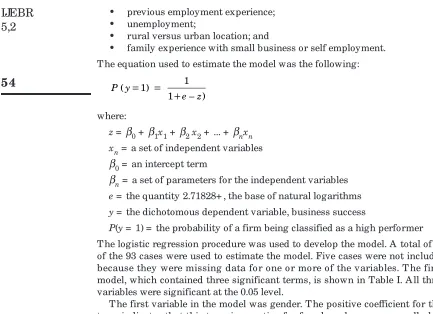
T he equation used to estimate the model was the following:
where:
z=
β
0+β
1x1+β
2x2+ ... +β
nxnxn= a set of independent variables
β
0= an intercept termβ
n= a set of parameters for the independent variablese= the quantity 2.71828+ , the base of natural logarithms
y= the dichotomous dependent variable, business success
P(y= 1) = the probability of a firm being classified as a high performer
T he logistic regression procedure was used to develop the model. A total of 88 of the 93 cases were used to estimate the model. Five cases were not included because they were missing data for one or more of the variables. T he final model, which contained three significant terms, is shown in Table I. A ll three variables were significant at the 0.05 level.
T he first variable in the model was gender. T he positive coefficient for this term indicates that this term is negative for females who were generally less likely to be founders than their male counterparts. A chi-square analysis of the relationship between gender and business start-up confirmed this. W hile 75 percent of male respondents had established small businesses, only 25 percent of females did so.
T he second term selected for inclusion in the model was the variable which measured whether the respondent had previously worked within a government agency or department. T he negative sign for this term’s coefficient indicated that those respondents who had such previous employment experience were less likely to be successful founders of small b usinesses. A subsequent
P y
e z
( )
– )
=
=
+
1 1
1
Model term Coefficient Significance level
Gender 1.86 0.0004
Previous experience in government employment –1.01 0.0468 Made redundant within previous two-three years –1.49 0.0407
Constant 1.66
Notes: –2 log likelihood for model with constant only = 100.07; –2 log likelihood for full model = 85.98
Table I.
Small business
start-ups
55
chi-square analysis confirmed this. Of the respondents who had previouslyworked in government jobs, only 37 percent had founded a small business while 63 percent had not.
T he third term in the model was a measure of whether the respondent had been made redundant within the previous two to three years. A s with the prev ious term, this term also possessed a neg ative coefficient. T he interpretation was that those respondents which reported recent redundancy were less likely to be successful founders of their business. Of those who had been made redundant, 69 percent did not proceed to start up while 55 percent of those who had not been made redundant had successfully founded a business.
Goodness of fit of the model
One method of assessing the goodness of fit of logistic models is to examine the –2LL measure. T his measure is calculated by the SPSS logistic reg ression procedure each time a model is developed. If a model fits perfectly, then the value for–2LL will be 0. T he –2LL is also calculated fo r the model which contains the constant only. T his enables an estimation of the level of improvement gained by adding the model terms (Norusis, 1993, p. 10). T hese two values for –2LL are shown in Table I. –2LL for the model with the constant was found to be 100.07, while that for the full model was 85.98.
Seeing how well the model classifies the data is another way of determining how well a logistic model performs. T his involves a comparison of the observed number of cases for each state of the dependent variable with the predicted number of each state as derived from the model (Wrigley, 1985, p. 50). Table II illustrates the classification performance of the model.
T he prior probabilities indicate the probability of a case being correctly classified into one of the two g roups before the model is applied to the data (A fifi and Clark, 1984, pp. 263-4). T he relative sizes of the two populations in the current model determined the value of 50.63 percent for the prior probabilities. T he posterior probabilities express the probability for each case of belonging to a particular group as determined by the chosen model (A fifi and Clark, 1984,
Predicted Total A ctual Starters Non-starters (% )
Prior probabilities
Starters 47 0 100.0
Non-starters 41 0 0.0
Classification accuracy of prior probabilities 53.41
Posterior probabilities
Starters 34 13 72.34
Non-starters 14 27 65.85
Classification accuracy of posterior probabilities 69.32
Table II.
IJEBR
5,2
56
p. 262). T he results of applying the model to the data are shown in the bottom half of Table II. T his shows that the model correctly classified 69.32 percent of the 88 cases. T his may be seen as a reasonable goodness of fit of the model.
Discussion of the results
T he finding s sug gest that there are three key demog raphic variables distinguishing small business start-up:
(1) gender;
(2) previous government employment; and
(3) recent redundancy.
Each of these three variables is essentially a measure of the barriers to small business establishment rather than a trigger or incentive. Each is strongly linked to the g roups w ho did not fo rm a b usiness. Females, prev ious government employees and those experiencing redundancy were all less likely to form businesses than those other respondents.
W hy do these characteristics appear to be a barrier to entrepreneurial activity? T here are a number of possible reasons for this. It is worth noting that other studies have previously found a similar barrier among their sample respondents. For example, Blanchflower and Oswald (1990) and Blanchflower and Meyer (1991) have examined the personality characteristics of those who established small b usinesses. A cco rding to this v iew the level of “entrepreneurial vision” possessed by the founder of the firm was a critical factor in their decision process. T his psychological view of the foundation of small businesses is shared by others (Chell et al., 1991). A ccording to Kazumi (1995) the entrepreneur is characterised by a combination of abilities and personal characteristics. A mong the key abilities are such thing s as imagination, the ability to create and execute plans, negotiation, leadership and managerial skills. T he personal characteristics are determination, optimism, independence and a willingness to take risks and rise to challenges.
Small business
start-ups
57
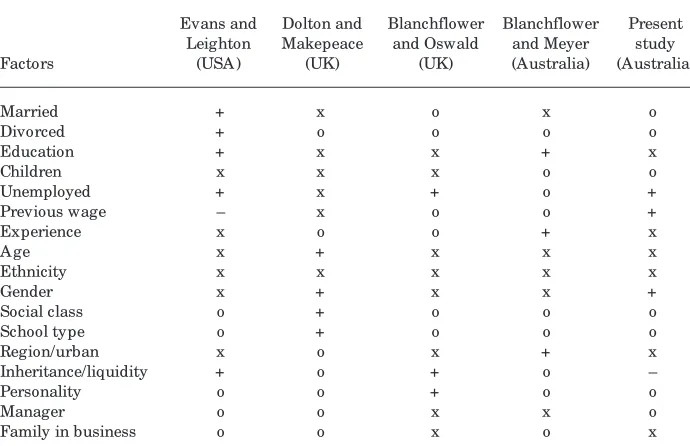
Dolton and Makepeace (1990) in their study of small business formationamong g raduates in the UK found that age, gender and social class were all significant motivators to business foundation. A study of small business foundation in the USA (Evans and Leighton, 1990) found that marital status, education and financial support were all positive and significant influences on small business establishment among both employed and unemployed workers. Table III shows the key findings from these previous studies as well as a summary of the key findings from this study. T he results shown in Table I highlight the inconclusiveness of these five studies regarding the impact of demographic variables. It should be noted that all these studies were drawing on somewhat different samples. T hree different countries were examined and different levels of age and educational background were included. However, as Storey (1994, p. 66) observes:
Several conclusions may be drawn from this table. T he first is that although all four [previous] studies are addressing a broadly similar issue, there must be some risk of omitted variable bias, since none appeared to include all variables, or even all variables which had been shown to be significant in other studies. Only four variables appear in all the studies – ethnic, sex, age and education – and only three variables appear with a significant coefficient in more than one of the studies. T hus unemployment appears to be positively associated with higher levels of self-employment in two studies, as does higher levels of education and being in receipt of some form of inheritance, enabling a liquidity constraint to be overcome.
Evans and Dolton and Blanchflower Blanchflower Present Leighton Makepeace and Oswald and Meyer study Factors (USA ) (UK) (UK) (Australia) (Australia)
Married + x o x o
Divorced + o o o o
Education + x x + x
Children x x x o o
Unemployed + x + o +
Previous wage – x o o +
Experience x o o + x
A ge x + x x x
Ethnicity x x x x x
Gender x + x x +
Social class o + o o o
School type o + o o o
Region/urban x o x + x
Inheritance/liquidity + o + o –
Personality o o + o o
Manager o o x x o
Family in business o o x o x
Key: + = variable is statistically positively significant in the study; – = variable is statistically negatively significant in the study; x = variable included in the equation, but not shown to be significant; o = variable not included in the equation
Source: Storey (1994)
Table III.
IJEBR
5,2
58
Forty-two percent of the sample reported having been born overseas and 55 percent reported having at least one parent who was a mig rant. Forty-one percent reported having parents who had family members who were self-employed. Despite this, family backg round and ethnicity were not strongly associated with small business foundation which is in contrast to other studies using empirical analysis (Curran and Burrows, 1988a; Meager, 1991). T he variety of testing procedures employed in these studies, the variations in their samples and the characteristics of their countries are all likely to contribute to the differences which are found in their findings. Such differences create a somewhat “fuzzy” picture of what factors are important to motivating small business foundation (Storey, 1994).
Managerial and research implications
Gender issues
T he issue of gender has been examined in previous research studies although it has only become a topic of strong interest in recent years. Much of the literature relating to small business issues has tended to ignore gender differences (A llen and Truman, 1991). A major problem has been a relatively low participation rate among women in small business as owner-managers (Curran and Burrows, 1988b), although this gap is rapidly closing.
Women’s entry into small business may also be influenced in a negative way by a “sectoral seg regation” process whereby occupations are separated into “male” and “female” industries (Hakim, 1979). Women have traditionally found g reater employ ment w ithin the serv ices secto r and this appears to be a continuing pattern within self-employment. T he business interests of female respondents in the present study ranged from beauty therapy treatment, aged care, recyc ling to bar management. A n ex amination of the Business Longitudinal Survey data of near 9,000 Australian small firms highlights the concentration of women in “traditional” female industry categories (IC/DIST, 1996).
Other issues facing women in the establishment and operation of small b usiness are their dual responsibilities of household and family versus employment. Women tend to spend fewer hours working in their businesses than men, due to home and family commitments (A llen and Truman, 1991). Further, the “traditional” female occupations are often remunerated at a lower level than their male counterparts (Curran and Burrows, 1988b).
W hile the majo rity of the female respondents v iewed their family responsibilities and child-rearing as a barrier to self-employment, there were several cases where owning a small business offered a favourable alternative to having a “9 to 5” occupation. For example, several young mothers said that they were attracted to the flexible hours and mobility of running their own business. Some worked out of home and could combine child care with work.
Small business
start-ups
59
willingness to lend to women for business purposes. T he level of businessadvisory services specifically available to women may also be an area requiring attention.
More research is required to identify how female entrepreneurs differ from males and what specific difficulties (if any) they may face. T he expansion of the services sector in most developed economies may assist women to achieve greater self-employment over the longer term.
Previous work history and redundancy
T he findings of this study that previous employment in the government sector and recent redundancy may serve as negative influences on small business formation is of interest. Little research has so far specifically addressed this issue. Keeble et al.(1992) found that individuals who had previous employment experience within large organisations were significantly more likely to establish their own businesses. However, the opposite was found by earlier research undertaken within the manufacturing industries (Cross, 1981; Gudgin et al., 1979). Other research suggests that previous managerial experience may be the key to whether an individual establishes a small business (Bates, 1990). W hat none of these earlier studies examines however, is the perceptions of nascent, as well as actual, entrepreneurs.
Many of those interviewed for the present study who did not found their own business were in employment and were reluctant to leave the “security” of their current job. Some of the younger respondents felt that they had to first build a career before venturing out on their own. One young couple who were paying off a large mortgage wished to first become more financially independent before taking on the risks of self-employment.
T he present study did not specifically examine whether the respondents had managerial experience. Education was measured by the study and possession of a university degree may indicate a likelihood for more managerial experience (althoug h there is no causal link sug gested here). A n ex amination of the relationship between recent redundancy and education level did not find any significant association. A similar examination of the relationship between previous government employment and education did find that higher education levels were significantly associated with this type of employment. Chi-square tests found these two variables to be significantly related at the 5 percent level. However, a partial chi-square test of education and business start-up controlling for previous government employment did not find a significant relationship. T hese additional findings may indicate that something other than education is responsible for the relatively poor start-up rate among former government employees and the recently redundant.
IJEBR
5,2
60
business he would be contributing to the economy. A nother government employee who successfully established her own business was an experienced public servant who felt that she “was getting old” and “had to do something she always wanted to do” in setting up her own business.
To fully explain these issues is likely to require additional research. T he “ cultural” backg round of the fo rmer government employee may be an important influence. Does the work environment and organisational culture commonly associated with public sector employment adequately prepare an employee for the rigours of small business self-employment? Further, does recent redundancy leave a fo rmer employee adequately prepared in a psychological sense for self-employment? Redundancy tends to harm the recipient’s self-image which is likely to serve as a detrimental influence on small business formation. T hese are important issues for public policy. T he large-scale public sector redundancies which have been a feature of the “efficiency drives” of both Australian governments both state and federal over recent years may do potential harm to the unemployment levels within the economy. If retrenched workers, particularly former government ones, are unable to find suitable employment they may choose to remain unemployed rather than found small businesses.
Conclusion
T his researc h study has hig hlig hted the potential impo rtance of three demographic variables:
(1) gender;
(2) previous government employment; and
(3) recent redundancy
as potential negative influences on small business formation.
Small business
start-ups
61
References and further reading
A fifi, A .A . and Clark, V. (1984), Computer-aided Mulivariate A nalysis, Van Nostrand Reinhold, New York, NY.
A ldrich, H. (1980), “A sian shopkeepers as a middleman minority: a study of small business in Wandsworth”, in Evans, A . and Eversley, D. (Eds), T he Inner City: Employment and Industry, Heinemann, London, pp. 389-407.
A ldrich, H. (1990), “Using an ecological perspective to study organizational founding rates”,
Entrepreneurship T heory and Practice, Vol. 14 No. 3, pp. 7-24.
A ldrich, H. and Zimmer, C. (1986), “Entrepreneurship through social networks”, in Seaton, D.L. and Smilor, R.W. (Eds),T he A rt and Science of Entrepreneurship, Ballinger, Cambridge, MA , pp. 2-23.
A llen, S. and Truman, C. (1991), “Prospects for women’s businesses and self-employment in the year 2000”, in Curran, J. and Blackburn, R. (Eds), Paths of Enterprise: T he Future of the Small Business, Routledge, London.
Bates, T. (1990), “Entrepreneurial human capital inputs and small business longevity”, Review of Economics and Statistics, Vol. 72 No. 4, November, pp. 551-9.
Baumol, W.J. (1968), “Entrepreneurship in economic theory”, A merican Economic Review, Vol. 58, pp. 64-71.
Birch, D. (1985), T he Job Generation Process, MIT Press, Cambridge MA .
Birch, D. (1987), Job Creation in A merica: How Our Smallest Companies Put the Most People to Work, T he Free Press, New York, NY.
Bird, B. (1988), “Implementing entrepreneurial ideas: the case for intention”, A cademy of Management Review, Vol. 13 No. 3, pp. 442-53.
Blanchflower, D. and Meyer, B. (1991), “Longitudinal analysis of young entrepreneurs in Australia and the United States”, National Bureau of Economic Research,Working Paper No.3746, Cambridge, MA .
Blanchflower, D. and Oswald, A . (1990), W hat Makes a Young Entrepreneur?, Working Paper No. 3252, National Bureau of Economic Research.
Boeker, W.P. (1988), “Organizational origins: entrepreneurial and environmental imprinting at the time of founding”, in Caroll, G.R. (Ed.), Ecological M odels of Organizations, Ballinger, Cambridge, MA , pp. 33-51.
Borch, O.J. and A rthur, M.B. (1995), “Strategic networks among small firms: implications for strategy research methodology”, Journal of Management Studies, Vol. 32 No. 4, pp. 419-41. Brockhaus, R.H. (1980), “Risk taking propensity of entrepreneurs”, A cademy of Management
Journal, Vol. 23 No. 3, pp. 509-20.
Brockhaus, R.H. (1982), “T he psychology of the entrepreneur”, in Kent, C.A ., Sexton, D.L. and Vesper, K.H., Encyclopedia of Entrepreneurship, Prentice-Hall, Englewood Cliffs, NJ, pp. 39-56. Bull, I. and Winter, F. (1991), “Community differences in business births and business growths”,
Journal of Business Venturing, No. 6, pp. 29-43.
Buttner, E.H. and Rosen, B. (1989), “Funding new business ventures: are decision makers biased against women entrepreneurs?”, Journal of Business Venturing, No. 4, pp. 249-61.
Byg rave, W.D. (1989), “T he entrepreneurship paradig m: a philosophical look at research methodologies”, Entrepreneurship T heory and Practice, Vol. 14 No. 1, pp. 7-26.
Castrogiovanni, G.J. (1991), “Environmental munificence: a theoretical assessment”, A cademy of Management Review, Vol. 16 No. 3, pp. 542-65.
IJEBR
5,2
62
Cross, M. (1981), New Firm Formation and Regional Development, Gower Publishing Company, A ldershot and Brookfield, VT.
Curran, J. and Burrows, R. (1988a), “Ethnicity and enterprise: a national profile”, Small Firms Policy and Research Conference, Cardiff.
Curran, J. and Burrows, R. (1988b), Enterprise in Britain: A National Profile of Small Business
Owners and the Self-employed, Small Business Research Trust, London.
Delacroix, J. and Solt, M.E. (1988), “Niche formation and founding in the California wine industry 1941-84”, in Caroll, G.R. (Ed.),Ecological Models of Organizations, Ballinger, Cambridge, MA , pp. 53-70.
Dess, G. and Beard, D. (1984), “Dimensions of organizational tasks environments”, A dministrative Science Quarterly, No. 29, pp. 52-73.
Dolton, P. and Makepeace, G. (1990), “Self-employment among graduates”, Bulletin of Economic Research, Vol. 42 No. 1, January, pp. 35-53.
Evans, D. and Leighton, L. (1990), “Small business formation by unemployed and employed workers”, Small Business Economics, Vol. 2 No. 4, pp. 319-30.
Gartner, W.B. (1985), “A conceptual framework for describing the phenomenon of new venture creation”, A cademy of Management Review, Vol. 10 No. 4, pp. 696-706.
Gould, A . and Keeble, D. (1984), “New firms and rural industrialization in East A nglia”, Regional Studies, Vol. 18 No. 3, pp. 189-201.
Greenberger, D.B. and Sexton, D.L. (1988), “A n interactive model for new venture creation”, Journal of Small Business Management, Vol. 26 No. 3, pp. 107-18.
Gudg in, G., Brunskill, I. and Fotherg ill, S. (1979), “New manufacturing firms in reg ional employment growth”, Centre for Environmental Studies, Research Series, No. 39.
Hakim, C. (1979), Occupational Segregation, Department of Employment Research Paper, HMSO, London.
Harrison, B. (1994), “T he small firms myth”, California Management Review, Vol. 36 No. 3, pp. 142-57.
Hosmer, D.W. and Lemeshow, S. (1989), A pplied Logistic Regression, John Wiley & Sons, New York, NY.
IC/DIST (1996), A Portrait of A ustralian Business: Results of the1995 Business Longitudinal
Survey, Small Business Research Program, Industry Commission and Department of Industry,
Science and Tourism, AGPS, Canberra.
Johannisson, B. (1988), “Business formation – a network approach”,Scandinavian Journal of Management, Vol. 4 No. 3, pp. 83-99.
Johnson, D. and Fan Ma, R.S., “A method for selecting and training entrants on new business start-up programmes”, International Small Business Journal, Vol. 13 No. 3, pp. 80-4.
Katz, J. and Gartner, W.B. (1988), “Properties of emerging organizations”, A cademy of Management Review, Vol. 13 No. 3, pp. 429-41.
Kazumi (1995), Studies of Small Business Managers: Entrepreneurialism in Small Business, Japan Small Business Research Institute, 15.94-6, March.
Keeble, D., Bryson, J. and Wood, P. (1992), “The rise and role of small business service firms in the United Kingdom”, International Small Business Journal, Vol. 11 No. 1, pp. 439-57.
Kolvereid, L., Shane, S. and Westhead P. (1993), “Is it equally difficult for female entrepreneurs to start businesses in all Countries?”, Journal of Small Business Management, Vol. 31 No. 4, pp. 42-51.
Small business
start-ups
63
Low, M.B. and MacMillan, I.C. (1988), “Entrepreneurship: past research and future challenges”,
Journal of Management, Vol. 14 No. 2, pp. 139-61.
McClelland, D.C. (1961), T he A chieving Society, Van Nostrand, Princeton, NJ.
Marett, C.B. (1980), “Influences on the rise of new organizations: the formation of women’s medical societies”, A dministrative Science Quarterly, No. 25, pp. 185-99.
Mason, C.M. (1983), “Some definitional difficulties in new firms research”, A rea, Vol. 15 No. 1, pp. 53-60.
Mason, C.M. (1989), “Explaining recent trends in new firm formation in the UK: some evidence from South Hampshire”, Regional Studies, Vol. 23 No. 4, pp. 331-46.
Matthews, C.H. and Moser, S.B. (1995), “The impact of family background and gender on interest in small firm ownership: a longitudinal study”,Proceedings of the ICSB 40th World Conference, Sydney, 18-21 June, pp. 245-62.
Meager, N. (1991), Self Employment in the UK, Institute of Manpower Studies, University of Sussex.
Norusis, M.J. (1993), SPSS for W indows: A dvanced Statistics release 6.0, SPSS Inc., Chicago, IL. Penning s, J.M. (1982), “Org anizational birth frequencies: an empirical investig ation”,
A dministrative Science Quarterly, No. 27, pp. 120-44.
Peterson, R.A . (1980), “Entrepreneurship and organization”, in Nystrom, P.C. and Starbuck, W.H. (Eds) Handbook of Organization Design, Oxford University Press, Oxford.
Romanelli, E. (1989), “Organization birth and population variety: a community perspective on origins”, in Cummings, L.L. and Staw, B.M. (Eds), Research in Organizational Behavior, Vol. 11, JA I Press, Greenwich CT, pp. 211-46.
Ronstadt, R. (1988), “T he corridor principle”, Journal of Small Business Venturing, Vol. 3 No. 1, pp. 31-40.
Schere, J. (1982), “Tolerance of ambiguity as a discriminating variable between entrepreneurs and managers”, Proceeding of the A cademy of Management Conference, New York, NY, pp. 404-8. Scott, M.G. and Twomey, D.F. (1988), “T he long-term supply of entrepreneurs: students’ career
aspirations in relation to entrepreneurship”,Journal of Small Business Management, October, pp. 5-13.
Shutt, J. and W hittington, R. (1987), “Fragmentation strategies and the rise of small units: cases from the North West”, Regional Studies, Vol. 21 No. 1, pp. 13-23.
Specht, P.H. (1993), “Munificence and carrying capacity of the environment and organization formation”, Entrepreneurship T heory and Practice, Vol. 17 No. 2, pp. 77-86.
Storey, D. (1994), Understanding the Small Business Sector, Routledge, London. Storey, D.J. (1982), Entrepreneurship and the New Firm, Beckenham, Kent.
Storey, D.J. (1987), Job Generation and Labour Market Change, Macmillan, Basingstoke.
Van de Ven, A .H., Hudson, R. and Schroeder, D.M. (1984), “Designing new business start-ups: entrepreneurial, organizational and ecological considerations”, Journal of Management, Vol. 10 No. 1, pp. 87-107.
Walker, R. and Greenstreet, D. (1990), “T he effect of government incentives and assistance on location and job growth in manufacturing”, Regional Studies, Vol. 25 No. 1, pp. 13-30. Walton, J. (1977), Elites and Economic Development: Comparative Studies on the Political Economy
of Latin A merica Cities, University of Texas Press, Austin, T X.
Weber, M. (1930), T he Protestant Ethic and the Spirit of Capitalism(1904), translated by Parsons, T., Scribner, New York, NY.
Wrigley, N. (1985), Categorical Data A nalysis for Geographers and Environmental Scientists, Longman, Harlow.