338
By
Cut Sarah Maqfirah1
Syiah Kuala University, Banda Aceh
ABSTRACT
The purpose of this research was to find out the effectiveness of using the 3H strategy (Here, Hidden, and in my Head) for teaching reading comprehension to second grade students at Inshafuddin Boarding Middle School, Banda Aceh and also to find out the students‟ responses to learning reading using the 3H strategy. This study used an experimental research design. The sample was selected by purposive sampling; the writer chose class VIII A as the experimental group (EG) and class VIII C as the control group (CG). The instruments used for collecting the data were a pre-test and a post-test plus a questionnaire. The results showed that the use of the 3H strategy was effective for teaching reading comprehension. Moreover, the results from the questionnaire showed that the majority of the students gave positive responses toward the use of the 3H strategy.
Keywords: 3H (Here, Hidden and in my Head) Strategy, Reading Comprehension, Narrative Text.
INTRODUCTION
Reading is one of the four skills needed for learning a language, especially an L2. The purpose of reading is to understand and remember what texts tell us about. Therefore, reading is not only for reading words silently or out-loud but also for comprehending the meaning of written texts. Blachowicz and Ogle (2008, p. 27) have said that reading comprehension is an active reading process to get information and to create meaning from reading materials by integrating what is read into what is already known.
1
339
In junior high school, reading is one of the skills that must be mastered by students learning English. Therefore, students need teaching-learning processes to learn how to understand texts in order to make them skillful readers. This is to help them comprehend texts easily so that they can understand what the texts say. Besides this, the reading texts used in junior high school are in the form of functional texts in which the text is used to solve or give a solution related to some problem faced in everyday life. The kinds of functional texts include reports, narratives, advertisements, notices, announcements and formal letters.
Most students only read the texts without thinking and paying attention to every single sentence that they read. Besides, many students do not have much time to read because when teachers give them a text and get the students to answer questions about the text, they only focus on how to answer those questions quickly without applying some strategies. In fact, reading strategies are very important to help students understand the information in the texts (Fitriani, 2014; Fitriani, 2015). They ignore the importance of being able to understand the text fully and finally they fail. Reading also needs to be mastered by the students because the questions in the national examination for English in recent years are mostly about reading comprehension. Therefore, students should be able to read and comprehend texts and must be encouraged to improve their ability in English reading comprehension.
Based on the writer‟s experience in teaching at Inshafuddin Boarding Middle School on February 15th, 2014, the students in the second grade (year 8) classes had some difficulties in learning English especially in reading. One of them was that they had difficulty understanding the meaning of words based on the context; they also had difficulty understanding sentences that contained inferential meaning. As a result, they were unable to answer all the comprehension questions correctly. This was proven by the results from the test given to the students during the teaching-learning session; the test result showed that only a few students achieved the minimum passing grade (KKM) in reading comprehension. The score that must be achieved by the students was 65. Most of the students got scores below 65, ranging between 30 and 62.
340
high school in the second grade needed to teach narrative text since in the 2013 Curriculum narrative and recount text must be taught in this semester. It is stated in the 2013 Curriculum that the students should understand social functions, structure of text and language elements from narrative text in the form of fables based on the context and usage. Moreover, according to the 2013 Curriculum, the standard of reading skills is that the students should be able to understand the meaning of simple short essays, such as narrative and recount texts.
Based on the problems above, there was no doubt that it would be difficult to achieve the learning target for reading comprehension. Besides, based on the poor results, improvement in reading comprehension skill was sorely needed. Regarding the purpose of reading, it was realized that reading comprehension is not an easy activity. McNamara (2007, p. 470) has explained that some difficulties may be faced by readers while reading strategies play an important role in helping new EFL readers to improve their reading comprehension. This means that the success of readers in getting the information or understanding that they need from what they read may depend on the strategy used. In other words, strategies can help readers to be more active and engaged in their reading activities. One strategy that can help students to improve their reading comprehension with narrative texts is called the Here, Hidden, and in my Head (3H) strategy. The purpose of this strategy is to teach students how to easily comprehend a reading text. Therefore, the writer was encouraged to try using the 3H strategy to see if it could have an effect on reading comprehension achievement.
341
understand this story because the content of the story is almost the same as the story known by the Acehnese as “Ahmad Ramanyang”. Other examples are the stories about the mouse deer. When a teacher reads a story about the mouse deer, the students are already aware that the mouse deer is a clever small animal.
Generally, the advantage of the Here, Hidden, and in my Head strategy is that it improves the student‟s comprehension in learning reading and it improves their ability to answer the questions whether explicit or implicit and it helps the students use their background knowledge. According to Graham and Wong in Westwood (2001, p. 61) there are some advantages of using the 3H Strategy, such as: (a) it can help students improve their reading comprehension, (b) it can increase their meta-cognitive functioning related to the comprehension task, (c) students can be more directly involved in the learning process, (d) there can be more interaction between the teacher and her students, (e) students can become more independent, and (f) learning activities can be more enjoyable.
Research Questions
1. Will there be any significant difference in reading comprehension achievements between students who are taught using the 3H strategy and those who are taught with the teacher-centered approach?
2. Will the second year students at Inshafuddin Boarding school be more motivated in learning reading comprehension of narrative texts by using the 3H strategy?
Research Objectives
1. To find out if there will be a significant difference in reading comprehension achievements between students who are taught using the 3H strategy and those who are taught with a teacher-centered approach.
342
LITERATURE REVIEW
Teaching Reading
Teaching reading comprehension is very important to help students understand what they read. The aim of teaching reading comprehension is to develop the student‟s ability to understand English texts effectively and efficiently. Reading is generally categorized as either silent reading or reading aloud. Both are nearly similar in their process; the second needs to utter the graphic symbols loudly because it can be aimed at conveying the information to listeners. Reading aloud is also one of the competence standards for junior high school students as stated in the school based curriculum; the students have to be able to read aloud a simple short narrative and recount text with communicative pronunciation, stress and intonation. In reading aloud, the reader sometimes reads aloud to convey information to people around her. When reading aloud the student needs to utter the words of the text, so it can be used to help determine the students‟ reading ability when learning to read.
Narrative Text
According to Anderson (1997), a narrative text is a text that has a purpose to entertain the reader or listener. However, narratives can also be written to teach or inform, to change attitudes or social opinions and to present a moral in a story. Porter (2002) has defined a narrative as a text that represents series of events. Some examples of narrative text are fantasy novels, historical, fictional and detective stories.
A narrative text consists of some steps. Neo (2005) has stated that a narrative text has a structure, which is represented below:
Climax
Raising Action Falling Action
Exposition Resolution
343
triangle consists of: (a) the Exposition: this establishes the characters and the situation; (b) Rising action: refers to a series of complications that lead to the climax; (c) the Climax: this is the critical moment when problems/conflicts demand something has to be done about them; (d) Falling action: these are the moments away from the highest peak of excitement; and (e) the Resolution: this consists of the final denouement or the resultant outcome (Neo, 2005).
The 3H, (Here, Hidden and in My Head) Strategy
The 3H strategy was developed to improve students‟ answering of written comprehension questions, particularly inferential questions. The 3H strategy is a question-answer relationship strategy used in reading comprehension. This strategy was used by Graham and Wong (1993) from a similar question-and-answer procedure devised by Raphael and Pearson as cited in Westwood (2001, p. 61) which alerts students to the sources of information available to answer questions.
One of the most obvious features of the 3H strategy is the question-answer relationship which is in the form of text explicit, text implicit, and script implicit. In text explicit, students can find the answer to a question in one sentence from the text directly. The central idea of text explicit is that answers are easily found in one sentence in the text. The second form of the 3H strategy is text implicit. This kind of answer deals with questions which require combining information from the text with background knowledge to answer the question. The last form of question-answer is script implicit. In the 3H strategy, script implicit questions are answered with information from the students‟ knowledge base only. Answers to these questions do not require the use of any specific information from the text, even though they may be asking about content from the general passage.
This strategy is very important for students to improve their ability in reading comprehension. Automatically this strategy teaches them how to answer the questions in a test. This is based on a statement by Graham (1992, p. 31), “Once students were introduced to the 3H strategy, the following points were brought to their attention: (a) some questions have no answers; (b) some questions have more than one correct answer; and (c) the answers to some questions change over time.”
344
background knowledge by using clues in the questions. Second, it is stressed to students that they should always check the passage for answers to questions, even if they feel they could provide adequate answers without doing so. Third, students verify their question and answer relationship predictions by identifying that if there is no information to answer the question in the passage, the answer must be script implicit. Similarly, if the answer or part of the answer can be found in the passage the question answer relationship could be either text explicit or text implicit.
Some studies have found that activating student‟s background knowledge before reading can improve their comprehension (Graham, 1992, p. 32). One of the most significant activities with the 3H strategy is activating and providing relevant background knowledge in learning reading. The steps that must be taught to students for using the 3H strategy include: what they know, what they do not understand, and what they need to find out. These steps can guide students to use background knowledge and ask questions about what they do not understand. Moreover, according to Graham (1992, p. 32), activating background knowledge in this way provides a means for students to relate new information to that that they already have available. Sharing and discussing what they already know about a topic also helps students to increase their store of relevant knowledge and to identify important information in the text when it is presented.
Related to Graham and Wong in Konza (2006, p. 108), the procedures of the 3H Strategy are as follows: (1) the class and the teacher read a short passage. (2) The teacher constructs questions of three kinds; (a) some questions are based on the actual content of the sample text (here); (b) some questions need to be inferred from information in the text (hidden); and (c) some questions require integration of previous knowledge or application of information to the new situation (in my head). (3) The teacher demonstrates the process of using each strategy, using „think aloud‟ strategies to model how each question may be approached. (4) Finally, students answer the questions from the teacher based on the information from the text and in their head.
345
one of the aims of this strategy is to activate the students‟ background knowledge which is important to answer questions; (c) it emphasizes the appropriate use of text information by encouraging students to re-read the passage selectively and to integrate information from the text with their own background knowledge.
RESEARCH METHODOLOGY
In conducting this research, the researcher used quasi experimental design in which there were two groups involved; one an experimental group (EG) which was taught using the 3H strategy, and the other was a control group (CG) which was taught by using the teacher-centered approach, that is the teaching strategy usually used by the teacher for teaching reading.
The population for this research was all students in the second grade at Inshafuddin Boarding School in the academic year of 2015/2016. The second grade had 3 classes, class VIIIA, VIIIB and VIIIC, each with 25 students, hence, the total population was 75 students.
In choosing the sample, the researcher used purposive sampling, Sugiyono (2010) has said that purposive sampling is a technique to select a sample with some specific considerations so that the data obtained will be more representative. The two classes chosen as the sample were class VIII A and class VIII C. Class VIII A was chosen as the experimental class (EG) where the 3H strategy was applied, and class VIII C was chosen as the control class (CG) which did not receive the 3H treatment.
346
Also, after the post-test, the EG students were given a questionnaire with 10 questions and answers on a 5-point Likert scale to find out about their motivation and their responses to the 3H learning process. SPSS was used to analyse the data following procedures proposed by Sudjiono (2005).
FINDINGS AND DISCUSSION
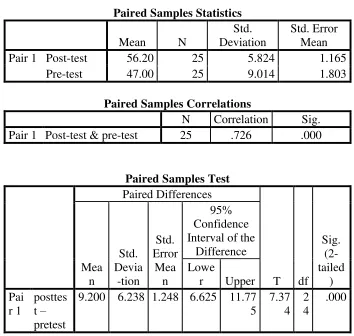
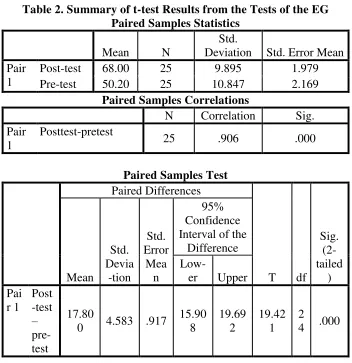
A paired test was done to find out the difference in achievement of the EG compared to the CG:
Table 1. Summary of t-test Results from Tests of the CG
347
348
Then, the results from the questionnaire are presented in the chart that follows. The numbers shown at the bottom ofthe chart are the number for each statement in the questionnaire. Five colors (dark blue, red, light green, purple, and light blue) are used to indicate the students‟ responses with the scales, respectively: strongly agree, agree, undecided, disagree and strongly disagree.
Chart 1. EG Students’ Responses to Using the 3H Strategy
Chart 1 above shows that almost all the EG students were interested in learning using the 3H strategy, with nearly three quarters (72%) of the students chose strongly agree and the rest (28%) of them agreed that they could answer the questions related to the text more easily. Then, 21% of them were motivated to learn to read texts by using the 3H strategy. For the question about the role of the strategy, whether it could make students more active in class, 10% strongly agreed and 12% agreed. 13% strongly agreed that 3H strategy made them easier to answer the three kinds of questions. Furthermore, 15% agreed that they were more motivated to master reading skills after they had learned the 3H strategy while, 7% agreed. As a result of being motivated, 15% wanted to learn various kinds of reading text by using the 3H strategy every day, 8% agreed, and 2% were not sure of continuing learning by using this strategy. It can be concluded that the majority of the EG students gave positive responses towards the application of the 3H strategy.
Discussion
After collecting and processing the data using SPSS, it could be seen that the students taught using the 3H strategy achieved
0% 20% 40% 60% 80% 100%
1 2 3 4 5 6 7 8 9 10
strongly agree
Agree
Undecided
Disagree
349
significantly better improvement in reading comprehension scores than those taught using the conventional teaching method. Thus, it can be stated that the 3H (Here, Hidden and in my Head) strategy was effective for teaching reading because it can significantly improve the students‟ comprehension.
Reflecting on the results obtained from the use of the 3H strategy for teaching reading, it was effective for several reasons. First, the students learnt more about three kinds of questions namely explicit, implicit and questions needing background knowledge (Westwood, 2001, p. 61). Second, by using the 3H strategy the atmosphere during the learning processes was more enjoyable and stimulated the students to be more active. They were asked to answer the questions by using English, one by one. Therefore, all the students were involved in the teaching-learning process. Then, the procedures of the 3H strategy were easy and interesting to follow by the students. Hence, it is recommended that the 3H strategy should be used by English teachers for teaching reading comprehension especially for teaching learning disabled students.
The second discussion deals with the students‟ motivation in learning when using the 3H strategy compared to using the conventional strategy. The result of the questionnaire showed that the majority of the students gave positive responses toward the application of the 3H strategy. They agreed that this strategy could motivate them and make them enjoy learning and comprehend narrative texts more easily.
350
CONCLUSIONS AND SUGGESTIONS
Conclusions
The 3H (Here, Hidden, and in my Head) strategy was more effective for teaching reading comprehension because it can increase the students‟ comprehension more than teaching by using a conventional method such as the grammar translation method. Furthermore, the results from the questionnaire showed that the majority of the EG students were more motivated and enjoyed studying more while they were involved in the processes of teaching-learning reading comprehension using the 3H strategy.
Suggestions
Based on the research findings using the 3H strategy for teaching reading comprehension of narrative texts was a successful strategy, however, there may be some limitations when applying this strategy. First, teachers or other researchers who intend to use this strategy in the teaching of reading should master the different kinds of questions, explicit, implicit and background knowledge questions well, before applying 3H in the classroom. Moreover, teachers also need to manage the time carefully in order to create meaningful and enjoyable lesson sessions. Second, the writer suggests that other researchers could use this strategy with different genre of text. Then, further studies can also investigate the effectiveness of the 3H strategy with students at other levels as well as for other English skills in order to enrich our knowledge about the implementation of teaching strategies.
REFERENCES
Anderson, M. (1997). Text Type in English 2. Macmillan Education AU.
Blachowicz, C., & Ogle, D. (2008). Reading comprehension strategies for independent learners. New York: The Guilford Press.
Fitriani, S. S. (2014). An Investigation into Reading Comprehension Strategies in Academic Texts in Aceh Province of Indonesia. The Third International Conference on Language Education 2013 (ICOLE 3), 95-126.
351
Graham, L. (1992). The 3H Strategy: Improving the ComprehensionLearning Disabled and Poor Readers Through A Question-Answering Strategy. Canada: Simon Fraser University. Graham, L., & Wong, B. Y. (1993). Comparing two modes of teaching
a question-answering strategy for enhancing reading
comprehension: Didactic and self-instructional training. Journal of Learning Disabilities, 26(4), 270-279.
Konza, D. (2006). Teaching Children with Reading Difficulties. Melbourne: Social Science Press.
McNamara, S. D. (2007). Reading Comprehension Strategies. New Jersey. Lawrence Erlbaum Associates.
Neo, E. (2005). Narrative for ‘O’ Level. Malaysia: Longman.
Porter, A. H. (2002). The Cambridge Introduction to Narrative. New York: Cambridge University Press.
Sudjiono, A. (2005). Pengantar Statistik Pendidikan. Jakarta: PT. Raja Grafindo Persada.
Sugiyono. (2010). Metode Penelitian Kuantitatif Kualitatif dan R&D. Bandung: Alfabeta.