Lecture Presentation
Lecture Presentation
Coordination
Coordination
Chemistry
Chemistry
By :Agung Nugroho Catur Saputro, S.Pd., M.Sc
TUJUAN
PEMBELAJARAN
Menjelaskan perbedaan kestabilantermodinamik dan kestabilan kinetik.
Membedakan istilah labil-inert dan
stabil-tidak stabil dalam reaksi senyawa kompleks Menjelaskan faktor-faktor yang
mempengaruhi kestabilan termodinamik senyawa kompleks
Menuliskan reaksi pembentukan senyawa kompleks secara bertahap (step-wise)
Menjelaskan faktor-faktor yang
mempengaruhi laju reaksi senyawa kompleks Menjelaskan mekanisme reaksi senyawa
CURAH
PENDAPAT
1. Apa yang anda ketahui tentang
istilah :
Stabil-tak stabil
Stabilitas
Inert –labil
Labilitas
2. Kedua istilah tersebut
mempunyai pengertian sama
atau berbeda?
Sifat
Stabi
l dan
tak stabil
termasuk kestabilan
termodinamika
Sedangkan sifat
Inert
dan
labil
termasuk kestabilan kinetika
Apa perbedaan kedua
istilah tersebut…?
CURAH
Contoh 1 :
Senyawa kompleks tetrasianonikelat(II)
dapat mengalami pertukaran ligan secara cepat (waktu paro sekitar 1 menit).
[Ni(CN)4]2+ + 4C*N- [Ni(C*N)4]2+ + 4
CN- (t ½ 30 detik)
Kompleks ini mempunyai harga tetapan
disosiasi sangat rendah (Kd = 1 x 10-22)
Kompleks ini juga mempunyai harga
tetapan pembentukan sangat besar (Kf = 1 x 10²²).
Kesimpulan :
Secara kinetika, senyawa
kompleks [Ni(CN)
4]
2-bersifat
labil
karena mengalami pergantian
(pertukaran) secara cepat dan
terus-menerus).
Secara termodinamik, senyawa
kompleks [Ni(CN)
4]
2-bersifat
stabil
karena tidak mudah
Contoh 2 :
Senyawa kompleks [Co(NH3)6]3+ secara
spontan dapat berubah menjadi senyawa lebih stabil [Co(H2O)6]3+ dengan harga
tetapan kesetimbangan sangat besar (Keq = 1025).
[Co(NH3)6]3+ + 6H3O+ [Co(H2O)6]3+ +
6NH4+ Keq = 1025 Pada suhu kamar, reaksi tersebut
berlangsung relatif lama (beberapa hari) untuk mencapai setimbang dan ternyata konsentrasi Co(NH3)6]3+ sangat rendah.
Kesimpulan :
Kompleks [Co(NH
3)
6]
3+secara
kinetika bersifat inert (lembam)
karena laju pembentukannya
relatif lama (perlu beberapa hari).
Secara termodinamik, kompleks
[Co(NH
3)
6]
3+bersifat tidak stabil
KESTABILAN SENYAWA
KOMPLEKS
Sifat kestabilan relatif senyawa kompleks dapat dibedakan menjadi dua hal :
Kestabilan termodinamik
Membahas energi ikatan logam-ligan, tetapan kestabilan dan variabel turunannya atau
potensial redoks yang mengukur kestabilan tingkat valensi logam.
Kestabilan kinetika
PRINSIP DASAR
REAKSI
In general, chemical reactions move from one
energy minimum (
the reactants
) through ahigher energy structure (t
he transition
state
) to another energy minimum (theproducts).
In simple cases, the energies and bond distances
can be shown as a three-dimensional surface, with two different bond distances along the base-plane axes and free energy as the vertical
The reaction MX + Y MY + X begins at bond forms, the reaction point moves to
represent the short M-Y bond distance and the longer distance between the two products
MY and X.
The free energy surface usually has a saddle shape,
much like a mountain pass between two valleys.
For more complex reactions, such a visual
representation is difficult or impossible, but the path between the reactants and the products is always the lowest energy pathway and must be the same
regardless of the direction of the reaction.
This is the principle of microscopic
reversibility, frequently described by the
mountain pass analogy; the lowest pass going in one direction must also be the lowest pass going in the opposite direction.
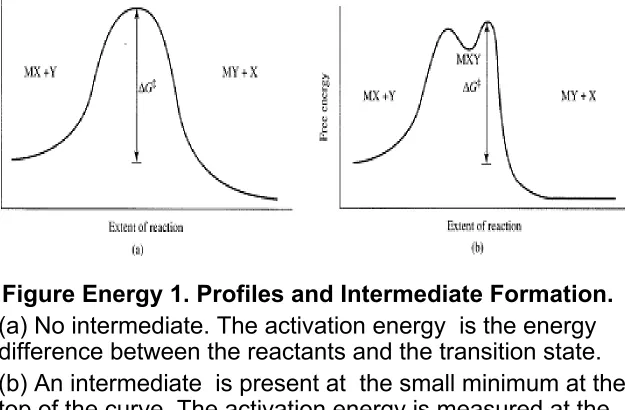
If the reaction is such that the conversion from reactants to products takes place with no hesitation at the transition point as in
Figure 1 (a), the structure at that state is called
the transition state
. If there is a structure that lasts a bit longer as in Figure 12-l(b), and particularly if it is detectable by some experimental means, it is called
an intermediate
.Figure Energy 1. Profiles and Intermediate Formation.
(a) No intermediate. The activation energy is the energy
difference between the reactants and the transition state.
(b) An intermediate is present at the small minimum at the
Kestabilan termodinaik dinyatakan
dengan istilah STABIL dan TAK-STABIL
Kestabilan kinetik dinyatakan dengan istilah INERT (LEMBAM) dan LABIL
Jadi suatu senyawa kompleks yang
bersifat stabil (termodinaik) mungkin bersifat labil atau mungkin bersifat
inert, demikian juga senyawa kompleks
tak-stabil mungkin juga bersifat inert
SENYAWA INERT DAN
LABIL
Many synthetic reactions require substitution, or
replacing one ligand by another.
This is particularly true when the starting material is
in aqueous solution, where the metaI ion is likely to be in the form [M(H2O)m]n+.
Some simpler reactions of this type produce colored
These reactions, and others like them, are very fast and
form species that can undergo a variety of reactions that are also very fast.
Addition of HNO3(H+), NaCI(Cl-), H3PO4(PO43-), KSCN(SCN-),
and NaF(F-) successively to a solution of Fe(NO3)3.9H2O
shows this very clearly.
The initial solution is yellow because of the presence of
[Fe(H2O)5(OH)]2+ and other "hydrolyzed" species containing
both water and hydroxide ion.
Although the exact species formed in this series depend on
solution concentrations, the products in the reactions given here are representative:
-Senyawa Labil
Compounds such as these that react rapidly are called
labile
. In many cases, exchange of one ligand for another can take place in the time of mixing the solutions.
Taube has suggested a reaction half-life (the time of disappearance of half the initial
compound) of one minute or less
as the
Senyawa Inert
(lembam)
Compounds that react more slowly are
called
inert or robust
(a term used less often). An inert compound is not inert in the usual sense that no reaction can take place; it is simply slower to react. These kinetic terms must also be
distinguished from the thermodynamic terms
Senyawa Inert
(lembam)
A species such as [Fe(H2O)5(F)]2+ is very
stable (has a large equilibrium constant for formation), but it is also labile.
Senyawa Inert
(lembam)
The possible confusion of terms is
unfortunate, but no other terminology
has gained general acceptance.
One possibility is to call the compounds
Although there are exceptions, general rules can
be given for inert and labile electronic structures.
Inert octahedral complexes are generally those
with high ligand field stabilization energies
(described in Chapter lo), specifically those with d3 or low-spin d4 through d6 electronic
structures.
Complexes with d8 configurations generally react
somewhat faster, but slower than the d7, d9, or dl0 compounds. With strong-field ligands, d8
Compounds with any other electronic structures
tend to be labile.
FAKTOR-FAKTOR MEMPENGARUHI KESTABILAN TERMODINAIK SENYAWA
KOMPLEKS